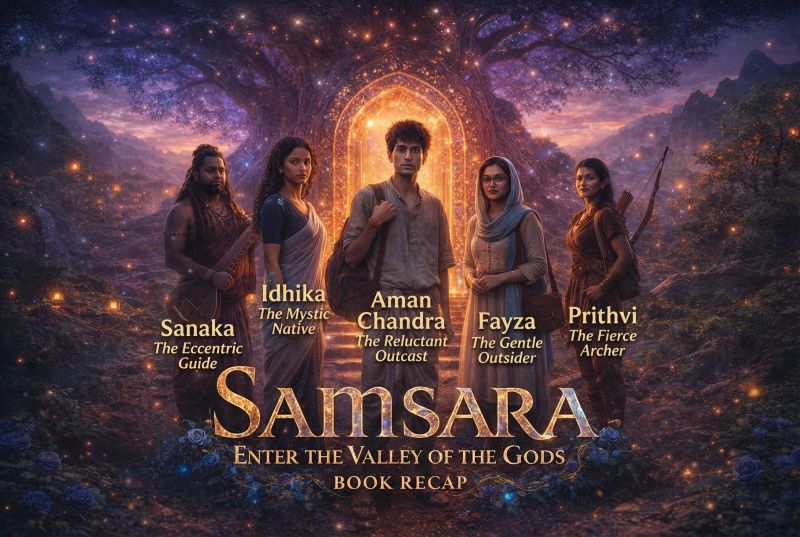


Plot Summary
Prologue
Vanyasa is known by many names — Gyanganj, Shambhala, Shangri-la — a valley hidden in the Himalayas, completely inaccessible, home to immortals who practice the ancient art of Atmayog. Every decade, for its own survival, the valley opens its doors to ten new Souls drawn from the plains of India.
These recruits must learn the valley's sacred ways and prepare for the Mahayatra, the ultimate journey into the mountains to retrieve Madhu — the honey that sustains the divine Kalpavriksha tree. They must survive this journey to earn their place among the immortals. Aman1 is one such Soul. Although his life has been one in which few choices happen to be his own, he goes on to determine the fate of a nation.
Son of a Traitor
Eighteen-year-old Aman Chandra1 has spent thirteen years perfecting invisibility. His father Avi,14 an army officer branded a traitor, died when Aman1 was five — no funeral, no honors, just eviction from military quarters and a lifetime as the traitor's son. By seventh grade, Aman1 had silenced himself entirely.
When a substitute teacher singles him out and a classmate plays a mocking song on a hidden phone, the armor he built brick by brick collapses. He flees school and confronts his mother Upasna,12 demanding truth about his father.
Before she answers, a dwarf-like stranger named Sanaka4 arrives and speaks privately with her. After he leaves, Upasna12 takes a cricket bat to the apartment wall, cracking open a hidden storage room containing a cardboard box: photographs of Avi14 beside an enormous tree, Sanskrit-covered palm leaves, stone coins, and a jar.
Mother Waves Goodbye Forever
Upasna12 promises to take Aman1 to a family friend in Agra who can explain the palm leaves. That night, she hands him a glass of milk — its taste slightly off — and Aman1 dreams of flying over a valley with a shimmering lake and a colossal tree, where a man with twinkling eyes looks straight at him. He wakes violently ill: nauseous, vision blurred, his knee shattered from a bathroom fall.
At the bus station, Upasna12 seats her son by the window and says she will buy water. She never boards. Through fading consciousness, Aman1 watches his mother12 standing motionless on the platform, face hidden in her hands, as the bus pulls away toward mountains that do not lie on any road to Agra. They will never see each other again.
Nandana Opens Its Roots
The bus dumps Aman1 at a moss-covered bridge deep in the Himalayas. He passes out, and Sanaka4 — the same stranger from Delhi — carries him through dense forest to Nandana, a colossal banyan whose vines form an impenetrable curtain. Sanaka4 sings the Song of the Valley, and the tree stirs awake.
Its vines seize Aman,1 compress his shattered knee until the bone clicks back into place, then gently set him down. When he tries to flee, a white elephant with five trunks charges — Sanaka4 freezes time itself, drags Aman1 back, and shoves him through the tree's gap into a tunnel.
They descend through Shreyan's Tunnel, pass a glowing thirty-foot gateway, and emerge on a ledge above the clouds. Below lies Vanyasa — a hidden valley ringed by seven mountains — and Aman1 draws breath as though for the first time in his life.
Indra Looks Away
The valley's healer Chitra13 administers Madhu, a sacred golden sap, and Aman1 sinks into a ceremonial dream called Adwaita. He witnesses the Founding of Vanyasa — a lavish feast hosted by Lord Indra, a four-armed deity holding blue fire.
Sages and chiefs propose rules for the new valley; Indra overrules them, declaring the land open to all beings and faiths equally. But Indra's gaze sweeps past Aman1 as though he does not exist. When Aman1 wakes and reports this, the matriarch Aranyani9 wails. Crowds collapse in despair.
Ten Adwaitas have now failed to produce an Eka — the leader the valley desperately needs for the Mahayatra, the perilous journey to gather Madhu for the Kalpavriksha's survival. Aranyani9 decrees Aman1 must stay regardless: he has tasted Madhu and seen too much. There is no going back.
The Eleventh Finds His People
Aman1 joins Gurukul classes under the Kalpavriksha — a tree so vast it umbrellas a third of the valley — learning meditation, weapons, and Atmayog, the art of projecting one's soul into animals. Fayza,3 a bespectacled Muslim girl whose family willingly sent her, insists on sitting beside him, filling the silence he normally guards.
During the first lesson, Idhika2 — the valley's only native-born Soul — connects her spirit to a vulture overhead, her arm tattoo glowing green. Aarti,7 a self-proclaimed leader among the recruits, shakes Idhika2 from her trance.
Idhika2 collapses; the vulture plummets dead — the first casualty of Atmayog's cost. Weeks later, Idhika2 confides to Aman1 that Aranyani9 has been training her privately and declared her the Eka. She offers to help Aman1 locate his father's abandoned box using Atmayog, in exchange for his silence.
Stolen from the Sangram Ring
During Suryast — the sacred hour when residents meditate in their huts — Aarti7 leads Prithvi6 and Payal17 past the Seven Hills' wall to Pataan, an underground arena inside Mount Kalanag where outlawed Sangram fights pit animal against animal through Atmayog.
Aarti7 defeats the celebrated Guru Amrav15 by connecting to a rooster at the last possible second, sending his cobra stumbling past the boundary. In the chaos, an eagle controlled by an unseen yogi snatches Prithvi6 — one of the Bhil twin archers — and carries her screaming over the Dronagiri woods.
Her brother Ujal5 watches helplessly. He alerts Aman,1 Idhika,2 and Fayza.3 They spend the night outside the cave waiting for a search party that returns empty-handed. At dawn, they resolve to approach their teacher, Acharya Ashwini,8 for help tracking the eagle across the cursed river.
Across the Cursed River
Acharya Ashwini8 uses Atmayog as a sparrow to trace the eagle's path beyond the Varunasmati, a river said to drain Vanyasis' strength. The group crosses on a fallen log and finds Prithvi6 captive in a hut belonging to a kirtimukha — an eight-foot horned beast who has interrogated her about the Eka and force-fed her Madhu.
The fight is savage: the kirtimukha strangles Fayza,3 batters Ujal,5 and corners Aman,1 who smashes a blazing teapot against its arm. Ashwini8 pins the monster to the wall with a single impossible arrow.
Prithvi6 points to a parchment above the fireplace: a letter signed by Chayan,11 leader of the Mountain Pishachus, ordering all beasts east of the river to find and deliver the Eka. Aman1 sets the hut ablaze. They flee with the letter — and the certainty that enemies are closing in.
Spies in the Sacred Mountain
Aman1 glimpses through Sanaka's4 bead curtain and spots the cardboard box — his father's belongings, retrieved from the bridge. His obsession deepens. Months later, Idhika2 takes her friends to visit her exiled father Rishi Ajan10 at Hathi-Paun.
Ajan10 performs a yagya fire ritual that projects cosmological visions: gods churning the Ocean of Milk to produce the Kalpavriksha, Indra planting it in the Himalayas, the serpent Vritra slain to form the Seven Hills. But Ajan's10 critical revelation is earthly — he spotted men wearing rubber-soled shoes near the Kalpavriksha at night, and Sanaka4 covered it up.
Prithvi6 confirms she saw boots in Aranyala months ago. Idhika2 uses Atmayog as a fly to infiltrate caves in Mount Sarp-poonch and confirms outsiders are there — possessing pens, diaries, and Atmayog knowledge — searching for Madhu.
Fifteen Barrels Beneath the Lake
The night before the Mahayatra, the five allies split up through Atmayog to search the valley for hidden Madhu. Idhika2 dives into Pandayam Tal as a brown tilapia, slips through a blue hole in the lakebed, and enters an underwater cave — a pocket of air beneath the lake where warm springs bubble.
In the darkest corner, she finds roughly fifteen gigantic barrels, one lid ajar, glowing golden. Madhu. Enough to sustain the Kalpavriksha for generations. The proof that Sanaka4 has been hoarding the sacred substance while sending Souls to risk death on the Mahayatra.
Idhika2 weeps inside the fish, races back to her friends, and together they spend hours perfecting a plan to expose Sanaka4 the next morning at the gathering of the Sabha and Samiti. No escape, no denial.
Scorpion Sting at Midnight
What the five Souls do not know is that Sanaka4 was already in the underwater cave — inhabiting Huhu, a twenty-foot crocodile scarred by Indra's ancient lightning bolt. He watched the tilapia intrude. Later, disguised as a sparrow, he perched outside Idhika's2 hut and overheard every word of their plan.
That night, while they sleep, Sanaka4 dispatches a lal bicchu — a red scorpion whose venom erases all memory formed after the sting. It crawls to each of the five huts. Dawn breaks and they remember nothing: not the barrels, not the scheme, not that the Mahayatra should have been cancelled.
Sanaka4 delivers his address to the assembled village with confident authority, the Souls march north into the Himalayas, and Idhika2 leads eleven recruits toward a journey she no longer remembers proving unnecessary.
Three Fall in the Snow
Days into the frozen trek, the lal bicchu's effects dissipate. Aman1 and Idhika2 remember everything — but when Idhika2 Atmayogs back to the lake, the barrels and Preservers are gone. Without proof, returning is futile. Then a spear from the darkness pierces Yuvan's16 skull.
Thirty kirtimukhas storm their camp led by Chayan.11 The Souls invoke Agni's protection — a translucent dome formed through ritual Atmayog — but it shatters when a kirtimukha stamps out the central fire. Dhara dies fighting. Prithvi6 pursues Chayan11 alone; he captures and binds her to a tree, then confesses the truth: kirtimukhas are guardians of Madhu, not barbarians.
Sanaka4 slaughtered five hundred of them a century ago using Atmayog. He drives his nails through Prithvi's6 lungs. Ujal5 finds his twin6 dying, hears her final whispered request, and disappears into the mountains.
The Flower Must Wither
Seven Souls remain. Around a campfire, Idhika2 presses Aman1 about the dream he had the night before the bus ride. He describes flying over a valley, a lake, a colossal tree, a man with twinkling eyes looking up at him. Idhika2 goes pale — this is a rare Adwaita called Sparrow over Vanyasa.
His mother12 must have slipped Madhu from the jar in the cardboard box into his milk that night. Indra did look at Aman.1 He has been the true Eka all along — the chronic nausea, the sharpened instincts, the brilliance at Chaturanga, all symptoms of the Gift of Instinct.
Then Idhika2 sings the Song of the Valley and reveals its buried meaning: the blue rose is the Eka. Every decade, the flower that is centered must wither. The Eka does not risk death on the Mahayatra. The Eka's death is the Mahayatra's design.
God Begs Him to Quit
Aman1 staggers alone into the deodar forest. Lord Indra materializes — barefoot, crowned, the same four-armed being from the Adwaita dream. The deity flies Aman1 across India, showing him a burning passenger train and a man beaten to death by a mob, then explains: collective belief created the gods four thousand years ago, but faith now enables more killing than salvation.
The Kalpavriksha is the last physical relic of Hinduism — if it dies without Madhu, the gods can finally dissolve from mortal memory. Indra commands Aman1 to abandon the Mahayatra.
When the vision ends, Fayza3 proposes they both Atmayog into banyan trees for a decade, hibernating until a new Eka is chosen, then live quietly in a remote village. Aman1 agrees. Fayza3 enters deep meditation in a mountain cave, her breathing slowing to nearly nothing.
The Vulture's Final Dive
Alone beside Fayza's3 motionless body, Aman's1 instincts ignite — he suddenly knows exactly where the Himalayan bees nest, at lower altitudes, just as he predicted. If he flees, the remaining Souls cannot enter Vanyasa without Madhu. Sanaka4 will hunt Fayza3 and his mother.12
He writes a farewell letter on a palm leaf, tucks it into Fayza's3 bag, and walks out without a goodbye. He leads the remaining five Souls to a thumb-shaped peak where golden honeycombs hang from a branch over a canyon.
He Atmayogs into a Himalayan vulture, dives twice to snap the branch loose, and bees swarm the bird, their venom locking his soul inside the dying creature. The vulture's eyes go pale. Aman's1 spirit lifts from the body and rises through the starlit sky toward the ocean of souls called Brahman.
Epilogue
Carrying kamandalus of Madhu, the five survivors — Idhika,2 Aarti,7 Payal,17 Jagrav,18 and Savitri19 — trek to Hathi-Paun, where Idhika's father Rishi Ajan10 greets them. From his back room emerges a man with Aman's1 slouch, Aman's nose, Aman's dark-brown eyes: Avi Chandra,14 alive.
He had been in deep Atmayog for thirteen years, hidden by Ajan10 to protect him from the Preservers who wanted him dead. When he learns his son was the Eka and is gone, his devastation is total.
The group hurries toward Vanyasa but finds the valley transformed: helicopters hover over Pandayam Tal extracting Madhu, armed men guard the tunnels, and Aranyani9 lies pinned under an electrified net. The Preservers have seized the valley. Avi14 sits down, closes his eyes, and enters Atmayog to rally the chiefs. The war for Vanyasa has only just begun.
Analysis
Samsara interrogates the paradox of faith-based protectionism through Sanaka's4 arc: a divine being so devoted to preserving Hinduism that he betrays every principle it espouses. The novel's central irony is architectural — the valley built by Indra to embody equality and interspecies harmony becomes, under Sanaka's4 stewardship, a system of coercion, manufactured scarcity, and ritual sacrifice. When Indra himself appears and asks Aman1 to let the Kalpavriksha die, the book poses a genuinely radical question: can a religion serve humanity better by ceasing to exist?
Garg layers this theological provocation with postcolonial texture. Sanaka's4 humiliation in seventeenth-century Germany — where European delegates dismissed Indian knowledge — maps directly onto historical encounters between colonial powers and indigenous epistemologies. His radicalization mirrors a recognizable pattern: legitimate grievance calcifying into fundamentalism, the protector becoming the predator. The novel refuses to dismiss his pain or validate his methods, instead examining how institutional betrayal replicates across millennia.
The recruitment system functions as a critique of systemic exploitation disguised as honor. Children are kidnapped, stripped of prior identity, and told their suffering serves a higher purpose — the Eka's sacrifice framed as duty rather than murder. That each Eka receives romantic privilege reveals the mechanism's cynicism: permit them a child so the system has emotional leverage for the next generation. Idhika's2 mother Shakuntala2 was the previous Eka, making Idhika2 both product and perpetuation of the cycle.
Aman's1 arc from forced silence to chosen sacrifice subverts the hero's journey. He does not grow into power — he is denied power at every stage, his true identity concealed by others' decisions. His final act is not triumph but defiance of Indra's direct command, Fayza's3 escape plan, and his own survival instinct. The novel argues that moral agency is not choosing between good and evil but choosing which love to honor when every path demands loss. In a world where gods themselves want to disappear, the most human act may be refusing to let others vanish for you.
Review Summary
Samsara received mixed reviews, with ratings ranging from 1 to 5 stars. Some readers praised the world-building, mythology, and potential of the story, while others criticized the lack of character development, confusing plot, and comparisons to Harry Potter and Percy Jackson. Many found the pacing inconsistent and the number of characters overwhelming. Some appreciated the Indian mythology elements, while others felt the execution was lacking. Several reviewers expressed interest in reading the sequel despite their criticisms.
People Also Read



Characters
Aman Chandra
The reluctant eleventh SoulAn eighteen-year-old from Delhi branded 'traitor's son' after his army-officer father was declared disloyal and died. Years of bullying compressed him into strategic silence—he stopped speaking in class by fourth grade and learned to weigh every word against potential attack. Beneath this guarded exterior lies fierce protectiveness triggered when others are threatened, and a pattern-recognition intelligence that surfaces in games of Chaturanga and moments of crisis. His relationship with his mother Upasna12 is his emotional bedrock, though it fractures when she sends him to Vanyasa without explanation. In the valley, he slowly allows Fayza3 and Idhika2 past his defenses—a process more terrifying to him than any monster. His arc traces the painful evolution from someone desperate to be invisible to someone willing to be seen.
Idhika
The Child of the ValleyThe only person born within Vanyasa's Seven Hills. Her mother Shakuntala died on the Mahayatra; her father Rishi Ajan10 was exiled for allegedly stealing Madhu, leaving six-year-old Idhika alone in a valley of adults. This dual abandonment fostered fierce competitiveness and emotional self-sufficiency that masks deep vulnerability. She is the most advanced Atmayogi among the Souls, capable of inhabiting birds, fish, and insects for extended periods. Her leadership is instinctive but undercut by impulsiveness—she slaps Aarti7 publicly, withdraws from Souls she dislikes, and struggles with the weight of secrets she carries. Her relationship with her father10 oscillates between rage and longing. Her core conflict is between protecting herself and protecting everyone she has come to love.
Fayza
Aman's anchor and compassA bespectacled Muslim girl whose family, guided by a sage from Rishikesh, consented to her departure for Vanyasa—making her among the few Souls not kidnapped. Homeschooled and deeply observant, she brings to the valley an outsider's clarity paired with genuine curiosity. She practices salat five times daily on a west-facing rug, seamlessly integrating her faith into Vanyasa's Vedic ecosystem. Her defining quality is a refusal to accept surface narratives: she digs beneath impressions, questions Sanaka's4 methods, and sees Aman1 for who he truly is rather than what his father's reputation dictates. She is the first person to earn Aman's1 trust, and their bond deepens from conversational companionship into something neither expected. Her emotional intelligence makes her both counselor and catalyst among the Souls.
Sanaka
Divine guardian turned zealotOne of four Kumars—divine sons born from Brahma's mind four thousand years ago—he is the self-appointed protector of the Kalpavriksha and de facto ruler of Vanyasa. Perpetually child-sized with a pot belly, dreadlocks, and a serpent-engraved chillum, he wields authority through ritualistic intimidation, physical violence, and unmatched Atmayog skill. His motivations trace to a humiliation in seventeenth-century Germany, where European delegates mocked Indian sacred knowledge. Since then, he has plotted to weaponize Atmayog for Hinduism's global revival—a mission he believes justifies kidnapping children, hoarding Madhu, and collaborating with outside military forces called the Preservers. He is both Vanyasa's protector and its greatest internal threat: a zealot whose love for his faith has calcified into willingness to sacrifice everything, including the valley itself.
Ujal
Prithvi's fiercely protective twinA Bhil tribal archer missing his right thumb in ancestral tradition honoring Ekalavya. Intense and protective to the point of possessiveness, he dreams of bringing his parents to Vanyasa. His relationship with Idhika2 develops into unspoken affection, though she maintains careful distance. His identity revolves around guardianship of his twin sister Prithvi6—a role that both defines his purpose and leaves him devastated when circumstances pull them apart.
Prithvi
Bhil archer with a secret loveUjal's5 twin sister and a formidable archer who earns the title of Tritiya Archer. Kidnapped alongside her brother by Sanaka's4 men, she harbors a private love for Bhavesh, a boy from their homeland. Brave and sharp-eyed—she spots the Preservers' boots in Aranyala early on—her loyalties are divided between the valley's demands and her desire to return to the plains. While Ujal5 believes they share one goal, her secret motivation gives her journey a bittersweet undertow.
Aarti
Ambitious survivalist or antagonistA Brahmin girl from Muzaffarnagar who lost her father in communal riots. Arriving first among the Souls, she was shunned by Idhika2 before they ever spoke, which forged her into a fiercely self-reliant operator. She applies lipstick in the wilderness, forms alliances through calculation, and wields social power with precision. She builds a faction with Payal17 and navigates the valley's politics by instinct. Whether she is antagonist or survivalist remains deliberately ambiguous—her actions oscillate between cruelty and self-preservation.
Acharya Ashwini
Limping warrior-teacherThe Pratham Sadhu who serves as the Souls' first teacher under the Kalpavriksha. Despite a permanent limp, he moves with silent efficiency and possesses extraordinary Atmayog skills. He combines genuine care for his students with institutional loyalty—torn between protecting recruits and obeying Sanaka4. His martial abilities surface dramatically during the kirtimukha rescue, revealing a warrior beneath the patient educator.
Aranyani
Forest goddess and valley matriarchThe ancient goddess of Aranyala forest and spiritual matriarch of Vanyasa, with green eyes and bark-colored skin. She commands the forest itself and opposes Sanaka's4 recruitment of Aman1 but cannot fully override his divine standing. Her private training of Idhika2 reveals maternal instincts she extends to the valley's children, though her authority has quiet limits when confronted with Sanaka's4 millennia-old schemes.
Rishi Ajan
Idhika's exiled scribe-fatherIdhika's2 father, a former scribe banished for allegedly stealing Madhu. Living in isolation at Hathi-Paun, he continues obsessive research into the valley's secrets, driven by guilt over his wife Shakuntala's death and determination to prove his innocence. His conspiracy theories, dismissed as delusion, turn out to carry devastating truth about Sanaka's4 true designs and the outsiders infiltrating the valley.
Chayan
Kirtimukha leader seeking vengeanceLeader of the kirtimukhas, branded Vanyasa's greatest enemy but harboring a far more complex history. His forked beard and dagger-like nails make him fearsome, but his rage stems from a century-old wound. The truth of who the kirtimukhas really are—and what Sanaka4 did to them—reframes the valley's entire narrative of outside threat.
Upasna
Aman's enduring, sacrificing motherA dishwasher who endured years of public shame after her husband's14 disgrace. She makes the agonizing choice to send Aman1 toward Vanyasa, watching the bus carry him away without boarding herself—an act whose full reasoning remains heartbreakingly unclear.
Chitra
Valley's healer and truth-keeperVanyasa's vaidya who administers Adwaita ceremonies and treats injuries. She introduces the concept of the lal bicchu's memory-erasing venom and provides treatments for Aman's1 persistent nausea—though her diagnoses prove misleading.
Avi Chandra
Aman's officially dead fatherAn army officer declared a traitor and dead thirteen years ago. His cardboard box of belongings—photographs beside the Kalpavriksha, palm leaves in Sanskrit, stone coins—becomes Aman's1 consuming quest for truth about his final mission.
Guru Amrav
Temple priest and secret duellerCaretaker of Indra's temple on Kalanag, known for his stale bread and secretly a champion Sangram fighter in Pataan. His cobra-based Atmayog makes him formidable—until Aarti7 outsmarts him.
Yuvan
Flashy rebel among the SoulsA chain-wearing, sarcastic Soul who masks restlessness with bravado. He attempts to escape Vanyasa and fails, collapsing from hunger beyond the wall.
Payal
Aarti's loyal enforcerBroad-shouldered and quick-fisted, she follows Aarti's7 lead without question, serving as both physical protector and social ally in the valley's shifting alliances.
Jagrav
Pampered peacemaker from MumbaiSon of a Mumbai industrialist who mourns his comfortable life with comic desperation. Despite constant complaints about mosquitoes and missing chocolates, he proves surprisingly brave in combat.
Savitri
Boxer with a hidden wristwatchA national-level boxer from Haryana with rugged arms and pragmatic wisdom. Her concealed analogue wristwatch keeps the Souls tethered to the passage of real-world time.
Plot Devices
Madhu
Sacred honey fueling all conflictA golden sap produced by Himalayan bees, it sustains the Kalpavriksha, powers Adwaita ceremonies, and serves as the valley's most precious resource. Its scarcity—real or manufactured—drives the entire Mahayatra system. Sanaka4 hoards it to manipulate the valley into dependence, while the Preservers seek it for its hallucinogenic and spiritual properties. It also triggers Aman's1 true Adwaita when his mother12 slips it into his milk, and its presence in the underwater cave beneath Pandayam Tal becomes the central evidence of Sanaka's4 conspiracy. The device operates on multiple levels: as literal sustenance for a divine tree, as currency of power within Vanyasa's politics, and as the substance whose retrieval demands the Eka's life.
Atmayog
Soul projection into animal bodiesThe ancient art of projecting one's soul into animals, learnable only under the Kalpavriksha's shade. Practitioners develop a glowing Deh tattoo on their forearm and can inhabit creatures ranging from flies to vultures, experiencing the world through their senses. It serves as surveillance (Idhika2 spying on the Preservers), combat (the Sangram arena and kirtimukha battles), communication (sparrows carrying messages), and hibernation (meditating yogis who age only days per decade). Its cost is lethal: if the host animal dies while occupied, the practitioner risks death. The Mahayatra's fatal mechanism exploits this—bee venom in the host vulture permanently locks the Eka's soul inside, preventing return to the human body.
The Lal Bicchu
Memory-erasing red scorpionA bright-red scorpion whose venom erases all memory formed after the moment of the sting. Introduced early by healer Chitra13 as a theoretical method to return Aman1 to the plains—if stung immediately upon arrival, he would forget Vanyasa entirely. The device is Chekhov's gun: mentioned in Aman's1 first days, it fires when Sanaka4 deploys it against the five Souls who discovered his hidden Madhu. The sting wipes their knowledge of the underwater barrels, the exposure plan, and the fact that the Mahayatra should have been cancelled. Its rules are specific and crucial: it erases the future from the point of sting, not the past, which is why the Souls eventually recover their memories days later on the journey.
The Song of the Valley
Hymn encoding the Eka's fateAn ancient Sanskrit hymn sung to open Nandana's passage into Vanyasa. On the surface, it serves as a ritual key—Sanaka4 sings it to part the guardian tree's vines. But the Song contains a prophecy in plain sight: its lyrics describe a blue rose that blooms every decade, eliciting awe, before declaring that in the valley fortified by the serpent, that flower must wither. The blue rose is the Eka. The Song is known by every Vanyasi yet its meaning remains unexamined by most, functioning as the story's central dramatic irony. When Idhika2 finally decodes its lyrics for Aman1, the hymn transforms from a beautiful tradition into a death sentence.
The Cardboard Box
Aman's link to his father's truthA dusty box hidden behind Upasna's12 apartment wall, containing photographs of Avi Chandra14 beside the Kalpavriksha, palm leaves with Sanskrit notes and maps of Sarp-poonch's caves, stone coins called danas, and a jar of Madhu. It is the story's physical MacGuffin—Aman1 loses it on the bridge, discovers Sanaka4 retrieved it, steals it back to study, and returns it before Sanaka4 notices. Each item inside unlocks a layer of the conspiracy: the photographs prove Avi14 entered Vanyasa, the maps identify the Preservers' hiding places, and the danas suggest prolonged residence. The jar of Madhu, taken by Upasna12 before Aman1 could see it, triggers his true Adwaita through the milk she prepares.
FAQ
Synopsis & Basic Details
What is Samsara: Enter the Valley of the Gods about?
- Journey to a Hidden Realm: Samsara: Enter the Valley of the Gods follows Aman, a quiet teenager burdened by his father's past, who is unexpectedly brought to Vanyasa, a mythical valley hidden in the Himalayas, as one of ten chosen "Souls of Samsara."
- Training for a Sacred Quest: Along with other recruits like Idhika, the valley's native "Child," Aman must train in ancient arts like Atmayog (soul connection) to prepare for the Mahayatra, a perilous journey essential for the valley's survival.
- Uncovering Deceit and Destiny: As Aman grapples with his new reality, his father's mysterious connection to Vanyasa, and the valley's secrets, he uncovers a web of manipulation orchestrated by Sanaka, the valley's enigmatic guardian, leading him to confront his true destiny and the dangers threatening Vanyasa.
Why should I read Samsara: Enter the Valley of the Valley of the Gods?
- Rich Blend of Mythology and Fantasy: The novel weaves together elements of Indian mythology, Vedic concepts (Samsara, Atman, Brahman, Yugas), and fantasy adventure, creating a unique and immersive world hidden within the Himalayas.
- Deep Character Journeys: Readers will connect with characters like Aman, Idhika, and Fayza as they navigate psychological complexities, forge unexpected bonds, and undergo significant personal growth while facing external threats and internal doubts.
- Intriguing Mysteries and Symbolism: The story is layered with subtle clues, recurring symbols (serpents, fires, the blue rose), and unanswered questions that invite readers to look beyond the surface plot and engage in deeper interpretation and analysis.
What is the background of Samsara: Enter the Valley of the Gods?
- Rooted in Vedic Philosophy: The core concepts of the story, such as Samsara (the cycle of rebirth), Atman (the soul), Brahman (the universal consciousness), and the idea of multiple life cycles, are drawn directly from ancient Indian Vedic and Upanishadic traditions.
- Mythological Landscape: The valley of Vanyasa is depicted as a place where ancient gods (Indra, Agni, Yama) and mythical creatures (kirtimukhas, Airavata, Vritra) are real and actively involved in the world, drawing on figures and tales from the Rigveda, Puranas, Ramayana, and Mahabharata.
- Geographical Inspiration: The valley is explicitly located within the hidden folds of the Himalayas, with specific mountains (Sarp-poonch, Kalanag, Rohini) and a lake (Pandayam Tal) forming its physical and symbolic boundaries, inspired by real-world geography and mythical hidden realms like Gyanganj or Shambhala.
What are the most memorable quotes in Samsara: Enter the Valley of the Gods?
- "But in the valley fortified by the one that slithers, For the sake of home, that flower must wither.": This line from the "Song of the Valley" (Prologue, Ch 4, Ch 28) is a recurring motif and a poignant piece of foreshadowing, hinting at the sacrifice required of the Eka ("that flower") for the valley's survival ("the one that slithers" refers to Vritra/Seven Hills).
- "Your body is not yours. You are not flesh, bones or blood. You are, in fact, very light, weighing no more than a pinch of cotton. All you are is a soul.": Acharya Ashwini's teaching (Ch 8) encapsulates the core philosophical premise of Atmayog and the valley's spiritual focus, emphasizing the transient nature of the physical form compared to the eternal soul (Atman).
- "Our lives are only just beginning.": Fayza's hopeful declaration (Ch 29) to Aman as they prepare for a decade-long Atmayog encapsulates their shared desire for a future together, free from the valley's immediate dangers, and highlights the theme of finding hope and connection amidst overwhelming circumstances.
What writing style, narrative choices, and literary techniques does Saksham Garg use?
- Third-Person Limited Perspective: The narrative primarily follows Aman's perspective, offering insight into his thoughts and feelings, but occasionally shifts to other characters (Idhika, Prithvi, Sanaka) to broaden the scope and reveal parallel events or hidden motives.
- Integration of Myth and Lore: The author seamlessly weaves mythological tales, Vedic concepts, and the valley's unique history into the narrative through dialogue, teachings, and character experiences, grounding the fantasy elements in a rich cultural framework.
- Symbolic and Foreshadowing Language: Recurring motifs (serpent, fire, specific animals) and seemingly simple descriptions or lines of dialogue often carry deeper symbolic weight or subtly hint at future plot developments and character destinies.
Hidden Details & Subtle Connections
What are some minor details that add significant meaning?
- The Red Thread's False Hope: Aman's red thread (Ch 1), a blessing from the gods, is initially presented as a symbol of divine protection and hope by his mother. His frustrated act of yanking it off signifies his rejection of passive faith and superstition in the face of real-world suffering, contrasting with the valley's active engagement with the divine.
- Idhika's Twelve Eyes as a Caterpillar: When Idhika first achieves Atmayog into a caterpillar (Ch 3), the detail that she sees through its "twelve eyes" but still has "blurred vision" subtly highlights the limitations and disorientation of inhabiting another form, even with enhanced senses, foreshadowing the challenges and sacrifices inherent in mastering Atmayog.
- The Mat Trader's Confiscated Items: The mat trader's knowledge that items from the plains are confiscated (Ch 9) is a seemingly small detail that confirms the valley's strict isolation policy and the thoroughness of Sanaka's control, explaining why Aman's phone was useless and reinforcing the difficulty of escaping or bringing outside elements in.
What are some subtle foreshadowing and callbacks?
- The Song of the Valley's Prophecy: The initial performance of the "Song of the Valley" (Prologue) and its later recitation (Ch 4, Ch 28) explicitly foreshadows the fate of the Eka ("that flower must wither"), a detail initially presented as a mysterious lyric but revealed to be a literal prophecy of sacrifice.
- Aman's Dream of the Kalpavriksha: Aman's vivid dream of flying over a valley with a massive tree and a lake (Ch 2) is a direct foreshadowing of Vanyasa and the Kalpavriksha, hinting at his destined connection to the valley even before he arrives, and later revealed to be his true Adwaita experience (Ch 28).
- The Kirtimukha's Burned Tail: The detail that Huhu, the crocodile Sanaka Atmayogs into, has a "burn mark running across it where Indra's bolt had struck" (Ch 25) is a callback to the Airavata legend (Ch 17), subtly linking Sanaka's chosen companion to a past divine intervention and hinting at the ancient nature of the conflict he is involved in.
What are some unexpected character connections?
- Aman's Father and the Preservers: The revelation that Aman's father, Avi Chandra, was not a traitor but a member of "The Preservers" (Ch 23, Ch 30), an organization from the plains with a hidden agenda in Vanyasa, is a major unexpected connection that reframes Aman's entire understanding of his past and his father's legacy.
- Sanaka and the Four Kumars: The disclosure that Sanaka is one of the four divine Kumars, sons of Brahma (Ch 22, Ch 25), elevates his character from a mere valley guardian to an ancient, powerful deity, explaining his authority and deep-seated motives related to preserving Vedic traditions, and revealing a connection to the very foundation of Vanyasa.
- Avi Chandra and Rishi Ajan's Alliance: The unexpected alliance between Aman's father, Avi Chandra, and Idhika's father, Rishi Ajan (Ch 30), formed after Ajan kidnapped Avi, reveals a shared goal to expose Sanaka and protect their families, creating a poignant parallel between the two fathers and their sacrifices for their children.
Who are the most significant supporting characters?
- Acharya Ashwini: As the Souls' first teacher (Ch 8), he introduces them to Atmayog and the valley's philosophy, acting as a wise, albeit sometimes strict, mentor. His knowledge of Vanyasa's history and his protective nature (Ch 12, Ch 14) make him crucial to the Souls' survival and understanding.
- Fayza: Beyond her romantic connection with Aman, Fayza serves as his primary confidante and a voice of reason among the Souls (Ch 8, Ch 9, Ch 15). Her background and perspective from the plains offer a contrast to the valley's ways, and her unwavering support is vital to Aman's emotional journey.
- Idhika: As the "Child of the Valley" and initially presumed Eka (Ch 3, Ch 9), Idhika is the bridge between the plain-dwelling Souls and Vanyasa's ancient traditions. Her internal struggles, knowledge of the valley, and eventual revelation of the Eka's true fate (Ch 28) drive much of the plot and thematic exploration.
Psychological, Emotional, & Relational Analysis
What are some unspoken motivations of the characters?
- Upasna's Desperate Hope: Upasna's motivation for sending Aman away (Ch 2) is not explicitly stated as a desire for him to be a Soul, but rather a desperate act fueled by Sanaka's visit and her belief that the thread (and perhaps Vanyasa) offers a divine chance for his life to "turn around," a last resort born of years of hardship and shame.
- Idhika's Need for Validation: While Idhika is presented as confident in her role as the Child of the Valley and potential Eka (Ch 3, Ch 9), her intense desire to "impress her gurus" (Ch 8) and her devastation upon failing Atmayog (Ch 8) reveal an unspoken need for validation and acceptance within the valley community, perhaps stemming from her father's exile.
- Sanaka's Fear of Irrelevance: Sanaka's manipulation and hoarding of Madhu (Ch 25) are driven by a stated desire to protect Hinduism, but his actions also suggest an unspoken fear that without actively intervening and controlling the flow of power (Madhu), his ancient role and the traditions he represents will become irrelevant in a changing world, as hinted by Indra (Ch 29).
What psychological complexities do the characters exhibit?
- Aman's Trauma-Induced Passivity: Aman's years of bullying and being labeled a "traitor's son" (Ch 1) have instilled in him a deep-seated passivity and avoidance of attention, which he must psychologically overcome to become the active, courageous Eka, a transformation marked by moments of instinctual action (saving Fayza, finding the bees).
- Aarti's Insecurity Masked by Arrogance: Aarti's competitive nature and arrogant demeanor (Ch 6, Ch 8) are psychological defense mechanisms likely stemming from insecurity, possibly related to her background or the pressure to prove herself in the valley, as hinted by her reaction to Idhika's perceived snub on her first day (Ch 28).
- Ujal's Protective Impulsivity: Ujal's fierce protectiveness towards Prithvi (Ch 6, Ch 11) is a core psychological trait, but it is often coupled with impulsivity (running into the cave, chasing Chayan), revealing a struggle to balance his emotional drive with strategic thinking, a complexity that ultimately leads to his disappearance (Ch 27).
What are the major emotional turning points?
- Aman's Breaking Point: The moment Aman is mocked in class and feels the "old feeling came rushing back" (Ch 1), leading him to confront his mother about his father, is a major emotional turning point, shattering his carefully constructed emotional armor of indifference and setting him on the path of seeking truth.
- Idhika's Reconciliation with Her Father: Idhika's visit to Rishi Ajan at Hathi-Paun (Ch 21) is a pivotal emotional turning point, allowing her to confront her anger and pain over his exile and abandonment, leading to a fragile but significant reconciliation based on shared purpose and understanding.
- Aman's Acceptance of His Fate: The conversation with Indra (Ch 29) and the subsequent realization of his destiny as the sacrificing Eka is the ultimate emotional turning point for Aman, forcing him to move past fear and self-pity to embrace a selfless purpose, culminating in his final act.
How do relationship dynamics evolve?
- Aman and Fayza's Deepening Bond: Their relationship evolves from cautious companionship (Ch 8, Ch 9) to deep trust and mutual support (Ch 15, Ch 24), culminating in a moment of shared intimacy (Ch 23) and a plan for a future together (Ch 29), showcasing the power of genuine connection forged in challenging circumstances.
- Idhika and Aarti's Rivalry to Tentative Understanding: The initial intense rivalry between Idhika and Aarti (Ch 6, Ch 8), fueled by ambition and insecurity, gradually shifts towards a more complex dynamic (Ch 28) as they confront their past actions and the shared dangers, leading to a moment of tentative understanding and apology.
- The Souls' Collective Unity: Despite initial cliques and conflicts (Ch 8, Ch 16), the shared experiences, dangers, and revelations (Ch 26, Ch 27) force the remaining Souls to forge a stronger collective identity and reliance on each other, demonstrating how adversity can build unity and loyalty.
Interpretation & Debate
Which parts of the story remain ambiguous or open-ended?
- The Ultimate Fate of Vanyasa: While the remaining Souls return with Madhu (Epilogue), the story ends with the Preservers having invaded the valley (Epilogue). The outcome of the conflict between the Souls/Vanyasis and the Preservers, and the long-term future of Vanyasa, is left unresolved, setting the stage for future stories.
- The Specifics of Sanaka's "Larger Scheme": Sanaka's motivation is linked to preserving Hinduism and weaponizing Atmayog (Ch 25), but the full scope and detailed plan of his alliance with the Preservers and what he intended to do with the hoarded Madhu remain somewhat ambiguous, leaving room for interpretation of his true goals.
- The Nature of Indra's Intervention: Indra's appearance to Aman (Ch 29) and his stated goal of dissolving religion for humanity's sake is a significant, yet sudden, divine intervention. The extent of his influence, whether this was a singular event or part of a larger divine strategy, and the reliability of his perspective are open to debate.
What are some debatable, controversial scenes or moments in Samsara: Enter the Valley of the Gods?
- Sanaka's Recruitment Methods: Sanaka's practice of kidnapping Souls from the plains, tearing them from their families and lives (Ch 6, Ch 15), is highly controversial within the narrative itself (Fayza, Ujal, Aarti question it) and raises ethical debates about whether the valley's survival justifies such forceful recruitment.
- The Eka's Required Sacrifice: The revelation that the Eka must "wither" (Ch 28), implying a necessary death to gather Madhu, is a deeply controversial aspect of Vanyasa's tradition. It prompts questions about the value of individual life versus collective survival and whether this ancient ritual is inherently unjust.
- Indra's Goal to Dissolve Religion: Lord Indra's stated intention to erase the idea of god and religion from the plains (Ch 29) is a highly provocative and debatable concept, challenging traditional religious views and presenting a controversial divine perspective on the role of faith in human suffering.
Samsara: Enter the Valley of the Gods Ending Explained: How It Ends & What It Means
- Aman's Sacrifice and the Madhu's Retrieval: The ending sees Aman, having accepted his destiny as the true Eka, perform the final, fatal act of Atmayog into a vulture to break off the branch holding the Madhu hives (Ch 30). His sacrifice allows the remaining six Souls to collect the essential Madhu and begin their journey back to Vanyasa.
- The Valley Under Invasion: Simultaneously, the Epilogue reveals that while the Souls were on the Mahayatra, the Preservers, aided by Avi Chandra and Rishi Ajan (who sought to expose Sanaka), have invaded Vanyasa, pulling Madhu from the lake and capturing key figures like Aranyani. The valley is in chaos.
- Meaning: Sacrifice, Unforeseen Consequences, and Ongoing Conflict: The ending signifies that Aman's sacrifice, while successful in obtaining Madhu, did not immediately save the valley. It highlights the theme that individual heroic acts can have unforeseen, larger consequences and that the conflict between Sanaka/Preservers and the traditional Vanyasis is far from over, leaving the future of the valley and its traditions uncertain.
Download PDF
Download EPUB
.epub digital book format is ideal for reading ebooks on phones, tablets, and e-readers.








































