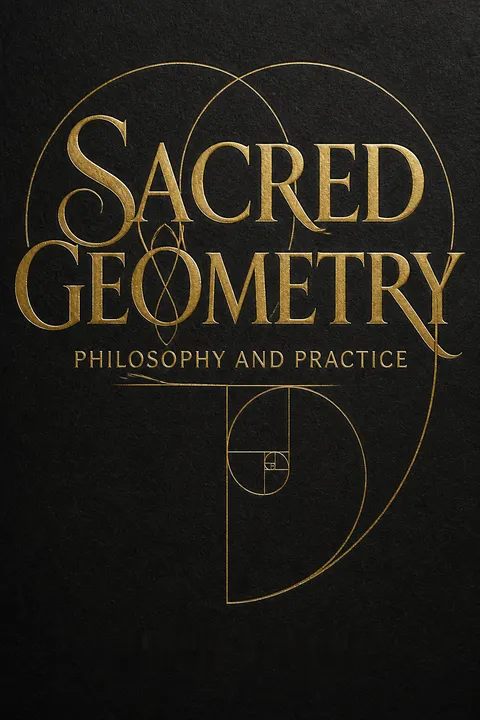

Key Takeaways
1. Sacred Geometry: The Universal Language of Reality
Both our organs of perception and the phenomenal world we perceive seem to be best understood as systems of pure pattern, or as geometric structures of form and proportion.
Ancient wisdom, modern science. Ancient cultures, from Egypt to Greece, understood reality through the metaphors of geometry and music, recognizing them as fundamental patterns of universal order. This perspective aligns remarkably with contemporary science, which increasingly views the material world not as substance, but as knowable through underlying patterns of wave forms and geometric structures. Our perception itself is a geometric interpretation of vibratory frequencies.
Patterns of existence. Whether in biology, chemistry, or physics, the universe reveals itself as an interwoven configuration of wave patterns and proportional relationships. For instance, the helix form of DNA, crucial for replication, is determined by fixed geometric proportions, existing as abstract relationships prior to any material counterpart. Similarly, the precise twelvefold symmetrical pattern of chlorophyll molecules enables photosynthesis, transforming light into life substance.
Innate geometry. Our senses respond to proportional, not just quantitative, differences. The smell of a rose is due to the geometry of its molecules, not merely their chemical composition. This "innate geometry of life" extends to cellular specialization and even our perception of sound, which interprets logarithmic differences in frequencies. Sacred Geometry, therefore, is a discipline for intellectual and spiritual insight, revealing timeless universal actions hidden from sensory perception.
2. Unity vs. Zero: The Foundation of Cosmic Understanding
Ancient geometry begins with One, while modern mathematics and geometry begin with Zero.
Contrasting origins. The starting point of geometric thought profoundly shapes our understanding of reality. Ancient sacred geometry begins with a metaphysical Unity, symbolizing an incomprehensible Oneness from which all order springs. In contrast, modern mathematics and geometry, influenced by the relatively recent concept of zero, begin with a void, leading to different philosophical and practical outcomes.
Zero's impact. The adoption of zero, originating in India and transmitted by Arabs, revolutionized calculation but also introduced philosophical complexities. It allowed for concepts like negative numbers and abstract entities without geometric form, leading to a separation between numerical systems and the natural world. This shift contributed to a worldview where the non-quantitative was deemed non-existent, fostering atheism and a perception of the universe as an empty void.
Unity's continuum. Ancient mathematics, rooted in Unity, saw all existence as fractions of an unknowable One, knowable through their proportional relationships. This perspective avoids the dichotomies created by zero, presenting a natural progression where all elements are real and flow from a central unity through inversion and reciprocity. This aligns with post-Einsteinian physics, which views the universe as a continuous field of interconnected energy, devoid of true "zero" states.
3. The Primal Division: Unveiling Archetypal Roots
Unity creates by dividing itself, and this can be symbolized geometrically in several different ways, depending upon how the original Unity is graphically represented.
Creation from within. The fundamental act of creation is Unity dividing itself to become multiplicity. Geometrically, this is visualized by a circle (unmanifest Unity) or a square (Unity poised for manifestation) undergoing internal division. This act is not about combining two ones, but about one becoming two from within, mirroring biological cellular division.
The sacred roots. The division of Unity reveals "incommensurable" or "irrational" roots (√2, √3, √5), which are supra-rational, invariant relationships. These roots are not mere numerical quantities but archetypal symbols for universal processes:
- √2 (Generative): Symbolizes the power of multiplicity, endless proliferation, and the instantaneous transformation of one into two, akin to cellular fission.
- √3 (Formative): Linked to the Vesica Piscis and the cube, representing the creative basis of all three-dimensional form and structural triangulation.
- √5 (Regenerative): Connects to the Golden Proportion, symbolizing bonding, mediation, and the regenerative seed that lifts mortal realms towards divine image.
Paradoxical truths. These geometric divisions reveal paradoxes, such as the same line unit being both root and diagonal, or the act of halving a square producing a double in area. These paradoxes highlight the dynamic, transformative power inherent in the division of Unity, demonstrating how finite forms can intrinsically express the infinite.
4. Alternation: Nature's Rhythmic Progression
The truth of every progression or evolution is rhythmic alternation and oscillation.
Dynamic roots. While incommensurable roots represent fixed, invariable qualities, they are also generators of change within the continuum of organic life. Ancient mathematicians, lacking decimals for irrational numbers, expressed these root powers as a succession of whole number ratios that alternately approached the true root value, revealing the Principle of Alternation.
Cosmic pulsation. This alternating pattern, seen in Diaphantine mathematics, models vibrational systems where a vibrating string moves above and below an abstract node. It symbolizes the rhythmic pulsation of Cosmic Life, a universal law found in Taoist philosophy (yin and yang) and the I Ching. Every progression or evolution is characterized by this rhythmic oscillation, where everything alternates towards its opposite.
Root and germ. R.A. Schwaller de Lubicz's concept of the "germ" further illustrates alternation. The root (positive geotropism) descends and transmutes from below, while the germ (negative geotropism) causes upward and outward growth, culminating in a new seed. These polarized, directional opposites of the same power demonstrate that life progresses through continuous alternation, with each phase containing the potential for its opposite.
5. The Golden Proportion (Phi): Divine Blueprint for Life
The Golden Proportion is a constant ratio derived from a geometric relationship which, like √2 and other constants of this type, is ‘irrational’ in numerical terms.
Unique division of Unity. The Golden Proportion (Phi, Φ) is the only possible proportional division with two terms (a:b::b:a+b), where the largest term is a wholeness composed of the sum of the other two. It is the ultimate reduction of proportional thought to causal singularity, representing the Trinity: "Three that are Two that are One." This unique division is considered "golden" because it is the most intimate relationship proportional existence can have with Unity.
Creative asymmetry. Unlike equal division, which results in static equilibrium, the Golden Proportion provides the asymmetrical division necessary for the dynamics of progression and extension from Unity. It is the "first issue of Oneness," a creative duality within Unity, where the entire proportional universe relates back to and is contained within this initial division. This makes it a model for conscious evolution, where the manifest world is an image of the Divine.
Ubiquitous presence. Phi is found wherever there is an intensification of function or particular beauty and harmony of form. It governs:
- The distribution of seeds in sunflowers (Fibonacci Series, which approximates Phi)
- Branching patterns in plants
- The fivefold symmetry of many flowers (e.g., roses, orchids)
- The proportions of the human body (navel dividing the body at Phi)
- Sacred art and architecture across civilizations (Egypt, Greece, Renaissance)
6. Gnomonic Growth: Spirals of Conscious Evolution
A gnomon is any figure which, when added to an original figure, leaves the resultant figure similar to the original.
Growth by accretion. Gnomonic expansion describes a type of growth where an added figure (the gnomon) leaves the resultant figure similar to the original. This principle is fundamental to nature's growth patterns, particularly in permanent tissues like bones, teeth, horns, and shells (e.g., Nautilus pompilius). It signifies that the old form is contained within the new, reflecting a continuous, self-similar expansion.
Spirals of time. Gnomonic expansion creates intersections upon which spirals can be drawn, known as logarithmic spirals or Spira mirabilis. These spirals are ubiquitous in nature, from ram horns to sunflower florets, and serve as profound images for the movement of Time and evolution. They symbolize a universe constantly approaching both infinite expansion and infinite contraction, representing the continuity between fundamental polarities.
Consciousness evolution. Gnomonic time offers a unique perspective: past time remains present as form, and formation grows through pulsating, rhythmic accretion. This suggests an evolution not merely of substance, but of consciousness, where each layer retains the past while moving forward. The human brain's evolution, with its successive layers (hindbrain, midbrain, cerebral cortex), exemplifies this gnomonic expansion, where older structures are retained and built upon.
7. Squaring the Circle: Harmonizing Spirit and Matter
Because the circle is an incommensurable figure based on π, it is impossible to draw a square more than approximately equal to it.
Bridging realms. The "Squaring of the Circle" is a symbolic practice in Sacred Geometry that seeks to construct a square virtually equal in perimeter or area to a given circle using only compass and straight-edge. While mathematically impossible to achieve perfectly due to pi's irrationality, it represents the geometer-cosmologist's attempt to express the pure, unmanifest spirit-space (circle) through the manifest, comprehensible world (square).
Creation's paradox. Dividing a unitary circle into two halves, as in the yin-yang symbol, reveals a paradox: the circumferences of the two inner circles equal the larger circle's, but their combined area is only half. This symbolizes the separation of mutually repellent forms (duality) arising from a common, homogeneous source (unity), akin to milk coagulating into curd and whey.
Life's return. The geometric construction of squaring the circle often reveals the pentagon, the symbol of life and its fivefold symmetry, which appears only in living organisms. This suggests that within the initial division of unity, the plan for life's return towards the light is already embedded. The Golden Proportion, as the primary division of Unity, acts as the "invisible provocator," the universal contractive power that initiates this process.
8. Mediation: Geometry as Frozen Music
The laws which govern the creation of things are the same laws as those which allow for their comprehension, and essential knowledge is an understanding of these laws.
The science of means. Mediation is the cornerstone of ancient philosophical mathematics, exploring how a single mean term binds two extremes. Plato emphasized this as "essential knowledge," an understanding of the metaphysical constructs that enable comprehension. This science defines three major medians:
- Arithmetic Mean: (a+c)/2, describes equality of difference (e.g., 3, 5, 7).
- Geometric Mean: √(ac), describes equality of ratio (e.g., 4, 8, 16).
- Harmonic Mean: 2ac/(a+c), describes an inverse relationship (e.g., 6, 8, 12).
Musical harmony. These three medians form the basis for musical harmony. The "musical proportion" (1, 4/3, 3/2, 2) arises from inserting the arithmetic and harmonic means between the double geometric ratios of the octave (1:2). This progression corresponds to the tonal intervals of the perfect fourth and fifth, the basic consonances in nearly all musical scales.
Cosmic order. The law of musical harmony, viewed through mediating proportions, symbolizes the natural order of the created worlds. It reveals how oppositional yet simultaneous movements interact to create both sound and form, demonstrating that "Geometry is frozen music." Experiments by Hans Jenny show that sound frequencies can arrange random particles into orderly geometric patterns, physically manifesting this ancient wisdom.
9. Anthropos: Man as the Cosmic Blueprint
Man is not a mere constituent part of this universe, but rather he is both the final summarizing product of evolution and the original seed potential out of which the universe germinated.
Cosmic Man. The anthropocosmic doctrine posits that Man (consciousness capable of self-reflection) is both the culmination of evolution and the original seed potential of the universe. This is akin to the seed containing the blueprint for the entire tree. Genesis, for example, presents Adam as both the summation of creation (Chapter 1) and the first-born, primal pattern for universal life (Chapter 2).
Evolutionary inversions. Evolution is seen as a continuous, alternating exchange between eternal Cosmic Man and evolving humanity. The Universal Being involutes into dense mineral forms, which then provoke an opposite evolutionary movement in plants, animating and freeing divine qualities. The animal kingdom then "involves" these principles again, leading to individual mobility and will. This rhythmic involution and evolution drive the succession of kingdoms.
Body as cosmos. Human physiology reflects universal cosmology. Our bodies contain important geometric and geodesic measures, with proportions like the Golden Section (at the navel) linking individual man to universal design. The ideal human form, embodying these invariant cosmic relationships, becomes a canon for art, architecture, dance, and poetry in many civilizations, symbolizing the link between our own physiology and the grand cosmic order.
10. Cosmic Volumes: The Genesis of Form
There are five volumes which are thought to be the most essential because they are volumes which have all edges and all interior angles equal.
Platonic Solids. The five regular polyhedra—tetrahedron, octahedron, cube, dodecahedron, and icosahedron—are considered the most essential volumetric forms. They are the three-dimensional expressions of the triangle, square, and pentagon (3, 4, 5) and were known to ancient civilizations long before Plato, who associated them with the four basic elements (fire, air, earth, water) and aether.
Interlocking genesis. These solids arise spontaneously from each other in a nested, generative sequence. The icosahedron (Purusha, the divine seed-image) generates the dodecahedron (Prakriti, the Universal Mother). Within this, the interlocking tetrahedron (yin and yang) gives rise to the cube (material existence), at whose heart lies the octahedron (crystallization of matter). This intricate dance of forms symbolizes the materialization of Spirit and the creation of form from pure potentiality.
Harmonic constellation. This "stunning constellation of harmonies" demonstrates that if the cube is dimensioned as 1, the icosahedron's side is Φ, the dodecahedron's side is 1/Φ, the interlocking tetrahedron's side is √3, and the octahedron's side is √2. This reveals that the same transcendental proportions (Φ and √2) underpin the genesis and interrelationships of these fundamental cosmic volumes, representing the constant interchange between primal male and female creative principles.
People Also Read

Download PDF
Download EPUB
.epub digital book format is ideal for reading ebooks on phones, tablets, and e-readers.








































