
Plot Summary
Prologue
A chorus addresses the audience before the first scene with a warning dressed as a promise: in Verona, two equally noble families have nursed a grudge so old no one remembers its origin. From these warring houses, two lovers will be born whose passion and destruction will be the only force capable of ending their parents' hatred.
The audience knows the ending before the first sword is drawn. What remains is the how — the precise sequence of choices, coincidences, and catastrophes that turn inevitability into agony.
Verona's Streets Run Red
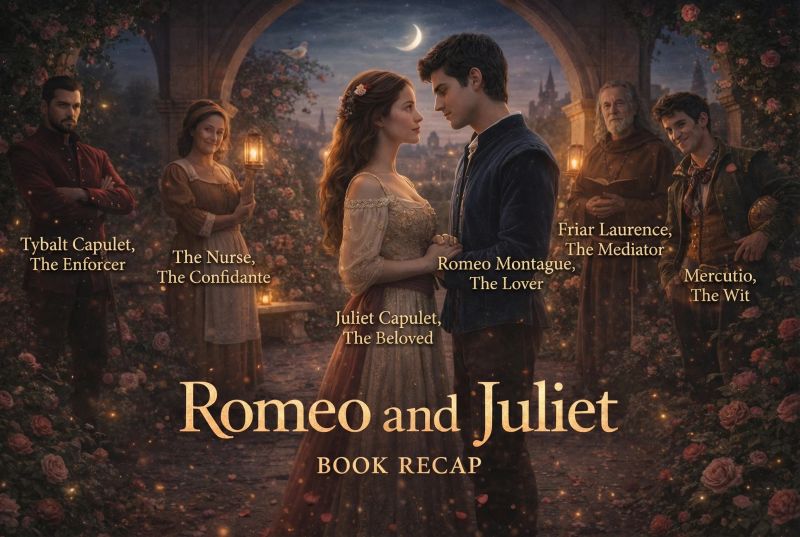
Capulet and Montague servants clash in the street, swords drawn over nothing more than a bitten thumb and inherited spite. Benvolio,9 Romeo's1 peace-seeking cousin, tries to separate them, but Tybalt5 — Juliet's2 hotheaded cousin — turns it into a real fight, declaring he hates peace as much as he hates all Montagues. Both patriarchs arrive ready to brawl.
Verona's Prince10 breaks it up with a decree: the next person to disturb the streets will pay with their life. Meanwhile, Romeo1 is nowhere near the violence. He has been wandering at dawn, weeping over a woman named Rosaline who has sworn off love entirely. His friend Benvolio9 urges him to look at other women. Romeo1 insists no one could replace her.
Enemy at First Kiss
A chance encounter sets the whole story spinning. A Capulet servant, unable to read, asks Romeo1 to decipher a guest list for that evening's feast. Benvolio9 spots Rosaline's name and convinces Romeo1 to attend the masked ball.
Romeo1 goes reluctantly, haunted by a premonition that the night will set some fatal consequence in motion. At the feast, he sees Juliet2 and every torch in the hall dims beside her. Tybalt5 recognizes Romeo's1 voice and reaches for his rapier, but Capulet7 himself intervenes, ordering restraint.
Tybalt5 retreats, vowing revenge. Romeo1 and Juliet2 meet, share a flirtatious exchange woven like a prayer between pilgrims and saints, and kiss twice. Only then does each discover the other's name — and that their houses are mortal enemies.
The Orchard Confession
After the feast, Romeo1 scales the Capulet orchard wall, unable to leave. Above on her balcony, Juliet2 speaks aloud to the night, wishing Romeo1 would shed his family name — names are arbitrary, she reasons; strip his away and the person she loves remains unchanged. Romeo1 steps from the shadows and startles her.
She is mortified he overheard her private confession, but also direct: she asks if he loves her and warns him not to swear by the inconstant moon. Their conversation is interrupted repeatedly by the Nurse6 calling from inside. Before parting, Juliet2 makes the decisive move: if his love is honorable and his purpose marriage, he should send word tomorrow about where and when. Romeo1 agrees without a breath of hesitation.
Married Before Noon
At dawn, Romeo1 rushes to Friar Laurence,3 a Franciscan monk who doubles as an herbalist, gathering plants that hold both medicine and poison in a single bloom. The Friar3 is stunned — only yesterday Romeo1 was weeping over Rosaline, and now he begs for an immediate wedding to a Capulet. He chides Romeo1 for the fickleness but agrees to perform the ceremony, reasoning that this union might transform the families' hatred into love.
The Nurse6 serves as go-between, carrying Romeo's1 message to Juliet:2 come to Friar Laurence's3 cell this afternoon. Juliet2 nearly goes mad waiting for the Nurse6 to stop complaining about her aching bones and deliver the news. That afternoon, barely a day after meeting, Romeo1 and Juliet2 are secretly married.
Blood Under Romeo's Arm
The afternoon sun bakes Verona's streets. Tybalt,5 still burning from the feast, finds Romeo1 and calls him a villain. Romeo1 — now secretly Tybalt's5 kinsman by marriage — refuses to fight and offers puzzling kindness. Mercutio,4 the Prince's10 witty and restless relative, cannot stomach what looks like cowardice. He draws on Tybalt5 himself.
Romeo1 steps between them to stop the duel, and in that gap Tybalt5 thrusts his blade under Romeo's1 outstretched arm, stabbing Mercutio.4 Mercutio4 dies cursing both houses. Grief and rage shatter Romeo's1 restraint. He chases Tybalt,5 fights, and kills him. Benvolio9 urges Romeo1 to run before the Prince10 arrives. Romeo1 flees, calling himself a plaything of fate — a husband at midday, a killer before sunset.
One Night, Then Mantua
The Prince10 hears testimony and sentences Romeo1 to banishment rather than death — Tybalt5 killed Mercutio4 first, which bought Romeo1 mercy. At the Friar's3 cell, Romeo1 collapses, arguing that exile from Juliet2 is worse than execution.
The Friar3 talks him down: Juliet2 is alive, the Prince10 showed mercy, there is still hope. He instructs Romeo1 to go to Juliet2 tonight, then flee to Mantua at dawn while the Friar3 works toward reconciliation. Meanwhile, Juliet2 learns from the Nurse6 that her new husband killed her cousin.5
She rages, then forgives — Tybalt5 would have killed Romeo.1 That night the lovers consummate their marriage. At dawn they debate whether it is the lark or the nightingale. It is the lark. Romeo1 descends. Juliet2 watches him go, seeing him pale as a corpse in a tomb.
Every Ally Abandons Juliet
Before Juliet2 can grieve Romeo's1 departure, her mother11 arrives with what she considers cheerful news: Juliet2 will marry the noble Count Paris8 on Thursday. Juliet2 refuses. Capulet7 enters expecting gratitude and erupts into a fury that shakes the household — he threatens to disown her, drag her to the church, and cast her into the streets to starve.
Lady Capulet11 washes her hands of the matter. Most devastatingly, the Nurse6 — Juliet's2 lifelong confidante, the woman who nursed her as an infant — advises her to simply marry Paris.8 Romeo1 is as good as dead, the Nurse6 reasons, and Paris8 is the better match. Juliet,2 betrayed to her core, dismisses the Nurse6 from her confidence forever and resolves to seek the Friar's3 help — or die.
Forty-Two Hours of Death
Juliet2 arrives at Friar Laurence's3 cell with a knife, ready to die rather than commit bigamy. The Friar,3 rattled, offers an alternative as desperate as the situation demands. He gives her a vial of distilled liquor: drink it, and her pulse will stop, her skin will go cold, her body will stiffen into a perfect simulation of death lasting forty-two hours.
Her family will lay her in the Capulet burial vault. The Friar3 will send word to Romeo1 in Mantua. Romeo1 will come to the vault, be present when she wakes, and carry her away to freedom. Juliet2 takes the vial without hesitation. She returns home, tells Capulet7 she has repented and will marry Paris.8 Capulet,7 delighted, moves the wedding up to the very next morning.
Plague Stops the Letter
Alone in her chamber that night, Juliet2 dismisses the Nurse6 and her mother,11 lays a dagger beside her bed, and confronts her terrors. What if the potion is actually poison? What if she wakes too early, trapped in a vault full of bones, with Tybalt's5 festering corpse beside her? Fear nearly breaks her, but she drinks.
The next morning, the Nurse6 finds her cold and stiff — the household convulses with grief, and the wedding transforms into a funeral. In Mantua, the Friar's letter explaining the plan never arrives: the messenger was quarantined in a house suspected of plague. When Friar Laurence3 learns this, he rushes toward the tomb, knowing Juliet2 will wake within hours — alone, with no one expecting her to be alive.
Together in the Vault
Romeo's1 servant Balthasar13 reaches Mantua first with the only news he has: Juliet2 is dead and buried. Romeo1 buys poison from a starving apothecary. At the Capulet tomb, he encounters Paris8 mourning and kills him in a fight.
Inside the vault, Romeo1 sees Juliet2 — her lips still crimson, her cheeks flushed, beauty untouched by what he believes is death. He drinks the poison and dies with a kiss. Friar Laurence3 arrives moments later, but too late. Juliet2 wakes beside Romeo's1 still-warm body. The Friar3 begs her to flee; she refuses.
She finds the empty vial, kisses his poisoned lips, then drives his dagger into her chest. When the families gather over the bodies, the Friar3 confesses everything. Capulet7 and Montague,12 shattered, clasp hands and vow to raise golden statues of each other's child.
Analysis
Romeo and Juliet1 is often reduced to a parable about young love, but Shakespeare built it as a precise anatomy of how institutional hatred metabolizes through individual bodies. The Montague-Capulet feud has no remembered origin, no grievance anyone can articulate — it persists as pure social inertia, a loyalty test requiring no reason beyond inheritance. The play's most radical insight is that inherited hatred needs no villains to do its work. Capulet7 is not a monster; he is a father who believes he knows best. The Nurse6 is not a traitor; she is a pragmatist shaped by survival. Tybalt5 is not evil; he is a young man who internalized a code no one thought to question.
The compressed timeline — roughly four days from first meeting to mutual destruction — is not romantic exaggeration but structural argument. Shakespeare places the speed of passion against the immovability of institutions. The lovers' urgency isn't foolish because it moves fast; it moves fast because the world they inhabit offers no space for it to exist slowly. Every adult system — family authority, arranged marriage, civic law, religious counsel — fails them. Friar Laurence3 embodies the play's most sophisticated failure: a genuinely wise man whose schemes shatter against contingency. His dual expertise in medicine and poison mirrors the double-edged nature of every intervention he attempts.
The play also dissects masculinity as lethal performance. Romeo's1 refusal to fight Tybalt5 — his most moral act — is read by Mercutio4 as shameful submission, triggering the chain of killings. The honor code demands violence; love demands vulnerability. These systems are incompatible, and Romeo1 is destroyed between them. Juliet,2 operating entirely outside the masculine honor economy, consistently makes clearer, braver decisions than any male character. Her isolation in the third act — abandoned by father,7 mother,11 and nurse6 in rapid succession — is the moment the play reveals whose story it truly is, and whose courage most exceeds the world that produced her.
Review Summary
Romeo and Juliet receives mixed reviews, with many praising Shakespeare's poetic language and timeless themes of love and tragedy. Some readers find the young lovers' actions foolish, while others appreciate the play's emotional depth. Critics note the story's enduring influence on popular culture. Many recommend reading the original text for its linguistic beauty, though some prefer modern adaptations. Overall, the play remains a classic exploration of passionate love, family conflict, and fate's cruel hand.
People Also Read


Characters
Romeo
Lovesick Montague heirThe only son of the Montague12 family, Romeo opens the story lovesick over a woman who will never return his affection—performing the role of romantic sufferer before he knows what love actually costs. His passion for Juliet2 transforms this performance into something genuine, but his psychology remains volatile: he swings between ecstasy and despair with no middle register. He is generous, poetic, and capable of profound feeling, yet dangerously impulsive—he makes irreversible decisions in moments of passion without pausing to calculate consequences. His relationship with Friar Laurence3 reveals a young man who craves a father figure's steadying hand yet consistently ignores counsel when emotion seizes control. Romeo's tragedy is not that he feels too much, but that he acts before feeling has resolved into thought.
Juliet
Capulet's young daughterNot yet fourteen, Juliet begins the play as a sheltered, obedient daughter—willing to consider a suitor she has never met, deferential to her parents' wishes. Her psychological transformation is the story's most remarkable arc. Where Romeo1 is reactive, Juliet is strategic: she proposes their marriage timeline, devises the communication plan, and drives every decisive turn in their relationship. Her intelligence is underestimated by every adult around her—her father7 sees disobedience, her mother11 sees a weeping girl, her nurse6 sees a charge to be managed. Juliet possesses independent thought and moral courage exceeding everyone in the play, paired with emotional honesty that makes her love feel chosen rather than accidental. She does not fall into love; she walks in with her eyes open.
Friar Laurence
Herbalist monk and confessorA Franciscan monk who serves as Romeo's1 confessor and spiritual father, Friar Laurence is the play's most complex authority figure. His knowledge of herbs—where medicine and poison coexist in the same plant—mirrors his role in the story: every intervention he makes carries equal potential for remedy and ruin. He assists the lovers not from sentimentality but from political hope, believing their union might heal Verona's fractured houses. His psychology reveals a man who overestimates his own cleverness and underestimates the chaos of circumstance. He is genuinely compassionate but fatally confident that careful planning can redirect fate. When his designs begin to unravel, his desperation escalates in parallel, exposing the dangerous gap between wisdom and control.
Mercutio
Romeo's brilliant, reckless friendRomeo's1 closest friend and a kinsman of Prince Escalus10, Mercutio is the play's most electric presence—brilliant, bawdy, and allergic to sentimentality. His Queen Mab speech reveals a mind that oscillates between dazzling invention and dark cynicism. His wit masks fierce loyalty and an intolerance for anything he perceives as dishonor or cowardice among those he loves.
Tybalt
Capulet's volatile swordsmanJuliet's2 cousin and the Capulet family's fiercest fighter, Tybalt treats the feud as personal religion. Described as a precise and deadly swordsman who fights with technical perfection, he possesses a hair-trigger temper that no elder can reliably control. His hatred of Montagues is not strategic but instinctive, making him the feud's most dangerous instrument—a blade perpetually waiting for any excuse to be drawn.
The Nurse
Juliet's lifelong caretakerJuliet's2 caretaker since infancy, the Nurse is bawdy, warm, and garrulous, providing much of the play's comic relief. She serves as Juliet's2 confidante and facilitator, making the secret relationship possible. Her worldview is fundamentally pragmatic—she prioritizes survival and material comfort over romantic fidelity—which ultimately places her at odds with Juliet's2 deeper commitments when circumstances grow desperate.
Capulet
Juliet's commanding fatherJuliet's2 father initially appears reasonable—he values his daughter's consent and urges Paris8 to win her heart. But beneath this progressiveness lies a patriarchal core that surfaces when his authority is challenged. He views his daughter's obedience as a non-negotiable extension of his social standing, and the distance between his initial tenderness and his capacity for rage reveals how conditional his affection truly is.
Paris
Juliet's noble suitorA nobleman and kinsman of the Prince10, Paris courts Juliet2 through proper channels—respectful, patient, genuinely admiring. He is not a villain but a conventional man operating within conventional expectations, which makes his role in Juliet's2 predicament suffocating precisely because his intentions are entirely honorable. He cannot see what he cannot imagine: that Juliet's2 heart already belongs elsewhere.
Benvolio
Romeo's peacemaking cousinRomeo's1 cousin and the Montague12 family's voice of reason, Benvolio consistently attempts to prevent violence and counsel moderation. He tries to break up brawls, advises Romeo1 to broaden his romantic horizons, and provides truthful testimony when questioned by authority. He represents the moderate, sensible path that the world of this play makes tragically insufficient.
Prince Escalus
Verona's sovereign rulerVerona's Prince stands above the feud, wielding civic authority to contain private hatreds. His decrees shape the consequences every character faces, making him the story's ultimate arbiter of justice and mercy.
Lady Capulet
Juliet's distant motherMarried young herself and emotionally distant, Lady Capulet aligns with her husband's7 authority and withdraws when Juliet2 most needs support, embodying the rigid expectations placed on women within the family hierarchy.
Montague
Romeo's concerned fatherRomeo's1 father, troubled by his son's melancholy but unable to penetrate his private world. He represents the older generation's powerlessness before their children's secret passions.
Balthasar
Romeo's loyal servantRomeo's1 faithful servant who carries news between Mantua and Verona. His dutiful reporting, though well-intentioned, becomes pivotal when it outpaces critical information from other sources.
Plot Devices
The Family Feud
The inherited poisonThe Montague-Capulet feud is ancient, its origins never explained—which is precisely the point. It persists as pure social inertia, a loyalty test requiring no reason beyond inheritance. The feud shapes every relationship: it makes Romeo1 and Juliet's2 love forbidden, turns Tybalt5 into an enforcer, forces the Friar3 into secrecy, and gives the Prince10 his central governing crisis. It operates not through dramatic confrontations alone but through ambient pressure—the constant awareness that names determine loyalties, that love across houses is treason. Servants absorb it, children inherit it, and even peacemakers like Benvolio9 cannot escape its gravitational pull. The feud can only be dissolved by something of equal irrational force.
The Prince's Death Decree
Raises all stakes instantlyAfter the third street brawl, Prince Escalus10 decrees that anyone who disturbs the peace again will be executed. This single pronouncement transforms every subsequent conflict: when Tybalt5 challenges Romeo1, the stakes become not merely personal honor but capital punishment. The decree is why Romeo1 tries so desperately to avoid fighting, which is why Mercutio4 steps in on his behalf. When Romeo1 does kill Tybalt5, the Prince10 commutes the sentence to banishment—partly because Tybalt5 killed the Prince's10 own kinsman first. The decree functions as a pressure system driving characters into increasingly desperate and confined choices, eliminating the middle ground where reason might have prevailed.
The Sleeping Potion
Fakes death to buy timeFriar Laurence's3 distilled liquor induces a death-like state lasting forty-two hours—no pulse, no warmth, no breath. It is the centerpiece of the Friar's3 rescue plan: Juliet2 will appear dead, be placed in the family tomb, and wake to find Romeo1 waiting. The potion embodies the play's recurring duality of medicine and poison, remedy and catastrophe. It works exactly as designed—the tragedy lies not in the chemistry but in the communication surrounding it. The potion transforms a living girl into a convincing corpse, and that perfect deception becomes precisely the thing that undoes everyone who loves her. It is the Friar's3 herbalist knowledge made desperate and literal.
The Undelivered Letter
Fate's cruelest mechanismFriar Laurence3 writes to Romeo1 in Mantua explaining the sleeping potion plan, entrusting it to a fellow friar. But the messenger is detained when health officials quarantine a plague-suspected house he visits. The letter never reaches Romeo1. This device transforms a recoverable situation into irreversible tragedy—had Romeo1 received the letter, the plan would have succeeded. The plague quarantine is entirely random, connected to no character's choice or flaw, representing the play's argument that even the most careful human planning cannot account for chance. The device arrives late in the action, compressing the catastrophe into an agonizing sequence of near-misses where minutes and miles determine everything.
Romeo's Premonition
Foreshadows the trajectoryBefore entering the Capulet feast, Romeo1 confesses a sense of dread—his mind warns that some consequence hanging in the stars will begin its course this night and end with his untimely death. He goes anyway, surrendering to whatever force steers him. This moment establishes the play's central tension between fate and choice: Romeo1 senses the trajectory but walks into it willingly. The premonition recurs in echoes—Juliet's2 vision of Romeo1 pale as a body in a tomb, Romeo's1 dream in Mantua of being revived by Juliet's2 kisses. Each functions as a warning the characters cannot heed because the story's momentum demands their forward motion, and their own natures refuse retreat.
FAQ
Synopsis & Basic Details
What is Romeo and Juliet about?
- Forbidden love blooms: Romeo and Juliet, from feuding families, fall deeply in love, leading to a secret marriage.
- Escalating family conflict: The families' hatred fuels violence, resulting in tragic deaths and Romeo's banishment.
- Desperate measures, tragic end: Juliet fakes her death to avoid a forced marriage, but miscommunication leads to both lovers' suicides.
Why should I read Romeo and Juliet?
- Timeless exploration of love: The play captures the intensity and passion of young love, making it relatable across generations.
- Tragic consequences of hate: It powerfully illustrates how feuds and prejudice can lead to devastating outcomes.
- Masterful use of language: Shakespeare's poetic verse and dramatic storytelling create a captivating and emotionally resonant experience.
What is the background of Romeo and Juliet?
- Set in Renaissance Verona: The play is set in a time of social hierarchy, family honor, and arranged marriages.
- Feuding families common: The conflict between the Montagues and Capulets reflects real-world tensions between powerful families.
- Cultural context of honor: The characters' actions are driven by a strong sense of personal and family honor, influencing their choices.
What are the most memorable quotes in Romeo and Juliet?
- "O Romeo, Romeo! wherefore art thou Romeo?": Juliet's iconic lament captures the conflict between her love and Romeo's identity.
- "What's in a name? that which we call a rose / By any other word would smell as sweet": Juliet questions the importance of names and family ties in love.
- "For never was a story of more woe / Than this of Juliet and her Romeo": The Prince's final lines emphasize the tragic nature of the lovers' tale.
What writing style, narrative choices, and literary techniques does William Shakespeare use?
- Poetic verse and prose: Shakespeare blends elevated language with everyday speech, creating a dynamic and engaging narrative.
- Dramatic irony and foreshadowing: He uses these techniques to build tension and highlight the characters' tragic fates.
- Use of soliloquies and asides: These allow the audience to access the characters' inner thoughts and motivations, enhancing emotional depth.
Hidden Details & Subtle Connections
What are some minor details that add significant meaning?
- The Nurse's rambling stories: Her long-winded tales about Juliet's childhood reveal her deep affection and maternal bond with Juliet.
- Mercutio's Queen Mab speech: This fantastical monologue reveals his cynical view of love and foreshadows the play's tragic turn.
- The apothecary's description: His poverty and desperation highlight the corrupting influence of money and the desperation of the poor.
What are some subtle foreshadowing and callbacks?
- Romeo's premonition before the Capulet party: His sense of impending doom foreshadows the tragic events that follow.
- Juliet's "My grave is like to be my wedding bed": This line foreshadows her death and its connection to her marriage.
- The recurring motif of light and dark: The contrast between light and dark symbolizes the lovers' fleeting happiness and the darkness of their fate.
What are some unexpected character connections?
- Tybalt and Romeo's brief kinship: Their connection through Romeo's marriage to Juliet adds a layer of complexity to their conflict.
- The Prince's connection to Mercutio: Mercutio's death is a personal loss for the Prince, highlighting the far-reaching consequences of the feud.
- Friar Laurence's role as a father figure: He acts as a confidant and advisor to Romeo, highlighting the lack of parental guidance in the play.
Who are the most significant supporting characters?
- The Nurse: She acts as a messenger and confidante, playing a crucial role in the lovers' secret relationship.
- Mercutio: His wit and cynicism provide a counterpoint to Romeo's romanticism, and his death is a major turning point.
- Friar Laurence: His well-intentioned but flawed actions drive much of the plot, highlighting the dangers of interference.
Psychological, Emotional, & Relational Analysis
What are some unspoken motivations of the characters?
- Capulet's need for control: His desire to control Juliet's life stems from his own insecurities and need for social standing.
- Lady Capulet's emotional detachment: Her lack of emotional connection with Juliet reveals a loveless marriage and a focus on social status.
- Romeo's desire for belonging: His intense love for Juliet may stem from a need for connection and purpose, given his family's feud.
What psychological complexities do the characters exhibit?
- Romeo's impulsivity and emotional extremes: He swings between lovesickness and despair, highlighting his volatile nature.
- Juliet's internal conflict: She struggles between her love for Romeo and her loyalty to her family, showcasing her maturity.
- Friar Laurence's moral ambiguity: His attempts to help the lovers lead to unintended consequences, revealing his flawed judgment.
What are the major emotional turning points?
- Romeo and Juliet's first meeting: This moment of instant connection sets the stage for their passionate but doomed love.
- Mercutio's death: This event triggers Romeo's rage and sets the tragic events in motion.
- Juliet's decision to take the potion: This act of desperation highlights her willingness to risk everything for love.
How do relationship dynamics evolve?
- Romeo and Juliet's relationship: It evolves from infatuation to a deep, passionate love that defies family and social norms.
- Juliet and the Nurse's relationship: It shifts from a close bond to a strained one as the Nurse advises Juliet to marry Paris.
- The Capulets' family dynamic: It transitions from a seemingly loving family to one torn apart by grief and anger.
Interpretation & Debate
Which parts of the story remain ambiguous or open-ended?
- The role of fate vs. free will: The play leaves it open to interpretation whether the lovers' fate was predetermined or a result of their choices.
- The extent of Friar Laurence's culpability: It's debatable whether he is a well-meaning helper or a catalyst for the tragedy.
- The true nature of the families' reconciliation: The ending suggests a truce, but the depth of their change is left uncertain.
What are some debatable, controversial scenes or moments in Romeo and Juliet?
- Juliet's age and agency: Her young age raises questions about her autonomy and the societal pressures she faces.
- The Nurse's betrayal: Her advice to Juliet to marry Paris is seen by some as a betrayal of their bond.
- Romeo's impulsive actions: His quick shift from Rosaline to Juliet and his violent reactions are often debated.
Romeo and Juliet Ending Explained: How It Ends & What It Means
- Romeo's suicide: Believing Juliet is dead, he chooses to die by poison, highlighting his despair and devotion.
- Juliet's suicide: Upon finding Romeo dead, she uses his dagger to end her life, emphasizing her unwavering love.
- Reconciliation through tragedy: The families' feud ends only after the deaths of their children, highlighting the futility of their hatred and the high cost of their conflict.
About the Author
Other books by William Shakespeare

Download PDF
Download EPUB
.epub digital book format is ideal for reading ebooks on phones, tablets, and e-readers.








































