
Key Takeaways
1. America's Irreversible Demographic Shift: The "New America" is diverse, young, and progressive.
Our country is hurtling toward a New America that is ever more racially and culturally diverse, younger, millennial, more secular, and unmarried, with fewer traditional families and male breadwinners, more immigrant and foreign born who are more concentrated in the growing metropolitan areas, which are magnets for investment and people.
Demographic transformation. The United States is undergoing a profound demographic shift, moving towards a "New America" characterized by increasing racial and cultural diversity. This emerging demographic is younger, more secular, and less reliant on traditional family structures, with a growing proportion of immigrants and foreign-born residents concentrated in dynamic metropolitan areas. This transformation is not merely a trend but an irreversible trajectory shaping the nation's future.
Millennials lead change. Millennials have surpassed baby boomers as the largest generation and will constitute a significant portion of the electorate, bringing with them distinct values. Approximately 40% of millennials are racial minorities, and a substantial majority support gay marriage, reflecting a widespread acceptance of multiculturalism. Their preference for urban living over suburbs further concentrates these diverse values in economically vibrant metropolitan centers.
Cultural alignment. This "New America" embraces diversity, views immigration as enriching, and champions women's aspirations for respect and equality. Major social movements and legal battles have consistently pushed the country towards greater freedom, equality, and democracy, aligning the Democratic Party with these evolving civic norms while increasingly alienating the Republican Party from the country's modern values.
2. GOP's Decades-Long Counterrevolution: A consistent fight against civil rights, women's equality, and immigration.
The Republican Party is trapped in an ever more desperate counterrevolution against the cumulative and accelerating trends that are producing a New America.
Historical opposition. The GOP has consistently opposed major social changes that have shaped modern America, starting with the Civil Rights Act of 1964 and the Voting Rights Act of 1965. Republican leaders, particularly from the South, actively resisted these laws and continued to signal to white voters that they would protect their interests against emerging racial equality. This stance laid the groundwork for deep racial polarization within the parties.
Battle against women's rights. The party also launched a sustained "culture war" against the sexual revolution and women's equality, particularly after Supreme Court decisions legalized birth control (1965) and abortion (1973). While Democrats embraced these new freedoms, the GOP nationalized opposition to abortion, aligning with social conservatives and Evangelicals, and advocating for policies that sought to restore traditional patriarchal family structures.
Anti-immigrant stance. Despite bipartisan efforts to expand legal immigration in the 1980s and 1990s, a powerful insurgent wing within the GOP initiated a three-decade campaign against immigration. Figures like Pat Buchanan warned against the country's changing demographics, advocating for policies like an "impenetrable wall" and moratoriums on legal immigration, which resonated with a base increasingly uncomfortable with growing diversity.
3. Trump's Radical Acceleration of GOP's Decline: Militant Tea Party and Evangelical agenda alienates the nation.
Trump got the job of leading the GOP because he hated Obama and Clinton so viscerally, and he promised to repeal Obamacare and build a wall against Mexican immigrants.
Seizing the counterrevolution. Donald Trump effectively seized leadership of the Republican counterrevolution by tapping into the deep-seated anger and resentment of the Tea Party and Evangelical base. He campaigned on a platform of visceral opposition to Barack Obama's legacy, promising to repeal Obamacare, build a border wall, and halt what he perceived as the "New America's" triumph. His "birther" claims against Obama signaled his willingness to engage in aggressive, racially charged attacks.
Militant governance. Once elected, Trump governed as a militant Tea Party and Evangelical conservative, appointing cabinet secretaries hostile to their own departments and proposing drastic budget cuts to social programs and environmental protections. His administration prioritized:
- Deconstructing government agencies (e.g., State Department, EPA, HHS).
- Appointing conservative Supreme Court justices (Gorsuch, Kavanaugh) to overturn abortion rights.
- Defunding Planned Parenthood and promoting abstinence-only education.
- Withdrawing from the Paris climate accord and denying human-caused global warming.
Alienating the mainstream. Trump's rhetoric and policies, characterized by racist, misogynist, and nationalist signals, branded the GOP as an anti-immigrant, white, and patriarchal party. This extremism, while solidifying his base, horrified college-educated and affluent women, millennials, and people of color, driving them to vote in record numbers against his GOP and further polarizing the country.
4. The New America's Powerful Backlash: Mass mobilization and the 2018 blue wave.
The millions who joined the Women’s Marches that dwarfed President Trump’s inauguration signaled to the New America: You are not powerless.
Immediate resistance. Trump's election triggered an immediate and powerful backlash from the "New America," starting with the Women's Marches in January 2017, which became the largest single-day demonstration in U.S. history. These protests, driven by a sense of shock and a realization that fundamental rights were at risk, galvanized a broad coalition of diverse groups. The marches signaled that the majority stood against Trump's agenda and were ready to resist.
Cascading activism. The initial protests evolved into sustained activism, including:
- A surge of women candidates and victories in Democratic primaries.
- Demonstrations against Republican efforts to repeal Obamacare.
- Student walkouts and marches for gun control after school shootings.
- Teacher strikes in GOP-controlled states demanding increased education funding.
This continuous engagement transformed public sentiment, pushing it strongly in favor of liberal democratic values and government action.
The 2018 blue wave. This intensified politicization culminated in a sweeping Democratic victory in the 2018 midterm elections, marking the most emphatic repudiation of a president in modern history. Democrats gained 40 House seats, flipped six statehouses, and won nearly 400 legislative seats. This wave was fueled by unprecedented turnout from the Rising American Electorate (African Americans, Hispanics, unmarried women, and millennials) and a broad rebellion of women voters against Trump's GOP.
5. GOP's Disconnect on Working-Class Economics: "Work requirements" fail to address deep financial pain.
The only thing Republicans and President Trump have had to offer the struggling working class is all government benefits being subject to “work requirements.”
Misguided solutions. Despite Trump's promises to the "forgotten Americans," the GOP's primary economic offering to the struggling working class has been the imposition of "work requirements" for government benefits like food stamps and Medicaid. This approach, rooted in the belief that such programs foster "indolence," ignores the reality that most recipients are children, disabled, or elderly, or already working. This policy has been shown to make people poorer without improving long-term employment.
Ignoring economic realities. The GOP's focus on austerity and tax cuts for the wealthy has consistently overlooked the profound economic struggles of ordinary Americans. While elites proclaimed a booming economy, most working people faced:
- Stagnant wages that couldn't keep pace with rising costs.
- Skyrocketing healthcare and prescription drug expenses.
- Uncertainty from lost protections for preexisting conditions.
- A belief that the economic system unfairly favors powerful interests.
This disconnect alienated a significant portion of the white working class who had initially supported Trump.
Voters reject austerity. The 2018 election results, particularly in the Rust Belt, demonstrated a clear repudiation of the GOP's anti-government stance and its "work requirements" agenda. Voters, including many who had supported Trump, rejected the notion that food stamps and Medicaid were "hammocks." They sought leaders who understood their financial pain and were willing to use government to address issues like healthcare costs and stagnant wages, rather than dismantling social safety nets.
6. Democrats' Missteps Paved Trump's Path: Complacency on the economy and corporate power.
So, how did Democrats ever let Donald Trump become president of the United States?
Out-of-touch messaging. Democrats, despite controlling the presidency and Congress early in the decade, failed to adequately address the profound economic pain of ordinary Americans after the 2008 financial crisis. President Obama's consistent message of "building on the progress" and a "dependable recovery" resonated poorly with voters whose incomes had stagnated, wealth had declined, and who faced soaring costs for essentials like healthcare and education. This complacency left a vacuum that Trump exploited.
Ignoring corporate power. Democrats also largely failed to articulate a strong critique of corporate power and a political system perceived as rigged by big money. While progressive groups highlighted issues like CEO greed, outsourcing, and the influence of billionaires in politics, the Democratic leadership, particularly Hillary Clinton's campaign, was reluctant to aggressively challenge Wall Street and corporate interests. This silence allowed Trump to position himself as the anti-establishment champion against "crony capitalism."
Campaign malpractice. Hillary Clinton's 2016 campaign, despite internal warnings, prioritized attacking Trump's temperament and character over presenting a compelling economic vision for change. Her campaign's focus on "ladders of opportunity" and "stronger together" proved less engaging than a "level the playing field, rewrite the rules" message that resonated with voters' anger about a rigged economy. This strategic misstep, combined with external factors like Russian interference and FBI actions, contributed to Trump's unexpected victory.
7. The Unbearable Cost of Living and Healthcare: A core driver of voter anger and anti-corporate sentiment.
It is the cost of health care that is most explosive, though.
Financial precarity. For most Americans, the post-2008 economic recovery was characterized by stagnant wages and an endemic cost-of-living crisis. Any modest income gains were quickly eroded by formidable and rising expenses for:
- Healthcare and prescription drugs.
- Childcare and education.
- Housing and student debt.
A significant portion of the population, including a majority of unmarried women and large numbers of minorities and millennials, could not handle an unexpected $500 expense, highlighting widespread financial insecurity.
Healthcare as a breaking point. Healthcare costs emerged as the most explosive issue, with nine out of ten Americans describing them as "out of control." Prescription drug prices, in particular, evoked intense anger, with voters describing pharmaceutical companies as "killers" and "criminals" driven by greed. This sentiment underscored a broader skepticism towards big corporations perceived as manipulating the system for profit at the expense of ordinary citizens.
Anti-corporate consensus. This widespread economic distress fueled a strong anti-corporate sentiment across the electorate, including among college graduates and millennials. CEOs of large corporations were widely viewed as "overpaid," "greedy," and "out of touch," using lobbyists and campaign donations to "buy their laws" and rig the economy. This anger at corporate power and political corruption became a central theme that Democrats could leverage, as demonstrated by the success of messages like "tax scam for the rich" in the 2018 midterms.
8. Immigration: The GOP's Losing Battle: Public opinion shifts towards a multicultural America.
On Election Day, a stunning 54 percent of those who voted said immigrants “strengthen our country.”
Trump's losing war. President Trump's aggressive anti-immigrant campaign, characterized by warnings of invasion, border troops, and Willie Horton-style ads, aimed to mobilize his base but ultimately backfired. While it made immigration a top voting issue for Republicans, it alienated a broader electorate. On Election Day 2018, a majority of voters (54%) affirmed that immigrants "strengthen our country," a stark contrast to Trump's narrative.
Shifting public sentiment. Public opinion has decisively moved towards embracing immigration and multiculturalism. Three-quarters of Democrats and a large majority of independents believe America benefits from immigration. For the Rising American Electorate (Hispanics, African Americans, millennials), immigration has become a civil rights issue, generating intense support for immigrants' roles. Even white millennials and college graduates overwhelmingly embrace America's immigrant future.
Democrats' opportunity. Democrats have a clear path to electoral strength by championing a comprehensive immigration reform that balances border security with a path to citizenship. This approach, which emphasizes that America is an immigrant country enriched by diversity and that immigration must be managed to benefit all citizens, resonates broadly. It allows Democrats to move beyond merely defending immigrant rights to actively shaping a future where immigration is seen as a strength, not a threat.
9. The Shattering 2020 Election: An unprecedented blue wave to redefine American politics.
The year 2020 will produce a second blue wave on at least the scale of the first in 2018 and finally will crash and shatter the Republican Party that was consumed by the ill-begotten battle to stop the New America from governing.
Impending electoral collapse. The author predicts a second "blue wave" in 2020, surpassing the 2018 midterms, which will "shatter" the Republican Party. This is driven by an electorate that is even more polarized, politicized, and determined to vote. Early 2019 polling indicated a generic Democratic candidate leading Trump by ten points, suggesting a potential doubling of Obama's 2008 landslide margin.
GOP's self-inflicted wounds. Trump's continued embrace of his Tea Party-Evangelical base, even after the 2018 repudiation, further alienates crucial voter segments. His administration's actions, such as the government shutdown over the border wall, only deepen public despair with politicians. The GOP's unwavering commitment to an anti-immigrant, socially conservative, and anti-government agenda ensures its continued decline among:
- Affluent, college-educated, and suburban voters.
- Millennials and younger generations.
- Moderate Republicans and secular conservatives.
This internal fracture will lead to significant defections and a lack of enthusiasm outside Trump's loyalist core.
Democratic unity and momentum. In contrast, Democrats are expected to be united and consolidated, substantially increasing their chances for down-ballot gains. The divisive 2016 primaries are unlikely to be repeated, as Trump's presidency has unified Democrats in their resolve to defeat him. This unity, combined with high voter engagement, positions Democrats to protect and expand their House majority, sweep competitive Senate races, and gain hundreds of state legislative seats, fundamentally reshaping the political landscape.
10. Progressive Hegemony and a New Era of Reform: Government's expanded role to address systemic issues.
When the Republican Party is fully defeated, the country will be freed from the decade-long effort to stop Democratic governance and governmental function.
Liberation from gridlock. The predicted shattering defeat of the GOP in 2020 will liberate the country from a decade of conservative counterrevolution and governmental gridlock. This moment will usher in a new era of progressive reform, allowing Democrats to address long-suppressed economic and social problems with renewed urgency and an expanded role for government. The intellectual energy for policy innovation is now firmly on the left.
Bold progressive agenda. Democrats are poised to implement transformative policies, including:
- Curbing corporate power and expanding public power.
- Raising taxes on the rich and corporations to fund vital investments.
- Investing in infrastructure, clean energy, and education.
- Creating genuine public options in healthcare, education, and housing.
- Actively addressing racial and gender inequality, placing inclusion at the core of policy.
This agenda reflects a broad consensus among Democrats and a significant portion of the country that the economy and politics are rigged, demanding systemic change.
Redefining American identity. A post-Trump era will see multiculturalism no longer politically contested, aligning with a "creedal national identity" that embraces diverse racial and religious backgrounds. Democrats will lead on comprehensive immigration reform, ensuring it benefits all citizens while enriching the nation. This shift will allow the GOP, if it is to become relevant again, to shed its anti-immigrant, anti-modernity stance and adapt to the values of the "New America."
Review Summary
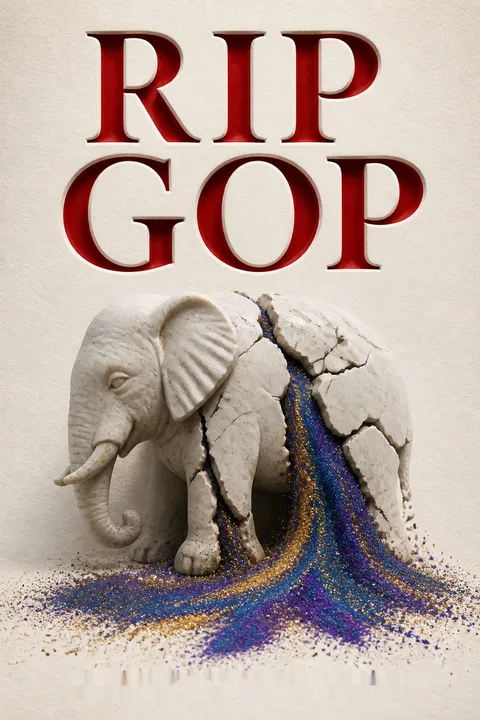
Reviews of RIP GOP are mixed, averaging 3.69/5. Readers appreciate Greenberg's data-driven analysis of Republican demographic challenges and his segmentation of GOP voter groups. Many praise his focus group research and historical political context. However, critics note the book's overly optimistic predictions about a 2020 Democratic landslide proved inaccurate. Some find the writing uneven, particularly early chapters. Recurring criticisms include Democratic complacency, Greenberg's insider bias, and insufficient strategy for countering Republican tactics. Readers across the spectrum find value in his polling insights despite disagreeing with his conclusions.
Download PDF
Download EPUB
.epub digital book format is ideal for reading ebooks on phones, tablets, and e-readers.








































