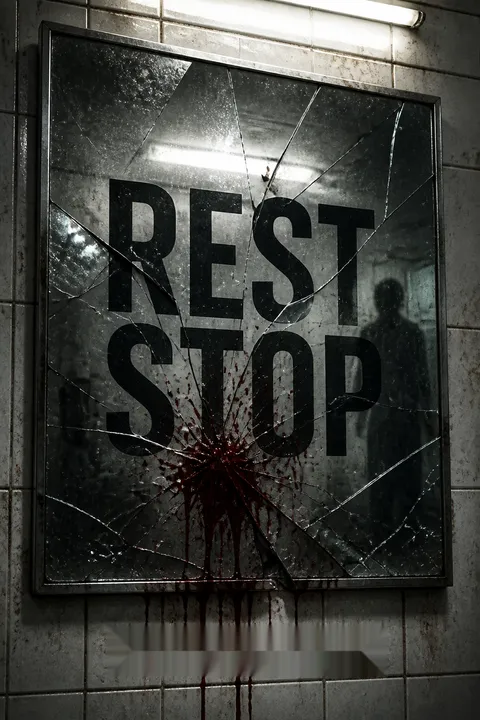

Plot Summary
Midnight Drive, Heavy Thoughts
Abe Neer, a Jewish bassist in a failing band, drives through the oppressive Midwest night towards his comatose grandmother, Bobbe, whom he both loathes and feels bound to. On the phone with his brother, family guilt oozes through conversations, dark humor masking real pain. Haunted by the death of music legends and the political tension of 2016, Abe's mind drifts to his failures, especially his "crushed bug" heart over Jenna—his bandmate Ty's new girlfriend, and the girl Abe quietly loves. He procrastinated this trip, overwhelmed by dread of seeing Bobbe and self-loathing for his own inertia. As the diner music transitions to yacht rock, the road ahead feels as meaningless as the bug splat on his windshield.
Descent into Isolation
At a deserted highway exit adorned by a bizarre "Create Hate" van, Abe enters the vivid, empty brightness of the gas station, seeking sugar but feeling alienated among snack aisles and his own inner critic—Bobbe's voice. The isolation grows: the parking lot is uneasily still, and inside, there are no people at all, despite the presence of other cars and the van. The store, silent but for machines, unnerves him. He finds a googly eye on the floor, a kid's toy turned sinister. Abe feels the tickle of generational trauma; everyone's fighting their own wars, but why do some become monsters and others not?
Strange Warning Signs
Abe's dread hardens. Voices—Bobbe's, Ty's, Jenna's—haunt his memory as he grabs snacks. The googly eye's presence grows heavier. He discovers the bathroom is "unlocked," decides a pitstop is safer than another stop down the road, and enters. Unsettling jokes on the door ("Occupado" in French) cannot dispel the sense that he's being watched. The absurdity notches up as paranoia sets in—what if everyone's hiding, what if it's a trap? The banality of fluorescent-lit gas stations becomes the site of existential threat.
Locked In and Alone
When Abe tries to leave, the door refuses to open. He finds evidence of a deadbolt installed on the outside—locked deliberately by someone unseen. Panic and self-mockery war for dominance as he tests kicking and shoulder ramming; the door holds. Voices from the past—Bobbe's taunting, Ty's encouragement—battle for his attention in the claustrophobic silence. As he listens, every surface seems to pulse with threat. Then comes the faint, horrifying noise above the ceiling.
Bugs, Blood, and Panic
A monstrous spider drops from the vent, defying logic. Abe cycles through disgust, terror, and attempts at bravado, trying to befriend and then kill the spider "Boris". The battle is physical, panicked, and ends with his injury—a hand swollen and numbed. But the presence above remains. Suddenly, a rattlesnake crashes from the vent, escalating horror. Abe, pushed to frantic action, jabs at the snake, then improvises a desperate plan: wrangle it into the toilet and sit atop the seat, crushing and killing it.
Predators in the Walls
Abe is left panting, bloodied by both his animal invaders and the exertion of survival. Cryptic notes made from candy wrappers, slid under the door, spell out "You're gonna be glad you stayed in there." He's the subject of a taunting puzzle orchestrated by some twisted watcher, and the dread grows as he realizes his luck is finite and more dangers—possibly worse ones—loom.
Notes and Games Begin
As Abe confronts successive notes—insinuating doom and his own helplessness—he wrestles with horror and metaphysical uncertainty. Is this Schrödinger's box? Alive and dead, trapped and free. Memories of band games, existential jokes, and guilt-induced Jewish philosophy swirl. When the lights go out, hallucinations and genuine terror compound: his old childhood fear, the Hairlip Man, manifests in the dark. He is undone by loneliness, ancestral trauma, and the parade of monsters, both external and within.
Confronting Darkness Within
In the blackness, Abe confronts what terrifies him most: abandonment, helplessness, and the haunting voice of Bobbe. But his own inner voice interjects: to survive, he must think rationally, rely on resilience passed down through suffering, and find practical solutions. He reclaims the light—literally, by finding the switch—and is rewarded with a reprieve. Notes announce he should be "glad he stayed in there," implying the locked door protected him from worse outside. When he finally ventures out, he witnesses a gas station transformed into a scene of unspeakable carnage—bodies butchered, organs and blood everywhere.
The Bloody Revelation
The slaughter's author is a man in a googly-eyed mask, exuberant and childlike, yet horrific—a manifestation of "Create Hate". The chase resumes, forcing Abe back into the bathroom. Salvation appears—police, Jenna—only to be revealed as a taunting daydream, not reality. Abe is left locked in, forced into dialogue with his "mirror" Bobbe, who offers both condemnation and sly wisdom: his mind is his weapon, his pattern is to run or hide, and his opportunity is within his grasp.
The Monster's Masked Face
Abe hatches schemes: using broken glass as a weapon, exploring the ceiling, only to fall into a fresh cascade of insects. Each new mini-ordeal becomes a test—and momentary victories kindle an adrenaline-fueled "invincibility." He bludgeons and smashes his way out of the bathroom, careening into the blood-streaked store and the horror beyond. Yet, even when escape seems possible, violence begets more violence—a wounded "clerk" appears, and in paranoid self-defense, Abe stabs him.
Fleeting Salvation, False Escape
Wracked with guilt, Abe resolves to help the clerk and returns to the store for supplies—totally exposed, but desperate to preserve his humanity. The "clerk" feigns humanity, requests an inhaler, and betrays Abe with a venomous snake attack: the cycle of trust and betrayal forms another existential trap. As paralysis overtakes him, the "clerk" becomes monstrous once again, donning the googly mask. Abe only just manages to crawl into the bathroom and lock himself in, their deadly game resetting.
Humanity Upon a Knife Edge
Numb with venom, Abe faces both literal and psychic death. Ghostly Bobbe shares hard-earned wisdom about generational trauma, survival, and the "already broken glass." Ty's voice reruns old betrayals and stunted courage. Abe experiences memories, especially his failure to seize love or to directly fight for what he wants. He realizes: to survive, he must act, not just reflect.
Old Fears, New Wounds
Drawing on muscle memory and inner reserves, Abe improvises a soap-filled condom—his only weapon—and emerges for a final confrontation. However, the killer—now in a mirror-faced mask—confounds expectations, his reflection multiplying Abe's own terrified, broken visage. The showdown is physical and psychological: objects fly, knives flash, blood flows. After a desperate somersault, Abe seizes a final beat of resourcefulness—using the dead rattlesnake's "posthumous bite reflex" to wound the killer fatally.
Wrestling with the Divine
In the denouement, the killer pretends to be God—confessing boredom, malevolence, and mutability beneath every mask. The final fight is both absurd and sublime: Abe's declaration of love, thanks, and gratitude disarms God with laughter, granting Abe the opening to deliver a final, fated strike. The killer hemorrhages, his divinity (or madness) no protection, dying amid pop snacks and bloody tiles. Is he a madman, a vessel for evil, or truly God? Abe is too exhausted, relieved just to have survived.
Creation of Monsters
Rescue finally arrives—police, authorities, the waking world. But reality bleeds into hallucination: does Abe ever truly leave the bathroom's mortuary embrace? He purchases the killer's van later, haunted but compelled. He repeats patterns of seeking safety, ritual, and avoidance. Life resumes, but he is changed—scarred, haunted, oscillating between wanting to harm and desperate to heal.
Love, Legacy, and Survival
Reunions with Jenna and Ty are colored by distance; he can't quite re-join the living. The band limps onwards; music is briefly transcendent but never lasting. Visits to Bobbe's hospital room are quiet, neither forgiveness nor hate uncomplicated. Generational trauma is unspoken but ever-present. The nature of evil, survival, and faith—especially their Jewish articulations—echo in the spaces between visits.
Rest Stops and Moving Forward
Abe drives, haunted but alive, feeling both God's absence and presence in each mile. Fantasies of violence spark and die. He is left in perpetual tension: between becoming the next creator of hate and refusing to yield to hatred; between being locked in the bathroom and driving the endless highway. Every stop is temporary. Every scar a legacy. He clings to the possibility of moving forward, even if unsure what form survival takes from moment to moment.
Analysis
Rest Stop is a modern horror fable about the banality and inheritance of trauma, the inescapability of self, and the absurd cruelty of both the everyday and the cosmic. Cassidy refracts classic horror—the monster, the locked room, the slasher—through a deeply Jewish lens, where survival and guilt are inseparable legacies. The novella questions what it means to be broken: Is it a curse or merely the state of all living things? Abe's claustrophobic ordeal, alternately comic and terrorizing, dramatizes the struggle to transform suffering into meaning—or at least into endurance. By making the killer a self-styled "God," the story provocatively asks who "creates hate," and why. The path to salvation is never linear or pure: attempts to do the right thing can kill; escape is always partial and ambiguous; and even survival comes with lasting wounds and the temptation toward violence or numbness. Rest Stop insists that the only lasting "rest" is temporary, the only solution is to keep moving through life's rest stops—scarred, aware, and, against all odds, grateful for the journey.
Review Summary
Rest Stop is a tightly crafted horror novella that has garnered mostly positive reviews for its claustrophobic tension, gory thrills, and surprisingly layered character development. Readers praise its fast pace, anxiety-inducing atmosphere, and blend of dark humor with genuine scares. Many highlight its exploration of Jewish identity and generational trauma as unexpected strengths. Common criticisms include a confusing ending, an occasionally unlikable protagonist making poor decisions, and a tonal shift from tense thriller to chaotic horror comedy that didn't work for everyone.
People Also Read
Characters
Abe Neer
Abe is the everyman thrust into cosmic horror, carrying historic trauma: a Jewish musician sensitive to his family's suffering and, especially, his hard-shelled, cruel grandmother. He resents but is shaped by Bobbe's disdain and the weight of generational pain. Sensitive, intelligent, and self-deprecating, Abe oscillates between resigned cynicism and desperate hope. He wants connection—romantic and otherwise—but often self-sabotages, wracked by guilt and inertia. His psychological journey is the heart of the novella: from avoidance to confrontation, from a wish to escape pain to facing it head-on. Ultimately, he learns survival sometimes means enduring the brokenness, and finding moments of defiant joy and humanity even while haunted by darkness.
Bobbe Meydl
Bobbe is Abe's grandmother, an old-world matriarch hard-forged by suffering. Her cruelty and racism are both wounds on her descendants and defense against the world; she's a symbol of the twisted blessings and curses of survival. Her voice alternates between derision, warning, and reluctant wisdom, serving as Abe's internalized superego. Bobbe's experiences—war, displacement, anti-Semitism—warp her into the hairlip man's counterpart: a victim turned vessel of inherited pain. Ultimately, her harsh lessons push Abe to accept loss and survive, though never offering easy comfort or forgiveness.
Ty
Ty is everything Abe is not: affable, athletic, and unselfconscious. As bandmate and friend, he pushes Abe to confront desires, often through awkward humor or forced positivity. His pursuit of Jenna forces Abe to reconcile jealousy and self-worth. Ty's voice echoes in Abe's mind as encouragement, rebuke, and memory, shaping the portrait of friendship tested by love and circumstance. Ty's optimism is both insulating and infantilizing—and, at times, just the energy Abe needs to keep moving forward.
Jenna
Jenna exists simultaneously as real person and ideal in Abe's psyche—funny, stylish, sharp. Her relationship with Ty and kindness to Abe intensify his yearning and sense of inadequacy. Jenna is not a passive vessel but an assertive, self-defined figure whose presence forces Abe to confront his own inertia and passive suffering. She, too, is a survivor—though the breadth of her struggles is less clear than Bobbe's or Abe's.
The Googly-Eye Clerk / "God"
The relentless, playful killer in the gas station is part trickster god, part homegrown monster—alternately childlike and cosmic, he transforms the banal (a mask of plastic eyes) into the face of evil. His games—bugs, snakes, games with notes, and arbitrary violence—metastasize all of Abe's worst fears. The killer claims divinity, and, in a sense, embodies the universe's randomness and capacity for cruelty. He is as much an existential riddle as a literal threat.
Abe's Brother
More responsible and attentive, he underscores Abe's failings but also offers grounding. Their phone conversations thread guilt and compassion, a lifeline to the world beyond crisis.
The Clerk (Actual Victim)
The genuine teenage clerk is a brief but biting emblem of innocence and unnecessary suffering. Their short, doomed encounter with Abe highlights the randomness and horror of violence, as well as the brutal cost of misperception under pressure.
The Hairlip Man
Bobbe's ultimate monster, representing everyday evil—unmasked, mundane, yet unforgettable. For Abe, he is both the echo of historical atrocity and the inescapable paranoia of trauma passed down.
Bugs and Snakes (Boris and Others)
These creatures, seemingly ridiculous but fatally threatening, personify the crawling anxiety and physical threat that define Abe's ordeal. They also serve as his proving ground—his capacity both for violence and survival.
The Van / Create Hate Sign
The van is a specter in the narrative: a literal vehicle of hate, its stark message a warning, a lure, and a challenge. It recurs in Abe's post-trauma life, an ambiguous inheritance.
Plot Devices
Claustrophobic Setting and Trapping
The gas station bathroom becomes a crucible—Abe is sealed off from escape, forced to confront not only physical threats but his own internalized failures, family voices, and fears. This entrapment magnifies generational trauma, pushing the trivial—snack aisles, a bathroom mirror—into existential terrain.
Generational Trauma and Inner Monologue
Abe's mind is a chorus of the living and dead: Bobbe's relentless, often cruel advice, and Ty's encouragement and accusations. Trauma is shown as both a shield and poison, inherited or self-imposed, and voices from his lineage shape every decision, rationalization, and moment of hope or despair.
Symbolism and Metaphor
The dead bug is Abe's own brokenness; the "Create Hate" van a physical sign of evil's insidiousness; googly eyes and notes reflect surveillance and powerlessness. Bugs and snakes represent both trivialized and mortal threat; the mask distorts identity, self-recognition, and the boundary between mundane and monstrous.
Hallucination vs. Reality
Dreams, relived trauma, and possibly supernatural elements braid together so that neither Abe nor the reader can be certain what is happening externally. Rescue is often a mirage; the line between survival and damnation always blurred.
Puzzles and Rituals
The killer's notes, the creation of weapons from everyday objects, and the repetitive return to the bathroom all underscore survival as a process of decoding, improvising, and enduring—often thankless, never straightforward.
The Reflection and Mirroring Motif
Mirrors multiply Abe's face and trauma; the killer's mirror mask embodies the threat inherent in both self-recognition and unknowingness. Survival, in the end, is inseparable from staring one's own brokenness in the eye.
Download PDF
Download EPUB
.epub digital book format is ideal for reading ebooks on phones, tablets, and e-readers.








































