
Plot Summary
The Victorian on Fairview Lane
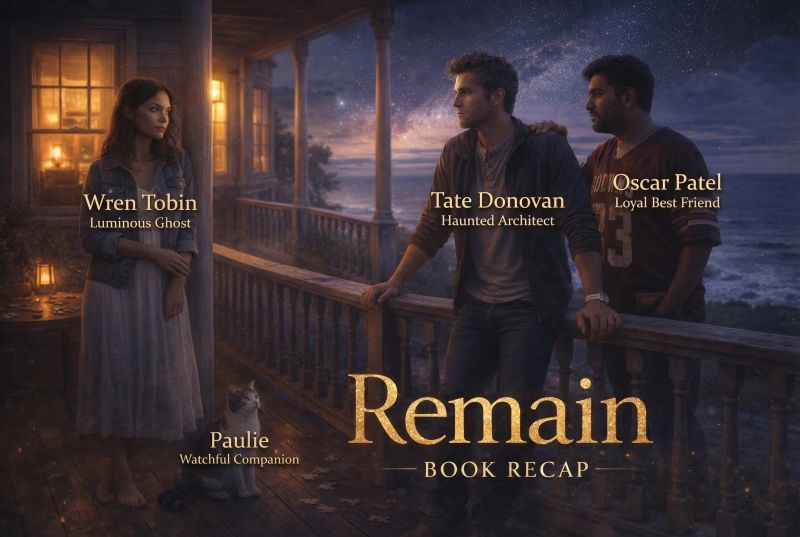
Tate Donovan,1 thirty-eight, recently discharged from a Connecticut psychiatric hospital after a paralyzing depression, arrives in Heatherington on Cape Cod.
His best friend Oscar3 — a self-made near-billionaire with five young children — has commissioned him to design a vacation home, a project meant to anchor Tate1 after losing both his architecture firm and his sister Sylvia,4 the only person who truly understood him. Oscar3 secured lodgings in a massive Victorian bed-and-breakfast that has been closed since its owner died.
The caretakers, a married couple named Louise5 and Reece,6 show Tate1 through the creaking house. Louise5 wears a small heart-shaped locket. Tate1 notes the hallway bathroom's outward-swinging door, marked by a cheerful sign. He settles in with his cat, Paulie — and that first night, hears someone humming in the empty kitchen.
Sylvia's Breath, Sylvia's Gift
Months earlier, Tate1 sat at Sylvia's4 hospital bedside for their final conversation. His older sister — forty-two, with a lifelong heart condition — told him something extraordinary: she could see the dead. Their mother had the same ability.
Some spirits were visitors who came and went, but others, trapped by trauma, remained — and if they lingered too long, their goodness leached away until only pain survived. She'd always wanted to help the trapped ones but never knew how. Then she asked Tate1 to open his mouth and blew lightly into it, a transfer their mother had instructed.
She promised he would fall in love and that it would change his life forever. Since her death, Tate1 has experienced peripheral flickering — involuntary movements at the edge of his vision that neurologists cannot explain.
The Stranger in the Parlor
Tate's1 brother-in-law Mike12 sends the first of Sylvia's posthumous videos, in which she urges Tate1 to talk to a stranger — at a coffee shop, gym, even a grocery store — and be open to the idea that the encounter happened for a reason.
Minutes later, Tate1 descends to the parlor and finds a dark-haired woman doing yoga by the fireplace. She notices his red, swollen eyes and invites him to talk, using words that mirror Sylvia's4 almost verbatim. Shaken by the coincidence, Tate1 opens up about everything — his childhood, Sylvia,4 his hospital stay.
He plays the video. Her empathy feels boundless. But when he steps into the kitchen and asks her to answer Louise's5 knock at the door, he returns to find the woman gone. No yoga mat, no water bottle — only Paulie, curled where a hoodie had been.
Two Years Dead
She returns the next day, crouching beneath the dining table for a lost jigsaw puzzle piece — though a thousand-piece puzzle and a sweating glass of ice water have materialized on a table that was bare moments ago.
She introduces herself as Wren,2 mentions her fourth-grade teacher Ethel Lampier, and recommends a Keats poem about beauty that never passes into nothingness. When Tate1 rushes outside to bring Louise5 and Reece6 as witnesses, he returns to find Wren,2 the puzzle, and the glass all gone.
Reece6 goes pale, then furious: Wren Tobin2 died almost two years ago. Tate1 googles her name and stares at photographs that match the woman exactly — same face, same Patriots sweatshirt. His mind couldn't have conjured someone he'd never seen. She is not a hallucination.
The Bathroom at Two A.M.
Tate1 wakes to crying in the hallway bathroom. He finds a towel-wrapped figure near the bathtub who repeatedly smashes the back of her head into the faucet — the sound like something detonating on asphalt. When he hits the lights, she vanishes.
Tate1 has taped every window and door, strung threads across the stairs — all undisturbed. His phone captures the audio but no visual: the click of a latch, squealing pipes, sickening crunches. No one entered the house.
Oscar3 hears the recording and offers the only rational response: if every possibility is impossible, whichever seems least impossible must be the truth. Tate1 decides to stay and help Wren2 rather than flee. He buys a game of Charades at a downtown toy store — which, he discovers, Wren2 herself once co-owned.
Charades with a Ghost
During afternoon visits, Daytime Wren2 appears as her living self: warm, funny, radiant. She can conjure objects — glasses of wine, plates of fruit — but cannot touch anything in the real world. She teaches Tate1 to do laundry, start a fire, and cook beef bourguignon from Julia Child's recipe.
They play Charades for hours, Tate1 so hopeless that his guesses — balloon pasta, hungry funerals — reduce them both to helpless laughter. Between rounds, she reveals fragments of her troubled life: Grandma Joyce,13 who raised her after her mother died.
Nash,8 her business partner, who stole fifty thousand dollars. Griffin,7 her estranged husband, whose violence terrified her. Dax,9 a married counselor who became obsessed after she confided in him. She fades at sunset each evening, dissolving into the gathering dark.
Wren Says Murdered
Two versions of Wren2 occupy the same house but inhabit different realities. By day she is bright and unaware of her death. By night she appears bloated and gray-skinned, her skull wound bleeding, trapped in the bathroom where she drowned.
During one nighttime visit, she manages a sandpapery whisper: she died in the bathtub. But when Tate1 says she slipped, she says no. She was murdered. She doesn't know by whom — her terror eclipses memory. In previous encounters, Tate1 noticed her back arching as if yanked by the hair, her body stumbling backward as though dragged.
Not the mechanics of a fall — the mechanics of an attack. Oscar3 frames the mission: Tate1 must earn Daytime Wren's2 trust and find her killer before the nighttime version consumes what remains.
Rattling Three Cages
Oscar3 leverages his local connections to learn that the medical examiner labeled Wren's2 death suspicious, not accidental. The wound was on the back of her head — yet she would have faced the faucet. No towel lay near the tub.
Armed with this, Tate1 and Oscar3 confront Nash8 at the toy store about the stolen money; Nash8 erupts and orders them out. At the Mercy Center, they present Dax9 with his own obsessive love letter, found in Wren's2 belongings; he coolly denies writing it and threatens defamation.
At the festival grounds, they challenge Griffin's7 claim of reconciliation; Griffin7 lunges at Tate1 in fury. Each man denies involvement. Each has a plausible account for the night Wren2 died. Tate1 and Oscar3 leave with suspicions sharpened but proof still elusive.
Wren Through Other Eyes
Tessa,10 Dax's9 wife, follows them and confronts Tate1 on the street. She insists Wren2 initiated everything — kissing Dax,9 then calling the police when he refused her. She reveals that Wren2 pursued Griffin7 while he was engaged to another woman, and that seducing unavailable men was Wren's2 lifelong pattern.
Louise,5 the caretaker, offers her own account: Wren2 was spoiled, couldn't keep friends, caused Joyce13 sleepless nights, and pressured her grandmother into financing the toy store. Oscar3 privately warns Tate1 that everyone has an agenda — including Wren2 herself.
Tate1 cannot reconcile these portraits with the woman he knows, but he can't dismiss them either. Meanwhile, Wren's2 daytime appearances shorten, her image flickering to translucence with increasing frequency — a battery draining toward zero.
The No-Touching Game
On their last full afternoon together, firelight painting the parlor, Wren2 proposes a game: get as close as possible without making contact. She traces the plane of his face without touching it; he outlines her collarbone and shoulder. The air between their palms hums with electricity.
Later, she leads him upstairs. They undress, standing inches apart, each mapping the other's body in charged silence — an intimacy rendered more exquisite by the impossibility of a single touch. Tate1 whispers that he loves her, words he has never said to anyone.
She whispers it back. Her form stutters and fades as the sun drops, but not before they lie together on the bed, exchanging heated whispers. She mentions plans to attend the festival, then take a warm bath. Tate's1 stomach twists at the words.
Shoved Down the Cellar Stairs
That evening, Tate1 discovers the power is out. Opening the cellar door, he feels a hard shove at his back and tumbles into darkness. Someone descends after him, striking him repeatedly with something heavy.
In the pitch-black cellar, Tate1 fights back with a laundry iron, landing blows until the attacker flees into the woods. Battered and bleeding, he drives to the festival with Oscar3 to identify who did it. Griffin7 has been managing a broken generator since five o'clock — dozens of witnesses. Nash's8 friend confirms they arrived together before five.
Oscar3 locates Dax9 and Tessa10 in the crowd. Every suspect has an alibi. The killer is someone Tate1 never considered. His peripheral flickering splits into two signals — one pulling him urgently home, the other hovering softly over the festival.
The Locket on Louise
Back at the powerless house, Tate1 lights candles and enters the bathroom. He watches Wren's2 murder play out like a film only he can see. She hums as she draws a bath, wearing her grandmother's heart-shaped locket. The door bursts open. A figure in a cheap emoji mask seizes her hair and drags her backward, smashing her skull into the faucet with a sickening crunch.
Then a second, smaller figure appears — both hold Wren2 beneath the water until she stops moving. The smaller figure reaches into the tub and removes the locket from Wren's2 neck. Tate's1 blood turns to ice. He has seen that locket before — around Louise's5 neck, on the day he arrived. Before he can move, a blow from behind sends him crashing to the floor.
Wren Saves Tate
Reece6 strikes Tate1 unconscious, then sets the house ablaze with a flaming pan and cognac. Wren2 — now fully aware she's dead after confronting her own corpse in the tub — sees everything but cannot physically intervene.
When Oscar3 arrives in his SUV, she presses herself against the parlor window, mouthing his name, pointing at the floor where Tate1 lies. Oscar3 sees her — the first person besides Tate1 to do so — and runs for the door. Louise5 rams him with Reece's6 truck. Inside the inferno, Wren2 kneels beside Tate1 and whispers that she loves him, begging him to wake.
His eyes flutter open. He staggers through the front door as the parlor explodes behind him, then drags Oscar3 across the gravel to safety. Debris from the blast kills Reece.6 Police arrive as Louise5 raises a crowbar over Tate.1
Dancing in the Ruins
Days later, Tate1 returns to the charred foundation on crutches. The house is ash and blackened timber — only one corner still stands, preserved like a stage for a final scene. He calls Wren's2 name, and she appears behind him in a white dress, luminous and at peace. She knows everything now — what Reece6 and Louise5 did, what Tate1 sacrificed to help her.
She tells him Sylvia4 watches over him still. She asks him to live well, love deeply, treasure friends, and honor the gifts he's been given. They play the no-touching game one last time, tracing each other's faces in the open air. She tells him she loved him from the moment they met. Then her outline fades, dissolves, and she is gone. Behind him, the last standing wall crashes to the ground.
Epilogue
Eight months later, Tate1 is back in Manhattan, transformed. He has taken up yoga and cooking lessons and runs in Central Park on a healed knee. Oscar's3 house is progressing through construction, its front elevation graced with Wren's2 suggested window boxes.
The trust litigation revealed the motive: had Wren2 died before the trust distributed, Reece6 — Joyce's13 only other blood relative — stood to inherit millions from the property. Louise5 pleaded guilty to attempted murder, forestalling investigation into Wren's2 death. Tate1 dines monthly with Sylvia's4 widower Mike,12 to whom he confided everything about Wren,2 and is dating a woman named Rachel — not yet in love, but open to it.
Standing at his apartment window, watching snow blanket Central Park, he notices a boy in a red T-shirt racing through the drifts. The child leaves no footprints. Tate1 puts on his coat and heads outside, honoring the gift Wren2 asked him to protect.
Analysis
Remain operates as a supernatural love story whose deeper architecture explores how grief can become a doorway rather than a dead end. Sparks and Shyamalan construct a narrative in which Tate's1 psychological imprisonment — depression, emotional numbness, the inability to connect — mirrors Wren's2 literal imprisonment in the house where she died. Neither can be freed alone; each requires the other to break their respective cycles, creating a reciprocal rescue that elevates the story beyond conventional ghost-story mechanics.
The novel's most subversive move is its treatment of truth as inherently perspectival. Wren's2 self-account conflicts sharply with Louise's,5 Tessa's,10 and Griffin's7 versions. Rather than resolving this into a single authoritative narrative, the text insists that every person's story is both true and incomplete. Tate1 must love someone he cannot fully know — a condition that applies to every real relationship but is literalized through the supernatural premise.
Wren's2 dual nature — daytime warmth and nighttime horror — maps onto a sophisticated understanding of trauma's corrosive power. Sylvia's4 warning that trapped spirits eventually lose their humanity provides the ticking clock, but it also reflects the clinical reality of untreated psychological wounds consuming identity from the inside out. Tate's1 own trajectory from hospitalization to numbness to genuine feeling parallels Wren's2 movement from denial to awareness to release.
The ending refuses consolation. Wren2 cannot remain. Love does not conquer death. But the novel argues that love's value is independent of its permanence — echoing Sylvia's4 conviction that it is infinitely scarier to never have loved than to lose love. Tate's1 final act, heading into the snow to help a ghost child he cannot yet understand, reframes his gift not as a burden but as a vocation. The supernatural becomes a metaphor for how love persists after loss: invisible, intangible, but unmistakably present in the lives it has transformed.
Review Summary
Characters
Tate Donovan
Grieving architect who sees ghostsA thirty-eight-year-old architect from a spectacularly wealthy Manhattan family—the kind where children are raised by nannies and fly on private jets but never learn their parents' faces. His emotional architecture mirrors his professional one: precise, controlled, structurally sound, and uninhabited. His sister Sylvia's4 death cracked the foundation, plunging him into a depression so severe he couldn't bathe for weeks. Hospitalized for four months, he emerges functional but hollow. He deflects intimacy through work and keeps everyone except Oscar3 and Sylvia4 at arm's length. His journey is one of learning to be vulnerable—through games, cooking lessons, and conversations with a woman who cannot be touched but who reaches him more deeply than anyone living ever has.
Wren Tobin
Ghost of the B&B's ownerWren exists in two states: by day, she is the vibrant, quick-witted young woman she was in life—a small-town girl who loves poetry, games, and cooking, who dreams of culinary school in Paris but fears leaving the only home she's known. By night, she is something else entirely—trapped in the bathroom where she died, reliving her trauma in a loop of escalating horror. Raised by her tough, pragmatic Grandma Joyce13, Wren is resourceful and warm but carries deep insecurity about her place in the world. She cycles through relationships—business, romantic, platonic—that seem to end in betrayal. Whether she is a manipulator or a victim depends on who tells her story, and the truth likely contains elements of both.
Oscar
Tate's fiercely loyal best friendThe rarest kind of friend: unconditionally present. A scholarship kid from a South Asian immigrant family in Dorchester, he met Tate1 at Exeter and became the brother Tate's1 parents never provided. His success—building a vintage jersey company sold for nearly a billion dollars—hasn't changed his essential warmth. He is a hugger, a joker, a man who measures wealth by the laughter at his dinner table. With five young children and a deeply loving marriage to Lorena11, he embodies the life Tate1 has never permitted himself to imagine. Throughout the story, Oscar balances belief with pragmatism, never dismissing the supernatural but always anchoring Tate1 to reality. He is the compass Tate1 uses when his own orientation fails.
Sylvia
Tate's dead sister, spiritual guideTate's1 older sister, who died at forty-two of heart failure after a lifetime of illness. Extroverted, joyful, and spiritually attuned, Sylvia possessed the ability to see spirits and transferred that gift to Tate1 before her death. She serves as the story's moral compass, guiding Tate1 through three posthumous videos that catalyze his growth at critical moments. She is the love Tate1 always had but never fully appreciated—the mother-figure his parents never were.
Louise
The B&B's devoted caretakerThe caretaker of the Victorian bed-and-breakfast, married to Reece6. Louise presents as anxious, dutiful, and maternal, expressing genuine distress about the property's uncertain future. She wears a small heart-shaped locket and speaks reverently of Grandma Joyce13. She was the one who discovered Wren's2 body in the bathroom, and the trauma of that discovery visibly haunts her. Her loyalty to the property and its history runs deep, intertwined with a fierce protectiveness of her husband and their livelihood.
Reece
Groundskeeper, Joyce's great-nephewThe groundskeeper and Grandma Joyce's13 great-nephew—aside from Wren2, the only surviving blood relative. Physically imposing and perpetually wary of outsiders, Reece was raised without father figures after his own dad died during a failed robbery. Joyce13 took him in out of familial obligation. He is territorial about the property and openly suspicious of Tate's1 presence and motives, viewing wealth as a tool the privileged use to take from people like him.
Griffin
Wren's estranged husbandA narcissist with a salesman's polish and a dealership heir's entitlement, Griffin runs the town's Mask and Music Festival and radiates confidence that barely conceals his substance abuse and violent tendencies. He claims his marriage to Wren2 was being restored; everyone else says otherwise. He fights the divorce to claim half of Wren's2 inherited property, treating love as another transaction to win.
Nash
Wren's embezzling business partnerWren's2 former co-owner of Bird's Toys and Games. Outwardly civic-minded and genial, Nash secretly embezzled fifty thousand dollars from their shared business using fake invoices and an unauthorized loan.
Dax
Obsessive counselor, stalkerA substance abuse counselor who became fixated on Wren2 after she confided in him about Griffin7. His practiced composure masks deeply manipulative tendencies and a capacity for obsession that blurs professional and personal boundaries.
Tessa
Dax's wife, Wren's accuserDax's9 wife, who harbors a grudge against Wren2 stretching back to high school. She confronts Tate1 with a scathing counternarrative painting Wren2 as a predatory manipulator of unavailable men.
Lorena
Oscar's wife, surrogate familyOscar's3 Italian-American wife, a former economics major who manages five children with unflappable grace. Warm, practical, and fiercely caring, she serves as Tate's1 surrogate family alongside Oscar3.
Mike
Sylvia's devoted widowerSylvia's4 widower, a shy music teacher whose quiet devotion defined their marriage. He sends Tate1 the posthumous videos at Sylvia's4 instruction and becomes an unexpected source of companionship.
Grandma Joyce
Wren's tough, beloved grandmotherWren's2 deceased grandmother—a tough, contradictory pioneer-type who raised Wren2, ran the B&B, and fiercely valued independence. Her death from Covid unmoored Wren2 and left the property in legal limbo.
Plot Devices
Sylvia's Three Videos
Posthumous catalysts for growthSylvia4 recorded three videos before dying and arranged for her husband Mike12 to send them at intervals. Each arrives at a critical juncture: the first urges Tate1 to connect with a stranger, directly precipitating his conversation with Wren2. The second recounts how Sylvia4 knew Mike12 was the one—through tender, ordinary moments like a private piano serenade—reshaping Tate's1 understanding of love. The third confronts the terror of loving when loss is certain, giving Tate1 courage to surrender to his feelings for Wren2 despite knowing she's already gone. Together, the videos function as a spiritual compass, each arriving precisely when Tate1 needs direction, as though Sylvia4 orchestrated events from beyond death.
The Hallway Bathroom
Crime scene and spiritual prisonThe only bathroom with a tub, marked by a door that swings outward with a cheerful sign. By day, it is an elegant room with Italian marble and a claw-foot tub. By night, it becomes Nighttime Wren's2 prison—the site where she was killed and where her traumatized spirit relives the attack in an escalating loop. Tate's1 nighttime visits to this room yield the story's most crucial revelations: first, that Wren2 was murdered, and ultimately, a spectral reenactment of the crime itself, complete with the detail of a second killer removing the heart-shaped locket from Wren's2 neck. The bathroom is both the wound that traps Wren2 and the keyhole through which the truth is finally glimpsed.
The Peripheral Flickering
Inherited supernatural compassSince Sylvia's4 death, Tate1 experiences involuntary flickering at the edges of his vision—diagnosed as stress-related but actually the manifestation of the gift his sister transferred. The flickering serves as navigational instinct: it guides him to the shed where Wren's2 belongings and crucial evidence are stored, leads him to the Boggle game Wren2 loved at the toy store, and on the climactic night, splits into two signals—one pulling him urgently back to the house, the other hovering softly over the festival. The device transforms across the narrative from a medical symptom Tate1 hides from his psychiatrist into a spiritual inheritance he learns to trust and follow.
The Heart-Shaped Locket
Murder evidence in plain sightGrandma Joyce's13 heart-shaped locket appears twice before its significance detonates. Louise5 wears it when Tate1 first arrives—a small detail in a scene crowded with introductions. Wren2 wears it during their last intimate afternoon, calling it her grandmother's keepsake. When Tate1 witnesses Wren's2 murder in spectral replay, he sees the second attacker reach into the tub and remove the locket from Wren's2 neck. The recognition is immediate and devastating: Louise5 was wearing it all along. The locket functions as the story's smoking gun—a piece of evidence visible from the opening chapter but invisible until context made it unmistakable.
The No-Touching Game
Physical language of impossible loveWren2 invents this game as a way to be intimate within the constraints of her non-corporeal existence: two people get as close as possible without making contact, and the first to touch loses. It begins as a charged parlor game by the fireplace and escalates into the story's most intimate scene, when they undress and trace each other's bodies without touching. The game crystallizes the novel's central paradox—love at its most intense is simultaneously love at its most impossible. It also functions as a metaphor for Tate's1 lifelong emotional pattern: always approaching but never quite arriving. With Wren2, he finally reaches the threshold, and for once, proximity itself becomes enough.








































