Key Takeaways
1. The Pre-Reformation World: A Powder Keg of Change
No one alive in 1450 can fully realize that they are living on the edge of a new era or envision the transitions that hover on the horizon.
Seeds of discontent. The period between 1450 and 1517 was marked by profound shifts that set the stage for the Reformation, even if their full impact wasn't immediately apparent. Europe was experiencing a commercial revolution, leading to increased urbanization and the rise of a literate bourgeoisie. This economic dynamism fueled a demand for new knowledge and challenged traditional social structures.
Technological and intellectual ferment. The invention of the printing press in 1455 revolutionized the dissemination of information, making books cheaper and more accessible, and creating a wider reading public. Simultaneously, the Renaissance brought a renewed interest in classical antiquity and early Christian sources, fostering a critical spirit among intellectuals. This "ad fontes" movement, particularly Christian humanism, questioned medieval traditions and called for a return to purer forms of faith.
Political and religious instability. Europe was also undergoing significant political centralization, with emerging sovereign states challenging the fragmented feudal order and papal authority. The Great Schism (1378-1415) had severely damaged the papacy's prestige, and widespread clerical corruption, from absentee bishops to simony, fueled endemic calls for reform. Figures like John Wycliffe and Jan Hus had already laid groundwork for dissent, demonstrating that challenges to Rome could gain significant followings, though often met with violent suppression.
2. Luther's Spiritual Odyssey Ignites a Revolution
Though I lived as a monk without reproach, I felt that I was a sinner before God with an extremely disturbed conscience.
A monk's torment. Martin Luther's personal spiritual crisis, marked by intense despair (Anfechtung) and a profound sense of his own sinfulness, drove his theological breakthrough. Despite rigorous monastic observance, he struggled with the Catholic doctrine that salvation was earned through good works and penance, finding no peace in the idea of a wrathful God. His vow to St. Anne during a thunderstorm, leading him to monastic life, ironically set him on a path to reject vows and the cult of saints.
Theological breakthrough. While studying the Psalms and St. Paul's Epistle to the Romans, Luther found his answer in the concept of justitia Dei (God's righteousness). He realized that God's righteousness was not a demanding standard humans had to meet, but a gift freely given through faith. This led to his core doctrines:
- Sola fide: Salvation by faith alone.
- Sola gratia: Salvation by grace alone.
- Simul justus et peccator: Christians are simultaneously righteous and sinful.
Challenge to authority. Luther's theological insights directly contradicted the practice of selling indulgences, which promised remission of sins for monetary contributions. His ninety-five theses, initially an academic challenge, quickly became a public manifesto, amplified by the printing press. By questioning indulgences, Luther inadvertently challenged papal authority, the role of the clergy, and the entire Catholic system of salvation, transforming a personal spiritual struggle into a widespread religious revolt.
3. Luther's Paradox: Rebel Against Rome, Reactionary Against Radicals
I am and, God willing, shall remain a stable, proud and fearless spirit in my defiance of you, Eck, the pope, and your mob, even the devil.
Defiance and survival. Luther's unwavering defiance against Pope Leo X and Emperor Charles V, famously articulated at the Diet of Worms in 1521, cemented his image as a fearless rebel. Protected by Elector Frederick the Wise and supported by a burgeoning German nationalist sentiment, Luther survived excommunication and imperial outlawry. His prolific writings, rapidly disseminated by the printing press, transformed him into a national hero and the face of a burgeoning anti-Roman movement.
The "wild growth" of reform. While Luther was in hiding, the Reformation in Wittenberg took a more radical turn under Andreas Bodenstein von Karlstadt and the Zwickau Prophets, who pushed for immediate, sweeping changes like iconoclasm and the abolition of the Mass. This "wild growth" of ideas, often more egalitarian and socially revolutionary than Luther intended, forced him to return and reassert control. Luther condemned these "fanatics" (Schwärmer) as agents of the devil, fearing their extremism would destabilize society and discredit his reforms.
Conservative turn. Luther's response to the Peasants' War (1524-1525) further revealed his reactionary stance. Despite the peasants' use of "Christian freedom" to justify their demands, Luther vehemently condemned their rebellion, calling for their brutal suppression. He argued for a strict separation of his "two kingdoms"—the spiritual and the earthly—insisting that Christian freedom was spiritual, not social or political. This conservative turn, while alienating many commoners, secured the support of German princes, transforming Lutheranism into a state-sponsored "ruler's Reformation" and ensuring its survival against both Catholic and radical threats.
4. The Swiss Reformation: Godly Cities and Iconoclastic Zeal
I preach exactly the same way as Paul wrote; why don’t you call me a “Paulist,” then?
Erasmian roots. Ulrich Zwingli, born weeks after Luther, developed his reformist ideas independently, heavily influenced by Erasmus's humanism and Neoplatonism. His conversion, sparked by Erasmus's "Complaint of Jesus," led him to reject the cult of saints and emphasize Christ as the sole mediator. Zwingli's early career in Glarus and Einsiedeln saw him preaching directly from the Bible and criticizing mercenary service, reflecting a distinct Swiss context of communal autonomy and democratic tendencies.
Zurich's transformation. Zwingli's move to Zurich in 1519 marked the beginning of a rapid, systematic reformation. Unlike Luther's initial focus on justification, Zwingli prioritized correct worship and the eradication of "idolatry." The "sausage affair" of 1522, where laymen publicly broke Lenten fasts, challenged civil law based on sola scriptura. This led to public disputations where Zwingli, backed by the city council, dismantled Catholic traditions:
- Abolition of images and altars (iconoclasm).
- Replacement of the Mass with a symbolic communion service.
- Establishment of the Ehegericht (marriage court) and synods for moral discipline.
The "godly city" ideal. Zwingli envisioned a unified Christian society where church and state worked hand-in-hand to enforce God's law, a "godly city" that would serve as a model for others. This theocratic ideal, emphasizing communal righteousness and obedience to the Ten Commandments, contrasted sharply with Luther's two-kingdom doctrine. Zwingli's commitment to this vision was so profound that he died fighting for it at the Battle of Kappel in 1531, defending Zurich against Catholic cantons. His legacy, continued by Heinrich Bullinger, established a distinct Reformed tradition that prioritized social transformation and strict moral discipline.
5. The Radical Reformation: Diverse Paths to a Pure Church
A separation should take place from the evil which the devil has planted in the world.
Beyond Magisterial Reform. The Radical Reformation encompassed a diverse array of groups and individuals who believed that Luther, Zwingli, and Calvin had not gone far enough in reforming the church. They sought a complete "restitution" of the apostolic church, emphasizing a strict separation from "the world" and its perceived corruption. Their core tenets included:
- Voluntary church membership: Only adult believers could be baptized.
- Rejection of infant baptism: Leading to their label "Anabaptists" (rebaptizers).
- Ethical transformation: A focus on moral perfection and living without sin.
- Separation of church and state: Refusal to hold civil office or swear oaths.
Persecution and martyrdom. The Anabaptists faced severe persecution from both Catholic and Magisterial Protestant authorities, who viewed their beliefs as seditious and dangerous to social order. Felix Mantz, drowned in Zurich in 1527, became the first Protestant martyr at the hands of other Protestants. This persecution, ironically, reinforced their identity as true Christians, mirroring the early church. Their steadfastness in the face of torture and execution became a hallmark of their faith, documented in works like The Martyr's Mirror.
Diverse radical expressions. The Radical Reformation was far from monolithic:
- Pacifist communitarians: Groups like the Swiss Brethren and later Hutterites (who practiced communal ownership of goods) emphasized non-violence and withdrawal from worldly affairs.
- Apocalyptic activists: Figures like Thomas Müntzer and Melchior Hoffman combined mystical inspiration with revolutionary zeal, advocating for the violent establishment of God's kingdom on Earth, culminating in the disastrous Münster Rebellion (1534-1535).
- Spiritualists: Individuals like Hans Denck and Caspar Schwenckfeld prioritized inner spiritual experience over external rituals and dogma, often advocating for religious toleration and a universal, unmediated connection to God.
- Evangelical Rationalists: Anti-Trinitarians like Michael Servetus and the Socinians challenged core Christian dogmas as illogical, paving the way for later Enlightenment skepticism.
The Radicals, despite their relatively small numbers, profoundly influenced the discourse on religious freedom, the separation of church and state, and the nature of Christian community, often anticipating "modern" ideas centuries ahead of their time.
6. Calvin's Geneva: A Blueprint for Global Transformation
That king who in ruling over his realm does not serve God’s glory exercises not kingly rule but brigandage.
Systematic theology and civic piety. John Calvin, a second-generation Reformer, transformed Geneva into a model "godly city" and the epicenter of an international Protestant movement. His Institutes of the Christian Religion, first published in 1536, provided the most systematic and comprehensive summary of Reformed theology, emphasizing:
- Sola scriptura, sola fide, sola gratia: Shared with Lutherans.
- Soli Deo gloria: To God alone be the glory, a central tenet.
- Total depravity: Humanity's complete corruption by original sin.
- Double predestination: God's eternal decree to save some and damn others.
Theocratic governance. Calvin, initially reluctant, was persuaded by Guillaume Farel to lead Geneva's Reformation. He established a unique church-state structure through the Ecclesiastical Ordinances of 1541, creating four offices (pastors, elders, doctors, deacons) and the Consistory, a powerful moral court. This body, composed of pastors and lay elders, rigorously enforced Christian discipline, regulating everything from dress and names to public behavior, aiming to make Geneva a visible "Kingdom of Christ" on Earth.
International influence and resistance theory. Geneva became a "Protestant Rome," training missionaries who spread Calvinism across Europe (France, Netherlands, Scotland, Germany, Hungary, Poland). Calvin's uncompromising stance against "idolatry" and "Nicodemism" (feigning Catholic faith to avoid persecution) forced his followers to make stark choices. While Calvin cautiously advocated passive resistance to ungodly rulers, figures like John Knox developed revolutionary theories, arguing that subjects had a duty to overthrow idolatrous monarchs. This blend of rigorous theology, strict social discipline, and a willingness to resist perceived tyranny made Calvinism a formidable force in shaping early modern political thought and fueling religious conflicts.
7. The English Reformation: A Monarchy's Shifting Faith
For what avails it to dispute against one who disagrees with everyone, even with himself?
Royal supremacy. The English Reformation was unique, driven primarily by the monarchy's political needs rather than theological conviction. Henry VIII's desire for a male heir and an annulment from Catherine of Aragon led him to break with Rome, establishing the Act of Supremacy in 1534, which made him the "Supreme Head" of the Church of England. Despite his anti-papal stance, Henry remained largely Catholic in doctrine, persecuting both papal loyalists (like Thomas More) and Protestants.
Protestant shifts and Catholic reversals. Under Henry's sickly son, Edward VI (1547-1553), the Church of England moved decisively towards Protestantism, influenced by Reformed theology and figures like Archbishop Thomas Cranmer. The Book of Common Prayer (1549, 1552) replaced Latin rituals with English, abolished prayers for the dead, and removed altars. However, Edward's death brought his staunchly Catholic half-sister, Mary I (1553-1558), to the throne. "Bloody Mary" reversed the reforms, restored Catholicism, and executed nearly 300 Protestants, including Cranmer, Ridley, and Latimer, creating a powerful Protestant martyrology through John Foxe's Book of Martyrs.
Elizabethan Settlement. Elizabeth I (1558-1603) re-established royal supremacy and a Protestant church, but pursued a via media (middle way) to avoid extreme Catholic or Protestant positions. The Act of Uniformity (1559) mandated a revised Book of Common Prayer with deliberately ambiguous language to accommodate diverse views. While this settlement brought relative peace, it alienated both Catholics (recusants) and zealous Calvinists (Puritans), who sought a "purer" church. Elizabeth ruthlessly suppressed Catholic dissent, executing hundreds as traitors, while managing Puritan nonconformity through a mix of pressure and limited toleration, setting the stage for future conflicts in the British Isles.
8. Catholic Reform: Healing the Body of Christ from Within
The Church is called the Body of Christ, as may be seen in the epistles of St. Paul to the Ephesians, and Colossians: appellations each of which has considerable influence in exciting the faithful to prove themselves worthy of the boundless clemency and goodness of God, who chose them to be his people.
Internal impetus and external challenge. Catholic reform was a continuous process, predating Luther, but intensified dramatically in response to the Protestant Reformation. This period, often termed the Counter-Reformation, saw the Church define its identity in opposition to Protestantism while simultaneously addressing its own internal corruption. The metaphor of the Church as the "Body of Christ" guided reforms, emphasizing a hierarchical, top-down approach to healing the entire institution.
The Council of Trent's legacy. The Council of Trent (1545-1563) was pivotal, clarifying Catholic doctrine and instituting sweeping institutional reforms. It unequivocally rejected Protestant tenets like sola fide and sola scriptura, reaffirming the seven sacraments, the sacrificial nature of the Mass, purgatory, and the veneration of saints and relics. Crucially, it mandated:
- Clerical reform: Bishops to reside in their dioceses, priests to be celibate, and the establishment of seminaries for clerical education.
- Liturgical standardization: A new Roman Missal and Breviary imposed uniformity, replacing local variations and solidifying Latin as the sacred language.
- Censorship: The Index of Forbidden Books was established to control the spread of heretical ideas.
New orders and renewed piety. Beyond Trent's decrees, a vibrant spiritual renewal emerged, often led by new religious orders. These orders, like the Jesuits, Ursulines, and Hospitallers, adapted to modern challenges by focusing on education, charity, and missionary work, while upholding traditional Catholic piety. Mysticism and miracles were re-emphasized as proofs of divine presence and human perfectibility, contrasting sharply with Protestant skepticism. This period saw a "hypersacralization" of the world, with an explosion of confraternities, devotional literature, and a renewed emphasis on the intercession of saints and the efficacy of good works.
9. Catholic Global Missions: Expanding the Faith Across Continents
In the place of many thousands of souls that have been led astray in Upper and Lower Germany . . . the almighty good God . . . has chosen another people in another world, who knew hitherto nothing about Christ and his true faith.
Providential compensation. Catholic overseas missions, spearheaded by Spain and Portugal, expanded dramatically in the sixteenth and seventeenth centuries, often seen as divine compensation for the souls lost to Protestantism in Europe. Unlike Protestant states, which engaged in overseas ventures later, Catholic powers integrated missionary efforts directly into their colonial and commercial expansion, making "Christianization" synonymous with Europeanization in many contexts.
The American Indies: Conquest and conversion. The evangelization of the New World began with Columbus's second voyage, but quickly became entangled with brutal conquest and exploitation. Missionaries like Bartolomé de Las Casas vehemently condemned the colonists' atrocities against indigenous populations, leading to debates about native humanity and laws like the Requerimiento and Laws of Burgos. Despite these efforts, the high death toll among natives led to the massive importation of African slaves, creating new missionary challenges.
- Mexico and Peru: Franciscans, Dominicans, and later Jesuits established vast missions, often building churches over destroyed native temples. Mass baptisms occurred, but genuine conversion was slow, and native cultures often blended Christian and ancestral beliefs.
- Jesuit Reductions: In South America, Jesuits created autonomous "reductions" to protect natives from exploitation, fostering unique Christian communities with communal living and a blend of European and indigenous arts.
The East Indies: Cultural accommodation and conflict. Missions in Asia, particularly in India, China, and Japan, faced different challenges due to highly developed and often disdainful local cultures. Missionaries, especially Jesuits like Francis Xavier and Matteo Ricci, adopted strategies of cultural accommodation, learning local languages and customs, and targeting elites.
- Japan: Xavier's initial success led to thousands of converts, but imperial suspicion of European expansionism and the aggressive tactics of other orders led to severe persecution and martyrdom, driving Christianity underground.
- China: Ricci's strategy involved impressing mandarins with Western science and philosophy, translating Christian concepts into Confucian terms, and gaining a foothold at the imperial court. This "accommodationist" approach, however, sparked the "Chinese Rites Controversy" within the Catholic Church, ultimately leading to papal condemnation and the decline of the mission.
Catholic missions, despite their complexities and often tragic outcomes, profoundly shaped global Catholicism, fostering a universal identity and an enduring commitment to evangelization that transcended European conflicts.
10. The Age of Religious Wars: Europe's Bloody Confessional Divide
What makes any violence “religious” in nature? This is a tough question, especially when it comes to the sixteenth and seventeenth centuries.
Religion as a catalyst for conflict. The period from roughly 1550 to 1650 is often termed the "Age of Religious Wars," reflecting the pervasive role of confessional differences in fueling widespread violence. While intertwined with political, social, and economic factors, religious identity and grievances were often the primary drivers of conflict, leading to unprecedented bloodshed and atrocities.
German and Swiss conflicts. The Holy Roman Empire saw decades of tension between Catholic and Lutheran princes, culminating in the Schmalkaldic War (1546-1547), where Emperor Charles V initially defeated the Lutherans. The subsequent Augsburg Interim (1548) failed to reconcile differences, leading to further conflict and eventually the Peace of Augsburg (1555), which established cuius regio, eius religio ("whose realm, his religion"), formalizing Germany's religious division. In Switzerland, the Battle of Kappel (1531) saw Zwingli's death and led to a similar, albeit uneasy, coexistence between Catholic and Protestant cantons.
French Wars of Religion. France endured a brutal series of civil wars (1562-1598) between Catholics and Huguenots (Calvinists). Sparked by events like the Vassy Massacre (1562), these conflicts saw extreme violence, including the St. Bartholomew's Day Massacre (1572), where thousands of Huguenots were slaughtered. The wars, driven by noble factions and religious zeal, devastated France until Henry IV's conversion to Catholicism and the Edict of Nantes (1598) granted limited toleration, though tensions simmered for another century.
Dutch Revolt and the Thirty Years' War. The Netherlands experienced the Eighty Years' War (1566-1648), a struggle for independence from Catholic Spain fueled by Calvinist resistance. This led to the partition of the Low Countries into a Catholic south and a Protestant Dutch Republic. The most devastating conflict, the Thirty Years' War (1618-1648), began in Bohemia and engulfed much of Central Europe, involving major European powers. This war, while rooted in religious divisions, evolved into a complex struggle for political dominance, causing immense demographic and economic devastation, particularly in Germany. The Peace of Westphalia (1648) formally recognized the religious divisions and the sovereignty of states, marking a turning point where religion's role in international conflict began to wane.
11. The Age of Orthodoxy: Defining Faith Amidst Fragmentation
Contention is the mother of orthodoxy, and hairsplitting its midwife.
The quest for doctrinal purity. Following the initial revolutionary phase, the mid-sixteenth to early eighteenth centuries became an "Age of Orthodoxy," characterized by intense efforts within each Christian tradition (Catholic, Lutheran, Reformed, Anglican) to define and enforce precise theological doctrines. This process, known as "confessionalization," aimed to solidify distinct religious identities and ensure internal uniformity amidst widespread fragmentation.
Lutheran internal struggles. After Luther's death, the Lutheran Church was plagued by internal disputes between Philippists (who favored compromise with Catholicism and the Reformed) and Gnesio-Lutherans (who insisted on strict adherence to Luther's original teachings). Debates over adiaphora (indifferent matters) and the Eucharist led to accusations of "crypto-Calvinism" and even imprisonment. The Formula of Concord (1580) ultimately established Gnesio-Lutheran orthodoxy, but theological scholasticism continued to flourish, often reviving methods Luther had once rejected.
Reformed precision and division. Reformed Protestantism, particularly Calvinism, also sought rigorous doctrinal definition. Heinrich Bullinger's Second Helvetic Confession (1566) and Calvin's Institutes provided comprehensive theological frameworks. However, debates over predestination and the human will led to the Arminian controversy in the Netherlands, culminating in the Synod of Dort (1619), which affirmed "Five-Point Calvinism" (TULIP) and led to schism. Similar debates occurred in France and England, shaping the character of Puritanism and contributing to the English Civil War.
Catholic post-Trent orthodoxy. The Council of Trent's decrees provided a clear framework for Catholic orthodoxy, but internal debates persisted, particularly regarding the interplay of divine grace and human free will. The Molinist controversy and later Jansenism, both rooted in interpretations of St. Augustine, caused significant internal strife, with figures like Blaise Pascal defending Jansenist rigor against Jesuit "laxity." These theological battles, often involving papal condemnations and political maneuvering, demonstrated Catholicism's commitment to doctrinal precision and its struggle to maintain unity.
12. The Age of Doubt: Science and Skepticism Challenge Religious Hegemony
The seeker after truth must, once in the course of his life, doubt everything, as far as possible.
Unintended consequences of fragmentation. The intense theological disputes and religious wars of the Reformation era, while solidifying confessional identities, inadvertently fostered a climate of skepticism and rationalism. The constant bickering and inability of churches to agree on fundamental truths led many, particularly among the intellectual elite, to question the very foundations of revealed religion. This "desacralization" involved a gradual reduction of the sacred's scope and essence, making it more spiritual and less accessible through the material world.
Rise of scientific empiricism. Nicholas Copernicus's heliocentric theory (1543) and Galileo Galilei's astronomical observations (early 17th century) challenged traditional, biblically-aligned cosmologies. Figures like Francis Bacon championed a new empirical method, prioritizing observation and experimentation over ancient authorities or religious dogma. This scientific revolution, while not inherently anti-religious, proposed an alternative epistemology that bypassed divine revelation, leading to:
- Displacement of heaven: Galileo's cosmos had no physical place for God's eternal realm.
- Emphasis on natural laws: Miracles became less credible, attributed to deception or natural phenomena.
- Human reason as ultimate arbiter: Descartes's "de omnibus dubitandum" (everything must be doubted) epitomized this shift, placing individual reason at the center of truth-seeking.
Skepticism, deism, and toleration. The proliferation of conflicting religious claims and the horrors of religious violence fueled a growing demand for religious toleration. Figures like Sebastian Castellio argued for freedom of conscience, while deists like Edward Herbert of Cherbury and John Locke sought a "natural religion" based on universal reason and ethics, stripping away dogma and ritual. This intellectual ferment, while often met with condemnation and persecution, gradually eroded the state's ability to enforce religious conformity, paving the way for the Enlightenment and a more secularized Western society where religion increasingly became a private rather than public concern.
Review Summary
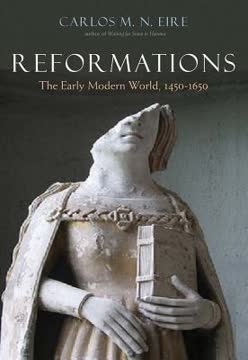
Most reviewers praise Reformations: The Early Modern World, 1450-1650 as a comprehensive, accessible, and balanced account of both Protestant and Catholic reformations. Highlights include its coverage of pre-Reformation movements, the Jesuits, missionary efforts, and the origins of secularism. Many appreciate Eire's engaging writing style despite the book's considerable length. Critics note occasional tedium, some geographic omissions, overreach in scope, and possible confessional bias. Comparisons to MacCulloch's work appear frequently, with some preferring that alternative, though most consider this an impressive and rewarding achievement.
People Also Read