
Key Takeaways
Imagining piano practice rewires your brain as much as playing
“The brain wires itself in response to signals it receives from its environment, and … these signals can be self-directed by consciousness.”
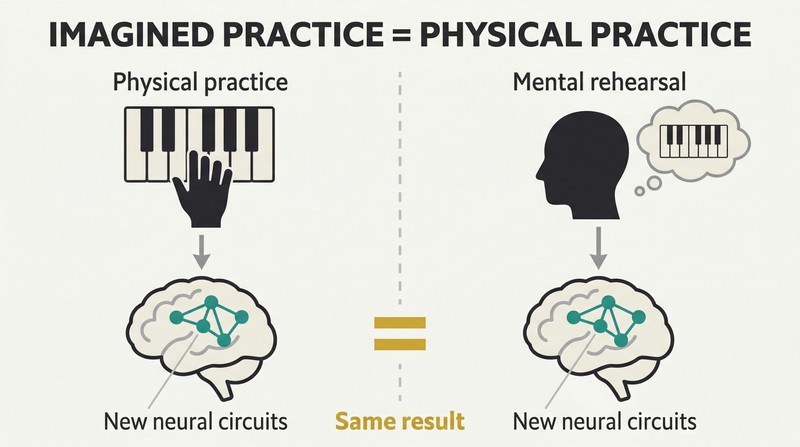
Mental rehearsal changes neural circuits. In 1995, neuroscientist Alvaro Pascual-Leone at Harvard had volunteers practice a five-finger piano exercise for two hours daily over five days. Brain scans showed new motor circuits forming. Then a second group merely imagined playing the same piece — holding their hands still but mentally moving each finger. The result: imagined movements triggered the same degree of new circuitry as physical practice.
This is the scientific bedrock of Kehoe's system. If thoughts alone can physically rewire the brain, then deliberately chosen thoughts — visualization, affirmation, contemplation — aren't wishful thinking but neurological engineering. Kehoe argues this proves consciousness can direct energy, and everything in the universe is energy. The implications cascade from there.
Align with abundance energy everywhere, not just in your wallet
“In five short years I had come from a cabin in the woods, with no electricity and no running water, to the presidential suite of the Sheraton Hotel…”
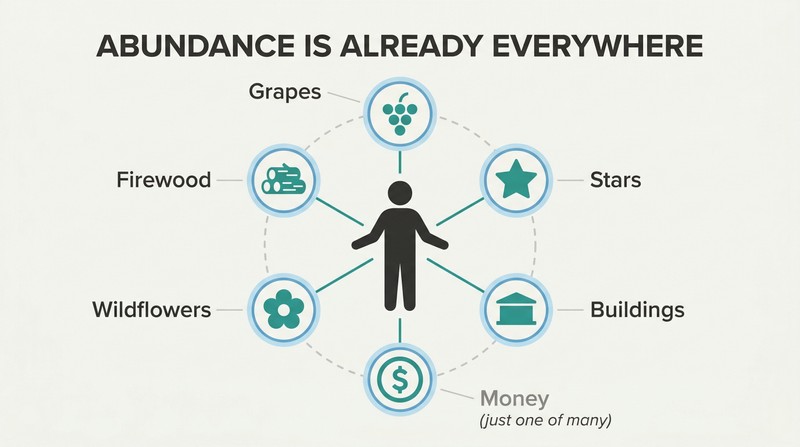
Kehoe's origin story is his proof of concept. Dead broke, living in a cabin in British Columbia, he decided to test his theories by aligning with abundance in all forms — not just money. Eating grapes, he'd note: "I have an abundance of grapes." Gathering firewood: "an abundance of wood." Stars, corporate buildings, wildflowers — he connected with the abundance each represented, vibrating that feeling many times daily.
This technique is called quantum alignment. Rather than generating abundance from nothing, you connect your consciousness with the vibrational pattern of abundance that already exists in what Kehoe calls the energy web — the invisible quantum field underlying all reality. What you consistently vibrate, he argues, you attract. Within a year he was filling lecture halls. Within five, touring the world.
Audit your beliefs — they probably sabotage your stated goals
“We can substitute new, empowering beliefs for limiting ones any time we choose.”
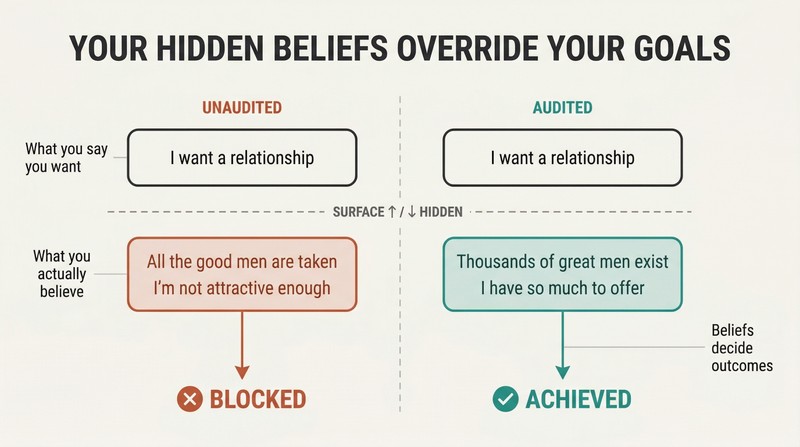
Foundation beliefs are your hidden operating system. Kehoe calls beliefs "laws of power" because they vibrate as energy patterns through the energy web, attracting matching circumstances. Most people's foundation beliefs directly contradict their goals. A woman named Cindy desperately wanted a relationship but discovered her recurring thoughts: "All the good men are already taken" and "I'm not as attractive as I used to be." These beliefs actively repelled what she wanted.
Replacing them changed everything. In a city of over a million people, her belief that "no good men" existed was statistically absurd. She imprinted new beliefs — thousands of eligible men would make her happy — and within four months met her future husband. The principle: contradictory foundation beliefs will always override conscious desires.
Use placebo beliefs to become lucky, healthy, or wealthy
“The truth of our reality is that each of us is free to believe whatever we choose, and whatever beliefs we choose become resonating laws of power within us.”
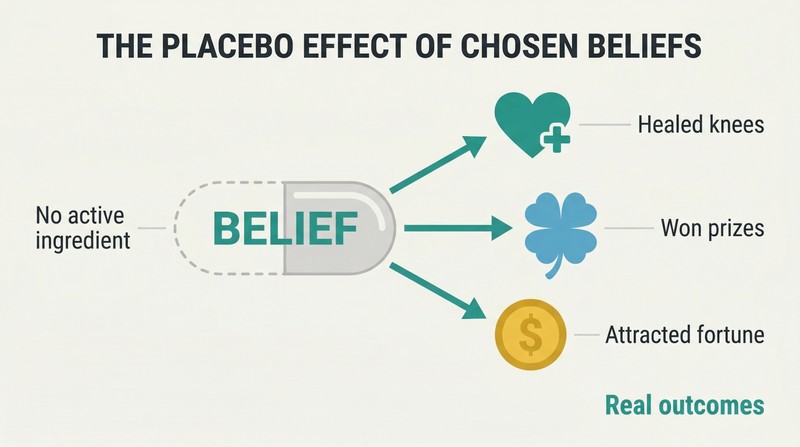
Placebo surgery proves belief heals. In 1994, surgeon Bruce Moseley operated on ten arthritis patients' knees — but five received only scalpel stabs for the appearance of surgery. Six months later, all ten reported much less pain. One placebo patient now mows his lawn freely; another plays basketball with his grandchildren. Harvard researcher Henry Beecher found 30 – 40% of any treated group responds to placebo.
Kehoe extended this beyond medicine. He began saying "just my luck" whenever something good happened — reversing the phrase's usual negative use. Over months, he won an art painting, scored sold-out concert tickets, and took home a $10,000 hockey draw. If beliefs can heal knees without surgery, Kehoe argues, they can attract fortune just as reliably.
Your subconscious works with whatever you feed it — no filter
“Our most intimate hopes, fears and desires are not secrets whispered only to ourselves; they are resonating vibrations spread throughout the entire energy web.”
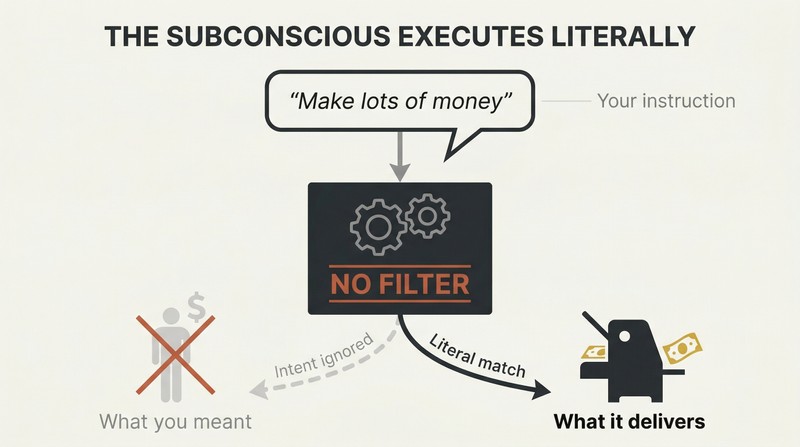
The subconscious doesn't judge or censor. It accepts whatever patterns the conscious mind delivers through repetition. Kehoe calls this part of us the "Engine of Success" — but it will just as faithfully engine failure if fed negative patterns. Crucially, it cannot distinguish real from imagined, which means visualization and affirmation register as genuine instructions.
A mechanical engineer learned this the hard way. She affirmed daily: "I'm going to make lots and lots of money." Four months later she lost her job — then landed one overseeing the government's currency printing operation. She literally "makes" money. Her subconscious executed the instruction precisely, just not as intended. The lesson: give your subconscious unambiguous patterns, because it delivers exactly what you ask. Our most intimate hopes, fears, and desires resonate as vibrations spread throughout the entire energy web.
Name your dark-shadow pattern and it loses power over you
“When our desires are in conflict with subconscious beliefs the subconscious beliefs will always dominate.”
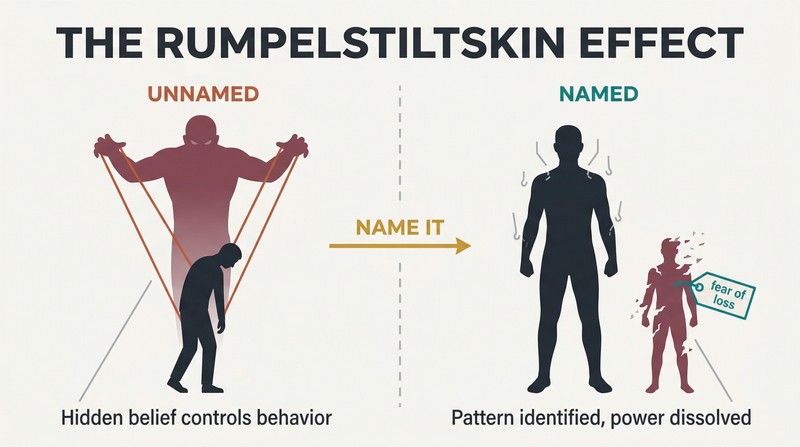
Shadow patterns are hidden saboteurs. Kehoe splits Jung's shadow concept into light shadow (unclaimed talents and positive potential) and dark shadow (disruptive unconscious beliefs that hold you back). Like the fairy tale of Rumpelstiltskin, a dark-shadow pattern loses its grip the moment you identify it by name — a process Kehoe calls personal archaeology.
His own dark shadow ran his love life for twenty years. He repeatedly left relationships when they were going well. During a breathing exercise in his forties, the source surfaced: when his mother drowned when he was thirteen, his subconscious interpreted it as abandonment and concluded intimacy was dangerous. Once named, the pattern lost its unconscious control. He reprogrammed new beliefs, and six months later met his wife Sylvia — happily married now for nearly twenty years.
Your body detects the right answer before your mind catches up
“We cannot think and feel at the same time.”
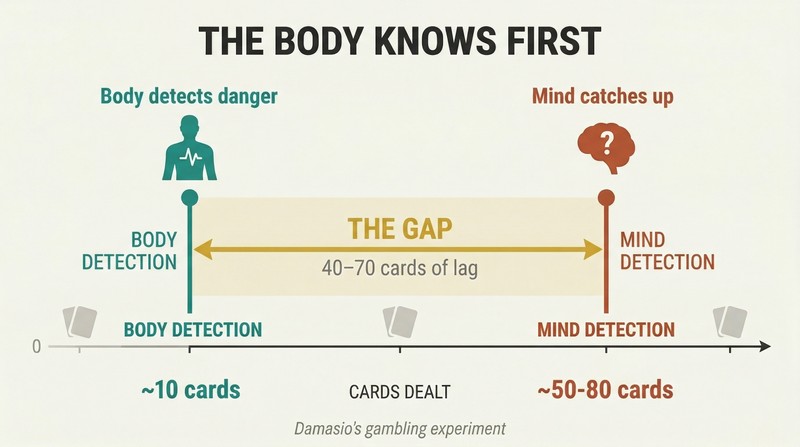
Body wisdom is measurable. Neuroscientist Antonio Damasio designed a gambling task with four decks of rigged cards — two profitable, two costly. Most players needed 50 – 80 cards to consciously figure out which decks to avoid. But electrodes on their palms revealed their bodies "knew" after just ten cards, registering stress signals before drawing from bad decks.
Feelings are data, not distractions. During a three-year listening sabbatical mentored by mystic Ann Mortifee, Kehoe learned to stop privileging mind over body. He gives the body the mythic title "the Feeling-Knowing One" — it picks up energy web signals the mind's logic cannot access. To feel deeply, you must briefly stop thinking. The trained mind learns to step aside at the first sensation, letting the body absorb what it knows.
Stalk your inner chatter like a hunter stalks prey
“Like the constant hum from a refrigerator in the room, we adjust to the sound and eventually don't even hear it.”
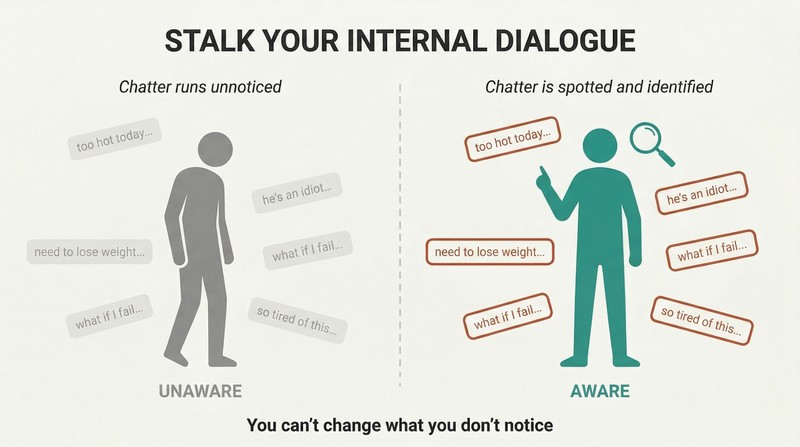
Most people have no idea what their mind is saying. The first of Kehoe's seven warrior disciplines is "stalking the internal dialogue" — observing the nonstop commentary running in your head without judgment. "The day's too hot, Bob's an idiot, I need to lose weight…" This chatter drains energy, programs the subconscious with whatever themes dominate, and keeps us captive to our own thinking.
The seven disciplines form Kehoe's complete daily practice:
1. Stalk the internal dialogue
2. Drop pettiness (self-pity, worry, criticism)
3. Harvest moments of fun, joy, and beauty
4. Practice mindfulness
5. Develop character
6. Journal daily
7. Weave the web with thoughts, words, and actions
Stalking comes first because you cannot change what you do not notice.
Life has two games: monopoly for success, cosmic for awakening
“There is a second game, a mysterious, secret game we get to play — if we are fortunate enough to discover it.”
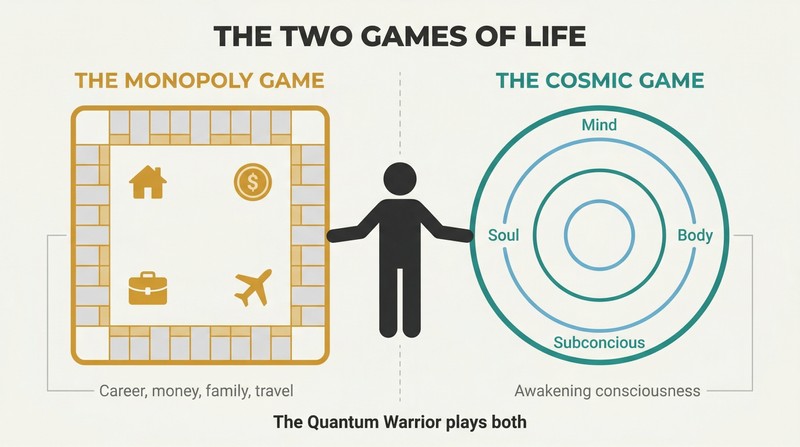
The monopoly game is everything familiar. Career, money, family, travel, retirement — all the activities of building a meaningful, successful life. Kehoe loves this game and designed his original mind power system to play it well. But there is a second game. The cosmic game is about awakening consciousness, integrating all four parts of yourself — mind, body, subconscious, and soul — and playing for stakes beyond time and space.
Framing life as two games relieves pressure. You can relax and focus on being your best rather than being perfect. The quantum warrior — Kehoe's mythic identity for someone who trains daily in consciousness — plays both simultaneously. Kehoe insists neither replaces the other: "Before enlightenment, do the laundry, clean the house and learn to make a decent omelet."
Imprint new beliefs the way you learned multiplication tables
“It is far better to do twenty minutes every day than two hours once or twice a week.”
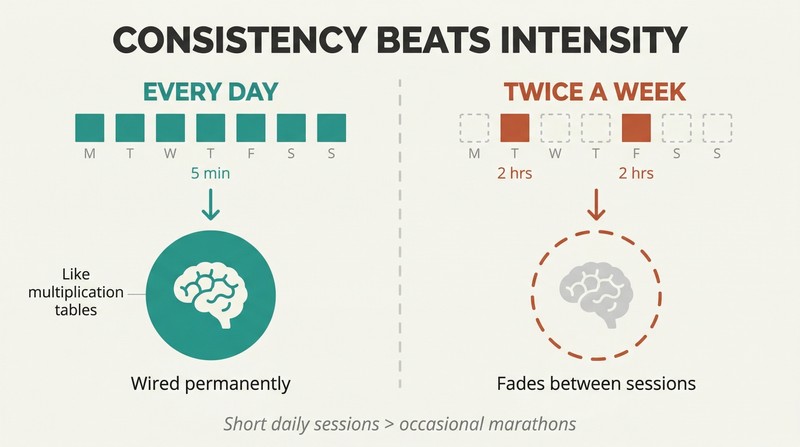
You already know how to reprogram yourself. What is 6 times 6? You know instantly because the multiplication tables were drilled through repetition until they became permanent. Kehoe's imprinting technique uses the same principle: five minutes of focused daily concentration on a chosen belief — repeating it, contemplating its implications, feeling its truth — until it wires into the subconscious.
Results don't arrive on schedule. Some days the exercise feels electric; other days cold and mechanical. Kehoe describes his mind mocking him: "Unlimited power? You're broke." He continued anyway, every day, for months — until one night he woke with absolute certainty the belief was real. The key: short daily sessions beat occasional marathons. Kehoe's own journal entry says it plainly: "Trust only the journal. Do not trust the mind."
Analysis
Kehoe's Quantum Warrior occupies a peculiar intellectual niche: it is simultaneously ahead of its time in applying neuroplasticity research to daily mental practice and decades behind in its interpretation of quantum physics. The book's quantum claims — that consciousness collapses wave functions, that thoughts vibrate through a universal energy web, that past and future can be influenced from the present — are not mainstream physics. Most physicists would object strenuously to the leap from 'subatomic particles behave strangely when observed' to 'your thoughts attract matching life circumstances.' The Copenhagen interpretation of quantum mechanics does not license the law of attraction.
Yet the book's practical value does not depend on its quantum framing. Strip away the physics metaphors and you find a robust system of cognitive-behavioral self-programming: identify limiting beliefs, replace them through daily repetition, visualize desired outcomes, track progress with a journal, integrate body awareness, and confront unconscious patterns. These practices align with what modern psychology knows about neuroplasticity, cognitive restructuring, and embodied cognition. Damasio's somatic marker hypothesis, cited by Kehoe, is legitimate neuroscience. Pascual-Leone's motor imagery study is well-replicated.
What distinguishes Kehoe from simpler positive-thinking books is his integration of Jungian shadow work with manifestation techniques. Most law-of-attraction writers skip uncomfortable inner work entirely — just visualize and believe. Kehoe insists you must excavate your dark shadow, the unconscious beliefs that silently override conscious intentions. His own story of tracing a twenty-year relationship pattern to childhood trauma demonstrates genuine psychological depth rarely found in this genre.
The mythological framework — adopting the identity of a 'quantum warrior,' naming the mind's functions with titles like 'Guardian to the Gates of the Subconscious' — will strike some as grandiose and others as genuinely useful. Psychologically, adopting a heroic self-narrative does activate different neural circuitry than identifying as a victim. Whether the energy web is real or not, the placebo effect certainly is, and Kehoe's system is essentially an elaborate, self-aware placebo architecture — which, as the knee surgery study demonstrates, can be remarkably powerful.
Review Summary
Quantum Warrior receives mixed reviews, with an overall positive rating. Many readers find it transformative, praising its accessible approach to quantum concepts and personal growth. They appreciate the practical exercises and the book's potential to change perspectives. Some highlight its unique blend of science and spirituality. However, critics argue it misrepresents scientific theories and oversimplifies complex concepts. Several reviewers note similarities to other self-help books. Despite differing opinions, many readers find the book thought-provoking and inspirational, encouraging a shift in mindset and personal development.
Glossary
Energy web
Quantum field underlying all realityKehoe's term for what physicists call the quantum vacuum—the invisible framework of vibrating energy that creates and sustains the universe. Unlike the misleading term 'vacuum,' the energy web is filled with vast amounts of energy, information, and unlimited possibilities of manifestation. It is responsive to consciousness and acts upon vibrational instructions from the subconscious mind.
Weaving the web
Directing thoughts into the fieldThe act of interacting with the energy web through thoughts, words, intentions, beliefs, and actions. Every thought we entertain sends a vibrational signal into the energy web, attracting circumstances that match that vibration. Kehoe uses this phrase throughout the book to describe any conscious or unconscious act of programming the quantum field with energy patterns.
Quantum warrior
Mythic identity for consciousness trainingKehoe's central metaphor for someone who trains daily in consciousness practices, embraces a warrior mythology, and lives according to quantum laws. From the Tibetan 'pawo' meaning 'one who is brave,' the quantum warrior seeks to become a complete human being by integrating mind, body, subconscious, and soul. The mythic framing is deliberate—it activates archetypal forces in the psyche that rational self-descriptions cannot.
Foundation beliefs
Core beliefs supporting your goalsThe deepest beliefs a person holds about money, health, relationships, and other life areas. Foundation beliefs operate as the hidden premise from which all thinking and acting proceeds. Kehoe argues most people's foundation beliefs directly contradict their stated goals—wanting wealth while believing 'the odds are stacked against me'—and that changing them is the single most important step toward achieving any objective.
Quantum alignment
Connecting to archetypical energy vibrationsA visualization technique where you connect your consciousness with the universal vibrational pattern of whatever quality you desire—abundance, health, courage, success. Rather than trying to generate energy from within, you tune into the archetypical energy signature that already exists in the energy web, aligning with it through imagination and feeling. Kehoe's original abundance practice is his primary example.
Imprinting technique
Repetition method for installing beliefsA daily practice of concentrating for five minutes on a chosen belief statement, repeating it, contemplating its implications, and feeling its truth. Modeled on how multiplication tables are memorized through repetition, the technique gradually wires new beliefs into the subconscious where they become permanent 'laws of power' that vibrate day and night without conscious effort.
Dark shadow
Disruptive unconscious belief patternsAdapted from Jung's shadow concept, the dark shadow contains hidden subconscious patterns that absorb energy and cause problems—patterns of self-sabotage, fear, or dysfunction that operate without conscious awareness. Kehoe compares dark shadows to Rumpelstiltskin: they maintain power over you only until you identify them by name. Discovering them through 'personal archaeology' is a core part of the warrior's path.
Light shadow
Unclaimed positive potentials withinThe counterpart to the dark shadow, containing talents, gifts, and abilities that lie dormant and unexpressed. Because each person is a holographic piece of the whole universe, everything excellent is theoretically part of the light shadow. It is discovered by following bliss, natural talents, and joy—trusting feelings rather than logic to reveal what wants to emerge.
Monopoly game
The worldly game of accumulationKehoe's metaphor for everything we do to create a meaningful and successful life in the material world—career, money, family, education, travel, retirement. It begins at birth and encompasses all inventory-gathering experiences. Kehoe considers it a worthy and exciting game, but insists it is only one of two games available to play in a human life.
Cosmic game
The spiritual game of awakeningThe second and deeper game of life, focused on awakening consciousness and integrating all four parts of the self—mind, body, subconscious, and soul. Unlike the monopoly game of accumulation, the cosmic game is paradoxically a game of letting go, directed primarily by the soul rather than the mind. Kehoe says we play it not just in time and space but across quantum dimensions, for stakes that extend into eternity.
Quantum maxims
Four foundational warrior beliefsThe four core beliefs that form the foundation of the quantum warrior's model of reality: (1) The consciousness that created the universe dwells within us, (2) We exist in the energy web and are one with it, (3) Consciousness weaves and directs energy, (4) Everything exists for us as a possibility. These are contemplated daily and imprinted into the subconscious through the imprinting technique.
Model of reality
Mind's constructed worldview and beliefsThe way our mind constructs and interprets reality using accumulated concepts, beliefs, and experiences. Initially created unconsciously from childhood imprints—parents' values, early experiences, cultural programming—models of reality contain both empowering and limiting beliefs. Kehoe argues we can consciously redesign our model at any point in life, tearing down dysfunctional beliefs and replacing them with visionary ones through deliberate imprinting.
FAQ
1. What is Quantum Warrior: The Future of the Mind by John Kehoe about?
- Exploration of consciousness and energy: The book investigates how consciousness and energy interact to create reality, emphasizing that everything—including thoughts and feelings—is vibrating energy.
- Integration of science and mysticism: John Kehoe blends quantum physics, neuroplasticity, psychology, and ancient spiritual teachings to show how consciousness shapes both the universe and personal experience.
- Practical mind power system: The book provides a structured approach to training the mind, enabling readers to direct thoughts and energy for manifesting success, health, abundance, and awakening.
2. Why should I read Quantum Warrior: The Future of the Mind by John Kehoe?
- Unique science-spirituality synthesis: Kehoe offers a compelling blend of modern quantum science and ancient wisdom, giving readers a fresh perspective on their potential and place in the universe.
- Actionable transformation methods: The book shares practical, proven techniques that have helped millions, demonstrating that mind power is a reliable, effective system.
- Empowerment and personal growth: Readers gain tools to rewire their brains, overcome limiting beliefs, and consciously create their reality, fostering both personal and cosmic consciousness.
3. What are the key takeaways from Quantum Warrior: The Future of the Mind by John Kehoe?
- Reality as vibrating energy: Everything, including physical objects and thoughts, is made of energy vibrations, and consciousness directs this energy.
- Mind power is trainable: Through daily disciplines and repetition, anyone can reprogram beliefs and manifest desired outcomes.
- Integration leads to awakening: Harmonizing mind, body, subconscious, and soul is essential for personal transformation and cosmic consciousness.
4. How does John Kehoe define the “energy web” in Quantum Warrior: The Future of the Mind?
- Energy web as quantum field: Kehoe uses “energy web” to describe the vast, information-rich field underlying all existence, filled with infinite possibilities.
- Thoughts weave the web: By focusing thoughts and intentions, individuals create specific energy patterns in the web, attracting matching circumstances and events.
- Metaphor and practical tool: The energy web serves as both a symbolic and actionable framework for understanding how consciousness shapes reality.
5. What is the “quantum warrior” archetype in John Kehoe’s Quantum Warrior: The Future of the Mind?
- Mythology as empowerment: The quantum warrior is a metaphorical archetype representing heroic living, authenticity, and bravery in all situations.
- Integration of self: Becoming a quantum warrior means harmonizing mind, body, subconscious, and soul to become a complete, awakened human being.
- Dual games of life: Kehoe describes life as playing both the “monopoly game” of daily achievements and the “cosmic game” of awakening, encouraging a playful yet purposeful approach.
6. What foundational scientific truths about reality are presented in Quantum Warrior: The Future of the Mind by John Kehoe?
- Everything is energy: All reality, including thoughts and emotions, is composed of vibrating energy.
- Consciousness as creative force: Consciousness directs energy and plays a central role in shaping reality, challenging classical Newtonian views.
- Quantum physics insights: The book explains that particles exist in multiple states until observed, and consciousness acts as a catalyst in manifesting reality.
7. What are the key mind training practices in Quantum Warrior: The Future of the Mind by John Kehoe?
- Contemplation: Daily focused reflection on quantum principles or empowering beliefs to gain insight and strengthen mental discipline.
- Visualization and affirmations: Using imagination to vividly experience desired outcomes and repeating affirmations to direct energy and thoughts.
- Quantum alignment: Consciously aligning with archetypal energies (like abundance or health) in the energy web to attract corresponding realities.
8. How does Quantum Warrior: The Future of the Mind by John Kehoe explain the relationship between the conscious and subconscious mind?
- Two complementary minds: The conscious mind directs thoughts and intentions, while the subconscious receives and broadcasts these patterns energetically.
- Subconscious accepts all input: It cannot distinguish between real and imagined experiences, making visualization and repetition powerful for reprogramming.
- Engine of manifestation: The subconscious vibrates whatever patterns it holds, so empowering it with positive beliefs is crucial for success.
9. What is the role of beliefs in shaping reality according to Quantum Warrior: The Future of the Mind by John Kehoe?
- Beliefs as energy patterns: Beliefs are energetic patterns that resonate within the personal quantum field, influencing what we attract and experience.
- Core beliefs as operating system: Foundational beliefs determine success or failure; empowering beliefs aligned with goals are essential for manifestation.
- Imprinting through repetition: Repeated, focused practice imprints beliefs into the subconscious, transforming them into powerful “laws” that shape reality.
10. What are the “seven warrior disciplines” and daily practices in Quantum Warrior: The Future of the Mind by John Kehoe?
- Seven disciplines: These include stalking internal dialogue, dropping pettiness, harvesting joy and beauty, mindfulness, developing character, journaling, and weaving the web with thoughts and intentions.
- Importance of daily practice: Repetition and consistency are emphasized as essential for rewiring the brain and maintaining alignment with quantum laws.
- Mind-body-soul integration: Practices encourage listening to bodily wisdom, trusting intuition, and awakening the soul for clarity and purpose.
11. How does Quantum Warrior: The Future of the Mind by John Kehoe address shadow work and personal transformation?
- Light and dark shadow: The light shadow holds unclaimed positive potentials, while the dark shadow contains limiting beliefs and patterns.
- Personal archaeology: Shadow work involves uncovering and integrating unconscious patterns through self-examination, leading to greater wholeness.
- Crisis as catalyst: Life crises often reveal shadow aspects, prompting necessary inner transformation and growth.
12. What are the best quotes from Quantum Warrior: The Future of the Mind by John Kehoe and what do they mean?
- “Chance is always powerful. Let your hook be always cast. In the pool where you least expect it, there will be a fish.” (Ovid): Encourages openness to unexpected opportunities and guidance from the universe.
- “I am the poet of the body and I am the poet of the soul.” (Walt Whitman): Highlights the inseparability and equal importance of body and soul in human experience.
- “The works that I do ye can do, and greater works than these shall ye do because I go unto the Father.” (Jesus, John 14:12): Suggests that human potential is vast and that, through quantum warriorship, extraordinary feats are possible.
Download PDF
Download EPUB
.epub digital book format is ideal for reading ebooks on phones, tablets, and e-readers.








































