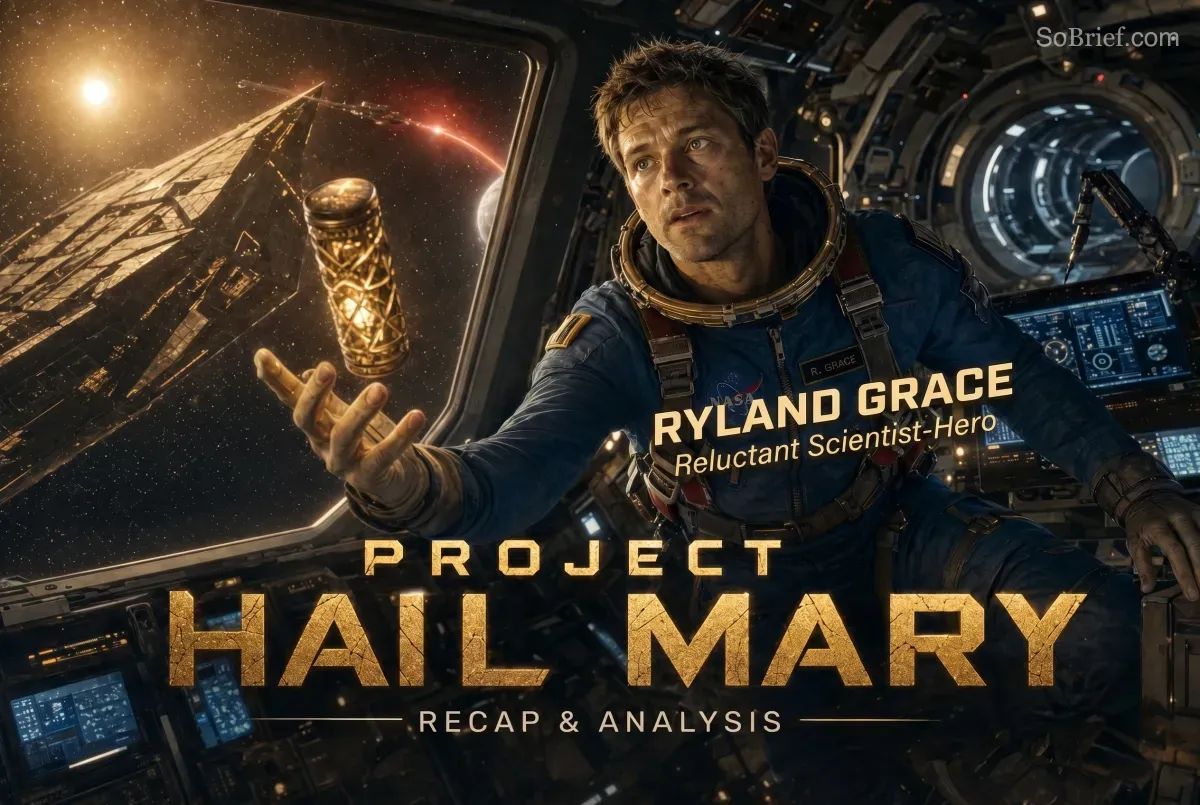



Plot Summary
Waking in a Coffin Ship
A man wakes in an oval bed to a computer demanding simple math. He can barely speak, can't open his eyes, and is threaded with tubes, IVs, and electrodes. Robot arms tend to him from above. He manages to answer the questions, regains motor control, and discovers he's in a round room with two other beds — each containing a desiccated corpse. The computer asks his name.
He doesn't know it. He doesn't know anything about himself: not his profession, his nationality, or why he's here with two dead people and no door — only a ladder leading to a sealed hatch. His body is muscular despite what was clearly a long coma. The robot arms catch him when he falls. Whatever happened here, he survived it. The others did not.
Gravity Doesn't Lie
He times objects falling from a table with a stopwatch. The math is second nature — he's definitely a scientist. The result is unsettling: fifteen meters per second squared, when Earth's gravity is 9.8. He builds a pendulum to confirm, runs the same test on two different floors, and rules out a centrifuge.
No sound, no vibration, no turbulence. He's experiencing genuine gravitational acceleration stronger than anything in the solar system. Earth, the moon, Mars — nowhere matches. He knows these facts automatically, the same way he knows physics equations, but can't recall his own name.
His subconscious keeps feeding him fragments: an email about a mysterious infrared line stretching from the sun to Venus. A friend telling him the sun is getting dimmer. Something enormous is wrong, and he is tangled up in it.
Memories of a Dying Sun
Memories surface in shards. He recalls Astrophage — his own coinage — a single-celled organism that absorbs solar energy, stores it as mass, and breeds on Venus. He discovered its life cycle: gathering energy from the sun, propelling itself to Venus for carbon dioxide, reproducing, and returning.
He named it during a conversation with Eva Stratt,3 the Dutch administrator given absolute authority by every UN nation to solve the crisis. Stratt3 conscripted him to examine the first samples, treated him as a guinea pig, and watched him prove that alien life uses water — demolishing his own career's central argument.
He remembers his name at last: Ryland Grace.1 He speaks it to the ship's computer, and a locked hatch clicks open. Three rooms now lie before him: dormitory, laboratory, and a cockpit packed with screens.
One-Way Ticket to Tau Ceti
The cockpit reveals a star that rotates ten times faster than the sun. Grace1 is not in the solar system at all — he's orbiting Tau Ceti, twelve light-years from Earth. The Hail Mary's fuel is Astrophage, and four small probes called beetles — named John, Paul, George, and Ringo — are designed to ferry his findings back to Earth.
The ship has no return fuel. He was placed in a medically induced coma for the multi-year journey, and only he survived. Tau Ceti was chosen because, uniquely among nearby infected stars, its Astrophage population hasn't spiraled out of control.
Grace's1 assignment is to discover why. He gives his dead crewmates — Commander Yáo6 and Engineer Ilyukhina7 — a burial through the airlock, committing their bodies to the stars and their names to his faltering memory.
Stratt Builds Her Ark
Through recovering memories, Grace1 pieces together the backstory. Stratt3 operated from a borrowed Chinese aircraft carrier, drafting scientists worldwide: Dimitri,4 a Russian who built the Astrophage-powered spin drive; Lokken,5 a Norwegian who designed a centrifuge so the lab could function in gravity; Redell,11 a convicted engineer whose blackpanel scheme paved a quarter of the Sahara to breed two million kilograms of fuel.
Climatologist Leclerc9 estimated half of humanity would die within nineteen years, so Stratt3 ordered two hundred forty-one nuclear weapons detonated along an Antarctic fissure, releasing trapped methane as a greenhouse stopgap.
The crew was selected from the rare one-in-seven-thousand humans whose genes could survive long-term comas. Every decision Stratt3 made was ruthless, efficient, and aimed at a single objective: making the Hail Mary launch on time.
Neighbors at the End of Space
After engine cutoff, Grace1 activates the Petrovascope and confirms Tau Ceti has a Petrova line — Astrophage is present but hasn't destroyed this star. Then a flash of Petrova-frequency light blinks in the void. It grows brighter, pulses, and holds steady before cutting out.
He fires his engines briefly as a signal. The unknown source mimics his pattern instantly — too fast for remote control. When he pans the telescope, he finds a ship: a hundred thirty-nine meters long, made of enormous flat panels, with a diamond-shaped center hull and pyramid nose.
Nothing from Earth looks like this. The hull is blotchy gray and tan, fabricated from an unknown material. A robot arm on the hull waves at him. Someone aboard is watching. Grace1 realizes he is no longer alone in the universe.
Same Enemy, Different Stars
The aliens send a cylinder through space at a considerate crawl. Grace1 catches it during an EVA — it reeks of ammonia and radiates heat. Inside, he finds a model: a star with a Petrova-line arc leading to a planet, plus a three-dimensional map of local stars.
Tau Ceti sits at the center, and one star off to the side has its own tiny Petrova-line symbol connected by a filament. Grace1 matches the positions against his astronomical database. The alien homeworld orbits 40 Eridani — a star also infected with Astrophage.
The message is unmistakable: they came from there, and they came for the same reason. Grace1 solders a wire from Tau Ceti to Sol on the map, adds a crude wax Petrova-line symbol, and throws the cylinder back. Two civilizations are fighting the same extinction.
Rocky Speaks in Chords
A connecting tunnel now spans both ships, divided by a clear wall. On the other side: a creature the size of a Labrador with five legs radiating from a pentagonal carapace, rocky armor for skin, and no visible eyes. Grace1 names him Rocky.2
The alien communicates in musical chords — multiple notes played simultaneously from somewhere inside his body. He perceives the world through sonar so refined he can read the hands of Grace's1 clock through the divider. They begin with numbers — Rocky2 uses base six, having six fingers across two hands. They add units of time, length, and mass.
Grace1 writes software to translate Rocky's2 chords into English in real time. Rocky,2 blessed with perfect memory, needs no such aid. Word by word, they construct a shared language from physics — the one vocabulary guaranteed to overlap between any two civilizations.
Taumoeba Eats the Enemy
They orbit Planet Adrian — the world where Tau Ceti's Astrophage breeds — and Grace1 deploys an external collector. The samples teem not just with Astrophage but with an entire ecosystem of microorganisms. Under the microscope, an amorphous blob engulfs a cluster of Astrophage, enveloping them like an amoeba swallowing prey.
The black cells turn translucent and die within seconds. Grace1 names the predator Taumoeba. The discovery electrifies them both: if this organism can be introduced to Venus and to Threeworld — the breeding ground in Rocky's2 home system — it would devour the Astrophage populations naturally.
But they need a sample from the actual breeding altitude, ninety-one kilometers deep in Adrian's atmosphere. Grace's1 lowest safe orbit skims a hundred kilometers above the surface. Those nine kilometers might as well be a canyon filled with fire.
Rocky Crosses the Wall
They forge a ten-kilometer xenonite chain to fish through Adrian's atmosphere while the Hail Mary hovers on angled engines. The sampler seals successfully, but reflected infrared light melts a hole in the hull. Astrophage fuel pours out, propelling the ship in an uncontrolled spin.
Grace1 is pinned at lethal g-forces, his pilot's chair shearing from the floor and crushing him against the console. Rocky,2 who thrives in high gravity, breaks through the airlock into Grace's1 freezing, oxygen-rich, low-pressure environment — an atmosphere that literally sets his internal radiator organ on fire.
He slashes Grace's1 restraints and collapses, smoke billowing from his carapace vents. Grace1 arrests the spin using the centrifuge cables, then drags Rocky's2 scalding, unconscious body back through the ship and into his own atmosphere. Both barely survive.
The Nitrogen Wall
Grace1 tests Taumoeba in simulated Venus and Threeworld conditions. Both experiments fail — every organism dead within seconds. He isolates the killer: nitrogen. Even Venus's modest 3.5 percent is lethal; Threeworld has 8 percent. Adrian's atmosphere, where Taumoeba evolved, contains none.
Grace1 devises a plan borrowed from how bacteria develop antibiotic resistance: breed Taumoeba in gradually increasing nitrogen concentrations, selecting survivors each generation. Rocky2 builds ten precision breeder tanks with exact gas-injection controls.
Generation after generation, the nitrogen tolerance creeps upward — 0.01 percent, then 0.1, then 0.6. Each increment is a minor victory against extinction. The process takes weeks, with no guarantee of success. But evolution, Grace1 knows, is relentless when given the right pressure. They settle in for the longest experiment of both their lives.
Two Million Kilograms of Hope
During the breeding marathon, Rocky2 mentions that his ship carries far more Astrophage than expected. Eridians never discovered relativistic physics — they calculated the entire journey using Newtonian mechanics and massively overpacked fuel.
The confused navigation that resulted from time dilation and length contraction left Rocky2 bewildered during his trip, but the happy accident means he has millions of kilograms to spare. When Grace1 explains his ship was designed never to return, Rocky2 is stunned. He immediately offers two million kilograms — more than enough for a round trip to Earth.
Grace1 breaks down sobbing. For months he has quietly accepted death as the price of the mission. In a single sentence from an alien engineer, the calculus of his life inverts completely. The suicide mission is no longer a suicide mission.
The Coward's Truth
The final memory surfaces. Grace1 didn't volunteer. When the primary and backup science specialists died in an Astrophage experiment gone wrong, Stratt3 selected Grace1 as their replacement — he had the coma-resistant genes and years of training. He refused.
He begged, wept, and screamed that he didn't want to die. Stratt3 had a soldier restrain him and outlined her plan with clinical calm: sedate him before launch, load him unconscious onto the Soyuz, administer a French amnesia drug so he'd forget the coercion entirely.
She was ninety-nine percent certain he'd do the right thing once he woke up at Tau Ceti. He threatened to sabotage the mission. She didn't flinch. Grace1 must reckon with who he actually is: not a noble volunteer but a terrified man whose courage was manufactured by someone else's ruthlessness.
Escape Through Xenonite
Taumoeba -82.5 thrives in both Venus and Threeworld simulations — a breakthrough worthy of celebration. Then Grace1 discovers Taumoeba loose in his ship's Astrophage supply. Through careful experimentation, he isolates the cause: the directed evolution didn't just create nitrogen resistance.
To survive nitrogen purges inside the xenonite breeder farms, the microbe evolved to burrow into the molecular structure of xenonite itself — worming between atoms the way a person navigates a jungle, while inert nitrogen molecules bounce off like tennis balls hitting trees.
The ship's generators die. Every fuel line is contaminated. Grace1 sits in total darkness until Rocky2 builds a sealed replacement generator powered by a small Astrophage reserve. But the damage runs deeper than the Hail Mary. Rocky's2 ship stores its Taumoeba in xenonite farms too.
The Light Goes Out
Using three beetles as improvised engines, Grace1 and Rocky2 maneuver the Hail Mary back to the Blip-A. Rocky2 fabricates replacement fuel tanks from scavenged metal. They sterilize every pipe with nitrogen and refuel from Rocky's2 reserves. Then comes the farewell.
Grace1 gives Rocky2 a laptop loaded with humanity's collected knowledge. Rocky2 gives Grace1 xenonite samples for Earth's scientists. They press fist and claw against the divider one last time and fly apart — Rocky2 toward Erid, Grace1 toward Earth.
Every day, Grace1 checks the Petrovascope for Rocky's2 engine flare. For weeks, the dot of light persists — a friend still visible across the void. Then one morning, it isn't. Rocky's2 Taumoeba has escaped its xenonite farms. His ship is dead somewhere in the dark between stars.
Grace Turns Around
Grace1 has enough food for the trip to Earth or the trip to Erid — not both. If he continues home, humanity gets its hero and Rocky's2 entire species perishes. If he turns around, the beetles can carry the Taumoeba and data to Earth without him, but Grace1 will starve long before he could ever return. He loads each beetle with a mini-farm of Taumoeba and a USB drive of findings, then launches all four toward Earth.
He reverses course. He doesn't deliberate long. The math is simple, the decision enormous, and somewhere in the calculation is a man who once refused to board this ship at all — now choosing to die so that an alien engineer and four billion Eridians might live. He points the Hail Mary into the dark and accelerates.
Knocking on an Alien Hull
Finding the Blip-A is like locating a toothpick in an ocean. Grace1 repurposes his spin drives as a makeshift radar — blasting Petrova-frequency light into space and scanning for reflections with the Petrovascope. After days of methodical sweeping across every angle, a flash answers back four million kilometers away.
He closes the distance and confirms the contact on radar. He does an EVA in total darkness, kicks off the Hail Mary's hull, and slams into the alien ship. He lashes himself to a rail and hammers the hull with a wrench.
Rocky's2 voice crackles through the radio — alive, stunned, overjoyed. Reconnected, Rocky2 proposes that Grace1 might survive after all: Taumoeba uses biology compatible with humans but lacks Eridian heavy metals. Grace1 could eat it. They link ships and set course for Erid together.
Epilogue
Years later, Grace1 lives on Erid inside a pressurized dome, maintained by thirty Eridian caretakers. He is aging — arthritic from the double gravity, subsisting on lab-grown clones of his own muscle tissue and vitamin supplements synthesized by Eridian scientists who studied his biology with the fervor of a species repaying an unpayable debt.
Rocky2 visits daily. One morning, he arrives vibrating with excitement: Eridian astronomers have confirmed that Sol has returned to full luminosity. The beetles worked. Earth's scientists deployed the Taumoeba.
The sun is whole again. Grace1 weeps — the first tears Rocky2 has seen from him in years. Then he walks to his favorite room in the dome, where thirty young Eridians wait at their desks. He sits at an organ keyboard, plays the opening chord, and asks who can tell him the speed of light.
Analysis
Project Hail Mary operates as a thought experiment about the relationship between competence and courage — and whether the distinction matters when the stakes are species-level survival. Grace1 is explicitly not brave. He is dragged onto the mission, chemically stripped of his objections, and only becomes heroic through accumulated small decisions that each seem logical in isolation. The novel argues that heroism is not a character trait but an emergent property of circumstances, knowledge, and proximity to people who need you. Grace1 doesn't choose to be brave; he chooses, repeatedly, not to abandon someone standing right in front of him.
The friendship between Grace1 and Rocky2 embodies the book's deepest conviction: that intelligence, when paired with goodwill, can bridge any gap. They share no biology, no senses, no cultural framework — yet within weeks they're finishing each other's sentences. This is not sentimental; it's presented as an inevitable consequence of two problem-solvers facing the same problem. The novel suggests that scientific methodology is itself a universal language, and that the collaborative instinct may be as fundamental to sapient life as the survival instinct.
Stratt3 functions as the novel's moral fulcrum. She is simultaneously the most effective and most disturbing character — a woman who will kidnap a man, erase his memory, and send him to die because the arithmetic demands it. The book neither condemns nor celebrates her. It simply presents the trolley problem at planetary scale and shows what a person looks like who has already pulled the lever. Her presence forces the reader to confront an uncomfortable truth: that democratic values and individual rights may be luxuries that extinction doesn't respect.
Perhaps most subversively, the novel inverts the competence-fantasy genre it appears to inhabit. Grace1 solves problems not through genius but through persistence, collaboration, and the willingness to be wrong. His greatest scientific achievement — breeding nitrogen-resistant Taumoeba — nearly destroys both missions. The lesson is not that science saves us, but that science is a process of controlled failure, and survival depends on how quickly you recognize and respond to the failures you've created.
Review Summary
Project Hail Mary is widely praised as an entertaining and thrilling sci-fi adventure. Readers appreciate the engaging storytelling, accessible scientific explanations, and compelling characters, particularly the alien Rocky. Many find it on par with or better than Weir's previous hit, The Martian. The book's humor, problem-solving elements, and emotional depth resonate with readers. Some criticize the similarity to The Martian and occasional overuse of scientific details. Overall, it's considered a captivating read that balances science, humor, and heart, with a satisfying ending that leaves many readers emotional.
People Also Read








Characters
Ryland Grace
Amnesiac astronaut, reluctant heroA junior-high science teacher with a doctorate in molecular biology, Grace retreated from academia after a controversial paper arguing life doesn't require water was ridiculed. He found genuine happiness teaching children, channeling his intelligence into enthusiasm rather than ambition. Beneath his nerdy warmth runs a deep vein of risk-aversion—he avoids romantic relationships, confrontation, and anything that might wound him. His attachment to his students is both authentic and a safe harbor. Stratt3 recognizes what Grace cannot: his brilliance, his rare coma-resistant genes, and the gap between what he believes about himself and what he's capable of. The tension between his self-image as ordinary and the extraordinary demands placed on him drives his entire arc.
Rocky
Eridian engineer, Grace's counterpartA spider-sized, five-limbed alien from 40 Eridani who perceives the world through sonar rather than sight, Rocky is his species' equivalent of a brilliant mechanic who ended up carrying the weight of a civilization. He communicates in musical chords, thinks in base-six mathematics, and possesses perfect memory—yet approaches every problem with humility, calling himself merely a repair specialist rather than a scientist. His culture values communal watchfulness (Eridians observe each other sleeping), and his loneliness after losing twenty-two crewmates to radiation is profound but rarely expressed directly. He bonds instantly with Grace1, recognizing a kindred isolation. Rocky's engineering genius is matched only by his emotional generosity—he gives freely, fixes relentlessly, and never counts the cost to himself.
Eva Stratt
Ruthless mission architectA former Dutch ESA administrator granted unprecedented global authority by a unanimous UN vote, Stratt operates with the cold precision of someone who has internalized the arithmetic of extinction. She speaks multiple languages, reads every document, and never delegates decisions that matter. Her interpersonal register oscillates between calculated charm and open bulldozing—she will cajole a Nobel laureate or commandeer an aircraft carrier with equal composure. Stratt is not cruel by disposition; she studied history and understands what starvation does to civilizations. She simply refuses to let sentiment interfere with survival math. Her willingness to sacrifice individuals—including her own freedom and reputation—for the species makes her both the story's most effective leader and its most morally unsettling figure.
Dimitri Komorov
Russian spin-drive inventorA gregarious Russian physicist who heads Astrophage energy research, Dimitri discovers that Astrophage stores energy as mass via neutrino production—the key insight enabling interstellar propulsion. He designs the spin drive, a deceptively simple rotating-triangle mechanism that converts Astrophage into directed thrust. Warm, punning, and perpetually enthusiastic, he becomes Grace's1 closest friend on the aircraft carrier. His partnership with Grace1 blends complementary talents: Dimitri understands physics at industrial scales while Grace1 grasps biology at cellular ones.
Dr. Lokken
Norwegian centrifuge designerA fiery ESA scientist initially hostile to Grace1 over their opposing views on extraterrestrial biology, Lokken forces her way into Stratt's3 orbit to deliver a critical insight: the Hail Mary's lab equipment won't function in zero gravity. Her centrifuge design—splitting the ship in two halves connected by cables—becomes essential to the mission. Principled and confrontational, she represents the scientific establishment that once rejected Grace1, now working alongside him out of necessity.
Commander Yáo
Hail Mary's stoic commanderA Chinese military officer selected as the Hail Mary's primary crew commander, Yáo is characterized by quiet authority and unyielding honor. He speaks rarely, but when he does, rooms fall silent. He insists that every crewmember serve voluntarily—a principle that creates tension with Stratt's3 utilitarian methods. His seriousness is tempered by an inability to resist Ilyukhina's7 humor. Grace1 remembers him as someone who would give his life for the mission or his crew without hesitation.
Olesya Ilyukhina
Hail Mary's exuberant engineerA Russian materials expert and the Hail Mary's primary engineer, Ilyukhina radiates infectious energy and irreverent humor. She hugs Stratt3 upon meeting her, declares herself happy to die for Earth, and keeps vodka in her personal kit. Her casual warmth serves as counterweight to Yáo's6 severity. Grace1 recalls her fondly—she would have been ecstatic about first contact. Her engineering role aboard the ship mirrors Rocky's2 function on the Blip-A, drawing a quiet parallel between the two crews.
Martin DuBois
Primary science specialistAn American scientist holding three doctorates in physics, chemistry, and biology, DuBois combines extraordinary intellect with almost comical social earnestness. He maintains impeccable posture, addresses everyone formally, and volunteers personal information with disarming candor. Selected as the Hail Mary's primary science expert for his unmatched breadth of knowledge, he approaches the suicide mission with dignified acceptance. Grace1 trains him on Astrophage biology and finds him both brilliant and bewildering.
Dr. Leclerc
Climatologist and reluctant warriorA French climatologist and self-described hippie who calculates that half of humanity will die within nineteen years. Stratt3 assigns him to engineer greenhouse-gas solutions, culminating in his ordering nuclear strikes on Antarctica to release methane—an act that devastates his pacifist identity.
Dr. Lamai
Coma technology pioneerA Thai medical scientist whose company developed coma-resistance gene testing and automated care systems. Her medical robots maintain the crew during the multi-year coma journey. She discovers that only one in seven thousand humans carries the necessary genetic markers.
Bob Redell
Convicted engineer, energy visionaryA New Zealand engineer imprisoned for embezzlement and negligent homicide at a solar facility, Redell designs the blackpanel system that paves a quarter of the Sahara Desert to breed the mission's two million kilograms of Astrophage fuel. Stratt3 extracts him from prison for his scalable engineering mind.
Steve Hatch
Beetle probe inventorAn irrepressibly optimistic Canadian engineer from the University of British Columbia who designs the beetle probes—small, self-navigating spacecraft that will carry data from Tau Ceti back to Earth. He names them after the Beatles and views Astrophage as ultimately beneficial technology.
Annie Shapiro
Backup science specialistAn American microbiologist famous for inventing the Shapiro DNA-splicing method during her PhD thesis, she serves as DuBois's8 backup for the science specialist role. Brilliant and informal, she develops a relationship with DuBois8 during training.
Plot Devices
Astrophage
Threat, fuel, and story engineA single-celled alien organism that absorbs stellar energy and stores it as mass via neutrino production, Astrophage is simultaneously the story's central antagonist and its enabling technology. It dims every star it infects, threatening extinction across multiple systems, while its extraordinary energy density—governed by E=mc²—makes it the only viable fuel for interstellar travel. Astrophage maintains a constant body temperature of 96.415°C, propels itself with Petrova-frequency infrared light, and breeds on planets with carbon-dioxide atmospheres. Its life cycle—migrating from star to planet and back—creates the visible Petrova line that first alerts astronomers to the crisis. The entire plot hinges on this duality: Astrophage is both the problem humanity must solve and the only tool that makes solving it possible.
Taumoeba
Astrophage predator and salvationAn amoeba-like microorganism native to Planet Adrian that evolved to consume Astrophage, Taumoeba represents the natural biological check that keeps Tau Ceti's Astrophage population in balance. Its discovery beneath Grace's1 microscope transforms the mission from pure investigation into a practical rescue operation. However, Taumoeba cannot survive nitrogen—present in both Venus's and Threeworld's atmospheres—requiring Grace1 to breed a nitrogen-resistant strain through directed evolution over many generations. The organism's remarkable adaptability becomes both its greatest asset and its most dangerous quality: it evolves faster and more creatively than its human handler anticipates, developing capabilities that threaten to undermine the very mission it was bred to serve.
The Beetles
Data carriers to EarthFour small, self-navigating Astrophage-powered probes designed by Canadian engineer Steve Hatch12 and named John, Paul, George, and Ringo. Each carries five terabytes of storage and enough fuel to return to Earth autonomously, accelerating at five hundred g's to reach 93 percent of light speed. They represent the Hail Mary's only method of reporting findings to Earth, since no radio could bridge twelve light-years reliably. Their design assumes the crew will die at Tau Ceti—the beetles are the mission's true payload. In practice, they serve multiple unexpected roles: as improvised engines when the Hail Mary loses power, and ultimately as the vessels that carry Taumoeba samples and scientific data back to Earth when Grace1 cannot return himself.
Xenonite
Alien super-material, pivotal vulnerabilityAn Eridian-manufactured compound primarily composed of xenon bonded in ways that defy human chemistry, xenonite is harder than diamond, stronger than any known material, and transparent in certain formulations. It enables the tunnel connecting the two ships, the divider wall through which Grace1 and Rocky2 communicate, and the breeder farms that house Taumoeba. Its extraordinary properties—withstanding twenty-nine atmospheres of pressure on a flat panel—make it seem invulnerable. This perceived invulnerability becomes critical when evolved Taumoeba learns to permeate its molecular structure, turning the material that enabled interspecies cooperation into a vector for catastrophic fuel contamination aboard both ships.
Grace's Amnesia
Narrative structure and character revealGrace's1 memory loss from the extended coma serves as the novel's primary structural device, parceling out backstory through triggered flashbacks while maintaining present-tense suspense. Each recovered memory expands the reader's understanding—from the Petrova line's discovery to Stratt's3 recruitment to the crew selection process—while the final recovered memory delivers the story's most devastating character revelation. The amnesia was partly natural (coma side effects) and partly engineered (a French retrograde-amnesia drug administered by Stratt3 to prevent Grace1 from sabotaging the mission). This device allows the narrative to unfold as a mystery even though the protagonist lived through every event, and it transforms the question of identity from a plot convenience into the story's central psychological tension.
FAQ
Synopsis & Basic Details
What is Project Hail Mary about?
- Amnesiac scientist saves Earth: A man wakes up with amnesia on a spaceship and must piece together his identity and mission to save Earth from a solar crisis caused by a mysterious microorganism.
- Interstellar journey for answers: The story follows his journey to another star system, Tau Ceti, where he hopes to find a solution to the solar dimming and encounters an alien species facing the same threat.
- Collaboration and sacrifice: The narrative explores themes of collaboration, friendship, and self-sacrifice as the protagonist works with an alien engineer to find a way to save both their worlds.
Why should I read Project Hail Mary?
- Engaging sci-fi adventure: The book offers a thrilling and fast-paced science fiction adventure with a compelling mystery and high stakes, keeping readers hooked from beginning to end.
- Unique alien encounter: The story features a unique and heartwarming friendship between a human and an alien, exploring themes of communication, understanding, and cooperation across species.
- Smart and witty writing: Andy Weir's signature style of combining hard science with humor and relatable characters makes the book both intellectually stimulating and emotionally resonant.
What is the background of Project Hail Mary?
- Scientific plausibility: The story is grounded in real scientific concepts, including astrophysics, microbiology, and orbital mechanics, making the world feel believable and immersive.
- Global collaboration: The mission is a result of international cooperation, reflecting the need for global unity in the face of existential threats, and highlighting the political and social challenges of such a project.
- Technological innovation: The book explores advanced technologies, such as Astrophage-powered engines and xenonite materials, showcasing humanity's ingenuity and problem-solving capabilities.
What are the most memorable quotes in Project Hail Mary?
- "I am Emperor Comatose. Kneel before me.": This quote highlights the protagonist's initial disorientation and humor as he grapples with amnesia and his strange surroundings.
- "They say hunger is the greatest seasoning.": This quote reflects the protagonist's initial experience with the food on the ship, emphasizing the power of basic needs and the human experience.
- "We were a crew. And I'm all that's left.": This quote captures the protagonist's emotional turning point as he remembers his lost comrades and the weight of his responsibility.
What writing style, narrative choices, and literary techniques does Andy Weir use?
- First-person perspective: The story is told from the first-person perspective of Ryland Grace, allowing readers to experience his thoughts, emotions, and discoveries firsthand, creating a strong sense of intimacy and connection.
- Humorous and witty tone: Weir employs a lighthearted and humorous tone, even in the face of dire circumstances, making the story engaging and relatable, and balancing the scientific complexity with levity.
- Detailed scientific explanations: The book incorporates detailed scientific explanations, often presented through the protagonist's internal monologues, making complex concepts accessible and enhancing the story's plausibility.
Hidden Details & Subtle Connections
What are some minor details that add significant meaning?
- The "Thin Red Line" email: The email title, initially a seemingly random detail, becomes a crucial clue that triggers the protagonist's memory and reveals the nature of the solar crisis.
- The stopwatch in the toga: The stopwatch, initially a seemingly random item, becomes a tool for scientific discovery, highlighting the protagonist's resourcefulness and scientific mindset.
- The names of the beetles: The names "John," "Paul," "George," and "Ringo" are a subtle nod to the Beatles, adding a touch of humor and cultural reference to the story.
What are some subtle foreshadowing and callbacks?
- The supply drawers falling: The seemingly random event of the supply drawers falling on the protagonist foreshadows the ship's later structural issues and the chaotic nature of the mission.
- The "wrongness" of falling objects: The protagonist's initial feeling of "wrongness" about falling objects foreshadows the discovery that he is not on Earth and is experiencing a different gravitational force.
- The mention of the Amaterasu probe: The early mention of the Japanese solar probe foreshadows the later revelation that the sun's output is decreasing, setting the stage for the main conflict.
What are some unexpected character connections?
- Stratt's past at ESA: Stratt's background as an administrator at ESA, initially a minor detail, explains her ability to navigate international politics and her authority over the mission.
- Grace's teaching background: Grace's past as a junior high science teacher, initially a seemingly random detail, explains his ability to communicate complex scientific concepts and his passion for education.
- Dimitri's knowledge of Astrophage: Dimitri's expertise in Astrophage, initially a minor detail, becomes crucial for understanding the microorganism's properties and developing solutions.
Who are the most significant supporting characters?
- Eva Stratt: Stratt's unwavering determination and authority drive the mission forward, making her a crucial figure in the story, despite her often-abrasive personality.
- Dimitri Komorov: Dimitri's expertise in Astrophage and his collaboration with Grace are essential for understanding the microorganism and developing solutions, highlighting the importance of international cooperation.
- Dr. Lokken: Lokken's expertise in centrifuge technology and her ability to challenge Stratt's decisions make her a key figure in the mission's engineering and design.
Psychological, Emotional, & Relational Analysis
What are some unspoken motivations of the characters?
- Stratt's fear of failure: Stratt's relentless pursuit of success is driven by a deep-seated fear of failure and the responsibility she feels for the fate of humanity.
- Grace's desire for purpose: Grace's initial reluctance to embrace his role is rooted in his past failures, but he ultimately finds purpose and meaning in the mission, driven by a desire to make a difference.
- Rocky's loyalty to his people: Rocky's unwavering commitment to saving Erid is driven by a deep sense of responsibility and loyalty to his species, even at the cost of his own life.
What psychological complexities do the characters exhibit?
- Grace's amnesia and identity crisis: Grace's amnesia forces him to confront his past and redefine his identity, leading to a journey of self-discovery and acceptance.
- Stratt's internal conflict: Stratt's ruthless efficiency masks a deep internal conflict between her desire to save humanity and her fear of making the wrong choices.
- Rocky's emotional depth: Rocky's seemingly stoic nature hides a deep well of emotions, including loyalty, grief, and a strong desire to protect his people.
What are the major emotional turning points?
- Grace remembering his crew: The protagonist's emotional breakdown upon remembering his crewmates highlights the deep bonds of friendship and the pain of loss.
- Grace's decision to save Rocky: Grace's decision to prioritize Rocky's survival over his own reflects his growth as a character and his commitment to friendship and collaboration.
- Grace's acceptance of his fate: Grace's acceptance of his impending death and his focus on completing the mission demonstrate his resilience and selflessness.
How do relationship dynamics evolve?
- Grace and Rocky's friendship: The relationship between Grace and Rocky evolves from a professional collaboration to a deep and meaningful friendship, highlighting the power of shared experiences and mutual respect.
- Grace and Stratt's dynamic: The relationship between Grace and Stratt evolves from a reluctant partnership to a grudging respect, showcasing the complexities of leadership and collaboration.
- The crew's camaraderie: The crew's shared experiences and sacrifices create a strong sense of camaraderie, highlighting the importance of teamwork and mutual support in the face of adversity.
Interpretation & Debate
Which parts of the story remain ambiguous or open-ended?
- The origin of Astrophage: The story does not fully explain the origin of Astrophage, leaving open the possibility of other intelligent species or natural phenomena involved in its creation.
- The long-term effects of Taumoeba: The long-term effects of introducing Taumoeba into Earth's atmosphere are not fully explored, leaving open the possibility of unintended consequences.
- The future of humanity and Erid: The story does not fully resolve the future of humanity and Erid, leaving open the possibility of further challenges and collaborations.
What are some debatable, controversial scenes or moments in Project Hail Mary?
- Stratt's methods: Stratt's ruthless and uncompromising methods, while effective, raise ethical questions about the use of power and the value of individual lives.
- Grace's forced participation: Grace's forced participation in the mission raises questions about free will and the morality of sacrificing individuals for the greater good.
- The use of nuclear weapons in Antarctica: The decision to use nuclear weapons to release methane into the atmosphere raises ethical questions about the long-term environmental consequences of such actions.
Project Hail Mary Ending Explained: How It Ends & What It Means
- Grace's sacrifice and legacy: Grace's decision to prioritize Rocky's survival over his own highlights the themes of self-sacrifice and the importance of friendship, leaving a lasting legacy of hope and collaboration.
- The potential for future contact: The ending suggests the possibility of future contact between Earth and Erid, emphasizing the importance of interstellar cooperation and the potential for shared knowledge.
- The cyclical nature of life: The story ends with a sense of hope and new beginnings, suggesting that even in the face of extinction, life finds a way to endure and evolve, highlighting the cyclical nature of life and death.
Download PDF
Download EPUB
.epub digital book format is ideal for reading ebooks on phones, tablets, and e-readers.








































