

Key Takeaways
Pray as you can, not as you think you should
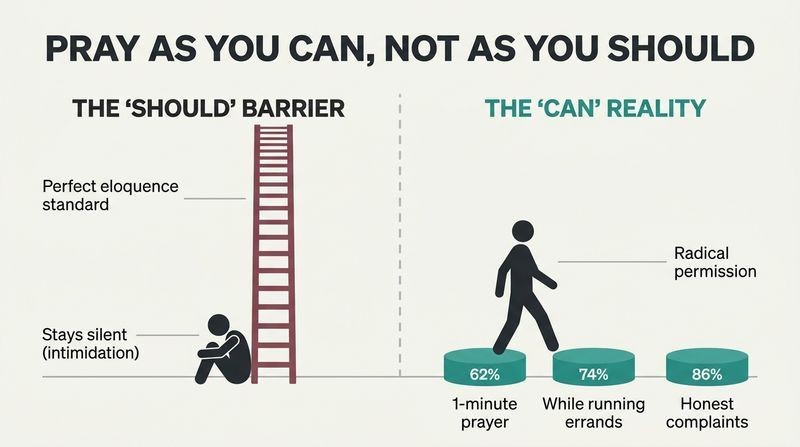
Staton's foundational rule, borrowed from Dom John Chapman, dismantles the biggest barrier to prayer: the fear of doing it wrong. Most people picture prayer as eloquent monologues delivered in a special holy voice, so they stay silent, feeling like an amateur following Winston Churchill in a speech class. The fix is radical permission.
If you cannot pray for an hour, pray for a minute. If you zone out sitting still, pray while running errands. If praise feels fake, pray your complaints instead. If you are more comfortable with cynicism than innocence, that is a perfect starting place. The only nonnegotiable is showing up honestly and repeatedly. As one professor put it, if you are praying, you are already doing it right.
This reframing echoes behavioral science on habit formation: lowering the activation threshold beats demanding heroic effort. James Clear's two-minute rule and Staton's one-minute prayer share DNA. What distinguishes the argument is its theological grounding: God prefers the rough draft full of rants over the polished version, because relationship, not performance, is the aim. The claim is liberating but worth pressure-testing. Critics might note that low-bar practices can stay low forever without some structuring intention. Staton anticipates this by pairing permission with persistence, which keeps the door open without letting minimalism calcify into complacency.
Prayer begins with presence, not with getting outcomes
Staton's origin story anchors this: at thirteen, a skeptic, he walked prayer laps around his middle school each summer, praying by name for classmates from a school directory. He did not just need God, he discovered he liked God's company. Roughly a third of his eighth-grade class came to faith that year. Twenty years later, as a Brooklyn pastor, he returned to that parking lot at dawn, weeping, simply wanting to be there.
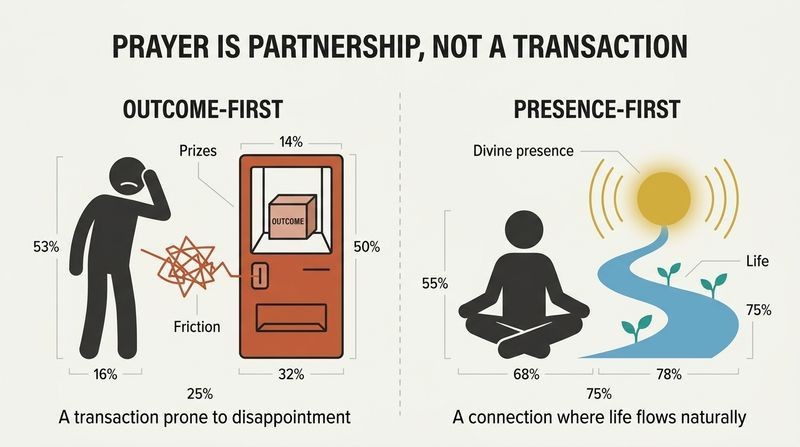
The point: prayer is choosing God's company before it is a transaction. We rush to results and get tangled when outcomes disappoint. But in a world that mostly ignores God, choosing to say "I want to be with you" blesses the Father's heart. Prayer starts with preferring presence, and everything else flows downstream of that.
There is a useful parallel to attachment theory here. Secure relationships are built on non-instrumental contact, time spent together with no agenda, not merely crisis calls. Staton essentially argues most people relate to God like an anxious partner who only texts when they need something. Reframing prayer as companionship rather than petition mirrors what psychologists call the difference between transactional and communal relationships. The risk is that "presence" becomes vague spiritual mood music. Staton grounds it concretely: a physical place, a repeated time, a walked path. Presence is a practice with coordinates, not just a feeling.
Ruthlessly eliminate hurry, the great enemy of the spiritual life
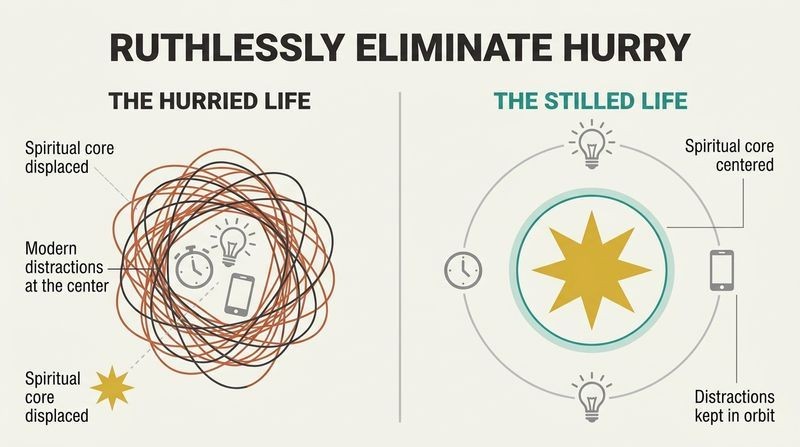
Drawing on Dallas Willard, Staton argues stillness is nearly impossible in a life shaped by three inventions: the clock (1370, shifting us from natural to artificial time), the light bulb (1879, cutting average sleep from ten hours), and the iPhone (2007). A 2016 study found the average user touched their phone 2,617 times daily; by 2019 screen time had doubled to over five hours a day.
Psalm 46's command "Be still, and know that I am God" is not a self-care slogan but rebellion against an ancient reflex. Since Eden, humans have hidden from truth by staying in motion. A five-year study of 20,000 Christians named busyness the number one distraction from God, trapping doctors, lawyers, and pastors most. Stillness lets God move from the periphery back to the center.
Staton joins a chorus (Willard, Comer, Rolheiser) diagnosing hurry as a spiritual pathology, and the framing is sharp: we blame our environment, but Thomas Kelly's Hawaii sabbatical showed the frantic pace traveled with him. Our outer chaos mirrors inner disorder. This resonates with research on attention residue and the default mode network, which only activates during rest. There is a mild irony worth naming: Staton sells an app to support the practice, and the same devices fragmenting attention now host meditation tools. The deeper claim holds regardless. Stillness is not productivity's enemy but the precondition for seeing your life accurately.
Start prayer by remembering who you are talking to
When the disciples asked Jesus to teach them, he opened with "Our Father," a scandal in a culture that approached God through cleansing rituals and animal sacrifice. The ancient question was never "Does God exist?" (obviously, given the pillar of fire) but "Is God knowable?" Jesus made the awesome God intimate without diminishing his majesty. Staton's threefold foundation:
1. Remember who God is (Father, not distant dictator).
2. Remember who you are (beloved, a "saint" meaning one who has tasted God's goodness).
3. Remember who we are to each other (siblings, since Jesus said "our," not "my").
The serpent's original tactic in Eden was subtle: he called God by the impersonal title Elohim, demoting Father to stingy dictator, twisting a generous command into a restrictive one. Prayer restores the memory the serpent stole.
The linguistic detail about Elohim versus Yahweh Elohim is genuinely illuminating and reflects real scholarly attention to divine names in Genesis. Staton's insight that temptation works by eroding trust in character, not by direct persuasion, maps onto modern manipulation tactics, from gaslighting to disinformation, which rarely make outright claims but seed doubt. The reframing of "saint" as anyone who has experienced God's goodness, rather than a moral elite, democratizes the term usefully. One nuance: calling God "Father" carries real pain for those with abusive fathers, a wound Staton acknowledges elsewhere. The concept survives because it names divine character, not human fatherhood.
Confession is descent into deeper layers, not a shrinking to-do list
Staton rejects the common assumption that spiritual maturity means confessing less because you have less to confess. The opposite is true. Maturity is an archaeological dig, uncovering layer after layer of what was in you all along, alongside how deeply grace has penetrated. He traces his own descent honestly: a Goosebumps ghost story that terrified a kindergartner at age seven, teenage rage, college gossip, a pornography addiction that persisted through Bible college, ministry, and marriage, now impatience and anger toward his wife and toddlers.
Sin, biblically, is not condemnation but diagnosis: a refused relationship with God that spills into wrong relationships with others. Hebrews says Jesus does not lob pep talks from a distance; he co-suffers, drawn instinctively toward our weakness like a doctor who survived the same disease. The goal is a church without secrets, not a church without sin.
The inversion of maturity-as-less-confession is the chapter's most counterintuitive gift, and it aligns with clinical psychology's view that self-awareness deepens rather than resolves as people grow. The Moravian revival of 1727, which Staton recounts, began not with a strategy but with a night of raw mutual confession, and the hundred-year prayer meeting was its overflow. This challenges performance-driven religious culture directly. Brene Brown's research on vulnerability and shame offers secular corroboration: naming shame in trusted relationship weakens its grip, while secrecy feeds it. The one caution: confession without safe, mature community can retraumatize. Staton rightly stresses trusted spiritual friendship as the container.
You were created to rule, and prayer restores that lost authority
Staton frames prayer's whole story in four acts: creation, fall, promise, and Jesus. Genesis says humans were made to "rule" as image-bearers, co-managers of God's world, all of us royalty. The fall was a communication breach. He compares it to his friend Russell, whose brain injury left his mind intact but severed from his body, so a thought like "move your hand" produced nothing. We see the world's suffering, carry God's authority, yet stay paralyzed.
Intercession (praying for others, from the Latin "to come between") is how the breach heals. Jesus won back "all authority" and told disciples they would now ask the Father directly, "in my name," meaning under his authority. To pray is to enter Jesus's standing before God, distributing heaven's resources into a broken world. God does not need intercessors; he chooses them.
The paralysis metaphor is vivid and theologically ambitious, casting prayer as the nervous system reconnecting divine intention to earthly action. This "participatory sovereignty" sits in a long debate between Calvinist determinism and open theism. Staton leans toward the latter without fully committing. Walter Wink's line that history belongs to the intercessors captures the high view. The obvious objection, which Staton honors rather than dodges, is unanswered prayer: if we are co-rulers, why does so much go unaddressed? The framework's strength is that it makes prayer consequential rather than decorative. Its vulnerability is theodicy, which the book confronts head-on rather than smoothing over.
Pray small, ordinary requests, not just noble cosmic ones
Staton confesses his internal eye-roll when his mother-in-law prayed for a parking spot amid global hunger and overconsumption. Then she found the spot and thanked Jesus, with gratitude in her heart and bitterness in his. His point: Jesus deliberately wedged "give us today our daily bread" between cosmic petitions like "hallowed be your name" and "your kingdom come."
Using everyday deli-counter language keeps prayer grounded in this day: what you will eat, whom you will meet, how you will feel. If you pray only for big noble things, you live a cramped spiritual life with little room for the actual God who gives good gifts like a father handing out ice cream. Gutierrez said the healthy soul's diet is prayer, justice, and gratitude. Staton had two of three; his soul was shriveled from missing gratitude.
The parking-spot debate is a genuine fault line in contemporary spirituality, pitting social-justice seriousness against childlike petition. Staton's resolution, that gratitude for small things is the nutrient a healthy soul cannot skip, finds support in positive psychology: Emmons and McCullough's gratitude research links regular thankfulness to measurable wellbeing gains. There is a real tension he mostly sidesteps: privilege can disguise itself as piety, and thanking God for a parking space beside genuine suffering can numb rather than sensitize. The strongest reading is not that all requests are equal, but that a God too grand for small things is a God too small for intimacy.
Pray in the middle voice: join God's action, do not initiate or spectate
Borrowing from Eugene Peterson, Staton distinguishes three grammatical voices. Active: I initiate ("I give advice"). Passive: I am acted upon ("I am given advice"). Middle: I participate in an action begun by another ("I take advice"). English lost the middle voice; ancient Greek kept it, and prayer lives there.
Active prayer tries to manipulate God into our will (the Pharisees' code-cracking). Passive prayer empties the self toward blank serenity (Eastern meditation). Jesus did neither. Mary modeled the middle voice at the Annunciation: "I am the Lord's servant. May your word to me be fulfilled," surrendering to and participating in a plan that upended her life. God's activity is like the Mississippi's current: you can swim with it, or fight and be dragged along exhausted, but you cannot pretend it is a still pond.
The grammatical framing is Peterson's, and it is one of the more elegant conceptual tools in Christian spirituality, dissolving the false binary between manipulating God and passive resignation. It parallels the psychological concept of agency within constraint, or the Stoic dichotomy of control reframed relationally. The middle voice also resembles improvisation in jazz or flow states, where the performer is neither fully in control nor passive but responsively engaged. One limitation: discerning "what God is already doing" is notoriously subjective and has justified everything from courage to self-delusion. Staton's safeguard is that middle-voice prayer produces the fruit of Jesus, especially mercy toward the marginalized, which offers an external check.
Intimacy produces fruitfulness, never the reverse
Staton warns against a common tragedy: pursuing mission, activism, and justice while skipping intimacy with God. It often starts strong through gritted teeth, but frequently ends in exhaustion and resentment, with the most dedicated servants growing cold and judgmental toward the church. Mother Teresa insisted she was not an activist but a "contemplative in the heart of the world"; her care for the dying was the accidental overflow of prayer.
The Hebrew word for personal righteousness and outward justice is identical: tsedaqah. To be righteous is to care for the poor, and vice versa. Jesus told the Pharisees who cleaned the outside of the cup to be generous to the poor, and everything would be clean. Prayer is the furnace that fuels mission; fruit is the collateral gain of loving God, not a goal pursued directly.
This is a crucial corrective for burnout culture, and it has empirical teeth. Research on helping professions consistently shows compassion fatigue correlates with depleted internal resources and lack of restorative practice. The tsedaqah point, that Hebrew does not separate inner devotion from outer justice, undercuts the false split between contemplatives and activists that has long divided religious communities. Staton's claim that fruitfulness apart from intimacy "tends to end in resentment" is a strong generalization that ignores plenty of effective secular activists, but as pastoral wisdom about sustainability it rings true. The insight generalizes: any mission divorced from its animating source eventually hollows out.
Keep asking, because silence is not a no and never wasted
Jesus's "ask, seek, knock" uses a Greek tense implying continuous action: keep asking, keep seeking, keep knocking. Staton illustrates with Jenna, who prayed daily for years for a baby while receiving smaller answered prayers (groceries, rent money, even a microwave within 48 hours). Then her sister-in-law Helen, granted a miracle baby, died of cancer before the child's first birthday. Jenna's crisis: either God is not powerful enough or not good enough.
Her counselor asked what reason could justify Helen's death. There was none. That left a choice: embrace mystery or run from it. Jenna chose trust, not that God willed the death, but that God is good and present in suffering. Scripture says God collects two things, prayers (golden bowls in Revelation) and tears (kept in his bottle), and both are ingredients in redemption. No tear is wasted.
Staton confronts theodicy without cheap resolution, which is the chapter's integrity. His parable reading is sharp: Jesus contrasts God with the unjust judge rather than comparing them, so the logic is "how much more." The Acts 12 detail lands hard: James executed, Peter miraculously freed, same circle, same prayers, different outcomes, no explanation offered. His honest "I don't know" is more credible than tidy answers. The distinction Parker Palmer draws, that deeper faith means enduring more doubt, aligns with research on post-traumatic growth, where meaning emerges through rather than around suffering. The framework's power is that it refuses to make God's goodness contingent on getting what we asked for.
Sustain prayer with a monk's rhythm and a lover's heart
Staton's title concept: pray like a monk (disciplined rhythm), live like a fool (reckless love). Fidelity is boring, which is precisely why it matters. Love comes easy at the honeymoon and in old age, but the ordinary middle years must be structured. Jesus modeled a daily prayer rhythm (morning, midday, evening) inherited from the Hebrew tradition, seen in Daniel praying three times daily and echoed throughout Acts. The Lord's Prayer itself adapts the ancient Jewish Kaddish, made radically personal.
Bonhoeffer told a couple that their love would not sustain their marriage; their marriage would sustain their love. Prayer works the same way. The Moravian refugees at Herrnhut, disillusioned after five years, finally committed to disciplined daily prayer, and 48 people launched a hundred-year, round-the-clock prayer meeting and the modern missions movement. Structure is the trellis on which love grows.
This is the book's synthesizing thesis, and it neatly resolves the perennial tension between spontaneity and discipline that fractures devotional life. The jazz analogy is apt: improvisation requires mastery of scales first. Behavioral science backs the rhythm claim, since fixed cues (time and place) automate behavior far better than relying on motivation, which is a depleting resource. The Bonhoeffer line reframes commitment as the scaffolding that carries you through the inevitable troughs of feeling. The Kaddish detail is historically sound and disarms the myth of the Lord's Prayer as wholly original. The honest admission that fidelity is boring is what makes the prescription trustworthy rather than romanticized.
Analysis
Tyler Staton's book is a genre hybrid: part memoir, part pastoral theology, part practical manual, structured loosely around the Lord's Prayer with each chapter closing in a hands-on exercise. Its audience spans what he calls saints, sleepwalkers, and skeptics, and its central wager is that prayer, not doctrine or institutional church, is the live wire connecting a suspicious post-Christian West to God.
The book's intellectual signature is its refusal of tidy answers. Where much devotional writing traffics in triumphant testimonies, Staton fixates on "the middle," the murky space between petition and outcome where doubt festers. His willingness to hold Peter's miraculous rescue and James's execution in the same frame, offering only "I don't know," is rare and disarming. This intellectual honesty is the book's greatest asset and distinguishes it from prosperity-adjacent spirituality.
Staton draws heavily on a specific lineage: Willard, Peterson, Nouwen, Manning, Greig, Comer. This is both strength and limitation. The synthesis is skillful, but readers may notice the book channels a particular contemplative-evangelical stream, and its treatments of Eastern meditation and other traditions are somewhat instrumentalized as contrast rather than engaged on their own terms. The theology of "participatory sovereignty," that God chooses rather than needs intercessors, wades into deep waters (open theism, the problem of evil, the efficacy of petition) without fully resolving them, which is arguably appropriate for a pastoral rather than systematic work. His reframings, notably confession as descent rather than ascent, and fruitfulness as the byproduct of intimacy rather than its goal, are genuinely useful correctives to achievement-oriented religious culture and burnout.
The practices anchoring each chapter save the book from being merely inspirational. Its recurring insight, that prayer is learned only by praying, not by reading about it, is a fitting self-critique: the book knows it is a menu, not a meal, and repeatedly points beyond itself to the conversation it hopes to start.
Review Summary
Praying Like Monks, Living Like Fools received overwhelmingly positive reviews, with readers praising its practical approach to prayer and inspiring content. Many found it transformative, encouraging a deeper connection with God and bolder prayer habits. Readers appreciated the balance of theological insights and personal anecdotes. Some criticized the book's organization and theological assumptions, but most found it impactful. The book's emphasis on perseverance in prayer and its practical applications resonated with many readers, who reported a renewed desire to pray and deepen their faith.
People Also Read




Glossary
Praying Like Monks, Living Like Fools
Disciplined rhythm plus reckless loveStaton's central formula for sustainable prayer. "Like monks" means grounding prayer in a fixed daily rhythm (morning, midday, evening) and structured practices that carry the relationship through dry, boring stretches. "Like fools" means the reckless, undignified love that drives it, exemplified by King David dancing in a priest's undergarment. Structure sustains love the way a marriage sustains romance.
The Middle Voice
Participating in God's initiated actionA concept borrowed from Eugene Peterson using Greek grammar. Active voice means initiating action; passive means being acted upon; the middle voice, lost in English, means participating in an action begun by another. Prayer lives in the middle voice: we neither manipulate God nor are passively manipulated, but join what God is already doing, like Mary's surrender at the Annunciation.
Intercession
Praying on another's behalfFrom the Latin meaning "to come between." It is the act of praying for someone else, motivated by love, distributing heaven's resources into places that love is lacking. Staton frames it as humans recovering their created role as co-managers of God's world, repairing the communication breach between divine intention and earthly action that the fall introduced.
Daily Bread Prayers
Ordinary, small, everyday requestsPrayers about immediate, mundane needs (a meeting, a meal, rent, even a parking spot) using common everyday language rather than special religious vocabulary. Named from the Lord's Prayer petition. Staton argues these ground prayer in the present day, wage war against the desire for control, and open the path to gratitude that a healthy soul requires.
Rebellious Fidelity
Faithful prayer as quiet rebellionStaton's term for committing to a daily prayer rhythm as an act of defiance against a culture of hurry, distraction, and self-sufficiency. It reframes disciplined, unglamorous, repeated prayer not as legalism but as freely choosing God's love on all the ordinary days, marching to a different order of loves.
Tabernacle of David
Open access prayer at the centerDrawn from David pitching a tent for the ark in Jerusalem's center, staffing it with around-the-clock worship for 33 years with no restrictions on access to God's presence. Staton uses it as his vision for the church: prayer prioritized at the center of a community, producing kingdom transformation in the surrounding city.
FAQ
What's Praying Like Monks, Living Like Fools about?
- Exploration of Prayer: The book delves into the beauty, mystery, and necessity of prayer, illustrating its transformative power in the lives of both believers and skeptics.
- Invitation to Experience: Tyler Staton invites readers to engage in prayer as a dynamic relationship with God, emphasizing its role in connecting with the divine.
- Practical Guidance: Each chapter includes exercises and reflections, making it suitable for both newcomers to faith and seasoned Christians seeking deeper exploration.
Why should I read Praying Like Monks, Living Like Fools?
- Inspiring Perspective: The book offers a fresh, relatable perspective on prayer, with engaging writing and personal anecdotes that resonate with readers.
- Practical Exercises: It includes exercises at the end of each chapter, helping readers implement what they learn and cultivate a meaningful prayer life.
- Addressing Modern Concerns: The book speaks to contemporary issues like anxiety and disconnection, encouraging a return to prayer as a source of strength and guidance.
What are the key takeaways of Praying Like Monks, Living Like Fools?
- Prayer as Relationship: Staton emphasizes that prayer is about building a relationship with God, not just making requests.
- Importance of Adoration: Adoration is crucial in prayer, reminding us of who God is and shaping our approach to requests and intercessions.
- Intercessory Prayer: The power of praying for others is highlighted as a selfless act of love, inviting God's action in their lives.
What are the best quotes from Praying Like Monks, Living Like Fools and what do they mean?
- “Prayer is a search for help outside the self.”: This quote highlights prayer as a humble acknowledgment of our need for divine assistance.
- “Be still, and know that I am God.”: Encourages stillness in prayer, allowing for a deeper connection with God.
- “History belongs to the intercessors, who believe the future into being.”: Suggests that intercessory prayer can shape history, calling believers to actively pray for the world.
How does Tyler Staton define intercessory prayer in Praying Like Monks, Living Like Fools?
- Act of Love: Intercessory prayer is defined as a selfless act of love, praying for others' needs and circumstances.
- Invitation to God’s Action: It invites God’s intervention in situations where love is lacking, asking for change in others' lives.
- Connection to Authority: Staton links it to the authority believers have in Christ, accessing God’s resources to effect change.
What practical advice does Praying Like Monks, Living Like Fools offer for improving my prayer life?
- Start Where You Are: Begin your prayer journey from your current state, without needing perfection or polish.
- Incorporate Stillness: Emphasizes the importance of stillness, suggesting that quieting the mind allows for a deeper connection with God.
- Use Everyday Language: Advocates for using simple language in prayer, making it more accessible and genuine.
How does Praying Like Monks, Living Like Fools address the issue of unanswered prayers?
- Understanding God’s Timing: Acknowledges the frustration of unanswered prayers but encourages trust in God’s timing and wisdom.
- Invitation to Deeper Relationship: Unanswered prayers can deepen one's relationship with God, prompting reflection and growth.
- Emphasis on God’s Sovereignty: Reinforces that God is sovereign and knows what is best, encouraging humility in prayer.
What role does gratitude play in Praying Like Monks, Living Like Fools?
- Foundation of Prayer: Gratitude shifts focus from requests to appreciation for God’s blessings, transforming prayer.
- Healthy Spiritual Diet: References a spiritual life consisting of prayer, justice, and gratitude, highlighting its importance.
- Connection to Daily Life: Encourages incorporating gratitude into daily prayers, recognizing small blessings and fostering awareness of God’s presence.
How can I apply the concepts from Praying Like Monks, Living Like Fools in my daily life?
- Set Aside Time for Prayer: Carve out dedicated time for prayer each day, making it a priority in your schedule.
- Engage in Community Prayer: Highlights the importance of praying with others, enhancing the experience and providing support.
- Practice the Exercises: Actively participate in the exercises provided to deepen understanding and experience of prayer.
How does Tyler Staton define prayer in Praying Like Monks, Living Like Fools?
- Prayer as Conversation: Defined as a conversation with God, emphasizing its relational aspect.
- Prayer as Participation: Seen as a way to participate in God’s work, shifting focus from requests to engaging with God’s plans.
- Prayer as Trust: Highlights trust in God with our lives and circumstances, cultivated through regular communication.
What specific methods does Staton suggest for improving prayer life in Praying Like Monks, Living Like Fools?
- Establish a Daily Rhythm: Create a daily rhythm of prayer, incorporating specific times for morning, midday, and evening prayers.
- Pray with Specificity: Encourage praying for specific needs and desires, fostering vulnerability and openness.
- Incorporate Scripture: Use Scripture as a guide for prayer, grounding prayers in biblical truth and enriching the experience.
What is the significance of the title Praying Like Monks, Living Like Fools?
- Monastic Prayer Life: Reflects adopting a monastic approach to prayer, emphasizing discipline and depth.
- Foolishness of Faith: Suggests embracing countercultural aspects of faith that may seem foolish to the world.
- Balance of Prayer and Action: Encapsulates the balance between a life of prayer and active engagement in the world.
About the Author
Other books by Tyler Staton

Download PDF
Download EPUB
.epub digital book format is ideal for reading ebooks on phones, tablets, and e-readers.








































