Key Takeaways
1. Electoral Autocracies Thrive on Genuine Popular Appeal, Not Just Repression
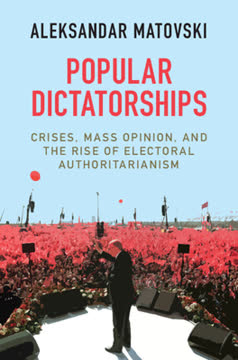
Challenging conventional wisdom, Popular Dictators shows that the success of electoral authoritarianism is not due to these regimes’ superior capacity to repress, bribe, brainwash and manipulate their societies into submission, but is actually a product of their genuine popular appeal in countries experiencing deep political, economic and security crises.
Beyond coercion. Electoral autocracies, regimes that mimic democratic institutions while subverting them, have become the most prevalent and resilient non-democracies globally. Unlike traditional dictatorships, their enduring success isn't primarily rooted in brute force, propaganda, or corruption. Instead, this book argues that their power stems from a genuine popular appeal, particularly in nations grappling with profound political, economic, and security crises.
Crisis-born legitimacy. In societies traumatized by turmoil, dysfunction, and injustice, elected strongmen emerge as appealing figures. They promise a unique blend of efficient, decisive rule and popular accountability, attracting mass support through the ballot box. This "crisis legitimation strategy" allows them to rule with a popular mandate, making them a far more insidious threat to global peace and democracy than previously understood.
A new paradigm. This perspective fundamentally reinterprets the nature of electoral authoritarianism. It suggests that these regimes don't merely "fake" democracy; they hijack it by tapping into real public anxieties and offering a seemingly pragmatic solution. This ability to usurp democratic processes, rather than just suppress them, is what distinguishes them and explains their proliferation in an era of supposed democratization.
2. Deep Crises Create a Demand for "Strongman" Rule
The most distinctive and yet least appreciated aspect of electoral authoritarianism, as this book will show, is that it has appeared in the wake of the deepest crises in the countries that have been ruled by such regimes.
Unmanageable turmoil. Electoral autocracies consistently emerge following periods of profound national crisis, including unmanageable conflict, state collapse, socioeconomic decline, and widespread political dysfunction. These are moments when societies are desperate for order and stability, and alternative political systems have become thoroughly delegitimized in the public eye.
Inverted legitimation. In such contexts, traditional ideological or programmatic appeals lose their resonance. Instead, there's a premium placed on strong-armed, decisive, and popularly accountable leadership. This book's empirical analysis, using cross-national data, confirms that transitions to electoral authoritarianism are most strongly and consistently predicted by deep economic and security crises, far more than transitions to other regime types.
A safer bet. For populations reeling from chaos, electoral authoritarianism often appears as the "least bad" option. It offers a middle ground, promising to curb the divisive pluralism of liberal democracy while avoiding the unchecked tyranny of closed dictatorships. This hybrid nature makes it uniquely attractive to crisis-weary majorities seeking a pragmatic path to stability.
3. The "Strongman" Appeal Blends Authoritarian Efficiency with Popular Accountability
Promising efficient, strong-armed rule tempered by popular accountability, elected strongmen attract mass support in societies traumatized by turmoil, dysfunction and injustice, allowing them to rule through the ballot box.
The "perfect dictatorship." The core appeal of elected strongmen like Russia's Vladimir Putin, Turkey's Recep Tayyip Erdoğan, or Mexico's PRI lies in their promise to combine the best aspects of democracy and authoritarianism while avoiding their worst excesses. They offer popular accountability without the perceived chaos of liberal democracy, and strong, effective governance without the arbitrary violence of unchecked dictatorship.
Emergency rule doctrine. This isn't mere "cheap talk"; it's a coherent legitimation formula. Strongmen justify their rule as a form of emergency governance, necessary to restore order and justice in troubled societies. They claim that traditional ideologies and political rules hinder effective government, positioning themselves as indispensable "fixers" unburdened by partisan dogmas.
Three core principles: The strongman appeal rests on:
- Rally-Around-the-Strongman: Unifying the nation behind firm leadership in times of grave threat.
- Negative Legitimacy: Portraying all other political forces as incompetent, corrupt, or dangerous.
- Democratic Legitimacy: Validating their authority through regular elections, claiming to embody the sovereign will of the people.
4. Electoral Legitimacy Enables Authoritarian Behavior, Rather Than Restraining It
The popular legitimacy these regimes secure by prevailing at the ballots does not restrain their authoritarian behavior. It actually enables it.
Tyranny of the majority. A crucial, disturbing insight is that winning elections doesn't temper these regimes' authoritarian tendencies; it emboldens them. When elected strongmen secure a popular mandate, they interpret it as a license to dismantle checks and balances, suppress media freedom, and persecute opponents—all in the name of restoring order and justice.
Coercion with impunity. Unlike unpopular dictatorships where repression can backfire, a genuinely popular electoral autocracy can wield coercive tactics with greater impunity. Majorities who believe authoritarian rule is necessary will not only condone such actions but may even increase their support, seeing it as proof of their leader's tough, effective governance. This transforms repression into a tool that reinforces, rather than undermines, popularity.
Bypassing accountability. By appropriating the majoritarian principle, elected strongmen claim an "irresistible" moral and political power. If their mandate reflects the sovereign will of the majority, then no other institution—legislature, judiciary, or media—can legitimately challenge their actions. This effectively bypasses "horizontal accountability," allowing them to govern with unchecked executive power until the next election.
5. Popular Support is a More Reliable Foundation for Autocracy Than Elite Loyalty
Compared to cajoling elites to stake their money, effort, pride, and fate in sustaining authoritarian rule, persuading the masses not to get in its way – particularly when they fear this might cause chaos, instability, or new injustices – seems like a much better bet.
Bottom-up stability. This book challenges the elite-centric view of authoritarian survival, arguing that popular consent is a more fundamental and reliable pillar. Ordinary citizens, facing existential threats during crises, are often more motivated than elites to seek the protection of strongmen, as they have fewer resources to shield themselves from turmoil.
Passive consent. For the masses, sustaining an autocracy often requires little more than passive acceptance—failing to mobilize against it or its opponents. Elites, conversely, must actively contribute through taxes, administration, and repression, making their loyalty more conditional and prone to collective action problems. This makes popular inertia a powerful guarantor of autocratic stability.
Deterring coups. High popular legitimacy acts as a crucial deterrent against elite defections and military coups. Shifts in public sentiment, such as declining approval or rising protests, signal regime weakness, making coups more likely to succeed. Conversely, strong popular backing makes elite challenges riskier, as they might face mass resistance, as seen with Hugo Chávez in 2002 and Recep Tayyip Erdoğan in 2016.
6. "Heresthetics" Allows Strongmen to Redefine Political Competition and Divide Opposition
The strongman heresthetic that I described in Chapter 2 is an powerful campaign strategy based on a simple ploy: an authoritarian candidate seeks to associate himself (so far, they have always been male) with a compelling solution to the most essential problem of society – restoring order in the wake of crisis – for which the other political alternatives have no good answers.
Structuring the world. Electoral autocrats master the art of "heresthetics"—manipulating the choices available to voters to compel support. They introduce a new, dominant cleavage in political competition: the choice to accept or reject strong-armed, popularly endorsed rule as the solution to national crises. This strategy displaces traditional ideological or programmatic appeals, rendering them irrelevant or even dangerous.
Divide and conquer. This new cleavage effectively divides the opposition while uniting the strongman's supporters. Opponents, often rooted in diverse ideological camps (e.g., liberals, communists, nationalists), struggle to form a cohesive front against a regime that claims to transcend partisan divides for national salvation. Their attempts to counter the strongman often lead to further fragmentation, as they appeal to mutually exclusive constituencies.
The Russian example. In post-Soviet Russia, Boris Yeltsin and later Vladimir Putin expertly used this tactic. They framed their rule as the only bulwark against chaos, forcing opponents to either temper their anti-authoritarian stance or risk being labeled as destabilizing. This allowed them to win elections even without overwhelming popular enthusiasm, by exploiting the opposition's inability to unite around a credible alternative.
7. Russia's Post-Soviet Trauma Exemplifies the Rise of Crisis-Legitimated Strongman Rule
The popular mood that has underpinned Putin’s rule was forged not by one, but three successive catastrophic crises, which struck Russia in the last two decades of the twentieth century.
Triple catastrophe. Russia's experience since the late 1980s serves as a paradigmatic case of crisis-driven strongman rule. The collapse of Communism, the disintegration of the Soviet Union, and the catastrophic economic and political "shock therapy" of the 1990s inflicted profound collective trauma. This era saw a 42% economic decline, twice that of the Great Depression, and a population loss comparable to major wars.
Demand for order. These crises fostered a deep-seated popular demand for a strong, decisive leader. Public opinion surveys from the period show a dramatic shift: in 1989, 45% rejected concentrated power, but by 1996, nearly 70% supported temporary or permanent strong-armed rule. This shift occurred before Vladimir Putin's rise, demonstrating that popular demand preceded the supply of a strongman leader.
Putin's ascent. Putin capitalized on this mood, presenting himself as the "fireman" who would restore order. His brutal campaign in Chechnya cemented his image as an effective strongman, fulfilling the public's yearning for stability. His "Millennium Manifesto" explicitly framed his presidency as a response to Russia's imminent collapse, promising a "strong state power" within a democratic framework, effectively codifying the strongman legitimation doctrine.
8. "Survival Values" Drive Mass Opinion Towards Authoritarianism in Troubled Societies
People’s values and behavior are shaped by the degree to which survival is secure . . . When survival is insecure, people tend to close ranks behind a strong leader, forming a united front against outsiders – a strategy that can be called the Authoritarian Reflex.
Primacy of security. In societies plagued by severe crises, the desire to restore and preserve stability becomes the primary driver of mass opinion. This "Authoritarian Reflex" subordinates other political preferences, such as ideological views, aspirations for equality, or demands for pluralism and free choice, to the overriding impulse for survival.
Cross-national evidence. Analysis of the European and World Values Surveys (WVS/EVS) confirms this global pattern. Periods immediately preceding the rise of electoral autocracies show the highest prevalence of "survival values"—an emphasis on physical and economic security, coupled with low intergroup tolerance. This contrasts sharply with periods before democratic transitions, which are marked by a decline in such anxieties.
Regime cleavage. This heightened sense of existential insecurity allows authoritarian forces to establish a dominant "regime cleavage" in political competition. Voters prioritize the choice of a strong-armed, electorally accountable regime over traditional ideological or policy debates. This dynamic, observed in Russia and other electoral autocracies, makes it difficult for opposition parties to unite or gain traction, as their platforms are perceived as secondary to the imperative of stability.
9. The Crisis Legitimation Paradox: Strongmen Must Manufacture Crises to Endure
To sustain support for their rule over the long run, electoral autocracies must therefore maintain, or even manufacture, the crises and conflicts that legitimize their rule, while also appearing to protect against them.
A double-edged sword. The crisis legitimation strategy is both the main strength and greatest liability of electoral autocracies. While it allows them to gain power and popular support, it also creates a paradoxical dilemma: if they fully succeed in restoring stability, they risk becoming redundant. If they fail, their legitimacy is undermined.
Manufacturing threats. To maintain their indispensable status, strongmen are compelled to perpetuate or even create the very crises they claim to protect against. This involves a delicate balance: manufacturing crises that simmer but don't boil over, ensuring a persistent sense of insecurity without triggering outright collapse. This "stabilization dividend" is crucial for long-term survival.
Domestic and international implications. This paradox explains why electoral autocracies are consistently associated with conflict. They may engage in low-grade domestic purges, anti-terror campaigns, or territorial disputes to remind the populace of ongoing threats. This behavior is not merely diversionary; it's "revitalizing," designed to renew their core legitimacy as essential protectors of order and national interest.
10. Electoral Autocracies Learn to Orchestrate Conflicts for Survival
This book predicts that elected strongmen will abandon this complaisant stance when they lack supermajority appeal, moving to a more aggressive, “code yellow” type of behavior.
Escalating tactics. Electoral autocracies exhibit varying levels of belligerence depending on their popular appeal. At their peak, they may pursue peace to solidify their "savior" image. However, when facing declining support, they shift to a "code yellow" strategy of manufacturing low-grade crises and controlled conflicts to demonstrate their necessity.
"Gambling for resurrection." When popular appeal is critically low, strongmen resort to "code red" behavior, engaging in high-stakes, riskier confrontations. This "gamble for resurrection" aims to reactivate populations' preservation instincts and rally-around-the-flag reflexes, diverting attention from domestic failures. Slobodan Milošević's actions in Serbia, escalating conflicts in the Balkans to demobilize opposition, serve as a stark historical example.
Dangerous diffusion. This dynamic fosters a dangerous form of authoritarian learning. Regimes share "recipes" for exploiting terrorist threats, ethnic conflicts, and international disputes. Putin's annexation of Crimea, for instance, demonstrated how a high-risk gamble could boost domestic support, inspiring leaders like Turkey's Erdoğan to pursue similar aggressive foreign policies to consolidate power at home. This perpetuates instability, as strongmen strategically fuel the very threats they claim to eliminate.