

Plot Summary
Prologue
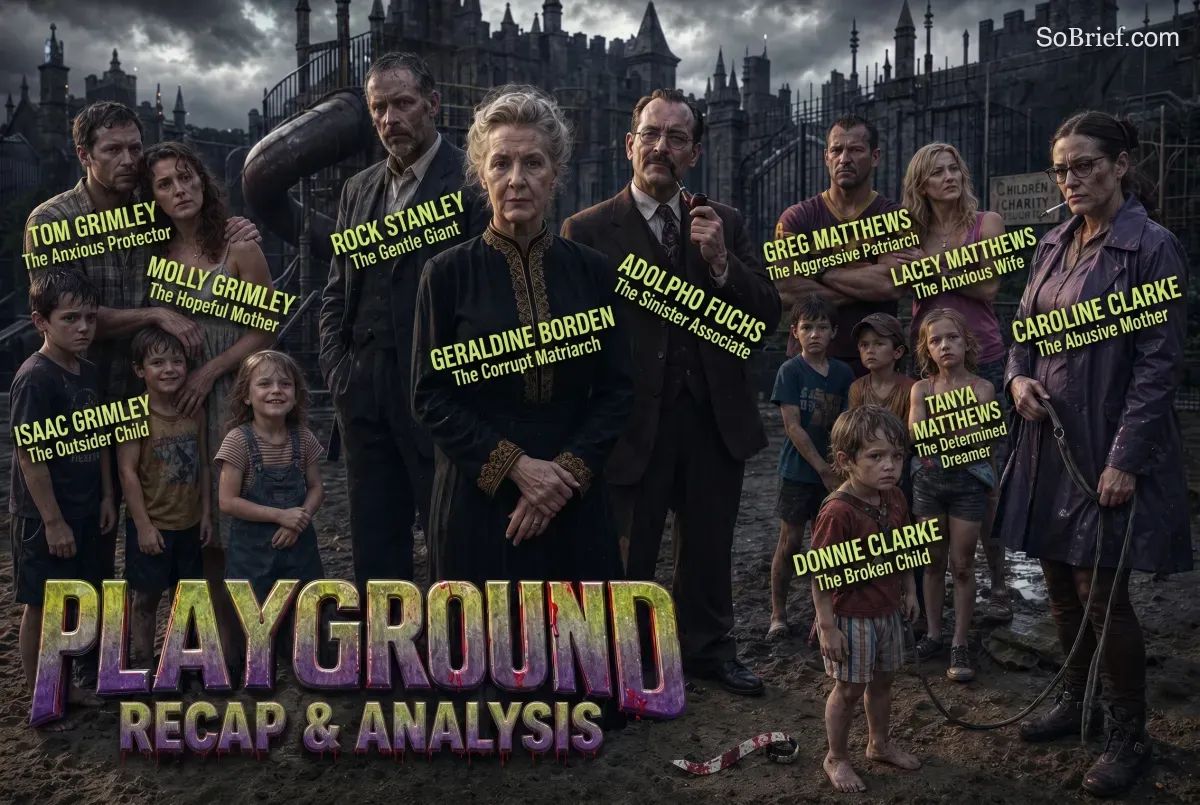
The book opens at a rain-soaked playground where Rock Stanley,1 a towering man with a brochure in his fist, watches a mother yank a leather leash attached to her six-year-old son Donnie.10 She times a violent tug to flip him off the swing headfirst into muddy sand, then slaps his skull clean. Rock1 recognizes the abuse — he knows it intimately.
The scene mirrors his own childhood under the grip of the woman who sent him here: Geraldine Borden,4 a wealthy recluse whose charity brochure promises playground equipment for disadvantaged communities. What it actually promises is something far worse. Rock1 approaches the mother.16 He has a quota to fill.
Golden Tickets at Broken Playgrounds
Tom8 and Molly Grimley9 can barely keep the lights on since Tom's8 layoff from Electric Boat. When a hulking stranger hands Molly9 a vibrant brochure at a decrepit park — along with a thousand-dollar retainer — the promise of three thousand more for letting their kids test an ultramodern playground feels miraculous.
Molly9 compares it to finding the golden ticket. Tom's8 gut says otherwise, but the bank balance speaks louder. Meanwhile, the Matthews family operates under different pressure: Greg,7 a former three-sport athlete whose torn ACLs ended his college career, funnels all hope into his athletic prodigy son CJ2 while dismissing eldest son Bobby6 as a worthless dud and steering daughter Tanya3 away from competitive swimming. Both clans are financially desperate enough to follow a stranger's brochure to a cliffside estate.
Geraldine's Infernal Obsession
Geraldine Borden4 grew up fixated on her mother's body — an obsession that began at seven and ended when she suffocated the dying woman by sitting on her face. When she realized her own appearance mirrored her mother's, narcissism replaced grief, and she filled a hidden wing with mirrors and mounted dildos for self-worship.
Desperate for a genetic replica, she bedded dozens of men only to discover irreversible infertility. At a playground, watching mothers with look-alike daughters, Geraldine's4 jealousy crystallized into purpose.
She recruited Adolpho Fuchs11 — a Nazi scientist pardoned through Operation Paperclip who had designed concentration camps — to build something more personal: a lethal playground beneath her estate, designed to destroy the children she could never have.
Inside the Gilded Gates
The Grimleys — Tom,8 Molly,9 and their three children Isaac,5 Sam,13 and Sadie12 — arrive at the Borden Estate alongside the Matthews clan of six. Geraldine,4 flanked by Fuchs11 and a freshly suited Rock,1 greets them with forged safety documents and rehearsed warmth.
She explains the children will play unsupervised while parents watch from a camera-equipped spy room — and sweetens the payment to four thousand dollars. Tom8 objects to the separation; Greg7 mocks him as overprotective, and the two nearly come to blows before Rock's1 massive frame separates them.
Bobby,6 the eldest Matthews boy, immediately corners bespectacled Isaac,5 threatening the scrawny kid. CJ2 steps in to defend him. Once every parent consents, the children pour through the gate. Geraldine4 locks it behind them.
Lacey's Bracelet Slips
Geraldine4 leads the parents to plush theater seats and instructs them to lean back and close their eyes for a breathing exercise. When she presses a hidden red button, curved steel collars rocket from each chair and lock around their throats.
Lacey Matthews15 — fidgeting with a zebra-print slap bracelet her daughter Tanya3 gifted her — jerks forward at the critical instant. The collar punches clean through her neck, severing her jugular. Blood drenches Greg's7 face as his wife gurgles her final breath beside him.
Tom8 and Molly9 are pinned, helpless. Geraldine4 reveals the truth: the brochures were lies, the real playground is underground, and most of their children will not survive it. Each collar contains a single-use button to broadcast one brief message to the kids below.
The Leash Changes Hands
When Donnie's mother Caroline16 arrives with the boy still tethered to her wrist, Rock's1 composure fractures. She jerks the leash so hard Donnie10 scrapes his knee on the stone steps — and the boy doesn't cry, because numbness is all he knows.
The parallel to Rock's1 own childhood detonates something. He seizes the leash, wraps it around Caroline's16 throat, lifts her off the ground, and slams her skull onto the steps. He mounts her and pounds her face into unrecognizable pulp.
Afterward, cleaning Donnie's10 scrape in a bathroom, Rock1 lifts the boy's shirt and discovers clusters of cigarette burns stippling his armpit. The discovery extinguishes his guilt. He pockets the bloodied leash — a strange comfort object he cannot explain — and delivers the silent boy to the playground.
Dobermans in the Sandbox
Fuchs11 orders the children toward the towering big slide at the playground's rear. When they hesitate, Rock1 opens the gate for two frothing Dobermans. Isaac5 trips and loses his glasses; one dog clamps its jaws on his tricep and shakes. Shirtless and eleven, CJ2 throws his tee over the other Doberman's head and hurls the blinded animal over the perimeter fence, breaking its neck.
He blinds the second with fistfuls of sand, kicks it loose from Isaac,5 and drags the bleeding boy into the steel cube at the slide's base. Inside, CJ2 asserts leadership over the group — including resentful Bobby6 — and bandages Isaac's5 arm with his seven-year-old brother Kip's14 undershirt before the cube rockets them skyward toward what waits below.
Sam Runs for the Door
The slide deposits the children underground, their skin ribboned by embedded razor blades, into a marble-strewn room where pitching machines fire baseballs. Near the exit, they discover a ball pit with a hanging dummy, a knife, and a hangman puzzle on a chalkboard.
The riddle hints that the real way forward is hidden behind the puzzle — not down the dark corridor with the glowing pink exit sign. But Sam,13 Isaac's5 eight-year-old sister, breaks from the group in hysteria, sprinting toward the corridor door.
Her foot triggers a buried landmine. The blast tears off her leg. The ceiling descends. CJ2 and Isaac5 drag Sam's13 body toward safety, but the stone catches her mid-torso. Her skull compresses. Her organs burst. Sadie12 is left clutching her sister's severed arm.
Hopscotch Over the Grinders
CJ2 solves the hangman puzzle, retrieves a skeleton key from inside the dummy's fire-ant-infested head, and unlocks a hidden passage. The children crawl through air ducts into a chamber where a chalk hopscotch path stretches between two industrial meat grinders.
Cages of live cattle hang overhead. Donnie10 dashes across the path fearlessly — CJ2 intercepts him before the boy hops back. The others follow as cows drop screaming into the machinery. Liquefied cattle spray through tubes positioned along the hopscotch squares.
Kip,14 the seven-year-old Matthews, takes a blast of gore to the face and tumbles sideways into the grinder. His body is shredded instantly. Bobby6 makes the final crossing drenched in his brother's processed remains — then punches Isaac,5 blaming him for Kip's14 death. The fracture between the families deepens.
Molly's Voice Over the Snakes
The children reach a fork in the red-lit darkness. Isaac5 and Sadie12 take swings suspended over a fire pit that ignites beneath them, forced to build enough momentum to leap across a chasm to safety. CJ's2 group mounts spring riders on a mechanized track, dodging pendulum axes that swing from the shadows.
When CJ2 dives to avoid a blade, the hangman's knife slips from his waistband — Bobby6 quietly pockets it. Both groups converge at monkey bars stretched over a pit of broken glass and writhing serpents.
Molly9 presses her collar's single-use PA button and shouts that the bars are greased — they must crawl on top instead of swinging underneath. Her warning proves lifesaving: the children scale the structure and shimmy across safely. It costs Molly9 her only chance to speak to them again.
Father's Voice, Bobby's Blade
The children face twin slides rigged with retractable circular saws. Isaac5 calculates the timing using his shoe as a test projectile, and everyone slides through safely — except Sadie,12 who freezes at the top in terror. Greg's7 voice crackles over the loudspeaker: he tells Bobby6 these kids killed Kip,14 and orders his eldest to use the girl as something to ride on, like a skateboard.
Bobby6 obeys. He stabs Sadie12 repeatedly in the back with the pocketed knife, pins her flat on the slide, plants his feet on her body, and surfs her through the spinning blades. The saws carve through her face, chest, and small limbs while Bobby6 rides above the carnage unscathed. He lands at the bottom and levels the dripping blade at Isaac.5
Two Enemies Dissolve Together
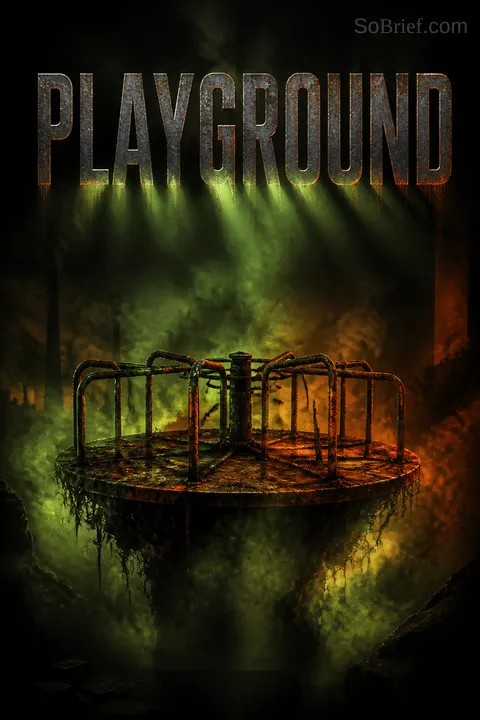
Bobby6 forces the remaining children onto a spinning merry-go-round suspended over a moat of bubbling toxic chemicals. As the ride accelerates, Isaac's5 rusted handhold gives way. Bobby6 seizes the moment, sawing the knife into Isaac's5 knuckles to peel him off the bar. Tom's8 voice booms from the PA, threatening Bobby6 — but Greg's7 counters, cheering his son on.
Isaac5 makes his decision: he releases his grip and clamps both hands around Bobby's6 wrist and the blade. Their combined weight tears Bobby6 free. They plunge together into the neon-green slurry. The acid dissolves their skin, melts their eyes from their sockets, and strips muscle from bone in seconds. The rivals who despised each other in life become one indistinguishable soup in death.
The Propeller Finds CJ
CJ,2 Tanya,3 and Donnie10 — the last three — enter a room dominated by a giant seesaw. When they sit, steel hooks erupt from the back supports and pierce deep under their armpits, pinning them in place. A spinning propeller whirs above their heads; flames erupt from the base.
They must seesaw ten times, each revolution bringing one sibling's skull within inches of the blades while the other's legs roast in fire. At count nine, CJ2 loses consciousness from his burns.
His dead weight crashes onto the coil spring, catapulting Tanya3 upward — she ducks below the propeller by millimeters — but the rebound launches CJ's2 limp body into the spinning steel. The blades split his skull and sever his head. Donnie10 pulls the screaming, half-burned Tanya3 free from her hooks and drags her toward a golden light.
Rock Tells Them to Stop
Tanya3 collapses in a sandbox at the base of a fifty-yard rope climber bristling with retractable spikes. Donnie,10 who has not spoken a single word the entire day, fishes lettered building blocks from the sand and arranges a message: he can ring the bell at the top.
When Tanya3 asks why he never talks, he opens his mouth to reveal a nub — his mother cut out most of his tongue. Before Donnie10 can climb, Rock's1 gruff voice rumbles over the loudspeaker, telling them to stay put. The game is over.
In the spy room, Rock1 smashes Fuchs'11 skull into the control panel, electrocuting the Nazi scientist to death and simultaneously releasing the parents' steel collars. Geraldine4 snatches the fallen Luger pistol and shoots Rock1 twice in the gut before fleeing into the estate.
Geraldine's Last Mirror
Rock1 kills Greg7 first — the man had been choking Tom8 — by forcing his entire fist down Greg's7 throat and clamping his broken nose shut until he suffocates. Molly9 patches Rock's1 gunshot wounds with strips of his own clothing, and he staggers toward Geraldine's4 bedroom.
She has barricaded herself in her hall of mirrors with the vintage Winchester rifle from the mantle. She fires at Rock's1 reflection and shatters glass. But Rock1 built this room mirror by mirror under her orders; he knows every dead space between the panes.
He punches through from behind, seizes her, and smashes her face into mirror after mirror, driving glass shards and suctioned dildos into her skull. He hoists her ruined body over a jagged glass spike and drops her onto it. Geraldine Borden4 dies staring at her own shattered reflection.
Survivors Reach the Surface
Tom8 and Molly9 help the hemorrhaging Rock1 descend to the underground playground. They heave open the heavy metal doors and find Tanya3 — face half-charred, arms gashed to the bone — sitting in the sandbox with Donnie's10 small burned arm draped over her shoulders. Tanya3 asks where her parents are. No one answers.
They climb the concrete steps into the estate's backyard, where the original beautiful playground still gleams in the fading sunlight. Rock1 deactivates the electrified perimeter gates and tells them they are free. Molly9 begs him to come to a hospital. Rock1 refuses. He asks only one thing: take care of the kid. His eyes linger on Donnie10 — the boy who mirrors everything Rock1 once was, and everything he might still become.
Epilogue
Rock1 stays behind alone, bleeding from everywhere. He is too massive for the slide, too heavy for the monkey bars — he crashes to the sand each time and laughs through the pain. He snaps the swing set clean off its bolts. Finally he crawls to the merry-go-round, spins it with whatever strength remains, and dives aboard.
Blood pools beneath him as the spinning slows. He watches the sky darken, feeling sunlight and ocean breeze on his bare skin for the first time without chains. The smile hurts his face — he has never held one this long. The man who spent thirty-four years as someone else's property dies doing the one thing he was never allowed to do: play.
Analysis
Playground operates as a sustained, unflinching thought experiment about the manufacture of monsters. Geraldine Borden4 wasn't born sadistic; her incestuous fixation germinated in childhood, was enabled by unchecked wealth, and calcified through biological denial. Fuchs11 wasn't invented as evil — a real government program laundered his war crimes into American assets. Rock1 wasn't broken by nature; decades of captivity eroded his agency until complicity became survival. Even Bobby,6 the story's most disturbing child antagonist, is transparently a product of Greg's7 toxic philosophy taken to its logical endpoint. Every villain in this novel is somebody else's creation.
The structural genius lies in its parallel architectures of control. Geraldine4 leashes Rock1 psychologically; Caroline16 leashes Donnie10 literally. Greg7 chains his children to athletic ambition; Lacey15 chains Tanya3 to gender expectations. The playground itself — with its posted rules, narrow corridors, and timed mechanisms — is simply the most honest version of what every authority figure has already been doing: confining children inside systems designed to serve adult needs.
The children's responses to lethal pressure reveal their parents' true investments. CJ's2 selflessness contradicts Greg's7 selfishness — he became good despite his father, not because of him. Tanya's3 strategic mind, dismissed at home as unfeminine, proves essential underground. Bobby's6 violence perfectly enacts Greg's7 win-at-all-costs philosophy. Isaac,5 the bullied weakling, demonstrates that courage is entirely divorced from physique. And Donnie10 — silent, abused, apparently empty — proves the most durable of all, because a child raised expecting the worst is perversely equipped to survive it.
The ending refuses sentimentality. Rock1 doesn't survive his redemption. The rescued children are permanently disfigured. The only closure is a dying man on a merry-go-round, doing at thirty-four what should have been possible at four. It is the saddest kind of victory: someone finally receiving what they deserved, exactly one lifetime too late.
Review Summary
Playground is a highly controversial splatterpunk novel that elicits strong reactions from readers. Many praise its shocking gore and compelling storytelling, while others criticize its graphic content, misogynistic themes, and writing style. The book follows children forced to participate in deadly playground games, drawing comparisons to Saw and Squid Game. Reviewers note the extreme violence, disturbing scenes, and boundary-pushing nature of the work. While some applaud the author's creativity and character development, others find the content offensive and poorly executed.
People Also Read
Characters
Rock Stanley
Geraldine's branded servantGeraldine Borden's4 adopted son and enforced servant—six-foot-three, two-hundred-eighty pounds, carrying the emotional development of a neglected child. Branded with the word 'MINE' on his chest, sexually exploited, and verbally demolished into believing he deserves nothing, Rock's identity is constructed from absence: no play, no friendship, no choice. He recruits families to the estate under duress, caught between complicity and survival. His psychology resembles complex PTSD layered with Stockholm syndrome—he hates Geraldine4 yet craves her approval. When he encounters Donnie Clarke10, a six-year-old whose abuse mirrors his own, something fractures in the conditioning. His arc turns on whether external compassion can penetrate decades of internalized worthlessness, and what remains of a person once the cage door opens.
CJ Matthews
The reluctant golden childEleven years old and blessed with extraordinary athleticism, CJ is treated by his father Greg7 as a retirement investment. Pushed relentlessly into baseball, he privately hates the sport and escapes into comics and music. His true gift isn't physical—it's moral. CJ possesses an instinct for fairness that his father never taught and actively undermines. He defends Isaac5 from Bobby's6 bullying, bandages wounds with torn shirts, asserts leadership through competence, and repeatedly risks his own life for others. Beneath the brave exterior lives a boy exhausted by performing someone else's dream. CJ embodies the tension between inherited talent and chosen purpose, between filial duty and personal identity. His leadership becomes the thread holding the terrified group of children together.
Tanya Matthews
Strategist beyond her yearsNine years old and the sharpest mind in the Matthews household, Tanya is the most underestimated member of her family. A straight-A student who dreams of competitive swimming, she is stifled by a mother who pushes cheerleading and a father who sees only sideline decoration. Her intelligence manifests as emotional and strategic acuity—she reads people, adapts approaches, and maintains composure when older children crumble. Throughout the underground playground, Tanya decodes the riddle-poems posted at each lethal station, serving as the group's intellectual compass while CJ2 provides its moral spine. She carries a quiet fury toward the gendered limitations imposed on her, which paradoxically fuels her resilience under extraordinary duress. Her relationship with CJ2 anchors them both.
Geraldine Borden
Barren architect of ruinWealth incarnate twisted into weaponized emptiness. Born into aristocracy, Geraldine developed a consuming incestuous fixation on her mother that began in childhood and calcified through biological denial—infertility stripped her of the genetic replica she craved to perpetuate the cycle. She worships her own reflection because she resembles her mother, filling her mansion with mirrors and instruments of self-pleasure. When reproduction proved impossible, jealousy toward fertile families metastasized into ideology. Geraldine doesn't simply hate children—she hates the biological privilege she was denied. Her playground is a monument to narcissistic wound, each lethal structure an expression of reproductive rage rendered in steel. She watches Tanya3 with particular intensity, seeing potential for something she has sought her entire life.
Isaac Grimley
The scrawny boy who adaptsTen, bespectacled, scrawny, and chronically underestimated—traits that make Isaac a magnet for bullies at school and inside the playground alike. His large, awkward ears are Bobby's6 favorite target. But beneath the timidity operates an analytical mind that compensates for what his body lacks. Isaac tests timing with improvised experiments, and his mother's9 shouted warning about greased monkey bars reaches him precisely because he listens when others shout. He bonds with CJ2 over shared decency, becoming a reluctant but genuine partner in survival. His arc traces the evolution from a child who avoids confrontation to one who charges directly into it, propelled by accumulated loss and a fierce promise to protect what remains of his family.
Bobby Matthews
The overlooked eldest sonThirteen years old and Greg's7 greatest disappointment—overweight, unathletic, passionate about skateboarding in a household that worships baseball. His father's relentless dismissal breeds a desperate craving for approval that, under extreme pressure, mutates into something monstrous. Bobby channels his humiliation into bullying weaker children, particularly Isaac5. He represents the direct psychological inheritance of toxic masculinity: a child who absorbs parental cruelty and redistributes it downward.
Greg Matthews
Win-obsessed vicarious fatherA former three-sport athlete whose torn ACLs at Boston College ended his career, Greg rebuilt his identity entirely around his children's athletic potential. He treats CJ2 as a financial investment and Bobby6 as a write-off. His competitiveness is pathological, consuming all parental instinct. Even imprisoned and watching children die on monitors, Greg cannot stop keeping score—he views the lethal playground as one final game the Matthews family must win, regardless of cost.
Tom Grimley
Skeptical but devoted fatherA laid-off shipyard worker whose skepticism about the playground offer proves tragically justified. Gentle and analytical by nature, Tom grew up in rough neighborhoods and retains the capacity for violence when pushed. Throughout captivity, he strategically works to crack Rock's1 emotional defenses, recognizing the giant's buried humanity when others see only a goon. His approach—empathy over aggression—becomes the family's only viable lifeline.
Molly Grimley
The hopeful, fierce motherMolly's optimism convinced Tom8 to accept the brochure offer, and that guilt shadows everything after. Yet her emotional openness—the quality that made her vulnerable to the con—also makes her the most effective at reaching Rock1. She uses her one PA message to save multiple children, patches Rock's1 gunshot wounds, and advocates for kids who aren't hers. Her capacity for empathy under apocalyptic grief reveals extraordinary psychological resilience.
Donnie Clarke
The silent, indestructible boySix years old, leashed to his abusive mother16, expressionless and seemingly unreachable. Donnie doesn't speak—not from choice, but because his mother severed most of his tongue. His emotional numbness, born from relentless cruelty, paradoxically becomes his survival advantage: while other children fracture under horror, Donnie barely flinches. He serves as both Rock's1 psychological mirror and the catalyst for the giant's moral awakening.
Adolpho Fuchs
The playground's Nazi engineerA Nazi scientist pardoned through Operation Paperclip, Fuchs designed concentration camps before Geraldine4 purchased his exclusive loyalty. His mechanical and biological expertise built every lethal structure in the underground playground. Urbane and pipe-smoking, Fuchs observes the children's suffering with clinical amusement, treating each death as engineering validation. He has stood by during every atrocity in the Borden household without a whisper of protest.
Sadie Grimley
The fierce little sisterSeven-year-old Sadie torments Isaac5 with targeted cruelty about his ears and appearance, yet her aggression masks a deep attachment she cannot articulate. She follows older sister Sam's13 lead in most things. When the playground strips away pretense, her ferocity transforms into courage—she swings across fire, defends Isaac5 from Bobby's6 fists, and clings to her sister's remains because letting go means accepting the unacceptable.
Sam Grimley
The empathetic middle sisterEight-year-old Sam is the gentlest Grimley child—a natural connector who gravitates toward lonely Donnie10 the moment she spots him standing alone at the gate. Her instinct to comfort others defines her, as does her vulnerability to panic.
Kip Matthews
Bobby's impressionable shadowThe youngest Matthews son at seven, Kip is tough but easily led—following Bobby's6 bullying without harboring genuine malice. His father monitors his athletic potential without rendering a final verdict.
Lacey Matthews
Cheerleading-obsessed motherGreg's7 wife and Tanya's3 chief obstacle to swimming lessons, Lacey wants her daughter in pom-poms, not pool lanes. She fidgets obsessively with a slap bracelet Tanya3 gifted her—a nervous habit with outsized consequences.
Caroline Clarke
Donnie's cigarette-wielding motherDonnie's10 mother wields a child leash and lit Parliament cigarettes to enforce total control. She represents the domestic mirror of Geraldine's4 institutional abuse—a smaller-scale tyrant manufacturing the same kind of broken human.
Plot Devices
The Playground Rules Signs
Riddle-based survival hintsPosted at every station of the underground playground, these signs contain rhyming riddles that hint at how to survive each obstacle without ever stating it plainly. The first warns not to stand tall and to use your ears and have a ball, hinting at the hangman puzzle's choking sounds and hidden key. Others describe hopscotch timing, swing strategies, and the seesaw's counting mechanism. Tanya3 becomes the group's designated interpreter, her intelligence directly saving lives when she decodes the veiled instructions. The signs serve a dual function narratively: they give Geraldine4 the illusion of fairness while ensuring most children will misunderstand and perish. They also generate dramatic irony, as readers sometimes decode the riddle before the characters do.
The Steel Neck Collars
Parent imprisonment mechanismConcealed within theater-style chairs in the spy room, these curved steel devices spring from the sides when Geraldine4 triggers a red button. Designed to lock around the neck and pin the head against the backrest, they render parents completely immobile. Each collar contains a small circular button that activates a one-time PA microphone, allowing each parent one brief broadcast to the playground below. The collars transform parents from passive spectators into helpless witnesses—close enough to watch their children die on camera screens, with just enough voice to offer one final piece of guidance. The device malfunctions fatally when Lacey15 lurches forward for her slap bracelet, the steel puncturing her jugular vein on deployment.
Donnie's Leather Leash
Abuse emblem and comfort tokenA leather child leash that Caroline Clarke16 uses to physically tether Donnie10. Rock1 initially views it as the embodiment of oppressive control—identical in principle to how Geraldine4 controls him. After detaching it from Donnie10, Rock1 pockets the bloodied leather and compulsively grips it throughout the story whenever anxiety or emotion overwhelms him. The leash functions as a transitional object representing Rock's1 unprocessed trauma: he cannot yet release what defined him. It also serves as a narrative bridge between the two abuse survivors—Rock1 and Donnie10—both shaped by parallel captivity under domineering women. The transfer of the leash from instrument of control to source of comfort symbolizes Rock's1 slow shift from captor's tool to protector.
The Single-Use PA Buttons
One-shot parental lifelineEach parent's steel collar contains a microphone button that broadcasts their voice through loudspeakers in the underground playground for just a few seconds before deactivating permanently. This device creates the story's most pivotal moral divergences: Molly9 uses hers to warn Isaac5 about greased monkey bars, directly saving multiple children. Greg7 uses his to order Bobby6 to murder Sadie12 as a human shield on the saw slide. Tom8 uses his to threaten Bobby6 during the merry-go-round in a failed attempt to halt the violence. The contrasting deployments illuminate the fundamental chasm between the Grimleys' selfless love and Greg's7 pathological competitiveness—given one final message to their children, each parent reveals exactly who they are.
The Hall of Mirrors
Narcissistic worship chamberA hidden wing behind Geraldine's4 bedroom, entirely covered floor-to-ceiling with extra-thick mirror panes and lined with suctioned dildos of various sizes. Geraldine4 designed it to worship her own reflection—a surrogate for the incestuous desire she can no longer fulfill with her dead mother. She uses the mirrors to stare at herself during sexual acts, imagining she is Mildred Borden reborn. The hall functions as both Geraldine's4 psychological portrait rendered architectural and the arena for her final confrontation. Crucially, Rock1 constructed the room under her direction, giving him intimate knowledge of its layout—including dead spaces between the panes where a body can hide. The instrument of her vanity ultimately becomes the weapon of her destruction.
FAQ
Synopsis & Basic Details
What is Playground about?
- Twisted playground competition: Playground is a horror novel centered around a group of underprivileged families lured to a secluded estate under the guise of testing a state-of-the-art playground for a lucrative payout.
- Sinister experiment unveiled: The families soon discover they are pawns in a sadistic experiment orchestrated by the wealthy and deranged Geraldine Borden, who seeks to fulfill her twisted desires through the suffering of others.
- Children navigate deadly games: The children are forced to navigate a series of increasingly dangerous and gruesome playground-themed challenges, while their parents are held captive and forced to watch.
Why should I read Playground?
- Extreme horror with depth: Playground offers a visceral and disturbing reading experience for fans of extreme horror, pushing boundaries with its graphic violence and unsettling themes.
- Exploration of dark themes: The novel delves into complex themes of control, abuse, societal inequality, and the corrupting influence of wealth, providing a thought-provoking, albeit disturbing, commentary on human nature.
- Character-driven narrative: Despite the extreme content, the story features compelling characters grappling with their own demons and fighting for survival, creating an emotional connection that elevates the horror beyond mere shock value.
What is the background of Playground?
- Socioeconomic disparity: The story highlights the stark contrast between the wealthy elite (represented by Geraldine Borden) and the struggling families, exposing the desperation and vulnerability of those living in poverty.
- Psychological manipulation: The novel explores the psychological effects of abuse, control, and trauma, both on the children forced to endure the playground's horrors and on Rock Stanley, Geraldine's long-suffering servant.
- Extreme horror genre conventions: Playground subverts the typical coming-of-age narrative by placing innocent children in a hyper-violent and exploitative environment, challenging the reader's expectations and forcing them to confront uncomfortable truths.
What are the most memorable quotes in Playground?
- "You're mine, remember?": This quote, spoken by Geraldine to Rock, encapsulates the theme of ownership and control that permeates the novel, highlighting the power dynamics within their twisted relationship.
- "Life ain't fair.": Greg's repeated assertion to his children reflects his cynical worldview and his belief in the importance of competition, even at the expense of others' well-being.
- "The pros don't feel pain.": This quote, also from Greg, reveals his distorted perception of success and his willingness to push his children to their limits, regardless of the physical or emotional cost.
What writing style, narrative choices, and literary techniques does Aron Beauregard use?
- Visceral and graphic descriptions: Beauregard employs vivid and unflinching descriptions of violence and gore, creating a sense of unease and horror that immerses the reader in the story's disturbing world.
- Alternating perspectives: The narrative shifts between the perspectives of the children, the parents, and Rock Stanley, providing a multifaceted view of the events and allowing the reader to understand the motivations and emotions of each character.
- Foreshadowing and symbolism: The author uses subtle foreshadowing and recurring symbols, such as the playground itself and the various toys and equipment, to create a sense of impending doom and to reinforce the novel's themes.
Hidden Details & Subtle Connections
What are some minor details that add significant meaning?
- The zebra-patterned slap bracelet: Tanya's gift to her mother, Lacey, initially seems like a harmless token of affection, but it later becomes a symbol of Lacey's vanity and her tragic death, highlighting the superficiality of her values.
- Rock's flat cap: This seemingly insignificant item of clothing represents Rock's subservient status and his attempts to blend in, concealing his true feelings and desires.
- The names of the characters: The name "Rock Stanley" suggests a solid, dependable nature, which is ironic given his internal struggles and his role in Geraldine's schemes. Similarly, "Geraldine Borden" evokes a sense of old money and aristocratic privilege, hinting at her family's dark history.
What are some subtle foreshadowing and callbacks?
- Caroline's use of a leash on Donnie: This early scene foreshadows the theme of control and the oppressive nature of Geraldine's influence over Rock, creating a parallel between the two abusive relationships.
- Tom's initial skepticism: Tom's repeated doubts about the playground offer foreshadowing of the sinister events to come, highlighting his intuition and his awareness of the potential dangers lurking beneath the surface.
- The description of the hall of mirrors: The detailed description of the hall of mirrors early in the story foreshadows its significance as the location of the final confrontation between Rock and Geraldine, emphasizing the theme of self-reflection and the distorted nature of reality.
What are some unexpected character connections?
- Rock and Donnie: Despite their age difference and vastly different circumstances, Rock and Donnie share a connection as victims of abuse and control, highlighting the cyclical nature of trauma and the potential for empathy across generations.
- Greg and Geraldine: Both characters share a warped sense of entitlement and a willingness to exploit others to achieve their goals, revealing a disturbing parallel between their personalities and their motivations.
- Molly and Rock: Molly's compassion towards Rock, despite his involvement in the horrific events, reveals her capacity for empathy and her ability to see beyond appearances, highlighting the potential for redemption even in the darkest of circumstances.
Who are the most significant supporting characters?
- Fuchs: As Geraldine's loyal accomplice, Fuchs enables her twisted desires and provides the scientific expertise necessary to carry out her plans. His presence adds a layer of historical horror to the narrative, embodying the theme of past evils resurfacing in the present.
- Tom Grimley: As a loving father and husband, Tom represents the values of family and community, providing a moral compass for the story and highlighting the importance of protecting loved ones in the face of adversity.
- Tanya Matthews: As a resourceful and intelligent young woman, Tanya emerges as a leader and a symbol of hope, demonstrating resilience and compassion in the face of unimaginable horror.
Psychological, Emotional, & Relational Analysis
What are some unspoken motivations of the characters?
- Geraldine's desire for control: Driven by a deep-seated insecurity and a longing for the family she never had, Geraldine seeks to exert absolute control over others, manipulating their lives and orchestrating their suffering to fulfill her twisted desires.
- Rock's yearning for acceptance: Haunted by his past and burdened by feelings of inadequacy, Rock craves Geraldine's approval, even though he knows it will never come. His desire for acceptance drives him to carry out her bidding, despite his growing moral qualms.
- Greg's need for validation: As a former athlete who never achieved his full potential, Greg seeks validation through his children's success, pushing them relentlessly and sacrificing their well-being to fulfill his own ego.
What psychological complexities do the characters exhibit?
- Rock's Stockholm syndrome: Rock's complex relationship with Geraldine exhibits elements of Stockholm syndrome, as he develops a twisted sense of loyalty and dependence on his abuser, despite her cruelty and manipulation.
- Tanya's survivor's guilt: As one of the few children to survive the playground's horrors, Tanya grapples with feelings of guilt and responsibility, questioning why she was spared while others perished.
- Greg's narcissistic tendencies: Greg displays narcissistic traits, characterized by his inflated sense of self-importance, his need for admiration, and his lack of empathy for others, particularly his children.
What are the major emotional turning points?
- Rock's violent outburst: Rock's murder of Caroline Clarke marks a turning point in his character arc, as he finally confronts his pent-up rage and begins to question his loyalty to Geraldine.
- The death of Sam Grimley: Sam's gruesome death serves as a catalyst for the parents' despair and for CJ's determination to protect the remaining children, highlighting the devastating impact of loss and the importance of resilience.
- Isaac's sacrifice: Isaac's willingness to sacrifice himself to save the other children demonstrates his selflessness and his growing sense of responsibility, marking a shift from fear to courage.
How do relationship dynamics evolve?
- CJ and Tanya's sibling bond: The shared trauma of the playground strengthens the bond between CJ and Tanya, as they rely on each other for support and guidance, highlighting the importance of family in the face of adversity.
- Tom and Molly's marital bond: The loss of their children tests the limits of Tom and Molly's marriage, but their shared grief and their determination to protect each other ultimately strengthen their bond, demonstrating the power of love and commitment in the face of unimaginable horror.
- Rock and Geraldine's power dynamic: The power dynamic between Rock and Geraldine shifts as Rock begins to question her authority and assert his own agency, culminating in a violent confrontation that marks the end of their twisted relationship.
Interpretation & Debate
Which parts of the story remain ambiguous or open-ended?
- The true nature of the "Helping Hearts" charity: The extent to which the charity is a legitimate organization or simply a front for Geraldine's twisted experiments remains ambiguous, leaving the reader to question the motivations of those involved.
- The ultimate fate of Donnie Clarke: While Donnie survives the playground, his future remains uncertain, leaving the reader to wonder whether he will be able to overcome the trauma he has endured and lead a fulfilling life.
- The extent of Fuchs's influence: The full scope of Fuchs's involvement in Geraldine's schemes and the extent of his past war crimes remain largely unexplored, leaving the reader to imagine the depths of his depravity.
What are some debatable, controversial scenes or moments in Playground?
- The graphic violence against children: The novel's explicit depiction of violence against children is highly controversial, raising questions about the limits of artistic expression and the potential for exploitation.
- The sexualization of power dynamics: The power dynamics between Geraldine and Rock, and the implied sexual abuse he endures, are disturbing and raise questions about the ethics of depicting such relationships in fiction.
- The nihilistic worldview: The novel's bleak and unforgiving portrayal of human nature and the apparent lack of redemption for many of the characters can be interpreted as nihilistic, prompting debate about the author's message and the overall value of the story.
Playground Ending Explained: How It Ends & What It Means
- Rock's final act of rebellion: Rock's decision to turn against Geraldine and free the remaining children represents a final act of rebellion against the oppressive forces that have controlled his life, offering a glimmer of hope amidst the darkness.
- The cycle of abuse is broken: By killing Geraldine, Rock breaks the cycle of abuse and prevents her from inflicting further harm on others, suggesting that even in the face of unimaginable horror, it is possible to choose a different path.
- The survivors face an uncertain future: While Tanya and Donnie escape the playground, their future remains uncertain, leaving the reader to ponder the long-term effects of their trauma and the challenges they will face in rebuilding their lives. The ending suggests that even in the aftermath of horror, the possibility of healing and resilience remains.
About the Author
Other books by Aron Beauregard



Download PDF
Download EPUB
.epub digital book format is ideal for reading ebooks on phones, tablets, and e-readers.








































