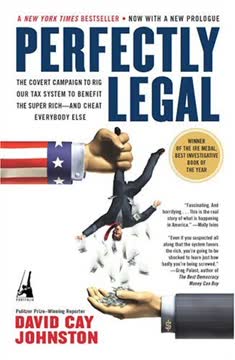
Key Takeaways
1. America's Tax System: Rigged for the Super Rich
But what surprised me more than anything was the realization that our tax system now levies the poor, the middle class and even the upper middle class to subsidize the rich, as you will see in the pages ahead.
Systemic inequality. The U.S. tax system, despite its democratic facade, has evolved into a mechanism that disproportionately benefits the wealthiest Americans. This covert campaign, driven by political influence and complex legislation, ensures that the super-rich pay a smaller share of their income in taxes, effectively shifting the burden onto the middle and working classes. This fundamental imbalance undermines the principle of progressive taxation and exacerbates wealth concentration.
Wealth concentration. Data reveals a stark widening of the income gap, with the richest 1% of Americans accumulating wealth at an unprecedented rate since 1929. By 1999, this elite group commanded as much disposable income as the bottom 100 million Americans combined, a dramatic increase from 1977 when they matched the bottom 49 million. This concentration is not merely a natural economic outcome but a direct consequence of tax policies designed to favor capital over labor.
Upside-down subsidies. The system often functions as an "upside-down subsidy," where tax breaks intended for broad benefit end up overwhelmingly favoring the affluent. For instance, the mortgage interest deduction, meant to aid homeownership, provides significantly larger tax savings to high-income earners with expensive homes. This redistribution of income upwards means that the poor and middle class inadvertently help finance the lifestyles of the wealthy.
2. The IRS: Handcuffed and Misdirected
The IRS budget has been restrained so severely that only one in five of the tax cheats it identifies is pursued to make him pay.
Enforcement crippled. The Internal Revenue Service, the nation's tax police, operates under severe budgetary constraints and political pressure, rendering it largely ineffective against sophisticated tax evasion. Despite identifying numerous tax cheats, the agency lacks the resources to pursue the majority of them, allowing billions in unpaid taxes to go uncollected annually. This deliberate weakening of enforcement emboldens lawbreakers and undermines the integrity of the entire tax system.
Targeting the vulnerable. Instead of focusing on high-value corporate and wealthy individual audits, the IRS disproportionately targets the working poor, particularly those claiming the earned income tax credit. In 2001, the IRS audited eight times more low-income individuals than those earning over $100,000, despite the far greater potential for evasion among the wealthy. This misallocation of resources is a direct result of congressional directives and political rhetoric that demonizes welfare programs while protecting the interests of the rich.
Political interference. Congressional hearings in the late 1990s, driven by anti-IRS sentiment, further "handcuffed" the agency, making agents fearful of pursuing aggressive cases against influential taxpayers. The "Ten Deadly Sins" provision, mandating firing for certain misconduct, created an environment where managers discouraged deep probes into wealthy individuals or corporations. This political interference has fostered a perception, and often a reality, that the rich and well-connected are immune from rigorous tax scrutiny.
3. Executive Pay: Untaxed Fortunes and Hidden Perks
When people read about chief executives making huge incomes, few realize that the executives typically do not pay taxes on all of that money immediately, the way Congress says everyone who makes much less must.
Deferred compensation bonanza. Top executives routinely defer vast portions of their compensation, often for years or even decades, allowing these untaxed fortunes to grow through compound interest. Unlike ordinary 401(k) plans with strict contribution limits, executive deferral schemes have no such caps, enabling the accumulation of billions in untaxed wealth. This system effectively grants executives interest-free loans from their companies, with shareholders bearing the cost of the deferred tax liability.
Corporate jet luxury. Executives enjoy lavish perks, such as personal use of corporate jets, at a fraction of their true cost, thanks to favorable tax rules. Congress mandates a deeply discounted valuation for personal jet travel, making it significantly cheaper for an executive to fly privately than to purchase a first-class commercial ticket. This hidden subsidy means shareholders and taxpayers absorb the real expenses, with corporations deducting these costs and the government collecting minimal imputed income tax.
Concealed costs. The true value and cost of these executive perks are often deliberately obscured from shareholders and the public. SEC rules, for instance, only require disclosure of "incremental costs," allowing companies to hide expenses like corporate jet usage if deemed necessary for executive security. This lack of transparency prevents proper oversight and allows executives to siphon off corporate assets for personal benefit, further enriching themselves at the expense of the company and its stakeholders.
4. The "Death Tax" Deception: A Myth for Billionaires
The super rich were using a myth about family farms to get a tax break for themselves, he said.
Manipulated narrative. The campaign to repeal the estate tax, rebranded as the "death tax," successfully leveraged emotional appeals about saving family farms and small businesses. This narrative, however, was largely a deception, as IRS statistics consistently showed that very few farms or small businesses were ever lost due to estate taxes. The real beneficiaries of repeal would be the ultra-wealthy, whose vast fortunes are the primary target of this tax.
Exemption thresholds. In reality, the estate tax only applies to a tiny fraction of the population, with high exemption thresholds ($1.35 million for couples in 2000, rising to $4.1 million for working farms). Most Americans, including the vast majority of farmers, would never accumulate enough wealth to be subject to it. The fear-mongering about the "death tax" was a calculated political strategy to garner broad public support for a tax cut that would overwhelmingly favor billionaires.
Unintended loopholes. The proposed repeal of the estate tax, coupled with the elimination of the gift tax and retention of "step-up in basis" rules, would have created massive new loopholes for the living rich. This would allow appreciated assets to be passed on without ever incurring capital gains tax, effectively enabling untaxed fortunes to grow and transfer across generations. This oversight, or deliberate design, highlighted the profound implications of piecemeal tax changes.
5. Stealth Taxes: Middle Class Subsidizes the Rich
But what surprised me more than anything was the realization that our tax system now levies the poor, the middle class and even the upper middle class to subsidize the rich, as you will see in the pages ahead.
Alternative Minimum Tax (AMT). The Alternative Minimum Tax (AMT), originally designed to ensure the super-rich paid some taxes, has stealthily become a burden on millions of middle and upper-middle-class families. Due to a lack of inflation adjustments and subsequent tax cuts, the AMT now negates many promised tax breaks for families, especially those with children or living in high-tax states. This unintended consequence forces these families to subsidize tax cuts for the wealthiest.
Social Security over-taxation. For two decades, working Americans have paid significantly more in Social Security taxes than immediately needed for benefits, accumulating a $1.7 trillion surplus by 2002. This excess, effectively an advance payment, was not saved but spent on general government operations, indirectly financing income tax cuts for the rich. This means the working poor and middle class paid extra taxes to allow the wealthy to keep more of their income.
Regressive burden. The Social Security tax, with its cap on taxable wages ($87,000 in 2003), is inherently regressive, meaning it takes a larger percentage of income from lower and middle earners. A married couple earning $87,000 pays the same maximum Social Security tax as someone earning $100 million, making it a tiny fraction of the wealthy's total compensation. This structure further shifts the overall tax burden away from the rich and onto those with less.
6. Corporate Patriotism: Profits Over Principle
As Barton spoke of profits trumping patriotism, fires were still burning at Ground Zero, where 2,800 Americans had died in the September 11 Al Qaeda attacks that brought down the World Trade Center towers.
Corporate inversions. Large corporations engage in "corporate inversions," moving their legal headquarters to tax havens like Bermuda or the Cayman Islands while maintaining their real operations in the U.S. This allows them to siphon profits out of the U.S. as tax-deductible payments to the offshore parent, effectively earning profits tax-free in America. This practice, openly promoted by accounting firms, prioritizes corporate earnings over national tax obligations.
Benefits without cost. Companies that invert continue to enjoy all the benefits of operating in the United States—military protection, contract enforcement, educated workforce, access to markets—without paying their fair share of taxes. The costs are shifted to other taxpayers, who must make up the lost revenue. Executives, in turn, can see their personal fortunes soar from the increased stock price resulting from these tax savings.
Political duplicity. Despite public outrage and bipartisan condemnation of these "unpatriotic" moves, political action has been weak and often includes loopholes. While some legislation has attempted to bar government contracts for inverted companies, these efforts are frequently undermined by exceptions that allow American subsidiaries to continue receiving contracts. This highlights the powerful influence of corporate lobbyists and campaign contributions in shaping tax policy.
7. Tax Shelters: Legalized Corporate Theft
A tax shelter is an investment that is worth more after-tax than before-tax.
Engineered disappearance. Tax shelters are complex financial arrangements designed by "tax engineers" at major accounting and law firms to make taxes disappear for wealthy clients. These schemes often involve prearranged transactions with no genuine business purpose other than tax avoidance, allowing individuals and corporations to achieve greater after-tax profits than their pre-tax gains. The secrecy surrounding these deals, often enforced by confidentiality agreements, makes them difficult for the IRS to detect.
Foreign tax credit manipulation. One common scheme involves manipulating foreign tax credits. Companies buy and sell shares of foreign companies in rapid, prearranged trades to generate foreign tax credits that can be used to offset U.S. tax liabilities, even if the trades result in no net economic gain. This effectively allows companies to "buy" tax credits from tax-exempt entities (like pension funds) that cannot use them, at the expense of the U.S. Treasury.
Fabricated profits and losses. Some shelters go further, fabricating profits for shareholder reports while simultaneously creating artificial losses for tax purposes. Enron, for example, used 881 offshore subsidiaries and complex schemes to report billions in profits to shareholders while paying almost no federal corporate income tax. These "internal machinations" highlight how financial engineering can distort economic reality for tax advantage, costing the government billions.
8. Mass Market Evasion: Encouraged by Inaction
The system simply cannot work if they get away with this.
Open defiance. Tax protesting has evolved from fringe groups to a mass-market phenomenon, with individuals and business owners openly boasting about not paying federal or state income taxes. These "tax cheats" often cite baseless legal theories, such as the "861 position," claiming no law requires them to pay. This open defiance, publicized in national media, challenges the fundamental premise of a voluntary compliance tax system.
Government's passive response. Despite public boasts and widespread knowledge of these evasion schemes, the IRS initially responded with remarkable inaction against the perpetrators. Instead of prosecuting the business owners, the IRS often targeted their employees, warning them to pay their taxes. This passive approach, driven by resource limitations and political caution, inadvertently validated the claims of tax protesters and encouraged more people to join their ranks.
Erosion of deterrence. The lack of aggressive enforcement against these visible tax cheats has severely eroded the principle of general deterrence. When individuals see others openly flouting tax laws without consequence, it fosters cynicism and encourages more people to believe that "only fools pay their taxes." This growing problem, estimated to cost the government hundreds of billions annually, poses a significant threat to the nation's financial stability and social contract.
9. Limited Liability: Fueling Professional Misconduct
The problem is that the LLP structure destroys the self-policing mechanism that helps to keep legal and accounting firms from using their enormous power to the detriment of others, especially the third parties like investors who rely on the integrity of audited financial statements to make decisions on buying and selling stocks.
Erosion of accountability. The widespread adoption of Limited Liability Partnership (LLP) structures by legal and accounting firms has inadvertently fostered a climate of professional misconduct. Traditionally, partners were fully liable for each other's actions, creating a strong incentive for self-policing and ethical behavior. The LLP model, however, shields individual partners from the misdeeds of their colleagues, reducing accountability and encouraging riskier, less ethical practices.
Moral hazard. This shift created a "moral hazard," where firms are less motivated to rigorously monitor partners involved in designing or promoting aggressive tax shelters. The worst outcome for the firm might be a business closure, but individual partners' personal assets remain protected. This legal shield allows firms to sell dubious tax schemes, often with "opinion letters" that provide a veneer of legitimacy but are riddled with caveats, effectively insulating clients from penalties even if the shelter is disallowed.
Consequences for society. The breakdown of professional integrity, fueled by the LLP structure, has contributed to major corporate scandals and the proliferation of abusive tax shelters. This means that legal and accounting expertise, instead of ensuring fair and transparent financial practices, is actively used to circumvent tax laws. This systemic issue drives up costs for honest taxpayers and undermines public trust in the financial and legal systems.
10. The Cost of Complexity: Billions Lost, Trust Eroded
The tax system continues to grow in complexity, while the resource base of the IRS is not growing and in real terms is shrinking.
Unmanageable complexity. The U.S. tax code has become overwhelmingly complex, with thousands of pages of laws and hundreds of major changes enacted in recent years. This complexity, often driven by special-interest provisions inserted without public debate, creates countless loopholes that only the wealthy and well-advised can exploit. For ordinary Americans, it's a source of confusion and frustration, while for the rich, it's a playground for tax avoidance.
Technological obsolescence. The IRS's outdated technology infrastructure further exacerbates the problem. Relying on Kennedy-era computers and magnetic tape storage, the agency struggles to process data efficiently or conduct sophisticated analyses to detect complex evasion schemes. Billions spent on failed technology projects, often awarded to military contractors instead of experienced financial system designers, have left the IRS ill-equipped for the demands of a modern economy.
Eroding trust. The combination of a complex, loophole-ridden tax code and a hobbled enforcement agency fosters a deep sense of unfairness and cynicism among honest taxpayers. When people perceive that the system is rigged, and that the wealthy can easily escape their obligations, it undermines the social contract and the willingness to comply. This erosion of trust poses a long-term threat to the stability of democratic society and the very idea of a "common good."
11. Reform is Possible: Demand Transparency and Fairness
We can go on with what we have and pay a heavy price in lost opportunity. Or we can speak up one by one until we are heard. Ultimately, we can create a tax system that actually promotes long-term prosperity.
Political will needed. Fundamental tax reform is urgently needed but remains elusive due to a lack of political will and the entrenched influence of the "political donor class." While various reform proposals exist, they often face significant opposition due to their potential to disrupt existing economic advantages or create new, unintended consequences. A serious, bipartisan debate, free from slogans and special interests, is essential to move forward.
Principles for reform. Any meaningful reform must prioritize transparency, simplification, and robust enforcement. This includes ending income deferrals for executives, requiring corporations to use a single set of books for both shareholders and the IRS, and eliminating special-interest favors inserted into tax bills. The goal should be a system that taxes all forms of income fairly and consistently, rather than favoring capital over labor or multinationals over domestic businesses.
Citizen engagement. Ultimately, the power to reform the tax system lies with the citizenry. By actively engaging in public discourse, demanding accountability from elected officials, and refusing to tolerate unfairness, ordinary Americans can counter the influence of the wealthy. A tax system that truly serves the common good requires informed participation and a collective commitment to justice, ensuring that everyone pays their fair share for a civilized society.
Review Summary
Reviews of Perfectly Legal are largely positive, averaging 4.12/5. Readers praise Johnston's accessible breakdown of complex tax issues, his even-handed criticism of both political parties, and his thorough exposure of how the wealthy exploit legal and illegal tax loopholes. Many find the book infuriating yet eye-opening. Common criticisms include repetitiveness, dated material (published 2003), and occasionally dry, technical content. Despite its age, most reviewers consider it highly relevant, noting that the systemic issues Johnston describes have largely persisted or worsened.
People Also Read


 Immersive