Key Takeaways
1. Paul McCartney's creative journey began with deep musical immersion
"McCartney's journey as a performing musician began with an immersion into these multiple traditions that lead to a wholehearted plunge into a journey of personal creative development to become a performing musician."
Early influences: McCartney's musical foundations were laid in his childhood home, where he was exposed to a wide range of musical styles. His father, a semi-professional musician, played a crucial role in introducing him to various genres, including:
- Music hall tunes
- Broadway show songs
- Jazz standards
- Popular hits of the day
This diverse musical background provided McCartney with a rich palette of influences that would shape his future compositions. The regular family sing-alongs and parties not only instilled a love for music but also taught him the power of performance and audience connection.
Instrument acquisition: McCartney's journey as a multi-instrumentalist began with:
- Joining the church choir
- Learning trumpet (his first instrument)
- Switching to guitar and adapting to playing left-handed
- Eventually mastering the bass guitar, which became his primary instrument with The Beatles
This progression across instruments broadened his musical understanding and contributed to his versatility as a songwriter and performer.
2. The Beatles' success stemmed from collaborative creativity and domain knowledge
"While there were multiple structural factors that contributed to the creativity in the work produced, it was these two, as individual agents, who brought their personal backgrounds to bear upon the collaborative system they found themselves in."
Complementary skills: The partnership between John Lennon and Paul McCartney was central to The Beatles' creative output. Their collaboration was characterized by:
- Shared musical influences and domain knowledge
- Contrasting personalities that balanced each other
- Ability to provide constructive criticism and feedback
- Competitive spirit that drove innovation
The Beatles' success was not solely due to individual talent but resulted from the synergy of their collective creativity. The band members, along with producer George Martin, formed a creative system that allowed for the exchange and refinement of ideas.
Domain immersion: The Beatles' extensive performing experience, particularly during their Hamburg years, provided them with deep domain knowledge. This immersion allowed them to:
- Master a vast repertoire of songs
- Develop their musical skills through intense practice
- Experiment with different musical styles and genres
- Gain insights into audience preferences and reactions
This accumulated knowledge became the foundation for their original compositions and innovative approach to music-making.
3. McCartney's songwriting process blends intuition with structured composition
"McCartney's acquired habitus wasn't just concerned with how to play his chosen instruments fluidly but included learning to work as a professional, including the values, the behaviour expected of a performing musician."
Intuitive approach: McCartney often relies on his intuition when composing, drawing from his vast musical knowledge and experiences. This intuitive process involves:
- Allowing melodies and ideas to emerge naturally
- Trusting his musical instincts developed over years of practice
- Being open to unexpected sources of inspiration
However, this intuition is not purely mystical but is grounded in his deep understanding of musical structures and conventions.
Structured refinement: Once the initial idea is captured, McCartney employs a more structured approach to refine and develop the song. This process includes:
- Analyzing the harmonic and melodic elements
- Crafting lyrics that complement the musical mood
- Arranging the song for different instruments and voices
- Collaborating with others to enhance the composition
This blend of intuition and structure allows McCartney to create songs that are both emotionally resonant and musically sophisticated.
4. 'Yesterday' exemplifies McCartney's creative system in action
"From the evidence, it can be argued that creativity is a dynamic system that works on a larger scale than that of the sole individual posited by the Romantic conception and concomitant understandings."
Myth vs. reality: The creation of 'Yesterday' is often portrayed as a mystical experience, with the melody coming to McCartney in a dream. However, a closer examination reveals a more complex creative process:
- Initial inspiration: The dream provided the melodic seed, but it was McCartney's musical knowledge that allowed him to recognize its potential.
- Verification: McCartney sought feedback from others to ensure the melody was original.
- Refinement: The song underwent several revisions, including lyrical changes and arrangement decisions.
- Collaboration: Input from George Martin and other Beatles members shaped the final version.
Systems model in action: The creation of 'Yesterday' demonstrates the interplay between:
- Individual (McCartney's skills and intuition)
- Domain (existing musical knowledge and conventions)
- Field (feedback from peers and industry professionals)
This systemic approach to creativity explains how McCartney was able to transform an initial idea into a timeless classic.
5. McCartney's production style evolved from mentorship to innovative experimentation
"McCartney's domain acquisition as a record producer appeared to develop through a process of osmosis, simply by being fully immersed into studio practice."
Learning from mentors: McCartney's early production experiences were shaped by his work with George Martin during The Beatles era. This mentorship provided:
- Technical knowledge of recording processes
- Understanding of arrangement and orchestration
- Insights into the producer's role in shaping a song
As McCartney transitioned to solo work and producing other artists, he built upon this foundation.
Innovative approaches: Over time, McCartney developed his own production style characterized by:
- Willingness to experiment with new technologies and techniques
- Emphasis on capturing the emotion and energy of performances
- Openness to collaboration with diverse musicians and producers
- Balance between musical instincts and technical proficiency
McCartney's production work on albums like "Band on the Run" and his later solo efforts showcases his ability to blend traditional techniques with innovative approaches.
6. Collaboration and adaptability define McCartney's post-Beatles career
"McCartney's creative practice never travels in a single direction. For every 'Honey Pie' there was a 'Helter Skelter', and for every 'Blackbird' a 'Why Don't We Do It In The Road?'"
Diverse collaborations: Throughout his post-Beatles career, McCartney has consistently sought out new collaborators, including:
- Rock and pop artists (e.g., Elvis Costello, Kanye West)
- Classical musicians and composers
- Electronic and ambient music producers (e.g., Youth)
- Visual artists and filmmakers
These collaborations have allowed McCartney to explore new musical territories and keep his work fresh and relevant.
Adaptability: McCartney's ability to adapt to changing musical landscapes is evident in:
- His willingness to embrace new technologies and production techniques
- Exploration of different musical genres (e.g., electronic, classical)
- Engagement with younger generations of musicians and audiences
- Continuous reinvention of his live performances
This adaptability has been crucial in maintaining his relevance and creative vitality over decades.
7. McCartney's diverse creative ventures showcase his willingness to take risks
"McCartney works hard. He is willing to try his hand at most things and is generally 'confident in his abilities'."
Multifaceted creativity: Beyond music, McCartney has ventured into various creative fields, including:
- Visual arts (painting and exhibitions)
- Literature (poetry and children's books)
- Film and animation projects
- Environmental and social activism
These diverse pursuits demonstrate McCartney's curiosity and willingness to challenge himself creatively.
Risk-taking: McCartney's career is marked by numerous instances of creative risk-taking:
- Experimental projects like The Fireman
- Ventures into classical music composition
- Unconventional releases (e.g., anonymous albums)
- Controversial performances (e.g., 'Freedom' at the Concert for New York)
While not all of these risks resulted in critical or commercial success, they showcase McCartney's commitment to artistic exploration and growth.
8. The systems model of creativity explains McCartney's enduring success
"Creativity is produced in the dialogue between [these] three interrelated factors."
Interplay of factors: McCartney's enduring success can be understood through the systems model of creativity, which emphasizes the interaction between:
- Individual: McCartney's talents, skills, and experiences
- Domain: The accumulated knowledge of music and songwriting
- Field: The network of peers, collaborators, and audiences
This model explains how McCartney's creative output is not solely the result of individual genius but emerges from a complex system of interactions.
Continuous evolution: The systems approach highlights how McCartney's creativity has evolved over time:
- Accumulation of domain knowledge through diverse musical experiences
- Adaptation to changes in the field (e.g., new technologies, audience preferences)
- Ongoing development of individual skills and interests
By engaging with all aspects of the creative system, McCartney has been able to sustain his creative output and relevance across decades.
Review Summary
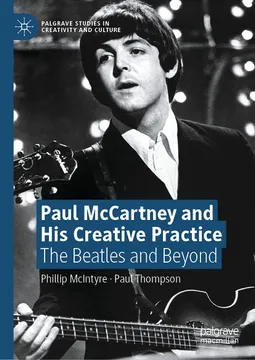
Paul McCartney and His Creative Practice is highly praised for its academic approach to understanding McCartney's creative process. The book is commended for debunking myths surrounding creativity and genius, instead focusing on the sociocultural factors that influenced McCartney's work. Readers appreciate the in-depth analysis of specific songs and collaborations, as well as the exploration of McCartney's role as a producer and businessman. The book is seen as a valuable resource for those interested in creativity studies and McCartney's artistic journey.
Download PDF
Download EPUB
.epub digital book format is ideal for reading ebooks on phones, tablets, and e-readers.








































