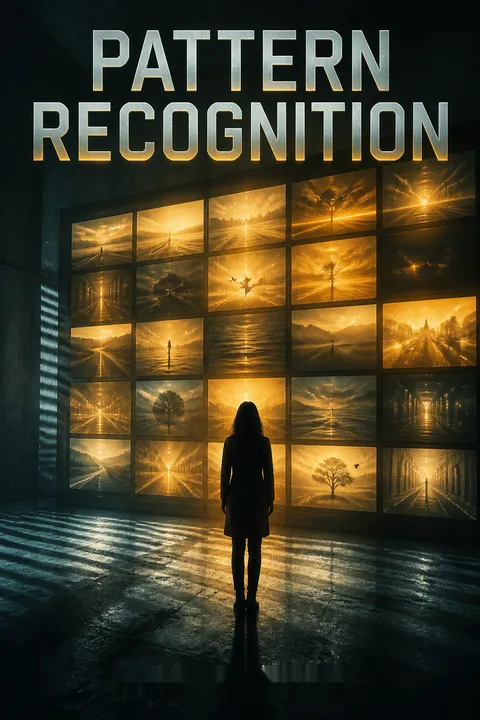

Plot Summary
Soul Lag in London
Cayce Pollard, a "coolhunter" hypersensitive to branding, wakes in a friend's London flat, her soul lagging behind her body after a transatlantic flight. She feels alienated by the city's subtle differences—electricity, appliances, even the air. Her friend Damien is away, leaving her in a sterile, semi-familiar space. Cayce's sense of self is fragmented, her identity defined by her minimalist, logo-free clothing and her acute, almost allergic, reaction to commercial symbols. She finds solace in an online forum dedicated to mysterious, anonymous film fragments known as "the footage," which has become her virtual home. The city's white noise and her own insomnia amplify her sense of being unmoored, both physically and emotionally, as she prepares for a consulting job with the enigmatic Blue Ant agency.
Market Allergies and Missions
Cayce's unique sensitivity to branding is both her curse and her marketable skill. She's summoned to Blue Ant's London office to evaluate a new logo for a major athletic shoe company. The meeting is tense: Dorotea, a rival consultant, seems hostile, and Cayce's visceral rejection of the proposed logo is immediate and inexplicable. Her role is not to create but to sense—she's a human litmus test for authenticity. Afterward, a lunch with Bernard Stonestreet, Blue Ant's local head, leaves her further unsettled, especially when she discovers her prized jacket has been deliberately burned. The incident signals that her presence in London is more fraught than she realized, and that professional rivalries may be masking deeper, more personal threats.
Footage Obsession Unveiled
Cayce's obsession with the footage—a series of enigmatic film fragments released online—serves as both escape and compulsion. The footage's origin, meaning, and creator are unknown, spawning a global subculture of "footageheads" who analyze every detail. Cayce's online alter ego, CayceP, is a respected voice in the community, especially in exchanges with Parkaboy, a Chicago-based theorist. The arrival of a new segment (#135) electrifies the forum, deepening the mystery and Cayce's emotional investment. The footage's timeless, placeless aesthetic resonates with her own longing for meaning and connection, even as it amplifies her sense of loneliness and the search for patterns in a chaotic world.
Encounters with the Past
Cayce's London wanderings bring her into contact with eccentric collectors, artists, and dealers—each obsessed with relics of the past, from mechanical calculators to vintage computers. These encounters, especially with Voytek and Ngemi, highlight the city's layers of history and the persistence of memory. The past is never far: Cayce's own trauma is rooted in the recent loss of her father, who disappeared on 9/11. The city's antique markets and arcades become metaphors for her search for meaning, as she navigates both personal grief and the collective anxieties of a post-9/11 world. The motif of pattern recognition—finding order in randomness—emerges as both a gift and a trap.
Perimeter Breached
Cayce's sense of safety is shattered when she discovers evidence of an intruder in Damien's flat. The violation is subtle but unmistakable: browser history altered, objects moved, a sense of being watched. Her professional paranoia, honed by years of navigating the semiotics of marketing, now turns inward. She secures the flat, recalling her father's lessons in perimeter defense, but the psychological impact lingers. The intrusion is linked to Dorotea, whose motives are increasingly suspect. Cayce's world becomes a labyrinth of surveillance, suspicion, and encoded messages, blurring the line between professional risk and personal threat.
Blue Ant's Proposition
Hubertus Bigend, Blue Ant's charismatic and unsettling founder, reveals his true interest: the footage. Over a series of tense, elliptical conversations, he proposes a partnership—Cayce is to find the maker of the footage, with Blue Ant's resources at her disposal. Bigend's fascination is not just commercial; he sees the footage as the ultimate viral phenomenon, a new paradigm for marketing and cultural influence. Cayce is wary, sensing both opportunity and manipulation. The proposition forces her to confront her own motivations: is she seeking truth, connection, or simply the next pattern to recognize? The boundaries between work, obsession, and identity blur further.
Viral Mysteries
The footage's viral spread is dissected by Cayce and her online peers. Theories proliferate: is it a work in progress, a finished film, or something else entirely? The footage's anonymity and lack of context make it a perfect vessel for projection, obsession, and community. Blue Ant's interest raises the stakes, as the footage becomes both commodity and cultural artifact. The search for its maker is complicated by layers of misdirection, encrypted messages, and the possibility of industrial espionage. The footage's power lies in its ambiguity, its ability to generate meaning without ever revealing its source.
Watermarks and Codes
A breakthrough comes when Parkaboy and his collaborators discover a digital watermark embedded in one of the footage segments. The watermark, steganographically concealed, points to a sophisticated operation—possibly involving a professional watermarking firm, Sigil Technologies, in Ohio. The discovery transforms the search from speculation to investigation, as Cayce and her allies pursue technical leads, social engineering, and cross-continental travel. The watermark is both clue and symbol: a hidden pattern within the pattern, a signature that both reveals and conceals. The hunt for the maker becomes a race against unseen adversaries, with Cayce caught between competing interests and her own need for closure.
Tokyo's Mirror World
Cayce's journey takes her to Tokyo, a city that both mirrors and distorts her own anxieties. Here, branding is omnipresent but strangely neutralized; the city's semiotic overload paradoxically soothes her. She navigates the city's subcultures, from beauty salons to fashion boutiques, adopting new CPUs (Cayce Pollard Units) to blend in. The search for the footage's origin leads her into the world of otaku, gender-bending online personas, and encrypted exchanges. The boundaries between reality and performance, self and avatar, become increasingly porous. Tokyo becomes a stage for both revelation and concealment, as Cayce edges closer to the source of the footage.
Jack Moves and Betrayals
The investigation turns dangerous as Cayce is targeted by unknown assailants—agents of rival interests, possibly connected to Dorotea or Blue Ant's competitors. A violent encounter in Roppongi forces her to rely on self-defense skills and the unexpected intervention of Boone Chu, a systems expert and Blue Ant's other operative. Trust becomes a scarce commodity, as betrayals and hidden agendas multiply. The search for the footage's maker is now a matter of survival as much as curiosity. Cayce's improvisational "jack moves" become both literal and metaphorical, as she navigates a world where every ally may be a double agent.
Into the T-Bone City
A new clue emerges: a map, extracted from the footage's digital whiteouts, shaped like a T-bone and overlaid with encrypted numbers. The map is both literal and symbolic—a geography of the footage's narrative, a key to its structure, and a pointer to its origin. The investigation now spans continents, from London to Tokyo to Moscow, as Cayce and Boone pursue leads through technical sleuthing, social engineering, and old-fashioned legwork. The T-bone city becomes a metaphor for the search itself: a space of hidden connections, dead ends, and the possibility of revelation.
Russian Connections
The trail leads to Russia, where the footage's watermark is traced to a powerful oligarch, Andrei Volkov, and his enigmatic nieces, Stella and Nora. The investigation reveals a web of surveillance, espionage, and personal tragedy. The footage is not just art but a product of trauma, loss, and the desire for connection. Cayce's own history—her father's disappearance, her mother's spiritualism, her own pattern-seeking—finds echoes in the Volkovs' story. The cost of truth becomes clear: to find the maker is to confront the wounds that drive creation, obsession, and the search for meaning.
The Maker Revealed
Cayce finally meets Stella and Nora, the twin sisters at the heart of the footage. Nora, the artist, is deeply wounded—physically and psychologically—by the violence that claimed their parents. Her art is both therapy and communication, constructed from fragments of surveillance, memory, and imagination. Stella, the facilitator, ensures the footage reaches the world while protecting her sister from exploitation. The footage's anonymity was both shield and invitation, drawing seekers like Cayce into its orbit. The revelation is both anticlimax and epiphany: the footage is not a puzzle to be solved but a wound to be witnessed, a pattern that resists closure.
The Dream and the Dig
The narrative's climax is mirrored by Damien's documentary dig in Russia, where the excavation of war graves becomes a metaphor for the search for meaning in trauma. Cayce's own grief for her father, unresolved and unresolvable, finds expression in the act of digging—literally and figuratively—through the layers of history, memory, and loss. The footage, the dig, and Cayce's journey converge in the recognition that some patterns cannot be completed, some wounds cannot be healed, and some mysteries must be lived with rather than solved.
Patterns and Endings
In the aftermath, Cayce finds a measure of peace—not in answers, but in acceptance. The footage's mystery remains, but its meaning has shifted: it is now a testament to survival, connection, and the persistence of art in the face of trauma. Cayce's own sensitivities, once a source of pain, become tools for navigating a world saturated with signs. The novel ends with her in Paris, in the company of friends and fellow seekers, her soul finally reeled in. The search for patterns continues, but now as a form of living, not a compulsion. The world remains ambiguous, but Cayce has learned to dwell within its meaning.
Analysis
Pattern Recognition is a novel for the age of information overload, global anxiety, and viral culture. William Gibson crafts a story that is both a thriller and a meditation on the search for meaning in a world saturated with signs, brands, and trauma. At its core, the novel explores the human need to find patterns—to make sense of chaos, to connect the personal and the collective, to transform wounds into art. Cayce Pollard's journey is emblematic of the post-9/11 condition: haunted by loss, hypersensitive to the commodification of experience, and driven by a longing for authenticity in a world of surfaces. The footage, with its anonymity and ambiguity, becomes a mirror for the reader's own pattern-seeking, inviting both obsession and humility. Gibson's narrative resists easy answers, embracing ambiguity as both challenge and comfort. The novel's lesson is not that all patterns can be recognized or all mysteries solved, but that the act of seeking—of connecting, witnessing, and creating meaning—is itself a form of survival. In a world where the boundaries between self and system, art and commerce, trauma and healing are increasingly blurred, Pattern Recognition offers a vision of resilience, empathy, and the possibility of finding home in the midst of perpetual motion.
Review Summary
Reviews for Pattern Recognition are largely positive, averaging 3.88/5. Many praise Gibson's vibrant, prescient prose and his compelling protagonist, Cayce Pollard, a logo-allergic marketing consultant navigating a post-9/11 world. Fans admire the novel's themes of branding, obsession, and viral culture, calling it accessible yet intellectually rich. Critics, however, find the pacing slow, the ending unsatisfying, and the first chapter overwrought. Some feel the mysterious "footage" McGuffin fails to captivate, while others consider the book a brilliant meditation on pattern-seeking and modern media.
People Also Read
Characters
Cayce Pollard
Cayce is a freelance "coolhunter" whose acute sensitivity to branding and design is both her professional asset and personal curse. Haunted by the loss of her father on 9/11, she is driven by a need to find meaning in chaos, to recognize patterns where others see only noise. Her allergy to logos is a metaphor for her deeper discomfort with the commodification of identity and experience. Psychologically, Cayce is marked by anxiety, grief, and a longing for connection—traits that make her both vulnerable and resilient. Her journey through the novel is one of self-discovery, as she learns to balance her gift for pattern recognition with the acceptance of ambiguity and loss.
Hubertus Bigend
Bigend is the founder of Blue Ant, a marketing agency that operates at the cutting edge of viral culture and global branding. He is both charming and unsettling, a figure who sees the world as a series of opportunities for influence and commodification. Bigend's interest in the footage is both genuine and self-serving: he recognizes its power as a viral phenomenon and seeks to harness it for his own ends. Psychologically, he is a master of persuasion, able to bend others to his will through a combination of flattery, intimidation, and strategic ambiguity. His relationship with Cayce is both adversarial and symbiotic, as he pushes her to confront her own motivations and limits.
Dorotea Benedetti
Dorotea is a consultant with a background in industrial espionage, hired to undermine Cayce's work and later revealed as a double agent. She is cold, calculating, and ruthless, using psychological manipulation and surveillance to achieve her goals. Her hostility toward Cayce is both professional and personal, rooted in envy and a desire for power. Dorotea's actions—burning Cayce's jacket, orchestrating break-ins, drugging her in Moscow—are manifestations of her willingness to cross ethical boundaries. Psychologically, she is driven by ambition and a need for control, but ultimately becomes a pawn in larger games she cannot fully comprehend.
Boone Chu
Boone is a technical consultant brought in by Bigend to assist Cayce in the search for the footage's maker. He is pragmatic, resourceful, and skilled in both digital and social engineering. Boone's motivations are complex: he is drawn to the challenge of the mystery, but also to Cayce herself. His actions—reading her email, withholding information, pursuing leads independently—reflect both loyalty and self-interest. Psychologically, Boone is marked by a desire for competence and recognition, but also by a capacity for empathy and collaboration. His relationship with Cayce is marked by mutual suspicion and eventual trust.
Parkaboy (Peter Gilbert)
Parkaboy is Cayce's closest ally in the footage community, a Chicago-based music producer whose online persona is witty, skeptical, and deeply invested in the search for patterns. He represents the collective intelligence and obsession of the footageheads, serving as both sounding board and provocateur. Psychologically, Parkaboy is driven by curiosity, a need for connection, and a willingness to embrace ambiguity. His eventual physical presence in Russia marks the convergence of virtual and real, theory and action, and his friendship with Cayce is a source of grounding and affirmation.
Stella Volkova
Stella is one of the twin sisters at the heart of the footage's creation. She is the outward-facing half, managing the distribution and protection of her sister's art. Marked by trauma—the loss of her parents in a bombing—Stella is both vulnerable and fiercely protective. Her decision to trust Cayce is a turning point, reflecting a longing for recognition and connection beyond the confines of secrecy and surveillance. Psychologically, Stella embodies resilience, empathy, and the complexities of survivorhood.
Nora Volkova
Nora is the reclusive, traumatized artist whose work forms the core of the footage. Physically and psychologically scarred by the violence that killed her parents, Nora communicates primarily through her art, constructing meaning from fragments of surveillance, memory, and imagination. Her creative process is both therapeutic and compulsive, a way of processing trauma and reaching out to the world. Psychologically, Nora is marked by dissociation, genius, and a profound need for expression. Her art is both a wound and a gift, drawing others into its orbit.
Damien Pease
Damien is Cayce's friend and occasional anchor, a video director whose own project—a documentary dig in Russia—mirrors the novel's themes of excavation, memory, and trauma. He represents the artist as witness, committed to documenting the past even as he is haunted by its horrors. Psychologically, Damien is both detached and passionate, able to navigate the ambiguities of art and history with a measure of irony and compassion.
Voytek Biroshak
Voytek is a Polish-born artist obsessed with obsolete technology, especially the ZX 81 computer. He serves as a guide to London's subcultures and a link to the novel's themes of memory, obsolescence, and the persistence of the past. Psychologically, Voytek is marked by eccentricity, enthusiasm, and a capacity for friendship. His projects and obsessions mirror Cayce's own search for meaning in the detritus of culture.
Win Pollard
Win is Cayce's father, a security expert who disappears on 9/11. His absence is a central trauma for Cayce, shaping her quest for meaning and closure. Win's legacy—his lessons in perimeter defense, his skepticism, his own pattern-seeking—haunts the narrative, serving as both inspiration and burden. Psychologically, Win represents the costs of vigilance, the ambiguities of history, and the persistence of grief.
Plot Devices
Pattern Recognition
The novel's central device is the concept of pattern recognition—the human tendency to find order in randomness, to seek meaning in the noise of modern life. This device operates on multiple levels: Cayce's professional skill, her personal trauma, the collective obsession with the footage, and the broader cultural anxieties of the post-9/11 world. Pattern recognition is both a tool for survival and a source of vulnerability, as characters risk seeing connections where none exist or missing the genuine threats hidden in plain sight. The narrative structure itself mirrors this device, unfolding as a series of clues, red herrings, and revelations that resist final closure.
Viral Media and Anonymity
The footage serves as both MacGuffin and metaphor—a work of art whose anonymity and ambiguity make it the perfect viral phenomenon. Its spread is facilitated by online communities, encrypted messages, and the collective intelligence of its followers. The footage's lack of context invites projection, obsession, and community, while its hidden codes and watermarks drive the plot forward. The device of viral media allows the novel to explore questions of authorship, authenticity, and the commodification of culture in the digital age.
Surveillance and Espionage
The novel is saturated with surveillance—both literal and metaphorical. Characters are watched, followed, and manipulated by rival interests, from corporate spies to Russian oligarchs. The devices of break-ins, bugged phones, and digital forensics create an atmosphere of paranoia and uncertainty, blurring the line between professional risk and personal threat. The motif of espionage serves to highlight the novel's themes of trust, betrayal, and the costs of seeking truth in a world of hidden agendas.
Trauma and Memory
The characters' actions are driven by trauma—Cayce's loss of her father, Stella and Nora's orphanhood, the collective shock of 9/11. Memory is both a source of pain and a tool for survival, shaping the search for meaning and the creation of art. The device of excavation—literal in Damien's dig, metaphorical in Cayce's investigation—serves as a metaphor for the persistence of the past and the difficulty of achieving closure. The novel's structure, with its recursive patterns and unresolved mysteries, mirrors the workings of trauma and memory.
Foreshadowing and Recursion
The narrative is structured around recurring motifs—dreams, mantras, fragments of dialogue, and repeated images. These echoes serve as both foreshadowing and commentary, reinforcing the novel's themes of ambiguity, uncertainty, and the search for meaning. The lack of final closure—both in the footage and in Cayce's personal journey—underscores the novel's commitment to ambiguity and the acceptance of unresolved patterns.
Blue Ant Series
Download PDF
Download EPUB
.epub digital book format is ideal for reading ebooks on phones, tablets, and e-readers.








































