
Plot Summary
The Fire That Made Rufus
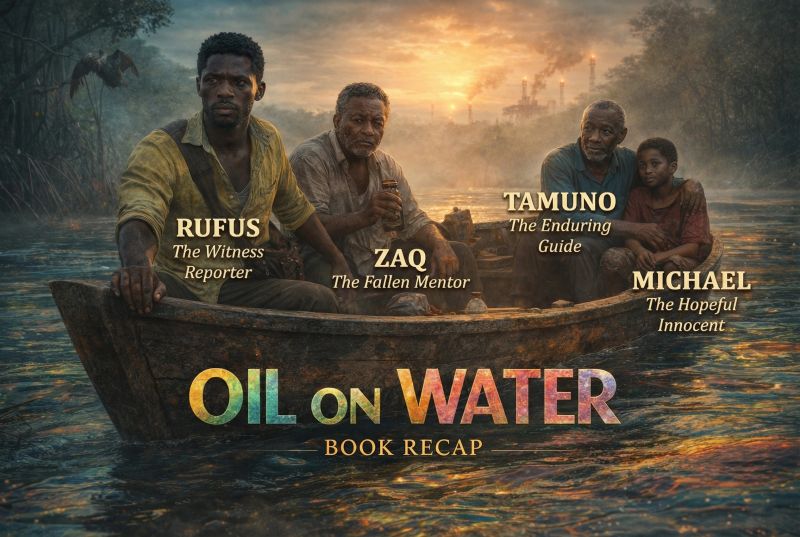
Rufus1 grew up in a Niger Delta village where his father, laid off by an oil company, turned to buying illegal petrol from children and reselling it at night. An explosion in the barn where the drums were stored sent fire tearing through the town.
Boma,11 Rufus's1 older sister, was burned so severely that half her face became a permanent landscape of scars. His father went to prison. His mother retreated to her village. Rufus1 was in Lagos earning a journalism certificate and didn't learn of the disaster until he came home clutching his diploma.
He published the story as a pipeline accident — a lie, but one that could have been true in countless other villages. That article became his only writing sample, and the wound beneath it became the engine of his career.
The Assignment Nobody Wants
James Floode,5 a British petroleum engineer in Port Harcourt, came to the offices of the Daily Star to recruit its best journalist. His wife Isabel3 had disappeared — kidnapped, presumably, by militants. Zaq,2 once Nigeria's most celebrated reporter, now bloated with drink and slumped behind a desk, initially refused.
Then the dismissive tone of Floode's5 diplomatic handler stung his pride, and he agreed. At Rufus's1 paper, the Reporter, the assignment notice hung unclaimed for two days — the previous expedition had gotten two reporters killed, including Rufus's1 colleague Max Tekena,17 shot in the back during a hostage interview.
When Rufus1 heard Zaq2 was going, he volunteered. His editor sneered. Rufus1 stammered through his pitch but was accepted, banking on Zaq2 as guide and teacher.
Ambush at the Burning Island
Six reporters launched from the oil-company jetty with an armed guide, heading south to confirm Isabel3 was alive. The guide failed to make radio contact with the kidnappers. They circled for hours, lost in identical mangrove channels, until they found an island already devastated — huts blown open, trees sheared by gunfire, three dead militants sprawled in the bush.
A military ambush had beaten them to the rendezvous. As the reporters photographed the carnage, masked gunmen emerged from hiding, seized their boat, and vanished.
The militants sent a canoe back after midnight, and an old boatman named Tamuno4 — with his young son Michael14 — ferried the stranded group to Irikefe Island, a shrine settlement with a sculpture garden of clay figures facing the sun. Zaq,2 delirious with fever, refused to leave when the others caught the ferry home.
Floode's Confession Over Cocktails
Rufus's1 front-page story earned him the Chairman's praise and the seat of honor at the editorial lunch. He then visited Floode's5 double-gated waterfront mansion.
Over whiskey, the husband admitted the marriage was already dead — Isabel3 had come to Nigeria hoping to save it by having a baby, but Floode5 had another woman, a local, already expecting his child. Rufus1 noticed Floode's5 hand brush the maid Koko's16 thigh as she served drinks. Floode5 offered a hundred thousand naira for Rufus1 to return to Irikefe and convince Zaq2 to keep searching, plus another hundred thousand for Zaq.2
Rufus1 pocketed the envelopes, unsure whether he'd honor the deal or simply keep the money. Back home, he found Boma11 waiting — evicted, her husband John gone, her scarred face tracked with tears.
Only a Stone in the Grave
Back on Irikefe, Rufus1 found Zaq2 gaunt but lucid, attended by a nurse named Gloria.7 The priest Naman6 led them to the shrine's cemetery and showed them a fresh unmarked mound — the grave of Isabel Floode,3 he claimed, brought by the militants and buried after she died of illness.
Zaq2 didn't believe it. That night, fortified by whiskey, the two dug up the grave by lamplight. Rufus's1 shovel struck not flesh but stone — a boulder planted as a decoy. Isabel3 was alive. By morning, Naman6 discovered the desecration.
The head priestess had just died, and the disturbed grave threw the burial ritual into disarray. The priests confined Rufus1 and Zaq2 to their hut. But days later, Naman6 relented — sending Tamuno4 at dawn with a boat to spirit them deeper into the Delta.
Through Poisoned Country
Deeper into the waterways, Rufus1 and Zaq2 drifted through villages emptied by the oil war. In one, a poisoned well exhaled the stench of something decomposing in its depths. Dead birds hung oil-slicked from mangrove branches. A severed human arm floated past the boat.
At a market village, soldiers descended to arrest a blacksmith named Karibi for allegedly aiding militants — his son predicted conviction was certain. That night they sheltered with Tamuno's4 brother, Chief Ibiram,13 whose entire clan lived in exile on stilts over mud flats.
The chief described how oil companies seized their ancestral land, arrested their head chief who died in custody, then waved a contract the dead man had supposedly signed. Ten families refused the money and left — their uncollected payment a curse on the companies. They had been wandering ever since.
The Major's Petrol Baptism
An oil-company helicopter spotted their boat. Military speedboats intercepted, sank Tamuno's4 canoe, and marched them to a camp commanded by a volatile officer. The Major10 lined up seven captured militants in a clearing.
Then, methodically, he poured petrol over each bowed head — including Tamuno's4 and young Michael's,14 lumped in with the prisoners. Rufus1 confronted him and was jabbed in the chest, told he could easily join the kneeling men. The camp doctor, Dagogo-Mark,12 pulled Rufus1 aside afterward with devastating news: Zaq's2 blood work revealed a rare hemorrhagic fever endemic to these poisoned waters.
His liver was likely gone already. Without a proper hospital, the doctor said quietly, Zaq2 was dying. He'd seen it before. A man gets a headache, then a rash, then an organ simply stops.
Irikefe Shattered
The Major10 announced that militants had attacked Irikefe and loaded his prisoners onto boats. What Rufus1 found broke him more than any dead body: the sculpture garden pulverized, arms and heads sundered from clay torsos, a face staring upward with an expression so lifelike its mouth seemed eager to share a secret.
Naman,6 bloodied but composed, explained that militants had demanded the worshippers' allegiance and pointed at Gloria7 — she would be their hostage. When soldiers arrived by helicopter, they bombed everything indiscriminately.
Then Boma11 appeared — she had come to find Rufus1 and arrived just before the violence. She carried grim news from his office: his editor said not to bother returning. Rufus1 had lost his job, his camera, his notebook. He had only Zaq's2 fading breath and a deadline pressing from every direction.
Half-Drowned, Still Searching
Zaq2 and Naman6 conspired to send Rufus1 off the occupied island to reach Port Harcourt and alert editors. Wearing a worshipper's white robe, Rufus1 swam from shore, blacked out in the water, and woke facedown on a beach.
He walked through the gutted village, found Gloria's7 ransacked room, and collapsed on her bed with fever. A fisherman's family gave him a hidden boat, and he launched into heaving waves that swamped his craft. Villagers found him unconscious on a spit of dry land.
When he recovered, a woman told him something that reignited everything: a white woman with blackened skin had passed through days ago, accompanied by a man named Salomon8 — Isabel's3 driver, the prime suspect in her kidnapping. The villagers had sent them to Chief Ibiram,13 who was migrating north with his whole clan.
Isabel in the Tent
Rufus1 paid two boatmen to pursue Chief Ibiram's13 flotilla and caught the migrating clan camped in a forest by the river. The chief led him to a tent where Isabel3 sat thin and rash-covered, her hair hacked to jagged edges, wearing someone else's blouse. She spoke carefully.
She had come to Nigeria to get pregnant and save her marriage, but Floode5 wanted a divorce — there was another woman already carrying his child. Devastated, she fled to the European Club. There Salomon8 found her and revealed his own parallel betrayal: Koko,16 the Floodes' maid, was also Salomon's8 fiancée — and she was pregnant by Floode.5
He took Isabel3 to his uncle's motel. She never intended to disappear. But she woke the next morning inside a kidnapping that Salomon8 had not planned alone. Her headache forced a pause. The rest of the story belonged to Salomon.8
Rufus Trades His Freedom
That night, as the clan loaded their boats to travel under cover of darkness, speedboats roared out of nowhere. Militants circled the flotilla, flashlights blinding the women and children. Their leader demanded the white woman. Isabel3 stood and identified herself, trembling.
She and Salomon8 were pulled from Tamuno's4 boat. Then the militant demanded a hostage — insurance against betrayal. When he began counting to three, punctuating each number with gunfire, and his men moved toward Michael,14 Rufus1 stood up. He would go.
He climbed into the water and was shoved beside Isabel3 and Salomon8 in the militants' boat. Tamuno4 lay stunned in the water after being struck with a gun butt. Within thirty minutes, Rufus1 found himself scaling granite steps carved into a cliff face, entering the Professor's9 hidden camp — a prisoner once more.
Salomon's Confession
Under a leafless tree ringed by armed guards, Rufus1 persuaded the defeated Salomon8 to talk. After Koko16 confessed the baby was Floode's,5 Salomon's8 neighbor and a corrupt police officer named Jamabo hatched the ransom scheme — just collecting payment for what the oil man had stolen, they told him.
They locked Isabel3 in the motel room, but Salomon's8 face appeared on television as a suspect. Panicking, Jamabo escalated: moved the hostage, tripled the ransom. Then the Professor's9 men arrived, executed Jamabo on the spot, and absorbed the operation.
The Professor9 raised the price to ten million dollars. Salomon8 had once helped Isabel3 escape by bashing a guard with a rock. Now, recaptured and awaiting punishment, he tried to run in the dark. He fell from the cliff edge onto the rocks below. The river carried his body away.
The Professor's Two-Day Clock
The Professor9 — small, ordinary, lounging in a hammock between mango trees — told Rufus1 that Salomon8 had died at dawn. He handed Rufus1 an envelope containing Isabel's3 hair and a two-day ultimatum for Floode.5 He confirmed Gloria7 had been freed days earlier.
He told Rufus1 to write the truth — about the flares, the poisoned water, the soldiers driving escalation. An escort delivered Rufus1 to the far riverbank and pointed him toward a forest path. When he finally reached Irikefe and found Gloria7 at her standpipe, she smiled — the most beautiful sight he could remember.
After he bathed and ate and slept five hours, she told him gently: Zaq2 was dead. He had been buried in the empty grave they'd once dug up together, under a wooden cross bearing only his name, his profession, and the date.
Descent from the Hill
Rufus1 knelt at Zaq's2 grave, wishing he had a bottle of Johnnie Walker to pour as a libation. He recalled Zaq's2 one contented memory — four months in Ouagadougou with a woman whose name he never shared, the smile lingering on his sleeping lips.
In the morning, Boma11 appeared in a worshipper's white robe. She had joined the daily processions to the sea, and her spirit, for the first time since the fire, felt settled. She was staying. Gloria7 offered to accompany Rufus1 to Port Harcourt.
From the hilltop, he watched the procession sway into the waves — somewhere among the white figures was his sister,11 beginning to heal. On the horizon, gas flares sent up their perpetual smoke. He turned and began his descent toward the ferry, carrying in his pocket a woman's future and a two-day clock.
Analysis
Oil on Water operates as a detective story whose mystery turns out to be beside the point. Rufus1 and Zaq2 set out to find one kidnapped woman, but what they uncover is an entire ecosystem — human, ecological, political — in terminal collapse. The novel's power lies in its refusal to simplify. The Professor9 is neither freedom fighter nor pure criminal. The Major's10 cruelty has roots in genuine paternal trauma. Salomon's8 kidnapping scheme began as a cuckolded man's revenge fantasy. Even Floode,5 the nearest thing to a villain, genuinely wants his wife returned. Every character acts from comprehensible motives inside a system that transforms individual grievances into collective catastrophe.
Habila structures the narrative as a journey upriver — consciously echoing Conrad's Heart of Darkness — but inverts the colonial gaze. The horror at the center is not African barbarism but the petroleum industry's systematic poisoning of land, water, and social fabric. The abandoned villages are not primitive ruins — they are post-industrial wastelands, the aftermath of extraction that took everything and left only pipelines and gas flares. The Delta's violence is not chaos but consequence.
The novel performs a sophisticated meditation on journalism's limits. Rufus1 discovers that bearing witness is necessary but insufficient — his published story changes nothing, his camera sinks, his notebook is lost. Zaq's2 famous article once moved governors to action; decades later, the same exploitation persists in different forms. The gap between reporting and remedy haunts the narrative, suggesting that the 'meaning of the story' Zaq2 urged Rufus1 to seek may be less about what journalism reveals than about what it fails to repair.
Perhaps most resonantly, the novel charts how environmental destruction and family dissolution feed each other in an unbroken cycle. Rufus's1 father loses his oil-company job and turns to black-market petrol; the resulting fire destroys his daughter's11 face and his family's unity. Floode's5 petroleum career corrodes his marriage, and his driver's8 betrayal echoes the oil companies' betrayal of the Delta. Oil doesn't just poison the water — it corrodes every human bond it touches, turning love into leverage and land into commodity.
Review Summary
Oil on Water is a compelling novel about two journalists searching for a kidnapped woman in Nigeria's oil-rich Delta region. The book explores themes of environmental devastation, corruption, and violence surrounding the oil industry. Readers praised Habila's vivid prose and complex characters, though some found the non-linear narrative confusing. Many appreciated the book's illumination of an important issue, while a few felt the story lacked engagement. Overall, reviewers found it a thought-provoking read that effectively portrays the human and ecological costs of oil exploitation.
People Also Read


Characters
Rufus
Narrator, young journalistThe narrator and moral center, Rufus is a twenty-five-year-old journalist from the Niger Delta whose career was born from personal catastrophe. Raised in a village gutted by the oil economy, he witnessed his sister's11 disfigurement, his father's imprisonment, and his family's disintegration—then wrote about it as his first published story. He carries persistent guilt for having been absent during the fire, earning the ironic family nickname 'the Lucky One.' Beneath his ambition lies a deep need to bear witness as atonement. His relationship with Zaq2 evolves from hero worship to genuine partnership, and his willingness to sacrifice himself for Michael14 reveals that his instinct for protecting others outweighs his instinct for self-preservation. He is observant, patient, and quietly stubborn.
Zaq
Legendary journalist, Rufus's mentorOnce Nigeria's most celebrated journalist—the man who humanized Bar Beach prostitutes, defied military dictators, and could quote Aristotle between sips of Shiraz—Zaq arrives in the story as a ruin of his former self. Corpulent, alcoholic, exiled from Lagos after a cocaine scandal that may have been a setup, he works for a petty editor who gloats over his diminishment. Beneath the decay, his instincts remain sharp: he spots the fake grave, engineers the midnight dig, and recognizes Rufus's1 potential before Rufus1 does. His illness maps onto the Delta's own poisoning—a body consuming itself from within. His mentorship of Rufus1 becomes his final creative act, a passing of the craft performed without ceremony but with unmistakable intention.
Isabel Floode
Kidnapped British schoolteacherA British schoolteacher who traveled to Nigeria to save her failing marriage, only to become a pawn in conflicts she barely comprehends. Her kidnapping originates not from political militancy but from her husband's driver8, acting from personal betrayal. Isabel is neither helpless nor hysterical—she assesses Salomon's8 trustworthiness, endures captivity with stubborn composure, and cooperates with her own escape. Her willingness to tell Rufus1 everything, including details that embarrass her, reflects a fundamental honesty that contrasts sharply with her husband's5 evasions. She represents the human cost of the oil economy's collateral damage—a woman whose personal marital crisis collided with systemic violence, leaving her stranded between cultures and casualties.
Tamuno
Old fisherman guide and fatherAn aging fisherman who first appears navigating the Delta's treacherous waterways with his young son14. His selflessness is absolute: he asks Rufus1 and Zaq2 to take Michael14 to Port Harcourt for a better life, knowing the poisoned rivers offer no future. His willingness to sacrifice everything for his child becomes the novel's most quietly devastating thread, and the bond between father and son serves as a moral compass against which all other relationships are measured.
James Floode
Isabel's estranged husbandIsabel's3 husband, a gifted petroleum engineer who hides behind cocktails and a double-gated mansion. His affair with the household maid16 triggered the chain of events leading to the kidnapping. He expresses genuine concern for Isabel3 yet remains insulated by privilege, deploying money where presence is required. His contradictions—grief and infidelity coexisting without apparent discomfort—embody the oil industry's own relationship to the Delta.
Naman
Irikefe shrine's head priestThe tall, composed priest of Irikefe's nature shrine who mediates between worshippers, militants, and outsiders with careful diplomacy. His fabricated story about Isabel's3 grave protects his community from retribution, yet he ultimately helps Rufus1 escape, showing his deepest allegiance lies with truth rather than institutional safety. His theological calm provides a philosophical counterpoint to the surrounding violence.
Gloria
Shrine nurse, Rufus's loverThe shrine's hired nurse, Gloria occupies a liminal space on Irikefe—neither worshipper nor outsider. Her romance with Rufus1 develops quickly but feels genuine, two people finding intimacy amid chaos. Abducted by militants and later freed, she proves resilient and self-possessed, her calm demeanor masking whatever trauma she has absorbed. Her professional detachment and personal warmth coexist without contradiction.
Salomon
Isabel's driver, betrayed fiancéIsabel's3 driver, a university graduate stuck in menial work whose fiancée Koko16 was impregnated by his employer Floode5. His pain metastasizes into a kidnapping plot he didn't initiate but couldn't refuse. He is simultaneously victim and perpetrator—a man whose genuine care for Isabel3 coexists with the crime he committed against her. His confession to Rufus1 reveals the kidnapping's heartbreaking banality.
The Professor
Delta's most feared militantThe Delta's most feared militant leader is, according to military intelligence, a secondary-school dropout and ex-convict who murdered his predecessor and inherited both the title and the myth. Small, ordinary-looking, and mild-spoken, he executes a man without raising his voice and controls media narratives as carefully as territory. He represents the gap between revolutionary mythology and criminal reality.
The Major
Vengeful military commanderA military officer exiled to the Delta swamps after taking vigilante revenge for his daughter's rape at university. He pours petrol on prisoners in a ritual of psychological torture that his own men know will one day end in a struck match. His personal trauma has calcified into systematic cruelty, though his backstory complicates any simple judgment of him as monster.
Boma
Rufus's scarred older sisterOnce the faster and braver sibling, Boma's face was destroyed in the oil-drum fire. Her husband John married her despite the scars but eventually left. She functions as Rufus's1 conscience—the living reminder of everything the Delta's oil economy has cost his family. Her arc traces a movement from devastating loss through paralysis toward unexpected renewal, mirroring the broader narrative's search for healing in a wounded land.
Dr. Dagogo-Mark
Itinerant Delta doctorAn overweight, chain-smoking civilian doctor stationed at the Major's10 camp who serves as the story's philosopher-witness. He watched an entire village disappear after oil was discovered, sent his toxicology findings to authorities who filed them away, and now moves between communities as an itinerant healer. His clinical compassion and philosophical fatigue coexist—he diagnoses the dying and laments the dead with equal precision.
Chief Ibiram
Exiled clan leaderTamuno's4 brother, leader of ten families displaced after oil companies seized their ancestral land. His nomadic clan's hospitality shelters both the reporters and, later, the escaped Isabel3. His quiet dignity and cloudy-eyed pessimism embody the Delta's displaced communities.
Michael
Tamuno's young sonTamuno's4 boy, who proudly writes his name in the sand to prove his worth. His vulnerability—threatened by both petrol drenching and militant abduction—drives Rufus's1 most selfless decision in the story.
Beke Johnson
Zaq's petty, envious editorZaq's2 editor at the Daily Star, who once shared a flat with Zaq2 as rookies. He holds Zaq's2 fallen status over him while narrating, with grudging admiration, the brilliant career that preceded the collapse.
Koko
The maid who triggers everythingThe Floodes' maid and Salomon's8 fiancée, whose affair with James Floode5 and resulting pregnancy set the entire kidnapping in motion. She never appears directly but shapes every character's fate.
Max Tekena
Rufus's killed colleagueA naturally gifted reporter at Rufus's1 paper whose death during a hostage interview created the vacancy and the fear that gave Rufus1 his opportunity to volunteer.
Henshaw
Articulate captured militantAn educated militant imprisoned by the Major10 who provides an ideological counterpoint, claiming the fighters represent the Delta itself and will outlast the soldiers through sheer endurance.
Anita
Zaq's great lost loveA former Bar Beach prostitute who became Zaq's2 great love. Her story, told in his famous 'Five Women' article, launched his career. Her reappearance years later entangled him in the scandal that destroyed it.
Plot Devices
The Oil-Polluted Landscape
Environment as testimonyThe Niger Delta's waterways, villages, and air function as the novel's most persistent character. Dead birds draped in oil, poisoned wells, a severed arm floating in the current, gas flares burning perpetually on the horizon—the landscape is not backdrop but evidence. Every abandoned village tells the same story: oil companies extracted wealth and left contamination that killed fish, poisoned drinking water, and forced communities into exile. The pollution functions narratively as both motive and consequence—it explains why militants fight, why villagers flee, and why Zaq's hemorrhagic fever mirrors the Delta's own toxicity. The environment makes the political argument that no character needs to articulate explicitly: the land itself testifies.
The Fake Grave
Pivots the quest from death to lifeNaman6 shows Rufus1 and Zaq2 an unmarked mound in the shrine's cemetery, claiming it contains Isabel's3 body—a retaliatory killing by the Professor9. Zaq2 suspects the lie immediately but waits until midnight to act. The excavation, powered by whiskey and desperation, reveals only a boulder beneath the soil. This device functions as the narrative's central pivot: it transforms the story from a search for a body into a hunt for a living woman, raises questions about the priest's complicity, and triggers the priests' detention of the reporters. The empty grave also becomes the site of a deeply ironic later burial, completing a circle that neither reporter foresaw during their drunken midnight dig.
Zaq's Illness
Ticking clock, environmental microcosmZaq's2 deteriorating health—from mild fever to hemorrhagic crisis—operates as a ticking clock throughout the narrative. The doctor12 diagnoses a rare strain of fever bred in the Delta's contaminated waters, making Zaq's2 body a microcosm of the environmental catastrophe surrounding them. Good days give false hope; bad days create urgency. The illness strips away his defenses and reveals the man beneath the legend: generous, regretful, still capable of recognizing a great story and a promising protégé. It also forces the power dynamic between Rufus1 and Zaq2 to reverse—the student must carry the mentor, literally and figuratively, as the journey grows more treacherous.
The Sculpture Garden
Embodies cultural memory's fragilityThe Irikefe shrine's clay statues—some a century old, all facing east or west to honor the sun's cycle of death and renewal—represent the Delta's cultural heritage under siege. They are maintained by worshippers who believe in the healing power of the sea. When military bombs shatter them, the destruction carries symbolic weight that transcends the immediate violence: a hundred years of ancestral memory broken by a single helicopter sortie. The community's subsequent repair of the statues, incorporating the scars into their dignity rather than concealing them, mirrors the novel's broader argument about survival through restoration rather than erasure.
Floode's Brown Envelopes
Tests Rufus's moral compassThe two hundred thousand naira that Floode5 hands Rufus1 in brown envelopes creates an immediate moral test. Rufus1 considers simply taking the money and never returning to Irikefe—Floode5 couldn't sue him, and reparation from an oil polluter might be justified. That he returns anyway, and shares some with Boma11 for rent, shows his emerging ethical core. The money also funds the next stage of the journey, making Floode5 an unwitting financier of the investigation that will eventually expose his own culpability in the kidnapping's origins. The envelopes recur as physical objects—passed to Zaq2, spent on whiskey, waved at fishermen for boat passage—each transaction measuring Rufus's1 distance from and proximity to corruption.
Download PDF
Download EPUB
.epub digital book format is ideal for reading ebooks on phones, tablets, and e-readers.








































