

Key Takeaways
Nursing school hands you a diploma, not readiness. Expect it.
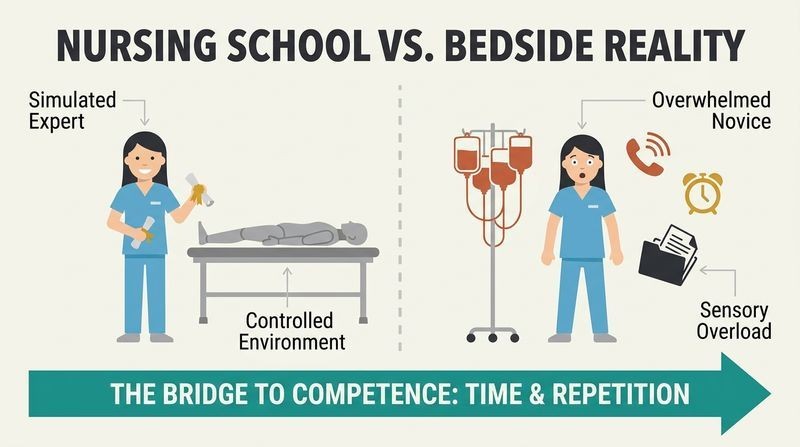
The gap between classroom and bedside is enormous. Schwartzbach, an ICU nurse, describes leaving a corporate media job at 23 to pursue something that let her give, learn, and grow. Her new-graduate orientation on a busy cardiac transplant unit lasted just six weeks, eighteen shifts, before she was expected to keep critically ill patients alive on her own.
She calls the affliction every new nurse catches "expert to novice syndrome": you graduate feeling like the ace of the class, then discover that reciting textbook chest-pain protocol means nothing when you have five patients, fifteen anxious family members, and a brain she describes as pulsed in a blender. Real competence comes only from time and repetition, not from your GPA or how many mannequins you catheterized in the lab.
What's striking is how universal this pattern is beyond nursing. Researchers call it the theory-practice gap, and it plagues teaching, law, and engineering alike. The Dreyfus model of skill acquisition maps exactly this journey from novice, who leans on rigid rules, to expert, whose judgment becomes intuitive. Physicians get years of residency to cross that chasm; nurses often get weeks. That structural mismatch, not individual weakness, explains why new-nurse turnover runs high. Schwartzbach's honesty is a useful antidote to impostor syndrome: naming the gap as normal and expected reframes early failure as a developmental stage rather than proof of unfitness.
You'll feel like you're drowning; that feeling is not the truth.
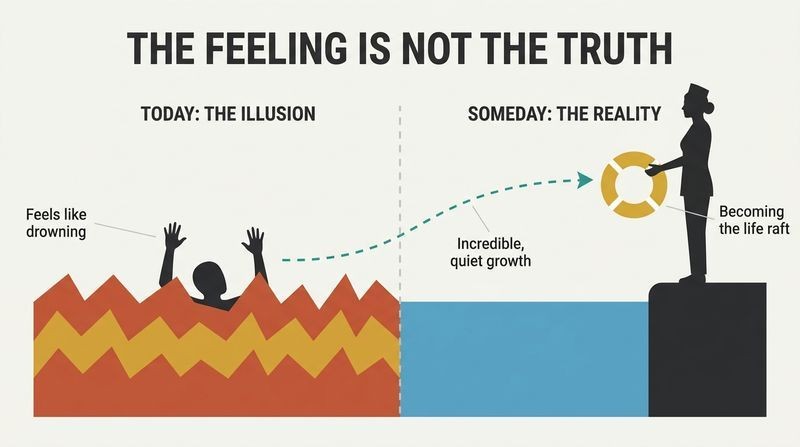
The emotional whiplash is the job, not a bug. Schwartzbach catalogs the ordinary catastrophes of a new nurse's shift: crying in the car with the radio off, cleaning more bodily fluids in twelve hours than most people see in a lifetime, getting screamed at by patients and cardiologists, walking into a room to find a patient unresponsive and forgetting everything you learned. After each scenario, she repeats a mantra: that's okay.
Her counterweight is the word "someday." Someday you will run a code on adrenaline instead of terror. Someday a doctor will thank you for catching something early. Someday you'll take an actual lunch break during actual lunchtime. Someday you'll become the life raft for another terrified beginner. The despair is real but temporary; the growth is quiet but inevitable.
The rhythmic reassurance echoes what psychologists call self-compassion, which Kristin Neff's research links to greater resilience and lower burnout than self-criticism. By normalizing the ugly cry and the frozen-in-a-code panic, Schwartzbach preempts the shame spiral that drives many capable people out of demanding fields. There is a mild risk here: relentless positivity can tip into toxic positivity, glossing over legitimate structural problems like unsafe staffing ratios. Her genius is pairing emotional validation with a promise of mastery grounded in time, which is empirically sound. Deliberate practice, not mere reassurance, is what actually closes the competence gap.
Nurses are the safety net catching doctors before they harm patients.
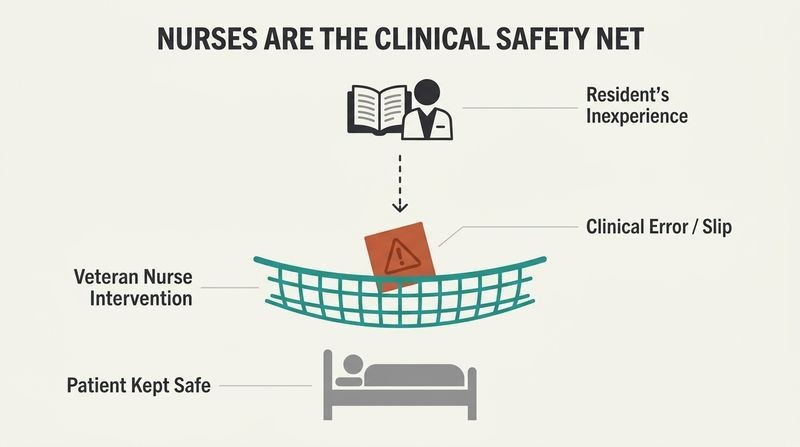
"July" is genuinely dangerous in teaching hospitals. Each July 1st, medical students in short white coats become residents in long ones, flooding hospitals with brilliant but clinically green physicians. Schwartzbach, who insists she is no physician-basher, argues that a core nursing job is protecting the patient from hastiness, inexperience, and sloppiness.
Her signature story: a post-surgical patient's blood pressure crashed to half of normal. The terrified surgical resident froze. Her veteran preceptor took one look at the x-ray, declared the chest had to be opened at the bedside, and calmly walked the resident through cracking a sternum to stop internal bleeding. The lesson she absorbed sounds absurdly simple but is hard to execute under pressure: a bleeding patient needs blood and the bleeding stopped. Nurses supply the experience that book-learning cannot.
Empirical work partly supports the July effect. Some studies find measurable spikes in medication errors and mortality when new residents arrive, though the effect size is debated. Schwartzbach's larger point aligns with high-reliability organization theory: safety emerges from teams and redundancy, not lone heroes. In aviation, crew resource management trains junior staff to speak up and senior staff to listen, precisely because hierarchy kills when unchallenged. Her advice on finessing suggestions to overworked residents ("Would you like me to start this medication, doctor?") is diplomatic error-trapping. The nurse becomes a human safeguard, though the ideal system would not rely so heavily on individual tact under duress.
Chart what you did, protect yourself, and buy your own malpractice insurance.
The record is the only version of events that survives. Schwartzbach invokes the old adage that if you didn't document it, you didn't do it. Years later, on a witness stand, you won't remember a patient, but whatever you charted becomes the only admissible evidence. Every electronic signature carries the full legal weight of a handwritten one.
Her rule for documentation borrows from a mini-skirt: short enough to get to the point, long enough to cover what matters. Document what you see, do, and who you call. Under-documenting leaves no proof; over-documenting digs a hole. She also urges every new nurse to spend roughly a hundred dollars on personal malpractice insurance rather than relying solely on the employer's coverage, because the universe does not always behave logically and, as she puts it, shit happens.
The defensive-documentation ethos is double-edged. It protects nurses and patients, but the same legal anxiety fuels the electronic-health-record burden now cited as a leading cause of clinician burnout. Studies show nurses and physicians spend more time charting than at the bedside, a phenomenon critics call death by a thousand clicks. Schwartzbach's mini-skirt heuristic is actually sophisticated risk management: precision beats volume. Her insurance advice is contested within the profession, since some argue personal policies can paint a target for plaintiffs, but the consensus leans toward coverage for autonomy and peace of mind. The deeper truth is that documentation is memory outsourced to the institution.
Stop "eating your young": bullying newbies is hazing, not toughening.
Nursing's cruelest tradition attacks its own tribe. Schwartzbach describes being called ditzy, dumb, and blonde, too pretty, too happy. The phrase "nurses eat their young" captures a sorority-style hazing culture where veterans belittle beginners under the logic of "I survived it, so you must too." She rejects the idea that this builds a thick skin, calling it a scare tactic that harms staff and patients alike.
Her practical counsel: bullies don't know what to do when you stand up to them. First they're confused, then annoyed, then they retreat. Assert yourself respectfully, back your practice with competence, and escalate to management if it continues. She frames it as a Mean Girls dynamic, urging new nurses to be Cady Heron in a hospital full of Regina Georges, and to remember that one hazing moment is never forgotten.
Lateral violence among nurses is a documented occupational hazard, with surveys suggesting a large share of new nurses experience it, contributing to first-year attrition. Sociologists link it to oppressed-group behavior, a theory that marginalized professions internalize powerlessness and redirect aggression horizontally rather than upward at institutions. That reframe matters: the bullying is partly a symptom of nurses lacking authority proportional to their responsibility, a tension the book names repeatedly. Schwartzbach's individual-level advice (assert yourself, escalate) is sound but incomplete. Cultures shift through structural interventions like zero-tolerance policies, civility training, and psychological safety, not just braver individuals standing their ground one confrontation at a time.
Treat the housekeeper and the attending as equals; hierarchy is a trap.
Everyone in the trenches keeps your patient alive. Schwartzbach offers a two-part chant. First, you are not above the nursing assistant, housekeeper, food-service worker, pharmacist, or respiratory, physical, and occupational therapists. Second, you are not beneath the attending physician, surgeon, executive, or nurse manager. The aim is to deliver competent, compassionate care as one team.
Drawing on her own grueling stint as a patient care technician, she notes the ancillary staff make nurses look good, and they remember how they were treated. Advanced practice nurses and physician assistants, though technically above staff nurses, depend entirely on the bedside nurse as the eyes and ears of the patient. Scratch backs through thoughtful interaction, she advises, and colleagues will treat you as their reference point. When you're hangry and frazzled, reorganize your priorities rather than taking it out on others.
This is applied organizational behavior. Research on psychological safety by Amy Edmondson shows that flattening status differences improves error reporting and outcomes in hospitals, where rigid hierarchy correlates with worse patient safety. Schwartzbach's Golden Rule pragmatism also reflects network theory: the people with informal power (who finds a bed, who expedites a lab) are rarely the ones with formal titles. Her framing sidesteps a subtler risk, though. Flattening hierarchy must not erase legitimate clinical authority when rapid, clear command matters, as in a code. The best teams toggle between egalitarian collaboration and decisive leadership depending on the stakes, a fluency she models elsewhere in the book.
Assess every patient yourself, every time, in the same fixed order.
Never trust another nurse's assessment over your own eyes. Schwartzbach runs the same head-to-toe sequence on every patient, every shift: neuro, pupils, motor, pain, respiratory, cardiac, gastrointestinal, genitourinary, pulses, skin, access, endocrine, and infectious disease. The ritual consistency means nothing gets skipped, whether she's admitting a patient, rounding, or handing off.
Even if the Chief Nursing Officer swears a patient has a perfect functioning IV, she says go into the room, look, touch, and flush the line yourself. She extends assessment to the environment: family chairs blocking the resuscitation bag, a tray table blocking a fire exit, no room for a code cart if the patient arrests. She learned this environmental vigilance only in the ICU, and it becomes life-or-death the first time a patient falls or codes. Look, listen, feel, and get a second set of eyes when something feels off.
The fixed-sequence approach is a cognitive-load management strategy. Checklists and standardized routines reduce omission errors, a principle Atul Gawande popularized from aviation and construction in medicine. By automating the order of assessment, Schwartzbach frees working memory for judgment about what the findings mean. Her insistence on independent verification counters automation bias and handoff-anchoring, well-documented sources of diagnostic error where clinicians defer to a prior colleague's conclusion. The environmental-safety point is underappreciated: latent hazards like a blocked crash-cart path are exactly what root-cause analyses uncover after adverse events. Her instinct that something "just isn't right" also deserves respect, as expert intuition often precedes measurable clinical deterioration.
You'll never forget your first patient death; nobody trained you for it.
No lecture prepares you to watch someone die. Schwartzbach's first loss was Joseph, an elderly man in his eighties who chose to stop fighting and drifted away peacefully surrounded by his children. Her first ICU death was the opposite: a bloody, screaming code, a patient who died on the operating table after she'd titrated medications and hung blood as fast as she could. She blamed herself until her charge nurse stopped her cold and refused to let her take credit for a loss no one could have prevented.
The hardest lesson she offers: it never gets easier. You simply build coping methods, part defense mechanism and part cheap therapy, that let you sleep and return the next day. Nursing school covers medication administration and when to call a physician, but never how it feels to bag your first body.
The claim that grief never eases but coping improves aligns with modern bereavement science, which has moved away from tidy stage models toward the idea of learning to carry loss rather than resolving it. Repeated exposure to patient death is a recognized driver of compassion fatigue and moral injury, terms borrowed from combat psychology to describe the wound of participating in outcomes that violate one's values. Schwartzbach's charge nurse performs a crucial protective function: externally reattributing blame, which research shows buffers against traumatic guilt. The gap she identifies, that clinical education teaches tasks but not the emotional labor of dying, remains a real curricular failure across health professions.
Dark humor and a good cry are survival tools, not unprofessionalism.
Laughter is the crutch that lets beaten-down nurses limp through. Schwartzbach ranks coping mechanisms only half-jokingly: laughter holds a solid number-two spot. When a unit is short-staffed and every admission goes wrong, the ability to crack a well-timed joke amid death and destruction is genuine survival equipment, not evidence of callousness. She was judged for seeming too cheerful in the ICU until colleagues realized her upbeat demeanor was how she contained the strain.
Crying earns equal respect. Her thirty-year veteran preceptor taught her that some days you need to cry because it feels like the only honest thing you did all day. She warns against the darker outlet: nursing carries what she calls a silent epidemic of substance abuse, and self-medication is a slippery slope. Find a healthy release, whether a run, a journal, or a garden.
Gallows humor is well studied among emergency responders, ICU staff, and soldiers, where it functions as emotional regulation and social bonding under conditions of chronic stress. Neurologically, laughter dampens cortisol and reinforces group cohesion, which may explain why it thrives precisely in the grimmest settings. Schwartzbach's pairing of humor with permission to cry reflects a mature model of affect regulation: suppression alone predicts burnout, while flexible expression predicts resilience. Her warning about substance abuse is sobering and evidence-based, as healthcare workers face elevated rates of addiction driven by stress and access. The through-line is that unprocessed emotion metabolizes into something toxic, so the outlet must be deliberate and healthy.
You cannot pour from an empty pot; guard your life outside scrubs.
Caring for others while neglecting yourself is not heroic. Schwartzbach insists nurses need an outlet to decompress: a drink with the crew at 8am after a night shift, a journal, a run, a garden, or ice cream and Netflix in pajamas. Once a nurse, always a nurse, but keeping the passion alive requires cutting the cord during time off.
Her most personal chapter recounts her mother's lung mass, discovered when presumed pneumonia turned out to be a tumor requiring removal of the right lower lung. When the phone call came, she tried her old trick of smashing bad news into a corner of her brain, wore extra-dark eyeliner so she wouldn't cry at work, then ruptured on her bedroom floor that night. The lesson: you cannot be a nurse first and a daughter second when it's your own mother. Take care of yourself first, or you'll have nothing left to give.
The empty-pot metaphor is folk wisdom that maps onto real research on caregiver fatigue and the conservation-of-resources theory, which holds that stress accumulates when demands outpace replenishment. Nurses are especially vulnerable because the caregiving instinct that makes them good at the job also erodes boundaries. Schwartzbach's most valuable insight is subtler than self-care platitudes: the danger of being unable to switch from clinician to family member. Health professionals treating their own loved ones face documented pitfalls, from compromised objectivity to delayed grief, which is why medical ethics generally discourages it. Permitting yourself to be simply a daughter, terrified and human, is its own form of competence.
Leave if the flame dies; a nursing degree opens many doors.
Disinterest at the bedside is dangerous, not just sad. Schwartzbach argues that when you clock in for the paycheck and not the work, you set yourself up for the kind of distraction that borders on unsafe patient care. She doesn't demand relentless cheer, which she finds annoying and unrealistic, but she insists you feel invested most of the time and constantly reassess where you stand.
She models this with her own indecision: she applied to, was accepted by, and turned down top nurse-anesthesia programs, a doctorate in nursing practice, and acute-care nurse-practitioner programs, before choosing, for now, to stay at the bedside and write. Her point is that more letters after your name don't guarantee more money or fulfillment, and an entry-level advanced-practice salary can dip below what you earned as a staff nurse. If nursing itself stops fitting, the degree still travels to case management, legal consulting, informatics, teaching, sales, and telemedicine.
The claim that disengagement threatens patient safety has empirical teeth. Studies link nurse burnout and low engagement to higher rates of infection, medication error, and mortality, meaning emotional depletion is a clinical variable, not a private matter. Schwartzbach's resistance to credential-chasing challenges a strong professional current pushing nurses toward advanced degrees. Her cost-benefit realism, that graduate debt can outpace the salary bump, mirrors broader critiques of credential inflation across knowledge work. The most liberating idea here is optionality: a nursing license is unusually portable, functioning almost like a general-purpose credential in healthcare. Framing departure as legitimate rather than as failure is a healthy corrective to sunk-cost thinking.
Nurses aren't angels or naughty stereotypes; they're the hidden reason patients live.
The profession's dirty secret is competence, not sainthood. Schwartzbach dismantles every cultural cliche: nurses are neither the starched-cap saints of history books nor the fishnet-stockinged fantasy, nor failed medical students. Male nurses, under 10% of the profession, battle constant assumptions that they're doctors or should have gone to medical school. Nurses swear, joke darkly, make mistakes, and are fully human.
Her closing argument is that when a family shouts "miracle" and a physician credits "modern medicine," the truth is often a critically thinking, intuitive, fiercely devoted nurse who caught the subtle change, questioned the order, and quietly kept the patient alive. There is no such thing as "just a nurse." She learned this watching her preceptor direct a bedside chest-opening, realizing nurses are the silent benefactors who keep patients comfortable, keep doctors on track, and most of all keep people alive, rarely taking credit.
The invisibility of nursing labor is a documented sociological phenomenon. Because much of nursing is surveillance and prevention, its successes are non-events (the code that never happened), making the work systematically undervalued in a system that rewards visible intervention. This helps explain the paradox the book returns to: immense responsibility paired with little authority and recognition. The stereotype critique matters practically, since the doctor-in-disguise assumption faced by male nurses and the fetishization faced by female nurses both undermine professional standing. Schwartzbach's central thesis, that nurses are the hidden infrastructure of survival, is not mere pride. It reframes the invisible as indispensable, which is the first step toward valuing it properly.
Analysis
This is a memoir-driven survival guide, not a systematic textbook, and that shapes both its strengths and its limits. Schwartzbach, an ICU nurse turned blogger, structures the book as a chronological journey from job hunt through first death through burnout and beyond, using profane humor as both entertainment and coping demonstration. The organizing tension throughout is a phrase borrowed from an old nursing poem: immense responsibility paired with very little authority. Nearly every chapter is a variation on how new nurses shoulder life-or-death accountability while occupying the bottom of a rigid hospital hierarchy.
What makes the book valuable is its emotional honesty about the theory-practice gap, a phenomenon well documented across professions but rarely discussed with such candor for nursing specifically. The book's most transferable insights, that competence comes only through time, that self-compassion beats self-flagellation, that dark humor and crying are legitimate regulation tools, that disengagement is a safety hazard, all align with current research on burnout, moral injury, and psychological safety, even though Schwartzbach cites almost no research and admits she is no expert.
The weaknesses are structural. Her advice operates almost entirely at the individual level: stand up to bullies, buy insurance, find a hobby. She names systemic problems (six-week orientations, unsafe ratios, lateral violence, substance abuse) but offers personal coping rather than structural reform, which can inadvertently place the burden of a broken system on the individual nurse. The relentless positivity occasionally borders on toxic positivity, and the clinical anecdotes, while vivid, are dated and specific to acute-care hospital settings, less useful for the many nurses in home care, long-term care, or outpatient roles she acknowledges but underserves.
Still, as an emotional inoculation for the terrifying first year, the book delivers exactly what its subtitle promises: the big human things nursing school forgot to teach, told by someone who clearly remembers being terrified and wants no one to feel alone in it.
Review Summary
"Oh Sh*t, I Almost Killed You!" receives mixed reviews, with an average rating of 3.73 out of 5. Readers appreciate the book's humor, relatability, and insights into nursing challenges. Many find it encouraging for new nurses, praising its candid approach and personal anecdotes. However, some criticize its repetitiveness, lack of substantive advice, and numerous grammatical errors. While some readers feel it reignites their passion for nursing, others find it lacks depth and fails to deliver on its promising title.
People Also Read

Glossary
Expert to novice syndrome
Feeling incompetent starting bedside practiceSchwartzbach's term for the disorienting drop new nurses experience when they leave school feeling accomplished, then discover that classroom mastery does not translate to real patient care. Symptoms include panic, self-doubt, and the fear of harming patients. She frames it as a disease every new nurse catches, curable only through persistence and time rather than additional study.
Nurses eat their young
Veterans bullying new nursesA longstanding profession-wide phenomenon in which experienced nurses belittle, berate, or haze beginners, often justified by an "I survived it, so you must too" mentality. Schwartzbach condemns it as a harmful scare tactic that damages both staff and patients, and urges new nurses to respond with respectful assertiveness backed by competence rather than accepting it as a rite of passage.
The empty pot
Cannot give while depletedSchwartzbach's shorthand, drawn from the saying that you cannot pour from an empty pot, for the caregiver-fatigue principle that nurses must replenish themselves before they can safely care for others. She argues that self-neglect is not heroic but dangerous, and that failing to maintain a life and outlets outside work leaves a nurse with nothing left to give patients or loved ones.
Short-Coats and Long-Coats
Medical students versus new residentsSchwartzbach's labels drawn from hospital dress: medical students wear short white coats, while graduated physicians wear long ones. She uses the July 1st transition, when short-coats become long-coats, to warn that teaching hospitals fill with brilliant but clinically inexperienced new doctors, making experienced nurses essential safeguards against error.
Holiday warriors
Essential staff working through holidaysSchwartzbach's affectionate term for nurses and other essential hospital staff who sacrifice holidays with their own families to care for strangers. She reframes the sacrifice as a privilege rather than misfortune, casting these workers as fortunate to help patients survive their darkest days, since a hospital cannot close for turkey and football.
FAQ
1. What is "Oh Sh*t, I Almost Killed You!" by Sonja Schwartzbach about?
- Honest look at nursing: The book is a candid, humorous, and practical guide for new nurses, focusing on the real-life challenges and emotional rollercoaster of starting a nursing career.
- What school didn’t teach: It highlights the gaps between nursing school education and the realities of bedside nursing, sharing lessons, mistakes, and survival tips.
- Personal stories and advice: Sonja Schwartzbach uses her own journey from corporate worker to ICU nurse to illustrate the struggles, growth, and triumphs of new nurses.
- Emotional and practical support: The book offers both emotional encouragement and actionable advice for surviving and thriving in the first years of nursing.
2. Why should I read "Oh Sh*t, I Almost Killed You!" by Sonja Schwartzbach?
- Real-world preparation: It prepares new nurses for the realities of the job that textbooks and classrooms often overlook.
- Relatable and supportive: The author’s voice is empathetic, funny, and honest, making readers feel less alone in their struggles.
- Practical tips and wisdom: The book is packed with actionable advice, from job hunting to handling difficult colleagues and patients.
- Emotional resilience: It addresses the emotional toll of nursing and offers strategies for coping, self-care, and maintaining passion for the profession.
3. What are the key takeaways from "Oh Sh*t, I Almost Killed You!" by Sonja Schwartzbach?
- Nursing is tough but rewarding: The profession is filled with challenges, mistakes, and emotional highs and lows, but it’s also deeply meaningful.
- Survival requires support: Building a support system, seeking mentorship, and learning from experienced nurses are crucial for new nurses.
- Self-care is essential: Nurses must prioritize their own well-being to avoid burnout and provide the best care for patients.
- Embrace imperfection and growth: Mistakes are inevitable, but honesty, accountability, and a willingness to learn are what make a great nurse.
4. What are the "Ten New Nurse Commandments" in "Oh Sh*t, I Almost Killed You!" and what do they mean?
- Self-care basics: Drink coffee, pee during your shift, and relax after work—basic survival for nurses.
- Documentation is vital: If you didn’t document it, it didn’t happen; thorough charting protects your license.
- Medication safety: Honor the six rights of medication administration to prevent errors.
- Teamwork and respect: Treat colleagues as you wish to be treated, even when tensions run high.
- Infection control and patient care: Wash hands, scrub hubs, and always prioritize patient safety and dignity.
5. How does Sonja Schwartzbach describe the transition from nursing school to real-world nursing in "Oh Sh*t, I Almost Killed You!"?
- Sink or swim reality: New nurses often feel unprepared and overwhelmed, as real-life nursing is far more complex than school scenarios.
- Short orientation periods: Many new nurses receive minimal on-the-job training, making the first months especially challenging.
- Emotional rollercoaster: Expect to feel scared, incompetent, and even want to quit, but these feelings are normal and temporary.
- Growth through experience: Over time, new nurses gain confidence, learn to prioritize, and develop the ability to handle crises.
6. What practical job-hunting and interview advice does "Oh Sh*t, I Almost Killed You!" offer new nurses?
- Get experience early: Work as a patient care technician, volunteer, or seek internships before graduation to improve job prospects.
- Network and hustle: Connections and hands-on experience often matter more than grades or resumes in landing a first job.
- Be authentic in interviews: Present your true self, highlight transferable skills, and avoid exaggerating your abilities.
- Prepare and follow up: Research the hospital, practice interview questions, and always send a thank-you note after interviews.
7. How does "Oh Sh*t, I Almost Killed You!" by Sonja Schwartzbach address mistakes and the fear of harming patients?
- Mistakes are inevitable: Every nurse will make errors, from minor slip-ups to more serious incidents, especially early in their career.
- Own up immediately: Honesty and prompt reporting are essential for patient safety and professional integrity.
- Learn and move forward: Use mistakes as learning opportunities rather than sources of shame or fear.
- Emotional impact: The fear of harming a patient is real and can be paralyzing, but support and time help nurses move past it.
8. What does Sonja Schwartzbach say about nurse culture, bullying, and teamwork in "Oh Sh*t, I Almost Killed You!"?
- "Nurses eat their young": The book discusses the unfortunate tradition of senior nurses being tough on newcomers, likening it to hazing.
- Stand up for yourself: New nurses are encouraged to assert themselves respectfully and not accept bullying as normal.
- Value every team member: Respect for all roles—nursing assistants, therapists, physicians—is emphasized as key to good patient care.
- Seek mentorship: Experienced nurses ("the OGs") are invaluable resources for learning and support.
9. How does "Oh Sh*t, I Almost Killed You!" by Sonja Schwartzbach address the emotional challenges and self-care needs of nurses?
- Emotional highs and lows: Nurses experience intense emotions, from grief over patient deaths to joy in making a difference.
- Laughter as medicine: Humor is a vital coping mechanism for dealing with stress and difficult situations.
- Crying is normal: It’s okay to feel and express sadness, frustration, or exhaustion—bottling it up is unhealthy.
- Find healthy outlets: Whether it’s socializing, hobbies, or therapy, nurses must find ways to decompress and separate work from personal life.
10. What are some of the most important skills and habits for new nurses according to "Oh Sh*t, I Almost Killed You!"?
- Thorough assessments: Always perform your own head-to-toe assessment and never rely solely on handoff reports.
- Documentation discipline: Chart accurately, concisely, and consistently to protect yourself legally and ensure continuity of care.
- Infection control vigilance: Hand hygiene, scrubbing hubs, and maintaining a clean environment are non-negotiable.
- Professional boundaries: Maintain patient dignity, respect privacy, and use social media wisely to avoid career-jeopardizing mistakes.
11. How does "Oh Sh*t, I Almost Killed You!" by Sonja Schwartzbach discuss career growth, advanced practice, and leaving bedside nursing?
- Many career paths: Nursing offers diverse opportunities, from bedside care to advanced practice, management, education, and beyond.
- No shame in change: It’s okay to leave bedside nursing if it’s not the right fit; self-awareness and happiness matter.
- Consider costs and benefits: Advanced degrees can be rewarding but require significant investment and may not always lead to higher pay.
- Follow your passion: Choose career moves based on personal fulfillment, not just external expectations or financial incentives.
12. What are the best quotes from "Oh Sh*t, I Almost Killed You!" by Sonja Schwartzbach and what do they mean?
- “If you didn’t document it, you didn’t do it!”: Emphasizes the legal and professional importance of thorough documentation.
- “Nursing is sink or swim.”: Captures the overwhelming feeling of being thrown into real-world practice with little preparation.
- “You will carry immense responsibility and very little authority.”: Highlights the paradox of nursing—huge accountability with limited power.
- “You can never not be a nurse.”: Reflects how nursing becomes an integral part of one’s identity, affecting all aspects of life.
- “Be a nurse that is better than what has been done to you.”: Encourages breaking the cycle of bullying and negativity in the profession.
Download PDF
Download EPUB
.epub digital book format is ideal for reading ebooks on phones, tablets, and e-readers.








































