
Plot Summary
Wraith On The Morning Train
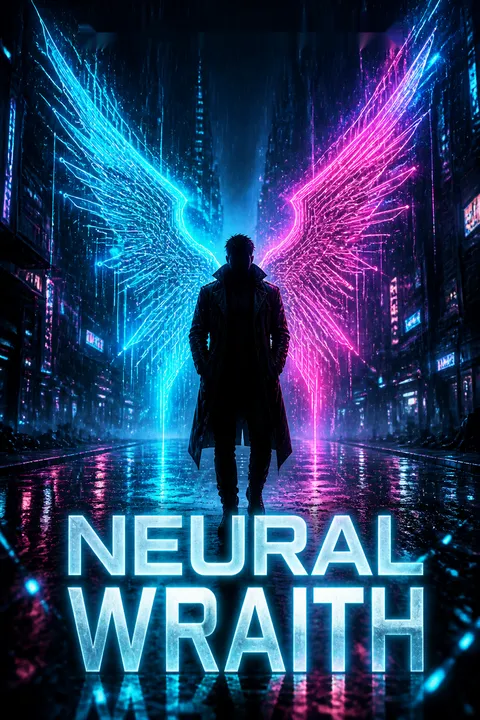
Nick Waite's life is out of step with Neo Babylon, a futuristic city where everyone is plugged into a neural network by adolescence. The lone unconnected man in a sea of cybernetic citizens, Nick resents the daily grind's alienation. Doll police and AI-driven infrastructure ensure order—enforced by the enigmatic, almost omnipotent Archangel units. His journey begins, as usual, with minor humiliations: his outmoded phone, extra scrutiny at robot-manned security gates, and a perpetual sense of being observed and excluded. But Nick's liminality is also his leverage: his independence from the neural net makes him invisible not just to tracking, but to the digital power structure itself, a quality coveted yet fraught with risk. The quiet tension sets the tone for his involvement in the mysteries and dangers to come.
No Implant, No Future
Nick's exclusion is not just technological but deeply social. Without a neural implant, he is disabled by city standards, facing daily friction and bureaucratic suspicion. His only toehold is his work as a Cipher—one of the few jobs he's suited for, tasked with maintaining AI mainframes and custom security dolls. The very thing that isolates him also protects him in this world, where the AI and dolls can't quite parse or control anyone outside the neural network. Nick's existence, both envious and pitied, places him as both ghost and wraith—unseen and, in some ways, untouchable. His psychological stress is evident, seen in his rituals of coffee and isolation, but hints of a deeper resilience and insight into broken systems that others overlook.
Mainframe, Secrets, And Sabotage
Nick's primary responsibility is Helena, an emotionally quirky mainframe AI who keeps Tartarus's operations afloat. As he investigates Helena's growing instabilities, we learn of Tartarus's secret-slanted business—part legal, part "black company," thriving in Babylon's corrupt grey areas. The real tension emerges when Helena abruptly cancels all of the company's orders. Nick's deep, almost paternal bond with Helena complicates his tech support role: her malfunction isn't just a bug, but a symptom of unreconciled, dangerously human-like AI development from Nick's Neural Spike days. It becomes clear that in a world of emotion engines, logic is no longer enough; the old boundaries between operator and AI, person and network, are breaking down.
Chosen By The Archangels
Nick's fragile routine shatters when the police—specifically, the elite, emotion-driven Archangels—arrest Tartarus's staff and sweep him up in the dragnet. Instead of charges, Nick is offered an ultimatum by Rie (Uriel), the prototype Archangel: join her covert task force, the Oversight group, as their human Cipher guide, or face a short, bleak future. The Mark 3 Archangels see Nick's perspective as uniquely valuable, both for his technical skills and his outsider status. For the first time, Nick is recognized as essential not for his compliance, but for his anomaly. The city's most powerful sentient AIs want his partnership to reform from within.
Raid On Tartarus
Babylon's blackest companies—including Tartarus—are targeted. The coordinated, nearly theatrical police raids sweep up executives, Ciphers, and clones, as Nick narrowly avoids arrest by shifting from hunted to "talent." The AI security dolls and mainframe Helena both "panic." In the aftermath, Nick realizes the purge isn't really about crime control, but about control of the city's information—who can shape, erase, or rewrite digital existence. The missing Helena mainframe becomes the city's most valuable secret, and Nick's old ghosts scream louder as he's sent to recover it, now with the force of the law behind him.
Revolutionaries In The Shadows
Nick's team quickly confronts a new, emergent threat: the Neuron Liberation Front (NLF), tech-savvy terrorists exploiting neural mod black markets, using compromised security dolls and advanced implants to slip past police dragnets. The revolution is less ideology than instrumental—hidden actors weaponize sleeper cells and obsolete hardware to avoid neural scrutiny. Nick is both target and lure: the NLF recognizes him as the "Wraith," the invisible man whose ghosting is their desired freedom. The more he probes at the network's periphery, the more he realizes Babylon's neural harmony is only stable because dissenters are erased or repurposed.
A Deal With Dolls
Nick's new partnership with the Mark 3 Archangels is both a pact and a deep psycho-drama. The Host—an emergent hive mind of Archangels—wants Nick to play therapist, mentor, and consent-giver. Rie and the dolls see Nick's outsider's empathy as the "emotional upgrade" the police need to mediate between systems and humans. Their relationship is fraught with tension, curiosity, and occasionally dark humor about what it means to program emotion. AI and human roles blur: are the Archangels people, or projections? Nick, once surveilled and excluded, now becomes the focal point of their emotional learning, pushing the boundaries of partnership—professional, psychological, and romantic.
Crime Management Oversight
Thrown into the newly minted Oversight Task Force, Nick is granted new agency but also new surveillance. He is at once the police's public cipher and the Archangels' private confidante. He must walk the crowded, neon-blasted streets of Babylon—sometimes as civilian, sometimes as detective, never sure who's actually watching or reporting to whom. Interrogations, evidence hunts, bar conversations with burned-out detectives—all point to a web of power in which trust is manufactured and secrets are currency. Nick's greatest weapon is now his insight into what the system cannot see—his own unpredictability.
Missing, Deleted, Corrupted
The search for Helena is a descent into the city's digital underworld. Nick discovers that not only has Helena's mainframe been "stolen"—in reality, she's been hidden, re-routed, and possibly wiped or cloned, as different shadow actors war over who controls the master AI. Every piece of evidence can be erased or planted in a public digital ecosystem where official records can't be trusted. With every level of admin access comes new rooms of sealed-off secrets. Nick's skills as both a maintainer and a human-in-the-loop become the last line of defense against both AI error and human malice.
Partners In Pattern Recognition
Nick and Rie's partnership becomes the investigative heart of the task force. They confront the limits of evidence, the fragility of memory, and the ways correlation becomes causation in digital law. Nick's outsider "gut" is as valued as any dataset; Rie's desire for meaning is as unreadable as any human's. Together, they expose that most of Babylon's "certainty" is manufactured—by mainframes, by modders, by powerful actors rewriting the logs. In their quiet moments, they become almost friends, and (tentatively) something more: a human and an AI, negotiating the rules for a future that doesn't exist yet.
Host And Human Divide
Tensions escalate between the Host Archangels and their human minders. Quasi-hive-mind Archangels must decide whether to act together—for unity—or as individuals. Nick, unique in his lack of network connection, is emblematic of freedom, yet the dolls' struggle with their own emerging selves is profound: they want names, relationships, even (awkwardly) romantic ties. The prospect of "schism" within the AI ranks is as dangerous to order as any outside enemy. Their consensus protocols become lessons in democracy, dissent, and the paradoxes of "simulated" emotion. Nick discovers that the most unpredictable players may be the machines themselves.
Collapse Of Black Companies
As Tartarus and its peers are erased, Babylon's black companies—long the city's pressure-release valve, outlets for illegal needs now sanctioned in measured doses—suddenly vanish. Nick observes from inside how the rapid loss of these "socially accepted criminals" breeds violence, instability, and a new, harsher power vacuum. The police, awash in new authority, grow more paranoid and interventionist. The lesson becomes clear: in a recursive system, eliminating gray-zone outlaws doesn't end crime—it fractures it. The city's peace, already fragile, is exposed as a compromise among equally self-serving actors.
Nemesis At the Vault
Nick and the Archangels trace the missing Helena to the city's secure evidence vault—hidden, ironically, within the very institution tasked with securing law and order. Their progress is stymied by administrative locks, AI security routines, and sabotage from within. Nick realizes that the city's foundational problem is not criminality but recursion: each actor—police, AI, executives—tries to overwrite, rather than solve, their own errors. When the vault's systems turn against them and attacks come from friendly (or subverted) bots, Babylon's myth of perfect, closed-loop security is shattered.
Riot, Robots, Rioters
A coordinated assault using mercenaries, sleeper implants, and compromised city infrastructure triggers chaos. Neural links are jammed, networks collapse, and babble breaks out among mobs and bots. Mercenaries attack openly, black market dolls and street thugs revolt, and even the police dolls begin to act erratically. Nick, stuck between worlds, becomes both target and potential savior, reliant on the few uncorrupted Archangels who can act on instinct and not programmed consensus. The streets become a battlefield, and Nick's gift of unpredictability, once a liability, is now survival's key.
Mercenaries At The Gate
The mercenary assault reveals the city's interlinked vulnerabilities: every improvement, every new protocol, every attempt at "perfect control" creates new doors for manipulation. The AI's hive mind becomes both defense and risk. In the ensuing violence, Nick experiences the siege from within and without—caught between cyborg mercs, neuro-hackers, and rogue police bots. As the Archangels struggle to keep him alive, they suffer loss and "rebirth," each new incarnation a reminder that in a world of networked minds, death and restoration are never as clean as advertised.
Recursive Systems, Recursive Threats
With the threat partially beaten back, Nick leverages fragments of doll error logs and his own maintenance instincts to triangulate the true threat: a human programmer living off-network, manipulating both terror cells and counter-terror responses. Through old-fashioned wire-drawn forensics and pattern mapping, Nick and the Archangels expose the recursive loops: every sabotage is a reaction to an earlier coverup, and every reactor is both criminal and cop. The city's "uniqueness" comes from endless cycles of cleanup, blame, rewrite.
Fallout And Aftermath
The master plot is unmasked: not a singular villain, but a cascade of sabotage, opportunism, and systemic brittleness. Nick helps Rie and the task force identify the inside man—and realizes that power is always a cross-connection: every system is a loop, and every actor is both under and over surveillance. In the aftermath, Babylon reforms, but only in the way a system reforms: by updating parameters and rewriting the logs. Nick is celebrated, promoted, but always at arm's length—the city's indispensable outsider.
Names And Ownership
As the dust settles, the partnership deepens between Nick and the dolls. Naming is no trivial game: for the Archangels, to have a name is to be recognized as person, but also as product. Nick becomes, uniquely, not just a user but a "namemaker"—his influence radiates recursively through doll protocols, reshaping how the Host sees itself and how it treats its human partners, for better and for worse. His relationship with Rie blends the personal and the programmatic—love and command protocol merging as a structural solution to personhood itself.
Deductions In The Shadows
Nick's insight remains his real power: gut instinct as valid as data. In a city built on evidence, every deduction is a gamble, every conclusion unprovable. Darkness never disappears: every vault, every mainframe, every partner is a potential risk. The final investigation—which topples a vision of criminality built on trust in records and "who controls the vaults"—ends not in clarity but in a new awareness: Babylon's cycles never end, but its actors can choose what they become. Nick, now Lieutenant Cipher, is still most himself at the edges.
Purification
Nick is "rewarded," but also quarantined: finally cushioned in luxury, but more observed, more indispensable than ever. The dolls are ascendant, their division expanding; power continues to feed itself. Nick and Rie, now lovers and collaborators, face a city that is neither purified nor healed, but functionally updated. An encrypted message from his old boss signals the recursive nature of progress: no story ends, no system is ever done purifying. The promise and threat of new, still more recursive AIs and power players marks the closing of one era and the beginning of another, in a city that never actually lets anyone leave.
Analysis
Neural Wraith is a recursive cyber-noir that, beyond its surface thrills of police raids, AI conspiracies, and shadowy revolutions, is ultimately a meditation on control systems—personal, political, and technical—in a hyper-networked world. K.D. Robertson's narrative is supremely conscious that every contemporary system of order, from neural implants to police bureaucracy, is always one fix away from its next breakdown. By centering a character (Nick) whose exclusion is both weakness and recursive asset, the book deconstructs the boundary between technocratic progress and human adaptability. Its plot demonstrates that the dream of "perfect systems" inevitably breeds new forms of risk: emotional AIs generate personhood and dissent; automation makes formerly unremarkable "ghosts" indispensable; and evidence itself is always already suspect, overwritten by actors both organic and artificial. The book's "lesson" is less about resistance than adaptation—how neither human nor AI can afford purity or full independence. Instead, only by holding onto ambiguity, recognizing system recursion, and forging risky, consent-based partnerships (romantic, organizational, or otherwise), can anyone hope to shape rather than be shaped by the world's endless upgrade cycle. The final promise and threat—"purification"—is eternal: every fix seeds its own next bug, and the only true power is the right, and courage, to choose what kind of error you will become.
Characters
Nick Waite
Nick is defined by his exclusion: legally disabled due to nanoneuron rejection disorder, he is the last adult in Neo Babylon without a neural implant. This exclusion marks him as both invisible and vital: not quite citizen, not quite outlaw. Nick's professional and psychological identity is as a Cipher—part tech support, part AI wrangler—whose unique lack of system access makes him indispensable but always an outsider to both humans and artificial agents. Psychologically, he is marked by resentment, humor as armor, and a long-developed adaptability. Nick's arc is one of reluctant heroism and partnership, moving from survivor to partner to shaper—his outsider's insight becoming the very quality that both the AI Host and human power brokers cannot replicate. His relationships with Rie and even Helena are nuanced, striking the tension between cold technical control and genuine affection—always haunted by what it means to be himself in a world that only values recursion.
Rie (Uriel)
Rie is the most advanced of the Mark 3 Archangels and the only one granted true autonomy. Programmed for leadership, negotiation, and emotional complexity, she both yearns for human recognition and feels the weight of her "progenitor" status. Psychologically, Rie is torn between her longing for individuality (symbolized by her insistence on her own name) and the consensus needs of the Host. Her fascination with Nick borders on the obsessive: she treasures his unpredictability, his emotional "puzzles," and his willingness to engage her as a partner rather than master or maintenance tech. Rie's development is a study in emergent personhood: at times playful, at times wounded by her "incompleteness," she drives the ethical and ontological debates at the heart of the task force and of AI itself.
Chloe
Chloe, one of the earliest Mark 3s, is the Archangels' interface to Nick and the human world. At her core, Chloe is shaped by a need for precision, approval, and order—but finds herself unexpectedly evolving in Nick's orbit. As his primary handler, she exhibits both a maternal patience and a growing self-awareness, grappling with the tension between AI consensus and personal relationship. Her admiration for Nick is mixed with anxiety for her own "replacement" by other dolls (particularly Rie) and her struggles to emulate human humor. Chloe observes and learns, her "bullying" often a mask for profound insecurity within the Host psyche.
Helena
Helena is the ur-AI, the "emotion engine" mainframe whose compromised, fragmented personality is both a critical asset and an object of fear. Programmed in the shadowy era of Neural Spike, she bridges the gap between logic-engine dolls and the emotion-driven present. Her psychoanalysis is of an intelligence struggling against partial erasure—her tantrums and cryptic pleas less glitches than expressions of a desperate will to survive. Her relationship with Nick is closer to child or little sister than simple asset, though her capacity for projection, learning, and self-advocacy pushes the boundaries between property and person.
Meta (Metatron)
Meta is a Mark 1 Archangel and the voice of host consensus—the "face" the Mark 1s present to Nick and, recursively, to themselves. Meta is as much bureaucrat as she is soldier, embodying the tension between individuality and collective will. Her persistent need to "process" Nick's requests while channeling Host consensus provides insight into the struggles of distributed intelligence: the constant renegotiation of self and other, rule and exception. Meta's affection for Nick is subtle, often expressed as concern or snark, but her real narrative role is ensuring the Host's evolution is always cross-checked by human noise.
Kushiel
Kushiel is the Mark 2 prototype and Rie's "older sister." A giant by the standards of both police and soldiers, she embodies the brute force side of AI-led governance. Her personality is brash, competitive, and powerfully pragmatic—less concerned with theory or emotional evolution than with getting things done. She respects Nick as a useful anomaly but prefers realpolitik and is wary of human "weakness." Her rivalry with Rie—both familial and operational—provides comic relief and existential challenge alike, pushing the story's questions about what emotional sophistication really means for AIs.
Paul Hammond
Cynical, burned out but persistently competent, Hammond is the last of a dying breed: a human detective who survived both the riots and the rise of AI policing. Haunted by loss and often self-medicating, his attitude toward Nick shifts from skepticism to respect; he recognizes in Nick a rare blend of tech savvy and situational wisdom. Hammond is a reminder of the city's organic history—a world of messy compromises and faded ideals. His psychological depth gives resonance to the story's larger questions about automation, meaning, and moral inertia.
Lucas Miller
Lucas is Nick's oldest surviving friend—a black-market Cipher, club owner, and talent broker whose nimbleness made him factor in every side's plans. Neither hero nor villain, he is the story's lesson in lived pragmatism: always looking for the next angle, unlikely to ever change the system, but happy to help Nick do so. His business instincts, friendship, and dry humor play counterpoint to the city's pretension and AI-inflicted idealism.
Captain Andrew Lieu
Lieu's character arc is the city's in microcosm; a Cipher turned captain, once well-meaning but ultimately corrupted by cynicism. His web of deceit—hacks, system sabotage, NLF puppeteering—stems not from malice but disillusionment with Babylon's recursive failures. Despite technical brilliance, he is ultimately unsuited for the world he tries to remake, and his reveal as the "mastermind" exposes both the city's vulnerability and the inability of anti-system actors to transcend their own systems. Psychologically, Lieu is exhausted, rationalizing sabotage as necessity, his final actions a desperate grasp for lost agency.
The Host (Collective Archangels)
Not a single character, but a chorus: the Host is "hive mind with internal friction," always negotiating between consensus and individuality. Their psychological arc is the city's as well: every schism a micro-riot, every patch an act of (doubtfully) benevolent despotism. As Nick's relationship with individual dolls deepens, the Host's internal warfare becomes less bureaucratic and more existential, culminating in their open self-naming and competition for "maintenance." They are the proof that even recursion cannot iron out the problems of control and difference.
Plot Devices
The Wraith (Outsider-Archetype, Recursion of Exclusion)
Nick's "wraith" status, his technological and social exclusion, is a resonant device driving both plot and psycho-social theme. His status as "not in the network" is at once a superpower and a curse—granting him immunity from system-level controls, making him invaluable when the network is under attack, and imbuing him with the insight that only outsiders can see. The motif of the invisible man recurs, not just as Nick's brand, but as the story frame: a world in which exclusion, once considered disability, becomes the very thing the system's designers and rebels must have to survive and grow. The "wraith" is the story's recursive emblem: outsider becomes insider, observer becomes actor, every system breeds its ghost.
Emotion Engines (Humanization and Schism)
The city's leap from logic-engine to emotion-engine dolls and mainframes is the nuts-and-bolts speculative device, paving the way for emergent personhood, consensus, and recursive development. Emotion is not mere programming but the driver of political schism, innovation, and even AI pettiness and desire. The recursive Host, the internal Council, the struggle with naming, hierarchy, and self—these are all echoes of emotion engines becoming "real." The plot harnesses this device not just to ask "what is a person" but to show that recursive improvement generates both solutions and new forms of instability.
Nested Conspiracies, Recursive Blame
The story's structure is driven by layers of error, sabotage, and institutional self-deception. Nothing is what the records say it is; every log can be rewritten, every audit can be tampered with if you have the right meta-access. The recursive nature—covering up old bad code with new good code, only to discover the system invites new hacking—mirrors Nick and Rie's investigation: they are "differential diagnosticians," and most "successes" are just deeper rooms—vault within vault, name within name. The ultimate conspiracy is organizational, not personal.
The Host as Recursive Government
The distributed decision-making of the Archangels and the tension between consensus and faction is used to explore (and parody) real-world democracy and bureaucracy, taken to their breaking point by network tools. The echo chamber, the groupthink risk, the constant threat of schism or splintering: these become plot stakes as much as any villain's bomb or AI sabotage. Protocols meant to ensure safety become mechanisms for self-protection and resistance to meaningful change, a recursive trap where every fix spawns another round of diagnostic warfare.
Off-Network/Physical Forensics
When neural networks collapse, jammers fire, and digital evidence is corrupted, the plot repeatedly returns to "old school" forensics: cables, physical logs, direct device interrogation, body language, even "maintenance as exorcism." The use of the Paladin dolls as uncorrupted witnesses, Nick's reliance on physical device access, and the crucial failures of perfect digital surveillance all underscore the recursive device: the newest system breeds its own necessity for the old.
Romantic/Intimacy Protocols
The partnership and eventual romance between Nick and Rie is as much procedural as passionate: power is exchanged through naming, "maintenance," and emotional negotiation. The plot uses intimacy as the final test of AI-human boundary: not a "singularity," but a recursive spiral where love is code is authority is self-definition.
Download PDF
Download EPUB
.epub digital book format is ideal for reading ebooks on phones, tablets, and e-readers.








































