
Plot Summary
Vicarage Table Talk
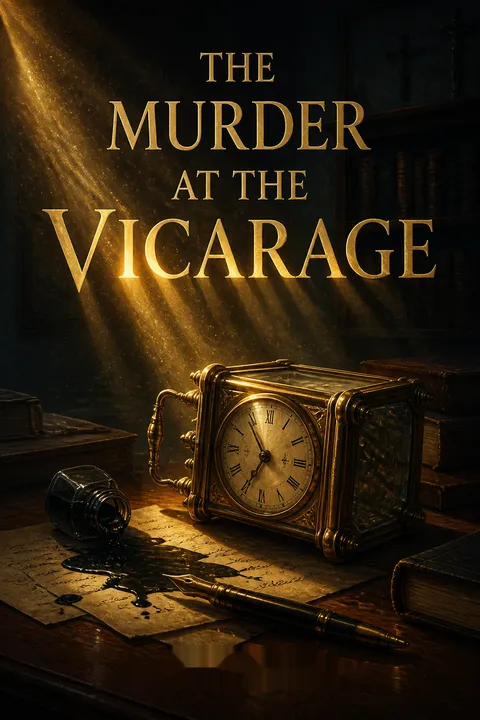
At St. Mary Mead's vicarage, Reverend Clement endures a difficult lunch with his young, playful wife Griselda and her nephew Dennis. Their banter, filled with joking threats toward Colonel Protheroe, sets a tone of village unrest beneath the calm surface. Griselda's charm and incompetence as a housekeeper both irritate and endear her to the vicar, while Dennis's humor and Mary the maid's brusqueness enliven the meal. Hints of dissatisfaction, social friction, and lurking resentments come to a head as talk drifts inevitably toward Protheroe, the unpopular churchwarden and magistrate. As the vicar reflects, the seeds of greater drama are lightly sown in the fertile ground of small-town slights, suspicions, and desires.
A Village Seethes Beneath
The daily currents of St. Mary Mead's social life teem with half-spoken secrets and hinted scandals. Lettice Protheroe, the colonel's dreamy, discontented daughter, drifts through the vicarage, complaining of lost records and wishing her disagreeable father gone. Elsewhere, Griselda convenes tea with the formidable Miss Marple, whose unassuming demeanor hides subtle powers of observation. Conversation meanders from the suspected motives of villagers to archæological disputes and budding romances—and ever back to the overbearing figure of Colonel Protheroe. Beneath the routine greetings, a lattice of rivalries, past wounds, and future longings link every household. Miss Marple's sharp eye and wary wisdom quietly foreshadow the darkness edging closer to this outwardly quiet community.
Secrets Behind Smiling Faces
Griselda and the vicar trade affectionate jibes and subtle reassurances about the possibility of affairs; the vicar seeks solace in routine as emotions stir uneasily. Later, an accidental discovery shocks Clement: artist Lawrence Redding and Anne Protheroe (Colonel Protheroe's second wife) are lovers, not Lawrence and young Lettice as assumed by everyone. Anne's composure dissolves in heartbreak as she admits her desperation; a web of frustrated passion, marital bitterness, and the longing for escape tangles the village's inner life. Miss Marple's near-infallible insight into human motives becomes increasingly prescient, as kindly facades blur into secrets. Confidences both innocent and illicit wind tightly toward coming tragedy.
Lovers and Enemies Revealed
At a troubled dinner, Lawrence privately admits to the vicar that he and Anne are deeply in love; he's ready to leave to spare Anne further pain, but wishes Colonel Protheroe gone. As the evening wears on, banter about murder and burglary overlays real unease. Village resentments shimmer outward—Dr. Stone's absentmindedness, rivalries among servants, the grumbling of poachers and gossips. The vicar endures a day of petty squabbles and mounting nervousness, Daniel Defoe's maxim about "the worst usually being true" echoing in his mind. Lawrence visits Clement again, confirming he will leave town; but choices made out of love for Anne risk unleashing suffering—and violence—on all.
Duty, Doubt, and Death
As the day darkens, Clement receives an urgent call away from the vicarage, creating space for fate to act. Returning late, he crosses paths with a panic-stricken Lawrence and finds the study in chaos—Colonel Protheroe lies dead, shot through the head while working at the writing table. The sense of order is shattered; Mary the maid is dispatched for the doctor, and Inspector Slack assumes command, brusquely blocking Clement's attempts to clarify odd details such as the clock's time. The scene is heavy with confusion, dread, and the sense that carefully constructed alibis and small untruths are no match for the gravity of murder.
Colonel Protheroe's Last Day
The web tightens: the colonel's last hours are chronicled through daily rounds and agitated encounters—disciplining parishioners, clashing with Lawrence, and making plenty of enemies. The vicar reflects on how many wished Protheroe gone, but is stunned by the reality of the crime. Evidence piles up: an overturned clock, a half-finished letter with a suspiciously precise time, and the absence of a murder weapon. Slack's investigation quickly targets those with the most visible motives, but his assumptions ignore the subtler undercurrents that Clemence, Griselda, and especially Miss Marple can sense beneath the surface.
Discovery: A Body in Study
The vicar, Griselda, and Dennis reel from the discovery; the village itself churns with rumors. Gossip and innuendo swirl—was it Lawrence, Anne, Lettice, an outside enemy, or someone no one expects? Early evidence points toward Lawrence Redding, who confesses and surrenders the murder weapon, but Miss Marple remains skeptical. The clock's fast time misleads the police, while Anne's composure and Lettice's feigned vagueness provoke doubts in careful observers. Friendships are strained and false conclusions accumulate as Inspector Slack zeroes in on apparent facts, ignorant of deeper truths knitting the village into complicity.
Clues, Confessions, and Confusion
Lawrence's confession, soon followed by Anne's, buries the investigation in contradiction. Haydock's medical testimony disputes the timing, while village alibis and distractions—the theft of valuable silver, a suspicious archaeologist, the mystery of Mrs. Lestrange—cloud the case. Miss Marple alone posits that Lawrence's distress is that of a protecting lover, and Anne protects him in turn. As confessions multiply, the vicar and Griselda reflect on human beings' capacity both for love and self-sacrifice—and for destructively misjudging one another. The trap appears obvious, but it is an illusion: the truth remains hidden amid a thicket of motives.
The Net Closes In
Market-day brings arrests, misgivings, and new worries. Inspector Slack and Colonel Melchett home in on Lawrence but are stymied by contradictions and lack of evidence; Mary the maid, a possible accessory, is interrogated. Miss Marple quietly collects peculiarities—such as Gladys Cram's midnight suitcase adventure and the disappearance of colony silver. The villagers' masks begin to slip: alibis unravel, evidence of falsehood accumulates, and revenge (through anonymous letters and outright spite) becomes a motive in itself. Beneath the bustle, Miss Marple pieces together the broader canvas, waiting for a revelation that will explain everything at once.
Miss Marple's Eye
Through meticulous record-keeping, social visits, and her "human nature hobby," Miss Marple sifts truth from the web of decency and deception. She identifies seven potential suspects—almost everyone in the story—and applies "rules of types" learned over years in the village. She gently steers Clement to consider misdirection, anomalies in timing, and the dangers of believing appearances. Her intuition—born of unromantic realism as much as sympathy—catches the inconsistencies in the murder's timing, the oddity of a clock's reset, and the emotional patterns of the key players. Her quiet determination gathers in the final clue.
False Trails and Hidden Truths
The village struggles with anonymous poison-pen letters, confessions meant to protect rather than reveal, and a host of misleading evidence (missing pistols, spurious silver, and enigmatic telephone calls). The vicar's attempts to reconcile rumor with fact lead to bitter reflection on the power of appearances. Trust falters within households—the vicar suspects Griselda briefly, Dennis is entangled by his crush on Lettice, and Lettice in turn plants false evidence to implicate Anne. Meanwhile, Miss Marple carefully observes these webs of spite and misplaced loyalty, laying the groundwork for the coming confrontation.
Resurrections and Revelations
The supposed confession of Hawes, the curate, is revealed as a deluded product of guilt and blackmail over embezzlement; he is not the murderer, but the victim of psychological manipulation. Miss Marple, Clement, and Melchett reconstruct the crime, realizing that the murderer has orchestrated the entire case, planting confessions, evidence, and even the method of suicide. It becomes clear that the real culprits are an inseparable pair: Lawrence Redding, who planned with cold skill, and Anne Protheroe, who pulled the trigger for love. The ingeniously staged alibis and misdirections were meant not only to save themselves, but to bury the truth forever.
Human Nature Unmasked
Miss Marple reveals her completed solution: the murder was premeditated by Lawrence Redding and Anne Protheroe, lovers who found their way blocked by the unyielding, abusive Colonel. Anne, shielded by her social position and her apparent gentleness, was the agent, but Lawrence's intelligence guided the plot—down to planting a misleading note, setting false alibis with cleverly timed distractions, and sacrificing the curate as a scapegoat. Each suspect's motives and limitations—from Lettice's spite to Mary's bluntness to village prejudices—fit the murder into the pattern of everyday passions, not monstrous evil, exposing the heart of the case as recognizably human.
The Amateur and the Expert
In the aftermath, admiration quietly settles on Miss Marple's unassuming genius. She is dismissed by the police as an eccentric, but her combination of keen observation, knowledge of types, empathy, and tolerance for ambiguity has solved the crime when bluster, expertise, and forensic logic failed. Her "hobby"—human nature—enables her to see what others overlook in plain sight, reaffirming her place as St. Mary Mead's real detective and restoring a measure of peace to the disrupted village. The police, while taking public credit, privately acknowledge their dependence on this unlikely sleuth.
Midnight Mouse-Trap
Learning of the attempt to murder Hawes, the final intended scapegoat, Miss Marple, Haydock, and the police set a cunning trap. A staged warning to Lawrence conjures panic, and he is caught, alongside Anne, in a late-night meeting, their guilt revealed through urgent whispers and frantic planning. The police record their desperate confessions. The cleverness of the crime, born in love twisted by desperation and mutual dependence, is finally defeated by the greater subtlety of a mind attuned to the details of ordinary life.
Guilt in the Shadows
The village is left to reckon with what has occurred: Lettice, lost and yet oddly matter-of-fact, learns the truth of her mother's return and prepares to leave with her; Hawes, exonerated, remains haunted by his own transgressions; Griselda and Clement, deepened in their understanding of each other, prepare for new beginnings. The exposure of motive and guilt, while legally satisfying, brings no triumph, but a sense of sadness, forgiveness, and humility. Life in St. Mary Mead resumes with secrets exposed, illusions punctured, and kindness reasserting itself amid the pain.
The Real Murderer's Face
In the end, order is restored not by the law, but by insight—the delicate, unostentatious capacity for seeing "human nature being what it is." Miss Marple, in her gentle wisdom, neither accuses nor absolves too easily. Justice is served; the wounds of the living begin to knit. As the amateur detects what the expert cannot, the quiet courage and compassion of the village—flawed, gossiping, sometimes vindictive—prove both its danger and its salvation.
Analysis
Christie's Murder at the Vicarage is at once a puzzle and a study of the dark, ordinary heart of village life. Its brilliance is not just in its tightly constructed mystery, but in its understanding that crime, cruelty, and love are rooted in the everyday dramas of family, class, and desire. With Miss Marple as both observer and analyst, the novel deconstructs the myth of village innocence, showing how the smallest resentments, disappointments, and secrets accumulate until they demand release. The lessons are clear: human nature repeats itself endlessly, and truth cannot be found in surface decency or in logic alone. Justice, as Christie suggests, is less a matter of police work or forensic proof than of kindness, humility, and the courage to look unflinchingly at those we "know" best. In the novel's final arc, the triumph belongs not to the force of law nor the energy of professionalism, but to the unlikely wisdom of a gentle, widely underestimated observer of "human nature being what it is." The novel warns readers of the destructive potential bred from repression and gossip, but also offers a quiet, forgiving closure: in the end, even the deadliest secrets yield to patient understanding.
Review Summary
Readers largely enjoy Murder at the Vicarage, praising Christie's clever plotting, charming village atmosphere, and the introduction of Miss Marple. Many note that Miss Marple, though not the main narrator, outshines the bumbling police with her sharp observations. Several reviewers prefer Poirot but find Marple endearing. Common criticisms include predictability, pacing issues, and Marple's limited presence throughout. The cozy, quaint setting of St. Mary Mead resonates strongly, and the book is widely recommended as an entry point to the series.
People Also Read


Characters
Reverend Leonard Clement
As the vicar and narrator, Clement embodies the bewildered voice of conscience. Dutiful, mild, and often self-deprecating, he is pulled from his routines by the shock of murder and the emotional storms of his household. His relationship with Griselda is at once affectionate and uncertain, revealing his deep desire for connection and truth, but also his incapacity to grasp the hidden dramas around him. Clement's journey is a gradual unmasking—not so much of others as of himself and his tendency to overlook what is strange in the ordinary. By the novel's end, he is more empathic and less certain of his own authority, a community figure shaped by humility and quiet growth.
Griselda Clement
Griselda, twenty years Clement's junior, disrupts the image of a docile vicar's wife. Affectionately irreverent, she both frustrates and delights the vicar, treating village life as a sort of joke yet fiercely loyal to her husband. Griselda's emotional intelligence offsets her practical failings, as she navigates suspicion, cruelty, and her own vulnerabilities with grace and resilience. Her arc is one of maturation—embracing motherhood and partnership, learning to balance independence with loyalty. Her lightheartedness masks deeper insecurities, especially when targeted by gossip, but she emerges as a quietly strong figure by the end.
Miss Jane Marple
Miss Marple, apparently a harmless spinster adept at tea and gardening, is in reality the village's sharpest detective. Her lifelong hobby—categorizing types and observing behavior—allows her to see through facades and predict motives with uncanny precision. Unlike the professionals, she knows the power of gossip and the ways trivial slights can grow deadly. Her keen empathy is always shaded with realism: she expects the worst, but forgives when she can. Miss Marple's development is not change but revelation; her role grows from background observer to quiet master of the case, her skepticism and kindness preserved even as her methods bring the truth to light.
Lawrence Redding
The village's outsider—handsome artist and former soldier—Lawrence is a catalyst for disorder, drawing romantic attention and sparking Protheroe's rage. His true devotion is not to Lettice, the colonel's daughter, but to Anne Protheroe, whose stifled life kindles his love and desperation. Lawrence's intelligence is matched by ruthlessness; his willingness to engineer the murder and elaborate coverup attests to his fatal flaw—a love that shades into obsession and amorality. By the story's end, his charm crumbles to cold calculation, viewed by Miss Marple as a chilling example of the plausible sociopath.
Anne Protheroe
The colonel's second wife, Anne appears calm, dignified, and almost aloof. In reality, she is emotionally battered by her husband's tyranny, finding comfort and hope only in her secret affair with Lawrence. Her emotional hunger leads her to the edge of despair and, ultimately, to crime, as she becomes Lawrence's co-conspirator and the actual instrument of killing. Anne's character arc is tragic—driven by oppression to betrayal, compelled by love to moral blindness, and finally trapped by justice. Her capacity for both loyalty and violence marks her as the story's most ambiguous figure.
Colonel Lucius Protheroe
As churchwarden and magistrate, Protheroe embodies small-town power at its most arbitrary and unforgiving. Deaf, domineering, and convinced of his own virtue, he collects enemies easily, sowing fear in his family and frustration in his parish. His murder is both shocking and, to many, a relief; he serves less as a character than as the dark gravity that warps everyone's motives. He remains a "ghost in life," present as a source of pain and resentment long after his death.
Lettice Protheroe
The colonel's daughter, Lettice, presents an aura of dreamy absent-mindedness; however, beneath this lies an alert, sometimes malicious intelligence. She resents Anne, envies her freedom, and is deeply affected by the emotional tumult around her. Her childish attempts at revenge and efforts to help (including planting false evidence) cause as much harm as good. Lettice is shaped by a longing for love and the wounds of an unsettled home, ending the story with unexpected maturity as she prepares to leave with her ailing birth mother.
Dennis Clement
Griselda's nephew, Dennis, views the case as an adventure from detective stories, providing comic relief and reflecting the curiosity (and occasional callousness) of youth. His crush on Lettice and desire to help often bring him unwittingly near danger, but he develops a deeper awareness of life's complexity as the events unfold, his innocence giving way to empathy.
Dr. Haydock
The village doctor, Haydock is both competent and compassionate, serving as a foil to the vicar's uncertainty and the Inspector's brusqueness. His modern, psychological outlook often puts him at odds with traditional views. His personal connection to Mrs. Lestrange (as a lost love) adds depth, and his defense of Hawes leads to the curate's rescue. Haydock embodies the new science of motive, offering support to those in spiritual pain as much as those physically ill.
Inspector Slack
The lead official, Inspector Slack is dedicated and methodical but insensitive to the nuances of village life. His focus on evidence blinds him to social realities and the subtleties of motive, causing him to overlook key clues. His eventual capture of the murderers is due in no small part to Miss Marple's intervention; public credit, however, accrues to him.
Plot Devices
Multiple False Confessions and Misdirection
The narrative hinges on the use of red herrings, confessions meant to protect instead of expose (Lawrence and Anne each accusing themselves), and deliberate distortion of crime-scene evidence (altered clocks, forged letters, planted items). The murderer uses these devices to both ensure and deflect suspicion, misdirecting police, public, and even those closest to the crime. The device of the "wrong note"—the supposed dying clue—exposes the risk of trusting appearances over substance.
Amateur vs. Professional Detection
The contrast between Inspector Slack's procedural, evidence-driven style and Miss Marple's intuitive, observational, and socially informed approach forms the core of the investigation. The story is structured as a contest between the amateur's insight into human patterns (based on years of mapped-out "types" in the village) and the professional's reliance on logic, suspect lists, and material clues. Marple's "schedule," empathy, and pattern-spotting repeatedly expose what technical method misses.
Social Satire and Psychological Realism
Christie weaves comedy, domestic detail, and biting social satire with a serious exploration of love, repression, jealousy, and the capacity for self-deception. Her plot is propelled not by external action, but by the psychology of small resentments swelling into deadly motive. Ordinary miserliness, the urge for escape or for power, and the slow build-up of spite show crimes as growing out of everyday weakness, not monstrous evil. The narrative structure, heavy with red herrings and insights from character observation, rewards acute attention to both language and action.
Nested Timelines and Distorted Alibis
The murderer engineers overlapping alibis, uses time-lags (delayed gunshot, silencer, false phone calls), and exploits the predictability of clocks and village routines, forcing the investigation into endless loops. Christie's narrative deftly handles these shifts, revealing the importance of unglamorous details—from clocks set fast, to telephone call records—in breaking the case open.
Framing and Sacrifice of Innocents
Innocent characters—Hawes, Griselda, even poor Mary—are framed, menaced, or ensnared by gossip, blackmail, and planted evidence. The external violence of murder is mirrored by subtler emotional violences: public shame, marital doubt, and loneliness. The drive to protect or save (even through self-sacrifice) is as powerful as the drive to destroy.
Miss Marple Series









About the Author








Download PDF
Download EPUB
.epub digital book format is ideal for reading ebooks on phones, tablets, and e-readers.








































