
Key Takeaways
1. Understand the root causes of student unmotivation
Depression among children as young as preschoolers is often overlooked as a cause of poor school motivation.
Psychological factors. Many unmotivated students are actually protecting themselves from perceived inadequacy or failure. They may have a fixed mindset about intelligence, believing effort won't improve their abilities. Others assert control through refusal to work. Depression and mental health issues can also significantly impact motivation.
Cultural influences. Modern culture often values material possessions over personal growth, leading to entitlement mentality. Many students expect success without putting in the necessary work. The "fast and easy" mentality has replaced "work and earn" for many youth.
Academic challenges. Students who struggle academically may give up to avoid looking "stupid" in front of peers. Repeated failures can lead to learned helplessness. A mismatch between challenge level and student ability can also diminish motivation.
2. Emphasize effort over ability to foster growth mindset
Mistakes are potent learning tools when viewed diagnostically rather than evaluatively.
Praise effort, not intelligence. Consistently emphasize the connection between effort and achievement. Highlight how mistakes and challenges are opportunities for growth. Use specific praise that focuses on strategies, perseverance, and improvement rather than innate ability.
Encourage improvement. Allow students to redo, retake, and revise work to demonstrate growth. Consider having separate grades for achievement and effort to reinforce the importance of trying. Implement strategies like:
- Improvement logs to track daily progress
- "Bank accounts" where students earn points for early/excellent work
- Celebrating small victories and incremental progress
Reframe struggles positively. Help students see partial success in their work (e.g., "You got 4 out of 10 correct - let's build on that!"). Use mistakes as teaching opportunities for the whole class.
3. Create hope by making learning achievable and relevant
Finding the right level of challenge is one of the most important tasks we face in reaching students.
Balance challenge and ability. Csikszentmihalyi's research shows motivation is lost when tasks are too easy or too difficult. Create "mountains students believe they can climb" by differentiating instruction and providing appropriate scaffolding.
Connect learning to real life. Consistently demonstrate how academic content applies to students' lives, interests, and future goals. Use concrete examples, invite professionals as guest speakers, and create hands-on projects that solve real-world problems.
Build basic skills. Ensure students have foundational reading, writing, and math skills. Without these, no amount of encouragement will sustain motivation. Use ethical confrontation if needed to push students past their comfort zones and develop these crucial abilities.
4. Respect student power and autonomy to increase engagement
Students feel respected and are likely to behave in a motivated way when they are asked for their opinion and when there is tangible evidence that their opinion influences classroom events.
Offer meaningful choices. Give students options in assignments, projects, and assessments. Allow them to choose topics, presentation formats, or which questions to answer. Frame requirements as choices with consequences rather than rigid demands.
Involve students in decision-making. Include students in developing classroom rules, procedures, and consequences. Ask for their input on curriculum sequencing when possible. Use focus groups to gather feedback on what's working and what needs improvement.
Empower through responsibility. Assign classroom jobs and leadership roles. Have students teach mini-lessons to their peers. Let them enforce agreed-upon rules and procedures. This builds ownership and reduces power struggles.
5. Build strong teacher-student relationships
There are times when we inspire motivation because of the work we have previously done to establish trust with our students.
Invest time in connection. Use strategies like the "2-minute intervention" - dedicating 2 uninterrupted minutes daily for 10 days to build rapport with challenging students. Have occasional lunches with students. Send personalized notes of encouragement and appreciation.
Show genuine interest. Learn about students' lives outside of school. Share appropriate stories from your own experiences as a student. Display photos of yourself at their age to increase relatability.
Separate behavior from worth. Consistently communicate that students are valued regardless of their actions. Use phrases like, "I'm disappointed in your behavior, but you're still an important member of our class."
6. Express enthusiasm to ignite passion for learning
Loving what you teach is actually a more important tool for motivation than loving your students.
Convey joy for teaching. Regularly express gratitude and excitement about being their teacher. Share your passion for the subject matter through energetic delivery and personal anecdotes about why you find it fascinating.
Model lifelong learning. Show students you're still growing by admitting when you don't know something and demonstrating how you find answers. Take classes outside your expertise to empathize with the student experience.
Create engaging openings. Start each class with high-interest activities like puzzles, jokes, or intriguing questions to hook students' attention. Use drama, music, and multimedia to bring lessons to life.
7. Implement practical strategies to motivate challenging students
Being successful at motivating difficult youth requires that our behavior be motivated by the following basic beliefs: All students are capable of learning when they have the academic and personal tools to be successful.
Use behavior modification judiciously. Short-term rewards and incentives can jumpstart motivation, but overreliance leads to entitlement. Use sparingly for rapid behavior change, then transition to more intrinsic motivators.
Employ private corrections. Address behavioral issues using PEP: Privacy, Eye contact, and Proximity. This preserves student dignity and increases receptiveness to feedback.
Reframe refusals positively. When students refuse to work, acknowledge the positive aspect (e.g., attending class) while encouraging more engagement. Use "power messages" that recognize student autonomy: "We both know you have the power to use respectful language. Thanks for using it."
Provide reasons for requests. Research shows people are more likely to comply when given a rationale, even if it's not particularly strong. Always explain the "why" behind assignments and rules.
Review Summary
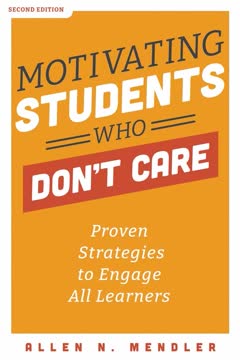
Motivating Students Who Don't Care receives mixed reviews. Some find it an excellent guide with practical techniques for teachers, especially those new to the profession. Readers appreciate its emphasis on building relationships and communication. However, experienced educators often find the advice basic or outdated. Critics note its brevity and lack of depth. Some praise its quick-read format and helpful reminders, while others feel it doesn't offer enough new insights. Overall, it's seen as more beneficial for newer teachers in well-resourced communities.
People Also Read


About the Author
Other books by Allen N. Mendler
Download PDF
Download EPUB
.epub digital book format is ideal for reading ebooks on phones, tablets, and e-readers.








































