

Key Takeaways
Financial literacy is a learnable skill schools never taught you
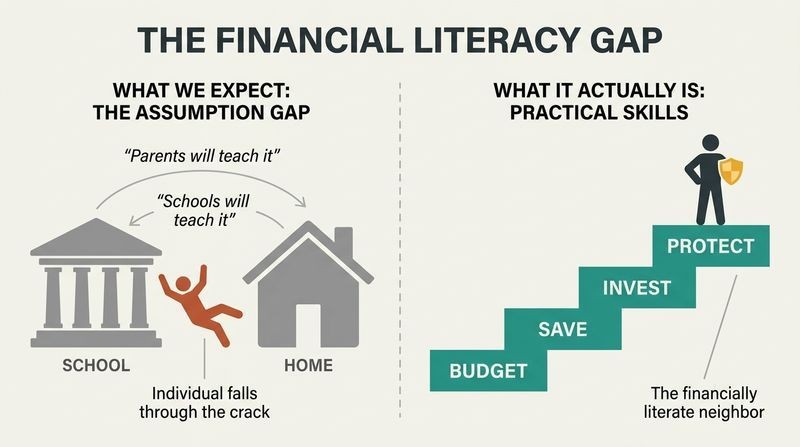
The gap nobody fills. Kolapkar argues that financial illiteracy is widespread yet ignored because schools assume parents will teach money skills, while parents assume schools will. Children inherit their elders' misconceptions dressed up as wisdom. The result: educated adults who still fall for the same recurring scams and repeat the same money mistakes.
Literacy means understanding how money works. It is not about tracking GDP or predicting markets. It is a practical, ongoing skill set: knowing your income and expenses, setting financial goals, budgeting, saving, managing loans, insuring properly, investing wisely, and staying alert to fraud. The author frames the ordinary but financially literate neighbor, not the billionaire, as the real role model worth decoding.
The framing echoes a broader global finding: an S&P survey found only about a third of adults worldwide are financially literate, and formal education correlates weakly with money competence. What sharpens Kolapkar's version is the intergenerational-transmission point. Behavioral economists call this the socialization effect: money attitudes crystallize young, often below conscious awareness. The book's insistence that you can override inherited scripts through self-education is empowering, though it slightly underplays structural constraints. For someone earning subsistence wages, no amount of literacy conjures a surplus to invest. Literacy is necessary but not always sufficient, a nuance worth holding alongside the optimism.
Overconfidence, not ignorance, is what wrecks financial decisions
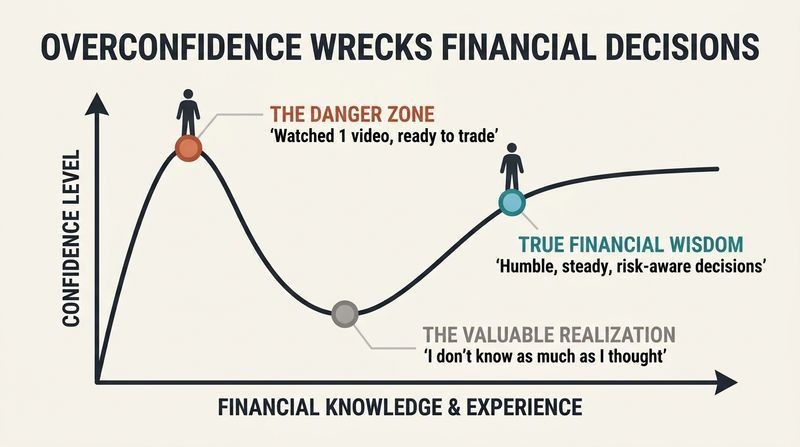
The lemon-juice bank robber. Kolapkar opens with McArthur Wheeler, who robbed banks in 1995 with lemon juice smeared on his face, convinced it made him invisible to cameras. Psychologist David Dunning studied the case and named the Dunning-Kruger Effect: people who know least about a subject are the most confident in it, while genuine experts stay humble.
How it plays out with money. The author maps this onto finance. The person who watched one YouTube trading video believes he can become the next Warren Buffett, ignoring that Buffett studied markets for eight decades. People assume their income will always rise, so they take endless loans for cars, trips, and interiors. Real knowledge, the book argues, begins with recognizing the vastness of what you do not know.
Anchoring a money book in the Dunning-Kruger study is a smart move because overconfidence is measurable and predictive. Research on retail traders consistently shows the most active (and confident) traders earn the worst returns, a finding Barber and Odean documented in Taiwan. The deeper insight is that finance punishes overconfidence more brutally than most fields, because losses compound and are often irreversible. One caveat: the effect can breed the opposite paralysis, where beginners never start because they fear their own incompetence. The healthy target is calibrated humility, curious enough to learn, cautious enough to verify, not frozen.
Flip your formula: subtract savings first, then spend the rest
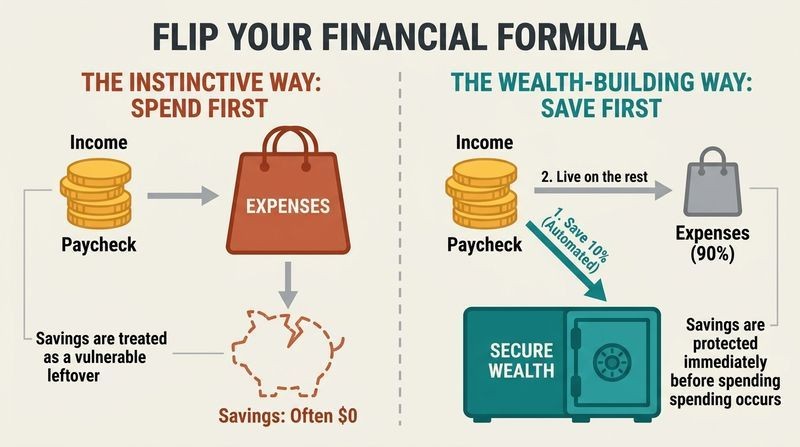
Most people run the equation backwards. The instinctive approach is Income minus Expenses equals Savings, which leaves savings as an afterthought that usually evaporates. Kolapkar insists on inverting it: Income minus Savings equals Expenses. Decide your savings percentage first, automate it, then live on what remains. If you set aside 10 percent, you simply run life on the other 90 percent, and your spending naturally recalibrates.
Percentage beats absolute amount. He illustrates with two earners: Akshay makes Rs 50,000 monthly but saves only Rs 2,000 (4 percent), while Makrand earns Rs 30,000 and saves Rs 3,000 (10 percent). The lower earner is building wealth faster. The book recommends saving at least 5 to 10 percent from your very first paycheck, automated through a SIP or recurring deposit so willpower never enters the equation.
This is the pay-yourself-first principle, and its power is behavioral rather than mathematical. Automation exploits what economists call present bias, our tendency to overweight immediate gratification, by removing the monthly decision entirely. Richard Thaler's Save More Tomorrow program showed that automatic, escalating contributions dramatically raised savings rates precisely because inertia started working for savers instead of against them. Kolapkar's percentage-over-amount emphasis is quietly radical in a status-obsessed culture that equates a big salary with wealth. The self-made teacher Prahlad in his example, who funded two children's professional education on a modest government salary, is the living proof that rate of saving trumps size of paycheck.
Build a three-to-four-month emergency fund before you invest a rupee
Engineering's margin of safety, applied to life. A bridge rated for 10,000 tonnes of daily traffic is built to hold 30,000. Kolapkar borrows this concept for personal finance: your emergency fund is the structural buffer that keeps a job loss, medical crisis, or pandemic from collapsing your finances. Covid made this vivid when salaries stopped and treatment costs erupted for the unprepared.
Sizing and placing it right. The fund should cover three to four months of essentials: groceries, rent, school fees, EMIs, insurance, and medical needs. Too small and it drains before the crisis passes; too large (nine to ten months) and you lose returns by parking cash in low-yield instruments. Keep it liquid, in savings accounts, sweep-in deposits, recurring deposits, or ultra-short-term funds. Crucially, a credit card is not an emergency fund, because card spending is borrowed money, not yours.
The margin-of-safety analogy is elegant, and it happens to be the same phrase Benjamin Graham used for value investing, though Kolapkar repurposes it for cash reserves. Empirical work backs the psychological payoff: studies link even a modest liquid buffer to lower financial stress and better decision-making, because scarcity itself taxes cognitive bandwidth, as Mullainathan and Shafir argued in Scarcity. The credit-card distinction deserves underlining. Treating available credit as a safety net is how many households slide from one emergency into permanent revolving debt at 36 to 42 percent annual interest. The fund is not just money; it is the freedom to say no and to think clearly under pressure.
Inflation quietly halves your money, so idle savings are losses
The compounding erosion. Kolapkar's starkest statistic: Rs 1 lakh in 1984 held the buying power of just Rs 7,451 by 2020. A product costing Rs 1,000 at 5 percent inflation costs Rs 1,629 after ten years, because each year's rise stacks on the previous inflated base. Milk that was Rs 15 a litre in 2010 hit around Rs 70 by 2023.
Why savings alone lose. A savings account paying 4 percent, after 20 percent tax, yields an effective 3.2 percent, which trails inflation of 4 to 6 percent. So the diligent saver who never invests actually grows poorer in real terms. The book's distinction is sharp: savings (deposits, cash) protect and provide liquidity; investments (equity, mutual funds, property) are meant to outpace inflation. You need both, but confusing one for the other guarantees you fall behind.
This reframes a comfortable habit, hoarding cash, as a slow-motion loss, which is precisely the mental shift most savers need. The behavioral trap here is money illusion, a term Irving Fisher coined for our tendency to think in nominal rather than real terms. A locker full of untouched cash feels safe and responsible, yet it is silently bleeding value. Kolapkar's savings-versus-investment taxonomy is the practical antidote. One refinement worth adding: inflation is not uniform. Medical and education inflation in India often run 8 to 14 percent, far above headline figures, which means retirement and children's-education corpuses need even more aggressive real growth than the average rate suggests.
Starting at 25 beats starting at 40, even investing far less
Time is the real engine. Compound interest means you earn returns on your returns, so your principal grows on an ever-larger base. Kolapkar contrasts two friends. Rahul invests Rs 10,000 monthly from age 25 at 10 percent. Amit lives large, then invests Rs 18,000 monthly from age 41. Both put in the same total principal of Rs 43.2 lakh by age 60. Yet Rahul ends with Rs 4.24 crore and Amit with only Rs 1.38 crore, a gap of nearly Rs 2.86 crore, purely because Rahul gave his money 36 years to compound versus Amit's 15.
Franklin's 200-year gift. Benjamin Franklin left roughly $4,500 to Boston and Philadelphia in 1790 with instructions to let it compound; two centuries later each city received about $6.5 million. The Rule of 72 offers a shortcut: divide 72 by your return rate to find the years to double your money.
The Rahul-Amit comparison is the single most persuasive argument in personal finance, because the intuition-defying gap does the convincing. Einstein reportedly called compounding the eighth wonder; whether apocryphal or not, the math is unforgiving. The asymmetry has a sobering flip side the book flags: compounding works identically on debt, which is why credit-card balances at 36 to 42 percent annually can double in roughly two years. The practical takeaway is temporal, not financial. The scarcest, most valuable input is early years, and they cannot be recovered later with more money. This is why financial procrastination is uniquely expensive compared with most other kinds.
Buy term insurance for protection, invest separately for returns
Never mix the two goals. Kolapkar's insurance thesis is blunt: insurance exists to replace your income for dependents if you die, not to make you rich while alive. Hybrid products like endowment plans and ULIPs (unit-linked plans mixing insurance and investment) do both jobs poorly, offering thin coverage and mediocre 4 to 6 percent returns.
The numbers are lopsided. A healthy 30-year-old can get Rs 25 lakh of cover for about Rs 6,000 a year via term insurance, versus Rs 1.45 lakh for the same cover via an endowment plan. Investing the Rs 1.39 lakh difference in equity mutual funds at roughly 12 percent produces far more wealth plus four-times-higher coverage. His rule: cover should be at least 20 times your annual income. And skip insurance entirely if nobody depends on you financially, which is why insuring young children makes no sense.
The buy-term-and-invest-the-difference doctrine is financial-planning orthodoxy globally, championed by figures from Suze Orman to Dave Ramsey, and Kolapkar's Indian numbers make it concrete. The reason bundled products persist despite poor value is incentive structure: they pay agents far fatter commissions, so they are sold, not bought. That is worth naming plainly. One nuance the disciplined-investor framing assumes is behavioral follow-through. Bundled plans, for all their inefficiency, do force savings on people who otherwise would not invest the difference at all. For the undisciplined, a mediocre forced-savings product can beat a superior plan they never actually execute. The ideal answer is term insurance plus automated SIPs that replicate that forcing function.
Distinguish good debt that builds assets from bad debt that shrinks you
Not all loans are equal. Good debt grows your net worth: home loans (property appreciates), education loans (raise earning power), business or cash-credit loans (fund income generation). Bad debt funds depreciating or consumable things bought to impress: vehicles beyond your need, gadgets, foreign trips, and above all credit-card revolving balances.
The credit-card trap. Kolapkar reserves his sharpest warning for cards. Paying only the minimum due invites 3 to 3.5 percent monthly interest, which is 36 to 42 percent annually, versus 7 to 12 percent on home loans. He offers a debt-freedom sequence: list every debt, attack the highest-interest ones first, pay more than the EMI to shrink the principal, avoid new loans to repay old ones (unless the interest rate genuinely drops), and keep total EMIs under 35 to 40 percent of income. Interest, he notes, is rent you pay for things you could not afford.
The good-debt/bad-debt distinction, popularized by Robert Kiyosaki, is a useful heuristic but deserves a caveat Kolapkar himself gestures at: good debt is only good if the underlying bet pays off. An education loan for a degree with no job market, or a property bought at a bubble peak, becomes bad debt retroactively. The credit-card math, though, is unambiguous and behaviorally treacherous. Minimum-payment framing is a documented dark pattern; research shows it anchors people to paying roughly that amount, dramatically extending repayment. The 35 to 40 percent EMI ceiling aligns with what lenders themselves use, making it a practical self-check before any borrowing decision.
Long-term investing builds wealth; intraday trading is disguised gambling
The market rewards patience, not activity. Kolapkar's data is sobering: a SEBI study found 89 percent of individual traders in equity futures and options lost money, with average losses of Rs 1.1 lakh. A Taiwan study found 99 percent of intraday traders lost money over time; in Brazil, 97 percent lost. Even Isaac Newton lost a fortune in the 1720 South Sea Bubble, remarking he could calculate the motion of stars but not the madness of men.
Invest like an owner. The alternative is value investing: study a company's business, management, profits, and debt, buy quality at a fair price, and hold for years. He cites Buffett's 20-Slot rule, imagine you get only 20 investment decisions in a lifetime, so each one demands real thought. For those without time or expertise, mutual funds and SIPs let professionals manage the work while you stay invested through market swings.
The loss statistics are the strongest part of this chapter because they replace anecdote with base rates, and base rates are what gamblers systematically ignore. The Newton anecdote lands a subtler blow: intelligence offers no protection against emotional decision-making, a point Daniel Kahneman's work on loss aversion reinforces. The book's emotional-cycle map, from optimism to euphoria to panic-selling at the bottom, describes exactly how retail investors buy high and sell low. One honest tension: index investing, which Kolapkar endorses via John Bogle, arguably beats both stock-picking and trading for most people, and even beats many active mutual funds after fees. The core message holds: time in the market beats timing the market.
If returns sound impossible, you are the product, not the investor
Ponzi and pyramid mechanics. Charles Ponzi promised 50 percent returns in 45 days in 1920; his name now labels every scheme that pays old investors with new investors' money rather than real profits. Kolapkar details India's Stock Guru scam (Rs 1,100 crore from 2 lakh investors, which paid 20 percent monthly to build trust before vanishing), Speak Asia (Rs 2,273 crore), and Saradha (Rs 4,000 crore-plus). All collapse the moment new deposits dry up.
The red flags are consistent. Watch for guaranteed high returns with no risk, complex schemes you cannot understand, artificial urgency (limited-period, once-in-a-lifetime), unregistered operators, and pressure from trusted friends already enrolled. His filter question: why would anyone bear a loss to make me rich? Verify registration on RBI, SEBI, and Ministry of Corporate Affairs sites before parting with money. Pyramid schemes differ from legitimate multi-level marketing by earning mostly from enrolment fees, not real product sales.
What makes this section valuable is the behavioral autopsy, not just the case list. Ponzi schemes exploit two reliable human failings: greed and social proof. The initial genuine payouts are the hook, converting skeptics into evangelists who then recruit their own networks, which is why these frauds spread through trust relationships rather than cold sales. Kolapkar's why-would-anyone-lose-to-help-me question is a genuinely useful circuit-breaker. Worth adding: legitimate returns cluster in a knowable band (deposits 6 to 7 percent, strong equity funds 12 to 15 percent), so anything promising multiples of that is, by definition, either fraud or extreme undisclosed risk. The math itself is the tell, no expertise required to spot it.
Stop comparing your finances; someone is always richer
The endless ladder. Kolapkar builds a chain: a teacher envies a tailor, who envies an IT worker, who envies a doctor, who envies a factory owner, who envies a listed-company chairman, who idolizes Mukesh Ambani, whose wealth trails Elon Musk's. Comparison has no finish line. He pairs this with Kubler-Ross's five stages (denial, anger, bargaining, depression, acceptance) reframed for money: progress begins only at acceptance of your actual starting point.
Wants versus needs. The Mexican fisherman parable drives it home: a banker urges a content fisherman to build a business empire so he can eventually retire to fish and relax, which is what the fisherman already does. Yet Kolapkar adds nuance most retellings skip, that the fisherman still needs insurance and savings against storms and his children's education. The goal is neither penny-pinching nor endless ambition, but knowing what genuinely satisfies you.
The comparison-ladder illustration is effective because it exposes envy as structurally unwinnable, not just morally unwise. Social-comparison theory, dating to Leon Festinger, shows we anchor self-worth to reference groups, and social media has weaponized this by making everyone's highlight reel constantly visible. Research on the hedonic treadmill confirms that lifestyle upgrades deliver only temporary satisfaction bumps before becoming the new baseline. Kolapkar's refinement of the fisherman parable is where he improves on the original. The usual version romanticizes subsistence; his adds that contentment without a financial buffer is fragility disguised as wisdom. Real freedom is having enough saved to genuinely choose your pace, not being forced into it.
Analysis
Money Works is a comprehensive, beginner-oriented financial-literacy manual written by an Indian chartered accountant, structured as a sequential curriculum: mindset, planning, insurance, debt, investing, markets, and fraud. Its intended reader is the newly earning Indian, financially anxious yet motivated, and the book self-consciously rejects the get-rich-quick genre in favor of slow, disciplined wealth-building. This makes it hard to summarize precisely because its value lies less in novel ideas than in comprehensive, culturally localized coverage: EMIs, ELSS, PPF, SIPs, Sukanya Samriddhi, the old tax regime, and India-specific scams. The density of practical detail resists compression.
Intellectually, the book is a synthesis rather than an original framework. It draws heavily on established authorities (Buffett, Bogle, Graham, Kiyosaki, Ramsey, Kahneman-adjacent behavioral ideas via Dunning-Kruger) and Indian scriptural wisdom (Subhashitas, Chanakya, Kabir), stitching them into an accessible narrative punctuated by relatable fictional vignettes. Its strongest contribution is behavioral: repeatedly locating the enemy inside the reader, in overconfidence, envy, instant gratification, FOMO, and comparison, rather than in external market complexity. This is psychologically sound and aligns with modern behavioral economics.
The book's limitations are those of its genre. It is optimistic about the power of individual literacy and comparatively quiet on structural constraints, wage stagnation, informal-sector precarity, and the reality that the poorest simply have no surplus to invest. Its investment advice, while directionally excellent (favoring low-cost, long-term, diversified equity exposure), occasionally overstates historical equity returns and understates sequence-of-returns and valuation risks. Its heavy reliance on motivational quotations sometimes substitutes inspiration for rigor.
Still, as a first financial book, it is unusually complete and honest. It refuses to promise shortcuts, insists on emergency funds before investing, separates insurance from investment, and devotes serious space to fraud, a genuine and underserved need in emerging markets. Its enduring thesis, that financial success is defined by how you manage wealth rather than how much you accumulate, is both defensible and quietly countercultural.
People Also Read








Download PDF
Download EPUB
.epub digital book format is ideal for reading ebooks on phones, tablets, and e-readers.








































