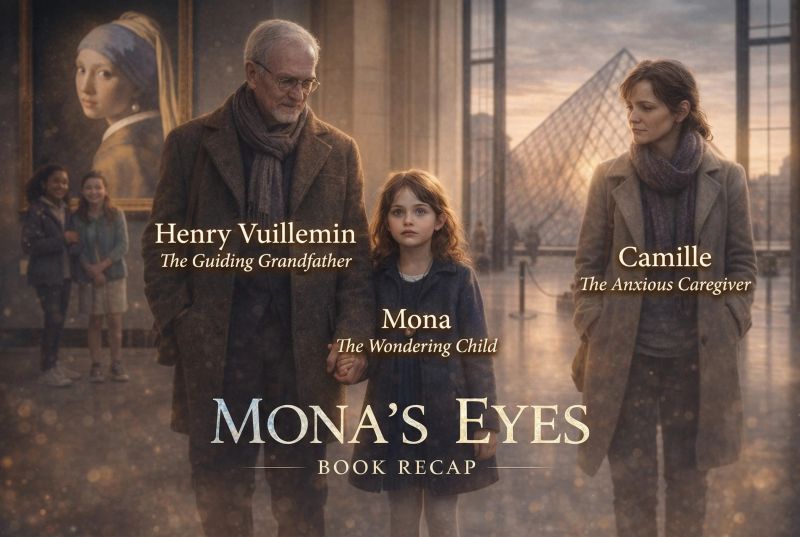

Plot Summary
Prologue
Ten-year-old Mona1 is doing math homework in the kitchen of her family's Montreuil apartment when something tears the world away. Without cause or warning, both eyes go dark — not the dimming of a room but an opaque screen rising from within her own body. Her mother Camille3 phones the doctor in a panic; her father Paul4 drives them to the Hôtel-Dieu hospital beside Notre-Dame.
Sixty-three minutes later, standing in a chill wind outside, Mona's1 vision returns — outlines first, then faces, then a gray pigeon taking flight. The MRI reveals nothing. Every test comes back clean. The doctors have no explanation. An evil spell has struck and retreated, leaving only the certainty of its possible return.
Dadé's Secret Prescription
Camille3 asks her father Henry2 — a towering, one-eyed former photojournalist scarred during the 1982 Shatila massacre — to escort Mona1 to a child psychiatrist every Wednesday. He agrees but conceives a different plan entirely.
Surveying his granddaughter's bedroom, crammed with plastic trinkets and garish posters, Henry2 realizes that if Mona1 goes permanently blind, her visual memories will consist of nothing worth keeping. He resolves to administer his own therapy: once a week, one masterpiece, first in silence, then through conversation.
The Louvre, then Orsay, then Beaubourg — a reservoir of beauty stored in her brain against the coming dark. Camille3 and Paul4 consent without knowing what they have sanctioned, trusting only that Mona1 adores her Dadé beyond any other adult alive.
Dr. Botticelli's First Session
Under the glass pyramid, Henry2 leads Mona1 to a modest room where tourists file past without pausing. The fresco is Botticelli's Venus and the Three Graces — cracked, faded, missing pieces.
Mona1 stares for six excruciating minutes, then declares that next to this battered painting, her grandfather's2 scarred face looks brand new. Henry2 crouches to her level and explains the allegory: three stages that make us human — giving, receiving, giving back — with receiving as the keystone.
Mona1 absorbs the lesson imperfectly but feels the magnetic pull of being spoken to as an adult. When she worries about lying to her parents about the phantom psychiatrist, Henry2 supplies the alibi. If asked the doctor's name, she should say Dr. Botticelli. Their shared conspiracy begins.
Wine Bottles on the Hedgehog
Mona's1 father Paul,4 a struggling vintage-goods dealer facing bankruptcy, has been drinking himself unconscious in his store, stacking empties on a spiked metal bottle-rack his daughter has always loathed.
One night Mona1 peeks through her bedroom door and watches Camille3 drag him from the kitchen table, papers scattered, bottle on the floor. The next morning Paul4 is ashen. Mona1 asks how he is — a kindness so adult it takes his breath away — then smiles at him with such disarming warmth that his hangover dissolves.
At dinner she stuns both parents: Paul4 could transform his problems into a beautiful story, she says, because sadness well told becomes something worthwhile. Camille3 marvels at the psychiatrist's progress. The real therapy is Wednesday afternoons with Botticelli, Leonardo, and Raphael.
The Blind Man in the Metro
For weeks Camille3 has obsessed over one question she cannot bring herself to ask Dr. Van Orst:6 will Mona1 go permanently blind? Rushing through the Châtelet metro corridors, she trips over the outstretched leg of a homeless man and snaps at him to watch out.
He responds with embarrassing politeness — he is blind. Camille3 sees his dark glasses on the floor, the cardboard sign, Mona's1 blue trousers right beside them. The coincidence scalds her.
She fabricates a work emergency and cancels the hospital appointment entirely, fleeing diagnosis as a vizier in a Persian fable flees Death only to find it waiting at the destination. Meanwhile, Mona1 has caught a fragment of a prior exchange between her mother and Van Orst6 — the words fifty-fifty — that will haunt her for months.
The Seashell Falls
While helping hang a display in her father's4 store, Mona1 climbs a stepladder and hammers a nail. The fishing line holding her grandmother's5 cornet-seashell pendant — already weakened when a school bully10 yanked it weeks earlier — snaps. The shell tumbles in slow motion, bounces off the step, and vanishes through a ventilation grille. Mona1 screams.
With the ferocity of a jailbird she wrenches the cast-iron grate free, plunges her arm into darkness, and retrieves the charm. But during those terrible seconds, a thousand black spots stole her sight again. The relapse was brief, and she tells no one — not her parents, not Henry,2 not Van Orst.6 The secret sits inside her like a compounding lie, each week of silence making confession harder.
Eighteen Out of Ten
At her next check-up, Van Orst6 asks Mona1 to read the standard eye chart. She clears it effortlessly, then reads a tiny notice pinned nearby — the Hippocratic Oath — with pinpoint diction from across the room. Van Orst6 measures her acuity at eighteen-tenths: not a school grade but an optical miracle.
Fighter-pilot vision. The paradox is almost cruel: a child haunted by blindness possesses one of the sharpest gazes on record. Camille3 is elated, Mona1 quietly troubled.
She has begun to sense that her extraordinary sight carries enormous weight, both as a medical puzzle and as an instrument through which fifty-two masterpieces will be burned into permanent memory. When she tells her mother she wants to make people better someday, Camille3 does not yet understand what fuels the wish.
Grandmother's Lead Army
Paul4 has been selling painted lead figurines that Mona1 stumbled across in his store's back room — cymbal-crashing clowns and cavalry soldiers that an eccentric elderly collector snaps up at fifty euros apiece. The income is a lifeline.
But when Camille3 visits the store and sees the figures, she falls quiet. These figurines belonged to her mother, Colette5 — Henry's2 late wife and Mona's1 adored grandmother, whose name is forbidden in the family. Henry2 had asked Camille3 to store them after Colette5 died, and they had been forgotten in the cellar.
Mona1 has been unknowingly selling her dead grandmother's5 possessions. The discovery cracks open a door sealed for eight years. For the first time, traces of the woman no one will discuss begin seeping back into Mona's1 life.
Mona Volunteers for Hypnosis
Back in October, Van Orst6 had proposed hypnosis and Paul4 refused outright, Mona1 recoiled, Camille3 stayed silent. Now, months later, Mona1 sits in the doctor's office and announces unprompted that she is ready to try. Van Orst6 calls it a giant step.
Camille3 is flabbergasted, privately crediting the mysterious Wednesday psychiatrist. In truth it is dozens of paintings deep — Botticelli's generosity, Rembrandt's unflinching self-knowledge, Poussin's trembleless dignity — that have fortified Mona's1 willingness to face what lives inside her.
The first session is gentle: safe-place imagery, loved ones conjured in warm abstraction. But as Mona1 floats in her altered state, a vast and tender cloud appears, thickening with the most beautiful and most tragic secrets she has ever sensed.
Mamie in the Tunnel
In the second trance, Mona's1 psyche hurtles through a gray-white tunnel at astonishing speed. Van Orst's6 voice recedes to a distant point. Sensations sharpen: her grandfather's2 cologne, her parents' warmth, then something thicker — an amorphous presence crystallizing into form.
Colette5 appears at Mona's1 bedside with her silver chignon and upturned mouth, stroking her hand, murmuring goodbye. The child calls out Mamie twice as the doctor snaps her awake. In a later session, Mona1 relives the original blindness — the math homework, the kitchen table, a vortex forming on its surface.
Her psyche regresses further, to eighteen months old, tottering toward Colette5 in a park, learning to walk under outstretched arms. The pendant passes from grandmother's neck to granddaughter's. Someone stops to say they admire Colette5 immensely.
Behind Saint-Lazare Station
For months, a woman in a green shawl has been discreetly following Mona1 and Henry2 through the Louvre and Orsay, eavesdropping on their conversations. She introduces herself beside Manet's tiny painting of an asparagus: Hélène,11 a retiring curator who calls their museum dialogues the finest reward of her career.
When Monet's Saint-Lazare Station is unavailable for viewing, she offers to take them into Orsay's restricted storerooms. Behind heavy doors, Mona1 discovers a museum beneath the museum: sliding racks of masterpieces, restorers at work, drawings in plan-chests.
The Monet sits on a portable easel. For the first time, Mona1 slips behind a painting and sees what no gallery wall reveals — an aged brown canvas on a wooden stretcher. The fragile banality beneath the immortal image stuns her into silence.
The Pointillist on the Podium
Each week a student in Madame Hadji's12 class must deliver a lesson on any subject. Mona1 brings the Seurat poster from her bedroom wall and, without help from Henry2 or her parents, explains Pointillism to thirty-three fifth-graders: Turner's dissolved landscapes, Monet's atomized brushstrokes, Seurat's optical mixing of color dots.
Mid-presentation, dissociation strikes — she hears herself against her grandfather's2 voice and the three words I am rubbish pulse through her mind. Tears threaten.
But she fights through, insists that Seurat wanted viewers to feel cleansed by shimmering color, and argues that painters needed to experiment to compete with black-and-white photography. The class sits stunned. Madame Hadji12 demands applause. Mona1 cannot tell if it is consolation or recognition. It is both — the debut of an eleven-year-old art historian.
The Troll in the Sleeve
July is scorching and Mona1 has eaten two ice creams too fast. Inside the Orsay, she sits before Hammershøi's Rest — a woman facing a bare gray wall, her nape exposed, the room silent as a held breath. Mona1 stares until she hallucinates a troll in the painted folds.
Then instinctively she pulls off her pendant. The world goes black. Henry2 stays calm, tells her to breathe. She grips his knee with one hand and fumbles the seashell back around her neck with the other.
Gradually the painting reassembles: Ida's nape, the chair, the white dish. Henry2 registers everything but says nothing about the cause. Mona1 blames the ice cream. But the pattern is now undeniable — three times the pendant has left her body, and three times the darkness has returned.
It All Hangs by a Thread
Van Orst6 has a hypothesis he can no longer delay testing. He asks Mona1 to stay fully conscious, eyes wide open, and slowly remove her pendant. She lifts the fishing line over her head. Shadows flood the room — walls, floor, furniture dissolve. Blindness reclaims her completely.
The doctor's voice guides her to breathe, to hang the seashell back. Light erupts the instant the shell settles on her chest. Van Orst6 now understands: the pathology is psychotraumatic, not functional.
Colette's5 final act — transferring the charm to her granddaughter with an instruction to keep the light inside her — lodged so deeply in Mona's1 subconscious that the pendant became a literal talisman of sight. He warns Camille3 with quiet gravity: Mona1 must never stop wearing it. They are close to a resolution.
The Red Notebook Betrayal
Mona1 has been keeping a red journal chronicling her museum visits, her growing investigation into Colette,5 her private emotions. Camille,3 searching for Van Orst's6 medical file, finds the notebook in Mona's1 room and reads it. She phones Henry.2
Then she sits her daughter down in Paul's4 store with the red cover visible in her hand. Mona1 screams — a raw unprecedented fury. She pushes her mother away and collapses onto the pavement in tears.
Paul4 sits beside her and speaks with an honesty that surprises even him: they are proud of her bravery and her loyalty to Henry's2 secret; Colette5 would have been proud too. Mona1 listens to her father but cannot forgive her mother. Something between them has cracked irreparably, and must now be rebuilt from scratch.
Forget the Negative
For years Henry2 has sensed something uncanny in Mona's1 speech — a particular tune, a quality he could detect but never define. Not sophistication, not metaphorical brilliance, but something structural hiding in plain hearing.
In front of Louise Bourgeois's installation at Beaubourg — whose lesson is about learning to say no — the answer arrives. Mona1 falls silent, physically unable to repeat the word. Henry2 sees it at last: she never uses the negative grammatical form. She can say impossible but never not possible, unaware but never did not know.
Her subconscious absorbed Colette's5 dying instruction — forget the negative, keep the light — so completely that negation itself was purged from her syntax. It is a dead woman's grammar living inside a child's mouth. Henry2 tells Mona1 gently: from now on, she must also learn to say no.
The Train to Cassis
On the southbound TGV, Mona1 shows Henry2 a pack of fifty-two playing cards, each bearing a picture of one masterpiece from their year together — her personal archive of everything she has seen. Henry2 marvels. Then, in the dining car, he tells her everything.
Colette's5 father killed himself with cyanide in a Nazi cell to protect his comrades. His daughter inherited two convictions: faith in God and the right to choose one's death. She campaigned for euthanasia, endured defamatory attacks, and used her figurines as memory exercises when a rare neurodegenerative disease began dissolving her mind.
When she could no longer recall the stories she had invented for each little lead figure, she decided it was time. She gave Mona1 the pendant, said goodbye at a farewell dinner, and left for a clinic. The family's silence had lasted eight years.
Epilogue
On the beach at Cassis — the very shore where Henry2 and Colette5 once picked up seashells and pledged their love decades ago — Henry2 tells Mona1 it is time. She removes the pendant. Darkness crashes over her eyes.
She fights through the void, trembling and mute, until her psyche summons Colette5 one final time. Her grandmother appears, signals her never to look back, and fades. Mona1 cries — uncontrollable childhood tears — and the tears wash the soot away. Blue returns in patches, then yellow, then red, then every shade between.
She buries the seashell in the sand, stands, and begins to twirl — spinning until rocks, pines, mountains, and ships melt into pure color. When Henry2 reaches her, she tells him how beautiful everything is. And how beautiful all that lies beyond.
Analysis
Mona's1 Eyes operates as a sustained argument that aesthetic experience is not ornamental but existential — that looking closely at art restructures the psyche rather than merely refining taste. Schlesser builds this case not through abstraction but through the specific mechanism of a child's brain converting visual splendor into psychological resilience. The novel's deepest insight is that Mona's1 blindness is not a failure of optics but of grief: her subconscious literalizes the removal of a grandmother's5 protective love as the removal of light itself.
The fifty-two-artwork structure risks monotony, but Schlesser prevents this by threading a genuine mystery beneath the pedagogy. The question of why Mona1 went blind, delayed across hundreds of pages, transforms each museum visit from a lecture into a clue. Henry2 is not simply teaching art; he is racing an hourglass, constructing an interior cathedral that will persist if the physical eyes fail.
The novel interrogates the Western assumption that seeing equals knowing. Mona's1 18/10 vision — sharper than almost anyone alive — coexists with total susceptibility to psychosomatic darkness. Extraordinary perception intensifies rather than protects against vulnerability. Similarly, Colette's5 euthanasia activism — choosing to enter darkness — mirrors Mona's1 eventual choice to remove the pendant and confront blindness voluntarily. Grandmother and granddaughter each face the void on their own terms, decades apart, on the same beach.
The most radical formal device is Mona's1 unconscious elimination of the negative grammatical form, revealed late as the linguistic imprint of Colette's5 dying words. This transforms the reading experience retroactively: every sentence Mona1 has spoken carries a ghost's watermark. It is Schlesser's argument, encoded in syntax, that love persists not as memory but as structure — that the dead reshape the very grammar of the living.
Review Summary
Mona's Eyes receives mixed reactions from readers (3.7/5 average). Many praise its beautiful art descriptions and the touching grandfather-granddaughter relationship, finding it an accessible introduction to art history. The book features 52 artworks from Parisian museums, examined as 10-year-old Mona faces possible blindness. Critics cite weak characterization, unbelievable dialogue for a child, and overly didactic tone that overshadows the plot. Some find it more art textbook than novel, while others appreciate its hypnotic exploration of art's healing power and life lessons embedded in each artwork discussion.
People Also Read

Characters
Mona
Child with imperiled sightTen years old when the story begins, an only child with enormous blue eyes and tawny-brown hair, Mona possesses extraordinary visual acuity and an uncanny sensitivity to others' feelings. She exists at the threshold between childhood and a premature maturity forced by medical crisis. Her attachment to her grandfather Henry2 is her central axis—a bond built on mutual respect, intellectual challenge, and a shared refusal to condescend. She carries a seashell pendant inherited from her grandmother5 that functions as both emotional anchor and mysterious talisman. Mona's speech contains a hidden structural quality her grandfather senses but cannot define for most of the story. Her journey is one of learning to see—not merely with the eyes but with a soul being forged through beauty and loss.
Henry
Scarred grandfather and art guideMona's1 eighty-year-old maternal grandfather, a former photojournalist for Agence France-Presse who lost an eye when a Phalangist slashed his face during the 1982 Shatila massacre. At nearly two meters tall, gaunt, and spectacularly erudite, Henry carries the authority of a man who has witnessed history's worst and distilled from it an unshakable faith in beauty. He speaks to Mona1 as an equal, refuses to simplify the world, and channels decades of knowledge into their weekly museum conversations. Beneath his commanding exterior, Henry harbors a grief so deep it has calcified into silence: the loss of his wife Colette5, whom he still cannot discuss. He wears a matching seashell pendant and swears his oaths on what is beautiful on earth.
Camille
Mona's protective, anxious motherNearing forty, slight and short-haired with a Parisian twang, Camille combines anarchic energy with formidable determination—mornings at a temping agency, afternoons volunteering for every cause from isolated elderly to undocumented immigrants. Her protective instincts toward Mona1 border on anxious control. She shares with Henry2 the unspoken taboo surrounding Colette's5 death and channels her terror of Mona's1 diagnosis into avoidance. Her discovery of Mona's private journal triggers the story's most painful confrontation between mother and daughter.
Paul
Mona's struggling, tender fatherFifty-seven, a gentle vintage-goods dealer drowning in debt and red wine, Paul runs a Montreuil store crammed with Fifties Americana—jukeboxes, pinball machines, heart-shaped keyrings. He drinks not from despair over bankruptcy but from fear that losing his store means losing his daughter's respect. His slow recovery runs parallel to Mona's1 journey as he reinvents himself through an improbable invention: converting antique rotary telephones for modern cellular use.
Colette
Mona's absent, defining grandmotherHenry's2 late wife, dead seven years before the story begins, Colette is the absent center around which the entire narrative turns. In life she was a Catholic woman of fierce conviction who campaigned for the right to die with dignity—a legacy that made her both admired and reviled. Her name is forbidden in the family, invoked only through the matching seashell pendants she and Henry2 once wore. To Mona1, she is a presence felt more than known: a ghost stirring in hypnotic trances, a face materializing from buried memory, a voice whispering instructions the child's subconscious absorbed before she could understand them. Colette embodies the novel's deepest paradox—that the fiercest love for life can coexist with the conviction that death deserves dignity.
Dr. Van Orst
Pediatrician and hypnotherapistA mixed-race pediatrician, ophthalmologist, and hypnotherapist at the Hôtel-Dieu hospital, prematurely bald with a gravelly smoker's voice and an enormous smile. Van Orst combines clinical rigor with intuitive boldness, proposing hypnosis when conventional medicine fails. His approach is patient and incremental—safe-place imagery before trauma retrieval—and his patience and inventiveness prove essential to unlocking the mystery of Mona's1 condition.
Jade
Mona's mischievous best friendMona's1 dark-complexioned school friend, famous for pulling grotesque faces. Fiercely competitive and occasionally cruel, she scores the decisive football goal that humbles the school bully Guillaume10.
Lili
Mona's gentler best friendMona's1 school friend whose parents' divorce forces a move to Italy. Her departure crystallizes the girls' awareness that childhood is ending. Her devotion to her cat becomes a small test of parental empathy.
Diego
Ridiculed classmate, innocent dreamerA shrill-voiced classmate whose innocent absurdities crack up the entire class. Perpetually mocked, Diego9 builds a rotating papier-mâché moon for the school project that quietly rivals anything his peers produce.
Guillaume
School bully Mona is drawn toA blond, good-looking bully repeating fifth grade, whose violence masks isolation. Mona1 loathes yet is drawn to him. Their silent encounters on playground rockers hint at the earliest stirrings beyond childhood.
Hélène Stein
Museum curator and secret admirerA retiring Musée d'Orsay curator who secretly follows Mona1 and Henry2 through museums, eventually introducing herself and granting them access to the storerooms housing Monet's Saint-Lazare Station.
Madame Hadji
Mona's elementary teacherMona's1 patient and perceptive fifth-grade teacher, who monitors the child's recovery without singling her out. Her classroom provides the stage for Mona's1 breakthrough presentation on Seurat.
Plot Devices
The Cornet-Seashell Pendant
Talisman bridging love and sightA tiny spiral shell on a fishing-line necklace, originally picked up by Henry2 and Colette5 on a beach in 1963, where the paired pendants sealed their love. When Colette5 transferred hers to three-year-old Mona1 during their final encounter, the shell absorbed the concentrated force of a grandmother's farewell. Mona's1 subconscious fused the pendant with light itself: removing it triggers blindness, wearing it sustains vision. The pendant appears in nearly every chapter—clutched in fear, tugged by a bully10, broken on a stepladder, tested by a doctor6—until it is finally returned to the sand where it originated. It is the single thread on which Mona's1 vision literally hangs.
The Wednesday Museum Visits
Art therapy disguised as psychiatryHenry's2 weekly ritual—one artwork, first in prolonged silence, then in conversation—functions as Mona's1 actual psychological treatment, disguised from her parents as sessions with a child psychiatrist. Over fifty-two Wednesdays across three Parisian museums, these visits build Mona's1 visual reservoir, emotional vocabulary, and intellectual confidence. Each artwork carries a life lesson, from Botticelli's instruction to receive graciously to Soulages's revelation that black is a color. The visits also serve as Henry's2 insurance policy: should blindness become permanent, Mona1 will carry an interior cathedral of masterpieces. The deception holds for nearly a year before unraveling.
The Vertunni Figurines
Colette's memory resurfacingHundreds of painted lead figurines hidden in Paul's4 store cellar function as the first physical traces of Colette5 to re-enter Mona's1 life. Their accidental discovery provides Paul4 with desperately needed income when an eccentric collector begins buying them. But Camille3 reveals they belonged to Colette5, cracking open the family's silence about her death. Each figure, once given a name and story by the grandmother, is a miniature memorial carrying the imprint of a life the family cannot discuss. They echo the novel's broader theme—articulated through Boltanski's art—that the dead persist in the objects they leave behind.
Mona's Red Journal
Private archive turned detonatorThe personal journal Mona1 begins writing in summer chronicles her museum visits, her growing investigation into Colette5, and her private feelings about growing up. It represents her first act of self-documentation—archiving herself, as Boltanski's art would phrase it. When Camille3 discovers and reads it while searching for a medical report, the journal becomes the instrument that shatters the year-long museum deception and forces the family's secrets into the open. The confrontation it triggers between mother and daughter marks the sharpest rupture in the novel, testing whether honesty and privacy can coexist in a family built on loving omissions.
Van Orst's Hypnosis Sessions
Gateway to buried memoryVan Orst's6 hypnotherapy serves as the clinical counterpart to Henry's2 art therapy. Where museum visits build Mona's1 conscious visual intelligence, the trance states excavate her subconscious—retrieving the buried memory of Colette's5 farewell, the pendant transfer, and the moment of separation that lies at the root of the blindness. The sessions progress from safe-place imagery through increasingly bold retrievals of trauma, eventually exposing hidden relapses that Mona1 concealed from everyone. The hypnosis also provides the framework for Van Orst's6 diagnostic breakthrough: Mona's1 condition is psychotraumatic rather than functional, anchored in a grief her conscious mind could not reach.








































