Plot Summary
Dream, Coffee, and Departures
Michael Young awakes from a cryptic dream beside an empty bed—his girlfriend Jane has left him, leaving only a note about their fractured relationship and her near comic custody over mundane things like the car. His mind is abuzz with caffeine and the awareness of his historical thesis finally finished, yet he's forced to navigate the private drama of breakups amid Cambridge's student bustle. Michael's love for history is laced with self-deprecating humor and a chronic sense of inadequacy, feeling more at ease judging the dead than analyzing literature's living pulse. This first morning—full of small frustrations and emotional shifts—reveals Michael's loneliness and his quest for identity and meaning through academic achievement, even as he fumbles with daily life.
The Well in Brunau
In an old Austrian town, Klara Hitler's life is depicted in quiet misery—her husband Alois is stern and violent, and their family suffers repeated tragedy as children die young. An outbreak of inexplicable infertility plagues her neighbors; male sterility spreads on one side of their street. The doctor suspects the well water as the cause but remains baffled—the contamination is mysterious and untraceable, yet permanently affects generations. This early interlude sets the roots for one historic child: Adolf Hitler, hinting at how the most minor, local events—a spoiled well, a chemical accident—can alter destinies. The narrative's blend of historical fact and intimate domestic detail foreshadows how fate hinges on apparent trivialities.
Cambridge Contrasts and Loss
Michael cycles through Cambridge, conscious of both the vibrant academic scene and his outsider status. Peers seem to belong effortlessly; Michael broods on class, intellectual anxieties, and the social hierarchies embedded in college life. Despite his thesis's completion, he struggles with the distinction between academic confidence and personal insecurity. These inner contradictions—pride in his work, uncertainty about its worth, bitterness about lost love—culminate in a moment of accidental loss as his meticulously prepared thesis is scattered to the winds by a broken briefcase clasp. Here, Fry draws out the absurdities of adult life, the fragility of achievements, and the way small flaws upend self-assurance.
Papers, Parcels, and Zuckermann
A misdelivered parcel leads Michael to Professor Leo Zuckermann, the enigmatic physicist whose pigeonhole sits just below his in the college mailroom. Their awkward first encounter is laced with mutual bemusement—the younger man's thesis is rescued by the older man's strangely calm presence. Zuckermann's fascination with Michael's research on Hitler's childhood leads to an unlikely friendship, their dialogue veering between the personal and the profoundly philosophical. It is in Zuckermann's rooms, surrounded by Holocaust histories, that Michael glimpses an aura of historical obsession and secret knowledge. Their bond quickly grows, and Zuckermann becomes both mentor and mystery.
Making Plans, Making Friends
Michael's sense of grievance over his breakup with Jane leads to childish acts of vengeance—defacing her car with graffiti and fighting over shared music tapes. His impulsive, often comic tactics for asserting himself reflect both immaturity and desperation for self-definition. Simultaneously, Michael navigates Cambridge's social fringes, encountering old lovers and awkward friends, barely managing the complications of everyday life. As he grows closer to Zuckermann, ideas about influencing the past are seeded, and the first inklings of a plan to alter history are born—not through violence, but subtle biological sabotage.
Love, Pills, and Science
Reunited temporarily with Jane, Michael tangles with more than emotions—Jane, a biochemist, introduces him to the world of genetic research, its moral dilemmas, and her own guarded, practical worldview. Their banter reveals mutual jealousy about professional pride and discipline, as well as shared affection. The discovery in her lab of a radical male contraceptive—tiny orange pills, potentially irreversible—sparks both comical misunderstanding and acute awareness of the ethical power of science. Their lives are entwined not just romantically but historically, as Jane's research becomes the key to Michael and Zuckermann's emerging scheme.
The Child Who Lived
Interludes in Austria describe Klara's agonizing labor, seen through a blur of laudanum and dreams of freedom. Alois's pride, Klara's suffering, and the successful birth of her child are tinged with both triumph and foreboding—a birth that will, in the unaltered timeline, bring Adolf Hitler into the world. Fry paints these scenes with tragic irony, threading omnipresent death and accidental survival through a family's grim love and resilience. These historical vignettes remind the reader that history's monsters are born not in evil, but in pain, chance, and ordinary desperation.
Questions, Chess, and Chance
Michael's engagement with Zuckermann deepens through coffee, chess, and philosophical conversation. Their exchanges shimmer with latent tension between guilt, Jewish identity, fate, and the limits of historical knowledge. Zuckermann reveals a device—TIM, the Temporal Imaging Machine—which acts as a quantum "window" onto past events. As their trust grows, so does moral complication: can one change the past to prevent atrocity, or will every action carry unpredictable cost? Their plan to send Jane's contraceptive into the Hitler family well in 1888 crystallizes—an intervention as subtle as it is profound. Both men are compelled by the temptation to "make history," haunted by personal and collective loss.
Camera, Action, Catastrophe
Through a cinematic, almost slapstick sequence, Michael and Zuckermann maneuver to access a satellite link and activate TIM. Their plot: transmit the male-sterilizing pill into the well that served Hitler's father; Adolf Hitler will never be conceived. Success is sudden, but the price is dislocated reality. Michael, overcome with anticipation, is swept into an altered timeline as the cosmos reels from the point of change; everything he knows vanishes in a burst of color and sound. The world is rebooted, but not as Michael hoped. The nature of history, and intervention, is thrown into doubt.
Colleges, Amnesia, New Worlds
Michael wakes in a strange dormitory—American, Princeton, not Cambridge. With no memory of ever having lived here, yet recognized as "Mikey" by friends, he stumbles through hangover, unfamiliar customs, and a body subtly not his own. Only hints—words, accents, obsessions—betray the existence of his old self. The laughter and camaraderie ring hollow; something feels off in this supposedly improved world. Michael senses that his own consciousness, not the world, is out of place. Amnesia becomes metaphor for the erasure—and persistence—of true identity.
Rewriting the Past
Seeking answers, Michael scours the Princeton library and history texts, discovering that his intervention has not prevented disaster, merely replaced it. "Gloder" now occupies Hitler's role in the new history—Europe still falls to a charismatic totalitarian, but this alternate dictator is more competent, less mad, perhaps more enduring. The Holocaust is replaced with even deeper, more methodical atrocity—a "Jewish Free State" whose fate is equally dire. Civil and sexual rights are curtailed, minorities are oppressed, and Michael's conscience reels; he learns the price of playing god with time.
The Nazi Who Wasn't
In this world, Zuckermann's counterpart is Axel Bauer, son of the real creator of Brunau Water, now a refugee shielded by American intelligence. Through covert meetings, coded notes, and mutual recognition, Michael and Axel/Bauer realize their intertwined destinies. American government agents close in, desperate to uncover the origins of mysterious knowledge Michael exhibits. The fabrication of memory and identity, and the lengths to which society will go to obscure uncomfortable truths, unfurl—Michael is both victim and architect of historical tragedy. Memory, guilt, and the burden of legacy define this new cold war.
Cats, Rats, and Consequences
Haunted by their errors, Michael and Bauer orchestrate a second, desperate mission: to reverse their historical meddling by placing dead rats (instead of pills) in the 19th-century well, ensuring it would be cleaned and the contamination never occur. Danger closes in as government agents attempt to stop them. In a moment of chaos and sacrifice, Michael's companion Steve intervenes and is killed, but not before triggering the machine and casting Michael—once more—through time's event horizon. Sacrifice, risk, and love become the final catalysts for change.
The Price of Perfection
Michael wakes once again in Cambridge, ostensibly restored to his "real world." Yet he senses lingering loss; there are subtle changes. Prejudices remain, people are different, and beloved things—Oily-Moily's music, for instance—are gone. History, it seems, cannot be remade without cost; every universe exacts its own price for utopia, the past for the sake of the present. Michael's experiments in historical engineering have only reinforced the paradoxes of change: whatever is "fixed," something vital is forfeited.
Conspiracy and Connection
Michael's knowledge of forbidden history draws suspicion from the authorities. Conspiracies abound as the government tries to unlock the source of his insight into a world that "never happened." Under scrutiny, Michael realizes that even with the power to sculpt timelines, new structures of secrecy, suspicion, and exclusion always prevail. The loneliness of the "time traveler" is laid bare; Michael is armed with truth but cannot share it, unable to be recognized or believed in his own time.
Memory, Love, and Homecoming
At last, Michael is back in his own world; reality is both the same and forever altered by the journey. The survival of love—unexpected, imperfect, but real—becomes both his grounding and his solace. The complexity of memory remains—his mind, overloaded with parallel lives, grasps at the only thing that abides: connection to another. Homecoming is not a return to an unruptured life, but a compromise; only love, not history, can render a life meaningful.
The Gist of History
In a coda both playful and profound, Michael reflects on the meaning of history—who writes it, who suffers for it, and who is allowed the illusion of changing it. The pursuit of perfection in past or present is shown to be fraught with risk and regret. Ultimately, history is a story we invent and reinvent, forever approaching but never arrived, like the circle with no beginning or end. Life resumes, but Michael, and the world, are altered—chastened, wary, and reminded of the precious power of the bonds that survive even the rewriting of reality.
Analysis
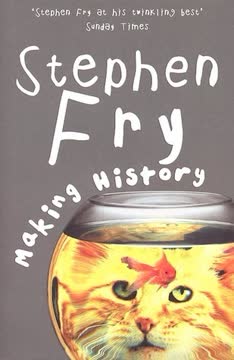
Stephen Fry's Making History is both a darkly comic and profoundly unsettling meditation on the ethics of time, memory, and the messy reality of progress. By weaving together the personal journey of Michael Young—a man obsessed with "fixing" both his life and the world—with historical speculation on eliminating Hitler, Fry exposes the illusory nature of simple solutions. Every attempt to perfect reality, whether through science, ideology, or personal reinvention, unleashes unanticipated consequences: the "better" world is often merely different, not improved, and new forms of exclusion, violence, or regret shadow every success. Fry's ingenuity lies in showing that history resists being neat, reasoned, and just; even the noblest interventions leave a residue of loss or unintended harm. The novel is also a passionate defense of empathy, affection, and the present moment—arguments and ambitions fade, but love, acceptance, and the capacity to forgive oneself and others endure, imperfectly but irreducibly. At heart, Making History is a call for humility—in facing both the paradoxes of the past and the unpredictability of our attempts to "make" meaning from it.
Review Summary
Making History receives mixed reviews, averaging 3.92/5. Many praise Fry's wit, humor, and thought-provoking alternate history premise—exploring a world where Hitler was never born, only for something worse to emerge. Readers appreciate the serious yet lighthearted tone and the well-researched historical elements. Common criticisms include a slow start (often the first 150-200 pages), underdeveloped characters, and a rushed ending. The novel's core philosophical argument—that removing one evil doesn't eliminate the conditions that create it—resonates strongly with most readers, making it ultimately rewarding despite its pacing issues.
Characters
Michael Young
Michael is both the narrator and subject—deeply intelligent, marvelously self-deprecating, and beset by chronic self-doubt. An English graduate student, Michael is the quintessential outsider: too sensitive for academic detachment, too skeptical for comfortable belonging, locked in perpetual negotiation between ambition and inadequacy. His attachment to Jane and his pursuit of the perfect thesis are alternately comic, tragic, and relatable. With his experiment in changing history, Michael is propelled beyond his comfort zone: he becomes perpetrator and victim, god and fool, guilty of the very hubris he critiques in others. His journey—intellectual, emotional, and existential—embodies Fry's meditation on knowledge, love, and the longing to do good despite the limits of understanding. Michael's interaction with history is always filtered through his empathy and analytic wit; his suffering, humor, and growth ground the novel's emotional arc.
Leo Zuckermann / Axel Bauer
Zuckermann/Zuckermann's counterpart Bauer is a distinguished scientist with a secret past—his family legacy is stained by complicity in atrocity. Wracked with guilt over his Nazi father's role in the Holocaust (or its alternate), Leo is driven by a desperate urge to atone, to "make history" in the most literal sense. His brilliance is cloaked in melancholy; his warmth is guarded by intellectual rigor and idiosyncrasy. Leo's interactions with Michael are electric: teacher and supplicant, challenger and coconspirator. The novel psychoanalyzes Leo as the inheritor of collective wounds and the walking paradox of victim, survivor, and would-be fixer. His readiness to risk causality for the chance of redemption renders him tragic—a man ruined by the insistence on correcting history, and transformed, ultimately, by the acceptance of love's limits and possibility.
Jane Greenwood
Jane, Michael's partner and sometime muse, provides sharp contrast—tough, pragmatic, and wry in both love and science. She is a model of the modern, competitive woman: intellectually formidable, yet emotionally understated. Jane's ambivalence—about their relationship, about her work—reflects the moral ambiguities faced by those at the cutting edge of discovery. The male contraceptive pills at the heart of the plot are a literal and figurative distillation of her power—and the risks of wielding it without foresight. Her loyalty, insight, and gentle mockery are profoundly stabilizing for Michael, yet she is written with enough complexity to resist being reduced to mere "supporting character"; she is a symbol of ethical limitation and the cost of progress.
Steve Burns
Steve, the Princeton "buddy" in the alternate timeline, represents innocence and the possibility of love. Initially just a guide through the confusion of Michael's new American life, Steve becomes a confidant—and, implicitly, a potential lover. His own outsider status (hinted at gay and ostracized), coupled with stoic compassion, makes him the novel's most quietly heroic figure. Steve's eventual self-sacrifice to help reset the world is both a tragic and redemptive gesture: he is the only character who fully chooses others' happiness over his own, highlighting the limits and depths of agency in historical correction.
Alois and Klara Hitler
Depicted in evocative vignettes, Hitler's parents are not shown as monsters, but as products of time, place, and their own limitations. Alois is abusive, prideful, and unenlightened; Klara is long-suffering, innocent, and tenacious. Their symbolic roles are to remind readers that even history's most infamous figures spring from ordinary, tragic beginnings, dramatizing the arbitrariness of fate and the powerlessness of individuals against broader historical tides.
Rudi Gloder
Appearing only in the revised timeline, Gloder emerges as the "replacement Hitler"—a more talented, less insane, but potentially more destructive leader. Charismatic, capable, and chilling, Gloder's rise demonstrates the futility of attempting to erase one evil: the vacuum will be filled. His fictionalized life arc, surrounded by loyalists and strategists, parallels the rise of fascism in Europe and interrogates the seductive myth that "better" is necessarily "good."
Brown and Hubbard
Charged with investigating Michael's knowledge of forbidden history, Brown and Hubbard are the ever-watchful eyes of the state. One soft, one hard, they enact the classic "good cop/bad cop" routine, yet their paranoia and suspicion reflect the larger surveillance culture—and the impossibility of secrecy or innocence in a world obsessed with control.
Hans Mend, Ernst Schmidt, Hans Gütmann, Rudi Gloder's Company
These minor characters—appearing in alternate war timelines—personify the randomness and loyalty at the heart of conflict. Their camaraderie, naiveté, and deaths illustrate the grim costs of historical mass movements, and the perpetual recycling of "heroes" and "villains" between eras.
Professor Angus Fraser-Stuart
Michael's thesis advisor, Fraser-Stuart is the archetypal blustery academic: exacting, dismissive, faintly ridiculous. A symbol of institutional standards and the gatekeeping of knowledge, his verdict over Michael's work provides comic relief but also amplifies the psychic stakes of intellectual risk and the need for validation.
Double Eddie, Jamie, and Cambridge students
These recurring secondary figures provide social texture, comic banter, and shifting perspectives on loyalty, rejection, and self-regard. Their presence reveals Michael's—and, by extension, everyone's—recurring anxiety about acceptance, belonging, and the fluid boundaries between friend, lover, and stranger.
Plot Devices
Time Travel as Causality Wrench
The central conceit of Making History is the literal undoing of the past: using a quantum device, Michael and Leo attempt to prevent Hitler's birth not through violence or assassination, but via subtle biological interference. Fry exploits time travel's unique narrative potential as a tool to interrogate moral complicity, the unpredictability of change, and the dangers of wish fulfillment. By replacing one evil with another, he exposes the delusion that history can be "fixed." The "event horizon"—a sensory and cosmic threshold—visually and psychologically represents the rupture that occurs whenever the past is tampered with, and the impossibility of controlling outcomes.
Parallel Realities and Amnesia
Michael's experience in a "new world"—his recognition by friends, but loss of context—mirrors the confusion and loss of meaning that come from rewriting history. Fry skillfully uses amnesia as both plot device and device of disorientation: readers are forced, along with Michael, to reconstruct reality from fragments, uneasy in every version. Parallelism is played structurally: histories repeat with variable details, reinforcing the novel's view that certain patterns—oppression, exclusion, unintended harm—are persistent, whatever the timeline.
Metafiction and Self-Referentiality
Fry overlays the narrative with explicit references to movies, play scripts, and academic jargon; he is acutely aware of the ways we process and narrate our past. Moments where Michael addresses narrative conventions, describes his life as if it were a film, or critiques the artifice of history-writing, destabilize the "reality" of any given timeline. Chapters are titled after themes, not events, reframing the action as subject to continual reinterpretation.
Comedy and Melancholy
Much of the emotional power of the novel comes from Fry's ability to keep sadness, futility, and heartbreak in close company with wit, sarcasm, and farce. The most devastating moments—betrayal, historical horror, personal grief—are delivered with a light touch but gather force precisely by their tonal counterpoint. Laughter is thus both self-defense and mnemonic device: memory and history are encoded through hilarity and pain in equal measure.
Foreshadowing, Paradox, and Recurrence
The briefcase's broken clasp, the lost pigeonhole parcel, the orange pill, the rats: recurring motifs echo through timelines, reinforcing both the randomness and autopilot of fate. Michael's repeated "waking up" in strange rooms, and the constant cycling through loss and reconnection, embody the novel's central paradox: history, like narrative, returns us to ourselves—change rearranges the furniture but not always the underlying architecture.








































