

Key Takeaways
How you spend your ordinary day is how you spend your Christian life
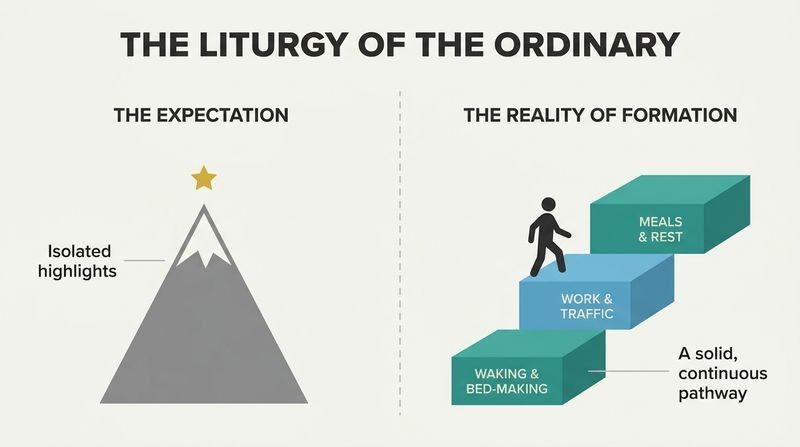
The dull bits matter most. Warren structures her book around a single ordinary day, from waking to sleeping, arguing that spiritual formation happens not in dramatic mountaintop moments but in bed-making, teeth-brushing, and traffic. She invokes Alfred Hitchcock's line that movies are life with the dull bits cut out, then notes we want a Christianity with the dull bits cut out too.
Jesus sanctified the mundane. The incarnate God spent roughly thirty years in obscurity as a carpenter before any miracle. If Christ was a carpenter, ordinary work is holy; if he lived quietly, obscurity has worth. Warren borrows Annie Dillard's aphorism that how we spend our days is how we spend our lives, treating the average Tuesday as the true proving ground of faith.
What's striking is how Warren inverts the ambition of much contemporary spirituality, which chases radical, world-changing intensity. Her claim echoes the Benedictine and Franciscan traditions, and resonates with psychologist Daniel Kahneman's finding that life satisfaction is built largely from the texture of everyday experience rather than peak events. It also anticipates habit science: identity forms through repetition, not resolution. The risk is romanticizing drudgery for people whose ordinary days are genuinely oppressive. Warren partly guards against this, but the reader should note her vantage point is a relatively comfortable American life, which shapes which mundane moments feel sacred versus merely survivable.
You wake up beloved before you accomplish anything
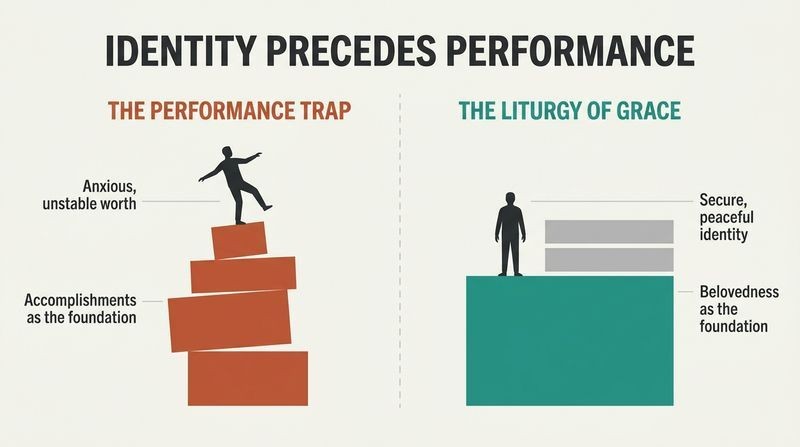
Identity precedes performance. Warren opens with the groggy seconds of waking, before we don our identities as workers, parents, or citizens. She points to Jesus' baptism: the Father declares him beloved before he has healed, taught, or resisted temptation. Belovedness is bestowed, not earned.
Remember your baptism daily. In Anglican practice, infants are baptized before they can affirm anything, and worshipers dip fingers in the font on entering church to recall they belong by grace alone. Lutheran theologian Martin Marty crosses himself each morning as a nonverbal prayer, remembering he is forgiven for the past and has grace enough for the day ahead. Warren suggests we begin each day as we enter the sanctuary: as someone already accepted, whose works flow from love rather than earning it.
This is grace theology applied to circadian rhythm, and it maps neatly onto research on self-worth. Psychologist Kristin Neff's work on self-compassion shows that people who anchor worth in unconditional acceptance rather than achievement prove more resilient and less anxious than those chasing contingent self-esteem. Warren's morning ritual functions like a cognitive reframe, deliberately installed before the day's evaluative machinery boots up. The theological particularity matters here: this is not generic self-affirmation but received belovedness from outside the self. For skeptics, the practice still offers something portable, a deliberate refusal to let productivity define the first thought of the day.
Your unexamined daily habits are liturgies training what you worship
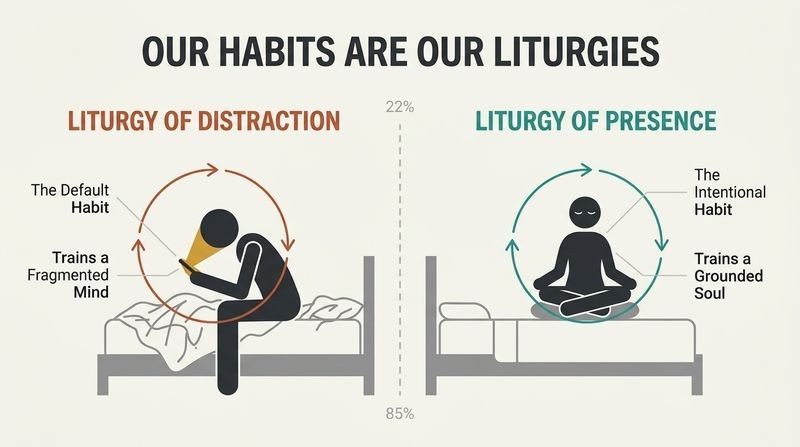
Everyone already has a liturgy. Drawing on philosopher James K. A. Smith, Warren argues we are shaped less by conscious beliefs than by repeated practices that aim our loves. A liturgy is any ritualized pattern that forms us. The question is never whether you have one, but what kind of person it is making you.
The smartphone as false sacrament. Warren describes grabbing her phone first thing each morning like digital caffeine, becoming imprinted on glowing screens the way a rescued wild animal imprints on humans. For Lent she swapped the ritual: she made her bed and sat in silence. A University of Virginia study found two-thirds of men chose to self-administer electric shocks rather than sit alone with their thoughts for fifteen minutes. Repetition, not novelty, forms a durable faith.
Smith's cultural liturgies thesis has become influential precisely because it dovetails with behavioral science. B. J. Fogg and Wendy Wood both show that most behavior is automatic, triggered by context rather than intention, which means environment design beats willpower. Warren's insight that a shopping mall or an app store is a formative liturgy anticipates later critiques of attention capitalism by scholars like Shoshana Zuboff. The shock study she cites is real and genuinely unsettling. One caution: not all repetition forms virtue, and rote practice can also deaden. Warren knows this, invoking the professor who tells a bored student that Augustine is not boring, he is.
Caring for your body is worship, not a distraction from it
Christianity is embodied, not floaty. Brushing teeth becomes a meditation on the incarnation. Warren rejects both Christian body-denial and body-obsession, insisting Scripture treats the body as integral to worship. Jesus slept, ate, groomed, and would have had bad breath. She cites the Jewish Asher Yatzar, a prayer recited after using the bathroom that thanks God for the body's openings and hollows.
Bodies are the most sacred objects on earth. Warren argues our muscles and teeth are more sacred than any communion chalice. Sexual sin scandalizes Scripture not because the body is dirty but because misusing it profanes something holy, like using consecrated wine in an occult rite. When words for prayer failed her after a hard year, she found she could still kneel; her body led her into prayer.
Warren's embodiment theology lands in a moment when neuroscience and psychology increasingly agree that cognition is embodied. Antonio Damasio's work on the somatic basis of emotion and research on posture affecting mood both support her claim that bending the body shapes the soul, not merely the reverse. Theologian Stanley Hauerwas, whom she cites, argues gestures are prayer, an idea echoed in ritual studies showing embodied practice encodes meaning more durably than propositional belief. The provocative move is calling the body more sacred than liturgical objects. It reframes bodily discipline as reverence rather than repression, though it leaves harder questions about disability, chronic illness, and bodies that resist care largely gestured at rather than resolved.
Small frustrations unveil the false gods you actually trust
Lost keys as apocalypse. Warren narrates losing her keys and spiraling through logic, self-condemnation, vexation, desperation, and despair over a two-inch piece of metal. Apocalypse literally means unveiling. These petty crises expose how tightly she clings to control and how little she has. Her lost keys reveal anxiety about competence; her broken dishwasher reveals an idolatry of ease.
Repentance is a daily rhythm, not a dramatic event. She cites musician Rich Mullins, who as a boy rededicated his life yearly at camp, then quarterly, then in his forties about four times a day. C. S. Lewis noted people ask for the patience a famine would require while grumbling at bad weather. Warren argues we have a robust theology for great suffering but ignore God in the daily grind, spending real days in low-grade despair.
The reframe here is diagnostically sharp: irritation is data. Cognitive behavioral therapy operates on a similar premise, that disproportionate emotional reactions expose underlying core beliefs worth examining. Warren's stages of losing keys are comic but psychologically accurate, tracking how threat to control triggers catastrophizing. Her Rich Mullins anecdote quietly dismantles the revivalist model of a single decisive conversion, replacing it with something closer to continuous course-correction, which aligns with research showing sustainable change comes from frequent small adjustments rather than dramatic overhauls. The blind spot she names, having a theology too big to touch a boring Tuesday, is a genuinely useful concept for anyone whose principles evaporate under minor stress.
Peace on earth is homegrown, starting with the people you snap at
A pacifist who yells at her husband. Warren confesses she dreams of global shalom while quarreling with her spouse over their daughter's schooling. Shalom is a Hebrew word for God's all-encompassing, all-redeeming peace. She quotes C. S. Lewis's demon Screwtape, who coaches a junior devil to keep a man praying passionately for humanity's soul while insulting his actual wife.
Passing the peace rehearses reconciliation. In liturgy, worshipers greet each other with the peace of Christ right before communion, enacting that you cannot approach the table unreconciled. Early Christians kissed; a third-century deacon would cry out asking if anyone held a grudge. Warren connects this to William Wilberforce's abolition, achieved not by one hero but by thousands of unnamed people making small choices, like a shopkeeper refusing to sell slave-harvested sugar. Anne Lamott calls earth Forgiveness School, best begun at the dinner table.
Warren dismantles a false binary between radical activism and domestic faithfulness, insisting both are simply Christian. Her farmer-prophet neighbor Steven, who grows vegetables with the homeless, tells her he wants to destabilize her comfort while she stabilizes him, a nicely mutual arrangement. Social science supports the priority of proximate relationships: research on prosocial behavior finds that people who neglect close bonds while pursuing abstract causes often burn out or become self-righteous, a pattern moral psychologist Jonathan Haidt might link to the seductiveness of moral grandstanding. The steelman for Warren is strong. The tension she leaves open is real, though, since some evils genuinely require confronting distant systems, not just being kind at home.
All honest work is holy; ditch the hierarchy of sacred jobs
Vocational holiness. Checking a dreaded email inbox becomes a meditation on work. The Puritans taught that we are sanctified not abstractly but through our specific craft: you become a holy blacksmith, mother, or systems analyst, not holy in general. The Reformation's scandal was declaring a diaper-changing parent as near to God as the pope, toppling the medieval ranking of monks and priests above ordinary laborers.
Beware the new hierarchy. Warren notes evangelicals now often elevate world-changing, poverty-focused jobs and quietly denigrate the rest. A friend left a conference feeling only radical careers mattered and everyone else just funded them. She commends the ministry of competence, illustrated by Dee, an excellent medical scheduler who kept a soulless office humane. She seeks a third way between workaholism and escapist contemplation, working as prayer, ora et labora.
Warren revives Max Weber's Protestant ethic from a spiritual rather than sociological angle, but adds a sharp contemporary critique: the progressive Christian world has simply rebuilt the medieval holiness hierarchy with nonprofit work at the top. That observation has bite. Management research on job crafting shows workers find meaning by reframing mundane tasks around service to others, precisely her ministry of competence. The harder question she raises but does not fully answer is whether modern abstracted labor, the alienated screen-work Arcade Fire laments, can genuinely be crafted into holiness, or whether some jobs are structurally dehumanizing in ways no reframe redeems. Her honesty in still hating email is disarming and credible.
Learn to wait, because impatience may be the root of all sin
Traffic as spiritual training. Stuck on Interstate 35, Warren confronts her illusion that she controls time. Theologian Hans Urs von Balthasar argues sin is essentially impatience, breaking out of time, snatching prematurely at what God intends to give slowly. Christians live in liminal time, the already and not yet, perpetually waiting.
Liturgical time reorders the calendar. The church year, with Advent before Christmas and Lent before Easter, always pairs preparation with celebration: first we fast, then we feast. This counters a consumer culture that rushes from Halloween to Christmas to the Super Bowl in constant revelry. Warren's friend Jan, painting through recurring cancer, made a canvas with a keyhole and told her, I always felt I was waiting for the gift, but I've come to see the waiting is the gift. A fallow field is never truly dormant.
The claim that impatience underlies all sin is bold and worth testing. It reframes classical vices like greed, lust, and envy as failures to wait for the right thing at the right time, a genuinely unifying lens that overlaps with research on delayed gratification, from Walter Mischel's marshmallow studies to work linking impulsivity with a wide range of poor outcomes. Warren's liturgical calendar functions as institutionalized counterprogramming against dopamine-driven immediacy, an idea resonant with critiques of on-demand culture. Jan's line about waiting being the gift risks sentimentalizing suffering, and Warren wisely lets it stand as hard-won testimony rather than tidy doctrine, grounding it in an actual body scarred by illness.
You cannot be a Christian alone; the church is not optional
Call and response friendship. Warren's long-distance friendship with Rebekka, sustained by rambling voicemails, models Christian community as antiphonal, speaking the good news back and forth. But she insists private friendship is not a substitute for church. Quoting Cyprian via Calvin, she argues you cannot have God as Father without the church as mother.
Love the church that wounds you. Warren rejects the popular consumer view that treats church as an optional service for individual spiritual needs, citing an author who claims to have graduated from church. After being deeply wounded by someone powerful in her congregation, she nearly quit, but a new church nursed her back, calling her the walking wounded. Flannery O'Connor said you suffer as much from the church as for it. The universal church is only ever accessed through a particular, irritating, local congregation.
Warren's ecclesiology cuts against the grain of American religious individualism, and the data back her worry: sociologists Robert Putnam and others document that disembedded, purely private spirituality correlates with weaker civic participation and thinner social support than embedded congregational life. Her refusal to idealize the church is what makes the argument credible. She names abuse, disunity, and her own complicity rather than papering over them. The concept that the universal is known only through the particular, that you love humanity by loving specific annoying neighbors, is philosophically robust and echoes personalist thinkers. The open wound is real: her counsel to stay implicitly assumes the wounding church is reformable, which for some survivors it demonstrably is not.
Savoring pleasure takes practice and is a spiritual discipline
Pleasure as touchstone of reality. Drinking tea, Warren argues delight is a legitimate response to God's goodness, not a distraction from holiness. Screwtape, the senior demon, frets that genuine pleasure gives a person a touchstone of reality and breeds self-forgetfulness. Contrary to the Puritan stereotype, monks invented coffee culture; cappuccino is named for the brown of Capuchin habits.
Enjoyment is a muscle. Overwhelmed after her first child's birth, Warren asked her mentor Father Kenny what to give up for Lent. He said, your whole life is Lent right now, and told her to take up the discipline of pleasure instead. Chesterton imagined God with childlike vitality, telling the sun do it again each morning, never tiring of monotony. Warren distinguishes pleasures of need from pleasures of appreciation, warning that the greedy cry of Encore turns a gift into an addiction.
Warren's reframe of enjoyment as effortful is counterintuitive and correct. Positive psychology's research on savoring, developed by Fred Bryant, shows that deliberately attending to and prolonging positive experience is a learnable skill that measurably raises well-being, and that most people are surprisingly bad at it. Her need-versus-appreciation distinction, drawn from Lewis, anticipates the hedonic-adaptation problem: escalating consumption erodes the very capacity for delight, which behavioral economists document in studies of how quickly windfalls stop feeling good. The theological turn, that beauty itself evangelizes when a culture no longer believes in truth, echoes Dostoevsky and philosopher Roger Scruton. The prescription is practical for anyone: schedule undefended time to enjoy one thing fully.
Going to sleep is a daily confession that you are not God
Rest exposes your limits. Warren closes the day arguing that sleep forces us to admit we are finite creatures, not the unlimited beings advertising promises we can be. Nearly 30 percent of American adults sleep under six hours nightly; the CDC calls insufficient sleep a public health problem. She reads this not merely as a medical issue but as a spiritual one, a culture of disordered love that disdains creaturely limits.
Sleep rehearses death and trust. Scripture uses death and sleep interchangeably; each night is a small memento mori, a reminder we will die. Early Wesleyan circuit-riding preachers worked up to a hundred hours a week until so many collapsed that the church created a worn-out ministers' fund, treating exhaustion as another cause rather than rethinking it. In Jewish time, the day begins at evening, so we start by sleeping while God works. We wake up, as one pastor put it, better people than when we lay down.
Warren's theology of sleep is unexpectedly radical in a productivity-worshipping culture. Her diagnosis that evangelical activism produced worn-out ministers as heroes rather than a warning parallels burnout research by Christina Maslach, who identifies chronic overwork culture, not individual weakness, as the driver of exhaustion. The claim that sleeplessness reflects a refusal of limits connects to sleep scientist Matthew Walker's argument that societies systematically undervalue rest to their measurable cost. The most arresting move is treating going to sleep as an act of trust, ceasing striving while God continues working, which reframes rest from laziness into faith. For secular readers, the portable insight is that honoring bodily limits is not failure but realism.
Analysis
Liturgy of the Ordinary is a work of practical theology disguised as a memoir of one unremarkable day. Its structure is its argument: by tracing waking, bed-making, teeth-brushing, key-losing, leftover-eating, arguing, emailing, commuting, calling a friend, drinking tea, and sleeping, Tish Harrison Warren enacts her thesis that spiritual formation happens in the granular repetitions of daily life, not in dramatic peaks. The book belongs to a growing evangelical retrieval of liturgical and sacramental tradition, and its intellectual engine is philosopher James K. A. Smith's claim that humans are formed by what they love, and love is trained by repeated practice rather than by right ideas.
What distinguishes Warren is her refusal of both poles that tempt her tribe. She rejects the intellectualist reduction of faith to correct doctrine, and she equally rejects the activist cult of radical world-changing that quietly shames ordinary vocations. Her recurring target is consumerism, which she diagnoses in three domains at once: worship reduced to emotional spectacle, food reduced to anonymous commodity, and spirituality reduced to personal self-fulfillment. Against all three she sets the twin poles of Word and sacrament, the ordinary bread and plain water that need no novelty to nourish.
The book's limitation is also the source of its charm: its vantage point is a materially comfortable American life, where the mundane is annoying rather than crushing. Warren gestures at war zones and profound suffering but writes most convincingly about lost keys and broken dishwashers. Readers in genuine precarity may find the sanctification of chores harder to inhabit. Yet the deeper move is durable across traditions. Warren offers a counter-formation to a culture organized around immediacy, stimulation, limitlessness, and self-actualization. Her prescriptions, remember your belovedness before you achieve, examine your habits as liturgies, honor your body and your limits, practice waiting and savoring, are portable well beyond her theology. The genius, as Andy Crouch notes, is showing the traffic runs both ways: the secular is shot through with the sacred, and the sacred is made of ordinary stuff.
Review Summary
Liturgy of the Ordinary receives high praise for its exploration of everyday moments as opportunities for spiritual growth. Readers appreciate Warren's ability to connect mundane tasks with sacred practices, finding profound meaning in routine activities. The book's emphasis on embracing ordinary life as worship resonates with many, offering a refreshing perspective on faith. While some readers disagree with certain theological points, most find the book's practical insights and relatable examples valuable for deepening their spiritual lives.
People Also Read






FAQ
What's "Liturgy of the Ordinary: Sacred Practices in Everyday Life" about?
- Daily Sacredness: The book explores how ordinary daily activities can be seen as sacred practices, connecting them to elements of Christian worship.
- Structure: It follows a day in the life of the author, Tish Harrison Warren, from waking up to going to sleep, highlighting how each moment can be infused with spiritual significance.
- Integration of Faith: It dismantles the divide between the sacred and secular, showing how every part of life is touched by faith.
- Christian Doctrine: The book emphasizes the incarnation, suggesting that Jesus' earthly life sanctifies the mundane aspects of human existence.
Why should I read "Liturgy of the Ordinary"?
- Practical Spirituality: It offers practical ways to integrate faith into everyday life, making spirituality accessible and relatable.
- New Perspective: The book provides a fresh perspective on how to find meaning and purpose in the mundane aspects of life.
- Encouragement: It encourages readers to see their daily routines as opportunities for spiritual growth and connection with God.
- Rich Insights: The book is filled with insights that can deepen one's understanding of Christian worship and its relevance to daily living.
What are the key takeaways of "Liturgy of the Ordinary"?
- Sacred in the Mundane: Every ordinary moment can be a sacred opportunity to connect with God.
- Embodied Faith: Our physical actions and routines are integral to our spiritual lives and worship.
- Community and Worship: The book emphasizes the importance of community and shared worship in the Christian faith.
- Patience and Waiting: It highlights the spiritual discipline of patience and waiting as central to the Christian life.
How does Tish Harrison Warren connect daily activities to Christian worship?
- Baptism and Waking: Waking up is likened to baptism, a reminder of being beloved by God.
- Making the Bed: This act is connected to liturgy and ritual, forming a life of order and beauty.
- Brushing Teeth: It reflects the importance of living in a body and the sacredness of physical care.
- Eating Leftovers: This is tied to the Eucharist, emphasizing nourishment from both Word and sacrament.
What is the significance of the book's title, "Liturgy of the Ordinary"?
- Liturgy Defined: Liturgy refers to the work of the people in worship, suggesting that daily life can be a form of worship.
- Ordinary Life: The title implies that ordinary life is filled with opportunities for sacred practices.
- Integration: It suggests a seamless integration of faith into every aspect of daily living.
- Sacred Practices: The book aims to show how routine activities can be transformed into sacred practices.
What are some specific practices or rituals mentioned in the book?
- Morning Rituals: Starting the day with a reminder of baptism and belovedness.
- Bed Making: A practice of creating order and reflecting God's creative work.
- Confession: Regular confession and absolution as a way to encounter grace.
- Passing the Peace: Extending peace to others as a daily practice of reconciliation.
How does the author address the sacred-secular divide?
- Dismantling the Divide: Warren argues that there is no part of life untouched by the sacred.
- Incarnation's Role: The incarnation of Jesus is central to understanding the sacredness of the ordinary.
- Everyday Worship: She emphasizes that worship is not confined to church but is part of daily life.
- Holistic Faith: The book promotes a holistic view of faith that encompasses all aspects of life.
What are the best quotes from "Liturgy of the Ordinary" and what do they mean?
- "We tend to want a Christian life with the dull bits cut out." This quote highlights the desire for a faith that is always exciting, ignoring the importance of the mundane.
- "How we spend our days is, of course, how we spend our lives." It emphasizes the significance of daily routines in shaping our overall life and faith.
- "Our bodies are instruments of worship." This underscores the idea that physical actions and care for the body are integral to spiritual life.
- "The crucible of our formation is in the monotony of our daily routines." It suggests that spiritual growth occurs in the repetitive and ordinary aspects of life.
How does "Liturgy of the Ordinary" address the concept of community?
- Call and Response: The book describes Christian friendships as call-and-response relationships, where believers speak truth to each other.
- Church's Role: It emphasizes the church as a vital community for spiritual growth and support.
- Shared Worship: The importance of communal worship and shared practices is highlighted as central to the Christian life.
- Interdependence: The book underscores the need for interdependence among believers, reflecting the body of Christ.
What role does patience play in "Liturgy of the Ordinary"?
- Central Virtue: Patience is described as a fundamental aspect of the Christian life, rooted in waiting for God's timing.
- Countercultural: The book presents patience as a countercultural practice in a world that values speed and efficiency.
- Spiritual Discipline: Waiting is seen as a spiritual discipline that aligns believers with God's purposes.
- Hope and Expectation: Patience is linked to hope and the expectation of God's future promises.
How does the book explore the theme of rest?
- Sabbath Rest: The book connects physical rest with spiritual rest, emphasizing the importance of Sabbath.
- Limits and Trust: Rest is portrayed as an acknowledgment of human limits and a trust in God's provision.
- Cultural Critique: It critiques a culture that values productivity over rest, advocating for a countercultural embrace of rest.
- Spiritual Renewal: Rest is seen as essential for spiritual renewal and growth, allowing believers to rely on God's grace.
What is the author's perspective on work and vocation in "Liturgy of the Ordinary"?
- Vocational Holiness: The book promotes the idea of vocational holiness, where work is seen as a craft and a place of spiritual formation.
- Blessed and Sent: Believers are described as blessed and sent into the world to do God's work through their vocations.
- Integration with Worship: Work is integrated with worship, with no competition between the two.
- Third Way: The book advocates for a balanced approach to work, avoiding both workaholism and escapism.
About the Author
Other books by Tish Harrison Warren

Download PDF
Download EPUB
.epub digital book format is ideal for reading ebooks on phones, tablets, and e-readers.








































