

Key Takeaways
America's most admired company collapsed because its legendary numbers were partly fiction
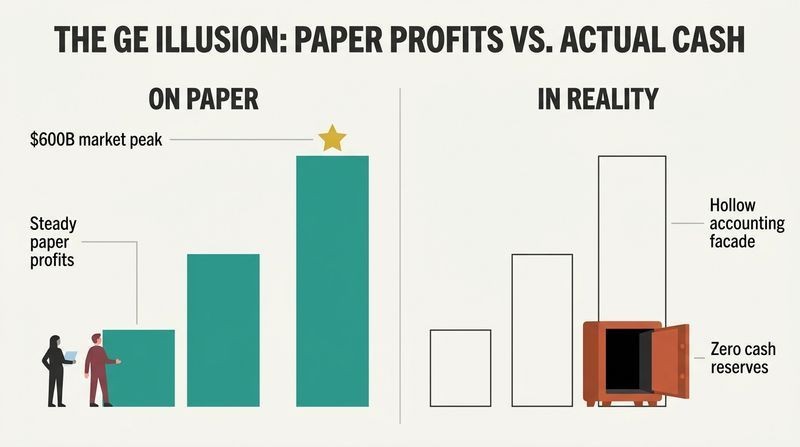
General Electric was once worth nearly $600 billion, the most valuable company in America, its stock a can't-lose staple of retirement portfolios. Within two decades it was ejected from the Dow Jones Industrial Average and traded below $7. The authors, both Wall Street Journal reporters, argue the fall was not sudden but the delayed detonation of habits baked in during the glory years. The opening scene sets the tone: incoming CEO John Flannery inspects GE Power in 2017 and discovers the crown-jewel division has quietly run out of cash, its profits existing mostly on paper. His verdict: they drove off a cliff with no skid marks. The book's thesis is that GE's celebrated management machine masked accounting artistry, not operational genius.
The book poses an unsettling question for all of business culture: how much of the management wisdom exported by GE was real? For decades, executives made pilgrimages to GE's training center and consultants sold GE-style rank-and-yank and Six Sigma worldwide. If GE's earnings were partly manufactured through financial engineering, the entire edifice of imitation rested on a flawed premise. This echoes what economists call the halo effect, described by Phil Rosenzweig: once a company posts great numbers, observers retroactively attribute virtues to its every practice. GE's collapse is a natural experiment revealing how much veneration was survivorship bias dressed as science.
When you set targets first and find the numbers later, fraud follows
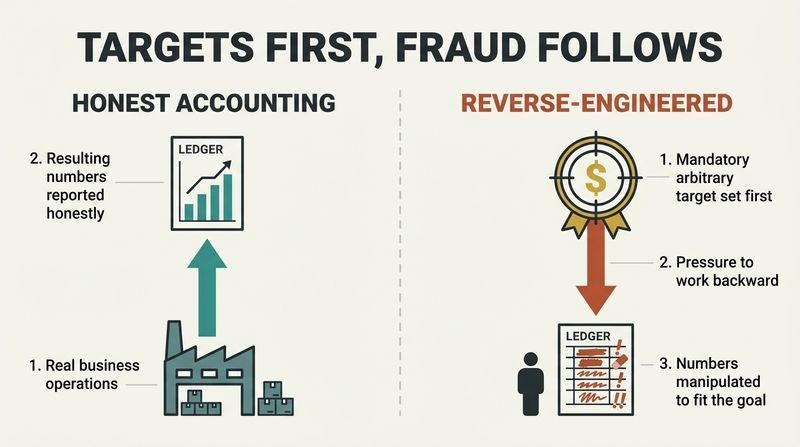
GE's core sin was reverse-engineering results. Managers received profit targets, then worked backward to figure out what sales and adjustments would produce them. In the Plastics division, accountants started with a goal and calculated what inventory figures would hit it. Immelt himself inherited books that had been gamed this way. The pressure was existential: missing your number at GE was career-ending, while the method of hitting it barely mattered. The SEC eventually found GE overstated earnings by hundreds of millions through tricks on jet-engine spare parts, commercial-paper hedging, and locomotive sales to banks that quietly resold them. GE paid a $50 million fine in 2009 without admitting wrongdoing.
This is a textbook case of Goodhart's Law: when a measure becomes a target, it ceases to be a good measure. GE institutionalized what psychologists call motivated reasoning at scale, giving thousands of finance staff both the incentive and the tools to make reality conform to the forecast. The deeper danger is cultural: once smoothing quarterly earnings becomes normal and auditors sign off, the line between aggressive accounting and fraud blurs until nobody can locate it. Organizations that punish bad news teach people to hide it, transforming small, fixable problems into catastrophic ones detected only when the cash finally runs dry.
GE Capital was a hidden bank that quietly generated half of profits
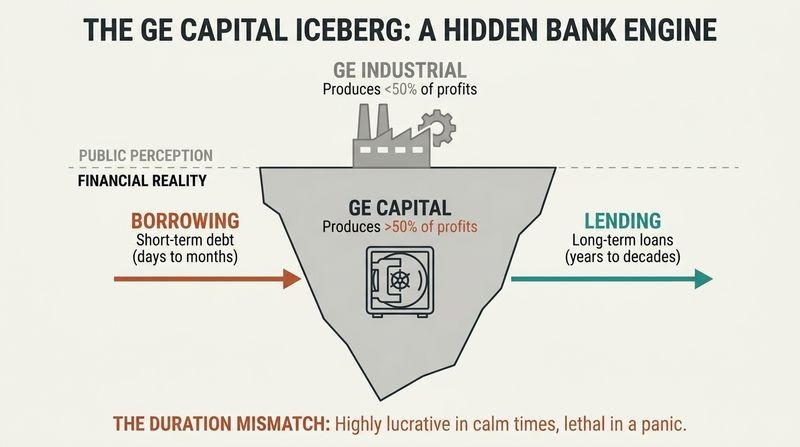
Jack Welch's most consequential innovation was not management training but finance. He transformed GE Credit into GE Capital, a lending colossus that used GE's pristine triple-A credit rating to borrow cheaply and lend at higher rates. By its peak, GE Capital produced more than half of GE's total profits. The most famous industrial company in America had effectively become one of its largest and most opaque banks. Crucially, GE Capital funded itself with commercial paper, short-term debt lasting days to months, then lent that money out for years. This duration mismatch was lucrative in calm times and lethal in a panic, exactly as bond investor Bill Gross warned in 2002.
GE Capital exploited a regulatory and perceptual arbitrage: it earned bank-like returns while enjoying an industrial company's valuation and escaping bank-level oversight. This is the same fragility that felled Lehman Brothers, borrowing short and lending long, which economists call maturity transformation. What makes GE's version striking is that investors accepted the black box because the industrial halo lent it credibility. The 2008 crisis exposed the illusion when the commercial-paper market froze and GE needed federal guarantees to survive. The lesson generalizes: any enterprise whose stability depends on continuous access to short-term funding is one confidence shock away from insolvency, regardless of its underlying assets.
Rewarding only optimism trains your best people to bury the truth
Immelt's leadership style prized relentless positivity. Presented with contrary data, he would say the analyst simply wasn't looking at it right. His recurring rebuke to underlings who flagged unrealistic targets was that their people didn't want it bad enough, as if earnings were a matter of willpower like a football coach's tackle drill. In GE Power, when lower-level executives warned that management's growth assumptions defied the market and basic math, the services chief shut them down with orders to get on board and make the numbers. Flannery later branded this culture success theater and made no more success theater his rallying cry.
Immelt's football-coach ethos reflects a genuine cognitive trap: leaders often confuse motivation with capability, treating market realities as obstacles to be willed away. Research on organizational silence by Amy Edmondson shows that teams lacking psychological safety systematically withhold bad news, which is precisely how GE's problems metastasized undetected. The irony is that GE's official brand was rigorous management and accountability, yet its emotional operating system punished candor. Contrast this with Ray Dalio's radical transparency or Andy Grove's paranoid welcoming of bad news. The uncomfortable truth: charisma and inspirational conviction, GE's most celebrated leadership traits, can be actively destructive when they suppress the flow of unwelcome information upward.
Overpaying for trendy deals is not strategy, it is fad-surfing
Immelt had a chronic habit of chasing whatever industry was hot, arriving late, and paying too much. Rivals joked he was fad-surfing. He plunged into security systems after 9/11 (later sold), water processing (a mess), and most disastrously, oil and gas. Between roughly 2007 and 2016 GE spent about $14 billion building GE Oil & Gas, buying Lufkin Industries for $3.3 billion in 2013. GE's financial models assumed $100-per-barrel oil. Within a year of assuring investors, crude fell below $50, then dragged the unit into perpetual cost-cutting. GE closed Lufkin's century-old Texas foundry just 868 days after arriving, evaporating over four thousand jobs.
GE's dealmaking illustrates the winner's curse: in competitive acquisitions, the buyer who wins is often the one who most overestimates value. Immelt's salesman instinct, treating price as secondary to the story of strategic fit, is the exact opposite of the discipline Warren Buffett and Charlie Munger preach. Notably, GE competitor Honeywell forbade its dealmakers from using future cost-cutting to justify a deal's math, while GE's Alstom acquisition rested on precisely such synergies. The Lufkin timeline is a haunting metaphor for the whole era: a company acquired at a peak price during a boom, then gutted the moment the cycle turned, with the cyclicality entirely predictable.
Never buy back your own stock unless it is genuinely cheap
Immelt spent more than $108 billion repurchasing GE shares after 2004, often at prices far above where they later traded. In his final eighteen months alone he spent nearly $26 billion while the stock struggled near $30. By late 2018 the entire company was worth just $67 billion, and the stock fell below $10. Buffett and Munger's rule for buybacks has two prongs: the company must have ample capital for operations, and shares must sell at a material discount to intrinsic value, conservatively calculated. GE violated both. It was paying a dollar for something soon worth far less while starving itself of cash it desperately needed.
GE's buyback binge exemplifies a governance pathology: repurchases can flatter earnings-per-share and executive compensation metrics even when they destroy value. Munger's warning that many CEOs never stop believing their stock is cheap applies perfectly. The buyback boom across corporate America since the 2000s has often functioned as financial cosmetics rather than genuine capital return. GE's case is extreme because the cash was borrowed or drawn from divesting GE Capital, then set aflame buying overpriced shares, leaving nothing to cover a hidden insurance liability. When Immelt's retirement was announced and buybacks stopped, monthly spending collapsed from $153 million to $18 million, as if someone had grabbed the assailant's hand.
Combining CEO and chairman lets a leader become his own boss
At GE the CEO also served as chairman of the board, meaning the person being overseen ran the oversight committee. Immelt handpicked directors over time, and the board became famous for deference. A new director once asked a veteran what a GE board member's role was; the answer was applause. Directors reportedly dozed during meetings, some seemed more interested in the corporate jet and perks, and when the Power division badly missed targets, no director asked what went wrong. The board also had a member who deeply understood oil, yet GE was blindsided by falling oil prices. The Federal Reserve, supervising GE Capital, urged directors to push back harder.
This is the central failure of corporate governance theory made flesh. The separation of chairman and CEO exists precisely to prevent the concentration of power the book documents, and its erosion since the Enron era is why many jurisdictions now discourage the dual role. But the deeper issue is board composition and incentives: directors earning over $300,000 a year plus charitable matches and product allowances face subtle pressure to preserve a lucrative, prestigious sinecure rather than antagonize the CEO who effectively appointed them. Jeffrey Sonnenfeld's research shows dysfunctional boards fail not from lack of expertise but from social dynamics that suppress dissent. GE had brilliant directors and terrible governance.
A story is not a strategy, no matter how well you tell it
Under marketing chief Beth Comstock, GE rebranded relentlessly: ecomagination, Imagination at Work, and a campaign recasting a 124-year-old industrial giant as a startup. The company sold limited-edition hot sauce, made a moon-boot sneaker, and paid BuzzFeed for sponsored content. Comstock's mantra was that strategy is a story well told. The Predix software platform embodied the gap between narrative and reality. GE poured roughly $5 billion into becoming a top-ten software company, marketed Predix aggressively, and staffed a huge organization before the product actually worked. Executives couldn't even agree how to pronounce it. One healthcare salesman confessed in an elevator that he didn't even know what they were selling.
GE's digital pivot is a cautionary tale about mistaking marketing velocity for product-market fit. The startup world's own doctrine, Eric Ries's lean methodology that GE tried to import, insists on building a minimum viable product and iterating with real customers, the opposite of GE's approach of hiring armies and building custom code that couldn't be resold. The pronunciation confusion is a perfect symptom: when even leadership can't articulate what a product does, the narrative has outrun the substance. There is a real insight buried here, that industrial data could be valuable, but GE proved that domain knowledge plus a compelling story cannot substitute for the unglamorous work of engineering software that functions.
The insurance business GE claimed to exit hid a $15 billion bomb
Immelt repeatedly cited GE's clean exit from insurance as proof of his shrewd timing. GE spun off most insurance into Genworth in 2004 and sold the rest to Swiss Re in 2006. But GE quietly retained a block of long-term care policies, coverage for nursing homes and assisted living, that no buyer would take. These policies were catastrophically mispriced, built on wildly optimistic assumptions never revisited for years. When auditors finally rebuilt the models with realistic assumptions under Flannery, GE needed $15 billion in reserves. The disclosure of this liability had even been removed from the annual report between 2012 and 2017. Immelt later admitted he would never have spent cash on buybacks had he known.
The insurance debacle crystallizes the book's thesis about buried risk. Long-term care insurance is an industry-wide disaster because insurers underestimated both longevity and the reluctance of healthy policyholders to lapse, but GE compounded this by removing the disclosure and neglecting to stress-test worst-case scenarios, the single most basic task of risk management. That directors genuinely believed the company had left insurance entirely reveals how opacity metastasizes: the left hand truly did not know what the right hand held. It also underscores a moral hazard in reinsurance, where upfront premiums arrive early and payouts come decades later, tempting managers to book the cash and defer the reckoning to successors.
Being too big to fail can mean being too big to manage or even see
GE's sprawl became its fatal weakness. The conglomerate operated with more than 500 separate profit-and-loss statements and hundreds of enterprise software systems, reshuffling its business units every eighteen to twenty-four months, which made year-over-year comparison nearly impossible. Even Flannery, a thirty-year GE veteran who had run a major division, found the whole enterprise impossible to grasp intuitively. Mistakes, even enormous ones, were absorbed by the sheer scale, so no one believed a single bad deal could sink the company. That belief was itself the danger: the size advantage that let one struggling unit lean on another also let losses, risks, and accounting tricks hide in the vastness until they compounded fatally.
GE's structure exemplifies what organizational theorists call the diseconomies of scale and complexity. Beyond a certain size, coordination costs and information loss overwhelm the benefits of diversification. The conglomerate discount, Wall Street's habit of valuing sprawling firms below the sum of their parts, reflects exactly this. GE's competitors Siemens and Danaher moved toward focus and thinner corporate overhead, while GE thickened its corporate layer under the euphemism of synergy. The frequent reorganizations, likely intended to refresh strategy, functioned instead as camouflage, resetting the baselines that would have revealed deterioration. Complexity is not merely inefficient; it is a place where accountability goes to die.
GE outsourced its rescue to a stranger because insiders knew only one playbook
When GE finally needed saving, its vaunted talent machine, which claimed it could train a manager to run any business anywhere, could not produce a savior from within. Flannery, a GE lifer, was fired after just fourteen months, the shortest tenure in company history, as the board lost confidence in his ability to juggle endless crises. The board turned to Larry Culp, an outsider who had run the smaller conglomerate Danaher for fourteen years with a disciplined, focused model. Culp cut the dividend to a token penny, sold the transportation and oil businesses, and pushed bottom-up management to replace top-down decrees, directly attacking the success theater culture.
The ultimate irony the book lands on is devastating: GE's proudest claim was that its management system was a transferable science, yet when the company most needed a great manager, it had to hire one from outside. This punctures the core myth that generalist managers, armed with GE-style rigor, can master any industry. The modern consensus has swung toward the opposite view, that deep domain expertise and focus outperform conglomerate breadth, which is why activist investors like Trian target sprawling firms. Culp's turnaround, borrowing lean principles from Toyota, ironically resembles the operational discipline GE once claimed to embody, suggesting GE lost not its philosophy but its practice of it.
Analysis
Lights Out is investigative business history at its finest, a forensic autopsy of how an American institution valued near $600 billion decayed into a penny-dividend shadow. Its power lies in refusing the easy villain narrative. Gryta and Mann, Wall Street Journal reporters who covered GE's collapse in real time, distribute blame across a system: two very different CEOs, a somnolent board, credulous investors, complicit auditors, and above all a culture that fused aggressive accounting, macho competitiveness, and mythmaking into a self-reinforcing machine that produced beautiful numbers and hid ugly truths.
The book's most transferable insight transcends GE. It is a study in how metrics corrupt organizations. When hitting a number becomes sacred and the method becomes irrelevant, when leaders reward optimism and punish candor, when scale grows beyond comprehension, an enterprise loses the ability to perceive its own reality. GE's finance arm, borrowing short to lend long, was a bank wearing an industrial disguise, enjoying cheap credit and light oversight until a panic exposed the fragility. Its earnings, smoothed quarter after quarter by GE Capital's convenient gains and offsetting charges, taught investors to trust a black box precisely because it was too complex to question.
What elevates the book is its human texture: Immelt's diet sodas pre-stocked in meat-locker conference rooms, the second empty jet shadowing him around the world, Bornstein weeping before executives, the elevator confession about not knowing what they were selling. These details convert abstract governance failures into visceral memory.
The book's limitation is its verdict-in-progress quality. Written in 2020, it cannot assess whether Culp's turnaround vindicates the breakup thesis or whether GE's woes were partly cyclical bad luck, as Immelt insists. Immelt's defenders get airtime but rarely the last word. Still, the central argument holds: imagination is not a strategy, a story well told is not the same as a business well run, and no company is too big to fall when its numbers stop being true.
Review Summary
Lights Out receives generally positive reviews, with readers praising its in-depth analysis of GE's decline under Jeff Immelt's leadership. Many appreciate the insights into corporate culture, financial engineering, and poor decision-making. Some readers, particularly former GE employees, find the book enlightening but painful. Critics note repetitiveness and occasional lack of depth. Overall, reviewers find it a compelling account of GE's fall from grace, offering valuable lessons on corporate governance and leadership.
People Also Read








FAQ
What's Lights Out: Pride, Delusion, and the Fall of General Electric about?
- Corporate Downfall Focus: The book chronicles the rise and fall of General Electric (GE), highlighting its transition from an industrial powerhouse to a company in crisis.
- Leadership Analysis: It examines the leadership styles of CEOs Jack Welch and Jeff Immelt, focusing on their strategies and the resulting consequences.
- Crisis and Recovery: The narrative covers financial crises, including the 2008 meltdown, and questions GE's ability to recover its former glory.
Why should I read Lights Out by Thomas Gryta?
- Corporate Culture Insight: The book offers a deep dive into GE's corporate culture, illustrating how internal dynamics can shape a company's fate.
- Historical Perspective: It provides a historical context of GE, relevant for those interested in business history and corporate governance.
- Lessons on Accountability: Emphasizes the importance of accountability in leadership, resonating with current discussions on corporate ethics.
What are the key takeaways of Lights Out?
- Leadership Dysfunction: Highlights how leadership dysfunction can lead to a company's downfall, emphasizing transparency and accountability.
- Financial Engineering Risks: Discusses the dangers of relying on financial engineering to meet earnings targets, serving as a cautionary tale.
- Need for Innovation: Underscores the necessity for companies to innovate and adapt to changing market conditions.
What are the best quotes from Lights Out and what do they mean?
- “No more success theater.”: Reflects the need for honesty and transparency in corporate reporting, eliminating facades of success.
- “Did you fucking know about this?”: Highlights the disconnect between reported success and actual performance, emphasizing accountability.
- “Green is green.”: Suggests merging corporate responsibility with financial performance, a key aspect of GE's rebranding efforts.
How did Jack Welch's and Jeff Immelt's leadership styles impact GE?
- Welch's Aggressive Tactics: Focused on efficiency, cost-cutting, and acquisitions, creating a high-pressure environment.
- Immelt's Innovation Shift: Attempted to pivot GE towards innovation and sustainability, promoting "Imagination at Work."
- Cultural Resistance: Immelt faced resistance to change, stifling growth and leaving GE vulnerable to external pressures.
What role did financial engineering play in GE's downfall?
- Earnings Manipulation: GE used financial engineering to present consistent earnings growth, eroding trust among investors.
- GE Capital Dependence: The reliance on GE Capital exposed the company to significant risk, revealed during the financial crisis.
- Regulatory Scrutiny: Increased scrutiny highlighted the risks associated with GE's financial practices, necessitating greater transparency.
How did the financial crisis affect GE's operations?
- Liquidity Issues: The crisis impacted GE's access to the commercial paper market, threatening its stability.
- Stock Price Decline: GE's stock price plummeted, reflecting concerns about its financial health and reliance on GE Capital.
- Strategic Reassessment: Forced GE to reassess its strategy, leading to divestitures and a focus on core industrial operations.
How did GE's corporate culture contribute to its decline?
- Pressure to Perform: Fostered an environment prioritizing financial targets, leading to unethical practices.
- Siloed Operations: Created silos that hindered communication and collaboration, contributing to dysfunction.
- Resistance to Change: Significant resistance to innovation stifled growth and left GE vulnerable to market pressures.
How did the Alstom acquisition affect GE?
- Strategic Misalignment: Intended to bolster GE's power market position, but revealed deeper issues within GE Power.
- Regulatory Hurdles: Faced significant scrutiny, leading to concessions that undermined the acquisition's rationale.
- Financial Strain: Added to GE's financial woes, contributing to a decline in cash flow and increased pressure.
What were the consequences of GE's aggressive accounting practices?
- Short-Term Gains: Allowed GE to report inflated profits, misleading investors about its financial health.
- Regulatory Investigations: Drew attention from regulators, damaging GE's reputation and revealing systemic issues.
- Long-Term Damage: Set the stage for financial instability, with severe consequences as obligations became unmet.
How did Jeff Immelt's leadership style impact GE?
- Optimism vs. Reality: Immelt's optimism often clashed with market realities, leading to overly ambitious decisions.
- Top-Down Management: Discouraged dissent, resulting in poor decision-making and failure to address problems.
- Focus on Growth: Prioritized growth and expansion, weakening the company's financial position.
What does Lights Out suggest about the future of conglomerates?
- Changing Market Dynamics: Highlights challenges faced by conglomerates in a rapidly evolving business landscape.
- Need for Focus: Suggests companies focus on core competencies for greater efficiency and profitability.
- Investor Expectations: Emphasizes the need for transparency and accountability to maintain investor trust.
Download PDF
Download EPUB
.epub digital book format is ideal for reading ebooks on phones, tablets, and e-readers.








































