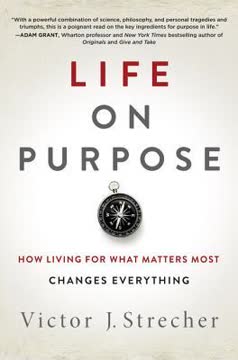
Key Takeaways
1. Personal Tragedy Ignites a Scientific Quest for Purpose
The crossroad of my life was right there—two miles off the shore of Lake Michigan. The signs were clear. One arrow said, “Change Everything.” The other said, “Death.”
A profound crossroads. The author's life was irrevocably altered by the sudden death of his daughter, Julia, at age nineteen. This personal tragedy, marked by a poignant moment in a kayak on Lake Michigan, served as a powerful catalyst, pushing him to confront existential questions and seek a new foundation for living. Julia's message, "Get over it, Dad," wasn't dismissive but a call to transcend self-pity and live for what truly matters.
The science of meaning. This personal quest led the author to Viktor Frankl's work, Man's Search for Meaning, which scientifically analyzed purpose emerging from tragedy. Frankl's observations from Nazi concentration camps highlighted that individuals with a purpose were more likely to survive. The author, a public health scientist, then delved into modern research, discovering compelling evidence for purpose's profound impact on health and longevity.
Purpose as a powerful intervention. Studies reveal that a strong purpose in life is linked to:
- Longer lifespan (12% reduced risk of dying for every one-point increase on a seven-point scale)
- Reduced risk of heart attack (27% lower risk) and stroke (22% reduced risk)
- Lower incidence of Alzheimer's disease (2.4 times less likely)
- Better psychological and social well-being (better sex, sleep, less depression, more relaxed)
- Physiological benefits (increased natural killer cells, reduced inflammation, increased HDL cholesterol, DNA repair).
If purpose were a drug, its benefits would be revolutionary, yet it's free and comes with positive side effects like more friends and deeper engagement.
2. Eudaimonia: The Deeper Happiness of True Purpose
Hedonic and eudaimonic well-being were originally distinguished to resolve basic and ancient philosophical questions regarding the best way for humans to live.
Beyond fleeting pleasure. Ancient philosophers like Aristotle distinguished between two types of happiness: "hedonia" (pleasure from gratifying short-term desires) and "eudaimonia" (happiness attained through self-transcendence and living in harmony with one's "inner daimon" or true self). While hedonic pleasure is natural, Aristotle warned against its excess, likening it to the life of "grazing animals." Modern society often reduces happiness to dopamine-driven pleasure, overlooking the deeper, more fulfilling path of eudaimonia.
Science validates ancient wisdom. Recent scientific studies have begun to explore the biological and psychological differences between these two forms of well-being. Research by psychologist Barbara Fredrickson found that:
- High hedonic well-being was associated with inflammatory gene expression and decreased antiviral response.
- High eudaimonic well-being showed the opposite pattern, indicating physiological health.
This molecular-level contrast suggests that while both contribute to feeling good, eudaimonia offers distinct biological advantages.
Purposeful aspirations lead to flourishing. Further studies, like Christopher Niemiec's work with college students, showed that those pursuing eudaimonic aspirations (personal growth, relationships, community) experienced greater life satisfaction and self-esteem, while those focused on hedonic goals (money, fame, image) reported more anxiety and physical symptoms of poor health. Brain imaging studies also revealed that adolescents whose reward systems activated more when giving money (eudaimonic) showed a decline in depressive symptoms, unlike those rewarded by keeping money (hedonic). Eudaimonia, therefore, requires self-discovery of what truly matters, transcending immediate desires.
3. Self-Transcendence: Living for Something Greater Than Yourself
Only to the extent that someone is living out this self-transcendence of human existence is he truly human or does he become his true self.
Beyond self-actualization. Viktor Frankl argued that true fulfillment comes not from self-actualization (as Abraham Maslow initially proposed), but from self-transcendence—forgetting oneself and focusing outward. Maslow later agreed, noting that "fully developed... human being[s]... tend to be motivated by values which transcend his self." Jennifer Pharr Davis, who broke the Appalachian Trail speed record, found her true purpose and performance surged only when she shifted from a self-focused goal to an "act of worship to something greater than myself."
Transcendent leadership and altruism. Great coaches like John Wooden prioritize character over winning, fostering wisdom in their protégés. Similarly, businesses like Zingerman's Deli, with its mission "To enrich as many lives as we possibly can," demonstrate that a transcending purpose can lead to greater financial success and employee engagement than a sole focus on profit. Studies show that:
- Empathic and altruistic behaviors are hardwired in animals and even infants.
- "Otherish" giving (helpful while preserving one's own goals) is a healthy, sustainable approach.
- Signs emphasizing patient safety (self-transcending) led to 45% more handwashing by healthcare professionals than self-focused signs.
This suggests that our innate nature leans towards connection and contribution.
Finding meaning in any work. Even in tedious jobs, individuals can "job craft" their roles into something transcending. Hospital custodians, for example, saw themselves as part of the medical team, bringing beauty to comatose patients or reading to lonely ones. This shift from working "for a buck" to a higher purpose increases productivity, reduces absenteeism, and boosts job satisfaction, transforming "a Monday through Friday sort of dying" into "a sort of life."
4. Energy and Willpower: The Essential Fuel and Rudder for Purpose
It’s not about time! Time management is crap. Think about it. You get home after a grueling day at work. You reach for a drink and the newspaper. There’s plenty of time to be engaged, but your spouse says, ‘You’re not here!’
Energy, not just time. Performance psychologist Jim Loehr argues that "time management is crap"; true engagement and performance stem from "energy management." The "right energy" comes from positive emotions and values, directed towards a specific purpose. Jimmy Carter, after his presidency, found a "second wind" by founding the Carter Center, tackling global challenges with ferocious energy fueled by self-determined goals. Aimee Mullins, born without fibulae, embodies this, transforming her physical challenges into a powerful expression of self-determination.
Willpower as a muscle. Willpower, often seen as an innate trait, can actually be depleted, strengthened, and fueled. It's depleted by ego threats (e.g., losing a sports game, being berated) or mental exertion (e.g., remembering complex information). Conversely, it can be strengthened through practices like meditation and fueled by stable blood glucose levels. The "marshmallow test" for children and studies on adult decision-making highlight willpower's long-term impact on health and life outcomes.
Purpose strengthens willpower. Research shows that affirming core purposeful values significantly boosts willpower. A study with college students found that those who affirmed self-transcending values ate significantly fewer cookies after an ego threat compared to those who affirmed self-enhancing values or no values. This indicates that aligning with a deeper purpose provides a powerful internal rudder, helping us resist temptations and stay on course.
5. SPACE: Rest and Mindfulness for a Focused Mind
If you just sit and observe, you will see how restless your mind is. If you try to calm it, it only makes it worse, but over time it does calm, and when it does, there’s room to hear more subtle things—that’s when your intuition starts to blossom and you start to see things more clearly and be in the present more.
Sleep: The brain's secret weapon. Often undervalued, sleep is crucial for restoring the immune system, enhancing brain plasticity, and boosting energy and willpower. Humans typically need 7-8 hours, with deviations linked to lower academic performance and health issues like obesity and diabetes. Napping, even short bursts, can significantly improve memory and energy, as demonstrated by historical figures like Edison and Da Vinci. Sleep also plays a vital role in creative idea generation during hypnogogic and hypnopompic states, and in skill consolidation during REM sleep.
Presence: Being here now. Mindfulness, or "presence," involves sustained, non-judgmental attention to the present moment. It can be cultivated through meditation, yoga, qigong, tai chi, or even everyday activities like gardening or conversation. Presence helps quiet the mind's constant wandering between past and future, leading to a "flow state" where time seems to disappear and sensory experiences are heightened.
Meditation's transformative power. Regular meditation offers profound benefits:
- Increases energy and willpower.
- Reduces insomnia and stress.
- Improves diet and enhances creativity.
- Decreases PTSD symptoms in veterans.
- "Loving-kindness meditation" specifically enhances self-transcendence, purpose, and even DNA repair.
These practices, whether focused-attention or movement-based, provide mental clarity and emotional regulation, essential for navigating life with purpose.
6. SPACE: Movement and Creativity for a Vibrant Life
A good thing is better when it’s more difficult.
Activity: The joy of movement. Aristotle valued habitual, strenuous physical exercise, seeing it as a path to excellence. Physical activity, encompassing aerobic, resistance, flexibility, and balance exercises, is a powerful generator of energy and willpower. Mike Mosallam's journey from obesity to running half marathons illustrates how gradually increasing activity can build both physical and mental strength, transforming his body into "armor" into a source of "thrill rush."
The "why" of activity. Research shows that the most motivating reason for physical activity is "well-being," leading to 30% more participation than goals like "losing weight" or "better health." This highlights the importance of intrinsic motivation and finding pleasure in movement. Sedentary behavior, even for active individuals, has negative health effects, emphasizing the need for consistent movement throughout the day, not just during structured exercise.
Creativity: A fundamental human need. Poet Edward Hirsch notes that "There's never been a culture without art," suggesting its deep psychological necessity. Creative expression, whether through traditional arts or everyday problem-solving, allows for emotional release, improves immune function, and reduces stress and pain. Even appreciating art, including sad or tragic forms, can be a creative act, fostering empathy and a sense of connection.
Purpose fuels innovation. Creativity involves both novelty and usefulness, and it's driven by purpose. Harvard professor David Perkins suggests that the creative process begins with a purpose, leading to innovative solutions. The author's own journey, from facing rejection for his health software to founding HealthMedia, Inc., exemplifies how necessity, born from purpose, drives innovation. Creativity requires courage to disrupt the status quo, as Carl Jung noted, often making innovators appear as "a fool rushing ahead."
7. SPACE: Eating Well to Sustain Your Purpose
If you truly get in touch with a piece of carrot, you get in touch with the soil, the rain, the sunshine. You get in touch with Mother Earth and eating in such a way, you feel in touch with true life, your roots, and that is meditation.
Food as fuel for mind and body. What, how much, and when we eat profoundly impacts our energy and willpower. A study with Israeli judges showed that parole decisions were heavily influenced by whether they had just eaten, demonstrating the direct link between glucose levels and self-control. The brain, though only 2% of body weight, consumes 20% of our energy, primarily from glucose.
The Mediterranean diet: A sustainable choice. This diet, rich in vegetables, fruits, fish, poultry, and healthy fats like olive oil, is easy to adopt and sustain due to its deliciousness and health benefits. It provides a slow, steady release of glucose from low-glycemic-load foods, preventing energy spikes and crashes. This contrasts with high-glycemic foods and sugary drinks, which lead to fatigue and reduced willpower.
Mindful eating and portion control. The food industry often manipulates our eating habits through marketing and oversized portions. To regain control, the author advocates for:
- Mindful eating: Savoring each bite, engaging all senses, and checking satisfaction levels.
- Portion control: Using smaller plates, wrapping leftovers, and avoiding the "clean-plate club" mentality.
- Strategic snacking: Opting for fruits, vegetables, nuts, and seeds to maintain stable glucose levels.
These practices, combined with a focus on whole, unprocessed foods, empower individuals to eat for sustained energy and willpower, rather than succumbing to external influences.
8. Resilience: Sailing Through Life's Storms with Purpose
One could reflect on their history and break down. I didn’t do that. I motivate myself because I have a goal to achieve. I turn my history into lessons.
Purpose as a shield against trauma. Studies on earthquake survivors in Pakistan, China, and Japan reveal a powerful link between purpose and resilience. Survivors with a strong sense of purpose experienced lower rates of PTSD and depression, and greater "post-traumatic growth"—improved relationships, psychological strength, and appreciation for life. This growth was often most pronounced in those most affected by the disaster, suggesting that trauma can "break open" individuals to re-examine beliefs and find new purpose.
The "shift-and-persist" model. Resilience, particularly for the poor and disadvantaged, involves two key factors:
- Shift: Accepting and adjusting to life's stressors, rather than fighting against every challenge.
- Persist: Maintaining a persistent pursuit of a goal, a "hope for a better life."
This approach helps individuals defend against stress and regulate inflammation, demonstrating that purpose is not a luxury but essential for survival and flourishing, especially in dire circumstances.
Embrace the dynamic journey. Purposeful living is a dynamic, ongoing process, not a one-time accomplishment. It requires continuous energy and willpower, fueled by the SPACE behaviors. The author's own purpose, evolving to include "grandfather" with the birth of his granddaughter, Madeleine Julia, highlights its wonderfully elastic nature. Life is short, and purpose provides the guidance to make choices that lead to a rich, meaningful existence, transforming grief into a clearer vision and challenges into lessons.
Review Summary
Reviews for Life on Purpose are mixed, averaging 3.77/5. Many readers praise the author's deeply moving account of losing his daughter as a compelling foundation for exploring purpose-driven living. The SPACE framework (Sleep, Presence, Activity, Creativity, Eating) is generally well-received, with readers appreciating the blend of science, philosophy, and personal narrative. Common criticisms include excessive self-promotion, insufficient practical guidance for finding personal purpose, and a weaker second half focused on lifestyle habits. Readers seeking actionable steps may feel underserved, while those wanting a scientific and philosophical overview find it rewarding.








































