

Key Takeaways
You do not automatically learn from experience; you must digest it
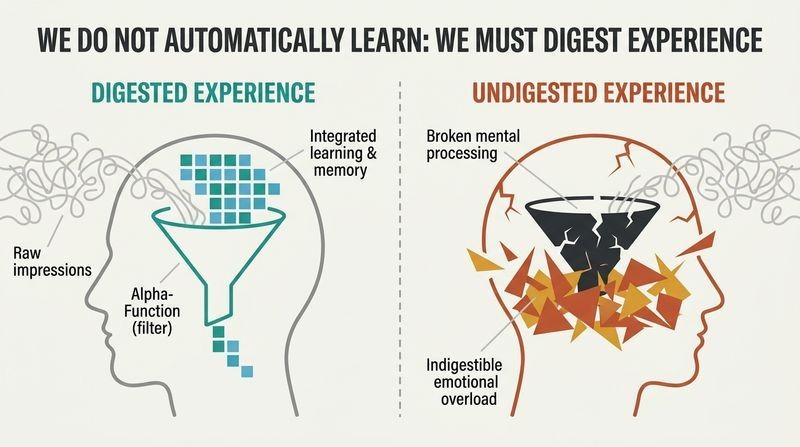
Raw experience is indigestible. Bion's central claim is that having an emotional experience and learning from it are two different acts. Between them sits a mental process he names alpha-function, deliberately using an empty term so no old meanings smuggle themselves in. Alpha-function works on the flood of sense impressions and emotions we are aware of and converts them into storable units called alpha-elements, the raw material for dreams, memory, and unconscious thought.
Failure has catastrophic consequences. When alpha-function breaks down, experience cannot be processed at all. Bion compares it to the digestive tract: failing to metabolize emotional experience is as disastrous to the personality as failing to eat is to the body. He includes among these disasters what he calls death of the personality, seen clinically in psychotic patients who cannot make use of anything that happens to them.
What's striking is how Bion reframes learning as a biological-style metabolism rather than information storage. This anticipates modern affective neuroscience: Antonio Damasio's work shows emotion is not noise interfering with cognition but the substrate that makes reasoning possible. Bion's alimentary metaphor also prefigures theories of emotion regulation, where unprocessed affect drives symptoms. The move to invent a meaningless term is genuinely radical for its era, a scientist refusing premature definition. The risk is unfalsifiability: a concept defined as unknown resists disproof. Yet as a clinical heuristic for why some patients seem to gain nothing from insight, it remains illuminating and oddly practical.
Undigested facts get evacuated, not remembered; digested ones become thinkable
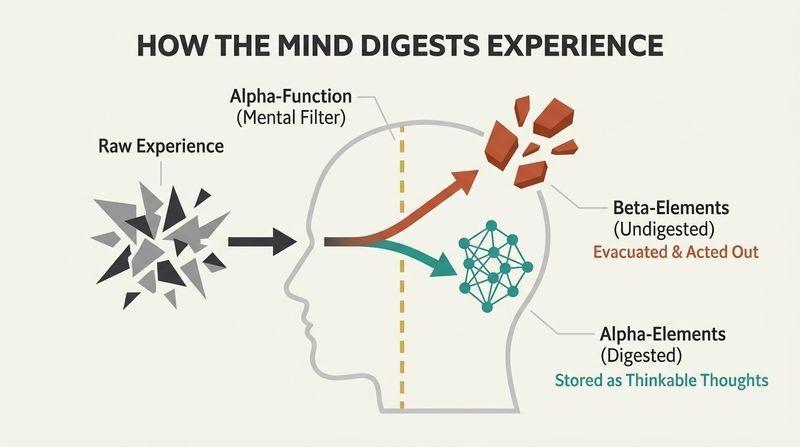
Two kinds of mental content. Bion splits experience into two products. Alpha-elements have been metabolized and resemble the visual images of dreams; they can be stored, linked, and used for thought. Beta-elements are the raw, unprocessed residue. Crucially, beta-elements are not felt as impressions of things but as the things themselves, concrete objects lodged in the mind.
Beta-elements can only be expelled. Because they cannot be linked or reflected upon, they are suited only for evacuation, discharged through projective identification or acted out. Bion gives a chilling example: a man who murders his parents to feel free to love, treating an internal problem as a physical object to be thrown out. A patient dominated by beta-elements greedily swallows one interpretation after another yet learns nothing, mistaking words for concrete things rather than meanings.
The distinction maps onto a broader puzzle in psychology: why insight sometimes changes nothing. Cognitive behavioral therapists encounter patients who intellectually grasp a reframe yet feel unmoved, echoing Bion's beta-dominated mind that cannot digest. His notion that unprocessed content gets acted out rather than thought resonates with trauma research, where unintegrated experience returns as reenactment or somatic symptom rather than narrative memory. Bessel van der Kolk's observation that the body keeps the score is a near cousin. One caution: the murder example is extreme and rhetorical. The everyday version, treating a difficult feeling as a hot potato to fling at others, is more relatable and equally instructive.
A mother's reverie is the infant's first digestive system for feelings
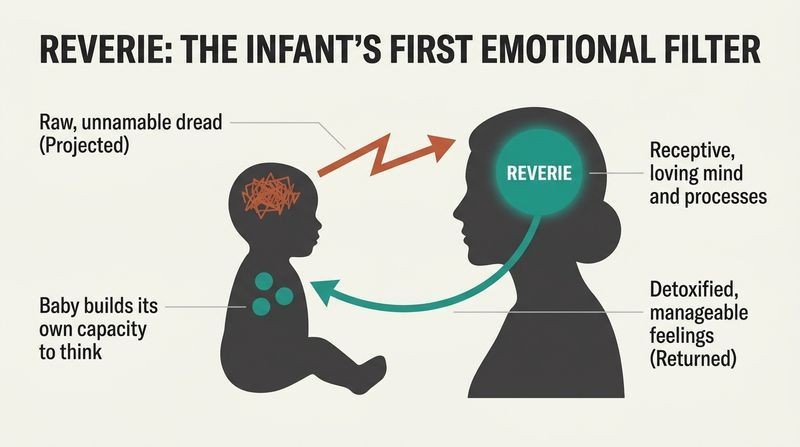
Thinking begins between two people. An infant flooded by a fear it cannot name projects that raw dread into the mother. If the mother is in a state Bion calls reverie, a receptive mind open to receiving the baby's projections and suffused with love, she absorbs the terror, processes it, and returns it in tolerable form. The baby reintrojects a now-manageable version and, over time, installs this detoxifying apparatus as its own alpha-function.
Love is expressed through reverie. Bion asks a deceptively simple question: when a mother loves her infant, what does she do it with? His answer is reverie. If the mother cannot perform this function, or does it without love, the infant is thrown back on its own limited capacity to tolerate frustration, and its ability to think itself is imperiled.
This is arguably Bion's most influential idea, seeding decades of attachment and mentalization research. Peter Fonagy's work on reflective functioning, where a caregiver's capacity to hold the child's mind in mind builds the child's own, is essentially Bion operationalized and empirically tested. Developmental studies on serve-and-return interaction and affect mirroring corroborate the mechanism. The concept also humanizes therapy: the analyst's reverie becomes a treatment tool. A fair critique is the heavy maternal framing, which reflects 1962 assumptions; contemporary work extends reverie to any consistent caregiver. Still, the core insight, that self-regulation is first co-regulation, has become foundational across developmental science.
Growth happens when a container holds and transforms what it receives
The container and the contained. Bion abstracts the mother-infant, mouth-breast relationship into a general model: a container that receives a projected contained. When the two meet in what he calls a commensal relationship, both dependent on each other, benefiting, and harmed by neither, they grow. The infant projects a fear of dying into the breast; the breast moderates it; the infant takes back something bearable and enlarged. This is the engine of mental development.
When containment fails, dread has no name. In the destructive case, the container strips out the good and forces back a worthless residue. The infant who began with a fear of dying ends up carrying what Bion calls a nameless dread, a terror that has been stripped of meaning rather than detoxified. Growth requires emotional linkage; denuded of emotion, both parties drift toward the inanimate.
Container-contained has traveled far beyond the clinic. Organizational consultants and group theorists use it to describe how institutions must hold members' anxiety rather than deflect it. Wilfred Bion's own group work fed directly into the Tavistock tradition of studying how teams either metabolize or evacuate collective fear. The concept of nameless dread is quietly profound: it names the difference between fear you can articulate and the free-floating anxiety that resists language, a distinction clinicians see in panic disorder and complex trauma. The generality is both strength and weakness. It explains so much that it risks explaining everything, but as a lens for spotting whether a relationship grows or hollows out people, it is sharp.
The pivotal choice: modify frustration or flee from it
One decision shapes the mind. Bion locates the origin of thinking in the gap between wanting something and getting it. Confronted with the frustration of absence, a personality makes a critical choice: to modify the frustration by developing thought that can tolerate the delay, or to evade it by expelling the discomfort entirely. This is, for Bion, the decision that matters most.
Tolerance builds thinking; intolerance destroys it. A baby able to tolerate frustration can hold the idea of an absent breast, and that held absence, the no-thing, becomes the seed of a thought. A baby who cannot tolerate frustration attacks its own perceptual apparatus, evacuating beta-elements to avoid the pain rather than thinking. Excessive intolerance, whether innate or driven by envy and greed, functions like a corrosive that forestalls thought before it can form.
Bion turns delay of gratification into the birthplace of cognition itself, a striking convergence with Walter Mischel's marshmallow experiments, where the capacity to tolerate waiting predicted later outcomes. But Bion goes deeper than self-control: he argues the very ability to think abstractly is forged in tolerating absence. The idea that a thought is the mind's way of coping with a missing thing anticipates work in cognitive science on mental representation as a substitute for the object. There is philosophical lineage here too, from Freud's reality principle to Hegel's notion that negation generates concepts. The claim that intolerance can be constitutional, not just learned, wisely limits therapeutic optimism.
Thoughts arrive before you can think them; thinking is a later tool
Reverse the usual order. Common sense says we think, and thoughts result. Bion inverts it: thoughts come first, and thinking is an apparatus the mind is forced to develop to cope with thoughts that already exist. The most primitive thought is simply the experience of a needed thing being absent, a no-breast that is felt as a bad presence demanding to be dealt with.
Two failures, not one. This reframing lets Bion diagnose a double breakdown. A patient may lack alpha-elements to think with, or may possess thoughts yet lack the apparatus to think them. He describes recovered psychotic patients who regain the capacity to dream yet still cannot think, resorting to projective identification to fling thoughts out. Thinking, he insists, is embryonic even in healthy adults and largely undeveloped by the species as a whole.
This inversion is Bion's most philosophically bold stroke and it unsettles our folk psychology. It resonates with the phenomenological tradition, where consciousness is always already thrown into a world of meanings it did not author. It also connects to contemporary predictive-processing models, in which the brain generates expectations that experience must satisfy or violate, echoing his pre-conception meeting realization. The claim that humanity has barely developed thinking is provocative and humbling, a rebuke to intellectual complacency. Skeptics will note it is hard to test the priority of thoughts over thinking empirically. Yet clinically it reframes many disorders not as bad thoughts but as a broken apparatus for processing them.
Dreaming keeps you sane while awake, not just while asleep
Dreaming runs continuously. For Bion, dreaming is not a nightly event but an ongoing function of alpha-function that operates every waking moment. As you talk to a friend, alpha-function is converting the experience into alpha-elements, letting you stay awake to the conversation while remaining asleep to the flood of unconscious material that would otherwise swamp you.
The contact-barrier divides the mind. The accumulating alpha-elements cohere into what Bion calls a contact-barrier, borrowing the old term for a synapse. This permeable membrane both separates and connects conscious and unconscious, and it is what creates the distinction in the first place. When it is replaced by an impermeable screen of raw beta-elements, thought loses resonance: a psychotic patient's speech becomes flat and one-dimensional, provoking in the listener a hollow so what.
Bion overturns Freud's model where the dream merely protects sleep. Here dreaming is the mind's constant filtering operation, and this presciently rhymes with modern theories that dreaming consolidates memory and regulates emotion, and with the default mode network's role in continuous background processing. His observation that psychotic speech lacks overtones, evoking a listener's flat so what, is a subtle clinical gem: meaning is felt as much in resonance as in content. The idea that a barrier both creates and mediates the conscious-unconscious divide is elegant systems thinking. One might push back that calling all mental filtering dreaming stretches the word, but the reframing productively blurs the false line between sleeping and waking minds.
Every relationship runs on love, hate, or knowing, and knowing never finishes
Three basic links. Bion argues an emotional experience cannot exist in isolation from a relationship, so he reduces all links between people to three signs: L for loves, H for hates, and K for knows. In recording a session, an analyst picks the one link that most truly captures the emotional key of the moment, then measures everything else against it.
K is a verb, not a possession. Bion is emphatic that K does not mean holding a piece of knowledge called the other person. It means being in the ongoing state of getting to know, while the other is in the state of getting to be known. Treating knowledge as a finished possession is a flight from the discomfort of not-yet-knowing, a way to evade the pain that genuine inquiry stirs up.
The insistence that knowing is a continuous relation, not a stockpile, echoes Socratic humility and the scientific ethos of perpetual revision. It also anticipates constructivist epistemology and process philosophy, where knowledge is activity rather than inventory. Clinically it is a discipline against the analyst's temptation to have the patient figured out, a temptation any expert in any field shares. Bion's reduction to three links is austere and arguably lossy: envy, guilt, and gratitude, which he considered, arguably deserve their own status. But the elegance is the point. By forcing a single key statement, he makes the observer commit to a felt truth rather than hiding in vague description.
The mind starves without truth as surely as the body without food
Truth is a nutrient. Bion makes a stark equation: awareness of emotional truth is to the personality what food, air, and water are to the body. The deprivation of truth produces an effect analogous to physical starvation. A patient who has destroyed his own capacity to know reality does not merely hold false beliefs; he is malnourished at the level of the psyche.
Destroying truth destroys the self. In the pathological states Bion describes, the pursuit of material comfort replaces the search for understanding, and concern for truth itself is annihilated. The person becomes insatiable, chasing quantity over quality, because the real hunger, for meaning and contact with a living object, can never be satisfied by substitutes. Psychic health depends on the willingness to metabolize what is real, however painful.
Positioning truth as biological need rather than moral luxury gives Bion's ethics unusual force. It converges with existential psychology, where Viktor Frankl argued meaning is a survival requirement, and with research linking self-deception and denial to worse long-term coping. The insatiable substitution of material comfort for understanding reads like a diagnosis of consumer culture avant la lettre, an endless swallowing that never nourishes. There is a bracing austerity here that resists the comfort-seeking of much pop psychology. The claim is hard to quantify, and one could argue certain illusions are protective in the short term. But as an account of why avoidance eventually hollows a person out, it rings true.
Beware the mind that strips meaning to prove its superiority
The anti-learning stance. Bion reverses his K link to minus K, the active work of misunderstanding. Some patients demonstrate that being able to misunderstand is superior to understanding, defeating every interpretation to assert dominance. Minus K does not merely fail to learn; it attacks meaning, extracting the value from thoughts and returning only a denuded, worthless residue.
A conscience with no morals. At the extreme, minus K produces an internal object Bion describes as a super-ego without any of the super-ego's function, an envious assertion of moral superiority without morals. Its defining hatred is aimed at any new growth in the personality, treating any budding attempt to seek truth as a rival to be destroyed. Where healthy learning turns the concrete into the abstract, minus K forces the abstract back into concrete things stripped of significance, leaving a person surrounded by bizarre, meaningless objects.
Minus K names a phenomenon everyone recognizes but rarely labels: the intellect weaponized against understanding, cleverness in service of not-knowing. It illuminates intellectual bad faith, contrarianism as identity, and the online culture of cynical takedown that gains status by demolishing rather than building. Bion's envious object that hates any new growth resembles what social psychologists study as tall-poppy dynamics and defensive devaluation. The insight that envy targets goodness precisely because it is good, drawn from Melanie Klein, is disturbing and clarifying. It reframes certain destructive personalities not as merely negative but as actively anti-developmental, systematically stripping value. The concept risks pathologizing ordinary skepticism, so the marker is the aim: growth denuded versus honestly questioned.
Analysis
Learning from Experience is Bion's compressed, deliberately difficult attempt to rebuild psychoanalytic theory around a single question: how does a mind convert raw emotional experience into thought? Written in 1962 in a near-mathematical notation, it reads less like a treatise than a set of working tools forged in the consulting room with severely disturbed, thought-disordered patients. Its density is the point; Bion warns against checking obscure passages and insists the reader think the ideas through rather than merely read them.
The book's originality lies in treating thinking as a digestive, relational, and fundamentally emotional process rather than a cognitive given. Alpha-function, beta-elements, the contact-barrier, reverie, and container-contained together form a developmental theory: the capacity to think is not born but installed through a caregiver's metabolizing of the infant's terror. This lineage runs directly into modern mentalization theory (Fonagy), attachment research, and affective neuroscience, giving Bion an empirical afterlife his abstruse prose never predicted.
Bion's deliberate use of empty terms as unknown variables, to be filled by clinical realization, is methodologically bold and philosophically slippery. It borrows the rigor of mathematics and the caution of Kant and Popper while resisting falsifiability, which is both its intellectual honesty and its vulnerability. His L, H, K notation and the K versus minus K distinction offer a genuinely fresh ethics of inquiry: knowing as ongoing relation, truth as psychic nourishment, and the disturbing recognition that some minds actively strip meaning out of envy.
The limitations are real. The maternal framing dates the work, the notation alienates, and the generality of container-contained borders on explaining everything. Yet as a meditation on why insight sometimes changes nothing, why frustration-tolerance builds cognition, and why learning is an emotional achievement rather than an informational one, it remains startlingly relevant to therapy, education, groups, and self-understanding.
Review Summary
Learning from Experience receives mixed reviews, with an overall high rating. Some praise it as a work of genius, highlighting Bion's ideas on psychoanalytic concepts and the origins of thinking. Readers appreciate its brevity and logical clarity, though many find it challenging. Critics argue it's overly abstract and poorly written, calling Bionism a cult. Despite its difficulty, many reviewers find value in Bion's exploration of learning, thinking processes, and psychoanalytic theory, recommending multiple close readings to grasp its concepts fully.
Glossary
Alpha-function
Digests experience into thinkable elementsBion's deliberately meaningless term for the unknown mental process that transforms raw sense impressions and emotions into alpha-elements, which can be stored, dreamed, remembered, and used for thought. He leaves it empty so no prior associations distort investigation, treating it like a mathematician's variable whose value is discovered through clinical work. Its failure leaves the mind unable to learn from experience.
Alpha-elements and beta-elements
Digested versus undigested mental contentAlpha-elements are metabolized units of experience, resembling dream images, suited to storage, linking, memory, and thought. Beta-elements are unprocessed raw impressions and emotions felt as concrete things-in-themselves rather than as representations. Beta-elements cannot be thought with; they can only be evacuated through projective identification or acted out, and they dominate the minds of thought-disordered patients.
Contact-barrier
Membrane dividing conscious and unconsciousNamed after the old term for a synapse, this is the permeable membrane formed as alpha-elements proliferate and cohere. It both creates and maintains the distinction between conscious and unconscious, allowing selective passage between them. When replaced by an impermeable screen of raw beta-elements, ordered thought collapses and speech loses resonance.
Reverie
Caregiver's mind that detoxifies feelingsThe receptive state of mind, suffused with love, in which a mother or caregiver takes in the infant's projected fears and emotions, processes them, and returns them in bearable form. Reverie is how love is functionally expressed and is the external source from which the infant builds its own alpha-function. Its absence imperils the infant's capacity to think.
Container and contained
Model of projective identification and growthBion's abstraction of the mother-infant and mouth-breast relationship into a container that receives a projected contained. When their link is commensal, both grow. When it is envious or denuding, the container strips out value and returns a worthless residue, converting a fear of dying into nameless dread. A general model applicable to individuals, therapy, and groups.
L, H, K links
Love, hate, knowing between objectsBion's three signs for the fundamental emotional links in any relationship: L (loves), H (hates), and K (knows). K is understood as the active, unfinished state of getting to know someone, not possessing knowledge of them. Minus K is the reversal: active misunderstanding that strips meaning and value from thoughts and interpretations.
Modifying versus evading frustration
The critical developmental choiceBion's account of the decisive choice a mind makes when facing the frustration of a need unmet. Modifying frustration means developing thought to tolerate delay, generating the capacity to think. Evading it means expelling the discomfort through evacuation, forestalling thought. Tolerance builds cognition; intolerance, whether innate or driven by envy, corrodes it.
Pre-conception and conception
Innate expectation meeting real experienceA pre-conception is an innate state of expectation, like the infant's built-in expectancy of a breast, comparable to an empty thought that can be thought but not known. When a pre-conception mates with the matching sense impressions of a real experience, it produces a conception. Repeated matings promote mental growth and the development of thinking.
FAQ
What's "Learning from Experience" by Wilfred R. Bion about?
- Psycho-analytical exploration: The book delves into the psycho-analytical exploration of emotional experiences and their relation to theories of knowledge and clinical psycho-analysis.
- Emotional experiences: It focuses on how emotional experiences are processed and understood, particularly in the context of psycho-analytical practice.
- Understanding thought disorders: Bion discusses the challenges of understanding and treating patients with thought disorders, emphasizing the psycho-analyst's role in this process.
- Communication of experience: The book also addresses the difficulties in communicating psycho-analytical experiences and insights to others.
Why should I read "Learning from Experience" by Wilfred R. Bion?
- Insight into psycho-analysis: It provides a deep insight into the psycho-analytical process, especially for those interested in understanding the complexities of the human mind.
- Unique perspective: Bion offers a unique perspective on the relationship between emotional experiences and thought processes, which can be enlightening for both practitioners and students of psycho-analysis.
- Practical application: The book discusses practical applications of psycho-analytical theories, making it valuable for those involved in clinical practice.
- Philosophical exploration: It also explores philosophical questions about knowledge and understanding, appealing to readers interested in the intersection of psychology and philosophy.
What are the key takeaways of "Learning from Experience" by Wilfred R. Bion?
- Alpha-function concept: Bion introduces the concept of alpha-function, which is crucial for transforming emotional experiences into thoughts that can be processed and understood.
- Importance of emotional processing: The book emphasizes the importance of processing emotional experiences to facilitate learning and personal development.
- Role of the psycho-analyst: It highlights the psycho-analyst's role in helping patients understand and integrate their emotional experiences.
- Challenges in communication: Bion discusses the challenges of effectively communicating psycho-analytical insights and experiences to others.
What is the alpha-function in "Learning from Experience" by Wilfred R. Bion?
- Transformation process: The alpha-function is a process that transforms raw emotional experiences into alpha-elements, which can be used for thinking and dreaming.
- Facilitates learning: It is essential for learning from experience, as it allows individuals to process and store emotional experiences in a meaningful way.
- Failure consequences: A failure in alpha-function can lead to an inability to dream, think, or learn from experiences, resulting in psychological disturbances.
- Psycho-analytical tool: Bion uses the alpha-function as a tool to understand and address thought disorders in psycho-analytical practice.
How does Bion describe the role of the psycho-analyst in "Learning from Experience"?
- Facilitator of understanding: The psycho-analyst acts as a facilitator, helping patients understand and integrate their emotional experiences.
- Interpreting emotional experiences: Analysts interpret patients' emotional experiences and provide insights that can lead to personal growth and healing.
- Addressing thought disorders: They play a crucial role in addressing thought disorders by helping patients develop their alpha-function.
- Communication challenges: Bion highlights the challenges analysts face in effectively communicating their insights and experiences to patients.
What is the significance of projective identification in "Learning from Experience" by Wilfred R. Bion?
- Mechanism of thought: Projective identification is described as a mechanism through which individuals project parts of their psyche into others, influencing their thoughts and emotions.
- Role in emotional processing: It plays a significant role in the processing of emotional experiences and the development of thoughts.
- Impact on relationships: Bion discusses how projective identification affects interpersonal relationships and the dynamics between patients and analysts.
- Therapeutic implications: Understanding projective identification is crucial for psycho-analysts to effectively address and treat thought disorders.
What are the best quotes from "Learning from Experience" by Wilfred R. Bion and what do they mean?
- "The emotional experience must now be considered generally and not only as it occurs in sleep." This quote emphasizes the importance of understanding emotional experiences in both waking and sleeping states for comprehensive psycho-analytical practice.
- "To learn from experience alpha-function must operate on the awareness of the emotional experience." It highlights the necessity of the alpha-function in transforming emotional experiences into learnable and usable thoughts.
- "The methods in this book are not definitive." Bion acknowledges the evolving nature of psycho-analytical methods and the need for continuous exploration and adaptation.
- "The theory of functions makes it easier to match the realization with the deductive system that represents it." This quote underscores the utility of the theory of functions in bridging the gap between theoretical concepts and practical realizations.
How does Bion address the challenges of communication in "Learning from Experience"?
- Complexity of experiences: Bion acknowledges the complexity of psycho-analytical experiences and the difficulty in conveying them accurately to others.
- Use of models and abstractions: He suggests using models and abstractions to communicate complex psycho-analytical concepts more effectively.
- Importance of clarity: The book emphasizes the need for clarity and precision in communication to ensure that insights are understood and applied correctly.
- Role of the analyst: Analysts must be aware of their own communication challenges and strive to improve their ability to convey insights to patients.
What is the contact-barrier in "Learning from Experience" by Wilfred R. Bion?
- Separation of consciousness: The contact-barrier is a concept that describes the separation between conscious and unconscious elements in the mind.
- Formation process: It is formed through the proliferation of alpha-elements, which are transformed from emotional experiences by the alpha-function.
- Role in thought processes: The contact-barrier plays a crucial role in maintaining the distinction between conscious and unconscious thoughts, facilitating ordered thinking.
- Clinical significance: Understanding the contact-barrier is important for psycho-analysts in addressing thought disorders and helping patients achieve mental clarity.
How does Bion's "Learning from Experience" relate to Kleinian theories?
- Influence of Melanie Klein: Bion's work is heavily influenced by Melanie Klein's theories, particularly in the areas of projective identification and the paranoid-schizoid and depressive positions.
- Integration of concepts: He integrates Kleinian concepts into his own theories, such as the alpha-function and contact-barrier, to provide a comprehensive understanding of emotional processing.
- Application in practice: Bion applies Kleinian theories to practical psycho-analytical work, offering insights into the treatment of thought disorders.
- Expansion of ideas: While building on Kleinian theories, Bion expands on them by introducing new concepts and methods for understanding and addressing emotional experiences.
What is the significance of the K link in "Learning from Experience" by Wilfred R. Bion?
- Knowledge and learning: The K link represents the relationship between knowledge and learning, emphasizing the process of getting to know and understand.
- Active engagement: It involves an active engagement with the subject of knowledge, rather than a passive possession of information.
- Role in psycho-analysis: The K link is crucial for psycho-analysts in facilitating patients' understanding and integration of their emotional experiences.
- Contrast with —K: Bion contrasts the K link with —K, which represents misunderstanding and the denial of knowledge, highlighting the importance of fostering a positive K link in therapy.
How does Bion's "Learning from Experience" address the concept of abstraction?
- Role in thought processes: Abstraction is a key concept in Bion's work, as it allows individuals to generalize and apply insights from specific experiences to broader contexts.
- Facilitating understanding: It facilitates understanding by enabling the transformation of complex emotional experiences into manageable and communicable thoughts.
- Challenges of abstraction: Bion discusses the challenges of abstraction, particularly in relation to patients who struggle with thought disorders and may perceive words as concrete objects.
- Importance in psycho-analysis: Abstraction is essential for psycho-analysts to develop effective theories and models that can be applied to various clinical situations.
Download PDF
Download EPUB
.epub digital book format is ideal for reading ebooks on phones, tablets, and e-readers.








































