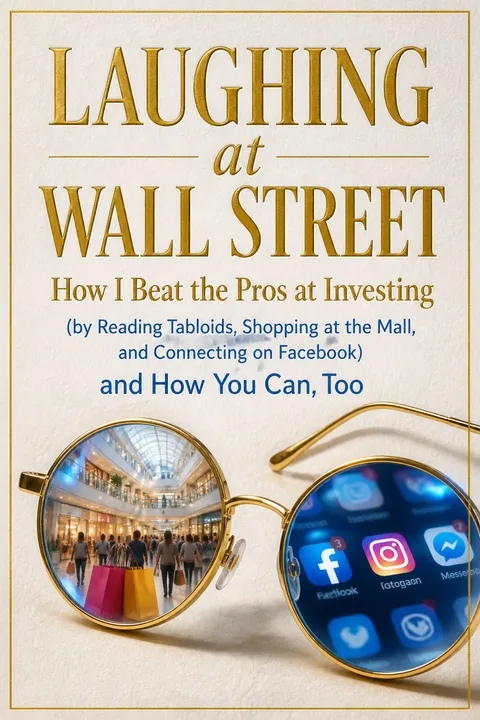


Key Takeaways
Buy stocks only when you know something Wall Street doesn't yet
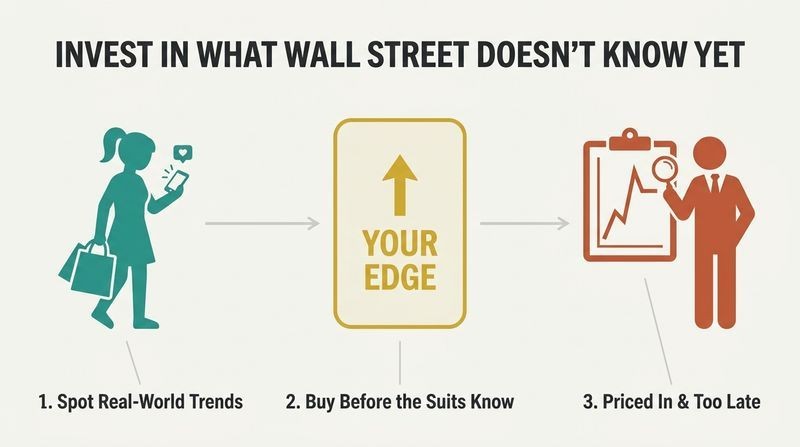
The one rule that matters. Camillo turned roughly $20,000 into over $2 million between 2007 and 2010, a period that included the market crash, while ranking number one among 40,000-plus portfolios tracked by Covestor. His entire method rests on advice his lawyer father gave him at age twelve, after refusing to help him buy Toys R Us stock before Christmas: the price already reflects everything the public knows. The only genuine edge is spotting something others haven't.
No math, no charts, no MBA. He doesn't read balance sheets, analyze price charts, or crunch financial ratios. His qualification is ordinary life: shopping malls, tabloids, Facebook, teenage relatives, and movie theaters. If you notice trends before the suits do, you can beat them.
The claim sounds like beginner's luck dressed up as philosophy, but it echoes Peter Lynch's famous "invest in what you know" from One Up on Wall Street. What's distinctive here is the framing around information timing rather than product familiarity. A fair challenge: verified three-year returns during one lucky window do not prove a repeatable system, and survivorship bias haunts every trading memoir. Still, the underlying claim about efficient markets is academically robust. Markets price in public information fast, so any durable edge must come from information not yet public. Camillo simply relocates that edge from insider tips to consumer observation, which is legal and widely available.
Both technical and fundamental analysis are elaborate coin flips
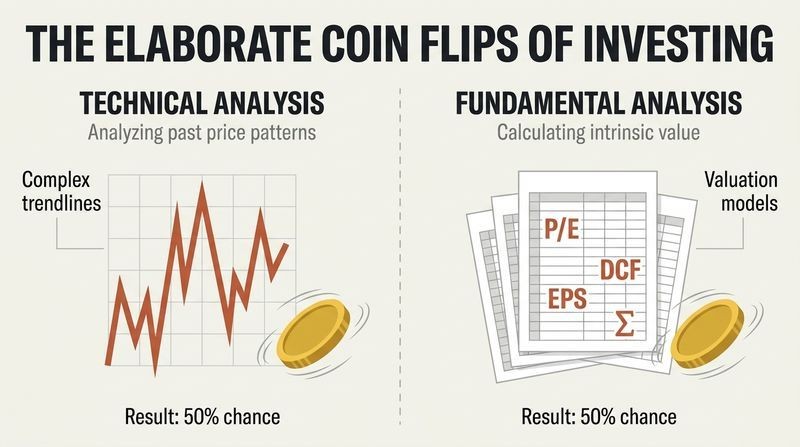
Two dominant methods, both weak. Technical analysis studies past price patterns to predict future moves. Camillo dismisses it, quoting Buffett, who found flipping charts upside down changed nothing, and a 2003 study by Amsterdam economist Gerwin Griffioen showing no statistically significant forecasting power once trading costs were included. Patterns like the January effect self-destruct the moment crowds chase them.
Fundamental analysis is a grind of inches. It estimates a company's true value from financials, betting the market eventually agrees. But ten analysts studying identical numbers reach ten conclusions, and success is measured in decades. Camillo illustrates valuation complexity with the fictional Baker family, imagined as a publicly traded household. Combining both flawed methods, he argues, just yields an ugly outfit made from two ugly clothes.
The dismissal of technical analysis aligns with decades of academic consensus (Fama's efficient market hypothesis). The critique of fundamental analysis is more contestable: value investing has minted durable fortunes, and Buffett himself is cited approvingly elsewhere in the book. The tension is real. Camillo wants Buffett's patience-based wisdom without Buffett's spreadsheet discipline. A sharper reading is that fundamental analysis works but offers no edge, because thousands of trained minds already do it. His argument is less "it fails" than "it is crowded." That reframing is stronger and worth foregrounding, since it explains why he hunts where the professionals are not looking.
Professionals lose your money for a fee, year after year
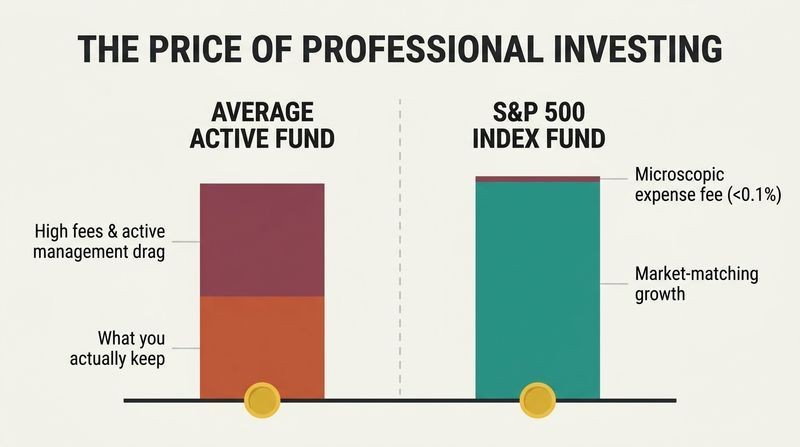
Nobody knows anything. Camillo borrows screenwriter William Goldman's line about Hollywood and applies it to Wall Street. Star telecom analyst Jack Grubman earned $20 million a year, yet following his buy recommendations from 1999 would have cost you 74.5%. The average professionally managed fund returns about 2% less annually than the market itself.
Index funds humiliate the pros. From 2004 to 2008, the S&P 500 beat 72% of large-cap funds, and the small-cap index beat 86% of its active rivals. Even in the 2008 crash, indexes outperformed most active funds, debunking the myth that pros protect wealth in downturns. Harvard's endowment lost $11 billion of $37 billion. A former senator called the mutual fund industry "the world's largest skimming operation."
This is the book's most empirically bulletproof section, consistent with SPIVA scorecards published annually since. The deeper mechanism deserves emphasis: fees compound destructively. A 2% annual expense ratio can erode more than half a portfolio over thirty years, a point the GAO confirmed. What Camillo underplays is that his own high-conviction, concentrated options strategy carries risks that low-fee indexing exists precisely to avoid. The honest synthesis is his own compartmentalization: index the money you cannot lose, gamble only the surplus. Bogle would applaud the first half and wince at the second, which is exactly the productive tension the book leaves unresolved.
Manufacture risk capital by multiplying every saved dollar by 100
Other People's Money, reimagined. On Wall Street, OPM means clients' funds that let insiders gamble with little personal downside. Camillo repurposes the acronym: money you would normally spend but choose to save for its investment potential. He keeps this in a separate "Big Money account," funded only with cash he isn't afraid to lose, walled off from his conservative "lockbox" of retirement savings.
The 100x mental trick. Because he aims to turn every $1 into $100, a $400 saved by delaying an HDTV purchase becomes a psychological $40,000. That reframe motivated him to watch football at friends' houses for a year. Skipping salon visits, brown-bagging lunches, or forcing your employer to add a low-fee index fund all become fuel for the risk account.
This is behavioral finance in disguise. The 100x trick exploits mental accounting, the same cognitive quirk Richard Thaler documented, but turned constructive rather than wasteful. By mentally tagging savings as "already lost" risk capital, Camillo neutralizes loss aversion, which he supports with MRI research showing the amygdala processes financial loss like physical pain. The danger is obvious: framing money as "not really yours" can rationalize reckless bets, the identical psychology that lets casinos thrive. His safeguard, strictly separating the lockbox from the Big Money account, is the load-bearing wall. Without that discipline, the 100x multiplier becomes a permission slip for gambling addiction.
Wear investor's glasses: treat daily life as a research lab
See it, believe it. Camillo's edge traces to his teenage years as a tag-sale "early bird," spotting mispriced male-oriented items (baseball cards, guitars) that female sellers undervalued. He noticed his 7-Eleven had slashed Snapple's shelf space by 75%, bet against the stock, and tripled $300 in days. That instinct became a discipline: constantly ask, could what I'm seeing materially move a company's sales?
Chance favors the prepared mind. He invokes Pasteur and the accidental discoveries of penicillin and Post-it notes to argue serendipity is really trained observation. He missed the Michelle Obama J.Crew surge (stock rose 186% in four months) despite the magazines sitting on his coffee table, while Oprah caught it instantly. Observation is a muscle you build through relentless practice.
The reframing of luck as preparation is well supported. Richard Wiseman's research on "lucky" people found they simply notice more opportunities because they stay relaxed and open. Camillo's gender-and-demographic angle is genuinely original: he argues Wall Street's blind spots cluster around female, youth, and rural products because the industry skews affluent, male, and metropolitan. That is a testable, sociologically grounded thesis about structural bias creating market inefficiency. The weakness is confirmation bias in reverse. For every Snapple or J.Crew he caught, countless shelf changes mean nothing. The book cannot show us the observations that led nowhere, which is where the real base rate lives.
Test observations like a scientist before betting a dollar
Hypothesis, then due diligence. A crowded Coach store during a recession sparked an observation, so Camillo generated five competing hypotheses (great products, luxury shoppers trading down, discounting, normal traffic, or a local fluke). He visited a dozen stores, recruited friends across states, and interviewed clerks. The truth was a sixth hypothesis he hadn't imagined: shoppers were trading down from Coach handbags to cheaper Coach accessories, a wash for revenue. He passed.
Verify it is publicly traded and material. Impact must be big enough to "move the needle," which is easier for small firms. He learned the hard way after researching dance-apparel maker Danskin, only to discover it wasn't public. Always confirm a tradeable company exists before spending a minute on research.
Applying the scientific method to investing sounds obvious yet is rare in practice, where people fall in love with a thesis and hunt only for confirming evidence. Camillo's insistence on entertaining a sixth hypothesis he never predicted models genuine falsificationism in Karl Popper's sense. The clerk interviews are a shrewd, underrated technique: frontline workers hold real-time data that quarterly reports lag by months. The materiality filter is equally important and often forgotten by amateurs who assume any good news moves a stock. His Zatarain's versus Kraft example (Hurricane Katrina crushed the small brand's parent but barely dented the giant) crisply teaches why scale dilutes signal.
Score Wall Street's consensus to confirm you hold an edge
Information arbitrage. Camillo's core coined term means buying at the moment of an information imbalance (you know something Main Street sees but Wall Street doesn't) and selling at information parity (when the crowd catches up). The gap between those two points is your profit window.
The consensus score. To verify Wall Street is still in the dark, he reads six months of analyst and journalist quotes on Yahoo Finance, sorting them into List A (support his hypothesis) and List B (reject it). Dividing A by B yields a score. Below 2 signals an imbalance and a buy; below 0.5 is a strong signal; above 2 means parity, so sell regardless of profit or loss. His iPhone thesis scored under 0.5 amid pundits predicting the phone would flop.
The consensus score is the book's most operational contribution, converting a fuzzy hunch into a crude but usable metric. Its spirit resembles sentiment analysis and contrarian indicators used by quant funds, though Camillo's version is manual and admittedly subjective. The iPhone quote gallery (Steve Ballmer, John Dvorak, and others confidently dismissing it) is a masterclass in how expert consensus can be spectacularly wrong about paradigm shifts. The method's fragility is that quote-sorting invites motivated reasoning: a believer will file ambiguous quotes as rejections to manufacture a low score. The discipline of exiting at parity even at a loss is the crucial, ego-bruising counterweight most investors lack.
Multiply your eyes by mining friends and stock message boards
You have people, too. Camillo argues your family, coworkers, and virtual networks are a distributed research department rivaling Goldman Sachs. A Facebook post from a friend's mom about the kids' show Chuggington led to a stake in tiny British producer Ludorum, whose stock rose nearly 50%. His video-game-obsessed brother tipped him to the underpowered but revolutionary Nintendo Wii, which soared from under $15 to over $70.
Coopetition on message boards. Investor forums like InvestorVillage let strangers pool research. A group of amateurs mining local news, YouTube patient diaries, and blogs pieced together clinical-trial success for biotech Delcath, buying at $2.73 before it hit $12.93. Camillo calls this cooperative competition, invoking James Surowiecki's Wisdom of Crowds: groups often outsmart their smartest member.
The distributed-cognition argument is powerful and increasingly validated. Prediction markets and platforms like Estimize have shown crowds frequently beat lone analysts. The Delcath case is striking because medical-device trials cannot fully blind surgical patients, creating a genuine, legal information leak that motivated amateurs exploited. That is a clever insight into where inefficiency structurally lives. Yet Surowiecki's own conditions for crowd wisdom (independence, diversity, decentralization) are exactly what message boards violate, since posters read and echo each other, breeding groupthink and pump-and-dump manipulation. Camillo acknowledges this with his cast of trolls and bashers. The net lesson: crowds are a sourcing tool, never a substitute for independent verification.
Use in-the-money call options to multiply returns fivefold to tenfold
Leverage, explained simply. A call option is the right, not the obligation, to buy a stock at a set "strike" price before an expiration date. Camillo compares it to paying $5,000 for the right to buy a $50,000 house anytime in six months; if a stadium announcement doubles its value, you sell the contract for a huge multiple without ever owning the house. Your maximum loss is the premium paid.
His measured-risk recipe. He favors "in the money" calls (strike price at or just below current stock price) for five-to-tenfold leverage, choosing expirations six to nine months out to give his thesis time to reach parity. On a 50% stock rise, $3,000 in stock earns $1,500, but the same in options earns roughly $12,000. Put options invert this for betting on declines.
Options are the accelerant that turns a solid method into a fortune or a crater. Camillo is refreshingly honest that leverage cuts both ways: options can expire worthless, wiping out 100% of the stake, whereas stock retains residual value. His preference for in-the-money over cheap out-of-the-money lottery tickets is genuinely prudent within a risky domain, since it demands smaller price moves to profit. The unspoken hazard is time decay (theta), which relentlessly erodes option value even when the thesis is correct but slow. For most readers, the responsible takeaway is that options amplify an edge you already possess. Applied to guesses, they simply accelerate ruin.
Wall Street's biggest blind spot is female, youth, and rural trends
Bias creates opportunity. Because the industry is dominated by affluent, middle-aged, metropolitan men, it consistently misreads products aimed at women, teenagers, and Middle America. Camillo calls Ugg boots, True Religion jeans, and Crocs the "triple crown": $1,000 rotated through those three from 2002 would have become $750,000 by 2007. Wendy's salads, Guitar Hero (Activision nearly tripled), and Salesforce's rise all fit the pattern.
Even giants hide imbalances. Apple, the most analyzed company on earth, repeatedly blindsided analysts because Wall Street's PC-and-BlackBerry culture couldn't grasp the emotional loyalty ordinary consumers felt. What matters isn't company size but whether the trend sits outside Wall Street's comfort zone. The bigger the company, though, the harder it is to move its stock meaningfully.
This is the book's sharpest sociological claim and its most falsifiable. The thesis that demographic homogeneity among decision-makers creates systematic blind spots has since gained empirical support from diversity-and-performance research in behavioral finance. It reframes market inefficiency as a cultural rather than purely informational phenomenon, which is genuinely fresh. The caution is that this edge is self-erasing: as retail investors, TikTok, and alternative-data hedge funds all now scrape consumer trends in real time, the arbitrage window has narrowed dramatically since 2011. The triple-crown returns also reek of hindsight cherry-picking. For every Crocs there were doomed fads. The principle endures; the specific easy money likely does not.
Analysis
Laughing at Wall Street is a hybrid: part investing memoir, part contrarian manifesto, part practical manual. Chris Camillo, a market-research executive with no finance pedigree, argues that the very traits qualifying someone as a Wall Street professional (quantitative training, institutional conformity, demographic homogeneity) actively disqualify them from spotting the consumer trends that move stocks. His thesis, information arbitrage, is elegant: buy when Main Street knows something Wall Street hasn't priced in, sell when the gap closes.
The book's intellectual foundation is stronger than its breezy tone suggests. Its attack on active management rests on solid ground (SPIVA scorecards have vindicated it repeatedly), and its behavioral insights about loss aversion and mental accounting are legitimate. The reframing of luck as trained observation, borrowed from Pasteur, is a durable idea with support from modern psychology.
Yet the book carries the structural flaws of every trading success story. Camillo's audited returns cover one extraordinary window, and we never see the observations that led nowhere, making it impossible to distinguish skill from survivorship. His examples are chosen in hindsight, when the winning trend is obvious. The most honest tension runs through the whole book: he reveres Buffett's patience while rejecting Buffett's analytical rigor, and he preaches low-fee indexing for the lockbox while betting concentrated options positions in the Big Money account. That contradiction is also his wisdom, since he insists the two pools never mix.
What dates the book is its own success. Written in 2011, before smartphones put trend-scraping in everyone's pocket and before alternative-data funds industrialized consumer surveillance, its edge has been partly competed away. The enduring value is not the specific trades but the mindset: markets are beatable at the margins where expert culture is blind, and ordinary life is a legitimate research instrument.
Review Summary
Laughing at Wall Street received mixed reviews, with an average rating of 3.72 out of 5. Many readers found the book insightful and accessible, appreciating Camillo's approach to investing based on everyday observations and trends. Some praised his explanation of information arbitrage and options trading. However, critics felt the content was too basic or lacked specific details. The book was generally recommended for beginners interested in stock market investing, though experienced investors may find it less valuable.
People Also Read




Glossary
Information Arbitrage
Trade the Main Street to Wall Street lagCamillo's core strategy: initiate an investment upon discovering an information imbalance, meaning game-changing consumer information that has emerged on Main Street but is not yet recognized by Wall Street, and exit the investment at the point of information parity, when that information becomes widely accepted by professional investors and is priced into the stock.
Game-Changing Information
News that materially moves company salesAny observation with the potential to materially impact a publicly traded company's sales, revenue, or profits, discovered before Wall Street recognizes it. To qualify for investment, it must be both material enough to move the stock and not yet accepted as fact by professional analysts and financial media.
Investor's Glasses
Seeing daily life as investment cluesA trained mode of perception in which you continually scan ordinary daily experiences (shopping, media, conversations, workplace changes) and ask whether what you are seeing could materially affect a company's sales. Camillo frames it as building an observation muscle, drawing on the scientific method and the idea that chance favors the prepared mind.
OPM / Big Money Account
Risk capital from reframed savingsCamillo repurposes "Other People's Money" to mean cash you would normally spend but instead save for its investment potential. This money funds a separate, risk-tolerant Big Money account used for aggressive information-arbitrage bets, kept strictly walled off from the conservative "lockbox" of long-term retirement and security savings.
100x Money Multiplier
Mentally value savings at hundredfold potentialA motivational reframe in which every dollar saved is mentally valued at its maximum investment potential of $100, based on the goal of turning $1 into $100 through aggressive investing. Seeing $400 in savings as a potential $40,000 makes small frugal trade-offs psychologically worthwhile and uncovers hidden risk capital.
Consensus Score
Ratio measuring Wall Street agreementA rough metric to test whether an information imbalance still exists. You collect six months of analyst and journalist quotes, sort them into List A (supporting your hypothesis) and List B (rejecting it), then divide A by B. A score below 2 signals an imbalance and buy opportunity; above 2 signals parity and a sell signal.
Coopetition
Cooperating with rival investors onlineCooperative competition among self-directed investors who share research on message boards even though they compete to buy the same shares. Benefits include faster information gathering, access to specialized expertise, and challenges that sharpen your own due diligence, drawing on James Surowiecki's Wisdom of Crowds concept.
Lockbox
Conservative walled-off security savingsCamillo's term (borrowed from Al Gore) for a risk-averse pool of money dedicated to long-term financial security, typically low-fee index funds, bonds, or cash. It must never share or compete for funds with the aggressive Big Money account, allowing risk-tolerant investing without endangering family security.
FAQ
What's "Laughing at Wall Street" about?
- Author's Journey: "Laughing at Wall Street" by Chris Camillo is about how the author, an amateur investor, managed to outperform professional investors using unconventional methods.
- Unique Approach: Camillo shares his strategy of using everyday observations, such as trends seen in tabloids, shopping malls, and social media, to make successful investment decisions.
- Investment Success: The book details how Camillo grew his investment portfolio from $83,752 to $2,388,311 over a few years, emphasizing that anyone can achieve similar success without traditional financial expertise.
- Empowerment: It aims to empower readers to become self-directed investors by leveraging their unique insights and observations from daily life.
Why should I read "Laughing at Wall Street"?
- Practical Insights: The book offers practical insights into investing that don't require a financial background, making it accessible to a wide audience.
- Proven Success: Camillo's personal success story serves as a testament to the effectiveness of his methods, providing a real-world example of how unconventional strategies can yield significant returns.
- Empowerment: It encourages readers to trust their instincts and observations, empowering them to take control of their financial futures.
- Engaging Narrative: The book is written in an engaging and relatable style, making complex investment concepts easy to understand and apply.
What are the key takeaways of "Laughing at Wall Street"?
- Observation is Key: Camillo emphasizes the importance of observing everyday trends and behaviors as a basis for investment decisions.
- Information Arbitrage: The concept of information arbitrage is central, where investors capitalize on information imbalances before they become widely known.
- Leverage Networks: The book highlights the value of leveraging personal and social networks to gather insights and validate investment hypotheses.
- Risk and Reward: It encourages taking calculated risks with money you can afford to lose, using tools like stock options to maximize potential returns.
How does Chris Camillo suggest using everyday observations for investing?
- Investor's Glasses: Camillo advises wearing "investor's glasses" to view the world with heightened awareness, spotting trends and opportunities others might miss.
- Real-World Examples: He provides examples like noticing long lines at a store or a new product gaining popularity, which can indicate potential investment opportunities.
- Hypothesis Testing: Once an observation is made, he suggests forming hypotheses and conducting due diligence to determine if it's a viable investment opportunity.
- Information Imbalance: The goal is to identify information imbalances where you know something that Wall Street doesn't yet recognize.
What is "information arbitrage" according to Chris Camillo?
- Definition: Information arbitrage involves exploiting the time gap between when information is first observed and when it becomes widely accepted by the market.
- Investment Strategy: Camillo uses this strategy to buy stocks based on early observations of trends before they are reflected in stock prices.
- Market Advantage: It provides a market advantage by allowing investors to act on insights before they become common knowledge.
- Exit Strategy: The strategy includes selling investments once the information reaches parity and is widely recognized by the market.
How does Chris Camillo recommend leveraging social networks for investing?
- Virtual Network: Camillo suggests using social networks like Facebook and investor message boards to expand your reach and gather diverse insights.
- Crowdsourcing Information: By engaging with a wide network, investors can crowdsource information and validate their observations with others.
- Real-Time Feedback: Social networks provide real-time feedback and can help identify emerging trends quickly.
- Community Support: Engaging with online communities can also provide support and additional perspectives, enhancing the decision-making process.
What role do stock options play in Chris Camillo's investment strategy?
- Leverage Tool: Stock options are used as a tool to leverage investments, allowing for greater potential returns with a smaller initial investment.
- Risk Management: They provide a way to manage risk, as the maximum loss is limited to the cost of the option.
- Super-Sizing Returns: Options can "super-size" returns by amplifying the impact of stock price movements on the investment.
- Strategic Use: Camillo advises using options strategically, focusing on "in the money" options to balance risk and reward.
What are some of the best quotes from "Laughing at Wall Street" and what do they mean?
- "People may doubt what you say, but they will believe what you do." This quote emphasizes the importance of actions over words, particularly in investing where results speak louder than predictions.
- "Learn to take big risks. Learn to survive big failures. But most importantly, learn how to win big in life—so you can give back even bigger." It highlights the necessity of risk-taking and resilience in achieving significant success.
- "The very best time to buy a company’s stock is when you think you know something about that company that others don’t." This encapsulates the essence of information arbitrage and the advantage of acting on unique insights.
- "Chance favors the prepared mind." This suggests that being observant and prepared increases the likelihood of recognizing and capitalizing on opportunities.
How does Chris Camillo address the fear of investing?
- Risk Tolerance: Camillo acknowledges the fear of losing money but encourages viewing investments as opportunities rather than risks.
- OPM Concept: He introduces the concept of using Other People’s Money (OPM) to fund investments, reducing personal financial risk.
- Calculated Risks: The book advocates for taking calculated risks with money you can afford to lose, emphasizing the potential for high rewards.
- Empowerment Through Knowledge: By equipping readers with knowledge and strategies, Camillo aims to empower them to overcome fear and take control of their financial futures.
What is the significance of the "100× money multiplier" in the book?
- Concept Explanation: The 100× money multiplier is a mental tool to motivate saving and investing by viewing every dollar saved as having the potential to grow 100 times through smart investments.
- Behavioral Change: It encourages behavioral change by making the potential future value of money more tangible and motivating.
- Investment Funding: This concept helps identify and accumulate funds for the Big Money account, which is used for high-risk, high-reward investments.
- Mindset Shift: It shifts the mindset from seeing small savings as insignificant to viewing them as seeds for substantial future wealth.
How does Chris Camillo suggest dealing with investment failures?
- Learning Opportunity: Camillo views failures as learning opportunities, essential for developing investment acumen and resilience.
- Risk Management: He emphasizes the importance of managing risk by investing only what you can afford to lose, minimizing the impact of failures.
- Adaptability: The book encourages adaptability and learning from mistakes to refine strategies and improve future investment decisions.
- Focus on Success: By focusing on the potential for success and the lessons learned from failures, investors can maintain motivation and continue pursuing their financial goals.
What are some real-life success stories shared in "Laughing at Wall Street"?
- Chris Stone's Story: Stone invested in Getty Images after observing its growth in the stock photography market, leading to significant returns.
- Laurent Lucas's Insight: Lucas invested in Intuitive Surgical after recognizing the potential of computerized surgery, resulting in a $3 million return.
- Charles Edward's Disney Investment: Edward invested in Disney based on its ability to make people happy, yielding a thirtyfold return over twenty years.
- DNDN Pirates: A group of investors, the DNDN Pirates, successfully invested in Dendreon by leveraging online communities and independent research, achieving substantial gains.
Download PDF
Download EPUB
.epub digital book format is ideal for reading ebooks on phones, tablets, and e-readers.








































