Key Takeaways
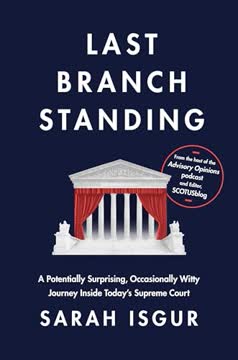
1. The Supreme Court: Last Branch Standing, Defined by Two Axes
The Supreme Court isn’t the same as Congress. Judicial philosophy isn’t the same as partisan politics.
A unique institution. The Supreme Court, unlike Congress or the Presidency, is the "last branch standing" in a broken political system, often dragged into partisan squabbles. Its core function, as Justice Breyer's "snails of justice" analogy illustrates, is to interpret ambiguous laws, balancing flexible standards with rigid rules. This role is increasingly critical as trust in other institutions declines.
Beyond left and right. The author proposes a "3-3-3 theory" to understand the Court, moving beyond a simplistic left-right (x-axis) political spectrum. This theory posits three groups of three justices, whose decisions are also influenced by a "y-axis" of judicial philosophy, which measures a justice's commitment to institutional stability, precedent, and the practical consequences of their rulings. This y-axis explains why justices with similar ideological leanings might diverge on key cases.
Unpredictable outcomes. Despite common perceptions, the Court's decisions are often not strictly ideological. For instance, 42% of cases in the 2024-25 term were unanimous, and many 6-3 decisions saw conservative justices dissenting. The Court's median justices (Roberts, Kavanaugh, Barrett) frequently align with liberals, demonstrating that partisan labels alone fail to predict outcomes.
2. The Court's Human Element: Clerks and Justices as People
A judicial appointment is like an arranged marriage with no option of divorce: it locks you into a long-term relationship with people someone else picked.
The "Elect" and their world. Supreme Court clerks, known as "the Elect," are highly accomplished law graduates who endure brutal work schedules for a year, earning a prestigious credential and significant post-clerkship bonuses. Their selection process is rigorous, often involving multiple clerkships and interviews that test not just intellect but also personality, as justices seek individuals who will fit into their "clerk family."
Life at One First Street. The Supreme Court building, a majestic marble palace, serves as both a workplace and a symbol of justice. Clerks and justices navigate its unique environment, from the highest basketball court in the land to shared dining rituals where work talk is forbidden. These interactions foster a collegial atmosphere, even amidst deep ideological disagreements, as justices learn to compartmentalize their professional battles from their personal relationships.
Beyond the robes. Justices are real people with personal lives, hobbies, and quirks, often referred to by their initials by insiders. They face unique challenges, including intense public scrutiny, security threats, and the difficulty of maintaining a normal social life. Despite their elevated positions, they strive to connect with each other and the public, emphasizing empathy and the importance of understanding diverse perspectives.
3. The Deciders: Institutionalists at the Court's Center
The Court revolves around the fifth vote.
The Chief's influence. Chief Justice John Roberts, often seen as the "ringmaster," is arguably the most powerful justice, consistently in the majority and strategically assigning opinions. He embodies the institutionalist ideal, prioritizing the Court's credibility and functioning as a unified body, even if it means alienating his conservative allies, as seen in his Obamacare decision. His goal is to protect the Court from political blowback and maintain its legitimacy.
Kavanaugh's pivotal role. Justice Brett Kavanaugh holds the pivotal "fifth vote" more often than any other modern justice, making him the Court's de facto center. Despite his conservative ideology, his institutionalist leanings lead him to seek common ground and uphold precedent, even when he disagrees with the outcome. His approach emphasizes listening to all perspectives and ensuring the losing party respects the process, reflecting his "clear eyes, full hearts" philosophy.
Barrett's measured conservatism. Justice Amy Coney Barrett, a conservative textualist, also demonstrates strong institutionalist tendencies, often refusing to go as far as her more hardline conservative colleagues. She prioritizes clarity in legal reasoning and the long-term stability of the law over immediate ideological victories. Her separate concurrences in high-profile cases, like those involving Donald Trump, reflect a cautious approach to legal revolutions, even for noble ends.
4. The Honey Badgers: Principled Contrarians on the Right
We are not supposed to do what is popular. We’re supposed to do what is right.
The grumpy trio. Justices Clarence Thomas, Samuel Alito, and Neil Gorsuch form a distinct bloc, characterized by their contrarianism and unwavering commitment to their judicial philosophies, often at odds with the Chief Justice's institutionalist vision. They are less concerned with public opinion or institutional harmony, prioritizing what they believe is the "right" legal answer, even if it means frequent dissents.
Thomas's unique path. Justice Clarence Thomas, the "old bull," rose from extreme poverty and segregation to become an intellectual leader of the conservative legal movement. His judicial philosophy, "text, history, and tradition," is a rigorous form of originalism that seeks to ground legal interpretation in the Constitution's original public meaning. Despite ethics controversies, his fiercely loyal clerk family and consistent jurisprudence underscore his independent and unyielding approach.
Alito's quiet conviction. Justice Samuel Alito, the "introvert," is a deeply sentimental and reserved individual with a strong moral compass, often dissenting in First Amendment cases where he believes speech inflicts profound harm. He describes himself as a "practical originalist," willing to accept prior precedents for stability while still believing them wrong. His chambers, filled with personal mementos, reflect a man who values quiet conviction over public fanfare.
Gorsuch's libertarian streak. Justice Neil Gorsuch, the "vigilante," is known for his "YOLO" approach to judging, prioritizing what the law says regardless of consequences. He is a staunch opponent of government overreach, often siding with liberals in criminal justice and tribal law cases. His majority opinion in Bostock v. Clayton County, interpreting "sex" to include gender identity, demonstrated his commitment to textualism even when it led to "liberal" outcomes, much to the chagrin of some conservatives.
5. The Lonely Liberals: Navigating a Conservative Court
There are ways to take the edge off the disagreement, like narrowing an opinion, deciding to leave a question that’s not before you for another case….
Strategies for influence. The three liberal justices—Sonia Sotomayor, Elena Kagan, and Ketanji Brown Jackson—often find themselves in dissent on a conservative-leaning Court. Their strategies for influence include narrowing opinions, leaving questions for future cases, and focusing on collegiality to maintain working relationships despite ideological divides. They understand that even in dissent, they can "appeal to the future" and shape legal discourse.
Sotomayor: The Resistance. Justice Sonia Sotomayor, "the resistance," is a passionate advocate for racial justice, whose personal experiences with affirmative action and discrimination deeply inform her jurisprudence. She is the Court's chief dissenter, often writing for future generations and emphasizing the power of the people to effect change. Her extensive public speaking, particularly to students, reflects her commitment to civic engagement and inspiring future leaders.
Kagan: The Strategist. Justice Elena Kagan, "the strategist," is the Court's most politically savvy member, adept at navigating ideological divides and building consensus. She is a demanding but respected boss, known for her sharp intellect, accessible writing, and biting humor. Kagan views the Court as an institution that speaks best with one voice, often preferring to join majority opinions or write fewer separate concurrences, even when she disagrees with aspects of the reasoning.
Jackson: The Insurgent. Justice Ketanji Brown Jackson, "the insurgent," is the most junior justice but has quickly made her voice heard through numerous separate opinions and active participation in oral arguments. She emphasizes that "other cases presenting different allegations and different records may lead to different conclusions," highlighting the fact-specific nature of legal outcomes. Her focus on hard work and a "capacity for hard work and a passion for the power of theatrical performance" reflects a determination to make her mark on the Court.
6. Judicial Power: Forged by Marshall, Tested by History
It is emphatically the province and duty of the judicial department to say what the law is.
Marshall's foundational role. The Supreme Court's power was not preordained but largely forged by Chief Justice John Marshall. In Marbury v. Madison (1803), Marshall brilliantly asserted the Court's power of judicial review—the authority to strike down acts of Congress that violate the Constitution—despite a clear conflict of interest. This decision established the judiciary as an independent and powerful branch of government.
The threat of impeachment. The failed impeachment of Justice Samuel Chase by President Thomas Jefferson's party was equally crucial in securing judicial independence. Despite Chase's blatant partisanship, the Senate's refusal to remove him for purely political reasons set a vital precedent: judges could not be removed simply for unpopular rulings, safeguarding their life tenure and ability to protect minority rights against majority rule.
Taney vs. Harlan. The Court's history is marked by both profound errors and prophetic dissents. Chief Justice Roger Taney's Dred Scott v. Sandford (1857) decision, which denied citizenship to Black people and invalidated the Missouri Compromise, is considered the worst in Court history, contributing to the Civil War. In stark contrast, Justice John Marshall Harlan's lone dissent in Plessy v. Ferguson (1896), declaring the Constitution "color-blind," became a beacon for future civil rights, demonstrating how one voice can speak for posterity.
7. The Evolution of Judicial Philosophy: From Living Constitution to Originalism
The Constitution that I interpret and apply is not living but dead, or as I prefer to call it, enduring.
Living constitutionalism's rise. In the mid-20th century, "living constitutionalism," championed by justices like Earl Warren and William Brennan, became dominant. This philosophy held that the Constitution's meaning evolves with society's "evolving standards of decency," allowing judges to interpret its broad principles to address modern problems. This approach led to significant expansions of rights but also drew criticism for judicial activism and substituting judges' policy preferences for legislative action.
The Lochner era and its backlash. The Lochner v. New York (1905) era saw the Court invalidate economic regulations based on an unenumerated "right to contract" under substantive due process. This period, where judges actively struck down laws they deemed unwise, became a cautionary tale for judicial overreach. The backlash, particularly during the New Deal, led to a shift towards judicial restraint in economic matters, giving Congress broad power under the Commerce Clause.
Originalism's ascent. The Federalist Society, founded by law students in 1982, spearheaded the conservative legal movement, advocating for originalism—the idea that the Constitution's meaning is fixed at the time of its adoption. Justice Antonin Scalia popularized "original public meaning" originalism (Originalism 2.0), focusing on how the text was understood by the public. This evolved into "text, history, and tradition" originalism (Originalism 3.0), which seeks historical analogues to interpret ambiguous constitutional provisions, as seen in New York State Rifle & Pistol Association v. Bruen (2022).
8. Congress's Retreat Empowers the Executive and Strains the Judiciary
The accumulation of powers, legislative, executive, and judiciary, in the same hands…may justly be pronounced the very definition of tyranny.
Congress's decline. Over the past decades, Congress has become increasingly dysfunctional, legislating less due to factors like:
- Consolidation of power in leadership
- Campaign finance reforms that entrenched incumbents
- Gerrymandering leading to polarized primaries
- Negative political polarization that demonizes compromise
This legislative vacuum has created a void that other branches have eagerly filled.
Presidential overreach. Presidents, armed with "a pen and a phone," have increasingly resorted to executive orders and administrative agency actions to implement their policy agendas, bypassing Congress. While this offers quick solutions, it leads to unstable policies that are easily reversed by subsequent administrations and frequently challenged in court. The bump stock ban and student loan forgiveness are prime examples of executive actions that the Court ultimately struck down, not on policy grounds, but because the President lacked the authority.
The Major Questions Doctrine. To rein in executive agencies, the Court has increasingly employed the "major questions doctrine." This canon of interpretation requires Congress to "speak clearly" when delegating significant economic or political power to agencies. This doctrine, along with the overturning of Chevron deference, shifts power back to the courts to interpret statutes and forces Congress to be more explicit in its legislative grants of authority, aiming to rebalance the separation of powers.
9. Confirmation Wars and the End of the Judicial Filibuster
Robert Bork’s America is a land in which women would be forced into back-alley abortions, blacks would sit at segregated lunch counters, rogue police could break down citizens’ doors in midnight raids...
The Borking of nominations. The 1987 nomination of Robert Bork to the Supreme Court marked a turning point, transforming judicial confirmations into intensely partisan battles. Senator Ted Kennedy's fiery speech against Bork, explicitly attacking his judicial philosophy, set the template for future confirmation wars. This shift meant nominees were no longer judged solely on qualifications but on their perceived ideological leanings and potential impact on cultural issues like abortion.
Escalation and the "Nuclear Option." The defeat of Bork, followed by the contentious Clarence Thomas hearings, fueled a tit-for-tat escalation. Democrats began using the filibuster to block lower court nominees, leading Senate Majority Leader Harry Reid to invoke the "nuclear option" in 2013, eliminating the filibuster for all judicial nominations except the Supreme Court. Republicans, under Mitch McConnell, then extended this to Supreme Court nominees in 2017, ensuring Neil Gorsuch's confirmation and paving the way for Brett Kavanaugh and Amy Coney Barrett.
Consequences for the judiciary. The end of the judicial filibuster has profound implications:
- Partisan purity: Nominees no longer need bipartisan support, incentivizing presidents to pick ideologically pure candidates.
- "Roberts Effect" reversed: The previous incentive for nominees to keep their views private has vanished; now, outspokenness can be an asset.
- "Maverick" judges: Circuit judges are increasingly writing separate opinions that challenge their ideological peers, potentially auditioning for higher courts.
- Forum shopping: Litigants strategically file lawsuits in districts with judges from their preferred party, leading to a proliferation of universal injunctions that halt national policies.
10. The Shrinking Docket and the Rise of the "Shadow Docket"
Strategically, a justice should vote to take a case when he believes that his view of the law will prevail.
Fewer cases, more impact. The Supreme Court's merits docket has dramatically shrunk since the 1980s, with the Court now hearing only about 60 cases annually, down from 150. This decline is attributed to factors like the 1988 Supreme Court Case Selections Act, the demise of the "courtesy fourth" vote, and a "Great Professionalization Shift" where justices, often from elite backgrounds, view their role narrowly as resolving only the most significant legal questions with "perfect vehicles."
The "Shadow Docket" emerges. In contrast to the shrinking merits docket, the "interim" or "preliminary" docket (often called the "shadow docket") has exploded. This docket handles emergency applications for injunctions or stays, often deciding the fate of major government policies without full briefing, oral arguments, or detailed opinions. This lack of transparency and expedited decision-making, particularly in politically charged cases, raises concerns about the Court's legitimacy and institutional strain.
Institutional strain. The proliferation of separate opinions (concurrences and dissents) further fragments the Court's voice, making it harder for lower courts to discern clear legal principles. The interim docket exacerbates this, forcing justices to make quick decisions on complex issues with limited information, often revealing ideological divides. This constant pressure and lack of consensus contribute to the perception of a fractured institution struggling to maintain its unity and authority.
11. Precedent: The Unbearable Lightness of Stare Decisis
Respecting stare decisis means sticking to some wrong decisions.
The weight of precedent. Stare decisis, Latin for "to stand by things decided," is a cornerstone of the rule of law, providing stability and predictability. However, no justice believes in absolute stare decisis; the debate centers on when to overturn a precedent. Factors considered include the quality of reasoning, workability, consistency with other decisions, societal changes, and reliance interests (how many people have structured their lives around the precedent).
Overturning Roe. Dobbs v. Jackson Women's Health Organization (2022) famously overturned Roe v. Wade (1973), a decision that had been criticized even by its supporters (like Ruth Bader Ginsburg) for its shaky legal foundation. The Dobbs majority argued that Roe and Planned Parenthood v. Casey (1992) were "egregiously wrong" and lacked constitutional grounding, returning the issue of abortion to the states. This decision highlighted the deep divisions over judicial philosophy and the role of the Court in defining fundamental rights.
The "Loving Problem" and its implications. A key challenge for originalism is the "Loving Problem": how to reconcile a strict historical interpretation with morally abhorrent precedents like Pace v. Alabama (1883), which upheld anti-miscegenation laws. While originalists would condemn such laws as morally wrong, a strict application of "text, history, and tradition" might struggle to find a constitutional basis for overturning them, raising questions about the limits of judicial philosophy and the Court's role in correcting historical injustices.
12. Preserving the Court: Reforms for a Fractured Institution
Your complaint isn’t with the Court; it’s with our politics.
Threats to legitimacy. The Supreme Court faces unprecedented threats to its legitimacy, stemming from partisan attacks, presidential defiance, and ethics scandals. Calls to "ignore the Court," "pack the Court," or impose "term limits" reflect a growing distrust in its impartiality. The proliferation of physical threats and surreptitious recordings further isolates justices, potentially deterring qualified individuals from seeking judicial office.
Proposed reforms. The author suggests several reforms to strengthen the Court's institutional integrity and public trust:
- Confirmation reform: A "two-track" system where nominees either secure a 60-vote supermajority or a simple majority in two successive Congresses, empowering voters and reducing partisan obstruction.
- Ethics enforcement: An independent ethics board of retired federal judges to review complaints and interpret the Court's ethics code, providing accountability without compromising judicial independence.
- Increased caseload: Encouraging the Court to hear more cases (e.g., lowering the "Rule of Four" to three) to reduce the perception that only "big ticket" ideological cases are heard.
- Transparency and engagement: Allowing credentialed reporters early access to opinions to ensure accurate coverage, banning cameras in the courtroom to preserve decorum, and encouraging justices to engage more with non-legal audiences.
- Procedural fixes: Ending forum shopping for universal injunctions by randomly assigning judges for nationwide relief, and implementing a system to break tie votes caused by recusals.
The core message. Ultimately, the Court's challenges reflect deeper problems in American politics. The author argues that the solution lies not in remaking the Court to align with partisan preferences, but in revitalizing Congress and civic engagement. The Court's role is to referee, not to legislate, and citizens must demand accountability from their elected representatives to address societal issues, rather than relying solely on the judiciary.
People Also Read