

Key Takeaways
Every justice debate secretly argues about welfare, freedom, or virtue
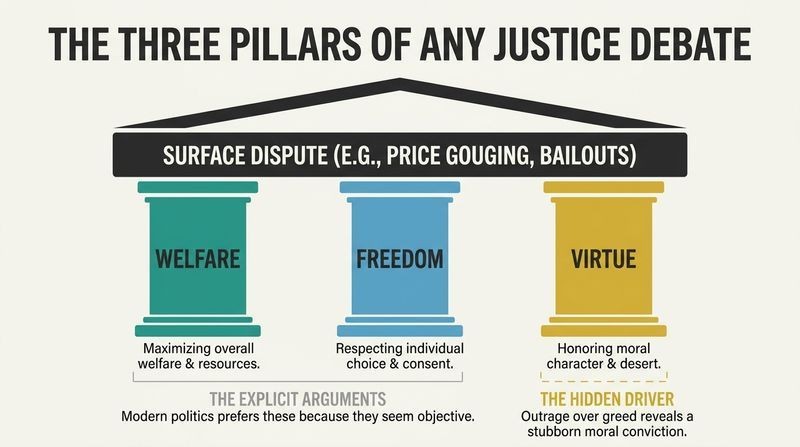
Three moral languages structure all disputes. When Hurricane Charley battered Florida in 2004 and merchants sold two-dollar ice bags for ten dollars, three arguments erupted. One asked what maximizes society's overall welfare (higher prices attract more supply but crush the poor). A second asked whether the exchanges were truly free (buyers fleeing a storm are coerced, not consenting). A third asked what virtue a good society honors (greed preying on suffering deserves punishment, not reward).
Sandel shows these three lenses recur everywhere: bailout outrage, Purple Hearts for psychological wounds, surrogate motherhood. Most modern political talk sticks to welfare and freedom because they seem nonjudgmental. But the visceral outrage at price gougers reveals a stubborn conviction that justice involves desert, not just choice or utility.
What's striking is how Sandel weaponizes ordinary intuitions against tidy theory. The framework echoes Isaiah Berlin's insight that societies juggle incommensurable values, but Sandel presses further: he argues neutrality is a mirage. Behavioral economics complicates the picture. Research on price gouging shows consumers punish sellers who raise prices during emergencies even when it is economically rational, suggesting our virtue intuitions are deep and evolved, not merely cultural artifacts. The weakness worth flagging: labeling every dispute as reducible to three categories risks tidiness of its own. Some conflicts blend all three simultaneously, and Sandel's tripartite map, while clarifying, can flatten genuinely novel moral situations.
Numbers alone cannot decide when killing one saves five
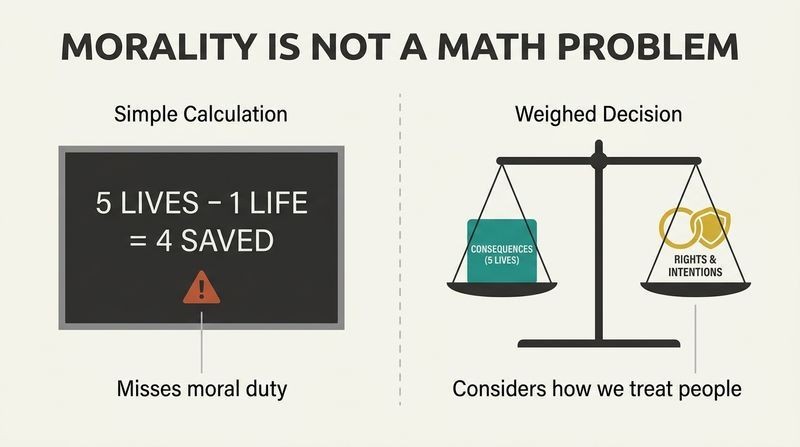
The trolley problem exposes our moral inconsistency. A runaway trolley will kill five workers unless you divert it onto a side track, killing one. Most people say divert. Now you stand on a bridge beside a heavy stranger; pushing him onto the tracks would stop the trolley and save the five. Almost no one will push. Yet both cases trade one life for five.
The puzzle forces us to reason. Maybe intention matters (you foresee but do not intend the side-track death). Maybe using someone as a physical instrument is the line. Sandel pairs this with the real 2005 case of Navy SEAL Marcus Luttrell, who spared unarmed Afghan goatherds only to see nineteen comrades die. The stories reveal that moral principles collide and must be weighed, not merely calculated.
The trolley problem, invented by Philippa Foot and refined by Judith Jarvis Thomson, has become a laboratory for moral psychology. Joshua Greene's fMRI studies suggest the push case activates emotional brain regions while the switch case engages cool cost-benefit circuits, hinting our two responses come from different neural systems rather than one coherent principle. This vindicates Sandel's point that intuition resists pure calculation. Critics counter that trolley scenarios are so artificial they distort real ethics, where uncertainty dominates. The Luttrell case is the corrective: unlike the sanitized hypothetical, actual dilemmas carry fog, consequences, and lifelong regret that no thought experiment can fully capture.
Maximizing total happiness can justify atrocities against the innocent
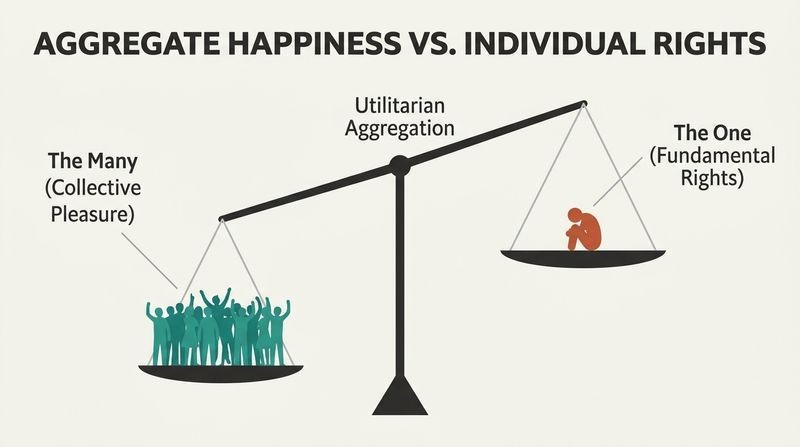
Utilitarianism's fatal flaw is aggregation. Jeremy Bentham argued the right act maximizes utility, the balance of pleasure over pain, counting everyone equally. It is intuitive and powers modern cost-benefit analysis. But two objections wound it. First, it ignores individual rights: if enough Romans enjoy watching Christians mauled by lions, the math might sanction the spectacle. Ursula Le Guin's story imagines a city whose entire happiness depends on one child's secret torture; utilitarianism struggles to condemn it.
Second, it forces everything onto one scale of value. Ford once calculated that fixing exploding Pinto gas tanks (eleven dollars per car) cost more than the projected deaths at 200,000 dollars per life. Philip Morris told the Czech government that smokers' early deaths saved money on pensions. The moral revulsion these triggered shows some goods resist a common currency.
Bentham's radicalism is underappreciated. He dismissed natural rights as nonsense upon stilts and built a genuine science of legislation, influencing everything from modern welfare economics to effective altruism. The Pinto and Philip Morris cases are devastating precisely because they follow the logic honestly. Yet defenders like Peter Singer argue that sophisticated utilitarianism already incorporates rights as rules that maximize welfare long-term. The deeper critique, developed by Bernard Williams, is that utilitarianism alienates us from our own integrity by demanding we treat our deepest commitments as mere inputs. Sandel's Le Guin example remains the sharpest intuition pump against pure aggregation ever deployed in popular philosophy.
Higher pleasures prove worth cannot reduce to intensity of desire
Mill tried to rescue utilitarianism and accidentally abandoned it. John Stuart Mill, distressed that Bentham ranked the child's game push-pin equal to poetry, insisted some pleasures are qualitatively higher. His test: whatever people who have experienced both prefer is the better pleasure. He declared it better to be Socrates dissatisfied than a fool satisfied.
But the test backfires. Sandel shows students an episode of The Simpsons, a Shakespeare soliloquy, and a wrestling brawl. They enjoy The Simpsons most yet judge Shakespeare highest. If preference decides quality, Shakespeare should lose. Mill escapes only by smuggling in a standard independent of desire, an ideal of human dignity and developed faculties. In doing so he leaves Bentham's ground entirely, conceding that character and nobility matter beyond the sum of felt pleasures.
Mill's move is philosophically honest and self-undermining at once, which is what makes it fascinating. He sensed that a doctrine treating all preferences as equal cannot explain why we educate children toward Bach rather than jingles. Modern research on hedonic adaptation and the distinction between pleasure and meaning (Martin Seligman, Daniel Kahneman) supports Mill's instinct: people report that meaningful but difficult pursuits yield deeper life satisfaction than easy pleasures. The tension Sandel exposes anticipates capability theorists like Amartya Sen and Martha Nussbaum, who argue well-being must be measured by what humans can be and do, not by subjective satisfaction alone. Mill was reaching toward that richer account.
If you own yourself, taxing your income resembles forced labor
Libertarianism follows self-ownership to unsettling ends. Libertarians like Robert Nozick argue each person owns himself, and therefore owns his labor and its fruits. Taxing Michael Jordan's earnings to fund welfare, on this view, claims part of his labor, making the state a part-owner of him, a step on a continuum from taxation to forced labor to slavery. A just distribution is any that arises from legitimate holdings and voluntary exchange, however unequal the result.
Sandel presses the logic to its limits. If we truly own ourselves, we should be free to sell a kidney to an eccentric collector, sell both kidneys even if it kills us, hire ourselves out for consensual cannibalism (the 2001 Rotenburg case), or sell ourselves into slavery. Most people recoil, revealing that even self-ownership enthusiasts do not embrace it consistently.
Nozick's Anarchy, State, and Utopia remains the most rigorous libertarian text, and the Wilt Chamberlain argument (updated to Jordan) is genuinely hard to refute on its own terms: liberty upsets patterns, so maintaining any distribution requires continuous coercive intervention. The force of Sandel's rebuttal is showing how few will follow self-ownership into consensual cannibalism or organ markets. This suggests our commitment to self-ownership is selective and instrumental. Interestingly, the same self-ownership premise grounds progressive causes: abortion rights, assisted suicide, and drug legalization all invoke my body, my choice. Sandel's real contribution is exposing that this principle cuts across the left-right spectrum unpredictably.
Market choices are only free when background conditions are fair
Consent can be coerced by necessity. The Civil War let draftees hire substitutes or pay a 300 dollar commutation fee; Andrew Carnegie and J.P. Morgan bought their way out. Students call this class discrimination. But Sandel asks: how is today's volunteer army different? Both let the comfortable pay others to fight. The data bites: enlisted recruits come disproportionately from middle and lower-income neighborhoods, while only 9 of 1,108 Princeton graduates in the class of 2006 enlisted, versus 450 of 750 in 1956.
A homeless person sleeping under a bridge chose it in some sense, but economic desperation is not freedom. The Baby M surrogacy case and India's outsourced pregnancies raise the same doubt. When a maid earning 25 dollars a month carries a stranger's baby for 4,500 dollars, calling that a free bargain ignores the coercion of poverty.
This is the fairness camp's central move against libertarianism, and it draws blood. The insight predates Sandel: Marx called it the dull compulsion of economic relations, and modern labor economists study reservation wages precisely because desperation shrinks bargaining power. Empirical work on military recruitment confirms enlistment spikes when local job markets collapse, supporting the coercion thesis. The challenge is where to draw the line. Nearly all choices occur under some constraint, so if imperfect background conditions void consent, almost no market exchange qualifies as free. Sandel wisely frames this as a family quarrel within freedom-based theories rather than a knockout, pointing toward Rawls for the resolution.
Some goods get corrupted when you price and sell them
Markets can degrade what they touch. Beyond fairness, Sandel raises a distinct objection: certain goods are damaged when treated as commodities. Philosopher Elizabeth Anderson argues commercial surrogacy degrades both children (treated as products) and women's labor (by requiring mothers to suppress the bond pregnancy naturally cultivates). The right way to value a good depends on its purpose. You honor a Stradivarius by playing it, not displaying it; you cherish a child, you do not manufacture one.
At Oxford's St. Anne's College, traditionalists opposing overnight male guests translated their moral objection into utilitarian terms about hot water and mattress wear. The compromise (guests paying fifty pence a night) produced the headline naming the students' price. The language of virtue did not survive translation into the language of money, showing some values cannot be captured on a single scale.
This anticipates Sandel's later work, What Money Can't Buy, and connects to Michael Walzer's spheres of justice, which argues different goods should follow different distributive logics, with money illegitimately invading spheres like justice, citizenship, and love. Empirical support comes from behavioral economics: the famous Israeli daycare study found fining late parents increased lateness, because the fine converted a moral obligation into a purchasable service. Titmuss showed paying for blood donation reduced supply and quality. The nuance critics raise: the corruption argument can smuggle in paternalism, letting elites decide which transactions are beneath people who might rationally prefer the money. Distinguishing genuine degradation from mere squeamishness remains genuinely hard.
Only acts done from duty, not inclination, have moral worth
Kant locates morality in motive, not results. For Immanuel Kant, an action has moral worth only when done because it is right, from duty, not from self-interest or even kindly feeling. A shopkeeper who deals honestly only to protect his reputation acts correctly but without moral worth. A spelling-bee contestant who confesses a misspelled word purely because it is right earns esteem; if he did it only to avoid feeling like a slime, the worth evaporates.
Kant redefines freedom as autonomy: acting from a law you give yourself through reason, not obeying appetites you never chose. Choosing ice cream flavors is not freedom, it is obeying desires. The supreme moral principle, the categorical imperative, commands unconditionally: act only on maxims you could will as universal law, and treat humanity always as an end, never merely as a means.
Kant's austerity feels alien, yet it undergirds modern human rights doctrine: dignity attaches to persons unconditionally, regardless of usefulness. The demand that we never treat people merely as means remains the sharpest moral test in bioethics, war, and labor debates. Schiller mocked Kant by noting that helping friends gladly seems to lack virtue on his account, and the objection stings. But Sandel's reading softens it: pleasure in doing right does not disqualify an act, provided duty is the operative reason. Contemporary moral psychology (Jonathan Haidt) challenges Kant's rationalism, showing moral judgments often precede reasoning. Still, Kant's insistence that persons are priceless, not price-able, endures as civilization's moral backbone.
Choose principles behind a veil hiding your place in society
Rawls makes fairness a thought experiment. Since no real social contract exists and actual agreements reflect unequal bargaining power, John Rawls asks what principles we would choose behind a veil of ignorance, not knowing our class, race, talents, or religion. Stripped of knowledge that could bias us, we would reject utilitarianism (nobody risks being the persecuted minority) and choose two principles: equal basic liberties for all, and the difference principle, permitting inequalities only if they benefit the least advantaged.
The deeper argument is moral arbitrariness. You did not earn your talents, your supportive family, or the luck of living in a society that prizes your particular gifts. Even the capacity for hard work depends on fortunate upbringing. So the naturally gifted may profit from their gifts only on terms that also lift those who drew shorter straws.
A Theory of Justice revived political philosophy in 1971 and remains its dominant text. The veil of ignorance operationalizes impartiality brilliantly, echoing the golden rule and Kant's universalizability while yielding concrete policy. The moral arbitrariness argument is Rawls's most radical and contested claim. Robert Nozick asked whether treating talents as common assets does not itself fail to respect persons as separate individuals. Conservatives object that it dissolves personal responsibility. Yet Rawls does not advocate leveling; his difference principle tolerates inequality that grows the pie for the worst-off, a logic embraced even by some market advocates. Behavioral experiments show people behind simulated veils do favor Rawlsian insurance against bad outcomes, lending empirical weight.
Distributive justice rewards contribution society happens to value, not virtue
Success is not the same as moral desert. Rawls severs justice from desert. You are entitled to the rewards the rules promise, but you do not morally deserve to be born with prized talents or into a society that prizes them. Woody Allen's character captures it: a comedian succeeds because society values jokes; among Apache warriors he would be unemployed. A schoolteacher earns 43,000 dollars while a talk-show host earns 31 million, not because one is more deserving, but because of contingent supply and demand.
This reframes the affirmative-action debate. Cheryl Hopwood, rejected by Texas Law School despite strong grades, felt she deserved admission. But Ronald Dworkin argues no applicant deserves a slot on any particular criterion; a university defines its mission first, then merit follows. Admission rewards social usefulness, not intrinsic worth. Even a Stradivarius-quality student is lucky, not entitled.
The desert-versus-entitlement distinction is philosophically clean but psychologically explosive. Meritocracy's core myth, that the successful earned their place, is precisely what Rawls dismantles, and Sandel later devoted an entire book (The Tyranny of Merit) to its corrosive social effects. The insight has empirical teeth: research on the birth-lottery, from birth order to zip code to parental wealth, shows outcomes are heavily path-dependent. Yet the claim that effort itself is merely fortunate upbringing strikes many as a step too far, seeming to erase agency entirely. Critics like Nozick note that denying desert while affirming entitlement lets Rawls have redistribution without quite explaining why the talented should accept their assigned role graciously.
You inherit obligations you never chose, like storytelling creatures do
We are encumbered selves, not free-floating choosers. Against the idea that we owe only what we consent to, Sandel defends obligations of solidarity: duties rooted in membership that require no act of will. Alasdair MacIntyre argues humans are storytelling beings who inherit debts and expectations from family, city, and nation. This explains why you may rescue your own child first, why Israel airlifted Ethiopian Jews rather than running a lottery among all refugees, and why present-day Germans feel responsibility for the Holocaust.
These loyalties can even override universal duties. Robert E. Lee opposed secession yet could not raise his sword against Virginia. William Bulger refused to help capture his fugitive gangster brother, while David Kaczynski turned in his brother the Unabomber. Their agonizing choices make sense only if loyalty carries genuine moral weight, not mere sentiment.
This communitarian critique, which Sandel helped launch in the 1980s against Rawls, restores texture to moral life that liberal individualism flattens. The narrative self resonates with psychology's finding that identity is fundamentally autobiographical (Dan McAdams) and that meaning derives from belonging. The danger, which Sandel acknowledges, is that unchosen obligations historically justified caste, patriarchy, and blood-and-soil nationalism. The German-Jewish and Robert E. Lee examples cut both ways: solidarity can demand atonement or excuse atrocity. The unresolved tension is adjudicating when membership-based claims should yield to universal ones. Sandel does not offer a formula, which is honest but leaves the most dangerous version of the idea insufficiently fenced.
A neutral government is impossible; justice requires debating the good life
Sandel's central thesis: neutrality is a myth. Modern liberalism, from Kennedy's 1960 promise to keep religion private to Rawls's public reason, hopes law can stay neutral among competing visions of the good life. Sandel argues this fails. You cannot resolve abortion without judging the moral status of the fetus. You cannot defend same-sex marriage on pure freedom-of-choice grounds, because the state could then not refuse polygamy; the real question is whether gay unions are worthy of honor, which requires taking a stand on marriage's purpose.
Since moral judgment is unavoidable, Sandel calls for a politics of the common good: cultivating civic virtue through national service, setting moral limits on markets, reducing inequality because it erodes shared civic life, and engaging religious and moral conviction directly rather than bracketing it. Pretending neutrality breeds backlash and hollow public discourse.
This is the book's payoff and its most contestable claim. Sandel is right that many hot-button issues (abortion, stem cells, marriage) cannot be settled without substantive moral premises masquerading as neutral procedure. His diagnosis of impoverished, avoidance-based public discourse anticipated the polarization and culture-war intensity of the following decade. The risk, which liberals like Rawls foresaw, is that inviting moral and religious argument into law can license majority tyranny and sectarian coercion, exactly the wars of religion liberalism was built to escape. Sandel's wager is that engagement breeds mutual respect better than suppression does. Whether robust moral debate produces understanding or merely sharper conflict remains, empirically, an open and urgent question.
Analysis
Justice is a philosophy book disguised as a Socratic seminar, built from Sandel's legendary Harvard course. Its structure is dialectical rather than thesis-driven for most of its length: Sandel escorts readers through utilitarianism, libertarianism, Kantian deontology, Rawlsian egalitarianism, and Aristotelian teleology, stress-testing each against vivid cases (price gouging, trolleys, the Pinto, surrogacy, affirmative action, the Casey Martin golf case). Only in the final chapters does his own position emerge. This makes the book hard to summarize faithfully, because its value lies as much in the method (reasoning back and forth between intuitions and principles) as in conclusions.
The intellectual arc is a slow-motion demolition of the ideal of a morally neutral state. Sandel begins by showing that our reactions to injustice invoke virtue and desert, not just welfare and freedom. He then demonstrates that every attempt to bracket the good, from Bentham's calculus to Rawls's veil, either fails on its own terms or smuggles in substantive moral commitments. The climax fuses Aristotle's teleology (justice means fitting goods to their purpose and honoring the right virtues) with communitarian claims about encumbered, storytelling selves who bear unchosen obligations.
Sandel's great pedagogical gift is making abstruse arguments feel personally urgent, and his even-handedness is genuine: he steelmans libertarianism via Nozick's Chamberlain argument before puncturing it. The book's limitation is that its constructive proposal, a politics of the common good engaging moral and religious conviction directly, is sketched rather than defended, and it underweights the historical reasons liberalism sought neutrality: the same moral confidence that produced abolitionists produced inquisitions. Written before the social-media polarization it seems to predict, Justice reads now as both diagnosis and unintended warning. Its enduring achievement is proving that thinking about justice inescapably means thinking about how to live, and that citizens can reason about this together without dogmatism.
Review Summary
Justice: What's the Right Thing to Do? explores complex ethical dilemmas through philosophical frameworks. Sandel's engaging writing style and use of real-world examples make abstract concepts accessible. Readers appreciate the book's ability to stimulate critical thinking about morality and justice. Many found it thought-provoking and praised Sandel's approach to presenting different philosophical perspectives without imposing his own views. The book's structure, moving from utilitarianism to virtue ethics, provides a comprehensive overview of major ethical theories. Some readers noted the book's Western-centric focus and occasional difficulty in comprehension.
People Also Read







FAQ
What's Justice: What's the Right Thing to Do about?
- Exploration of Justice Concepts: The book examines various theories of justice, such as utilitarianism, libertarianism, and Kantian ethics, applying them to real-world dilemmas.
- Philosophical Framework: Sandel uses philosophical arguments and real-world examples to engage readers in discussions about what constitutes a just society.
- Moral and Ethical Questions: It poses challenging questions about fairness, equality, and community, inviting readers to reflect on their beliefs and values.
Why should I read Justice: What's the Right Thing to Do?
- Engaging and Accessible: Sandel writes in a style that makes complex philosophical ideas understandable, using relatable examples to connect with readers.
- Critical Thinking: The book encourages readers to reflect on their moral beliefs and the principles guiding their decisions, challenging assumptions about justice.
- Relevance to Current Issues: Discussions are pertinent to contemporary debates on social justice, economic inequality, and civic responsibility, making it a timely read.
What are the key takeaways of Justice: What's the Right Thing to Do?
- Justice is Multifaceted: Sandel emphasizes that justice involves a balance of welfare, freedom, and virtue, requiring different approaches in different situations.
- Moral Reasoning is Essential: The book highlights the importance of moral reasoning in public discourse, helping individuals navigate complex ethical dilemmas.
- Civic Responsibility: Sandel argues for civic engagement and the duty of citizens to contribute to the common good, relevant in discussions about military service and social obligations.
What are the best quotes from Justice: What's the Right Thing to Do and what do they mean?
- “Justice is not a simple matter of maximizing welfare.”: This quote suggests that justice involves more than economic considerations, inviting reflection on moral principles and human dignity.
- “A just society is one that promotes the common good.”: It emphasizes the role of civic virtue in justice, suggesting a balance between individual interests and community needs.
- “We must ask not just what is the right thing to do, but why it is right.”: This encourages deeper reflection on moral choices, highlighting the importance of understanding the reasoning behind ethical beliefs.
What is utilitarianism as discussed in Justice: What's the Right Thing to Do?
- Maximizing Happiness Principle: Utilitarianism suggests actions are right if they promote the greatest happiness for the greatest number, focusing on outcomes rather than intentions.
- Critique of Utilitarianism: Sandel critiques it for potentially justifying actions that violate individual rights if they lead to greater overall happiness, overlooking individual dignity.
- Real-World Applications: Utilitarianism is discussed in scenarios like price gouging during emergencies, illustrating the tension between maximizing welfare and respecting individual rights.
How does libertarianism differ from utilitarianism in Justice: What's the Right Thing to Do?
- Focus on Individual Rights: Libertarianism emphasizes individual freedom and self-ownership, contrasting with utilitarianism's focus on collective happiness.
- Minimal State: Libertarians advocate for a minimal state that enforces contracts and protects property rights, while utilitarians may support government intervention for overall welfare.
- Moral Implications: Sandel discusses how libertarianism can justify economic inequality, while utilitarianism may overlook individual rights for the greater good.
What is the virtue argument in Justice: What's the Right Thing to Do?
- Moral Outrage: The virtue argument suggests societal outrage against actions like price gouging stems from a belief in their injustice, emphasizing character and virtue.
- Civic Virtue: Sandel argues for promoting civic virtue, where individuals support one another rather than exploit for personal gain, contrasting with market-driven justice.
- Balancing Interests: It suggests justice involves balancing individual interests with the common good, fostering community and shared responsibility.
What is the difference principle in Justice: What's the Right Thing to Do?
- Definition of the Difference Principle: Proposed by John Rawls, it states that inequalities are justified only if they benefit the least advantaged, ensuring inequalities serve a greater good.
- Moral Argument: Rooted in moral arbitrariness, it questions the fairness of inequalities based on factors beyond individual control, challenging merit-based success.
- Practical Implications: It impacts policies on taxation, welfare, and social justice, advocating for prioritizing the well-being of the most vulnerable.
How does Sandel address the concept of moral desert in Justice: What's the Right Thing to Do?
- Critique of Moral Desert: Sandel argues that rewarding individuals based on perceived worth is problematic, as success is often shaped by circumstances beyond control.
- Connection to Justice: Justice should not reward based on talents or efforts, emphasizing a broader context of individual achievements.
- Alternative Framework: Sandel advocates for fairness and equality of opportunity, creating a society where everyone has a fair chance to succeed.
How does Sandel use real-world examples to illustrate his points in Justice: What's the Right Thing to Do?
- Relatable Case Studies: Sandel uses examples like affirmative action and healthcare debates to ground philosophical arguments, making ideas accessible and relevant.
- Moral Dilemmas: The book presents dilemmas challenging readers to think critically about justice and ethics, understanding implications of different theories.
- Encouraging Dialogue: Real-world examples foster dialogue, prompting reflection on beliefs and values, encouraging deeper engagement with the material.
How does Sandel differentiate between libertarianism and Rawls's theory in Justice: What's the Right Thing to Do?
- Libertarian Principles: Emphasizes individual freedom and property rights, prioritizing personal autonomy over social welfare.
- Rawls's Approach: Focuses on justice as fairness, ensuring equality and benefiting the least advantaged, challenging libertarian views.
- Implications for Policy: These philosophies lead to divergent policy recommendations, with Sandel advocating for considering both individual rights and the common good.
How does Justice: What's the Right Thing to Do address the concept of civic responsibility?
- Civic Engagement: Sandel argues for citizens' duty to engage in civic life and contribute to the common good, relevant in military service and social obligations.
- Shared Sacrifice: Emphasizes shared sacrifice in a democratic society, suggesting all citizens should bear citizenship burdens, including military service.
- Moral Obligations: Civic responsibility involves obligations to one another as community members, challenging purely individualistic views of justice.
About the Author
Download PDF
Download EPUB
.epub digital book format is ideal for reading ebooks on phones, tablets, and e-readers.








































