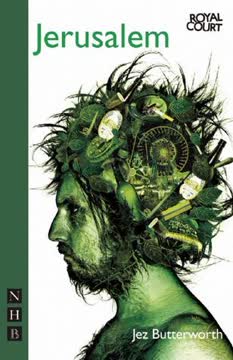
Plot Summary
May Queen's Song
The play opens with Phaedra, a teenage girl dressed as a fairy, singing "Jerusalem," invoking the mythic spirit of England. Her ethereal presence sets a tone of lost innocence and ancient tradition, hinting at the collision between the old and the new. The faded Cross of St George and woodland imagery on the stage evoke a land steeped in legend, but also in decline. Phaedra's song is abruptly cut short, foreshadowing the disruption of tradition and the fragility of innocence. This prologue frames the entire story as a struggle for meaning and belonging in a changing England, where the sacred and the profane, the magical and the mundane, are in constant tension.
Rooster's Defiant Kingdom
Johnny "Rooster" Byron, a charismatic, outlawed ex-daredevil, emerges from his ramshackle trailer in the woods outside Flintock. He is both king and pariah, holding court among the detritus of rural life. Council officials arrive to serve him an eviction notice, but Rooster mocks them with bravado and mythmaking, refusing to yield. His home is a sanctuary for the village's misfits, a place of wild parties and lawless freedom. Rooster's defiance is both comic and tragic, as he clings to his patch of land against the encroaching forces of bureaucracy and gentrification. The clearing becomes a microcosm of resistance, nostalgia, and the stubborn persistence of the outsider.
Gathering of Outcasts
As morning breaks, Rooster's clearing fills with a motley crew: Ginger, the failed DJ; Lee, about to emigrate; Davey, the contented local; Pea and Tanya, teenage girls; and the eccentric Professor. They recount the previous night's debauchery, share tall tales, and mock each other with affection and cruelty. The group's banter reveals their longing for escape, belonging, and meaning. Rooster is both their leader and scapegoat, offering them a place to rebel against the dullness and conformity of village life. Yet beneath the laughter, there is anxiety about the future, the threat of eviction, and the disappearance of Phaedra, the May Queen.
The Crisis Meeting
News spreads of a "Johnny Byron Crisis Meeting" in the village hall, where locals denounce Rooster as a menace. The new housing estate's residents, threatened by his presence, have petitioned for his removal. Rooster, ever the trickster, claims to have attended the meeting in disguise, mocking the hypocrisy of those who once celebrated him. The outcasts debate the decline of the Flintock Fair and the loss of old traditions, blaming the council and the new estate for sanitizing their world. The chapter exposes the deep divisions in the community, the scapegoating of outsiders, and the erosion of rural identity.
Legends and Lies
Rooster regales his followers with outlandish tales—his miraculous birth, his daredevil feats, and encounters with giants. These stories blur the line between truth and myth, elevating Rooster to a folkloric figure. The group alternately mocks and believes him, craving the magic he brings to their mundane lives. The legend of Rooster becomes a shield against the encroaching reality of eviction and adulthood. Yet, the lies also mask pain, loneliness, and the fear of irrelevance. The chapter explores the power of storytelling to create identity, community, and resistance, even as it reveals the fragility of those illusions.
The Lost Girl
The absence of Phaedra, the reigning May Queen, casts a shadow over the festivities. Rumors swirl about her fate—has she run away, been harmed, or simply sought escape? Her stepfather, Troy, is searching for her, and suspicion falls on Rooster's clearing. The group's concern is tinged with guilt and denial, reflecting their own complicity in the community's dysfunction. Phaedra's vanishing becomes a symbol of lost innocence and the dangers lurking beneath the surface of rural life. The search for her exposes the limits of Rooster's protection and the vulnerability of those who seek refuge with him.
Fair Day Revelry
The Flintock Fair erupts in chaotic celebration—floats, morris dancers, drinking, and games. Rooster's clearing becomes a parallel festival, a "beggars' banquet" of outcasts. Lee is toasted as he prepares to leave for Australia, and the group indulges in drugs, music, and mock rituals. The fair is both a last hurrah and a requiem for a vanishing way of life. The revelry masks underlying tensions: impending eviction, broken dreams, and the threat of violence. The fair's traditions are hollowed out, commodified, and yet, in Rooster's clearing, a wild, anarchic spirit persists—if only for a day.
Lee's Last Farewell
Lee, the youngest of the group, prepares to emigrate, seeking adventure and escape from the stasis of Flintock. His friends mock his "vision quest," but beneath the jokes lies real anxiety about change and loss. Lee's departure is both a rite of passage and a symptom of rural decline—youth fleeing for lack of opportunity. The group's attempts to bless and roast him reveal their own fears of being left behind. Lee's struggle to define himself, to find a "spirit name," mirrors the larger search for identity in a world where old certainties are crumbling.
The Giant's Drum
Rooster tells of receiving a magical drum from a giant, promising that if ever in need, he can summon ancient powers. The group treats the story as a joke, but the drum becomes a symbol of hope, resistance, and the enduring power of myth. When Lee bangs the drum, the mood shifts—play turns to unease, and the boundaries between fantasy and reality blur. The drum's presence foreshadows the coming confrontation and Rooster's desperate need for allies, real or imagined. The ritual underscores the play's central tension: the longing for transcendence in a world that refuses magic.
Dawn's Confrontation
Dawn, Rooster's ex-partner and mother of his son Marky, arrives to collect the boy. She confronts Rooster about his failures as a father, his drug dealing, and the impending police raid. Their exchange is raw, bitter, and laced with regret. Dawn's new life contrasts with Rooster's arrested existence, exposing his inability to move on or change. The scene reveals the cost of Rooster's defiance—not just to himself, but to those who love him. Marky's presence is a reminder of innocence at risk, and Dawn's ultimatum forces Rooster to confront the consequences of his choices.
The Curse of Eviction
Council officials return, armed with petitions and legal threats. They enumerate the community's grievances, stripping Rooster of his mythic status and reducing him to a criminal and nuisance. Rooster responds with curses and bravado, invoking ancient powers and threatening retribution. The eviction is both literal and symbolic—the end of Rooster's kingdom, the triumph of order over chaos, and the erasure of the outsider. The chapter is suffused with a sense of doom, as Rooster's resistance becomes increasingly desperate and isolated. The law's victory feels hollow, exposing the community's fear and intolerance.
Troy's Vengeance
Troy, Phaedra's stepfather, storms into the clearing, accusing Rooster of harboring or harming the girl. The confrontation is brutal, dredging up old wounds and exposing the community's darkest secrets. Troy's rage is fueled by guilt, shame, and a need to assert control. The group is cowed, complicit in the violence that follows. Rooster's power is shattered, his followers scattered. The scene lays bare the toxic undercurrents of rural life—abuse, betrayal, and the scapegoating of the outsider. The violence is both personal and communal, a reckoning for years of denial and complicity.
The Beating and Betrayal
Troy and his men return, beating Rooster savagely and branding him with marks of shame. The outcasts, including Ginger, are powerless to intervene, and Rooster is left broken and alone. The beating is both a literal and symbolic crucifixion—the destruction of the old order, the silencing of the rebel, and the triumph of conformity. Rooster's followers abandon him, unable to face the consequences of their allegiance. The betrayal is devastating, exposing the limits of friendship and the cost of standing apart. Rooster's suffering is both martyrdom and defeat, a final act of resistance in the face of annihilation.
Gifts and Goodbyes
In the aftermath, Lee and Davey return to say goodbye, their banter tinged with sadness and uncertainty. The Professor, garlanded with flowers, reflects on the passing of time and the beauty of the land. Rooster receives a goldfish—a symbol of fragile hope and continuity—from Lee. Phaedra reappears, seeking shelter and guidance. The clearing is now a place of ghosts and memories, haunted by loss but still alive with possibility. The chapter is suffused with melancholy, as each character faces the end of an era and the uncertainty of what comes next.
The May Queen's Dance
Phaedra, still dressed as the May Queen, asks Rooster to dance with her before her reign ends. Their dance is both innocent and charged, a fleeting connection between generations, between myth and reality. Phaedra's longing for recognition and Rooster's reluctance to let go encapsulate the play's central themes: the loss of innocence, the hunger for meaning, and the impossibility of returning to the past. The dance is interrupted by the arrival of Troy and his men, shattering the moment and plunging the clearing into violence once more.
Rooster's Stand
Bloodied and abandoned, Rooster is left to confront the approaching authorities. Ginger, his last loyal follower, is driven away by Rooster's refusal of friendship. Marky, Rooster's son, returns briefly, and Rooster imparts a final, defiant lesson about survival, blood, and the importance of resisting conformity. Alone, Rooster prepares for the end, cursing his enemies and invoking the spirits of his ancestors. The clearing is now a battlefield, the last stand of a doomed king. Rooster's isolation is complete, but his spirit remains unbroken.
Summoning the Giants
In the play's final moments, Rooster, battered but unbowed, beats the giant's drum and calls upon the legendary giants and spirits of England to rise and defend him. His incantation is both a desperate plea and a triumphant assertion of identity. The boundaries between myth and reality dissolve, and the clearing becomes a site of transformation and resistance. The play ends in blackout, leaving Rooster's fate—and the fate of his kingdom—unresolved. The final image is one of defiance, magic, and the enduring power of the outsider to challenge the world.
Analysis
"Jerusalem" is a fierce, funny, and heartbreaking meditation on English identity, belonging, and the fate of the outsider. Jez Butterworth crafts a world where myth and reality collide, exposing the tensions between tradition and change, freedom and conformity, innocence and corruption. Rooster Byron is both a tragic hero and a cautionary tale—a man who refuses to yield, even as the world closes in around him. The play interrogates the costs of resistance, the pain of exclusion, and the longing for magic in a disenchanted world. Its lessons are urgent and universal: the need to honor the past without being trapped by it, the dangers of scapegoating and intolerance, and the enduring power of storytelling to create meaning and community. In an age of rapid change and uncertainty, "Jerusalem" asks what it means to belong, to resist, and to dream.
People Also Read
Characters
Johnny "Rooster" Byron
Rooster is the heart of the play—a former daredevil, now a marginalized, lawless figure living in a trailer in the woods. He is both a father figure and a bad influence, offering sanctuary to the village's misfits while dealing drugs and flouting authority. Rooster's charisma is rooted in his ability to spin mythic tales, blurring the line between truth and legend. Psychologically, he is driven by a need for freedom, belonging, and recognition, but also haunted by loneliness and the inevitability of change. His defiance masks vulnerability, and his downfall is both self-inflicted and the result of communal scapegoating. Rooster's journey is a tragic arc from king to outcast, martyr to myth.
Ginger
Ginger is Rooster's most devoted companion, a failed DJ and perennial outsider. He craves validation and belonging, clinging to Rooster's world as a refuge from his own disappointments. Ginger's banter and bravado mask deep insecurity and a fear of irrelevance. His relationship with Rooster is both affectionate and dependent, and his eventual rejection by Rooster is devastating. Ginger embodies the longing for community and the pain of exclusion, serving as both comic foil and tragic figure.
Lee Piper
Lee is the youngest of the group, preparing to emigrate to Australia in search of adventure and meaning. He is both mocked and envied by his friends, who see in him the possibility of escape from Flintock's stagnation. Lee's "vision quest" is a search for identity, a rite of passage that mirrors the play's larger themes of transformation and loss. His departure is bittersweet, marking the end of an era and the uncertainty of the future. Lee's journey is both personal and emblematic of rural youth fleeing for opportunity.
Davey Dean
Davey is the most rooted of the group, happy with his lot in Flintock and skeptical of Lee's dreams of escape. He works in the abattoir, finds comfort in routine, and resists the pull of myth and adventure. Davey's banter is laced with affection and cynicism, and his loyalty to Rooster is pragmatic rather than idealistic. Psychologically, Davey represents the inertia of tradition, the comfort of the familiar, and the fear of the unknown. His relationship with Lee is both antagonistic and fraternal, exposing the tensions between stasis and change.
Phaedra Cox
Phaedra is the fifteen-year-old May Queen, missing for much of the play and the focus of communal anxiety. Her disappearance exposes the dangers and dysfunctions of rural life, as well as the limits of Rooster's protection. Phaedra's return is both a moment of hope and a reminder of lost innocence. Her dance with Rooster is charged with longing and ambiguity, encapsulating the play's themes of transformation, desire, and the passage of time. Phaedra is both victim and survivor, a symbol of what is at stake in the struggle for belonging.
Troy Whitworth
Troy is Phaedra's stepfather, a figure of menace and rage. His search for Phaedra is driven by guilt, shame, and a need to assert control. Troy's confrontation with Rooster is the play's most violent moment, exposing the community's capacity for cruelty and the scapegoating of outsiders. Psychologically, Troy is both victim and perpetrator, shaped by his own traumas and the toxic dynamics of rural masculinity. His violence is both personal and symbolic, a reckoning for years of denial and complicity.
Dawn
Dawn is Rooster's ex-partner and the mother of his son, Marky. She represents the world outside Rooster's kingdom—the demands of responsibility, the pain of broken relationships, and the consequences of defiance. Dawn's confrontation with Rooster is raw and honest, exposing his failures as a father and partner. She is both compassionate and unforgiving, determined to protect her son from Rooster's self-destruction. Psychologically, Dawn is torn between love and anger, hope and resignation.
Marky Byron
Marky is Rooster and Dawn's six-year-old son, caught between his parents' worlds. He is a symbol of innocence at risk, but also of continuity and hope. Rooster's final lesson to Marky is both a blessing and a curse, imparting the values of resistance and survival. Marky's presence humanizes Rooster, exposing his vulnerability and longing for connection. Psychologically, Marky is a blank slate, shaped by the choices and failures of the adults around him.
The Professor
The Professor is an elderly, whimsical figure who drifts through the play, offering poetic reflections and comic relief. He is a link to the past, a repository of local lore and tradition. The Professor's presence is both comforting and melancholy, as he witnesses the passing of an era and the fading of old certainties. Psychologically, he is detached, gentle, and wise, serving as a counterpoint to the play's violence and chaos.
Wesley
Wesley is the landlord of The Cooper's Arms, caught between loyalty to Rooster and the demands of the community. He is roped into the fair's rituals, humiliated, and ultimately forced to ban Rooster from the pub. Wesley's journey is one of reluctant conformity, as he sacrifices friendship for survival. Psychologically, he is weary, conflicted, and resigned, embodying the compromises required to navigate a changing world.
Plot Devices
Mythmaking and Storytelling
The play's central device is Rooster's mythmaking—his wild stories of miraculous birth, giants, and magical drums. These tales serve as both shield and weapon, creating a world where the outsider can be king and the mundane is transformed into the magical. Storytelling becomes a means of resistance, identity, and community, but also a way to evade responsibility and mask pain. The blurring of truth and legend is mirrored in the play's structure, where reality and fantasy collide, and the boundaries between them are constantly shifting.
Ritual and Repetition
The play is structured around the rituals of the Flintock Fair—May Queen, morris dancing, drinking, and games. These rituals provide continuity and meaning, but are also hollowed out by commercialization and decline. The repetition of songs, dances, and incantations creates a sense of cyclical time, where the past is always present and the future uncertain. Ritual becomes both a source of comfort and a site of conflict, as characters struggle to preserve or escape tradition.
Outsider vs. Community
The central tension is between Rooster, the outsider, and the community that seeks to expel him. This conflict is played out through legal threats, violence, and betrayal. The community's fear of Rooster masks deeper anxieties about change, loss, and the erosion of identity. The outsider becomes a scapegoat, bearing the community's sins and fears. The play interrogates the costs and consequences of belonging, exclusion, and resistance.
Foreshadowing and Symbolism
The play is rich in foreshadowing—the eviction notice, the missing May Queen, the giant's drum, the goldfish. Each object and event carries symbolic weight, hinting at the characters' fates and the play's larger themes. The drum, in particular, is a symbol of hope, resistance, and the enduring power of myth. The repeated references to blood, curses, and ancestry underscore the play's preoccupation with legacy, survival, and the cyclical nature of history.








































