

Key Takeaways
Stop asking why they do it; the real story is what it does to you
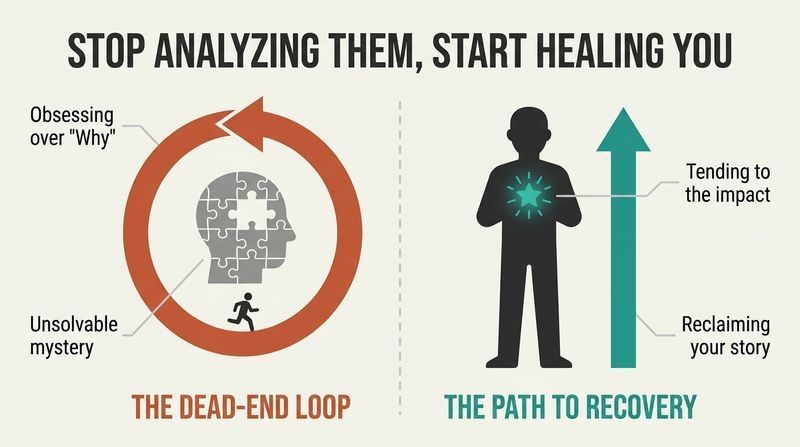
Most books on narcissism obsess over the narcissist, that charming figure who lies, rages, and escapes consequences. Durvasula flips the lens with a proverb: until the lion tells the tale, the hunt always glorifies the hunter. She argues the survivor is the neglected half of the story. Her clients, whether trapped with a cheating spouse, an invalidating mother, or an ungrateful father, all arrived with the same symptoms: anxiety, rumination, self-blame, isolation. Their panic rose and fell with the relationship, not their own pathology. Treating the anxiety while ignoring the relationship was, she says, like inflating a tire to fix an engine. Understanding why a narcissist manipulates does nothing to ease your pain. Healing starts when you stop analyzing them.
This survivor-centered pivot aligns with trauma-informed care's shift from "what's wrong with you" to "what happened to you," popularized by Bessel van der Kolk and Oprah Winfrey's collaboration. It also echoes betrayal trauma theory. The reframe is therapeutically shrewd: obsessive why-seeking can function as a covert bargaining strategy, an attempt to decode the person enough to fix them. One caution worth noting: fully abandoning the why can occasionally shade into premature labeling, where any difficult person becomes "a narcissist." Durvasula guards against this, but readers running with the concept should retain the humility that pattern recognition is not clinical diagnosis.
Narcissism is insecurity in armor, not confidence on display
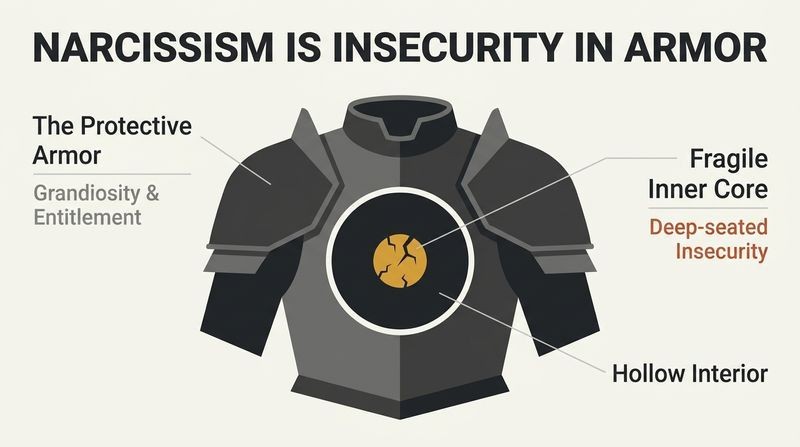
Durvasula defines narcissism as an interpersonally maladaptive personality style, a wide spectrum of traits that hang together and turn into consistently harmful behavior. The engine underneath is not high self-esteem but a fragile, variable, inaccurate self-appraisal. Grandiosity, entitlement, charm, and arrogance are a defensive suit of armor over a lurking sense of inadequacy. Key traits include:
1. Need for narcissistic supply (validation, admiration, attention)
2. Entitlement, theorized as the core pillar
3. Variable, hollow empathy that vanishes once they get what they want
4. Rage triggered by shame, and blame-shifting
5. Charm deployed tactically to secure supply
The traits themselves are not the problem; the harmful behaviors they generate are. Because personality is stable, these behaviors will not meaningfully change.
The insecurity-under-armor model reflects psychodynamic "mask" theory, but empirical psychology complicates it. Research on grandiose narcissism finds some genuinely high, stable self-esteem, not just compensation, whereas the fragility model fits vulnerable narcissism better. Durvasula's spectrum framing wisely sidesteps this debate. Her emphasis on entitlement matches the Narcissism Spectrum Model (Krizan and Herlache), which positions entitlement and self-importance at the center. The distinction between cognitive empathy (understanding feelings) and affective empathy (sharing them) is crucial and underappreciated: narcissists often have the former and weaponize it, which is precisely why victims feel intermittently "seen" and stay hooked.
The middle of the spectrum traps you: enough good days to keep hoping
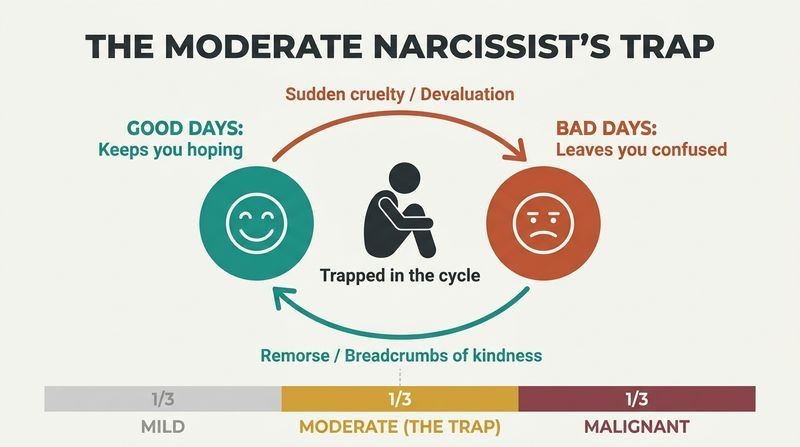
Durvasula distinguishes mild social-media narcissists from terrifying malignant ones, but zeroes in on moderate narcissism, where most people are stuck. The moderate narcissist has just enough insight to know their behavior is wrong, so they hide it, becoming a devil at home and an angel in the street. They offer enough good days to keep you invested and enough bad days to leave you confused. She sketches types: grandiose (shiny, charismatic), vulnerable or covert (victimized, sullen, resentful), communal (saintly do-gooder chasing praise), self-righteous (rigid, hypermoralistic), neglectful (detached ghost), and malignant (cruel, vindictive, near-psychopathic). The two-faced public-private split is the moderate narcissist's trademark, which is exactly why no one believes you: outsiders see composure, you experience contempt behind closed doors.
The moderate zone is the book's most useful contribution because it explains why survivors doubt themselves: intermittent reinforcement. Behavioral psychology shows variable-ratio reward schedules (the slot-machine principle) produce the most persistent behavior, more than consistent reward. A partner who is kind unpredictably is harder to leave than one who is reliably cruel. The vulnerable and communal subtypes deserve special attention because they defy the arrogant-alpha stereotype: the perpetually victimized "nice guy" and the humanitarian who treats staff terribly both escape detection. Durvasula's typology is clinically informal, not a validated taxonomy, but as a recognition tool for laypeople it is genuinely illuminating.
Gaslighting isn't lying; it's the slow demolition of your reality
Gaslighting is a systematic pattern that makes you doubt your memory, perception, judgment, and emotions until you question reality itself. It requires trust to work, which is why it thrives with lovers, parents, and bosses. Showing evidence (a text, a document, a recording) does not work; the narcissist deflects to your mental fitness or repeats the distorted narrative. Durvasula borrows psychologist Jennifer Freyd's DARVO model: Deny the behavior, Attack the confronter, Reverse Victim and Offender so the abuser plays wronged party. Warning signs you are being gaslighted include sending long explanatory texts, keeping receipts as an evidentiary base, recording conversations, and giving long preludes before speaking. The antidote is owning your reality out loud, checking in with yourself daily, and building gaslight-free zones with people who reflect reality back.
DARVO is one of the most portable concepts in abuse literature and appears constantly in high-conflict divorce and workplace harassment cases, where the accused reframes accountability as persecution. The evidentiary-base behavior Durvasula flags is poignant: victims become amateur documentarians precisely because their internal sense of truth has been eroded, a hallmark of what philosophers call epistemic injustice. The practical fix, narrating your own experience aloud, has grounding in cognitive research on metacognition and reality-testing. One nuance: not every dispute over facts is gaslighting. Genuine memory differences exist. The distinguishing marker is the systematic, self-serving pattern plus the attack on your sanity, not isolated disagreement.
The trauma bond, not weakness, is why you can't walk away
Durvasula rejects labels like codependent or masochist. Getting stuck is a normal human response, not a defect. Narcissistic relationships follow a cycle: love bombing (intense idealization that hooks you), devaluation (the mask slips, criticism begins), discard, and hoovering (sucking you back like a vacuum with fresh charm or pseudo-apologies). What cements you is the trauma bond, the deep sense of love or connection forged in a relationship of alternating harm and reward. The narcissist controls the emotional thermostat, so bad days come to signal a coming good day, and even the good days carry dread. She compares it to a riptide: the intensity pulls you out, and guilt, fear, finances, and the human drive for attachment keep you from swimming back. Childhood-origin bonds are more primal; adult-origin bonds are more cognitive.
Trauma bonding, coined by Patrick Carnes, is often misused to mean bonding over shared trauma; Durvasula correctly restores its meaning as attachment forged through cyclical abuse. Neurobiology supports her: intermittent reinforcement floods dopamine pathways similarly to addiction, and cortisol-driven stress paradoxically strengthens pair-bonding. Her refusal to pathologize the victim is a welcome corrective to decades of "codependency" discourse that subtly blamed survivors. The thermostat metaphor captures learned helplessness (Seligman) elegantly. Worth adding: attachment theory suggests those with anxious attachment styles may be especially susceptible, not because they are broken, but because the push-pull dynamic activates their attachment system maximally.
Your best qualities, not your flaws, are what the narcissist exploits
Durvasula reframes vulnerability: the traits that draw and trap you are often your virtues. Empathic people keep extending compassion and second chances, becoming a bottomless source of supply in an asymmetric empathic reversal where empathy flows out and none returns. Rescuers try to fix an endless project. Optimists cannot accept that someone won't change. Committed forgivers signal there will be no consequences. Other risk factors: growing up with narcissistic parents (which normalizes the behavior), paradoxically growing up in a happy family (which leaves you unable to imagine cruelty), life transitions like moves or divorces that lower your guard, rushed relationships driven by biological clocks, and histories of trauma or betrayal. Understanding your backstory is not self-blame; it is knowing where your armor is thin.
This is the book's most compassionate and counterintuitive move: locating susceptibility in strengths rather than deficits. It resonates with research on empathy as a double-edged trait and with the "pathological altruism" concept (Oakley). The happy-family vulnerability is especially sharp and rarely discussed: secure attachment can breed a naive faith that love and communication solve everything, leaving no template for malice. The framing carries a subtle risk, however. Emphasizing victim traits, even affirmingly, can slide back toward the very self-scrutiny Durvasula elsewhere discourages. She threads this needle by insisting these are calibration points, not culpability, and by demanding society examine why it rewards antagonism.
Narcissistic family roles cast children as props, not people
In narcissistic family systems, children are assigned roles that serve the parent's needs, not their development. Durvasula names them:
1. The golden child: favored supply source, but on a conditional pedestal
2. The scapegoat: repository of the parent's projected shame, blamed for everything
3. The helper: keeps the parent regulated by cooking, cleaning, soothing
4. The invisible child: psychologically abandoned, unseen, left to raise themselves
5. The truth seer/teller: sees the dysfunction clearly, becomes the black sheep
Roles can overlap, shift with age, or reverse. Her Smith family illustration shows all five: the ballet-prodigy golden child terrified to disappoint, the overweight scapegoat who develops eating disorders, the forgotten daughter who taught herself the bus routes home. These roles calcify into adult identities, which is why healing requires individuation, growing beyond the assigned part.
These archetypes descend from family-systems therapy (Bowen, Satir) and addiction literature's roles (the hero, the lost child, the mascot), which Durvasula adapts to narcissism. Their value is diagnostic: naming the role helps adults understand why they still over-function or shrink. The golden child concept is particularly nuanced because outsiders assume favoritism is fortune, missing the conditional, performance-contingent love and the survivor guilt it breeds. A limitation: real families rarely map this cleanly, and rigid role-assignment can become its own reductive story. Durvasula acknowledges overlap and fluidity, which keeps the framework a lens rather than a cage.
Radical acceptance means expecting the sting, not approving of it
The single most important shift Durvasula offers is radical acceptance: fully acknowledging that the narcissistic person will not change and the relationship will not improve. It is not submission, forgiveness, or becoming a doormat. It is rejecting the behavior while releasing the fantasy of transformation. She uses the scorpion and swan fable: the scorpion stings even after promising not to, because stinging is what it does. The greatest barrier is hope, which evokes grief when extinguished. Her mantra: "Don't burn your umbrellas." A string of good days will tempt you to relax and get "cocky," and then it rains again. Acceptance frees you because you stop pouring energy into fixing the unfixable and redirect it toward yourself, your workarounds, and the people who are actually good for you.
Radical acceptance originates in Marsha Linehan's Dialectical Behavior Therapy, where it means accepting reality to reduce suffering, not endorsing it. Durvasula's application is apt: the suffering often comes less from the abuse itself than from the repeated collision between reality and hope. This connects to grief theory, since accepting unchangeability triggers genuine mourning of a living person. The "don't burn your umbrellas" heuristic is behaviorally smart, inoculating against the extinction burst of optimism that good days produce. The hardest philosophical tension the book holds honestly: acceptance does not require leaving. You can radically accept and stay, which many must, for children, money, or love.
Your body detects narcissists faster than your rational mind
Durvasula argues the fallout of narcissistic abuse lives in the body, governed by the sympathetic nervous system (SNS), your fight, flight, freeze, and fawn response. When you sense the narcissist's threat (the jingle of keys at the door, a certain tone), your heart races, your mouth dries, your throat tightens. These reactions are reflexive, not chosen. She adds the fawn response, coined by therapist Pete Walker: surrendering your needs to appease and stay attached to a threatening person, common in those raised in abusive homes. Fawning is not weakness or complicity; it is a survival reflex. To manage it, activate the parasympathetic nervous system through deep breathing, sleep, nature, and grounding. Crucially, listen to the body as an early-warning system: when your mind makes excuses but your gut feels "funky," pay attention.
The body-as-detector framing is well supported by polyvagal theory (Stephen Porges) and van der Kolk's work showing trauma is encoded somatically before it is cognitively narrated. The fawn response fills a real gap: the classic fight-flight-freeze triad omitted the appeasement strategy that dominates in chronic relational abuse, and naming it relieves enormous shame. Durvasula's practical toolkit (paced breathing, grounding, connecting to pulse) reflects standard nervous-system regulation techniques. The insight that criticism at work can trigger the same alarm as a raging parent, because the SNS cannot distinguish, is a sophisticated point about generalization that helps survivors avoid mislabeling ordinary feedback as danger.
You can heal even while trapped: don't go DEEP
Most survivors cannot simply leave, whether for children, money, aging parents, or love, so Durvasula insists healing is possible while staying. The core survival skill is refusing the toxic dance. Her DEEP acronym lists what NOT to do:
1. Defend (they aren't listening)
2. Engage (don't get into the back-and-forth)
3. Explain (they will distort it)
4. Personalize (it's not about you; you're just interchangeable supply)
Supporting tools: gray rocking (becoming boring and unresponsive so you stop being good supply), yellow rocking (gray rock plus warmth and manners, for co-parenting), low contact, and reserving engagement only for your "True North" (a child, a value worth the fight). She warns never to call a narcissist a narcissist; it earns only word salad and rage. Stop making your success about proving them wrong.
DEEP is essentially disengagement operationalized, and it works by starving the behavior of reinforcement, the extinction principle from operant conditioning. Gray rocking has become folk wisdom in survivor communities; its limitation, which Durvasula honestly flags, is that it can provoke an escalation before boredom sets in, and it is untenable where cooperation is required, hence yellow rocking (credited to advocate Tina Swithin). The "stop making it about them" point is the deepest: even healing to spite them keeps the narcissist as your reference point. True liberation is indifference. Skeptics might note DEEP risks emotional suppression, but in a relationship where vulnerability is weaponized, strategic non-engagement is self-preservation, not avoidance.
You are allowed not to forgive, and forgiving repeat offenders can harm you
Durvasula challenges the near-universal gospel that healing requires forgiveness. Forgiveness works in healthy relationships, but narcissists read it as permission to reoffend, more supply for their entitlement. She cites research on the "doormat effect": forgiving a disagreeable partner who behaves badly erodes self-respect and self-concept clarity, and less-agreeable partners are more likely to reoffend when forgiven because they anticipate no consequences. She distinguishes forgiveness (actively ceasing resentment) from letting go and moving on, which do not require the offender at all. Personally, she has not forgiven the narcissists in her life; she wishes them no ill but sees clearly that they harmed and changed her without accountability. Pretending to forgive while still resenting creates internal tension that blocks healing. Self-forgiveness, however, releasing yourself for not seeing it sooner, is essential.
This is the book's most bracing contrarian stance, and it has empirical teeth. The doormat-effect research (Luchies, McNulty, and colleagues) genuinely complicates the forgiveness-industrial complex that dominates self-help and much of positive psychology. Durvasula is careful, not cynical: she supports survivors who choose to forgive and those who don't, insisting only that forgiveness be authentic rather than performative or coerced by religious and cultural pressure. This resonates with critiques of "toxic positivity" and premature forgiveness in restorative-justice literature, where forgiveness without accountability or amends can retraumatize. The reframe that letting go is not the same as forgiving gives readers permission to heal without a reconciliation they may never safely have.
Rewrite the story where you were cast as the problem
The final work is narrative. Narcissistic abuse hands you a fictional story in which you are not enough, too sensitive, and to blame. Durvasula's client Luna, raised by a malignant father and married to a belittling husband, spent decades believing her ambitions were grandiose; only in her late fifties, after divorce and building her own business, did she see the lie and thrive. Healing means identifying which parts of your story actually belong to the narcissist and revising them from a self-aware place. She distinguishes silent endurance (often mislabeled resilience) from genuine resilience, which includes feeling and expressing emotion. The book's title is the destination: after a lifetime of asking "what am I doing wrong," you arrive at the answer, it's not you. Thriving can be as small as getting through a whole day without hearing their voice in your head.
Narrative-identity work draws on narrative therapy (White and Epston), which externalizes the problem and re-authors the dominant story, and on research showing that redemptive life narratives correlate with wellbeing (Dan McAdams). Durvasula's distinction between stoic endurance and true resilience is culturally important, pushing back on traditions that valorize emotional suppression as strength. Luna's arrival in her late fifties is sobering realism, not every story resolves quickly, and healing is nonlinear. The definition of thriving as a quiet day free of the internalized critic is refreshingly modest against self-help's grandiose transformation promises. The insight that even rebellion (dyeing your hair to defy them) keeps you tethered underscores that authentic autonomy is defined by your values, not by opposition.
Analysis
Durvasula's central intervention is rhetorical and clinical at once: she turns the camera away from the fascinating predator and onto the person in its wake. This reframing is more radical than it appears, because the entire cultural and therapeutic apparatus, from true-crime fascination to couples counseling's shared-responsibility model, is oriented toward the narcissist. By declaring "it's not you," she names a form of harm (antagonistic relational stress) that traditional psychology has under-theorized, and she does so while sidestepping the diagnostic gatekeeping that lets abusers off the hook ("you can't call them a narcissist, they haven't been diagnosed").
The book's greatest strength is its integration of established science (Freyd's betrayal trauma and DARVO, Linehan's radical acceptance, Walker's fawn response, the doormat-effect research, polyvagal-adjacent somatic work) into a coherent survivor's roadmap. Its most original contributions are the moderate-narcissism focus (explaining self-doubt via intermittent reinforcement), the reframing of empathy and optimism as exploitable virtues rather than flaws, and the permission not to forgive, which cuts against the grain of the self-help genre.
The work is vulnerable to two critiques. First, definitional elasticity: because Durvasula deliberately widens "narcissism" toward "antagonism" and discourages why-analysis, the framework could license over-labeling of any difficult person, and she relies heavily on clinical observation and self-report rather than controlled outcome data. Second, the unfalsifiability trap: if good behavior is a mask and bad behavior is proof, the theory can explain anything, which is intellectually risky even when practically protective. Durvasula partly inoculates against this by insisting on consistent patterns over time and by centering behavior over label.
Ultimately the book functions less as a scientific treatise than as a validated, structured act of witness. Its therapeutic power lies precisely in converting private, shameful confusion into a named, predictable, shared pattern, which for many survivors is the first step from surviving toward genuine individuation.
Review Summary
"It's Not You" receives high praise from readers for its insightful approach to narcissistic abuse recovery. Many appreciate Dr. Ramani's focus on survivors rather than abusers, offering practical advice and validation. Readers find the book relatable, empowering, and life-changing, often feeling seen and understood. It's lauded for its comprehensive coverage of narcissistic behaviors in various relationships and its emphasis on healing. Some readers wished for more detailed coping strategies, but overall, the book is highly recommended for anyone dealing with narcissistic relationships or seeking to understand them better.
People Also Read







FAQ
What's It's Not You about?
- Focus on Narcissistic Relationships: It's Not You by Dr. Ramani Durvasula delves into the dynamics of relationships with narcissistic individuals, highlighting the emotional abuse and damage they can cause.
- Healing and Recovery: The book offers a roadmap for recognizing narcissistic behaviors, understanding their impact, and healing from the associated trauma.
- Empowerment for Survivors: Dr. Durvasula emphasizes that victims are not at fault, encouraging them to reclaim their identities and pursue healthier relationships.
Why should I read It's Not You?
- Expert Insight: Dr. Ramani is a respected psychologist with extensive experience in narcissism, providing valuable insights for those affected by such relationships.
- Practical Guidance: The book offers actionable advice for recognizing unhealthy patterns, setting boundaries, and fostering self-acceptance and healing.
- Validation of Experiences: Readers will find comfort in knowing they are not alone, as the book addresses common feelings of confusion, guilt, and self-blame.
What are the key takeaways of It's Not You?
- Understanding Narcissism: The book clarifies narcissism, its traits, and behaviors, helping readers identify narcissistic individuals in their lives.
- Cycle of Abuse: Dr. Durvasula outlines the cycle of narcissistic relationships, including love bombing, devaluation, and discard.
- Empowerment through Acceptance: Radical acceptance is a significant takeaway, encouraging individuals to acknowledge the unchangeable nature of narcissistic behavior.
What is narcissistic abuse, according to It's Not You?
- Definition of Narcissistic Abuse: It involves harmful, deceitful, and invalidating patterns by narcissistic individuals, causing significant psychological harm.
- Behavioral Patterns: The book details behaviors like gaslighting, manipulation, and emotional invalidation that characterize narcissistic abuse.
- Impact on Victims: Victims often experience confusion, self-blame, and a distorted sense of reality, leading to long-term emotional issues.
What is the cycle of narcissistic relationships?
- Phases of the Cycle: It begins with love bombing, followed by devaluation, and eventually reaches a discard phase.
- Discard Phase: The narcissistic individual may end the relationship or emotionally withdraw, leaving the partner feeling abandoned.
- Hoovering: After a discard, the narcissist may attempt to "hoover" their partner back in, using charm and manipulation.
How does It's Not You define narcissism?
- Spectrum of Traits: Narcissism is described as an interpersonally maladaptive personality style with traits ranging from mild self-centeredness to severe disorder.
- Core Characteristics: Key traits include a need for validation, egocentricity, lack of empathy, and manipulation.
- Behavioral Impact: The harmful behaviors stemming from these traits define narcissism and its impact on relationships.
What is radical acceptance in It's Not You?
- Definition of Radical Acceptance: It involves acknowledging that the narcissistic person’s behavior will not change, allowing individuals to stop trying to fix the relationship.
- Pathway to Healing: This acceptance is crucial for healing, helping individuals let go of false hopes and focus on their well-being.
- Emotional Relief: Accepting reality provides relief and clarity, enabling healthier choices moving forward.
What are the signs of narcissistic abuse?
- Common Behaviors: Signs include gaslighting, emotional invalidation, manipulation, and alternating between charm and hostility.
- Emotional Impact: Victims may experience confusion, self-doubt, anxiety, and a sense of powerlessness.
- Isolation and Control: Narcissistic abuse often leads to social isolation, as the abuser manipulates the victim's relationships.
How can I start healing from narcissistic abuse?
- Recognize the Abuse: Acknowledge that the relationship is toxic and the abuse is not your fault, breaking the cycle of self-blame.
- Seek Support: Therapy, support groups, or trusted friends can provide validation and help process experiences.
- Set Boundaries: Learning to set and maintain boundaries is crucial for protecting mental health and fostering recovery.
What techniques does Dr. Ramani suggest for coping with narcissistic relationships?
- The Ick List: Writing down negative behaviors and experiences serves as a reminder of the relationship's toxicity.
- Gray Rock Method: Becoming uninteresting to the narcissist by minimizing emotional responses helps reduce their control.
- Mindfulness Practices: Staying grounded and connected to feelings aids in managing anxiety and emotional distress.
How does It's Not You address the aftermath of leaving a narcissistic relationship?
- Post-Separation Abuse: Leaving often leads to increased manipulation and abuse, so understanding this can help prepare for challenges.
- Emotional Fallout: The book discusses the emotional turmoil, including doubt and regret, that can follow leaving a narcissistic partner.
- Support Systems: Building a support system is crucial, providing necessary emotional backing during the transition.
What is the significance of self-compassion in It's Not You?
- Foundation for Healing: Self-compassion is vital for healing, allowing individuals to treat themselves with kindness and understanding.
- Breaking the Cycle of Self-Blame: Moving away from self-blame and guilt helps recognize that they are not at fault for the narcissistic behavior.
- Empowerment Through Kindness: Fostering self-compassion helps reclaim self-worth and agency, crucial for moving forward.
About the Author

Download PDF
Download EPUB
.epub digital book format is ideal for reading ebooks on phones, tablets, and e-readers.








































