

Key Takeaways
For Muslims, politics is a sacrament, not a distraction from faith
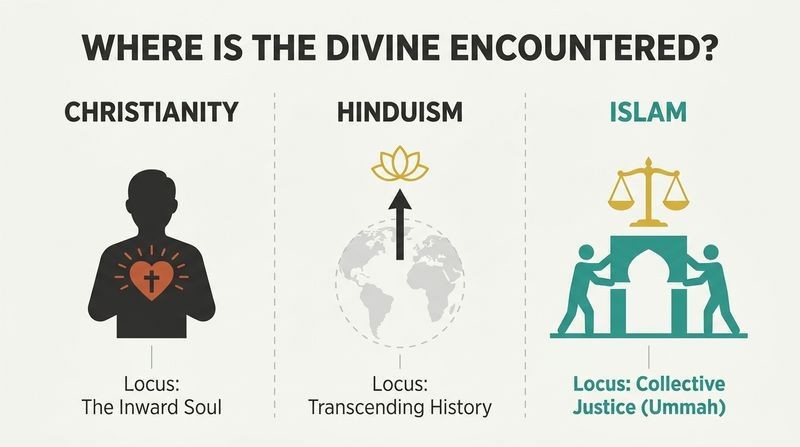
Armstrong's central thesis: where Christianity locates the sacred in inward belief and where Hindus dismiss history as illusory, Islam sacralizes history itself. The Quran gave Muslims a mission to build a just community in which even the weakest are treated with dignity. Living in such a society gives Muslims intimations of the divine.
This reframes everything. Political assassinations, civil wars, dynasties rising and falling: these are not sideshows to the real spiritual drama but the arena in which Muslims encounter God. A humiliated or unjust ummah (the Muslim community) is a genuine religious crisis, not merely a policy failure. When Christians would contemplate an icon, a Muslim would meditate on current events, searching for the hidden divine meaning inside them.
This single insight unlocks the whole book and much of modern headlines. What's striking is how it dissolves the Western puzzle over why religion and politics seem fused in Islam. The comparison bears pressure: Judaism too has a covenantal, this-worldly bent, and liberation theology pushed Christianity toward social justice. The claim risks overstating uniformity, since plenty of Muslim mystics did retreat inward. Still, as an interpretive key it is powerful, explaining why economic decline or foreign occupation registers as spiritual wound rather than mere inconvenience, and why calls to "put history back on track" recur across fourteen centuries.
Muhammad's revolution replaced blood tribe with a chosen community
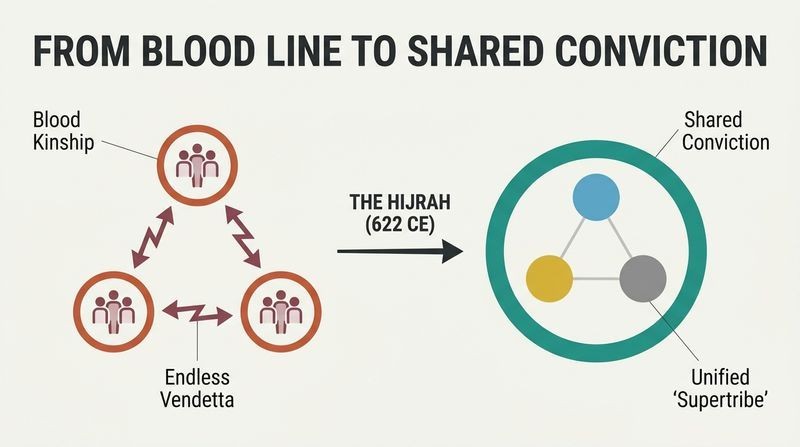
Seventh-century Arabia ran on the ghazu (raid) and endless vendetta, where tribal loyalty was sacred and the strong preyed on the weak. Muhammad's teaching was less a new theology than a social protest: stop hoarding wealth, care for orphans and the poor, or your society will collapse.
The truly radical act was the hijrah, the 622 migration to Medina. Muslims abandoned their blood kin to join a community bound by shared conviction, which in tribal terms was blasphemy. This "supertribe" of pagans, Jews, and Muslims who vowed mutual protection became a template. Within ten years Muhammad had ended Arabia's cycle of vendetta warfare, largely through an ingenious campaign that culminated in taking Mecca without bloodshed after a pilgrimage gamble at Hudaybiyyah.
Sociologists would recognize this as a shift from ascribed to elective identity, one of modernity's supposed hallmarks arriving in the seventh century. The parallel to early Christianity's break from ethnic Israel is obvious, yet Islam kept the communal, legal dimension that Christianity spiritualized away. Armstrong is careful to contextualize the harsher episodes, like the execution of the Qurayzah men, within the exterminate-or-be-exterminated logic of desert warfare. That framing is contested by other historians, but the larger point stands: the achievement was building solidarity across kinship lines, an organizational innovation as much as a religious one.
Success became Islam's evidence of God, which made decline a theological earthquake

Where Christianity found God in Jesus's apparent failure on the cross, early Muslims experienced political triumph as divine endorsement. A century after Muhammad's death the empire stretched from the Pyrenees to the Himalayas. This staggering conquest by a formerly despised people confirmed the Quranic promise that a rightly guided society must prosper.
Armstrong insists the expansion was not holy war. Umar's raids sought plunder and a common activity to preserve unity, not forced conversion, which was actively discouraged until the eighth century. The Arabs simply hit a power vacuum: Persia and Byzantium had exhausted each other. But the logic cut both ways. If success proves divine favor, then later humiliation at Western hands would strike at the very foundation of Muslim faith in life's purpose.
This is a profound and double-edged theology of history. It resembles the Deuteronomic bargain in the Hebrew Bible, where obedience brings prosperity and sin brings exile, a framework that made catastrophe interpretable but also spiritually devastating. The correction of the sword-point conversion myth is well supported: taxing non-Muslim dhimmis was more lucrative than converting them, so empire had fiscal reasons for tolerance. The deeper insight is psychological. A faith that reads worldly outcomes as verdicts on righteousness carries hidden fragility, because when the geopolitical tide turns, the crisis is not merely material but existential, a point that illuminates modern grievance.
Islam's great schism was a political quarrel, not a doctrinal dispute
The Sunni-Shii divide originated in a succession crisis, not theology. After Muhammad, the question was who should lead: the most capable companion (the Sunni answer, producing the four rashidun or "rightly guided" caliphs) or the Prophet's bloodline through his cousin Ali (the Shii answer).
The trauma crystallized in two events. Ali's murder in 661, and the 680 massacre of his son Husain at Kerbala. For Shiis, Husain's death became the enduring symbol of the just man crushed by corrupt power, mourned annually with weeping processions and passion plays. Sunnis developed a more optimistic stance: God stays with the community even amid flawed leaders, so unity trumps sectarian purity. Both positions answered the same haunting question of how a society that kills its holiest members can claim divine guidance.
Armstrong's framing usefully deflates the notion of an ancient theological chasm. The comparison she draws to Christianity's Christological debates is apt but inverted: Christians fought over the nature of Christ, Muslims over the nature of legitimate authority, revealing where each tradition located its deepest stakes. Political theorists would note this is really a debate about legitimacy and consent that most civilizations never resolve. One nuance worth adding: over centuries the divide did accrete genuine theological and legal differences, so calling it "purely political" describes origins better than the present. Still, the insight explains why the split hardened most under imperial rivalry.
Islamic law arose as grassroots protest against corrupt rulers
The Shariah did not descend from caliphs. It bubbled up from pious Muslims gathering in houses and mosques, dismayed that the luxurious Umayyad and Abbasid courts had betrayed the Quran's egalitarian spirit. Jurists collected ahadith (reports of the Prophet's words and actions) and worked out how a truly God-surrendered society should function.
Al-Shafii systematized this with four "roots" of law: the Quran, the Prophet's example (sunnah), analogy, and community consensus. Crucially, the Shariah restricted the caliph's power, denied any priesthood standing between God and the individual, and built protections for the weak. It was a counterculture. By imitating the smallest details of Muhammad's daily conduct, ordinary Muslims internalized the Prophet as a living presence and quietly rebuked the extravagance of the state.
This origin story reframes Shariah, often cast in the West as an instrument of state coercion, as something closer to a bottom-up constitutional movement limiting arbitrary power. The parallel to English common law developing partly against royal prerogative is illuminating. So is the absence of an ordained clergy, which makes Islam structurally more like Judaism, governed by scholars and jurists rather than sacramental priests. The tension Armstrong flags becomes crucial: a protest movement built to check rulers behaves very differently once rulers adopt it as state law, a transformation that would drain its oppositional energy and, arguably, its dynamism.
When the caliphate collapsed, Islamic spirituality flourished instead of dying
Counterintuitively, the fragmentation of central power after 935 was not decline but liberation. Once the caliph became a symbolic figurehead and regions governed themselves under local commanders and scholars, Islam thrived without state support. Independent courts on rough parity better matched the Quran's egalitarian spirit than any absolute monarchy had.
This era produced the flowering of Sufism, Islam's mystical tradition. Al-Ghazzali, called the most important Muslim after Muhammad, suffered a breakdown, realized he knew about God but did not know God, and returned to argue that only ritual and contemplative practice yield direct divine experience. He wove mysticism into mainstream piety. Sufi orders, mobile and international, became the glue binding a politically scattered civilization, giving even illiterate believers an inner life once reserved for elites.
There is a striking institutional lesson here that resonates with modern network theory: decentralized systems can be more resilient than centralized ones. Islam survived the Mongol devastation precisely because its identity lived in portable scholars and Sufi brotherhoods rather than a single capital. Al-Ghazzali's move mirrors William James's later distinction between knowing about religion and having religious experience. The claim that political weakness enabled spiritual depth is provocative and mostly persuasive, though one might counter that the era's prosperity and trade networks, not just political looseness, funded the cultural bloom. Either way, it complicates any simple story of rise and fall.
Gunpowder built three Muslim empires that betrayed Islam's egalitarian core
Between 1500 and 1700, firearms enabled three great empires: the Shii Safavids in Iran, the Moghuls in India, and the Ottomans spanning Anatolia, the Arab world, and southeastern Europe. Unlike the old Abbasid court, all three gave themselves an explicitly Islamic orientation. Yet all embraced absolute monarchy, which fundamentally contradicted the Quran's radical equality.
Their fates diverged instructively. Akbar the Moghul ruled a Hindu-majority land with brilliant pluralism, abolishing the tax on non-Muslims and hosting interfaith debate. His great-grandson Aurengzebe reversed course, destroyed temples, and reimposed discrimination, triggering the revolts that doomed the empire. The Ottomans exalted the Shariah but thereby captured its scholars, turning a once-oppositional law into a prop for the sultan and draining its reforming vitality.
The comparative history is the payoff here. Akbar versus Aurengzebe is almost a controlled experiment in governing diversity, and the tolerant ruler's empire outlasted the zealot's backlash, an argument with obvious contemporary relevance. Armstrong's observation that co-opting the Shariah emasculated its scholars is sharp political sociology: movements that win state power often lose their soul, a pattern visible from established churches to labor parties. One caveat: attributing imperial decline mainly to religious policy underweights the structural ceiling she herself names, namely that all agrarian economies eventually outrun their resource base regardless of ideology.
The West did not just conquer Muslims, it changed the rules of civilization
Armstrong's key move is distinguishing modernization from mere conquest. Europe underwent what she calls a second Axial Age: an economy built on continuously reinvested capital and technology rather than a fixed agricultural surplus. This let the West reproduce resources indefinitely and demanded democracy, secularism, and pluralism not as ideals alone but as engineering requirements for an efficient industrial state.
For colonized Muslims the experience was doubly cruel. Europe had three centuries to adapt at its own pace, with independence and homegrown innovation. The Islamic world had to modernize at breakneck speed, by imitation, under foreign control, with only a thin upper crust educated into the new ethos while the masses were left behind. The result was societies split against themselves, people feeling like strangers in their own transformed cities.
The cake metaphor Armstrong uses, that wrong ingredients yield a different cake no matter the recipe, is a genuinely useful corrective to naive expectations that non-Western modernization should replicate Western outcomes. This aligns with dependency theory and with scholars like Eisenstadt who argued for "multiple modernities." The framing generously reframes Muslim rage as a rational response to disruption rather than civilizational defect. Where it invites pushback: Japan modernized without colonization, which she notes, but so did some later Asian economies, suggesting agency and policy mattered alongside the colonial handicap. The core insight, that speed and subordination poisoned the transition, remains compelling.
Aggressive secularism, not religion, often lit the fundamentalist fuse
Armstrong argues fundamentalism is a global, modern phenomenon appearing in every faith, and it emerges as a reaction after modernization is well advanced, not before. It first surfaced among American Protestants, not Muslims, who were in fact the last of the monotheisms to develop it, in the late 1960s.
In the Muslim world, secularism was frequently imposed by force. Ataturk shuttered religious schools and banned traditional dress. Reza Shah's soldiers tore veils off women with bayonets. Nasser's camps held thousands of Muslim Brothers, most guilty only of handing out leaflets. Sayyid Qutb, once enthusiastic about Western culture, was radicalized watching fellow prisoners tortured and executed. Coercion breeds counter-coercion. Fundamentalism, Armstrong insists, is rooted in genuine fear of annihilation, and violence against the religious hardens rather than softens it.
This is the book's most policy-relevant argument and its most debated. The symbiosis thesis, that militant secularism and militant religion escalate each other, finds support in social movement theory, where repression radicalizes moderates by eliminating peaceful avenues, exactly the Algeria 1992 pattern where a cancelled election birthed a terror campaign. Critics reasonably note this can slide toward explaining away religious agency, and Qutb's ideology had intellectual roots beyond prison trauma. Yet Armstrong is not excusing violence, which she shows violates Quranic norms on prisoners and coercion. She is diagnosing conditions, and the diagnosis that humiliation plus repression equals extremism has considerable predictive power.
Veiling can be a modern choice, not a medieval relic
Armstrong challenges the reflexive Western reading of Islamic dress as pure oppression. The Quran itself does not require veiling all women; the practice was adopted three or four generations after Muhammad, borrowed partly from Byzantine Christian custom. When Reza Shah banned it and the Taliban later enforced it, both were coercive and counterproductive.
But many women, surveys show, choose the veil while holding progressive views on gender. For a rural woman who is the first in her family to attend university, Islamic dress can smooth a jarring passage into modernity, offering continuity and sacred meaning on her own terms. It quietly critiques the Western compulsion to display the body, asserts community over individualism, and signals an orientation toward transcendence rather than the cult of youth.
This is anthropologically grounded and echoes fieldwork by scholars like Saba Mahmood, who documented pious women exercising agency in ways liberal feminism struggles to categorize. The insight that a garment can mean the opposite of what outsiders assume, that it can be a vehicle of modern aspiration rather than its refusal, is a valuable exercise in interpretive humility. The honest tension Armstrong preserves is crucial: the same cloth is emancipatory when chosen and oppressive when forced, so context and consent are everything. Where readers might push: choice itself is shaped by social pressure, making the free-versus-coerced line blurrier than a clean binary suggests.
An ideal Islamic state is a horizon, never a possession
Armstrong's closing wisdom: because the perfectly just Muslim polity is a transcendent ideal, it can never be fully embodied by flawed humans. The twentieth century's parade of experiments proves it. Saudi Arabia claims the Quran needs no constitution, then must supplement it anyway. Pakistan oscillates between secular generals and Islamist pressure. Iran's revolution invented Velayat-i Faqih, rule by a mystically qualified jurist, an idea previously considered fringe.
Rather than seeing this restless searching as proof that Islam cannot modernize, Armstrong frames the quest for right government as an authentically religious activity, the Muslim equivalent of Christians endlessly debating doctrine. Thinkers like Iran's Khatami and Tunisia's Ghannouchi now seek modernity on Islamic terms, wanting technology and pluralism without the spiritual emptiness they perceive in the secular West.
Ending on the state as unreachable horizon is intellectually satisfying because it treats political striving the way theologians treat sanctification, as a process that dignifies rather than a goal that disappoints. This resonates with Reinhold Niebuhr's Christian realism, which held that justice is always approximate and pride the perennial corruption. The generous implication is that Muslim political turbulence reflects seriousness, not backwardness. A skeptic might note that calling perpetual failure "authentically religious" could rationalize dysfunction indefinitely. But Armstrong's deeper appeal, that the West should recognize Muslims' right to build modernity differently and that spiritual values still matter, lands as both fair and timely.
Analysis
Karen Armstrong's compressed history is animated by a single interpretive thesis that she pursues with unusual consistency: Islam sacralizes history, so for Muslims the political fate of the community carries the spiritual weight that doctrine or liturgy carries in Christianity. This is the book's great strength and its main vulnerability. As a lens it is illuminating, explaining the recurring pattern whereby crisis (civil war, Mongol invasion, colonial humiliation) triggers not despair but theological and mystical renewal. It also gives narrative unity to fourteen centuries that could easily dissolve into a list of dynasties.
The book is best read as sympathetic corrective history, written for a Western audience steeped in stereotypes of Islam as inherently violent and fanatical. Armstrong repeatedly dismantles these: conquest was pragmatic not missionary, conversion was long discouraged, anti-semitism was a Christian import, and fundamentalism is a modern global reflex rather than an Islamic essence. Her comparative instinct, constantly triangulating Islam against Judaism and Christianity, is genuinely useful and rare in popular history.
The scholarly caution to flag is her tendency toward apologetic framing. Harsh episodes are contextualized within their era, which is legitimate method but applied more consistently to Islam than she applies to the West. Her sociological determinism, that agrarian economies simply have lifespans and that modern values were engineering necessities, sometimes flattens human agency and the role of ideas. And the secularism-breeds-fundamentalism thesis, while powerful, can underweight the autonomous pull of ideology.
Written in 2000 and lightly updated in 2002, the book predates the sharpest phase of the war-on-terror discourse, which makes its calm insistence on Islam's internal diversity feel prescient. Its enduring value is teaching readers to see Muslim history from inside the tradition's own concerns, and to understand rage and revival as responses to real disruption rather than symptoms of a defective creed.
Review Summary
Islam: A Short History receives mixed reviews. Many praise Armstrong's accessible writing and balanced perspective on Islamic history. Critics argue she is too apologetic and oversimplifies complex issues. Readers appreciate the concise overview but some find it lacking depth. The book is commended for addressing Western misconceptions about Islam, though some feel it is biased in favor of the religion. Overall, it is considered a good introduction to Islam for non-Muslims, albeit with limitations in its brevity and potential biases.
People Also Read

Glossary
Ummah
The global Muslim communityThe community of Muslims, conceived as a single body bound by shared faith rather than tribe or nation. Building a just ummah where even the weakest are treated with dignity was, in Armstrong's reading, the central historical mission of Islam, making the community's political and social welfare a matter of sacred, not merely worldly, importance.
Sacralization of history
Finding God in political eventsArmstrong's term for Islam's defining characteristic: the conviction that Muslims encounter the divine through building and living in a just society, so that political events (wars, dynasties, conquests, defeats) are religiously meaningful rather than distractions from an inner spiritual life.
Hijrah
Migration from Mecca to MedinaThe 622 migration of Muhammad and the first Muslims from Mecca to Medina. It marks the start of the Muslim era because it was the moment Islam became a functioning community and political factor. Radically, it meant abandoning blood-tribe loyalty for a community based on shared conviction, an unprecedented act in tribal Arabia.
Shariah
Islamic sacred lawThe body of Islamic law derived from the Quran, the Prophet's example, analogy, and community consensus. Armstrong stresses it began as a grassroots protest movement limiting rulers' power and protecting the weak, with no priesthood mediating between God and the individual, before later empires co-opted it to legitimize absolute monarchy.
Rashidun
The four rightly-guided caliphsThe first four caliphs who succeeded Muhammad (Abu Bakr, Umar, Uthman, and Ali), revered especially by Sunnis as devout leaders close to the Prophet. Their turbulent reigns, including civil wars and assassinations, became formative reference points through which later Muslims defined their theology and political ideals.
Jahiliyyah
Age of ignorance/barbarismOriginally the pre-Islamic era of Arabian ignorance and vendetta. The fundamentalist thinker Sayyid Qutb controversially redefined it to describe contemporary Muslim societies he deemed apostate, arguing that faithful Muslims must separate from and fight such barbarism as Muhammad fought pagan Mecca, a key ideological root of Sunni militancy.
Sufism
Islamic mysticismThe mystical tradition of Sunni Islam, emphasizing direct inner experience of God through practices like dhikr (chanting divine names), contemplation, and devotion to a spiritual master. Once an elite fringe, it became mainstream after al-Ghazzali's endorsement, and its mobile international orders helped bind a politically fragmented Muslim world together.
Dhimmi
Protected non-Muslim subjectsNon-Muslims (Jews, Christians, Zoroastrians, later Hindus and others) living under Islamic rule as protected subjects. They paid a poll tax in exchange for military protection and full religious liberty to practice their faith and run their communities by their own laws, a tolerance Armstrong contrasts with premodern Europe.
Velayat-i Faqih
Rule by the juristThe doctrine, made central by Ayatollah Khomeini during the 1978-79 Iranian Revolution, that in the absence of the Hidden Imam only a mystically inspired jurist who knows the sacred law can legitimately govern. Previously an obscure and even heretical idea, it became the constitutional basis of the Islamic Republic of Iran.
Second Axial Age
The West's modern transformationArmstrong's term for the West's shift from an agrarian economy based on fixed surplus to one built on continuously reinvested capital and technology. This revolution demanded democracy, secularism, and pluralism as practical necessities, and it gave Europe the power to dominate the Islamic world, which had to modernize far too quickly and under foreign control.
FAQ
1. What is "Islam: A Short History" by Karen Armstrong about?
- Comprehensive overview: The book provides a concise yet thorough history of Islam, from its origins in 7th-century Arabia to the modern era.
- Focus on context: Armstrong emphasizes the interplay between spiritual ideals and political realities in Islamic history.
- Key themes: The narrative explores the development of Islamic beliefs, practices, sects, and the impact of external forces such as colonialism and modernity.
- Purpose: The book aims to demystify Islam for Western readers and correct common misconceptions.
2. Why should I read "Islam: A Short History" by Karen Armstrong?
- Accessible introduction: The book is ideal for readers seeking a clear, unbiased introduction to Islamic history and thought.
- Bridges misunderstandings: Armstrong addresses and clarifies widespread Western misunderstandings about Islam.
- Context for current events: Understanding the historical roots of contemporary issues in the Muslim world is a key benefit.
- Balanced perspective: The author presents both the spiritual and political dimensions of Islam, showing their interdependence.
3. What are the key takeaways from "Islam: A Short History" by Karen Armstrong?
- History and spirituality intertwined: In Islam, political and social life are deeply connected to religious ideals.
- Diversity within Islam: The book highlights the rich diversity of Islamic thought, practice, and sects, especially the Sunni-Shii split.
- Misconceptions addressed: Armstrong dispels myths about Islam being inherently violent or intolerant.
- Modern challenges: The book explains how colonialism, modernization, and Western influence have shaped contemporary Islamic societies and movements.
4. How does Karen Armstrong define the historical mission and core duty of Muslims in "Islam: A Short History"?
- Redemption of history: Armstrong argues that Islam’s historical mission is to create a just society where all, especially the vulnerable, are treated with respect.
- Community focus: The Quran commands Muslims to build an ummah (community) characterized by justice, equity, and compassion.
- Salvation as social order: Unlike some religions, Islamic salvation is seen as the realization of a just society, not just individual redemption.
- Integration of faith and politics: Political engagement and social justice are not distractions from spirituality but essential to Islamic religious life.
5. What are the Five Pillars of Islam, and how does "Islam: A Short History" explain their significance?
- Shahadah (Faith): Declaration of faith in one God and Muhammad as his prophet.
- Salat (Prayer): Ritual prayer performed five times daily, emphasizing submission and humility.
- Zakat (Almsgiving): Mandatory charity to support the poor, reinforcing social justice.
- Sawm (Fasting): Observance of Ramadan through fasting, fostering empathy for the less fortunate.
- Hajj (Pilgrimage): Pilgrimage to Mecca, symbolizing unity and equality among Muslims.
- Emphasis on practice: Armstrong notes that Islam prioritizes right living and community over abstract belief.
6. How does "Islam: A Short History" describe Islam’s relationship with other religions and its approach to religious diversity?
- Continuity of revelation: Islam sees itself as the continuation of the monotheistic tradition, respecting previous prophets like Abraham, Moses, and Jesus.
- People of the Book: Jews and Christians are recognized as recipients of earlier revelations and are called ahl al-kitab.
- No forced conversion: The Quran explicitly forbids coercion in matters of faith.
- Historical tolerance: Non-Muslim subjects (dhimmis) were generally allowed religious freedom and autonomy within the Islamic empires.
7. What is the significance of the Sunni-Shii split in "Islam: A Short History," and how did it originate?
- Origins in succession: The split began over disagreement about who should lead the Muslim community after Muhammad’s death—Ali (Shii view) or elected caliphs (Sunni view).
- Political and spiritual dimensions: While initially political, the division developed distinct theological and spiritual traditions.
- Impact on history: The Sunni-Shii divide has shaped Islamic history, politics, and identity, leading to different practices and interpretations.
- Modern relevance: Armstrong explains how this split continues to influence contemporary Muslim societies and conflicts.
8. How does "Islam: A Short History" address the concept of jihad and its significance in Islam?
- Primary meaning: Jihad primarily means "struggle" or "effort," often referring to the internal struggle for self-improvement and social justice.
- Defensive warfare: The Quran permits armed struggle only in self-defense or to protect the community, not for forced conversion.
- Historical context: Armstrong emphasizes that Muhammad’s military actions were shaped by the harsh realities of 7th-century Arabia.
- Modern interpretations: The book discusses how some modern fundamentalists have redefined jihad in more militant terms, often distorting its original meaning.
9. What are the roots and characteristics of Islamic fundamentalism according to "Islam: A Short History"?
- Modern phenomenon: Fundamentalism is a reaction to the challenges of modernity, colonialism, and Western dominance.
- Not unique to Islam: Armstrong notes that fundamentalism exists in all major faiths as a response to perceived threats from secularism.
- Defensive and reactionary: Islamic fundamentalists seek to return to what they see as the pure, original Islam, often in opposition to both Western influence and secular Muslim governments.
- Distortion of tradition: The book argues that fundamentalism often exaggerates or misinterprets traditional Islamic teachings, especially regarding violence and governance.
10. How does "Islam: A Short History" explain the challenges faced by modern Islamic nation-states?
- Colonial legacy: Many Muslim countries were shaped by arbitrary borders and institutions imposed by colonial powers.
- Struggle with secularism: Secularism was often imposed aggressively, leading to alienation and backlash among religious populations.
- Difficulty with democracy: Western-style democracy has often been undermined by foreign intervention or local elites, making it hard to establish stable, representative governments.
- Identity crisis: Modern Muslim states grapple with balancing Islamic values, national identity, and the demands of modernity.
11. What are the most common Western misconceptions about Islam, as discussed in "Islam: A Short History"?
- Violence and intolerance: The belief that Islam is inherently violent or intolerant is a persistent myth, often rooted in historical conflicts like the Crusades.
- Monolithic faith: Many assume Islam is uniform, ignoring its internal diversity and debates.
- Role of women: Westerners often misunderstand the status of women in Islam, not recognizing the historical and cultural complexities.
- Resistance to modernity: The idea that Islam is incompatible with modern values is challenged by Armstrong, who shows that Muslims have engaged with modernity in diverse ways.
12. What are the best quotes from "Islam: A Short History" by Karen Armstrong, and what do they mean?
- "In Islam, Muslims have looked for God in history." This highlights the centrality of social and political life in Islamic spirituality.
- "There shall be no coercion in matters of faith." Quoting the Quran, Armstrong underscores Islam’s foundational principle of religious freedom.
- "The struggle to achieve [justice] was for centuries the mainspring of Islamic spirituality." This reflects the book’s theme that social justice is at the heart of Islamic faith.
- "Fundamentalism is an essential part of the modern scene." Armstrong situates Islamic fundamentalism within a global, modern context, not as a uniquely Islamic phenomenon.
- "Religion, like any other human activity, is often abused, but at its best it helps human beings to cultivate a sense of the sacred inviolability of each individual." This quote encapsulates Armstrong’s balanced, humanistic approach to understanding Islam and religion in general.
About the Author
Other books by Karen Armstrong


Download PDF
Download EPUB
.epub digital book format is ideal for reading ebooks on phones, tablets, and e-readers.








































