
Key Takeaways
One language works with your boss, spouse, kids, and enemies alike
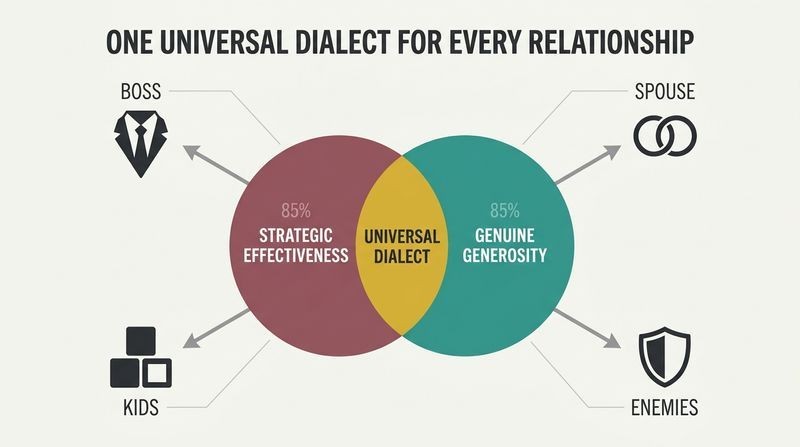
A universal dialect for relationships. Skube, a therapist and executive coach of 27 years, argues that most people believe they must become a different person in each setting: a shark at work, a softie at home, sports-talk with the guys, feelings with women. She rejects this exhausting shape-shifting. She calls her method Social Sorcery, a toolkit of communication moves that produce results anywhere without forcing you to fake a personality.
Kick butt and stay kind. Her tagline is Donald Trump marries Mother Teresa: strategic effectiveness fused with genuine generosity. The premise is that getting what you deeply want is actually good for the people around you. Suffering, she insists, is often not a personal defect but simple illiteracy in a language nobody taught you.
The claim that one communication grammar transfers across radically different social contexts is bold and partly contradicts sociolinguistics, which documents genuine register-switching (code-switching) as a competence, not a pathology. Skube's real insight is subtler: the underlying operating system (curiosity, ownership of feelings, specific requests) is portable even when surface phrasing shifts. This echoes Marshall Rosenberg's Nonviolent Communication, which similarly reduces conflict to observations, feelings, needs, and requests. The Trump-Teresa framing is memorable but dates the book; the deeper point, that self-interest and altruism need not oppose, aligns with game theory's positive-sum cooperation.
You repeat inherited scripts that fail, then repeat them harder
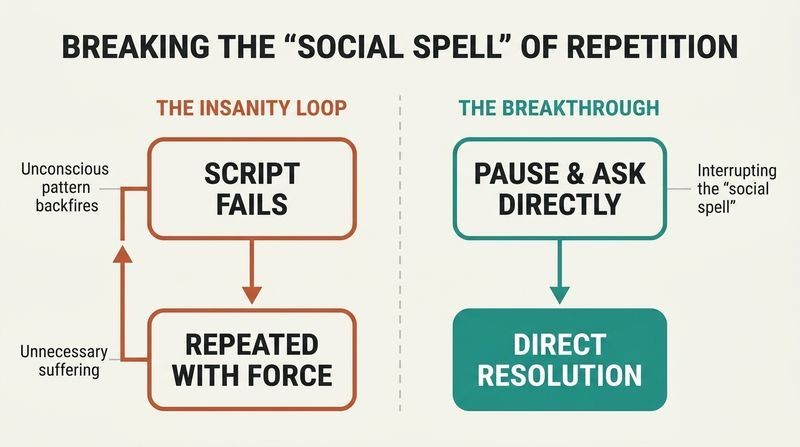
Getting off automatic pilot. Skube calls the inherited behaviors we run unconsciously social spells: patterns that feel normal and safe because our family used them, even when they consistently backfire. Jeffrey bounced through three jobs in five years, always finding bosses unsupportive, until he realized his misery was self-generated. When he finally spoke up in a meeting, colleagues listened and his boss sought him out.
Insanity is repetition with more force. The author confesses her family's championship pouting; when pouting failed as an adult, she pouted harder before learning to simply ask. She distinguishes necessary suffering (what we cannot control, which teaches compassion) from unnecessary suffering (rituals that never work). Breaking free starts with noticing your assumptions about people may be flatly wrong.
This is essentially the repetition compulsion Freud described, repackaged without jargon. Modern attachment theory backs Skube: internal working models formed in childhood become default templates we impose on new relationships. What's practically useful is her reframe of assumption-checking as the exit ramp. Cognitive behavioral therapy calls these automatic thoughts and treats them the same way, by testing them against evidence. The weakness: not all repeated bad outcomes are self-authored. Structural constraints, discrimination, and genuinely toxic environments exist. Skube's near-total emphasis on personal accountability, while empowering, can shade into blaming victims for circumstances they did not create.
Your body carries 93% of every message you send
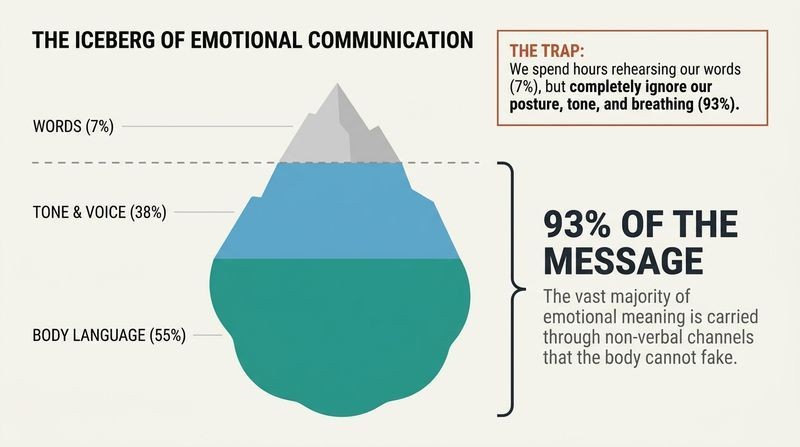
Words are the smallest channel. Citing psychologist Albert Mehrabian's classic study, Skube notes that words convey only 7% of emotional meaning, tone of voice 38%, and body language 55%. Yet we rehearse words for hours and ignore the rest. She peppers the chapter with reminders to keep noticing your breath, training what she calls a two-track mind that monitors physical sensation while thinking.
The body never lies, so read it and match it. She teaches entrainment: subtly mirroring another person's posture, pace, and pitch to build rapport and feel their emotional state from the inside. When words and body contradict (incongruent communication), trust the body. She once asked a client pounding his fist while professing love why his wife might think he was angry. He got it instantly.
The Mehrabian figures are among the most misquoted in psychology. Mehrabian studied only situations where a speaker's feelings and attitudes were ambiguous and the channels conflicted; he never claimed 93% of all communication is nonverbal. Skube reproduces the popular overreach. That said, the practical guidance is sound: incongruence between words and affect genuinely disorients listeners, a dynamic Gregory Bateson formalized as the double bind and linked to family dysfunction. Mirroring/entrainment has real support in research on the chameleon effect, where unconscious mimicry increases liking. The takeaway holds even if the exact percentage does not.
Name the feeling in one word before it hijacks you
Emotions drive the car; intellect is a passenger. Willpower fails at diets and deadlines because feelings, not logic, run most decisions. Skube's client Janet sobbed in meetings without warning; she learned to catch her body's early signals (tight stomach, burning eyes) and exit before the dam burst. The author insists you cannot be authentic or ask for what you need until you can label what you feel.
Four primary colors of emotion. Like a rainbow, feelings reduce to mad, sad, glad, and scared, with shades of intensity between irritated and furious. Corporate clients, forbidden to have feelings at work, default to blaming thoughts (Joe is undermining me) instead of emotions. Swapping the accusation for a single honest word (I'm mad) opens the door to actually solving the problem.
This maps neatly onto affect labeling, a well-replicated finding from UCLA neuroscientist Matthew Lieberman: putting feelings into words measurably dampens amygdala activity. Naming really does tame. Skube's mad-sad-glad-scared taxonomy resembles the basic-emotions research of Paul Ekman, though emotion scientists like Lisa Feldman Barrett now argue emotions are constructed, not hardwired, which would actually strengthen Skube's coaching point: richer emotional vocabulary builds richer emotional experience (emotional granularity). Her observation that workplaces pretend rationality rules while feelings secretly steer decisions anticipates the behavioral economics revolution. The gap: she offers little on regulating an emotion once named, beyond leaving the room.
Repeat people's words back before you react to them
Everyone is a customer, so listen. Skube's foundational tool is paraphrasing, which she calls Basic Ears: restating in your own words what someone just said, opened with a tag like So you're saying. Because we think at 400+ words per minute but speak at 175, our minds drift into assumptions, defensiveness, and rehearsing rebuttals. Paraphrasing forces attention and reveals the invisible warp field that distorts messages.
Advanced Ears reads the feeling. The upgrade, amplification, paraphrases the emotion beneath the words. A furious customer named John kept ranting until a rep named Patty reflected, It sounds like you're annoyed and on deadline. He deflated instantly and wrote glowing letters to three executives. Crucially, paraphrasing is not agreement; you can vehemently disagree while still demonstrating you understood.
This is active/reflective listening, formalized by Carl Rogers and central to hostage negotiation. FBI negotiator Chris Voss calls the emotion-labeling version tactical empathy and credits it with defusing armed standoffs, powerful evidence for Skube's claim that reflecting feeling calms people faster than solving their problem. The counterintuitive part, that upset people often get angrier mid-paraphrase before settling, matches the catharsis-then-de-escalation curve. One caution: mechanical paraphrasing (parroting) triggers suspicion, which Skube acknowledges with her Polly-wants-a-cracker warning. The skill's real difficulty is emotional, not technical: staying curious while your own defensiveness screams to interrupt.
Swap marshmallow words for exact behaviors you can see on TV
Tele-visioning kills vague blame. Abstract terms like respect, trust, selfish, and integrity are what a client dubbed marshmallow words: soft, mushy, and interpreted differently by everyone. Skube's fix is to describe behavior as precisely as stage directions for an actor. Instead of you're unsupportive, say I'd like you to wait until I finish before making your point. A frustrated mother replaced eat like animals with elbows off the table, one person talks at a time, utensils in hand, and the dinner wars ended.
Say I, not you. Pair Tele-visioning with I language: start sentences with your own perception, not an accusation. You are the ultimate authority on your experience, so no one can argue with I felt X, whereas You are Y invites a fight about truth.
Tele-visioning is behavioral operationalization, the same move scientists make when they turn a fuzzy construct into a measurable variable. Managers trained in giving specific, behavior-based feedback consistently outperform those trading in trait labels, because traits feel like character verdicts and trigger defensiveness, while behaviors feel changeable. This connects to Carol Dweck's growth mindset: naming a fixable action rather than a fixed flaw preserves agency. I-statements have decades of couples-therapy support (John Gottman's research). Skube's sharp addition is warning that I can smuggle in insults (I think you're a jerk), a loophole most communication books miss.
Quit power struggles by staying firm on ends, flexible on means
Control is the consolation prize, not the trophy. Skube says real power is control of yourself, never others. People who crave power over others live for power struggles; the way out is to know precisely what you want, ask for it directly, and stay willing to change your own behavior to get it. She likens insisting others adapt to you to demanding a German speaker learn English rather than learning a little German yourself. Changing your words does not change your soul.
Scripting makes mind-reading unnecessary. Imagine a magic wand: what exactly would the other person say or do that would fix this? Giselle scripted her ideal Valentine's Day (babysitter, roses at the door, a new candlelit restaurant) and her husband beamed, relieved to stop guessing. Even if you get a no, you now know what you wanted and can seek it elsewhere.
The ends-firm, means-flexible distinction is the heart of principled negotiation from Fisher and Ury's Getting to Yes: separate positions from interests. Skube's window-open-or-closed example is nearly identical to their famous library-window anecdote, suggesting shared lineage. Her claim that surrendering the need to be right multiplies power is well supported; ego-driven arguments about truth are negative-sum. Scripting resembles what therapists call behavioral rehearsal and what improv teaches as specificity. The subtle risk: scripting a partner's exact lines can tip into control if held rigidly. Skube guards against this by insisting the request is a starting point for negotiation, not a demand.
Some people want power, not love, so stop trying to convert them
Vampires venerate fear. Skube's most provocative move is naming a category of people her tools deliberately will not fix: those who want control rather than connection. Two tells give them away: they live for power struggles, and, like the mythical undead, they cannot reflect on their own behavior or meet others' needs even when asked directly. With them, only consequences (legal, financial, positional) work, never win-win reasoning.
Beware the enablers. Equally dangerous are Vampire Enablers, well-meaning people who deny that malice exists and blame victims for provoking it. She invokes the many ordinary Germans who looked away during the Holocaust, quoting Dante that hell's hottest places are reserved for those who stay neutral in moral crises. Protection begins with seeing the predator coming, not petting the scorpion.
Clinically, Skube's Vampires overlap with the dark triad (narcissism, Machiavellianism, psychopathy), and her insistence that empathy-based tools fail on low-empathy individuals is echoed by researchers like Robert Hare and George Simon, who warn therapists against assuming everyone negotiates in good faith. The framing usefully counters the self-help genre's default optimism that everyone can be reached with enough understanding. The danger cuts both ways: labeling difficult people as irredeemable Vampires can rationalize writing off anyone inconvenient and excuse one's own contribution to conflict. Skube hedges by demanding you master the basic tools first, so the label is a last resort, not a first reflex.
Ask why they want what they want, not who is right
ROAR turns fights into cooperation. For conflict, Skube offers a two-step model: Real Outcome and Affirm Relationship. The topics we fight about (laundry, money, the thermostat) are rarely the actual problem. Ask why do you want what you want of both parties. One person wants the window open for fresh air; the other wants it closed because they're cold. A space heater solves what an argument never could. Business partners Ned and Tamara stopped fighting about growth once he learned she was waiting on a loan he didn't know about.
Affirm without lying. Say something genuinely positive (I want us to work well together), set a mutually agreed time, and use behavior-based, I-framed language. Channel Columbo: dumb, curious questions extract more truth than clever accusations.
ROAR is a clean packaging of interest-based bargaining plus relationship maintenance, the two axes Gottman identifies as predicting whether couples survive conflict. His research found the strongest marriage predictor is not the absence of fighting but the ratio of positive to negative interactions (roughly 5 to 1), which validates Skube's insistence on affirming the relationship mid-dispute. The why-do-you-want-it question is the five-whys root-cause technique borrowed from Toyota's manufacturing, applied to emotion. The Columbo strategy, playing slightly dumb to lower defenses and gather information, is a documented interrogation and sales tactic; feigned ignorance disarms because it grants the other person superiority they no longer need to fight for.
Set calm consequences, never hot threats you won't enforce
Anger is an ally, not an enemy. Skube reframes rage as raw motivating energy and cites resilience research: survivors of terrible childhoods repeatedly say I got mad, and it saved my life. Anger is a finger pointing at an old wound, so trace your triggers to childhood patterns and warn people about them rather than exploding.
Imitate gravity. Consequences must be behavior-specific, stated calmly, and always followed through, unlike threats, which are impulsive and ignored. A wife who screams I'm calling my lawyer every time gets tuned out; one who calmly hands over separation papers is believed. When a subcontractor left globs of grout on Skube's tile and insisted that's how it looks in Italy, she didn't argue about who was right. She simply agreed she was picky and noted payment would wait until the work was clean. The tile got redone.
The gravity metaphor captures why consequences work better than threats: consistency and emotional neutrality signal inevitability rather than mood. This is straight operant conditioning, but Skube's insight that hot, inconsistent threats actively train people to ignore you is the part most people miss; intermittent, unfulfilled warnings are worse than none because they teach that your words are noise. Parenting research on authoritative (not authoritarian) discipline agrees: predictable, proportionate consequences beat volatile punishment. Her rehabilitation of anger aligns with emotion researchers who distinguish anger the signal from aggression the behavior. The grout story elegantly shows how abandoning the need to win the truth argument preserves leverage.
What you envy or despise in others is hidden in you
Find your insides outside. Drawing on Carl Jung, Skube argues that intense reactions to others are mirrors. The traits you passionately admire are usually strengths you own but cannot see; a manager who envied others' public speaking was himself the most eloquent in the room. The traits you vehemently hate reveal your shadow, the disowned parts of yourself. Beth's contempt for overweight coworkers masked her own undisciplined drinking; owning it led her to AA and to compassion.
Self-esteem is not a democracy. Quoting Eleanor Roosevelt, no one makes you feel inferior without consent, Skube notes that criticism only stings when it finds an inner voice that agrees. If someone said you had purple hair and you knew you didn't, you'd shrug. The barbs that enrage you are the ones a family member planted long ago.
Jung's shadow and projection are among his most empirically slippery yet experientially resonant ideas. The mechanism Skube describes, that we're fascinated or repelled by externalized aspects of ourselves, finds partial support in research on reaction formation and in the finding that homophobic hostility sometimes correlates with suppressed arousal. The Roosevelt principle connects to cognitive appraisal theory: events don't wound us directly, our interpretations do, the engine of both Stoicism and CBT. The practical genius is converting envy and contempt from dead-end emotions into diagnostic data about untapped potential and unowned flaws. The limit: not every irritation is a projection; sometimes rude people are simply rude.
Treat every conflict as a customized lesson from your Life Lab
You are a scientist, not a victim. Skube's closing frame casts life as a Life Lab that returns feedback through results. Dislike your results? Study the laws governing your experiments and change your approach. Recurring relationship problems (always working for people who exploit you, always drawn to critical partners) are not bad luck but the current course in your curriculum. Madeleine, passed over by four bosses, discovered she worked hard then waited silently for reward; when she started asking directly, she got promoted into her boss's job.
Projection replays old family movies. We screen childhood footage onto present faces, mistaking a boss's request for a parent's command. Naming the pattern lets you respond to the actual person in front of you. As one client joked, wait, the world isn't my mother?
The Life Lab reframe is essentially a locus-of-control intervention: shifting from external (life happens to me) to internal (my choices generate patterns) attribution, which correlates robustly with resilience and well-being. It also mirrors the experiential learning cycle of David Kolb: act, observe results, reflect, adjust. The projection concept is well grounded in transference, which extends far beyond the therapy room into every workplace and marriage. The book's persistent risk resurfaces here: relentless self-authorship can minimize genuine injustice and structural obstacles. Still, as a default operating stance, treating friction as information rather than persecution is among the most durable moves in applied psychology.
Analysis
Interpersonal Edge is a hybrid rarely attempted: a hard-nosed workplace communication manual fused with Jungian depth psychology and pop spirituality. Daneen Skube, a Seattle Times syndicated columnist and executive coach, brands her method Social Sorcery, deliberately courting whimsy (Vampires, spells, enchantment) to smuggle serious clinical content past readers allergic to therapy-speak. The structure moves outward in concentric rings: mastering yourself, then others, then the world.
Its intellectual backbone is more solid than the fairy-tale packaging suggests. Beneath the wands and rainbows sit well-validated techniques: reflective listening (Rogers), behavioral operationalization, I-statements (Gottman), interest-based negotiation (Fisher and Ury), affect labeling (Lieberman), and shadow work (Jung). Skube's genuine contribution is integration and translation. She insists the same skills that win a raise also save a marriage, and she supplies end-of-section toolkits that force practice rather than passive reading, a rare feature in the genre.
The book's signature tension is philosophical. Skube marries radical personal accountability (you author your own suffering, life is a lab returning feedback) with an equally strong warning that some people are irredeemable predators no amount of empathy can convert. This is unusually mature; most self-help either blames the reader for everything or promises everyone can be reached. Holding both prevents the naivete of pure positivity and the paralysis of pure victimhood.
The weaknesses are dated and definable. The Mehrabian 7-38-55 statistic is famously overstated. The Trump-Teresa framing has aged awkwardly. The spiritual register (dreams as soul letters, the universe conspiring via bumper stickers) will alienate empirically minded readers, though Skube pre-empts this by noting you needn't believe in electricity to use a drill. Her near-total emphasis on self-authorship can obscure structural constraints and occasionally edges toward blaming victims. Read as a practical grammar of relationships rather than metaphysics, it remains unusually useful, humane, and rehearsable.
Glossary
Social Sorcery
Universal communication toolkitSkube's name for her collection of communication tools and strategies designed to work in any setting, with anyone, without requiring you to change who you are. It combines strategic effectiveness with kindness, aiming to help you get what you want in ways that also benefit others. Practitioners are called Social Sorcery apprentices.
Interpersonal Edge
Competitive advantage in relationshipsThe state of relational skill and self-awareness you gain from practicing Social Sorcery. Having it means you can handle any person or situation with flexibility, staying calm and centered while choosing the most effective response rather than reacting automatically from old family patterns.
Social spells
Inherited automatic behavior patternsHabitual behaviors learned early from family, friends, or society that feel comfortable and normal but often fail to get us what we want. We repeat them unconsciously, like zombies, and impose expectations from our first relationships (family) onto everyone we meet.
Mystical abnormality
Choosing results over normalcySkube's playful term for the extraordinary effectiveness that comes from abandoning familiar-but-ineffective habits. Being mystically abnormal means choosing curiosity over being right, asking questions instead of assuming, and trying new behaviors that scare you, because normal responses (defending, blaming, withdrawing) rarely produce breakthroughs.
Tele-visioning
Describing exact observable behaviorsA tool for replacing vague abstract terms (marshmallow words like respect or selfish) with precise, concrete descriptions of behavior, as specific as stage directions for an actor. You describe what you would literally see the person doing on a TV screen, which tells them exactly what you want without triggering defensiveness.
Marshmallow words
Vague soft abstract termsSkube's label (coined by a client) for abstract words like trust, integrity, respect, or selfish whose meanings are soft and mushy, interpreted differently by everyone. Using them in conflicts guarantees misunderstanding; Tele-visioning replaces them with observable behavior.
Basic Ears
Paraphrasing the wordsSkube's term for paraphrasing: verbally repeating in your own words what a speaker just said, opened with a tag phrase like So you're saying. It forces attention, reveals distortions, and demonstrates understanding without implying agreement.
Advanced Ears
Amplifying the underlying emotionThe upgrade to Basic Ears, also called amplification. Instead of paraphrasing only the words, you reflect the feeling beneath them, for example noting that a ranting customer sounds annoyed and pressured by a deadline. It reaches the emotional core of a message and calms upset people faster than addressing content alone.
ROAR
Real Outcome, Affirm RelationshipSkube's two-step conflict model. Real Outcome: ask why do you want what you want of yourself and the other person to uncover the true underlying need beneath the surface argument. Affirm Relationship: mention something genuinely positive, avoid blame with I language and Tele-visioning, so the other person keeps their self-esteem and wants to cooperate.
Vampires
People who want controlSkube's metaphor for genuinely destructive people who crave power rather than love or connection. Two signs identify them: they live for power struggles, and they cannot reflect on their own behavior or meet others' needs even when directly asked. Empathy-based tools fail on them; only consequences work.
Vampire Enablers
Deniers who protect predatorsWell-meaning people who cannot admit evil exists and therefore help destructive people harm others, often blaming victims for provoking abuse. Like the ghouls of vampire myth, they enable predators in hopes of staying safe, but frequently become victims themselves.
Inner predator
Self-attacking internal voiceThe internal version of a Vampire: the part of us, formed by childhood wounds, that criticizes, doubts, and sabotages ourselves. It appears in nightmares as monsters or killers and drives addictive, compulsive, and self-destructive behavior. Recognizing it is necessary before you can defend against external predators.
Scripting
Stating exactly what you wantA tool that makes mind-reading unnecessary. You imagine a perfect world and specify precisely what the other person could say or do to fix a problem, then ask for it directly and neutrally. Even if refused, you gain clarity about your need and can pursue it elsewhere.
Life Lab
Life as feedback experimentSkube's frame for viewing your life as a laboratory that returns feedback through the results you get. Recurring painful patterns are not bad luck but the current lesson in your personal curriculum. Disliking your results means studying the underlying laws and changing your experimental approach.
Stop, drop, and roll
Pause-reflect-respond conflict reflexBorrowed from fire safety, Skube's memory aid for self-reflection under emotional heat. Stop the automatic negative response, drop into your feelings for a moment of reflection, then roll out a new, more powerful response after considering options, instead of fanning the flames by reacting on autopilot.
Download PDF
Download EPUB
.epub digital book format is ideal for reading ebooks on phones, tablets, and e-readers.








































