

Plot Summary
The Father Who Kept Going
Ingram1 grows up on a failing Texas farm, knowing little beyond the animals in the dirt and a father12 whose heavy legs stride past without acknowledgment. When two men in gray suits arrive from the bank, his father12 slaughters every animal, saddles the horse, and rides toward town.
He never comes back. Ingram1 and his mother13 eat the last of the chickens while the pork rots. She stops eating. Her skin breaks out in rashes. Her hair comes undone.
When the bank men return to say she has two days, she wakes Ingram1 before dawn, puts a hat on his head she says belonged to his brother14 — a brother he can't remember — and tells him to go, survive any way he can. Ingram1 walks away without looking back, turning not toward town but the other direction, into everything unknown.
Don't Trust a Smiling Man
Two days of walking have left Ingram1 sunburnt, barefoot, and half-dead from thirst. He steals meat off a stranger's plate in a roadside diner and flees. By night he falls into a ditch; by morning he wakes with bugs crawling from his mouth.
The highway rises above him on steel pillars, and beneath it he finds a tent made of tarps. Inside, a massive Black man11 pins Ingram's1 throat to the ground. When the man sees the boy is just starving, he releases him, feeds him stew and water, and delivers a warning: the world is split into black and white, Ingram1 is the luckier color, but nobody is safe.
Real kindness comes without a grin, the man says — never trust someone who approaches smiling. Then he pushes Ingram1 onward toward a city called Houston.
Naked Above Houston
Ingram1 floats naked down a river at night, losing his clothes to the current and his health to factory sewage that burns his skin green. The stream narrows into a concrete channel heading toward a black drainage tunnel.
He climbs out, finds a metal ladder, and ascends — emerging naked on the wall of a massive construction site. Below, hundreds of men work with hammers and yellow machines. A foreman named Ernie15 chases him along the wall-top while workers cheer. Ernie15 catches him, wraps him in his flannel shirt, and drives the feverish boy to a hospital.
There, Ingram1 nearly dies. In his delirium he dreams for the first time of a gray creature with red lidless eyes pressing cold against him in bed — a figure he will carry in his nightmares for years without understanding what it means.
Exit Means Out
In the hospital ward, a boy named Tab9 — older, sharp-tongued, coughing blood from polio — appoints himself Ingram's1 protector. Tab9 introduces him to two other boys, Peach and Wilson, and for the first time in his life Ingram1 has friends who look at him with interest.
The collision of their kindness with his painful memories overwhelms him; he bursts into uncontrollable tears. When a nurse threatens to send Ingram1 to reform school, Tab9 points to a red glowing sign and teaches him the word EXIT.
He bullies the reluctant Peach into surrendering his clothes. Ingram1 dresses and walks out, following exit signs down stairwells and through heavy doors until he is running barefoot between parked cars, escaping into Houston with nothing but borrowed clothes and one new word.
Ingram Meets Sinema
After stepping on broken glass and getting beaten by a group of boys, Ingram1 is rescued by the biggest among them, who walks him to a little white house. A girl named Sinema2 opens the screen door — dark-skinned, bright-eyed, exactly his age.
When their gazes lock, something shifts inside him that will never reverse. She takes his hand and leads him to Miss Maw,4 her enormous foster mother singing hymns over a sizzling stove. Miss Maw4 seats Ingram1 at the family table: fried chicken, grits, greens, and ice-cold lemonade. He weeps while eating.
That night, Sinema2 washes his wounded foot. Pa3 — her muscular, skeptical father — debates whether to keep the white boy. Miss Maw4 prevails. Come morning, Pa3 walks Ingram1 to the edge of Black Town and presses a bone-handled folding knife into his palm, meant for his dead son Martin.
Dimes and Whiskey
Sleeping under a highway tree, Ingram1 wakes surrounded by migrant workers. A truck takes them all to a corn farm, where he is given a cabin, a bed, and told he is thirteen — a lie the boss writes down because the farm will not hire children.
The work is brutal: cracking cornstalks out of the earth with his bare hands, running to catch the slow-moving tractor. His palms tear open and rebuild with calluses. By Friday he earns ten dimes. Mexican workers cheer as he throws back his first whiskey.
It burns like the river sewage, but the warmth that follows wipes away every ache. Each week the pattern repeats: work, earn, drink. The dimes flow straight from his pocket to the canteen bar. He learns Spanish from the workers' songs, but he is dissolving — waking on floors, pockets always empty.
Save Your Dimes
Jackson8 arrives at the farm carrying books and a suitcase — a writer from Massachusetts who has not put down a word in five years. He explains stories, reading, snow, and what it means to have a choice. His quiet presence at night keeps the gray creature of Ingram's1 nightmares at bay.
On the day Jackson8 leaves, he sits on Ingram's1 bed and delivers a plain warning: stop drinking, save your money, buy a truck, or die here like the rest. After Jackson8 goes, Ingram1 walks to a crooked tree at camp's edge, digs a hole with his knife, and buries his dimes in the dirt.
He never returns to the canteen. Weeks blur into months, his hidden stash growing, until a stranger in his cabin forces him to split the pile at knifepoint. Ingram1 takes what remains and walks off the farm for good.
The Thief in the Tree
Walking alone on a flat Texas road, Ingram1 is sucked into a tornado — lifted off the ground, whipped through black wind, and dropped back to earth with a shattered arm. He staggers for days without food or water, following the moon off the road and across dead grass, until he collapses beside a pond.
A white-haired man the size of a boy sits in a tree above him, watching. The man, who asks to be called Bull,6 is an escaped convict and lifelong thief raised by a Canadian houserobber. They catch bullfrogs together for supper.
That night, Bull6 wraps his legs around Ingram,1 grips the broken arm, and twists the bones back into alignment. When Ingram1 wakes, his arm is splinted with sticks. Bull6 hands him a compass and his leather jacket, leads him to a roadside diner, and charms a waitress named Marion7 into free burgers and a motel room.
Up Down, Up Down
That night, police come for Bull.6 He runs shirtless into the dark and is clubbed unconscious. Marion7 — the green-eyed waitress he charmed — takes Ingram1 in, feeds him daily from the diner, and one evening throws a cowboy novel at him. When she discovers he cannot read, she sits him down with a pencil.
The letter M: up down, up down. Night after night they lie in her bed as she traces words with her painted fingernails and Ingram1 sounds them out. He copies entire chapters of Mighty Mike onto waitress pads in tiny handwriting.
She teaches him the difference between fiction and reality — that women know which is which even when men refuse to. Reading puts what she calls sugar in the mind. Weeks pass, his arm heals, and when Marion7 meets a new man, she cuts Ingram's1 hair, teaches him to hitchhike, and sends him south.
The Ketchup Boy
Hitchhiking south, Ingram1 walks into Tannersville — empty streets, charred fields, silence everywhere. A toxic dumping from a freight ship has killed or evacuated the population. In the diner kitchen, a tiny blond boy named Kyle10 sits on the floor eating ketchup by the fistful, his father dead, his mother vanished.
Kyle10 rages at everything in a furious Texas drawl, including Ingram1 asking his name. They set off walking together, Kyle's10 small legs clapping on the pavement, his mouth never stopping. When Kyle10 collapses, Ingram1 hoists him onto his back.
At night he reads aloud from his copied Mighty Mike pages — and when the story runs out, he invents new adventures, discovering a capacity for storytelling born from needing to put a smaller boy to sleep. Caring for Kyle10 reorganizes Ingram's1 mind: for the first time, someone else's needs come before his own.
Sinema, Three Years Later
Ingram1 and Kyle10 stumble into New Austin — a gleaming, silent city of electric cars and color-coded segregation. Police chase them. A plainclothes officer from Old Austin collects the boys and reunites Kyle10 with his mother.
Ingram1 watches through a car window as Kyle10 is carried away, realizing he never told the boy his name. Standing alone on the sidewalk, he hears a familiar voice. Sinema2 is there — wider-faced, fuller-bodied, studying engineering at a college nearby. They share cheeseburgers and Cokes.
He tells her about the tornado; she laughs at his description of a black wind-tree. But when he asks to stay, she says plainly she cannot take care of him. That night Ingram1 sleeps between garbage cans across from her house, dreaming of the gray creature, wishing reality were something other than itself.
Soldier Behind the Wheel
A freckle-faced man named Bart5 picks Ingram1 up in a rusted white car heading south. Bart5 talks constantly — about his brother lost to the army, about fuel systems and pistons, about staying cool.
He teaches Ingram1 to drive on an empty highway, easing off the brake and onto the gas until the car becomes an extension of his body. At truck stops they eat spaghetti with chili and orange soda. Bart5 buys him a dictionary and a copy of Moby Dick, gives him his favorite yellow shirt, and starts calling him soldier.
When the oil company demands a last name, Bart5 registers Ingram1 under his own — Grover — making them brothers on paper. At the roadside he dismantles his car's dead engine piece by piece, teaching Ingram1 the mechanical gospel that will become his livelihood.
Black Fog and Iron
The oil fields exist in permanent artificial darkness — black fog low enough to swallow faces, machinery screaming without pause. Ingram1 works as a nut hugger, wrapping his body around drill pipes, holding giant wrenches steady as valves open against the earth's pressure.
Missing fingers and missing arms surround him everywhere. When a supervisor asks for engine mechanics, Ingram1 volunteers, fixes a dead motor, and earns a promotion. Machines speak to him as words never could. Pa3 — Sinema's2 father — arrives to work the drills, barely recognizes the oil-blackened boy, and starts sharing lunches with him.
Meanwhile Bart5 sinks into silence. One night he climbs into Ingram's1 bed just to sleep beside another person. The next morning, ashamed, he warns Ingram1 to fight off any man who does that — and stops speaking to him entirely.
The Pipe Bursts
Ingram1 calls Bart's5 name across the drill floor. Bart5 looks up from a shaking pipe. Their eyes meet for less than a breath. The pipe bursts, spraying a chunk of iron into Bart's5 chest, splitting him nearly in two. Oil catches a spark.
Bart5 burns — skin blue, clothes orange — screaming in a voice that no longer sounds human. Weeks later, while Ingram1 cleans engine parts at his workbench, a white flash swallows the world. A phosphorous explosion kills ninety-seven men and destroys the entire oil field. Jelly,16 a one-armed veteran, drags survivors out in an asbestos suit.
Ingram1 wakes weeks later in an Austin hospital, his back and legs rebuilt from charred flesh, his ears concussed, his mind temporarily emptied of everything — memory, feeling, thought. He stares at the ceiling and thinks about nothing at all.
Sinema's Ultimatum
In the hospital cafeteria, Ingram1 spots Sinema2 crying over a tray of food. Pa3 lies upstairs in pieces — hands gone, face burned past recognition. He dies days later. A lawyer named Erica20 secures Ingram's1 earned wages: two thousand dollars in cash.
She gives him Emily Dickinson's poems, calls him a poet for the way he describes his pain. When Sinema2 visits, Ingram1 blurts out a proposal — he wants to marry her, buy a truck, raise babies. She refuses. Whites and blacks do not marry in this world, she says, and besides: what kind of man ignores his own mother?
Does he not wonder whether she is suffering alone somewhere? Sinema2 pushes his forehead upright and tells him plainly: reality is what you make real. For the first time, Ingram1 has a purpose beyond survival.
The Devil Remembers
Ingram1 rebuilds a dead yellow truck with his own hands. He drives Sinema2 home to Miss Maw's,4 trading Pa's knife for her dictionary. Then he returns to his collapsed childhood home. At the Liberty town hall, a clerk reads him a folder: his name is Ingram Kessler. His brother Albert14 died of pneumonia when Ingram1 was six.
He finds his father12 crumpled outside a bar, hauls him to a motel, and pours whiskey until the truth spills. His father12 calls him a devil — the boy who lay beside Albert14 in his deathbed and survived while the family's light went out.
Drunk on the dregs, Ingram's1 sealed memories rupture: Albert's14 freckled grin, their games by the pond, the night death crawled into their shared bed. The gray creature was never a phantom — it was his brother's death, walled off by a six-year-old mind. Ingram1 weeps freely. The creature vanishes. He loads his father12 into the truck and drives east toward his mother.13
Analysis
Ingram1 examines what happens to a human consciousness that forms itself almost entirely through deprivation. The protagonist begins with fewer cognitive and emotional tools than almost any fictional character — no literacy, no family structure, no understanding of race, class, money, or his own body. Every encounter across his picaresque journey functions as a tutorial in some dimension of being human: the Mountain11 teaches that water matters more than food; Tab9 teaches that a child can refuse; Marion7 reveals that marks on a page contain other people's thoughts. What makes the novel remarkable is not the accumulation of these lessons but Ingram's1 method of absorption: he learns through his body first — hunger, pain, warmth, the grip of another hand — and his intellect follows.
The repressed memory of Albert14 operates as the novel's structural engine, hidden in plain sight. The gray creature haunting Ingram's1 dreams is not gothic decoration but a psychological portrait of childhood dissociation: a six-year-old's mind sealing away the night his brother died beside him. Every subsequent relationship Ingram1 forms — with Tab,9 Bull,6 Kyle,10 Bart5 — is an unconscious attempt to reconstruct the fraternal bond that was destroyed and buried. That Ingram1 cannot remember Albert's14 face yet reaches instinctively for every brother-figure he encounters is the novel's most devastating irony.
Louis C.K.'s decision to set the story in a near-future America — where cities split into new and old, where meat is outlawed and reinstated, where highways are left to crumble while electric cars hum through segregated enclaves — creates a world just strange enough to estrange familiar injustices. Poverty, racism, and child abandonment persist unchanged through technological transformation, revealed as permanent features of the American landscape rather than problems of any single era. The novel argues, through Ingram's1 accumulating journey, that the only counter to a world that does not care is the stubborn decision to care anyway — to carry someone smaller on your back, to fix what is broken, to drive toward the person who needs you rather than away from the pain you cannot face.
People Also Read

Characters
Ingram
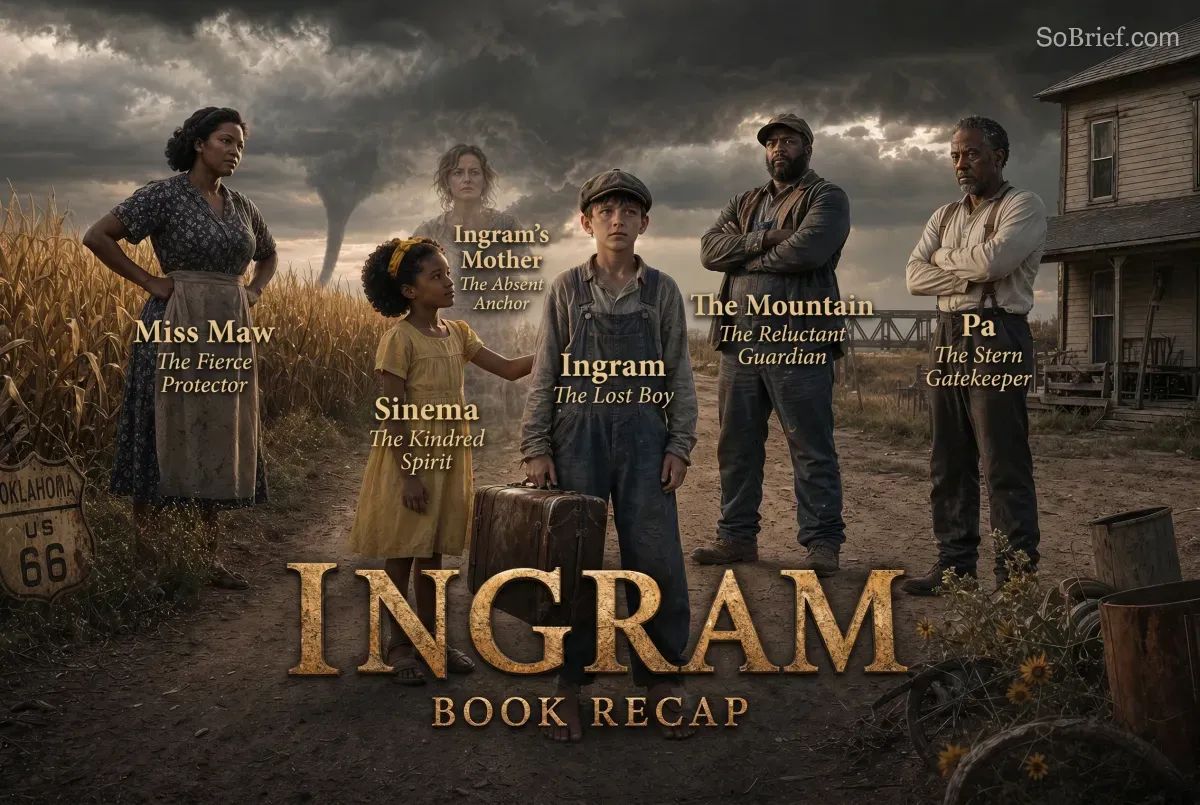
Feral boy finding his nameThe narrator, cast out of his home at nine years old with no education, no surname, and no understanding of the world beyond a failing farm. Ingram's psychology is shaped by radical deprivation—emotional, intellectual, material. He has never been taught to read, never sat at a dinner table, and has been beaten into a learned helplessness that makes him absorb violence without resistance. Yet beneath his ignorance lies a startling capacity to observe, absorb, and grow. He processes the world through his body first—hunger, pain, warmth, the grip of another hand—and his mind slowly follows. His emotional development unfolds through each person who briefly cares for him, each encounter building one more layer of a self that was never properly constructed. He is driven not by ambition but by the biological imperative to keep moving forward.
Sinema
Ingram's moral compassIngram's1 deepest human connection, first met as a girl his age at Miss Maw's4 house in Houston's Black Town. Sinema possesses an emotional intelligence that cuts through Ingram's1 confusion with gentle precision. She laughs easily but sees clearly. Where others pity him or use him, Sinema treats him as an equal while refusing to become his caretaker. Her own struggle—chosen by her father3 to attend college over her resentful sisters, bearing the guilt of opportunity—mirrors Ingram's1 isolation in subtler form. She studies engineering not from passion but necessity, sacrificing her love of literature for practical survival. Sinema functions as the person who repeatedly challenges Ingram1 to stop wandering and take responsibility for what he owes, not just what he wants.
Pa
Knife-giving, reluctant fatherSinema's2 father and Miss Maw's4 husband, a powerfully built Black man whose body is armor forged from a lifetime of labor. Having raised seven sisters after his own father's death, Pa carries the weight of sole provider with weary pride. His skepticism toward Ingram1—a white boy at his table—coexists with a rough tenderness that surfaces when he presses a knife meant for his dead son into the boy's hand. He wanted one thing: a strong son. Life gave him eight girls and one frail boy who did not survive.
Miss Maw
Matriarch who takes in straysThe matriarch of a Houston household full of foster girls, Miss Maw is enormous in body and spirit—a woman whose singing fills the kitchen and whose cooking fills the soul. She takes in strays of every kind, driven by Christian love and the grief of losing her son Martin. Her warmth is unconditional but her authority is absolute. The only kiss Ingram1 remembers receiving in childhood comes from her lips on his forehead.
Bart
Brother in yellow, engine teacherA freckled, fast-talking mechanic heading back to the oil fields he swore he would never return to. Bart becomes Ingram's1 closest companion—teaching him to drive, gifting him a yellow shirt, registering him under his own surname, calling him soldier. Beneath his studied coolness lies a man running from a failed marriage and a brother consumed by the army. Bart's mechanical knowledge becomes the seed of Ingram's1 livelihood, but his inner weakness manifests as depression and withdrawal that he cannot name or escape.
Bull
Thief with a compassA diminutive, white-haired escaped convict raised by a Canadian house thief who stole his mother at gunpoint. Bull moves through the world as pure momentum—stealing, charming, running. He splints Ingram's1 broken arm with sticks, gives him a compass and leather jacket, introduces him to cheeseburgers, and demonstrates that a man can be both kind and criminal. His capture by police is swift and inevitable, but his gifts travel further than he ever will.
Marion
Waitress who unlocks literacyA diner waitress with green eyes, painted fingernails, and a fierce intelligence she considers wasted on her circumstances. Educated by a bitter mother who believed schooling could change a woman's lot, Marion discovered that reading was the only real reward. She teaches Ingram1 to read and write with impatient brilliance, lying beside him in bed tracing letters. Her cynicism about men masks genuine care, and her understanding that women bear truth while men cling to their own fictions becomes one of Ingram's1 foundational insights.
Jackson
Blocked writer, pivotal advisorA failed writer from Massachusetts who arrives at the corn farm carrying books and an empty pen. Jackson introduces Ingram1 to the concepts of stories, choices, and the gap between seeming and being. His inability to write mirrors Ingram's1 inability to articulate his own experience. His parting advice—stop drinking, save your dimes, buy yourself a truck—becomes the hinge on which Ingram's1 farm years pivot from dissolution toward purpose.
Tab
Hospital rebel with backboneA sharp, sickly boy in the Houston hospital who appoints himself Ingram's1 protector. Coughing blood from polio, Tab projects toughness to mask his own terror. He teaches Ingram1 the word EXIT, introduces the radical concept that a child can refuse an adult, and orchestrates Ingram's1 escape when reform school threatens. He silences the ward with a word and gives away what little he has.
Kyle
Furious small boy, first chargeA tiny, furious blond boy found eating ketchup alone in an abandoned diner after toxic contamination kills his father and scatters his town. Kyle rages at everything in a broad Texas dialect, demanding the world acknowledge him. Caring for Kyle teaches Ingram1 responsibility—carrying the boy on his back, reading him stories, inventing new ones when the book runs out. Kyle's helplessness reorganizes Ingram's1 priorities: for the first time, someone else's survival matters more than his own.
The Mountain
First guide beneath the highwayA massive Black man living in a tarp tent beneath the Houston highway. Having been cast out by his own mother as a child, he recognizes Ingram's1 situation instantly. He nearly strangles the boy, then feeds him, teaches him that water matters more than food, and delivers the warning that echoes through Ingram's1 journey: never trust a smiling man, because real kindness arrives without performance.
Phillip Kessler
Absent father, broken manIngram's1 father—a large, silent man whose back is the only part of himself he shows his son. Once capable of fixing roofs and raising animals, Phillip collapses under financial ruin and a private grief he cannot articulate. His violence is reflexive rather than strategic—he hits when bothered, withdraws when overwhelmed. He banishes his surviving son to the shed and eventually abandons his family entirely, trading fatherhood for whiskey.
Sarah Kessler
Mother who lets goIngram's1 mother—a worn, quiet woman who feeds her family until nothing remains, then feeds only her son. She sends Ingram1 away as a final act of desperate love, knowing he will die if he stays.
Albert
The brother in the hatIngram's1 older brother, invoked once through a hat and whose absence haunts the novel like a shape beneath dark water. His existence lives in Ingram's1 earliest, most inaccessible memories.
Ernie
Foreman who carries the boyA thick, muscular construction foreman who discovers a naked, feverish boy on a wall and carries him to the hospital—one of the few adults who acts on compassion without being asked or obligated.
Jelly
One-armed oil field survivorA cheerful, one-armed oil field veteran who drives a forklift and jokes that losing a limb is the luckiest thing that can happen to a nut hugger. His fatalism masks a survival instinct that saves lives when disaster strikes.
Pete
Mechanic with a dying tradeA proud Black gas station owner who teaches Ingram1 brake repair and gives him the space to rebuild a yellow truck. Independent and practical, he runs the business his father started, knowing it will end with him.
Marshall
Elder worker on the farmAn elderly Black migrant worker with white hair who advises Ingram1 on the corn farm—teaching him to hide his money, save food for lunch, and never show anyone what he has.
Beth Anne
Resentful eldest foster sisterMiss Maw's4 tallest and angriest foster daughter, whose resentment of Ingram1—seated at the head of the table for being white—voices the racial tension simmering beneath the family's Christian generosity.
Erica
Lawyer who sees a poetA bald female lawyer who secures Ingram's1 oil field wages and, struck by his way of describing pain, gives him Emily Dickinson's poetry and tells him he is a poet—planting a new way for him to understand language.
Plot Devices
The Gray Creature
Embodies repressed childhood traumaA recurring figure in Ingram's1 fever dreams and nightmares—a cold, snail-skinned creature with red, lidless eyes that presses against him in bed, draining his warmth. First appearing during a childhood illness, the creature claims to be his coming death. It visits whenever Ingram1 is most vulnerable: sick in hospitals, alone in oil fields, sleeping between garbage cans. As Ingram1 grows stronger and more connected to living people, the creature recedes. Its true nature is the memory of lying beside his dying brother Albert14 as a six-year-old, watching death enter the boy's body—a trauma so overwhelming that Ingram's1 child-mind sealed the entire memory away, transforming it into a recurring phantom. The creature vanishes permanently only when Ingram1 recovers the memory it was built to contain.
Pa's Folding Knife
Inherited fatherhood, passed onA bone-handled folding knife that Pa3 gives Ingram1 at the edge of Black Town, originally intended for his dead son Martin. The knife becomes Ingram's1 sole means of physical protection across years on the road—he grips it nightly in his pocket, threatens a stranger to split his stolen dimes, and holds it before police in Austin. Beyond utility, the knife carries the transferred weight of fatherhood: Pa3, unable to give it to his own boy, passes it to one who has no father. When Ingram1 ultimately gives the knife to Sinema2—Pa's3 surviving daughter, now shouldering the family—the object returns to the bloodline it was meant for, transformed from a weapon of defense into an emblem of care.
Bull's Compass
First tool for choosing directionA fat, coin-shaped compass that pops open to reveal a directional needle. Bull6 gives it to Ingram1 along with his leather jacket the night police capture him. The compass becomes Ingram's1 most reliable tool, guiding him off roads and across open Texas grassland—toward Austin, through orange groves, around obstacles that would otherwise trap him. It represents the shift from aimless wandering to directed movement. Where the Mountain11 pointed Ingram1 toward Houston and Pa3 pointed him away from Black Town, the compass allows Ingram1 to choose his own heading for the first time, turning survival into navigation.
Mighty Mike, Showdown in Silverado
Gateway to literacy and inventionA cheap cowboy novel Marion7 uses to teach Ingram1 to read. He copies entire chapters onto waitress pads in tiny handwriting, creating a portable library he carries across Texas. When he meets Kyle10, the copied pages become bedtime stories—and when the text runs out, Ingram1 begins inventing new Mighty Mike adventures, discovering his capacity for narrative creation. The fictional cowboy wandering from town to town mirrors Ingram's1 own journey, but where Mike carries a gun and a guitar, Ingram1 carries a knife and a pencil. Marion7 tells him the arranged words put sugar in your mind, planting the seed for the poetry Ingram1 will later discover through Emily Dickinson.
The Yellow Truck
Freedom built from nothingA broken-down yellow pickup found at Pete's17 gas station in Austin, leaning on two flat tires with a mouse nest in the engine. Ingram1 buys it for a hundred dollars and rebuilds it using every mechanical skill he has accumulated—from Bart's5 roadside engine lesson to the oil field repair bench. The truck is the concrete fulfillment of Jackson's8 advice to save dimes. When its engine turns over for the first time, it becomes the first thing Ingram1 has ever made work from nothing. It carries him back to his childhood home on Draper Road, then east with his father12 toward his mother13—transforming from an object of personal desire into a vehicle for responsibility.
Download PDF
Download EPUB
.epub digital book format is ideal for reading ebooks on phones, tablets, and e-readers.








































