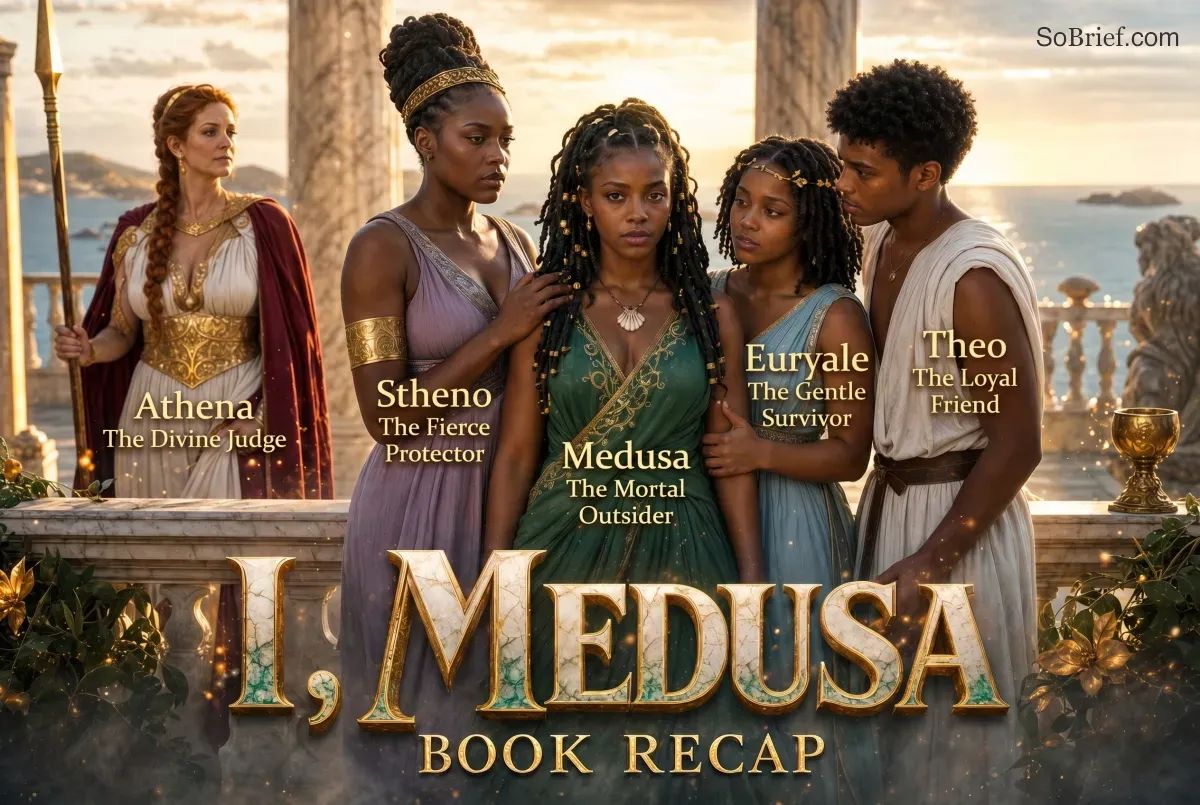


Plot Summary
Prologue
A woman enters a crumbling seaside temple at midnight. She offers herself as payment for a blessing she does not need, luring an old priest into intimacy. When he asks her name, she loosens her head wrap instead. Ink-black serpents uncoil from her scalp, and her eyes flash yellow.
The priest calcifies to cold gray stone beneath her, mouth still open mid-word. She sits atop his corpse and wonders how many more men she will kill before the rage is sated. Her name is Medusa,1 and she has become the very monster she was made into — the story tracing back to the girl she used to be, long before the snakes, the stone, the fury.
Mortal Girl, Immortal Cage
Medusa1 is seventeen, the youngest daughter of two ancient sea deities confined to a remote island. Her older sisters Stheno2 and Euryale3 are immortal and bleed golden ichor; Medusa1 bleeds red, and no one knows why. Their mother Ceto8 swings between wine-soaked tenderness and violence — she throws a goblet at Euryale's3 face for a mild suggestion, then cradles her and apologizes.
Their father Phorcys9 treats his daughters as political currency, choking Ceto8 when she questions him. Medusa's1 only true comfort is Theo,6 a mortal slave who washed up on the island as a child and shares her impossible dream of leaving. All three sisters are bound by the same quiet desperation: to escape this island, this family, this life where even love draws blood.
The Sea King Smiles
Medusa's1 parents host a spring feast, hoping to parade their daughters before potential suitors. The room buzzes when Poseidon,4 the most powerful god in the Sea Court, arrives uninvited.
He moves through the crowd like a panther through a jungle — charismatic, untouchable, drawing everyone closer while keeping them at arm's length. When Phorcys9 introduces his three daughters, Poseidon4 calls them beautiful and addresses Medusa1 by name. Something like a hundred hummingbirds takes flight inside her chest.
But across the hall, Queen Amphitrite12 finds Medusa1 and asks pointed questions about what qualities make a good husband. When Medusa1 glances involuntarily at Poseidon,4 the queen catches it. Her final look carries anger, recognition, and something worse: pity.
Maheer Chooses His Bride
Prince Maheer11 — a mortal bastard of the war god Ares — arrives to select a wife. He leads a massive lion onto the lawn and commands it to obey, impressing Medusa's father.9 He picks Euryale.3 But Stheno2 pulls Medusa1 aside and directs her attention to the prince's slaves: gouged eyes, missing fingers, amputated limbs. The lion was not trained through skill — it was fed human flesh.
When Euryale3 privately reveals that Maheer11 struck her the night before and tore her dress, Medusa's1 worst fears solidify. Euryale3 still wants to marry, because marriage means escape from the island. Medusa1 watches her sister weigh captivity against violence and choose the violence, and in that moment vows to stop it.
The Goblet and the Skull
Medusa1 steals gems from her mother's8 trove and visits Maheer's11 chamber at night, offering sapphires in exchange for rescinding his proposal. He refuses — his homeland overflows with precious stones. Then his eyes change. He tells her she is just the age he likes, orders her to undress, and pins her against the wall.
She smashes her wine goblet into his face. Blinded and screaming, he stumbles backward, trips on a pelt, and cracks his skull against a table corner. He dies with his eyes open. Medusa1 flees into the dark, leaving behind the gemstones and a carving knife Theo6 had given her — evidence that, come morning, will nearly condemn her best friend.
Valor Earns an Escape
Athena5 arrives to investigate and finds two goblets, the gemstones, and Theo's knife in the dead prince's chamber. Theo6 was the last person to deliver wine there. Terrified for him, Medusa1 goes to Athena5 and confesses everything. The goddess is not angry — she is intrigued. She asks how it felt to strike Maheer,11 and Medusa1 admits it felt good.
Instead of punishment, Athena5 offers something unimaginable: a place as an acolyte at her temple in Athens. Before Medusa1 departs, her mother8 visits her bedchamber sober and whispers a warning. After a great ancient war, Athena5 hunted perceived threats to Zeus's15 throne with gleeful brutality. The worst monsters, Ceto8 says, do not bother hiding in the dark.
Riddles, Braids, and Belonging
Hermes,14 the messenger god, flies Medusa1 to Athens, where the city's scale and chaos stun her. At the temple, a blond acolyte named Kallisto10 grabs her hair uninvited and calls her a filthy foreigner. Another acolyte, Apollonia7 — from a legacy priestess family — defends Medusa1 by invoking a divine vision. They form an instant alliance.
The first test silences all acolytes with a potion, then poses a riddle whose answer is time. Medusa1 helps Apollonia7 by creating a diversion with the hourglass. For the second test, knowing no weaving or embroidery, Medusa1 braids her own locs into an elaborate crosshatched pattern and presents hair braiding as her craft. The priestesses accept it. Four of ten acolytes remain.
The Boy Was a God
A kind, handsome boy keeps finding Medusa1 in Athens — helping her locate the temple's escaped owl, paying a vendor when she is nearly arrested, walking her home at night and validating her anger when no one else will. On the night of the Panathenaia festival, Medusa1 and Apollonia7 sneak into the city to celebrate. They drink, dance together, then separate.
When a man accosts Medusa1 near a public latrine, the boy intervenes and transforms. His body blazes with divine light, a golden trident materializes, and his voice becomes a living storm. He is Poseidon.4 The attacker flees. Walking Medusa1 home, the sea king tells her mortals are like flowers — fragile but more beautiful for being real. Then he kisses her.
Apollonia Screams for Mercy
The morning after Panathenaia, Medusa1 finds Apollonia7 at the Acropolis gates — chiton torn, bruised everywhere, limping. While searching for Medusa1 in the city, she was assaulted by soldiers. She begs Medusa1 to tell no one. But Kallisto10 overhears and threatens exposure.
Medusa1 kisses Kallisto's10 feet to buy silence; Kallisto10 tells the high priestess13 anyway. Apollonia7 is expelled for violating her chastity oath — the temple cannot keep girls who lack sound judgment, Athena5 declares, blaming Apollonia7 for putting herself in danger.
Apollonia7 screams and claws as priestesses drag her away. Medusa1 punches Kallisto10 until she bleeds. Taken to Athena5 afterward, Medusa1 learns for the first time what sex even is — her parents and sisters never explained it.
Five Children Taken
Home for a visit, Medusa1 finds her mother8 on the coastal rocks communing with an enormous sea creature — one of Ceto's8 ancient pets. In a rare moment of sobriety, Ceto8 names the children no one told Medusa1 about: three daughters born sharing a single eye, a girl with a serpent's tail, a son she calls her most beloved.
After the Gigantomachy, Zeus15 declared these children threats, and Athena5 came for them all. Medusa1 remembers that Athena5 asked about other children during their very first meeting on the island — the goddess already knew. The woman who praised Medusa's1 valor and offered her Athens had ripped apart this family long before. A new crack opens in the foundation of everything Medusa1 has built.
Blue Flame, Sacred Vows
Back in Athens, only three acolytes remain. A woman flees to the Acropolis pursued by soldiers, begging for sanctuary. Kallisto10 steps aside. The third acolyte runs for help. Only Medusa1 stands between the soldiers and the fugitive, cracking a broom across one soldier's face. The high priestess13 reveals the woman was Athena5 in disguise — the third test was courage.
Kallisto10 and the other girl are dismissed. That night, Medusa1 takes her vows: loyalty, obedience, and chastity. Her candle flame turns vivid blue. She is anointed a priestess of Athena.5 Meanwhile, Poseidon4 resumes visiting her on Athens's beach. He confesses the miracles attributed to Medusa1 — a healed child, a convenient rainstorm — were his doing, engineered to elevate her.
He Didn't Stop
At the autumn feast on her island, Medusa1 dances magnificently and drinks Olympian wine — a divine brew far more potent than any mortal vintage. Dizzy and disoriented, she reconciles briefly with Theo,6 then encounters Poseidon4 in the corridor. She leads him through the garden. They kiss on the grass.
But when she spots an owl's eyes in the olive tree and remembers her sacred vows, she whispers that she cannot do this. Poseidon4 pins both her arms above her head with one hand and pushes inside her. She cries out. He does not look at her face; his eyes glaze and his mouth hangs slack as he moves. When it is over, she stares blankly at the stars, something wet slicking her thighs.
Locs Fall, Theo Turns to Stone
Athena5 discovers them and punches Poseidon's4 jaw hard enough to crack bone. He retaliates by forcing her to her knees, threatening to violate her if she ever strikes him again. Then Athena5 drags Medusa1 by her hair before Zeus15 and the entire assembly. Poseidon4 lies smoothly, claiming Medusa1 pursued him, begged for it.
Zeus15 asks if she said no; drunk and shattered, she cannot remember the word leaving her mouth. Athena5 touches Medusa's1 scalp. Her locs — her pride, her deepest connection to her sisters — fall to the floor as living serpents erupt in their place and her eyes turn sulfur yellow. Theo6 charges forward to help. Their eyes meet. He turns to gray stone mid-stride, face frozen in terror. Medusa1 flees.
The Island Fills with Statues
Under a willow tree, Stheno2 and Euryale3 find Medusa1 — they have been cursed too, Stheno2 for calling Athena5 a hateful bitch, Euryale3 for crying out in anguish. Their parents have fled. But the sisters teach Medusa1 what they have already learned: the petrifying gaze activates only when willed, and they are stronger and faster than before.
When ships begin arriving — adventurers, conquerors, fortune hunters — Stheno2 leads the defense. She and Euryale3 grow to relish the killing, herding men across the sand and sporting with their terror. Medusa1 participates but holds something back. When a young boy arrives alone to slay the Gorgons, she tries to spare him. Stheno2 turns him to stone first. Medusa1 carries his body into the sea.
Apollonia Among the Statues
Among the crew of an Egyptian merchant who wants to hire the Gorgons as assassins, Medusa1 spots a figure she never expected to see again: Apollonia,7 gaunt and short-haired, reduced to the merchant's property. The sisters kill the merchant and his men. Medusa1 follows Apollonia7 down the beach and reveals herself — her friend never knew she came from this island.
She tends Apollonia's7 wounds, feeds her, gives her a bed. Over weeks, grief and tenderness intertwine until they share more than shelter. Apollonia7 shows Medusa1 a gentleness she has never known, asking permission before every touch. But she also delivers a warning: every time Medusa1 kills, a little less of her comes back.
One Last Kill in Cyrene
Medusa1 and Apollonia7 sail to Cyrene and build a quiet life at a tavern — sunsets, wine, dancing, love. Then women at the market tell Medusa1 about a priest of Athena5 who exploits young girls, impregnating a fifteen-year-old who came seeking blessings. Apollonia7 begs her not to act, not to destroy the peace they have built. Medusa1 promises she will not.
That night, she slips sedative powder into Apollonia's7 wine, goes to the temple, and turns the priest to stone — the scene from the book's opening. At dawn, three boys witness her dragging the statue to shore, snakes exposed. She flees alone by boat to protect Apollonia,7 rowing until hallucinations come and her mother's8 sea creatures carry her home.
No More Tools, No More Gods
Washed up on her island's shore, Medusa1 finds Athena5 waiting. The goddess offers a new purpose: become her instrument against the wicked, travel the world, punish those who deserve it. It is everything Medusa1 once wanted — freedom, purpose, the wider world. But she recognizes the shape beneath the offer. She would still be a tool, still serving someone else's will.
She tells Athena5 she wants nothing more from her. Athena5 warns that her death will be brutal. Medusa1 replies that there are worse things than death, then walks away without looking back. That night, she sits on the shoreline between her sisters,2 humming a wordless song. She is only eighteen, but she has already held many purposes. Discovering new ones will be enough.
Epilogue
Euryale3 finds Medusa's1 headless body at dawn. A hero armed by every Olympian — Hades'15 cloak of invisibility, Hermes'14 winged sandals, Hephaestus' sword, Athena's5 bronze shield to deflect the lethal gaze — crept in while she slept.
Stheno2 tears trees from the earth and turns every remaining slave to stone. The sisters build a raft and hunt the killer across continents for years but never find him or recover their sister's head. Over centuries, the old gods lose their worshippers and fade. Even Zeus15 disappears.
But Stheno2 and Euryale3 endure — they are not goddesses dependent on faith. They sit on their island's shore forever, watching poets reinvent their sister as maiden, mistress, monster, legend, always saving a place between them for the girl they simply called Meddy.
Analysis
I, Medusa interrogates the architecture of power not as abstraction but as the specific machinery by which institutions protect predators while punishing their victims. Ayana Gray structures the novel so that every authority figure who offers Medusa1 safety eventually demands ownership in return. Phorcys9 offers fatherly approval contingent on political utility. Athena5 offers purpose contingent on obedience and chastity. Poseidon4 offers love contingent on access to her body. The pattern illuminates how systems of power manufacture the illusion of choice while eliminating real alternatives.
The novel's most uncomfortable insight concerns institutional complicity. Athena5 is neither ignorant of nor indifferent to sexual violence — she understands it perfectly. She expels Apollonia7 not because she believes the girl immoral, but because the assault reflects poorly on the temple. When she discovers Poseidon4 with Medusa,1 her fury is proprietary, not empathetic. The curse is not divine justice but reputation management — punishing the victim because the perpetrator is untouchable. This dynamic mirrors how institutions from religious orders to universities have historically responded to sexual assault: protecting their brands at the expense of survivors.
Gray also complicates the revenge narrative. Medusa's1 rage is legitimate, earned through repeated violation. But the novel refuses to let righteous anger become its own justification. Apollonia7 serves as the moral counterweight, arguing that rage consumed without restraint does not avenge — it only destroys. Medusa's1 final choice, rejecting Athena's5 offer to weaponize her fury, is the novel's thesis distilled: power derived from someone else's purpose is just another form of servitude.
Perhaps most powerfully, the novel reclaims Medusa's hair as the site of her identity. In classical myth, the snake hair is horror. Here, hair is love — sisters braiding each other, oil massaged into scalps, golden cuffs placed with care. The curse's cruelty lies not in the snakes themselves, but in destroying the tenderness they replaced.
Review Summary
I, Medusa by Ayana Gray receives overwhelmingly positive reviews, with readers praising it as an exceptional feminist retelling that explores themes of power, trauma, and feminine rage. Reviewers appreciate Gray's portrayal of Medusa as a sheltered 17-year-old girl whose transformation into a "monster" reflects broader issues of sexual assault and victim-blaming. The book features a Black protagonist with locs, adding cultural depth. While most praise the gorgeous prose and character development, some wished for more content about Medusa's life after transformation, feeling the ending was rushed.
People Also Read





Characters
Medusa
Mortal daughter of sea godsThe sole mortal daughter of two ancient sea gods, Medusa bleeds red where her immortal sisters bleed gold—a biological fact that has shaped her self-perception since childhood. Intellectually gifted and self-taught in four languages from shipwrecked scrolls, she masks deep insecurity beneath curiosity and determination. Her defining psychological pattern is a cycle of helplessness and explosive anger: she absorbs injustice until something snaps, then acts impulsively and deals with consequences after. She craves recognition from authority figures—parents, mentors, powerful admirers—yet each figure who offers validation ultimately demands ownership in return. Her journey is one of discerning the difference between being valued and being used, between righteous anger and destructive rage. Her locs are her most treasured possession, symbolizing her bond with her sisters2.
Stheno
Eldest immortal sisterThe eldest of three sisters, Stheno is candid to the point of cruelty and protective to the point of ferocity. She masks deep emotional sensitivity behind an imperial exterior, dispensing hard truths because she considers lies a greater cruelty. Her worldview—that all men are cruel, that power is never given but taken—stems from a lifetime watching her father9 abuse her mother8. She is the sister who identifies the lion's true nature, who understands the politics of violence before anyone else. Where Euryale3 softens the world for Medusa1, Stheno sharpens her for it. Her love language is preparation: she braids hair, states uncomfortable truths, and teaches survival. She rarely shows vulnerability, but when she does, it signals that something has truly broken.
Euryale
Middle immortal sisterThe middle sister bridges Stheno's2 severity and Medusa's1 vulnerability with an ease that belies real strength. She is warm, emotionally generous, and often the first to offer physical affection—a function of growing up between two more guarded personalities. Yet her gentleness coexists with a pragmatic willingness to endure suffering in exchange for freedom. She weighs the cost of marrying a cruel prince11 against the cost of staying trapped and chooses the escape. Her resentment toward Medusa1 for sabotaging that choice is one of the story's most complex emotional threads: she loves her sister fiercely while mourning the agency that was stolen from her. Her identity is rooted in caretaking, which makes her own vulnerability all the more devastating when exposed.
Poseidon
King of the seaThe king of the sea appears first as distant royalty at a feast, then through a series of encounters in Athens where he is warm, validating, and seemingly protective. He has the charm of someone who has held power for millennia—easy laughter, poetic words, an ability to make anyone feel like the only person in the room. His marriage to Queen Amphitrite12 was not born of mutual love, and his reputation among the Sea Court is far more complicated than his public persona suggests. He represents everything Medusa1 has never had: attention, validation, the sense of being truly seen. Whether that attention is genuine or strategic is the tension that defines their relationship and determines Medusa's1 fate.
Athena
Goddess of wisdom and warGoddess of wisdom, warfare, and craft, Athena presents as Medusa's1 salvation—a powerful woman who values intelligence, courage, and justice above all else. She sees herself in Medusa1 and says so, offering a life far beyond what a mortal island girl could dream. Her mentorship is transformative but exacting: she rewards boldness that serves her interests while demanding perfect obedience and chastity from those in her service. Her standards are absolute, her mercy conditional, and her definition of loyalty rarely extends to those who can no longer serve her purposes. She embodies the paradox of a woman who achieved supreme power within a patriarchal system by becoming its most effective enforcer rather than its challenger.
Theo
Medusa's mortal best friendA mortal slave who washed up on Medusa's1 island as a child, Theo is her first real friend and the keeper of their shared dream of escape. He is kind, honest, and emotionally perceptive—the one person who sees through Poseidon's4 charm from the start. His handmade carvings and carving knives thread through the plot as symbols of gentle creation in a world of destruction. He represents the cost of Medusa's1 impulsive choices: her actions repeatedly put him at risk despite her fierce desire to protect him.
Apollonia
Acolyte turned intimate allyAn Athenian acolyte from a legacy priestess family, Apollonia is principled, brave, and emotionally mature beyond her years. She defends Medusa1 from xenophobia on sight, teaches her to navigate temple politics, and later becomes her most intimate companion. She is defined by resilience—surviving expulsion, poverty, and exploitation—while maintaining a moral compass that challenges Medusa's1 growing comfort with violence. She functions as both mirror and counterweight to Medusa's1 rage.
Ceto
Medusa's volatile sea-goddess motherAn ancient sea goddess reduced to alcoholism and volatile rages on a confining island, Ceto oscillates between cruelty and desperate tenderness, striking her daughters one moment and cradling them the next. Beneath the dysfunction lies genuine trauma: she has suffered losses so vast they have calcified into bitterness toward all Olympians. Her warnings about Athena5 prove more prophetic than paranoid, and her communion with sea monsters reveals a majesty her children have never been allowed to witness.
Phorcys
Medusa's power-hungry fatherA once-powerful sea god now obsessed with reclaiming status through his daughters' marriages and political connections, Phorcys treats his children as pawns and his wife as property. He represents how patriarchal violence cascades through families: he chokes Ceto8, who throws goblets at Euryale3, who accepts violence as the price of freedom. His approval of Medusa1 is always transactional, contingent on what she can deliver to elevate his standing among the Olympians.
Kallisto
Xenophobic rival acolyteA blond Athenian acolyte whose xenophobia and cruelty toward Medusa1 mask insecurity about her own privileged position. She bullies, blackmails, and manipulates, serving as the temple's petty enforcer of social hierarchy. Her willingness to weaponize others' suffering makes her more dangerous than her status would suggest.
Prince Maheer
Cruel demigod suitorA mortal bastard of the war god Ares who arrives to choose a bride. Charming on the surface, he conceals escalating violence behind wealth and noble lineage. His treatment of slaves and his behavior toward Medusa1 reveal a predatory nature that his status protects from consequences.
Amphitrite
Poseidon's long-suffering queenPoseidon's4 wife and sea queen, whose cold exterior conceals years of humiliation by an unfaithful husband. Her look of pity toward Medusa1 at the spring feast carries the weight of foreknowledge about what Poseidon4 does to young women who catch his eye.
Eupraxia
High priestess of the templeThe stern, principled high priestess of Athena's5 temple in Athens who conducts the acolyte tests with exacting authority. She enforces Athena's5 judgments without question, even when doing so destroys the innocent.
Hermes
Mischievous messenger godThe boyish, brash messenger god who flies Medusa1 to Athens on golden-winged ankles. His teasing lightness provides brief comic relief, but he serves Olympian interests without a second thought.
Zeus
King of the godsThe supreme ruler of the Olympians, who adjudicates Medusa's1 fate with procedural coldness. He asks whether she said no, accepts Poseidon's4 account, and delegates punishment without further inquiry.
Plot Devices
Medusa's Locs and Snake Hair
Symbol of identity and lossMedusa's1 locs represent her deepest connection to her sisters2 and her sense of self. Stheno2 and Euryale3 twisted them when she was small, and they oil and retwist them before every departure. Hair braiding becomes Medusa's1 answer to the craft test—her most intimate skill, passed down through touch. When the curse replaces her locs with living serpents, the loss is both physical and spiritual, severing the most tactile bond she shares with her sisters. The snakes become a new kind of power—feared, untouchable, ultimately controlled—but the transformation tracks the central question of whether the person beneath survives when everything visible about her has been violently remade.
The Seashell Necklace
Token of love turned toolStheno2 gives Medusa1 a simple leather-corded seashell necklace as a parting gift when she leaves for Athens, a talisman of home and sisterly love. When Medusa1 loses it in the city, Poseidon4 conveniently finds it and uses its return as a pretext to visit her on the island—transforming a symbol of genuine affection into a grooming instrument. After the catastrophe, Medusa1 buries the necklace at the base of a statue, interring one form of love at the feet of another. The necklace tracks the erosion of Medusa's1 innocence through whose hands it passes and what each holder wants from her.
The Petrifying Gaze
Weapon and prison combinedThe curse gives the Gorgon sisters the ability to turn anyone who meets their yellow gaze to stone. The power is controllable—it activates only when willed—but its first manifestation is accidental and devastating, claiming someone Medusa1 loves before she understands what has happened. The gaze functions as both empowerment and isolation: it ends the sisters' helplessness while ensuring they can never again be truly close to anyone outside their triad. Medusa1 uses it to defend her island, punish the wicked, and protect herself, but each use costs something. The device literalizes the novel's central tension between power as liberation and power as dehumanization.
Olympian Wine
Supernatural intoxicantWine brewed by the god Dionysus, supernaturally potent beyond any mortal vintage. It appears at the autumn feast where Medusa's1 sisters encourage her to drink—a gesture of celebration, not harm. The wine blurs her perception, impairs her judgment and memory, and leaves her unable to clearly consent or resist in the events that follow. Its role in the narrative mirrors real-world dynamics of intoxication and assault. When she is later asked whether she said no, her wine-muddled memory becomes the grounds on which her testimony is dismissed and her account overridden by a more powerful voice.
Theo's Carving Knife
Evidence that forces confessionA small carving knife Theo6 gave Medusa1, carried as protection to Prince Maheer's11 chamber and left behind after his accidental death. The knife's distinctive style links it to Theo6, nearly making him the prime suspect in Athena's5 investigation. It is the device that forces Medusa's1 confession—she comes forward not out of guilt for the killing, but to prevent an innocent friend from suffering for her actions. The knife symbolizes the unintended consequences that ripple outward from Medusa's1 impulsive choices, always finding those she loves most. It also catalyzes the invitation to Athens, making it both the instrument of danger and the unlikely seed of opportunity.
Download PDF
Download EPUB
.epub digital book format is ideal for reading ebooks on phones, tablets, and e-readers.








































