

Key Takeaways
Your greatest superpower is not believing every thought you think
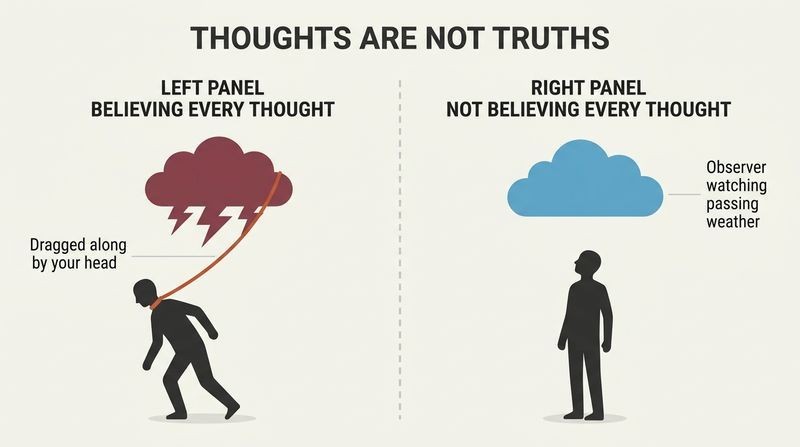
The core lesson of seventeen years. When a journalist asked Lindeblad what mattered most from his time as a forest monk, his answer was disarmingly small: he no longer believes his every thought. Thoughts arrive unbidden, shaped by upbringing, culture, and circumstance. We do not choose them and cannot control their shape. What we can choose is whether to believe them.
Thoughts are not truths. The untrained mind fuses identity with every passing thought, leaving us defenseless when the dark ones come. Approaching your own mind with a bit of skepticism and humor, treating a cruel or catastrophic thought as merely weather passing through, is what separates freedom from being dragged along on a leash by your own head. This ability is not exclusive to monks. It belongs to everyone.
What's striking is how this converges with modern cognitive behavioral therapy, which calls the same skill cognitive defusion: learning to observe a thought ("I am a failure") as a mental event rather than a verdict. Aaron Beck and Steven Hayes built entire therapeutic systems on this distinction. The Stoics reached it two millennia earlier, arguing we suffer not from events but our judgments about them. Lindeblad's contribution is experiential rather than clinical. He earned the insight through discomfort, not study, which is precisely why it lands. The claim's limit: some thoughts are accurate warnings, and discernment about which to trust remains genuinely hard.
Redirect attention to your breath to loosen thought's grip
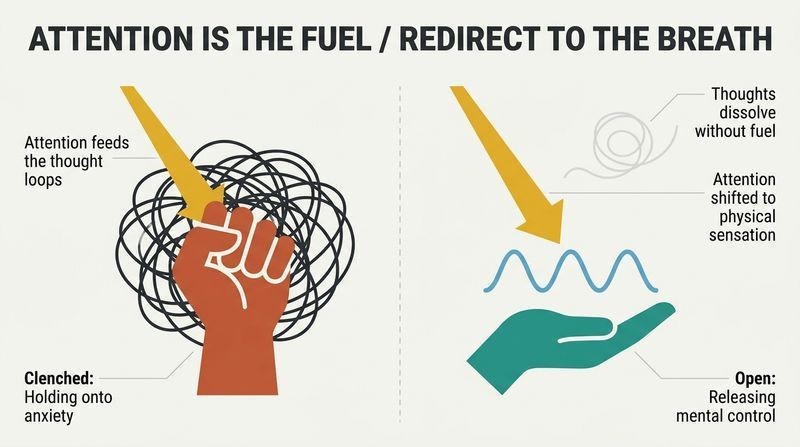
Attention is the only fuel. Trapped in Sunday-night dread on his sofa in Spain at twenty-six, a rising corporate star with a company car and a secretary, Lindeblad recalled a book's suggestion to locate inner stillness. He simply tracked his breathing for fifteen minutes, patiently returning his wandering mind again and again. The anxious thoughts did not vanish, but the gaps between them widened, and a clear impulse surfaced: it is time to move on. Days later he quit.
You cannot stop thinking (try not to picture a pink elephant), and forcing positive thoughts feels fake. But you can let go by moving your attention elsewhere. He offers a physical image: imagine a clenched fist unclenching into an open palm. Deliberately resting attention on something simple like breath gives a healing break from mental chaos.
The mechanism here is well supported. Attention functions like a spotlight, and neuroscience confirms that what we attend to strengthens through repeated neural activation, a rough version of Hebb's rule. By starving a rumination loop of attention, its intensity fades. What Lindeblad captures that clinical language misses is the gentleness required. Self-scolding for a wandering mind simply adds a second layer of thought. The instruction to return "without scolding yourself" mirrors what researchers call self-compassion, shown by Kristin Neff to predict resilience better than self-esteem. The open-hand gesture is a clever somatic anchor, giving an abstract skill a body to live in.
Outward success guarantees nothing about whether you feel alive
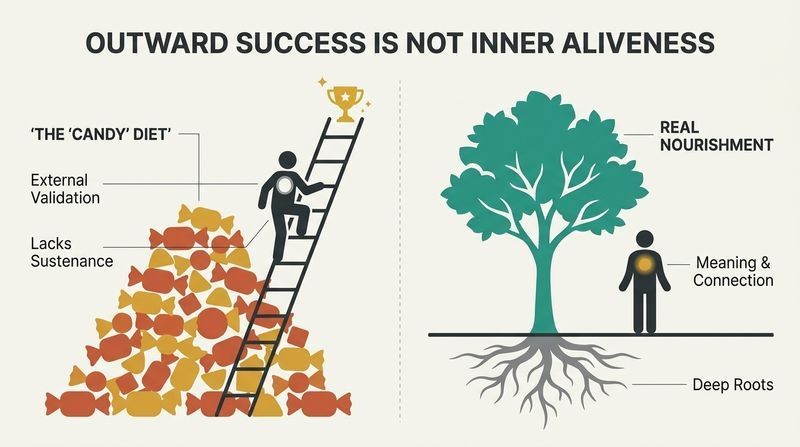
Success and happiness are different things. By twenty-six Lindeblad was on track to be the youngest chief financial officer of a corporate subsidiary, featured in the company magazine, flying business class. Each morning he tied his tie, gave his reflection a thumbs-up, and announced "showtime," while inside churned a constant dread of being found out as someone merely pretending to care about economics. He had climbed the ladder on willpower and self-discipline alone.
His diagnosis: work must nourish some deeper part of you, and that nourishment rarely comes from status. It comes from feeling connected to the people you work with, sensing your work matters, and using your actual talents. Chasing external validation, he later wrote, is like trying to live on candy. Colorful, fun, delicious in the moment, and utterly lacking in sustenance.
The candy metaphor maps neatly onto the psychological distinction between hedonic and eudaimonic well-being, and onto self-determination theory, in which Deci and Ryan identify competence, autonomy, and relatedness as the true nutrients of motivation. A prestigious title starved of all three predictably curdles into anxiety. Worth noting, though, is a survivorship caveat: it is easier to declare money hollow after you have earned and left it. For someone in genuine scarcity, the candy is also calories. Lindeblad half-acknowledges this elsewhere. The insight is real, but it lands most cleanly for those already past the base of the pyramid.
Most psychological suffering is self-inflicted by a hidden word: should
The Buddha's uncomfortable discovery. Lindeblad argues that the bulk of our mental pain is not caused by external events but manufactured inside us, by thoughts we cling to. The recurring culprit is a single word: should. Dad should not have said that. My partner should be different. And the cruelest one, I should be different, wiser, thinner, more mature. Each "should" is an argument with reality that we always lose.
This is hard to accept because it strips away the comfort of blame. We prefer to point at parents, colleagues, or politicians. But the liberating question becomes: is there anything I can do right now to suffer less? He suggests answering a nagging self-critical thought not with a fight but with a light dismissal, something like "thanks for your input, we'll get back to you," and then returning attention to the present.
This is essentially Byron Katie's "The Work" and Albert Ellis's rational emotive therapy, which targeted "musturbation," the tyranny of rigid shoulds, as the engine of neurosis. The philosophical lineage runs to Epictetus. The steelman is strong: locating suffering internally restores agency, since you cannot edit other people but can question your demands on them. The necessary nuance, which Lindeblad honors, is that this framework must never curdle into victim-blaming. Telling a trauma survivor their pain is "self-inflicted" would be grotesque. The claim works best for the ordinary friction of daily resentment, not for genuine injustice or clinical illness, where the internal and external genuinely intertwine.
Say "I may be wrong" three times when conflict brews
The magic mantra. During an all-night meditation, the abbot Ajahn Jayasaro promised a magic mantra, startling for a tradition that rejects mysticism. The whole hall leaned in. His revelation: when you sense a conflict about to erupt, repeat three times, sincerely, "I may be wrong." That is the entire technique, and it is the book's title.
Simple, true, and almost impossible to remember in the heat of the moment, precisely when the ego most craves being right. Lindeblad admits that the morning after telling this story onstage, he sulked through a breakfast quarrel with his wife, muttering that he now preferred a different mantra: "you may be wrong." His teacher's companion lesson: being right is never the point. Imagine, he asks, what conversations would sound like if most people, most of the time, remembered they might be mistaken.
This is intellectual humility rendered as a portable ritual, and research by Mark Leary and others links that trait to better decisions, less polarization, and more learning. The genius is packaging an abstract virtue into three words short enough to deploy mid-argument. It resonates with Philip Tetlock's finding that the best forecasters, the "superforecasters," hold beliefs as probabilities to be revised rather than flags to defend. One honest tension: chronic self-doubt can paralyze, and abusers can weaponize "maybe you're wrong" against victims. The mantra assumes a baseline of good faith and adequate self-worth. Deployed there, it is a solvent for needless conflict.
Stop labeling events good or bad; you cannot know yet
Maybe, maybe not. Ajahn Jayasaro told a Chinese parable of a farmer whose horse runs away. The nosy neighbor cries, "What bad luck!" The farmer answers, "Maybe, maybe not." The horse returns with two wild ones. "What luck!" "Maybe, maybe not." His son breaks a leg breaking one of them, then is spared army conscription because of that same broken leg. Each verdict of fortune or misfortune proves premature.
The farmer refuses to believe he can know whether any event is ultimately good or bad, and loosening that grip is both liberating and wise. Lindeblad notes that most things he worried about never happened, and most of what did happen he never saw coming. What we call knowledge of the future is really speculation dressed up as certainty.
The parable is a masterclass in what psychologists call the narrative fallacy, our compulsion to impose tidy cause-and-effect stories on a chaotic world. Nassim Taleb built "The Black Swan" around the same blindness to consequential surprise. There is also a link to affective forecasting research by Daniel Gilbert, which shows humans are chronically bad at predicting how events will make them feel, systematically overestimating the durability of both joy and disaster. The caution: radical agnosticism about outcomes can shade into passivity or a refusal to grieve real losses. The farmer's equanimity is a gift in uncertainty, not a license to feel nothing when a leg actually breaks.
To make people easier to bear, accept them exactly as they are
Pebbles on a beach. Thrown into a 24/7 commune of eccentric strangers he could not choose and rotated rooms monthly, Lindeblad expected solitude and got social friction. The abbot's image: we arrive like rough, jagged pebbles, and only by letting the other pebbles jostle and grind against us do our sharp edges wear smooth until we shine. One monk from Oklahoma openly hated him for four years, which, for a man addicted to being liked, became the exact medicine he needed.
His conclusion is bracingly practical. No one in history ever became more like what someone wanted by being judged for falling short. The only way to make a person easier to be around is to like them as they are. Humans have finely tuned detectors for reservation and for welcome, and both are contagious.
This anticipates a robust finding from relationship science: Carl Rogers called it "unconditional positive regard," and John Gottman's decades of marriage research show that contempt, the opposite of acceptance, is the single strongest predictor of divorce. Acceptance paradoxically enables change, a principle at the heart of Marsha Linehan's dialectical behavior therapy, which balances accepting clients as they are with helping them change. The Oklahoma monk detail is valuable precisely because it inverts the lesson: sometimes being disliked is the training. One limit worth naming is that acceptance is not endorsement; the framework still permits firm boundaries against genuinely harmful behavior, a distinction easy to blur.
Trade the clenched fist of control for the open hand of trust
Chaos may rattle you, but order can kill you. Newly arrived at a looser English monastery, Lindeblad seethed at its disorganized breakfast chore-assignments, certain he knew how a "real" forest monastery should run. His teacher Ajahn Sucitto caught him clenched with disapproval and offered that line. The lesson recurs through his life as the fist-to-open-palm gesture: less control, more trust; less needing to know everything beforehand, more taking life as it comes.
Monastic life was deliberately engineered to frustrate control. Monks did not handle money, choose their food, pick their roommates, or select their huts. Being forced to relinquish control was the curriculum. A nun once reminded him not to forget to leave room for miracles, since almost all the best things in his life had arrived outside his planning. Eisenhower's version: plans are worthless, but planning is everything.
The distinction between planning and demanding that plans come true is subtle and important. Cognitive scientists describe an "intolerance of uncertainty" that drives much anxiety, and treatments increasingly train patients to sit with not-knowing rather than compulsively seek premature closure. Lindeblad's "trust in Allah but tie your camel" balances this beautifully, guarding against the naive reading that trust means passivity. The open steelman: trust is efficient, freeing cognitive resources otherwise burned on hypervigilance. The fair critique is dosage. His seventeen years of guaranteed room and board made trust cheap, a point a skeptical talk-show host pressed him on directly. In precarious lives, tying the camel matters more.
Give yourself the compassion you reserve for people you love
It starts with you. The Buddha named four divine emotions: loving-kindness, compassion, empathetic joy (delight in others' good fortune), and equanimity. The instruction for growing them is blunt: you must always start with yourself. Your compassion for others stays fragile until you can turn tenderness inward, especially when you are struggling.
Most of us fail here, waiting to feel worthy of kindness first. But how good, thin, or successful must you become to qualify? You may wait forever. Lindeblad points out that the only lifelong relationship you have, from first breath to last, is with yourself, and asks what it would be like if that relationship were marked by forgiveness and humor rather than a harsh inner critic. If "love" feels too grand, one teacher preferred a humbler target: non-aversion, simply not disliking what you find in yourself and others.
Kristin Neff's research on self-compassion directly validates this ordering. Her studies show self-compassion, not self-esteem, buffers anxiety and depression, and crucially that people high in self-compassion treat others more generously, not less, debunking the fear that self-kindness breeds narcissism. The reframe from "love" to "non-aversion" is psychologically shrewd, lowering the bar to something achievable for people allergic to therapeutic sweetness. There is a cultural dimension too: Lindeblad names the Nordic harsh inner critic and the fear of being "found out" as inherited, not personal, which itself loosens shame. The one caution is that self-compassion can be misheard as self-indulgence; Neff distinguishes it sharply from self-pity and passivity.
Live so cleanly that you can meet death without regret
Gild the Buddha's back. Driving home after his ALS diagnosis, having sobbed on the phone with friends, Lindeblad felt a wave of gratitude: he had lived with integrity, carried no heavy karmic baggage, done nothing unforgivable he could not repair. He could face death with an open face. His ethics were not built on rules or a judging deity but on memory. You have to live with yourself, and shameful acts are tedious luggage to drag around.
The Thai phrase "gilding the Buddha's back" means placing your gold leaf where no one sees it. Do good without advertising, because the only witness who matters is you. His first abbot, offered a secret whisky by a cousin who promised no one would know, replied simply, "I will know." Integrity, in this telling, is self-interest correctly understood.
Grounding morality in memory and self-witness rather than external judgment is quietly radical and empirically friendly. Research on moral behavior finds that private self-awareness, feeling observed even by oneself, increases honesty. It echoes virtue ethics from Aristotle to Confucius, where character is built by accumulated action rather than rule-following. The ALS framing gives it teeth: mortality salience, studied in terror management theory, tends to make people cling to defenses, yet Lindeblad reports the opposite, a settling gratitude. That may reflect seventeen years of daily death contemplation beside literal funeral pyres. The honest question is whether such equanimity is trainable for everyone or partly a gift of temperament and practice combined.
Face death as a friend by remembering everything ends
This too shall pass. Diagnosed with ALS in 2018 and given one to five years, Lindeblad refused to become his illness or to fight death as an enemy. His monastery kept a human skeleton in a display case and sat beside burning bodies in the cremation grove, making mortality concrete rather than abstract. This training, he says, prepared him to want to live until he dies rather than merely to not-die.
He wrote a letter of gratitude to his own failing body, thanking it for fighting an uphill battle and promising to surrender when it could no longer go on. He questions why our culture frames death as a battle to be won, an insult, a failure. A dying monk asked his doctor's elaborate treatment plan a simple question: "Don't doctors die?" Death, Lindeblad suggests, is not the opposite of life but the opposite of birth.
This confronts what medicine often evades. Atul Gawande's "Being Mortal" documents how the fight-at-all-costs narrative produces worse deaths, more suffering and less meaning, than acceptance and hospice care. Lindeblad's letter to his body is a striking act of what psychologists call self-continuity and reconciliation. His account of helping his own father choose an assisted death in Basel, surrounded by family and bagpipe recordings, embodies the argument rather than merely asserting it. The framing of death as the opposite of birth rather than of life is philosophically elegant, sidestepping the assumption that consciousness simply stops. Whether one shares his intuition of "something on the other side," the practical fruit, living without dread, needs no metaphysics to justify it.
Analysis
This is a memoir-as-wisdom-literature, structured as thirty-eight short chapters that alternate between an extraordinary life story and the distilled lessons drawn from it. The narrative arc is unusually complete: a Swedish business prodigy abandons a corporate fast-track at twenty-six, spends seventeen years as a Theravada forest monk in Thailand, England, and Switzerland, disrobes into a devastating depression, rebuilds a life as a speaker and meditation teacher, and finally receives a terminal ALS diagnosis. The book was written as the author was dying, which lends every claim about impermanence and letting go an unusual evidentiary weight. He is not theorizing from comfort; he is testing the tools in the fire.
What distinguishes the book within a crowded mindfulness genre is its refusal of guru-posturing. Lindeblad repeatedly casts himself as the worst meditator in the monastery, falling asleep, fantasizing about pizza and flight attendants, sulking through marital spats. This self-deprecation is not decoration; it is the argument. His thesis, that the goal is not transcendence but becoming someone whose own company you can bear, gains credibility precisely because he admits how imperfectly he achieves it. The Winnie-the-Pooh-versus-Rabbit contrast (better to be wide-eyed and present than clever and certain) captures the anti-intellectual heart of a very intellectual man.
The intellectual core is a coherent package: thoughts are not truths, attention is choosable, control is mostly illusion, and humility ("I may be wrong") dissolves conflict. These map cleanly onto cognitive behavioral therapy, acceptance and commitment therapy, and Stoicism, giving the book secular reach beyond Buddhism. Its vulnerabilities are the genre's: the trust-the-universe strain can sound like privilege, and "self-inflicted suffering" risks minimizing real trauma. Lindeblad partly inoculates himself by naming these tensions and by grounding ethics in memory rather than dogma. The result is a rare thing, a spiritual book that earns its serenity by showing the terror underneath it.
Review Summary
I May Be Wrong receives overwhelmingly positive reviews, with readers praising its wisdom, humor, and humility. Many find it deeply moving and transformative, appreciating the author's honesty about his experiences as a Buddhist monk and his struggles with depression. Readers highlight the book's accessible approach to mindfulness and its valuable life lessons. While some find certain parts less engaging, most consider it a heartfelt, enlightening read that encourages self-reflection and personal growth.
FAQ
What's "I May Be Wrong" about?
- Author's Journey: "I May Be Wrong" is a memoir by Björn Natthiko Lindeblad, chronicling his transformation from a successful businessman to a Buddhist forest monk and back to a layperson.
- Life Lessons: The book shares the wisdom and insights Lindeblad gained during his 17 years as a monk, focusing on themes like mindfulness, letting go, and living with integrity.
- Facing Mortality: It also addresses Lindeblad's diagnosis with ALS, exploring how his spiritual practices helped him cope with the challenges of a terminal illness.
- Personal Growth: The narrative emphasizes personal growth, the importance of questioning one's thoughts, and finding peace in the present moment.
Why should I read "I May Be Wrong"?
- Inspiration: The book offers an inspiring story of personal transformation and resilience, appealing to those interested in spiritual growth and self-discovery.
- Practical Wisdom: Lindeblad provides practical advice on mindfulness and living a meaningful life, which can be applied to everyday challenges.
- Emotional Depth: The memoir is emotionally engaging, offering a candid look at the author's struggles and triumphs, making it relatable to readers facing their own life challenges.
- Unique Perspective: It provides a unique perspective on life from someone who has lived both in the corporate world and as a monk, offering insights into balancing material and spiritual pursuits.
What are the key takeaways of "I May Be Wrong"?
- Mindfulness and Awareness: The importance of being present and aware, rather than being consumed by thoughts and worries.
- Letting Go: Learning to let go of control and expectations, and embracing uncertainty as a natural part of life.
- Inner Wisdom: Trusting one's inner voice and intuition, which can guide decisions and provide clarity in difficult times.
- Compassion and Kindness: The value of compassion, both towards oneself and others, as a foundation for a fulfilling life.
How did Björn Natthiko Lindeblad's life change after becoming a monk?
- Simplified Living: Lindeblad embraced a life of simplicity, giving up material possessions and living according to monastic rules.
- Spiritual Growth: He focused on meditation and mindfulness, which helped him develop a deeper understanding of himself and the world.
- Community and Connection: Living in a monastery taught him the importance of community and the value of supporting and learning from others.
- New Perspectives: His experiences as a monk provided him with new perspectives on life, which he later applied when he returned to lay life.
What is the significance of the title "I May Be Wrong"?
- Humility: The title reflects the author's belief in the importance of humility and the willingness to question one's own beliefs and assumptions.
- Open-mindedness: It encourages readers to remain open-minded and consider different perspectives, rather than clinging to certainty.
- Conflict Resolution: The phrase "I may be wrong" is presented as a mantra for resolving conflicts and fostering understanding in relationships.
- Personal Growth: Acknowledging the possibility of being wrong is seen as a path to personal growth and deeper wisdom.
How does Lindeblad describe his experience with ALS in "I May Be Wrong"?
- Acceptance and Resilience: Lindeblad discusses his journey of accepting his diagnosis and finding resilience through his spiritual practices.
- Living Fully: Despite the prognosis, he emphasizes the importance of living fully and cherishing each moment.
- Support and Community: He highlights the role of his loved ones and community in providing support and strength during difficult times.
- Perspective on Death: His experience with ALS deepens his understanding of mortality and reinforces the lessons he learned as a monk.
What are some of the best quotes from "I May Be Wrong" and what do they mean?
- "I no longer believe my every thought." This quote emphasizes the importance of questioning one's thoughts and not being controlled by them.
- "This too shall pass." A reminder of the impermanence of life, encouraging acceptance of both good and bad times.
- "Trust will get you there." Highlights the value of trust in oneself and the universe, especially in uncertain times.
- "Be the thing you want to see more of in the world." Encourages readers to embody the qualities they wish to see in others, promoting positive change.
What is the "magic mantra" mentioned in "I May Be Wrong"?
- Mantra Explanation: The "magic mantra" is "I may be wrong," which Lindeblad suggests using to defuse conflicts and foster humility.
- Purpose: It serves as a reminder to remain open to other perspectives and to question one's own assumptions.
- Application: The mantra can be used in personal relationships and self-reflection to promote understanding and growth.
- Impact: By acknowledging the possibility of being wrong, individuals can create more harmonious interactions and reduce tension.
How does Lindeblad's story illustrate the concept of "letting go"?
- Monastic Life: His decision to become a monk involved letting go of material possessions and societal expectations.
- Mindfulness Practice: Through meditation, he learned to let go of thoughts and focus on the present moment.
- Facing Illness: His approach to ALS involves letting go of fear and control, accepting the uncertainty of his condition.
- Life Philosophy: Letting go is a recurring theme in his life, representing a path to peace and freedom from suffering.
What role does community play in "I May Be Wrong"?
- Monastic Community: Lindeblad's time in the monastery taught him the value of living in a supportive community focused on spiritual growth.
- Support System: After his diagnosis, his community of friends and family provided essential support and strength.
- Shared Wisdom: He emphasizes the importance of learning from others and sharing experiences to foster personal growth.
- Connection and Belonging: Community is portrayed as a source of connection and belonging, essential for a fulfilling life.
How does "I May Be Wrong" address the theme of forgiveness?
- Personal Reflection: Lindeblad reflects on the importance of forgiving oneself and others to achieve inner peace.
- Letting Go of Grudges: He discusses the negative impact of holding onto grudges and the freedom that comes with forgiveness.
- Compassionate Perspective: The book encourages readers to view others with compassion, understanding that everyone is fighting their own battles.
- Healing and Growth: Forgiveness is presented as a key to healing and personal growth, allowing individuals to move forward without bitterness.
What is the "intelligence of the moment" in "I May Be Wrong"?
- Definition: The "intelligence of the moment" refers to the intuitive wisdom that arises when one is fully present and aware.
- Accessing Wisdom: Lindeblad suggests that by quieting the mind and being present, individuals can access this deeper intelligence.
- Decision-Making: It is portrayed as a valuable tool for making decisions and navigating life's challenges with clarity.
- Beyond Rationality: The concept emphasizes that true wisdom often transcends rational thought and is found in moments of stillness.
Download PDF
Download EPUB
.epub digital book format is ideal for reading ebooks on phones, tablets, and e-readers.








































