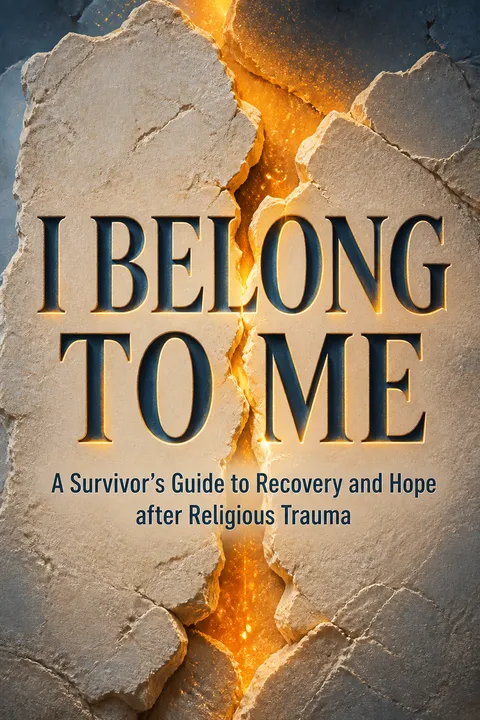

Key Takeaways
1. Religious trauma is a somatic and psychological injury that turns you against yourself
What I find particularly intolerable is that religious trauma turns us against ourselves, using our faith, families, and communities against our psychological soul.
Somatic and psychological harm. Religious trauma is not just a difference of theological opinion; it is a deep, systemic nervous system injury. It occurs when toxic doctrines and high-control environments overwhelm your body's ability to cope with stress, leaving you in a state of chronic, long-term dysregulation.
Internalized self-betrayal. High-control religious systems condition you to ignore your own intuition, bodily warning signs, and critical thinking. You are taught that your heart is inherently deceitful and that your suffering is a holy virtue, which effectively turns you into your own worst enemy.
Recognizing the symptoms. Healing begins when you stop minimizing your pain and recognize the evidence of trauma in your life:
- Chronic anxiety, hypervigilance, and panic attacks
- Dissociation, memory gaps, and emotional numbness
- Persistent physical symptoms like migraines, stomachaches, and autoimmune flare-ups
- Fawning behaviors designed to placate authority figures at the expense of your own safety
2. Audacity is required to break multigenerational chains of trauma and abuse
Trauma took my past. It doesn’t get my present and future, too.
Breaking the cycle. Unresolved trauma is passed down through generations like an invisible, toxic inheritance. To stop this cycle, you must develop the audacity to challenge family lore, expose secrets, and refuse to pass the pain to your descendants.
Investigating family history. Understanding the struggles of your ancestors—such as poverty, depression, or religious legalism—helps you find compassion without excusing their complicity. It allows you to see the patterns of behavior that you must actively unlearn.
Choosing a new legacy. You have the power to be the link that changes your family's trajectory forever. By doing the hard work of healing, you ensure your children and grandchildren grow up in safety:
- Rejecting the "suffer in silence" mentality
- Replacing generational codependency with emotional independence
- Modeling healthy boundaries and emotional regulation
- Creating an abundant mindset to replace inherited scarcity
3. Healing demands that you shift from an external locus of control to your own centrality
Orient with centrality. Say, 'Here I am,' and notice. Take account of your condition and surroundings, and breathe.
Shifting your center. High-control religions teach you that you are "lost" without external guidance, forcing you to rely on pastors, husbands, or dogmas. Healing requires shifting to an internal guidance system where you are the home base of your own life.
Reclaiming your perspective. You must learn to trust your own eyes, ears, and bodily sensations over the demands of a group. Wandering away from their rigid narratives is not a sin; it is a necessary step toward self-actualization.
Grounding in the present. When you feel disoriented by the loss of your former community, practice centering yourself in the physical world:
- Sit on the floor or grass to feel the earth's support
- Remind yourself of the current date, time, and location
- Avoid making major decisions until you feel a whole-body "yes"
- Honor your own boundaries and right to privacy
4. Unresolved shock and its aftermath make you highly vulnerable to further exploitation
No one can make wise choices while in shock. The options will be shitty. You won’t have a better option to fall back on.
The reality of shock. Escaping an abusive or high-control environment leaves you in a state of profound psychological shock. Your brain is operating from its most primitive, survival-oriented regions, which severely compromises your cognitive decision-making abilities.
Vulnerability to predators. In the raw aftermath of trauma, you are highly susceptible to new gurus, fast-talking partners, or high-control groups that promise quick stability. Because you lack emotional "skin," you may make choices you will later regret.
Triage and stabilization. Before trying to rebuild your life or make major commitments, you must prioritize immediate safety and nervous system recovery:
- Secure a safe, private physical perimeter
- Limit access to people who invalidate your experience
- Allow yourself to rest, hydrate, and stay warm
- Document your memories safely in a journal without public pressure
5. Purity culture and modesty dogmas systematically arrest female development and voice
Train a woman to sound like a child, and she will not sound like herself. Train a woman to dress like a child, and she will not feel like herself.
Arrested development. Purity and modesty cultures are designed to keep women in a state of perpetual childhood. By forcing girls to cover their bodies and modulate their voices into a sweet, unthreatening whisper, patriarchy stunts their natural maturation.
The "keep sweet" voice. The high-pitched, breathy "fundie baby voice" is a learned survival mechanism. It is a somatic response to trauma and a tool used to placate dominant males, preventing women from speaking with adult authority.
Reclaiming your maturity. Healing from purity culture requires unlearning the belief that your body and voice belong to anyone else. You must reclaim your right to grow up, speak loudly, and experience adult pleasure:
- Deconstructing the shame associated with sexual desire
- Reclaiming your natural, mature vocal tone and pitch
- Rejecting the binary of "virgin or ho"
- Learning accurate sexual anatomy and somatic consent
6. Reclaiming your true personality requires self-parenting and integrating your inner parts
Guarding my spiritual privacy now is part of reparenting four-year-old me.
Unbecoming the indoctrination. You were forced to adopt a personality that pleased your abusers before you even knew who you were. Reclaiming your true self is a process of "unbecoming" the rules, roles, and expectations that were forced upon you.
Internal Family Systems. Using parts work (IFS) helps you realize that your defensive behaviors—like people-pleasing or anger—are not bad traits, but protector parts. By offering these parts compassion, you can step back into your core Self.
Active self-parenting. You must become the loving, protective parent to your inner child that you never had. This means listening to your younger parts and giving them what they need to feel safe:
- Buying toys or items your inner child was denied
- Allowing yourself to play, create, and daydream without guilt
- Validating your childhood anger and sadness
- Protecting your inner child from current-day triggers
7. Somatic regulation and the vagus nerve are the physical pathways to emotional safety
My default operating system is fast; my growth discipline is to slow down.
The mind-body connection. Your vagus nerve is the physical superhighway that connects your brain stem to your heart and gut. When you are stuck in survival mode, this nerve is chronically stimulated, leading to physical illnesses like autoimmune disorders.
Completing the stress cycle. To heal, you must physically discharge the stress hormones (cortisol and adrenaline) that flood your body during a trauma response. You cannot simply think your way out of a dysregulated state; you must move your way out.
Somatic healing practices. Incorporating daily somatic exercises helps restore your vagal tone and brings your nervous system back to a state of safety:
- Crying, shaking, or dancing to release trapped energy
- Cold-water immersion or self-hugs (havening)
- Humming, singing, or making long vowel sounds to stimulate the vagus nerve
- Practicing slow, deep breathing to lower your heart rate
8. True recovery requires separating personal guilt from the grief of what was lost
In recovery, guilt and grief must each be held in separate hands. I don’t believe we can adequately contend with our guilt when we’re entangled in our grief.
Sorting guilt and grief. Survivors of religious trauma often carry immense guilt for their past complicity in harmful systems, alongside deep grief for their lost years. To heal, you must separate these two emotions so you can address them clearly.
Owning your impact. Contending with your guilt means admitting where your choices harmed others, even if you were operating under high control. It requires moving away from defensive self-blame and taking active responsibility to make amends where safe.
Mourning the unrecoverable. Griefwork is the process of naming and releasing the losses you cannot recover, such as a stolen childhood or missed opportunities. By actively mourning, you allow these losses to integrate into who you are:
- Writing down your specific losses without justification
- Allowing yourself to feel anger and sadness without shame
- Creating goodbye rituals to release the past
- Accepting that you did the best you could with the tools you had
9. Assertive boundaries and "I" statements protect your autonomy from manipulation
If we aren’t free to say no, we aren’t free to say yes.
The power of boundaries. Boundaries are not rules designed to control other people; they are the protective skin that defines where you end and someone else begins. They are essential for preventing enmeshment, codependency, and manipulation.
Flipping the script. If you were trained to be a people pleaser, saying "no" can feel incredibly mean or dangerous. You can ease into boundary-setting by reframing your limits as positive "I" statements that declare who you are.
Assertive communication. Practice stating your boundaries clearly and without overexplaining or apologizing for your needs:
- "I'm somebody who needs quiet time to recharge."
- "I'm somebody who leaves the room when voices are raised."
- "I'm somebody who does not discuss my spiritual beliefs in public."
- "I reserve the right to change my mind."
10. Embracing mystery and the "fuck-you" trauma response restores your ultimate agency
The fuck-you trauma response is your audacious attitude for healing. It’s your refusal to let the bad guys win.
Reclaiming your agency. The ultimate goal of recovery is not just survival, but liberation. The "fuck-you" trauma response is the fierce, protective energy that refuses to let systems or abusers grind you down ever again.
Embracing the unknown. High-control religion demands absolute certainty and rigid answers. True freedom lies in your ability to say "I don't know," to lean into the mysteries of the universe, and to trust your own intuition.
Living a liberated life. When you belong to yourself, you no longer abandon your own truth to keep the peace. You are free to write a new story, choose your own battles, and let your light shine:
- Valuing people and humanity over rigid dogmas
- Trusting your body's physical signals of safety and danger
- Practicing daily recovery habits like rest, nutrition, and hygge
- Showing up authentically as your whole, beautiful, imperfect self








































