

Key Takeaways
Work in bursts, not marathons — your brain craves rhythm
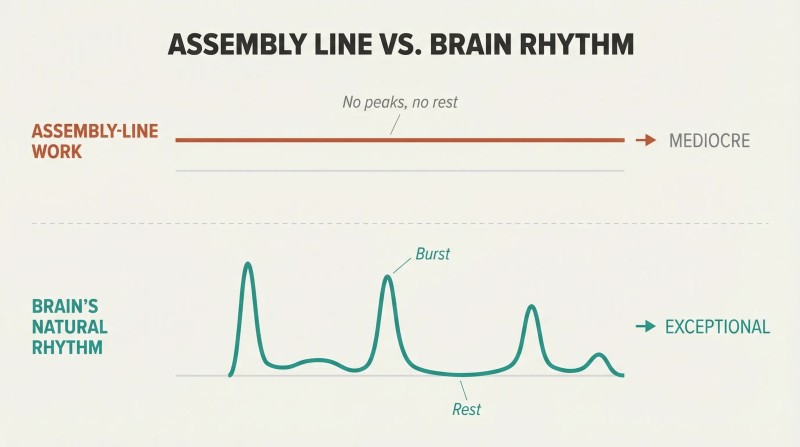
The assembly line broke your brain. Ford went from building 11 cars a month to one every 24 seconds with the conveyor belt — and that continuous-output template was imposed on office work. But flattening the mind's natural peaks and troughs prevents both rest and brilliance. In the AI age, where quality of thought matters more than quantity, that model is obsolete.
Rhythmic work is ancient. Hunter-gatherers across cultures — from the Hadza of Tanzania to the Yámana of South America — work in a "power law" pattern: intense bursts followed by longer stretches of lighter activity. Researchers found that Darwin, Freud, and Einstein answered their letters in the same bursty rhythms. In Seulo, Sardinia, centenarians herd goats at dawn, feast at midday, and drift through gentle afternoons — their mental sharpness persisting past age 100.
Your brain runs on three gears — only the middle one thinks well
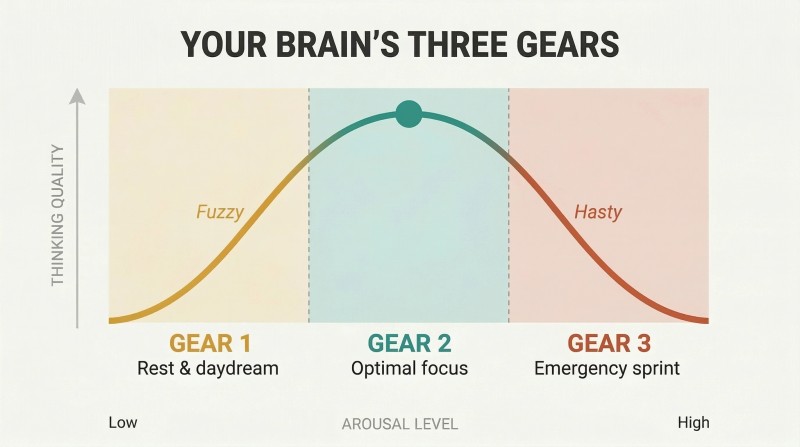
The blue dot network controls everything. A tiny cluster of brain cells called the locus coeruleus — which Storoni names the "blue dot network" — dispatches norepinephrine across your brain, shifting it between three operating modes:
1. Gear 1: Rest and daydream. Panoramic but fuzzy attention — ideal for recharging and a-ha moments
2. Gear 2: Optimal work mode. Your prefrontal cortex fully engages, enabling focus, learning, creativity, and problem-solving
3. Gear 3: Emergency sprint. Fast reactions but impaired thinking — prefrontal cortex goes partly offline
Knowledge work demands gear 2. The trap: stress, information overload, and emotional triggers easily push you into gear 3, where you process faster but think worse — making hasty decisions, missing nuance, and jumping to conclusions.
Cap work sprints at 90 minutes and front-load the hardest task
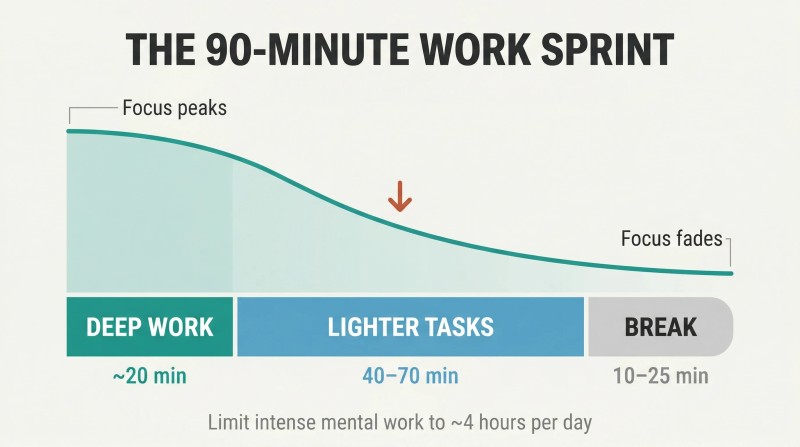
Your brain fatigues in 90-minute waves. The basic rest-activity cycle drives your alertness up and down roughly every 90 minutes. After that window, attention wanes and metabolic waste accumulates faster than the brain can clear it. Structure each session accordingly:
1. Tackle the hardest tasks in the first 20 minutes, when focus peaks
2. Switch to lighter work for the remaining 40 – 70 minutes
3. Take a 10 – 25 minute break to recharge
4. Limit total intense mental work to four hours per day
In a study of Danish schoolchildren, a 20 – 30 minute break between test sessions didn't just prevent decline — it actively improved scores. Without breaks, performance dropped every passing hour. The optimal break for exhaustion is a 20-minute nap, lying as flat as possible.
Do creative work at dawn and dusk, analytical work at midday
Norepinephrine follows the sun. It rises through the morning, creating peak focus between roughly 9 a.m. and 2 p.m., dips at midday (the post-lunch slump happens even if you skip lunch), and climbs again from 3 – 4 p.m. until 8 – 10 p.m. These windows are best for analytical, attention-heavy work.
Creative work thrives in twilight. The transitions between sleep and wakefulness — early morning and late evening — place you in a low-energy gear 2 state where attention can wander and refocus freely, ideal for spontaneous insights. Bank workers who made loan decisions during morning peak-focus hours would have earned an extra $509,023 per month. Night owls and morning larks should shift these windows accordingly — align your work type with your brain's clock, not the other way around.
Pushing through exhaustion flips your brain into its worst gear
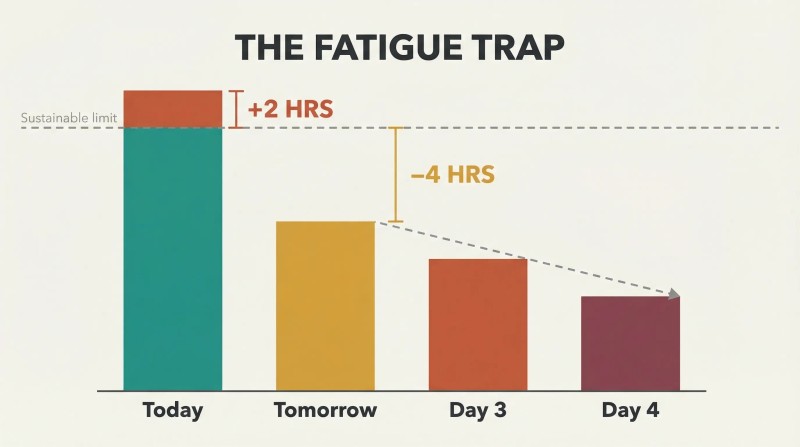
The fatigue trap is neurochemical. When intense work depletes your prefrontal cortex, your brain tries to pull you into gear 1 to rest. Override that signal and your brain compensates by cranking into gear 3 — leaving you simultaneously exhausted and overstimulated. You can't focus, filter distractions, or make sound judgments, yet you feel oddly wired.
Fatigue compounds across days. More than four hours of intense mental work today means your mind can't fully recover overnight, so tomorrow starts already in deficit. One study found students needed eight-plus days to recover from exam-period strain. Worse, staying locked in a high gear all day makes it impossible to wind down at night, sabotaging the sleep you need to recover.
Manufacture a sense of progress to ignite self-sustaining motivation
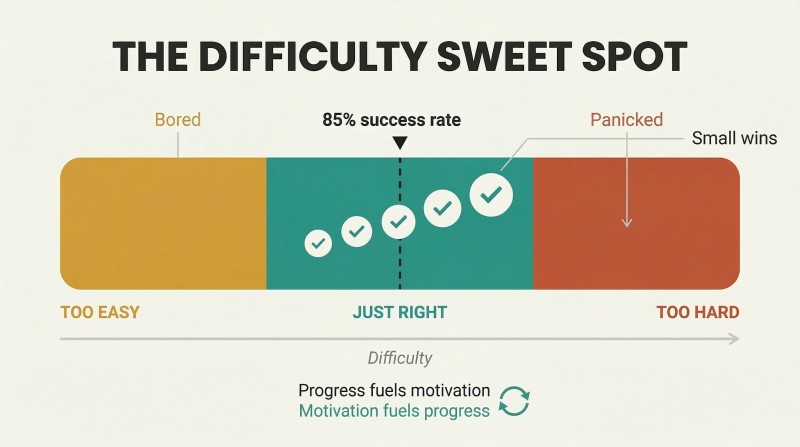
Learning Progress fuels the inner engine. Researchers Oudeyer and Kaplan identified a powerful mechanism: the sensation of incrementally improving at something generates intrinsic motivation — the self-sustaining kind that makes work feel lighter. A baby who discovers her kick moves a mobile toy keeps kicking, not for a reward, but for the pure thrill of agency. This same circuit operates in adults.
Apply it to any dull task. Instead of reading a cumbersome report start to finish, find something interesting and begin there — like tackling a crossword by solving the easiest clues first. Each small win generates momentum. The difficulty sweet spot: learning happens fastest around an 85% success rate. Too easy and you're bored into gear 1; too hard and you're panicked into gear 3. Stretch your skills just enough to feel progress.
Frame every challenge as winnable — fear of losing kills creativity
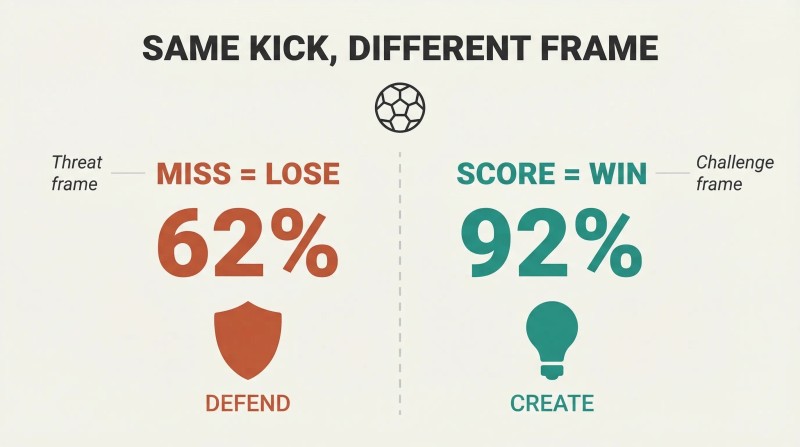
The penalty kick proof. Researchers analyzed every shoot-out in the World Cup, European Championships, and UEFA Champions League. When missing meant losing, only 62% of kicks scored. When scoring meant winning, 92% went in. The threat of loss drives you into gear 3, where focus and fine motor control collapse.
Controllability is the antidote. A threat downgrades into a challenge the moment you find something you can control. Workplaces with blame culture trap employees in a defensive gear 3 mindset — people "try not to fail" rather than "try to win." Since creative thinking is impossible in gear 3, punishing failed ideas destroys the innovation knowledge-age companies depend on. Protect people's sense of control and self-worth, and competition becomes a motivator instead of a cage.
Trigger flow by alternating micro-challenges with instant feedback
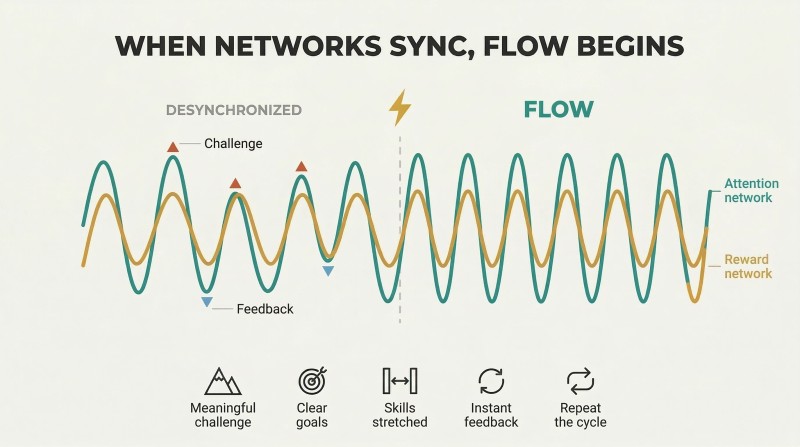
Flow is neural synchronization. When work alternates between challenge and feedback — stretching your skills, then confirming success — your brain's attention and reward networks begin firing in dialogue. Eventually they snap into sync, like an audience clapping in unison. That synchronization is flow: less effort, better performance. Five conditions unlock it:
1. A meaningful challenge
2. Clear goals for how to approach it
3. Skills stretched but not overwhelmed
4. Immediate, real-time feedback
5. Motivation to repeat the cycle
The game Tetris exemplifies this: each falling block poses a challenge, fitting it brings relief, and increasing speed maintains the volley. Structure work as a steeplechase of effort and reward — coding segments with test runs, design decisions with prototypes — and the challenge-feedback volley becomes self-sustaining.
Use breathing, cold water, and muscle tension as gear shifters
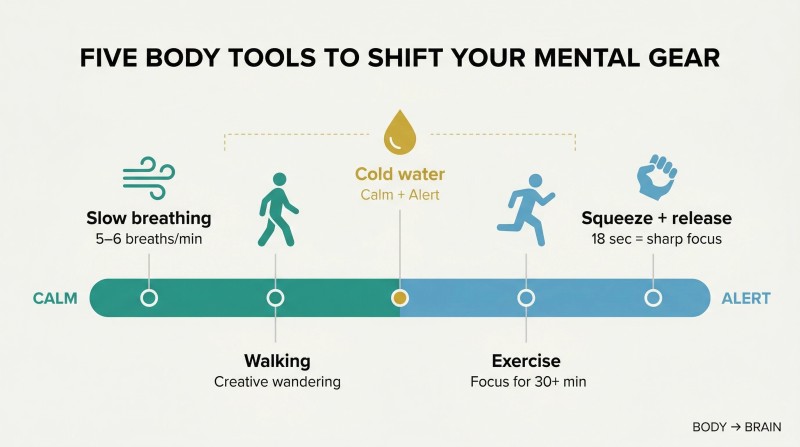
Your body is a gear lever. Your autonomic nervous system bridges body and brain — when your body accelerates, your mental gear follows. This makes physical actions surprisingly effective tools for shifting brain state:
1. Slow breathing (~5 – 6 breaths per minute) stimulates the vagus nerve, pulling the blue dot network into a gear 2 firing pattern
2. Squeezing a stress ball for 18 seconds, then releasing, sharpens focus and alertness
3. Cold-water immersion triggers both calming and alerting reflexes simultaneously — creating a rare "calm alertness" state
4. Moderate exercise raises your gear into focus mode for at least 30 minutes afterward
5. Walking keeps you in gear 2 while letting attention float — uniquely suited for creative breakthroughs, especially on unstructured routes rather than treadmills
Deliberately introduce controlled chaos to stay resilient
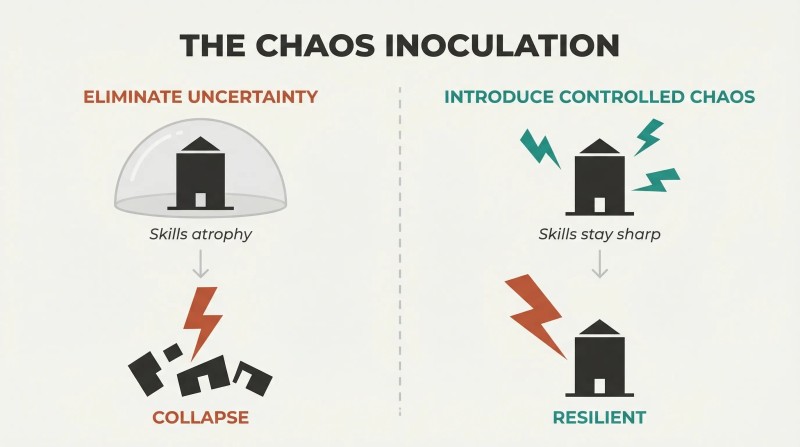
Netflix's Chaos Monkey breaks things on purpose. Engineers randomly disable parts of their system during business hours, forcing teams to practice recovery in controlled conditions. When real failures strike at 3 a.m., the team barely notices — they've already rehearsed.
Angkor is the cautionary tale. The medieval Khmer city built an elaborate water network that made it the world's largest preindustrial settlement. But eliminating all uncertainty from their water supply meant citizens forgot how to cope with shortage. When monsoon patterns shifted, the city collapsed. The same applies to digital workplaces: one IT manager found his team couldn't fix code they'd outsourced to AI for months. He now intentionally breaks the system in regular "fire drills." Exposure to manageable chaos preserves the skills you'll need when unmanageable chaos arrives.
Rich conversation beats lean data — brevity overloads the brain
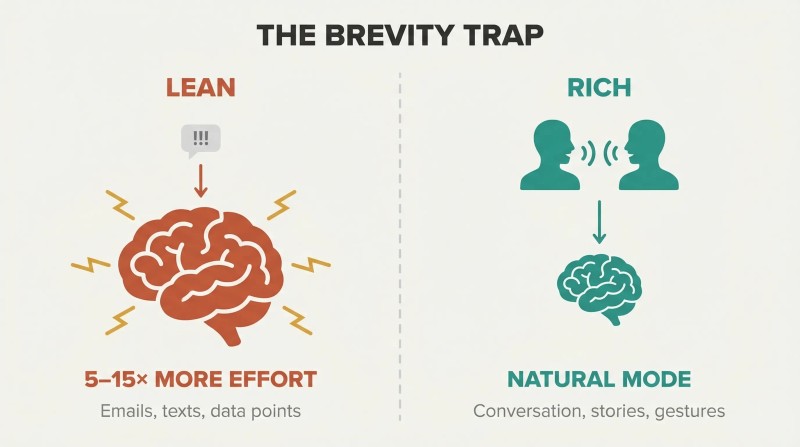
The brevity trap is real. As messages shrink from paragraphs to emojis, each fragment demands more cognitive work to decode. Research shows isolated statistics are harder to learn and remember than the same data embedded in a story. Meanwhile, labeling everything "urgent" makes nothing urgent — one manager found that "urgent urgent urgent" subject lines made emails less likely to be read.
Face-to-face communication saves brainpower. Professor Ned Kock's research shows people expend five to fifteen times more effort conveying complex ideas by email than in person. Our brains evolved for embodied communication — gestures, tone, expressions. The further we drift from this natural mode, the harder the mind works. For complex topics, invest in richer channels; for data, embed it in narrative context. Your working memory will thank you.
Analysis
Storoni's central contribution is translating the noradrenergic system — specifically the locus coeruleus – norepinephrine network — into an operating metaphor that knowledge workers can actually use. The 'three gears' framework is a genuine simplification of complex neuroscience, and it works because it maps onto subjective experience: most readers will instantly recognize the difference between being foggy, focused, and frantic. The book's intellectual spine rests on a provocative evolutionary argument: the assembly-line model of continuous, uniform output — inherited from Taylor and Ford — is neurologically maladapted for the kinds of cognitive work that AI cannot yet replicate.
What makes Hyperefficient distinctive in the crowded productivity genre is its refusal to offer a single system. Unlike books that prescribe one fixed method (Pomodoro, deep work blocks, time-boxing), Storoni argues the optimal approach is inherently dynamic — a rhythmic oscillation that adjusts to task type, time of day, and personal neurochemical profile. This is more honest about how brains actually function, even if it is harder to package as a lifehack.
The book's weaknesses mirror its strengths. The gear metaphor, while intuitive, flattens the enormous complexity of noradrenergic modulation into three discrete states when reality is a continuum. The author acknowledges this but the framework may still lead readers to think in rigid categories. Similarly, aggregating LC-NE, dopaminergic, and cholinergic dynamics under one umbrella is pedagogically useful but neurochemically imprecise.
The most underrated insight is the Learning Progress mechanism from Oudeyer and Kaplan's developmental robotics research, which Storoni applies to adult knowledge work. This reframes motivation not as willpower or personality but as an information-theoretic signal: the brain is intrinsically motivated when it detects that its predictions are improving. This bridges self-determination theory and predictive processing in a way few popular books attempt — and it carries immediate practical applications for anyone designing their own work or managing teams through rapid technological change.
Review Summary
Hyperefficient receives mixed reviews, with an average rating of 3.66 out of 5. Positive reviews praise its insights into brain mechanics, productivity strategies, and cognitive gears. Readers appreciate the practical advice for optimizing work habits and enhancing creativity. Critics find the content repetitive, obvious, or lacking depth. Some reviewers note the book's deep technical discussions, while others feel it could have been condensed. Overall, readers value the book's exploration of aligning work with natural brain rhythms, though opinions vary on its effectiveness and originality.
People Also Read








Glossary
Blue dot network
Brain's norepinephrine control hubThe locus coeruleus (LC) and its nerve trails that dispatch norepinephrine across the brain, along with its second-order effects on dopamine and acetylcholine systems. Storoni uses this as a simplified umbrella term for the LC-NE network. It controls the brain's overall configuration, pace, and operating mode—acting like a gear system that shifts the brain between rest, optimal work, and emergency sprint states.
Gear 1 / Gear 2 / Gear 3
Three brain operating modesStoroni's metaphorical framework for three norepinephrine-driven brain states. Gear 1 is a slow, resting state ideal for recharging and daydreaming. Gear 2 is the optimal work state where the prefrontal cortex is fully engaged, enabling focus, learning, creativity, and problem-solving. Gear 3 is a high-speed emergency state where reactions are fast but deep thinking is impaired because the prefrontal cortex goes partly offline.
Gear personality
Your innate gear sensitivityAn individual's innate tendency for mental gears to respond to stimulation. 'Stiff' gear personalities need more stimulation—pressure, challenge, uncertainty—to reach gear 2 and tend to thrive under high-intensity conditions. 'Springy' gear personalities react strongly to minimal stimulation, easily overshooting into gear 3. Gear personality can be influenced by past experiences, screen habits, and age, and determines the optimal work environment for each person.
Low-energy / high-energy gear 2
Creative substates within gear 2Two zones within gear 2 near its boundaries with gear 1 and gear 3. Low-energy gear 2 (near gear 1) features slightly looser attention ideal for spontaneous insights—the mind can wander then refocus at will. High-energy gear 2 (near gear 3) features heightened norepinephrine that amplifies peripheral details, enabling divergent thinking, brainstorming, and accelerated learning. Both support creativity through different mechanisms: wandering versus expanded attentional scope.
Learning Progress
Progress-driven intrinsic motivationA mechanism identified by researchers Pierre-Yves Oudeyer and Frédéric Kaplan describing how the sensation of incrementally improving at a task generates intrinsic motivation. Distinct from learning itself, it requires consistent awareness of making progress through feedback. The mechanism explains why moderate difficulty (around 85% success rate) feels most engaging and why mastery-oriented work feels inherently rewarding without external bribes.
BRAC (basic rest-activity cycle)
~90-minute alertness rhythmA roughly 90-minute cycle of rising and falling alertness first proposed by physiologist Nathaniel Kleitman. During sleep it manifests as alternation between deep sleep and REM sleep. While awake, it creates subtle waves of focus and fatigue. Storoni uses BRAC to recommend structuring work sessions in 60-to-90-minute blocks with breaks between them, arguing that pushing beyond this window forces the brain to accumulate harmful metabolic waste.
Quiet Eye
Gaze-fixing focus techniqueA technique in which you fix your gaze on a small focal target and hold it steady for at least 100 milliseconds before performing an action. Used by surgeons, snipers, and athletes to shift from gear 3 back to gear 2, improving precision and self-control under pressure. The technique works by anchoring attention and reducing the erratic eye movements associated with anxiety. Meditators have long used similar gaze-fixing practices.
Power law pattern
Rhythmic intense-burst work styleA mathematical relationship applied to work patterns where intense effort occurs in short bursts and lighter effort occupies longer periods. Found in hunter-gatherer foraging, animal movement, memory retrieval, and the correspondence habits of Darwin, Freud, and Einstein. Storoni argues this pattern matches the brain's natural wiring and should replace the continuous uniform-output model of assembly-line work as the foundation for knowledge work.
Chaos Monkey
Deliberate failure simulation toolA tool created by Netflix engineers that randomly disables parts of their computing infrastructure during business hours, forcing teams to practice recovering from failures in controlled conditions. Storoni uses it as a broader metaphor for deliberately introducing manageable uncertainty into work or life to maintain resilience—arguing that eliminating all volatility produces fragility, as illustrated by the collapse of the ancient city of Angkor.
Personal accelerators
Unique gear-raising triggersThe specific situations, fears, or stimuli that disproportionately raise an individual's mental gear compared to others. These are unique to each person based on innate wiring and life experiences—for example, someone may stay calm facing physical danger yet become highly anxious about deadlines. Identifying personal accelerators helps predict and manage situations where gear may shoot uncontrollably into gear 3, undermining focus and judgment.
FAQ
1. What is "Hyperefficient: Optimize Your Brain to Transform the Way You Work" by Mithu Storoni about?
- Modern Knowledge Work Redefined: The book explores how the digital age and AI are transforming knowledge work, shifting the focus from quantity to quality, and requiring new approaches to mental efficiency.
- Brain Optimization Framework: Storoni introduces a neuroscience-based framework for optimizing mental performance, emphasizing working in harmony with the brain’s natural rhythms rather than against them.
- Practical Strategies: The book provides actionable advice for structuring work, managing attention, and leveraging intrinsic motivation to achieve peak productivity and creativity.
- Adapting to Acceleration: It addresses the challenges of information overload, constant acceleration, and uncertainty in the digital era, offering tools to thrive rather than burn out.
2. Why should I read "Hyperefficient" by Mithu Storoni?
- Science-Backed Insights: The book distills cutting-edge neuroscience and psychology into practical strategies for anyone seeking to improve their mental performance at work.
- Relevance to Modern Work: It addresses the unique challenges of today’s AI-driven, information-saturated workplaces, making it highly relevant for knowledge workers, managers, and creatives.
- Actionable Tools: Readers gain concrete methods for managing attention, structuring work sessions, and fostering creativity and learning in fast-changing environments.
- Personalization: Storoni’s framework helps readers identify their own “gear personality” and tailor strategies to their unique mental wiring and work context.
3. What are the key takeaways from "Hyperefficient" by Mithu Storoni?
- Work with Brain Rhythms: Aligning work patterns with the brain’s natural rhythms (rather than assembly-line models) leads to higher quality output and less burnout.
- The Gear Model: The brain operates in three “gears” (restful, focused, and high-alert), and optimal performance comes from skillfully shifting between them.
- Power Law Working: The most effective work pattern is rhythmic—short bursts of intense effort followed by longer periods of rest or lighter work, mirroring evolutionary patterns.
- Intrinsic Motivation and Flow: Cultivating intrinsic motivation and structuring work to enable “flow” states are crucial for creativity, learning, and sustained productivity.
4. How does Mithu Storoni define "hyperefficiency" and what is her method for achieving it?
- Hyperefficiency Defined: Hyperefficiency is the state where mental performance is maximized by aligning work with the brain’s natural rhythms and optimizing both quality and efficiency.
- Gear Network Method: Storoni’s method involves understanding and managing the brain’s “gear network”—shifting between rest (gear 1), focus (gear 2), and high-alert (gear 3) states as needed.
- Power Law Pattern: She advocates for working in a power-law pattern—short, intense bursts of effort (gear 3) balanced with longer periods in gears 1 and 2 for recovery and sustained focus.
- Personalization: The method includes identifying your “gear personality” and using tools like light, sound, movement, and breaks to regulate your mental state.
5. What is the "gear network" in "Hyperefficient" and how does it impact mental performance?
- Brain’s Gear System: The gear network refers to the locus coeruleus-norepinephrine (LC-NE) system in the brain, which regulates mental pace and attention through three metaphorical gears.
- Gear 1 (Rest/Daydream): This state is for recovery, creativity, and idea incubation—attention is diffuse and the mind is relaxed.
- Gear 2 (Focus/Optimal Work): The ideal state for most knowledge work, learning, and problem-solving—attention is sharp, flexible, and sustainable.
- Gear 3 (High Alert/Stress): Useful for emergencies or automatic tasks, but prolonged time here leads to fatigue, poor judgment, and reduced creativity.
6. What is a "gear personality" according to Mithu Storoni, and why does it matter?
- Individual Gear Tendencies: Gear personality describes how easily a person shifts between mental gears—some have “stiff” gears (need more stimulation), others “springy” gears (easily overstimulated).
- Work Environment Fit: Understanding your gear personality helps you choose or adapt work environments and tasks that match your natural tendencies, reducing stress and improving performance.
- Personal Accelerators: Recognizing personal triggers that push you into higher gears allows for better self-regulation and avoidance of burnout.
- ADHD and Gear Personality: The book discusses how conditions like ADHD may reflect a need for more stimulation to reach optimal focus, reframing them as potential strengths in certain contexts.
7. How does "Hyperefficient" recommend structuring your workday for optimal brain performance?
- Follow Natural Rhythms: Align work sessions with the body’s 24-hour and 12-hour cycles—focus-intensive work in late morning and late afternoon, creative work in early morning and evening.
- Work in 60–90 Minute Blocks: Structure work into sessions of about 60–90 minutes, followed by breaks to prevent mental fatigue and maintain high performance.
- Use Breaks Strategically: Take breaks as “charging stations” (to reset focus) or “rest stations” (to recover), and consider short naps for deeper restoration.
- Limit Intense Work: Cap intense mental work at around four hours per day to avoid cumulative fatigue and diminishing returns.
8. What is the "power law" pattern of working described in "Hyperefficient," and why is it effective?
- Evolutionary Basis: The power law pattern mirrors how hunter-gatherers and even great thinkers like Darwin and Einstein worked—short, intense bursts of effort followed by longer, lighter periods.
- Protects Against Burnout: This pattern prevents chronic mental strain by allowing for recovery and peaks of brilliance, rather than flattening performance into monotonous output.
- Supports Creativity and Learning: Alternating between gears enables both deep focus and the incubation of creative ideas, maximizing both quality and innovation.
- Backed by Neuroscience: The brain’s own activity and attention cycles naturally follow power law distributions, making this approach biologically optimal.
9. How does "Hyperefficient" address creativity, learning, and problem-solving in the digital age?
- Creativity: Encourages alternating between focused and defocused states (gears 2 and 1), using techniques like walking, play, and environmental cues to foster spontaneous insights and divergent thinking.
- Learning: Recommends matching task difficulty to skill level (the “80% rule”), leveraging intrinsic motivation, and using movement or emotional cues to enhance memory and understanding.
- Problem-Solving: Suggests breaking problems into challenges with clear feedback, maintaining flexibility, and using both crystallized and fluid intelligence depending on the novelty of the problem.
- Adapting to Change: Emphasizes continuous learning and adaptability as essential skills, given the accelerating pace of technological and informational change.
10. What practical tools and techniques does Mithu Storoni suggest for managing attention and mental energy?
- Light and Sound: Use natural light cycles and soundscapes to regulate alertness—blue light and fast-paced sounds for focus, warm light and soft sounds for relaxation or creativity.
- Movement and Exercise: Incorporate physical activity, muscle contraction, and even breathing techniques to shift gears and maintain optimal mental states.
- Breaks and Naps: Schedule regular breaks and short naps to restore attention and prevent cognitive overload.
- Task Switching: Use disengagement techniques (like closing your eyes or walking) to efficiently switch between tasks and avoid attention residue.
11. How does "Hyperefficient" by Mithu Storoni tackle the challenges of information overload, urgency, and uncertainty in modern work?
- Lighten Cognitive Load: Organize and present information to reduce redundancy, use multiple modalities, and connect new data to existing knowledge for easier processing.
- Combat Urgency Inflation: Recognize and resist artificial urgency (e.g., constant “urgent” emails), and avoid letting external time pressures dictate mental pace.
- Decision Fatigue: Reduce the number of decisions, take breaks, and delay choices when possible to preserve mental resources.
- Uncertainty Management: Build resilience by regularly exposing yourself to controlled uncertainty (“chaos monkey” drills), practicing self-control, and using rituals to regain a sense of agency.
12. What are the best quotes from "Hyperefficient" by Mithu Storoni, and what do they mean?
- “Man was not designed to live at the speed of light.” (Marshall McLuhan, quoted) — Highlights the mismatch between human biology and the pace of modern technology, setting the stage for the book’s argument.
- “Efficiency is no longer defined by the quantity of output, but by its quality.” — Emphasizes the shift in what matters most in knowledge work today.
- “If, instead of imposing the rhythm of assembly-line work on your brain, you impose the rhythm of your brain on your work, mental performance can soar to exceptional heights.” — Summarizes the core thesis: work with, not against, your brain’s natural patterns.
- “We can shift, as McLuhan describes, from marching like a soldier in a straight line to spinning like a dancer moving in an undulating rhythm.” — Encourages embracing rhythmic, flexible work patterns for greater creativity and resilience in the digital age.
About the Author
Other books by Mithu Storoni

Download PDF
Download EPUB
.epub digital book format is ideal for reading ebooks on phones, tablets, and e-readers.








































