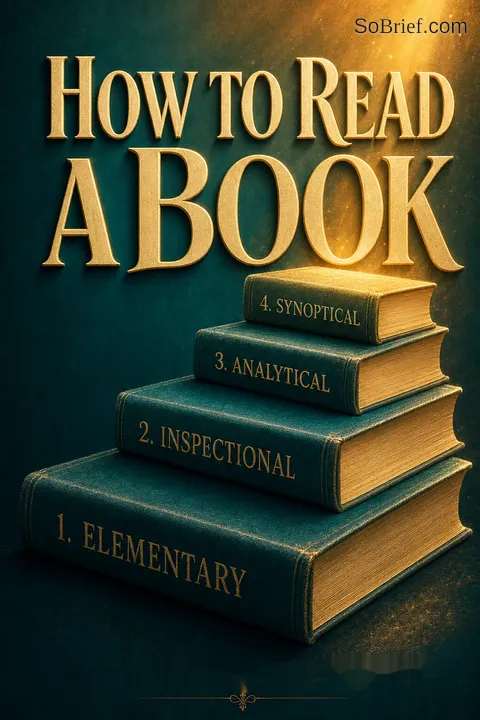


Key Takeaways
Your reading skill probably plateaued in sixth grade
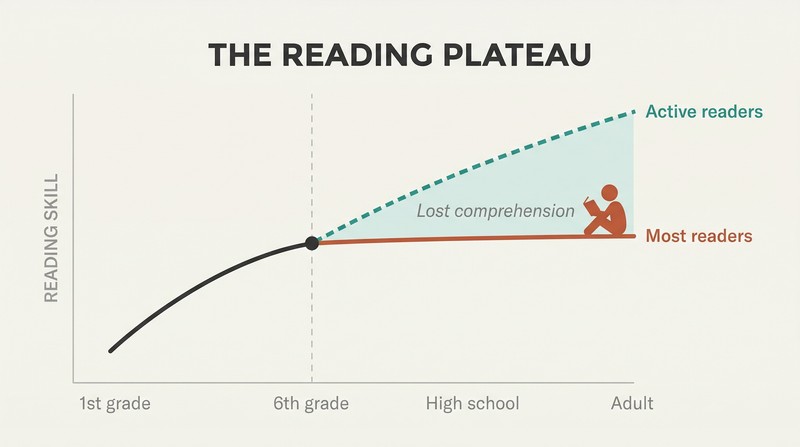
Most readers never graduate. In 1939, Professor Mursell wrote in the Atlantic Monthly that reading ability flattens after sixth grade — and Adler found this still true decades later. Schools pour enormous resources into teaching children to read but almost nothing into teaching adolescents or adults to read better. Speed reading courses don't fix this; they're essentially remedial, targeting the same elementary level. The real problem isn't velocity but comprehension.
Reading widely is not reading well. Adler draws a sharp distinction between gaining information (knowing that something is the case) and gaining understanding (knowing why, how it connects, what it implies). Most reading stays at the information level. The Greeks had a word for the well-read fool: sophomore — literally "wise fool."
Reading has four cumulative levels — most people stay at one
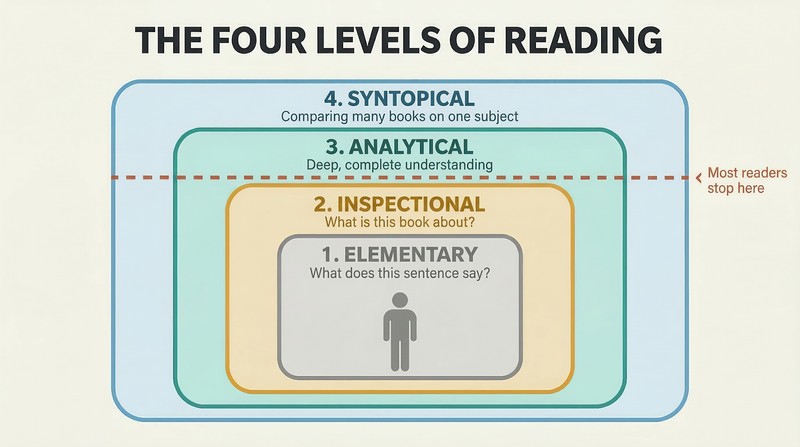
Four levels, not four types. Each level contains all those below it, like nesting dolls:
1. Elementary Reading: recognizing words and sentences — what does this sentence say?
2. Inspectional Reading: systematic skimming and superficial reading — what is this book about?
3. Analytical Reading: thorough, complete reading for deep understanding — the best possible given unlimited time
4. Syntopical Reading: reading many books on one subject and constructing an analysis that may not exist in any single book
Most people operate at levels one and two. Schools rarely teach analytical reading; colleges often don't either. A good liberal education should produce competent analytical readers. Yet many graduate students still haven't reached this level — let alone the fourth.
Skim every book systematically before you commit to reading it
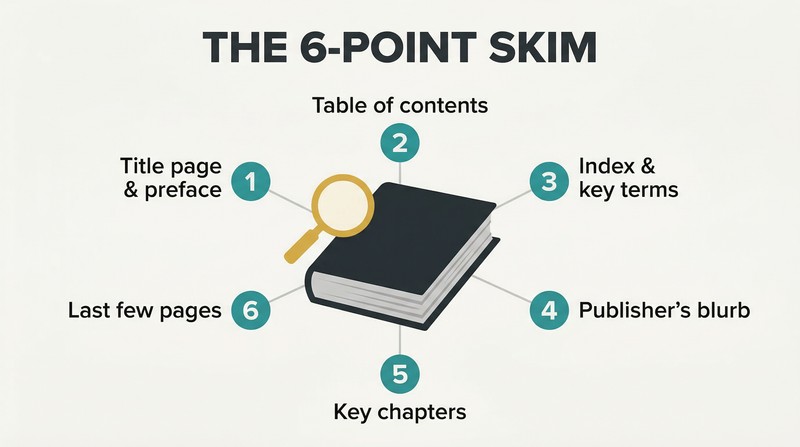
Skimming isn't lazy — it's strategic. Before reading any book analytically, give it a disciplined once-over using six steps:
1. Read the title page and preface
2. Study the table of contents for structure
3. Check the index for key terms and crucial passages
4. Read the publisher's blurb
5. Glance at chapters pivotal to the argument
6. Thumb through, dipping into paragraphs — and always read the last few pages
This takes minutes, not hours. Most people skip it entirely, starting on page one and plowing forward — facing the impossible task of grasping surface and depth simultaneously. Skimming first reveals whether a book deserves deeper attention and prepares your mind for what's coming.
Race through a difficult book first; puzzle it out second
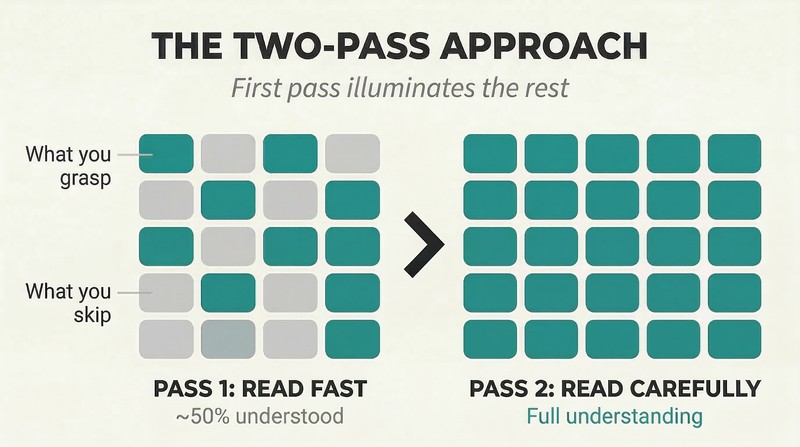
Don't let confusion stop you. Adler calls this the most overlooked rule: when tackling a difficult book for the first time, read it through without stopping to look up unfamiliar words or decode baffling passages. Concentrate on what you can understand. What you grasp on a first pass — even fifty percent — will illuminate the difficult parts when you return.
Shakespeare proves the point. Generations of students had their pleasure spoiled by being forced through Hamlet scene by scene, studying glossaries and footnotes. By the end, they'd forgotten the beginning and lost the whole play. Had they been encouraged to read it straight through first, they'd have understood enough to make the second, careful reading genuinely productive.
Adjust your reading speed to each passage — some deserve weeks
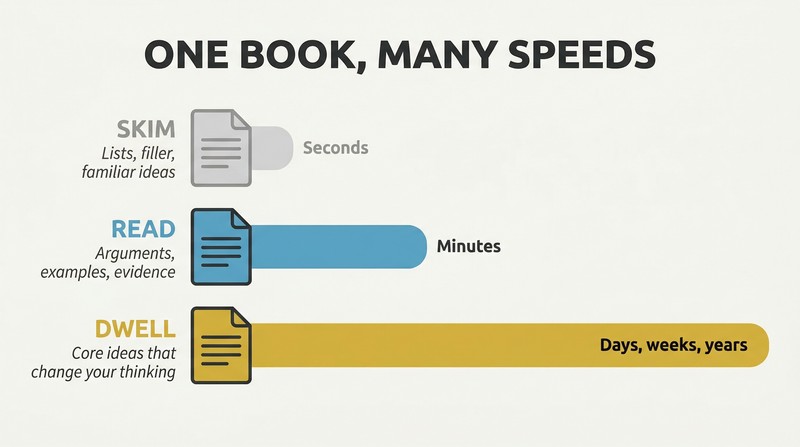
Speed reading solves the wrong problem. Speed reading courses promise faster reading with better comprehension, but the real skill is variable-speed reading. Many books barely deserve skimming. Some should be read quickly. A precious few demand painfully slow, attentive reading.
Consider the Declaration of Independence. The list of grievances against King George can be scanned quickly — a general impression suffices. But the opening two paragraphs, with words like "inalienable," "rights," "liberty," and "consent," deserve dwelling on. Adler suggests they demand reading at perhaps twenty words per minute — and that full comprehension could take days, weeks, or years. The goal is never maximum speed; it's appropriate speed.
Demand answers to four specific questions from every book
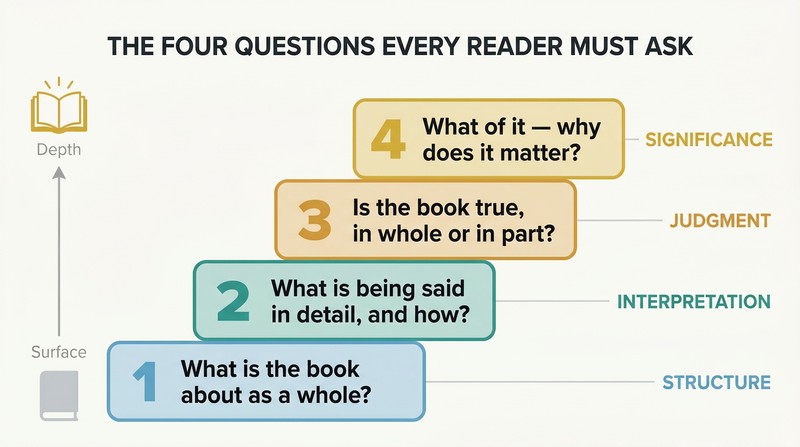
Four questions drive all active reading. Adler distills the reader's entire obligation into four questions that must be asked of any book worth serious attention:
1. What is the book about as a whole?
2. What is being said in detail, and how?
3. Is the book true, in whole or part?
4. What of it — why does it matter?
These map directly to the rules of reading. The first question drives structural outlining — classifying the book, stating its unity, finding the author's problems. The second drives interpretation — finding key terms, propositions, and arguments. The third demands critical judgment. The fourth forces you to reckon with the book's significance. A demanding reader asks all four; an undemanding reader asks none — and gets nothing in return.
Write in your books — that's how you truly own them
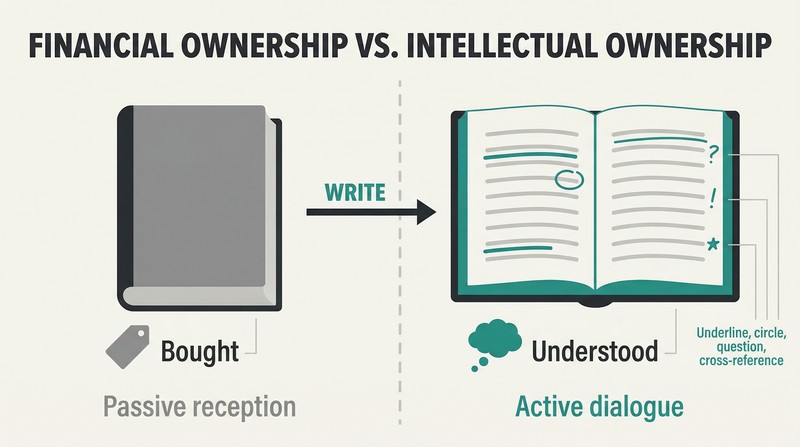
Marginalia is a thinking tool, not vandalism. Buying a book establishes financial ownership. Intellectual ownership comes from writing in it — underlining key passages, numbering arguments in margins, circling crucial words, jotting questions, and cross-referencing pages. These marks are physical signs of mental engagement. Writing keeps you awake, forces you to think, and transforms passive reception into active dialogue.
Use the endpapers strategically. After finishing, build a personal index on the back endpapers listing the author's points in order of appearance. Then turn to the front and outline the book's integrated structure. This outline measures your understanding — unlike a bookplate, it expresses intellectual ownership. The three types of notes — structural, conceptual, and dialectical — correspond to the three higher levels of reading.
Restate the author's ideas in your own words or admit defeat
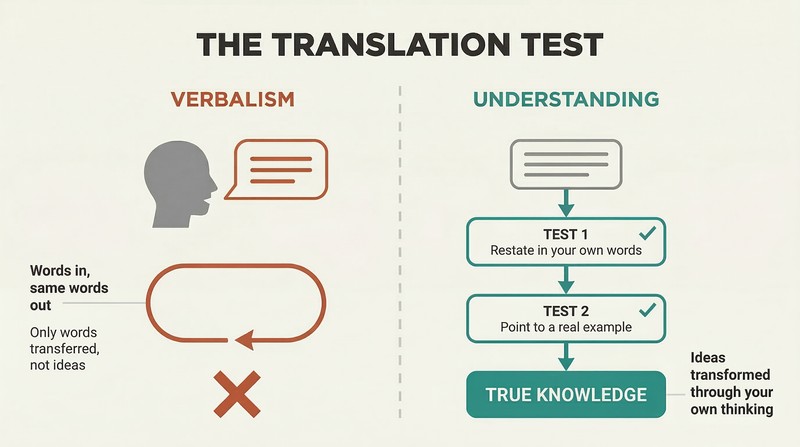
Passing the translation test is essential. Adler identifies verbalism — parroting an author's words without grasping the ideas — as the most common failure in reading. The antidote is a two-part test. First, can you restate the author's proposition in entirely different words? If you can only echo his phrasing, only words have passed between you, not knowledge. Second, can you point to a concrete experience or example the proposition describes?
The metaphysics example is telling. Students confidently repeated "Nothing acts except what is actual" with satisfied wisdom. But when asked to rephrase it, they couldn't manage "If something doesn't exist, it can't do anything." And when asked for a simple example — your bank account doesn't grow from a merely possible raise — they were stumped.
Never agree or disagree until you can say 'I understand'
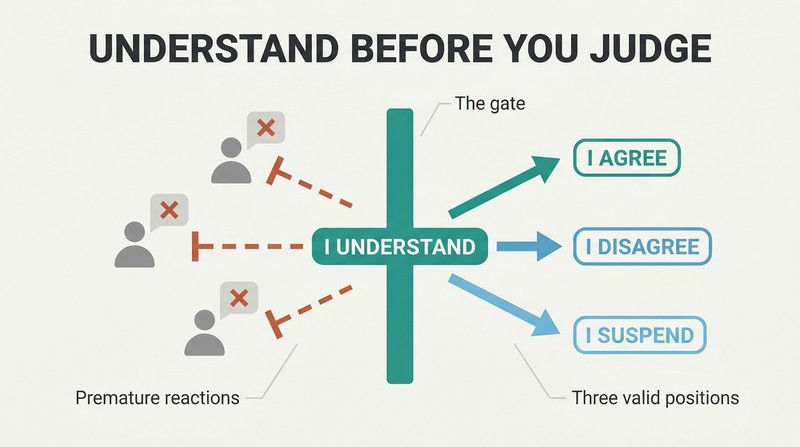
Understanding precedes all judgment. Adler's ninth rule prohibits criticism until you've completed structural outlining and interpretation. You must honestly say "I understand" before saying "I agree," "I disagree," or "I suspend judgment." These three positions exhaust all critical options — and agreeing is as much an exercise of judgment as disagreeing. Most people violate this rule constantly.
Four legitimate criticisms exist. When you do disagree, you must show the author is: (1) uninformed — lacking relevant knowledge, (2) misinformed — asserting what's false, (3) illogical — committing fallacies, or (4) incomplete — failing to solve all the problems posed. If you cannot support any of the first three, you must agree with the author as far as he goes. You have no freedom of will about this.
In syntopical reading, force authors onto your terms
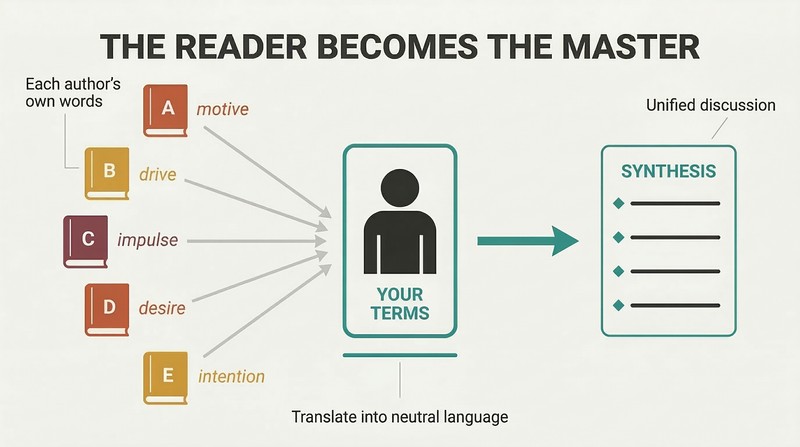
Syntopical reading reverses the reader-author relationship. In analytical reading, you submit to the author's framework. In syntopical reading — the highest and most demanding level — you become the master. You're investigating a question across many books, not studying any single one. This requires five disciplined steps:
1. Find relevant passages across your bibliography
2. Construct a neutral terminology all authors can be interpreted as using
3. Frame questions the authors can be seen as answering
4. Define issues by mapping opposing answers
5. Analyze the whole discussion to shed maximum light on the subject
The hardest step is terminology. Different authors use the same words differently and different words for the same ideas. You must translate everyone into your language — a radical act that every instinct of dutiful reading resists.
Fewer than 100 books are inexhaustible — find yours and reread them
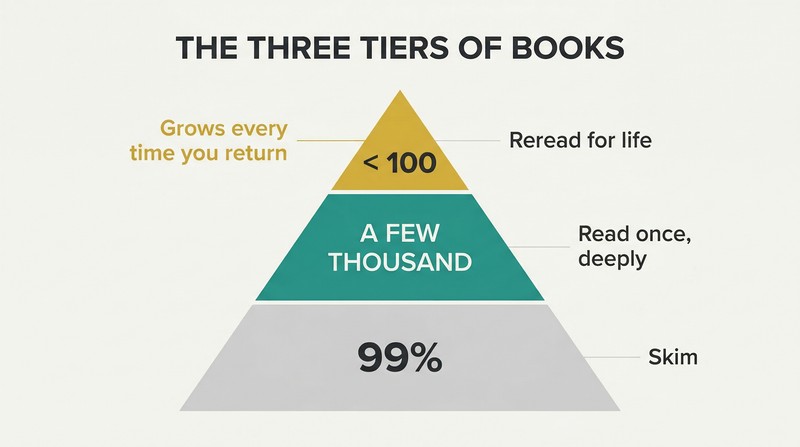
The pyramid of books has three tiers. Over 99% of books serve only amusement or information — skimming suffices. A few thousand deserve one thorough analytical reading; they'll stretch your mind, and that single reading will extract their full value. But fewer than a hundred belong to the highest tier: books so far above you that they remain above you no matter how skilled you become.
The test is simple: return to the book. If it seems smaller than you remember, it was merely good — you've outgrown it. If it seems to have grown with you, revealing layers you missed, it belongs in that rarefied top tier. These books are different for every reader, but they share one quality: they can lift you again and again, for the rest of your life.
Analysis
Adler's How to Read a Book, first published in 1940 and substantially revised in 1972 with Charles Van Doren, is arguably the most ambitious attempt ever made to codify the act of reading as a learnable discipline. Its central gambit — that most literate adults have never been taught to read beyond an elementary level — remains as uncomfortable and as true as it was eighty years ago, perhaps more so in an era of scrolling feeds and algorithmic content delivery.
The book's intellectual architecture rests on a Thomistic foundation. Adler, a devoted Aristotelian, organizes reading into a hierarchical framework of four cumulative levels and subdivides analytical reading into fifteen rules grouped in three stages, mirroring the scholastic method of division and subdivision. This gives the work both its greatest strength — extraordinary systematic clarity — and its most conspicuous limitation: a certain rigidity that can make reading feel more like an engineering project than a human encounter with ideas. The treatment of fiction and poetry is notably less assured than the treatment of expository prose; Adler is at his best with Aristotle and weakest with Shakespeare.
What makes the book enduringly valuable is its insistence that reading is not consumption but conversation. In an age when information is abundant and understanding scarce, Adler's distinction between reading for information and reading for understanding has become more important than he could have imagined. His framework anticipated the challenge of information overload by decades. The book's most radical idea — syntopical reading, in which the reader constructs an analysis that may not exist in any single book, using terminology belonging to no author — places the reader in the role of philosopher, not student. Adler knew this was his most ambitious claim, and he spent his final decades attempting to demonstrate it through the Syntopicon project. The result is a book that, ironically, meets its own criterion for greatness: it rewards rereading, and it remains above most of its readers.
Review Summary
How to Read a Book receives mixed reviews, with some praising its valuable insights on analytical reading and others finding it tedious. Many readers appreciate the book's guidance on approaching different types of literature and extracting deeper meaning. Critics note its dated language and verbose style. Some find the techniques impractical for casual reading but useful for academic pursuits. The book's emphasis on active reading and engaging with authors' ideas is widely commended, though its relevance in the digital age is debated.
People Also Read


Glossary
Elementary Reading
Basic literacy and sentence comprehensionThe first and lowest level of reading, concerned with recognizing individual words and understanding what sentences say. Typically mastered in elementary school through four sub-stages (reading readiness through functional literacy). All higher levels of reading include and build upon this foundation.
Inspectional Reading
Systematic skimming within limited timeThe second level of reading, aimed at getting the most out of a book within a set time. It has two parts: (1) systematic skimming or pre-reading—examining the title, table of contents, index, and key chapters; and (2) superficial reading—reading straight through without stopping at difficulties. The goal is to grasp the book's structure and general content.
Analytical Reading
Thorough reading for deep understandingThe third level of reading, consisting of fifteen rules organized in three stages: structural outlining (what is the book about), interpretation (what is being said and how), and criticism (is it true, and what of it). It is the most complete reading possible given unlimited time, aimed at transforming the reader's understanding rather than merely adding information.
Syntopical Reading
Comparative reading across multiple booksThe fourth and highest level of reading, in which the reader examines many books on a single subject. The reader constructs a neutral terminology, frames questions, defines issues across authors, and analyzes the discussion as a whole. Unlike analytical reading where the book is master, in syntopical reading the reader is master and the books serve the reader's inquiry.
Coming to Terms
Finding shared meaning with authorThe fifth rule of analytical reading, requiring the reader to identify an author's key words and determine precisely how they are used. A 'term' is a word used unambiguously; since most words have multiple meanings, the reader must determine which meaning applies in each context. Communication fails when writer and reader use the same words with different meanings.
Verbalism
Words without genuine understandingThe bad habit of using or receiving words without regard for the thoughts they should convey or the experiences to which they should refer. A reader guilty of verbalism can repeat an author's sentences but cannot restate the ideas in different words or provide concrete examples. Adler identifies it as the besetting sin of those who fail to read analytically.
Dialectical Objectivity
Impartial analysis of opposing viewsThe ideal stance of the syntopical reader, who tries to look at all sides of an issue and take no sides. It requires presenting opposing views without prejudice, treating conflicting positions impartially, and allowing the ordered discussion itself—rather than any set of assertions—to represent the truth. Absolute objectivity is acknowledged as impossible but remains the standard.
Syntopicon
Topical index to great booksA reference work created by Adler and his associates, serving as a topical index to the Great Books of the Western World. Under approximately 3,000 topics, it lists passages where each subject is discussed, helping readers locate relevant material across the set without prejudging its meaning. It was designed to solve the fundamental problem of syntopical reading: knowing where to start.
FAQ
What's "How to Read a Book" about?
- Comprehensive guide: "How to Read a Book" by Mortimer J. Adler and Charles Van Doren is a guide to improving reading skills across different levels and types of reading.
- Active and analytical reading: It emphasizes reading actively and analytically to enhance comprehension and retention.
- Levels of reading: The book outlines four levels of reading: Elementary, Inspectional, Analytical, and Syntopical, each requiring different skills and engagement.
Why should I read "How to Read a Book"?
- Improve reading skills: The book provides a structured approach to reading, making you a more effective and efficient reader.
- Broaden comprehension: By following its methods, you can learn to comprehend and analyze texts more thoroughly.
- Lifelong learning: The skills taught are applicable to a wide range of reading materials, supporting lifelong learning and intellectual growth.
What are the key takeaways of "How to Read a Book"?
- Active reading: Emphasizes engaging with the text through questioning and critical thinking.
- Four levels of reading: Understanding the four levels—Elementary, Inspectional, Analytical, and Syntopical—helps approach texts with appropriate depth.
- Reading for understanding: The ultimate aim is to not just know what a text says, but also what it means and how it relates to other knowledge.
What is the "Inspectional Reading" method in "How to Read a Book"?
- Quick overview: Inspectional reading involves skimming a book to get a general sense of its content and structure.
- Two types: It includes systematic skimming and superficial reading to understand the main ideas.
- Purpose: The goal is to determine whether the book is worth a more thorough reading and to get a basic understanding of its main ideas.
How does "Analytical Reading" work in "How to Read a Book"?
- Thorough understanding: Analytical reading involves understanding the book's structure, arguments, and the author's intentions.
- Four rules: It includes coming to terms with the author, understanding propositions, finding arguments, and determining solutions.
- Active engagement: Requires active engagement with the text, including making notes and asking questions to fully grasp the content.
What is "Syntopical Reading" according to "How to Read a Book"?
- Comparative reading: Syntopical reading involves reading multiple books on the same subject and comparing their ideas.
- Five steps: It includes inspection, finding relevant passages, bringing authors to terms, getting questions clear, and defining issues.
- Objective analysis: The goal is to analyze the subject objectively, using insights from various authors to form your own understanding.
What are the "Four Basic Questions" a reader should ask according to "How to Read a Book"?
- Main questions: The questions are: What is the book about as a whole? What is being said in detail, and how? Is the book true, in whole or part? What of it?
- Purpose: These questions guide the reader in understanding the book's content, evaluating its truth, and considering its significance.
- Engagement: By asking these questions, readers engage more deeply with the text and enhance their comprehension and critical thinking skills.
How does "How to Read a Book" suggest making a book your own?
- Active note-taking: Adler suggests marking the book with underlining, vertical lines, stars, numbers, and writing in the margins.
- Personal index: Creating a personal index on the endpapers helps summarize the book's structure and main points.
- Intellectual ownership: These practices help readers take intellectual ownership of the book, making it a part of their understanding.
How does "How to Read a Book" address different kinds of reading matter?
- Practical books: Provides strategies for understanding the author's advice and how to apply it.
- Imaginative literature: Emphasizes appreciating the author's style and themes.
- Scientific and philosophical works: Offers guidance on understanding arguments and evidence in these texts.
How does "How to Read a Book" suggest reading fiction differently from nonfiction?
- Focus on experience: For fiction, focus on the experience the author conveys rather than extracting factual information.
- Engage with characters: Understanding characters and their development is crucial in fiction.
- Appreciate the artistry: Recognize and enjoy the creative elements that make fiction unique.
What are the challenges of reading scientific and mathematical texts, according to "How to Read a Book"?
- Complex language: These texts often use technical language that can be difficult to understand.
- Abstract concepts: They deal with abstract concepts requiring high comprehension and critical thinking.
- Need for background knowledge: A certain level of background knowledge is often necessary, and additional resources may be needed.
What are the best quotes from "How to Read a Book" and what do they mean?
- "Reading is a complex activity": Emphasizes that reading involves understanding, interpreting, and critically evaluating texts.
- "The more active reading is, the better it is": Highlights the importance of engaging with the text through questioning and critical thinking.
- "The ultimate goal of reading is to read for understanding": Underscores the book's central message that reading should lead to a deeper understanding of the material and its implications.
Download PDF
Download EPUB
.epub digital book format is ideal for reading ebooks on phones, tablets, and e-readers.








































