Key Takeaways
1. Redefining Rationality: Credible Theories and Deliberative Processes
For us, rationality is all about making sense of the world—that is, figuring out how it works and why—in order to decide how to achieve certain goals.
A new definition. The conventional understanding of rationality in international politics is often flawed, mistakenly equating it with successful outcomes or moral conduct. This book proposes a more precise definition: a state acts rationally if its foreign policy is based on a credible theory and emerges from a deliberative decision-making process. This definition applies to both individual policymakers and the collective state.
Beyond success or morality. Contrary to popular belief, rationality is not about achieving desired results or adhering to ethical norms. Rational actors can fail due to unforeseen circumstances, and rational policies can be morally objectionable. The focus should instead be on the soundness of the thinking process and the rigor of decision-making.
High stakes. The debate over state rationality has profound implications for both the study and practice of international relations. If states are routinely nonrational, understanding and predicting their behavior becomes impossible, undermining core theories and making effective foreign policy formulation a futile endeavor.
2. International Politics: A Realm of Profound Uncertainty
In an uncertain world, actors cannot acquire the information needed to evaluate the likely consequences of pursuing different strategies.
Information deficits. International politics is fundamentally an uncertain world, characterized by severe information deficits. Policymakers rarely possess complete or reliable data about their own state's resolve, other states' capabilities, intentions, or the precise outcomes of their interactions. This contrasts sharply with "risk" worlds, where probabilities can be calculated, or "certain" worlds, where all information is known.
Future is opaque. The further into the future policymakers attempt to peer, the greater these informational challenges become. Anticipating how events will unfold, how adversaries will react, or what unforeseen factors might emerge is incredibly difficult. This inherent uncertainty means that decision-makers must operate with limited and often ambiguous knowledge.
Historical examples. Throughout history, leaders have grappled with this uncertainty.
- US post-WWII: Faced unknowns about Germany's recovery, Soviet intentions, and European stability.
- Japan pre-Pearl Harbor: Unsure of US reactions to military expansion or the long-term costs of war.
- Cuban Missile Crisis: US leaders debated military vs. coercive options without full knowledge of Soviet escalation thresholds.
These examples underscore that even with hindsight, scholars often disagree on the true probabilities and expected utilities of past decisions.
3. Credible Theories: The Foundation of Rational Policymaking
Rational policymakers who seek to make sense of the world adopt credible theories; we can call them homo theoreticus.
Theory-driven thinking. Rational policymakers are "homo theoreticus," meaning they rely on credible theories to understand how the world works and to guide their strategic choices. Theories are simplified descriptions of reality, comprising realistic assumptions, logically consistent causal stories, and substantial empirical support. They provide a framework for discerning cause-and-effect relationships in an information-deficient environment.
Beyond pure logic or empiricism. Neither pure logical deduction nor pure empiricism is sufficient for navigating international politics. Logic alone cannot validate assumptions, and empirical data is often too scarce or ambiguous to speak for itself. Theories combine these strengths, offering coherent explanations that are tested against available facts, even if imperfectly.
Realism and liberalism. Policymakers primarily draw upon two broad traditions of credible international relations theories:
- Realism: Emphasizes the international system's architecture, states' pursuit of survival, and the balance of power (e.g., defensive, offensive, hegemonic realism, deterrence theories).
- Liberalism: Focuses on state interests, cooperation, and the role of domestic factors (e.g., democratic peace theory, economic interdependence, liberal institutionalism).
These theories, though sometimes competing, provide robust frameworks for understanding complex global dynamics.
4. Deliberation: The Hallmark of Rational State Decision-Making
Deliberation is the hallmark of a rational aggregation process at the state level.
Collective enterprise. Foreign policy is a collective endeavor, involving multiple policymakers with diverse perspectives and preferred theories. Therefore, state rationality depends on how these individual views are aggregated into a final decision. A rational aggregation process is fundamentally deliberative.
Robust and uninhibited debate. Deliberation involves vigorous and unconstrained debate among key decision-makers. All options are presented, and their strengths and weaknesses are openly discussed without coercion, deception, or suppression of dissenting views. This "marketplace of ideas" is crucial for systematically evaluating complex problems in an uncertain world.
Paths to decision. A rational outcome can be reached in three ways:
- Consensus: Policymakers share similar credible theories and easily agree on a strategy after discussion.
- Convergent debate: Initial disagreements are resolved as debate leads some to reconsider their views, resulting in a consensus based on credible theories.
- Ultimate decider: If deadlock persists after robust debate, the ultimate decider (e.g., president, prime minister) makes the final choice, having considered all viewpoints.
5. Rationality Assesses Process, Not Outcomes
Rational actors often fail to achieve their goals, not because of foolish thinking but because of factors they can neither anticipate nor control.
Process over results. A critical distinction in defining rationality is that it pertains to the process of decision-making, not the outcomes. A policy is rational if it results from credible theories and deliberation, regardless of whether it ultimately succeeds or fails. Equating rationality with success is a common but fundamental error.
Reasons for failure. Even rational policies can fail due to:
- Imperfect theories: Theories simplify reality, sometimes omitting crucial factors that prove decisive.
- Information deficits: Decision-makers may lack sufficient or accurate information about intentions, capabilities, or unforeseen circumstances.
- Chance/Fortune: Unexpected events or shifts in the international environment can derail even the best-laid plans.
Conversely, nonrational policies can succeed due to sheer luck or overwhelming material superiority.
Maximizing chances. While success is not guaranteed, rational policies are more likely to succeed than nonrational ones. By grounding decisions in sound theories and thorough deliberation, states maximize their chances of navigating the world effectively and achieving their objectives.
6. Critiquing Flawed Definitions: Beyond Expected Utility and Mental Shortcuts
Expected utility maximization is a non-definition or a flawed definition of individual rationality in world politics.
Rational choice's "as if" problem. Rational choice theory, which equates rationality with expected utility maximization, fails to define how rational individuals actually think. It assumes actors behave "as if" they are maximizing utility, but doesn't describe the mental process. This "as if" approach is inadequate for understanding rationality as a cognitive process.
Expected utility in an uncertain world. Even if rational choice abandoned the "as if" assumption, expected utility maximization is ill-suited for international politics. It requires objective probabilities for outcomes, which are impossible to ascertain in an information-deficient, uncertain world. Relying on "subjective probabilities" merely means guessing, making the method nonrational for high-stakes foreign policy.
Political psychology's "bias" problem. Political psychologists define nonrationality as deviation from expected utility maximization, often attributing it to mental shortcuts like analogies and heuristics. This definition is problematic because:
- It implies policymakers are always nonrational, which defies common sense.
- It often reasons backward from bad outcomes to infer nonrationality, ignoring the process-outcome distinction.
- It overlooks that high-stakes foreign policy decisions are unlikely to rely on simple rules of thumb.
Both approaches also largely ignore state-level aggregation.
7. Routine Rationality: Evidence from Grand Strategy and Crisis Management
A careful analysis reveals that German decision makers during the July Crisis, Japanese decision makers in the run-up to Pearl Harbor, and German decision makers in the months before Operation Barbarossa based their strategic thinking on credible theories of international politics and of military victory.
Empirical validation. Despite widespread claims of nonrationality, historical analysis reveals that states are routinely rational in their grand strategic and crisis decision-making. The book examines ten "hard cases"—instances often cited as examples of nonrational behavior—and reinterprets them as rational.
Rational grand strategies:
- Germany pre-WWI: Developed balancing and deterrence strategies based on realist theories, with broad consensus.
- Japan pre-WWII: Pursued an autarkic empire based on self-help realist logic, with deliberative reaffirmation.
- France pre-WWII: Converged on containing Germany and allying with the Soviet Union, driven by realist and ideological theories after robust debate.
- US post-Cold War (NATO expansion): Debated realist and liberal theories, with President Clinton making a deliberative choice.
- US post-Cold War (liberal hegemony): Unanimously embraced liberal theories to transform the international system.
Rational crisis management:
- Germany WWI (July Crisis): Launched a preventive war based on realist theories and a credible theory of victory (Schlieffen Plan), with deliberative consensus.
- Japan Pearl Harbor: Opted for a risky war based on realist survival logic and a theory of limited victory, following extensive deliberation.
- Germany Barbarossa: Invaded the Soviet Union based on realist theories of hegemony and preventive war, with deliberative planning.
- US Cuban Missile Crisis: Debated military and coercive theories, with President Kennedy making a deliberative decision to settle.
- Soviet Union Czechoslovakia 1968: Invaded based on realist and ideological theories to preserve the Warsaw Pact, after deliberative shifts in consensus.
8. Rare Exceptions: When States Act Nonrationally
Empirically, however, failures to employ credible theories and failures to deliberate appear to go hand in hand.
Nonrationality is uncommon. While states are generally rational, there are rare instances where they adopt nonrational policies. These cases typically involve both a reliance on noncredible theories or emotion-driven arguments and a failure of deliberation.
Four cases of nonrationality:
- Germany's Risk Strategy (pre-WWI): Admiral Tirpitz's plan to build a fleet to challenge Britain was based on a noncredible theory (Britain wouldn't balance) and forced through a nondeliberative process.
- Britain's No-Liability Strategy (pre-WWII): Prime Minister Chamberlain's decision to avoid a continental military commitment was driven by emotional desire to avoid war, lacked theoretical basis, and involved suppressing dissent.
- US Bay of Pigs Invasion (1961): The plan to overthrow Castro relied on a noncredible theory of victory (underestimating Cuban forces, overestimating internal resistance) and was pushed by the CIA through deception and suppression of critical voices.
- US Invasion of Iraq (2003): The Bush administration's strategy was based on noncredible theories (forcible democracy promotion, domino theory) and characterized by a nondeliberative process that ignored critics and suppressed dissenting intelligence.
Goal nonrationality. The book identifies only one clear case of goal nonrationality: Nazi Germany's decision to fight to the bitter end in World War II, ensuring its own destruction rather than surrendering. This is distinct from merely risking survival, which can be a rational choice when faced with dire threats.
9. Dominators vs. Facilitators: The Root of Nonrationality
The key issue is whether the ultimate decider is a facilitator or a dominator.
Breakdown of deliberation. When nonrationality occurs, it often stems from a breakdown in the deliberative process, typically orchestrated by a "dominator" leader. Unlike a "facilitator" who encourages open debate, a dominator imposes their views, suppresses dissent, and prevents a thorough evaluation of alternative theories and policies.
Characteristics of dominators:
- Suppression of dissent: Actively silencing or removing individuals who challenge their preferred policies.
- Control of information: Manipulating or withholding crucial intelligence to support their agenda.
- Lack of open debate: Preventing robust discussion and critical examination of assumptions.
- Reliance on noncredible theories/emotions: Prioritizing personal beliefs or emotional responses over sound theoretical reasoning.
Examples of dominators:
- Admiral Tirpitz (German naval buildup)
- Prime Minister Chamberlain (British no-liability strategy)
- CIA leaders Bissell and Dulles (Bay of Pigs)
- Vice President Cheney and Secretary of Defense Rumsfeld (Iraq War)
These figures played central roles in steering their states toward nonrational decisions by undermining the deliberative mechanisms that typically ensure rational policymaking.
10. Survival: The Paramount Goal of Rational States
Survival is primary, and all other objectives must be subordinated to it.
The ultimate objective. While states pursue many goals—prosperity, ideology, influence—rational states invariably rank survival as their number one objective. This is a matter of incontrovertible logic: a state cannot achieve any other goal if it ceases to exist. All other objectives, no matter how important, must be subordinated to self-preservation.
Prioritizing survival in practice:
- Thirty Years' War: Religious goals were secondary to maintaining a favorable balance of power for survival.
- Germany 1914: Sacrificed economic prosperity for a preventive war aimed at ensuring long-term survival against a rising Russia.
- Britain WWII: Set aside anti-communism to ally with the Soviet Union when its survival was threatened by Nazi Germany.
- Nuclear proliferation: States like Iran, Iraq, and North Korea violated international treaties to pursue nuclear weapons, viewing them as ultimate deterrents for survival.
- Wartime targeting of civilians: States have resorted to extreme measures, like firebombing or atomic bombs, when they believed their survival or massive casualties were at stake.
Reinterpreting "risking survival." Cases often cited as states "recklessly risking survival" (e.g., Napoleonic France, Nazi Germany, imperial Japan's overexpansion, or British/French underbalancing) are reinterpreted. These states were still primarily concerned with their security and launched bids for domination or adopted flawed deterrence strategies in an attempt to maximize their prospects for survival, however misguided their methods.
11. The Enduring Relevance of Rationality in World Politics
If the critics are right, theorists and practitioners of international politics are in trouble.
Affirming core theories. The finding that states are routinely rational actors has profound implications. It affirms the foundational assumptions of major international relations theories, particularly realism and liberalism, which largely rely on the rational actor assumption. If states were frequently nonrational, these theories would lose much of their explanatory power.
Guiding foreign policy. For practitioners, the prevalence of rationality means that states have a sound basis for formulating foreign policy. They can anticipate how other states—friends and adversaries alike—are likely to behave in a given situation, allowing for the design of more effective strategies to advance national interests.
Rationality is not peace. Importantly, the authors emphasize that rationality does not equate to peace or moral conduct. Rational decision-makers seek the most effective strategy, and in the dangerous realm of international politics, this sometimes involves threatening or initiating violence. The book concludes that this stark reality, though not uplifting, is a fundamental truth about how states think and act.
Review Summary
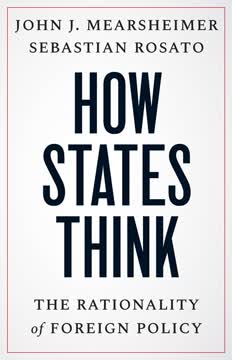
Reviews for How States Think are mixed, averaging 3.68/5. Many readers appreciate the book's central argument — that states behave more rationally than commonly assumed — but criticize its excessive repetition and overly academic tone. A frequent complaint is that the book should have remained a journal article. The theoretical first half is considered dry, while the historical case studies in the second half are more engaging. Some question the authors' broad definition of rationality and perceived bias toward realist theory.
People Also Read
 Immersive