

Key Takeaways
Your most important talent is the attitude you choose about yourself
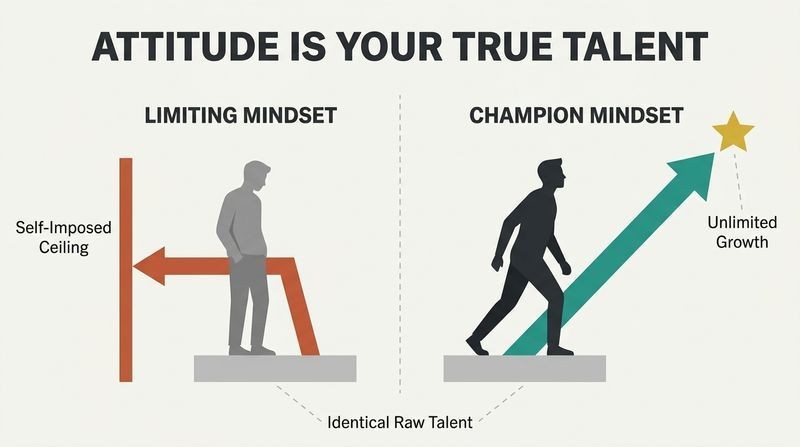
The champion's edge is mental, not physical. Rotella, a sports psychologist to winners of 84 major golf championships, opens with LeBron James, who told him flatly he wanted to be the greatest player in history. That declaration, not his 250-pound frame, was his real gift. Compare Pat Bradley: average size, average clubhead speed, from golf-poor New England, one tour win in eleven years. She told Rotella she wanted the LPGA Player of the Year, the lowest scoring average, every major, and the Hall of Fame. Within a decade she achieved all of it.
Talent is common; the will to maximize it is rare. As Bear Bryant quipped, jackasses do not win the Kentucky Derby, but plenty of talented people coast. What separates the exceptional is optimism, confidence, persistence, and a refusal to place limits.
What's striking is how this reframes agency. Carol Dweck's research on growth versus fixed mindset offers empirical backbone: students who believe ability is malleable outperform equally talented peers who believe it is fixed. Rotella arrived at the same conclusion through locker rooms rather than labs. The claim invites pushback though. Survivorship bias lurks everywhere here, since we rarely hear from the thousands who believed fiercely and still failed. The honest reading is not that belief guarantees greatness but that its absence nearly guarantees mediocrity. Attitude is necessary, not sufficient, a distinction the LeBron story quietly honors when it pivots immediately to 400 daily practice shots.
Choose optimism deliberately, because it is a decision and not a temperament
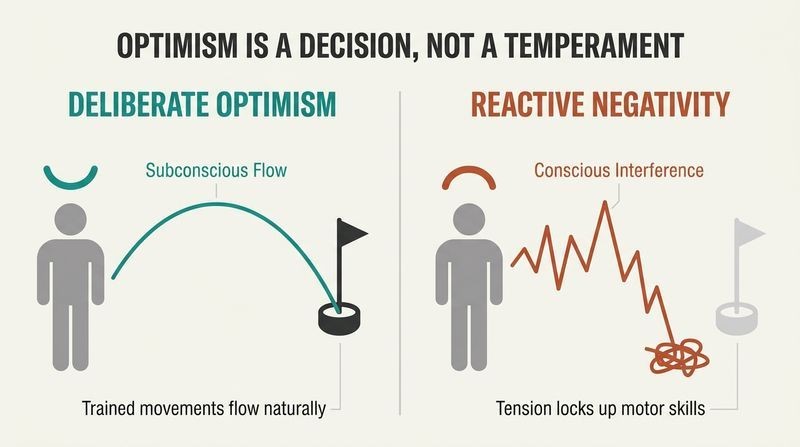
Optimism is a skill, not a birthright. Rotella insists no one is born a pessimist the way they are born left-handed. Consider Roger Bannister, who dismissed expert consensus that the human body could not run a four-minute mile, then broke it in 1954. Within a few years many runners followed, freed by his example. Padraig Harrington missed a cut at the Masters yet walked away energized, telling Rotella he now knew he could win a major because he had kept his mind present on every shot.
Situational optimism helps motor skills. Optimism keeps the subconscious in charge, letting trained movements flow. Rotella even tells golfers to smile before a putt, since frowning signals the conscious brain to seize control. Negative thinking, by contrast, correlates almost perfectly with failure.
Rotella's practical trick, smiling before a putt, anticipates the facial-feedback hypothesis studied by psychologists like Fritz Strack: physical expression can nudge emotional state, not just reflect it. His framing also echoes Martin Seligman's learned optimism, which he credits. Worth noting the nuance: defensive pessimism research by Julie Norem shows some high performers actually thrive by imagining worst-case scenarios, harnessing anxiety productively. So optimism is not universally optimal across personalities. But Rotella's domain, motor-skill performance under pressure, is precisely where his advice holds strongest, because rumination and self-consciousness demonstrably degrade fine motor execution. The card-counting analogy is apt: optimism improves odds without guaranteeing outcomes.
Build confidence by remembering triumphs and refusing to replay mistakes
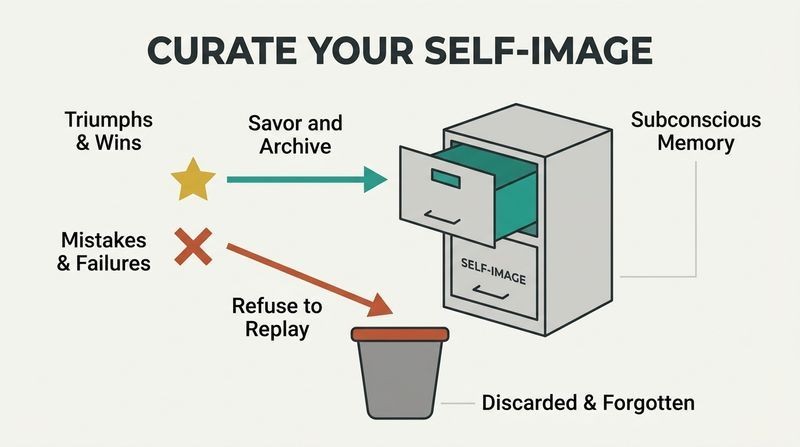
Your self-image is an archive you curate. Rotella leans on William James: people tend to become what they think about themselves. The subconscious records thoughts uncritically, like advertising slipping past your defenses, and recent, emotionally charged thoughts weigh most. Jack Nicklaus once flatly told a heckler he had never three-putted the final green of a tournament. He was factually wrong, but he genuinely believed it, because he forgot mistakes and savored good shots. That selective memory helped fuel eighteen majors.
Feed the subconscious deliberately. Rotella has struggling golfers keep a notebook of every good shot, even in practice. He warns against chasing a perfect swing as the source of confidence, noting both Tiger Woods and Phil Mickelson missed fairways constantly yet never doubted they could score.
This runs against the schoolroom instinct, drilled into everyone, to dwell on errors marked with red X's. Neuroscience partly supports Rotella: memory is reconstructive, not a recording, so deliberate rehearsal of successes genuinely reshapes self-perception. Yet there is tension with deliberate-practice research from Anders Ericsson, which requires ruthless attention to what went wrong. Rotella threads this needle by separating performance from review: forget mistakes during play, analyze them afterward. The Nicklaus anecdote is almost unsettling in its factual denial, but it illustrates a real principle: elite performers protect their confidence like a resource, treating accuracy of self-memory as less important than usefulness of self-memory.
Stop worshipping rivals' talent, because it is an excuse for quitting
We confuse the visible with the valuable. Rotella coached a slow lacrosse player he dismissed as talentless who then broke the school scoring record using quick hands from a stationary position. Greg Maddux, passed over by scouts for lacking a blazing fastball, became arguably baseball's greatest pitcher by mastering control and reading hitters. In golf, people equate length off the tee with talent, but tournaments are won by fewest strokes, not longest drives.
Real talent is largely internal. Rotella lists what actually predicts greatness:
1. Passion that survives struggle
2. A confident self-image before success arrives
3. A coachable, gracious personality that attracts helpers
4. Wisdom to pick trusted teachers and tune out the rest
Saying you lack someone's talent, he argues, is often a preemptive justification for mediocrity.
The insight cuts against a culture obsessed with measurable metrics, the forty-yard dash, the SAT, the radar gun. Rotella's point aligns with Angela Duckworth's grit research, which found perseverance predicts success beyond raw ability across West Point cadets and spelling-bee finalists. His Maddux example is a clean natural experiment: identical scouting inputs, radically different self-interpretation. One caveat worth naming: physical ceilings are real. A five-foot-seven player will not dominate the NBA no matter the mindset. Rotella concedes quickness and size exist. His sharper claim is subtler and defensible: within the pool of the genuinely capable, self-limiting beliefs, not physical gaps, explain most of the sorting.
Love the entire grind, especially the days nothing goes right
Commitment is tested by tedium, not glory. Rotella notes company results dip in the middle two quarters, mirroring gyms that empty by April. Exceptional people persist where others slack. Paul Runyan, a golf teacher in his nineties, publicly apologized for missing his self-imposed short-game practice on three days out of the year. Tom Kite's one piece of advice to tour rookies: you must love golf even when every putt lips out and every bounce goes out of bounds, not just when the trophies come.
Perseverance is habit engineering, not gritted teeth. A habit is a cue, a subconscious behavior, and a reward. You cannot erase bad habits, but you can overlay them: identify the cue, design a healthier response, enlist support, visualize, and chart progress. Break big goals into daily process steps.
Rotella essentially previews Charles Duhigg's cue-routine-reward loop and James Clear's identity-based habits, grounding an abstract virtue in mechanics. The neuroscience holds: basal ganglia habit circuits persist even after behavior stops, which is why relapse is chemistry, not weakness. His reframe of willpower is the most useful move here. Roy Baumeister's ego-depletion work suggested willpower is a finite resource, so relying on daily teeth-gritting is a losing strategy; habits automate the behavior and spare the reservoir. The Runyan anecdote, practicing 362 of 365 days at ninety, is almost comic in its devotion, but it makes the point unforgettable: the exceptional treat commitments to themselves as sacred.
Chase process goals daily, because dreams without a ladder stay fantasies
Dreams are cheap; processes are rare. Rotella distinguishes the two through a stalled client who dreamed of the PGA Tour, climbed every rung to get there, then coasted because he never built a process for what came next. John Calipari abandoned youthful outcome dreams (head coach by thirty, title by thirty-five) for what he calls the grind: getting measurably better every single day at defense, rebounding, and hustle. Sometimes the grind wins championships, sometimes it loses, but it is the only thing controllable.
Aim absurdly high, because goals double as ceilings. Rotella rarely sees anyone exceed the goal they set. Target avoiding three-putts and you two-putt your life away; instead try to make everything. If nobody thinks your goals are crazy, you are aiming too low.
This is the systems-over-goals argument that Scott Adams and James Clear popularized, but Rotella adds a sharper psychological wrinkle: goals function as ceilings because the subconscious calibrates effort to the target. There is real support in goal-setting theory from Locke and Latham, though their data actually favors specific, difficult, and measurable goals over vague grandiosity. The reconciliation is that Rotella wants big dreams paired with concrete daily process metrics, not big dreams alone. His warning about the three-putt goal is behaviorally acute: framing effects mean loss-avoidance and gain-seeking produce different physical outcomes even when the scoreboard looks identical, a subtle but performance-relevant distinction.
Treat nerves as a friend, then trust the routine you trained
There is no cure for nerves, only a use for them. Every major champion Rotella counseled was nervous on the final holes. Bill Russell vomited before games and won eleven titles. Nerves signal you care. The mantra is train it and trust it: drill a skill until the subconscious owns it, then at showtime quiet the conscious brain and let it fire. Nervousness sabotages performers by re-engaging conscious control, making the body stiff and awkward.
A performance process is a preshot routine for the mind. Golfers who overthink club selection under pressure abandon the free, instinctive play they show with friends. Rotella's cure is often distraction: Chris Hickman daydreamed of a Paris cafe between shots, Charl Schwartzel pictured his South African ranch. Clearing the conscious mind lets trained instinct take over.
The train-it-and-trust-it split maps onto dual-process cognition, Kahneman's System 1 and System 2. Choking research by Sian Beilock confirms Rotella's mechanism: pressure induces explicit monitoring of movements that should run automatically, disrupting them, which is why experts choke on skills novices cannot even attempt. His distraction technique is counterintuitive but evidence-based; Beilock found that having skilled golfers focus externally or sing to themselves preserved performance better than focusing on mechanics. The reframe of nerves as friend rather than foe also echoes Alison Wood Brooks's finding that reappraising anxiety as excitement improves performance more than trying to calm down. Rotella's clinical intuition tracks the lab remarkably well.
Judge yourself by adherence to process, not by outcomes and luck
Outcomes lie; process tells the truth. Rotella watched Calipari chew out his Kentucky team after a 25-point win because they only played hard for 32 of 40 minutes. Calipari never mentions winning, only the standard of effort, and he times criticism for right after victories, when players can absorb it. Average people suffer perceived exertion, overestimating their effort. When Kentucky freshmen wear heart monitors, they discover they play at 50 percent while NBA players hit 80 to 90.
Set your own standards and catch drift early. Amateur champion Bill Shean scored his rounds not by strokes but by the percentage of shots on which he honored his full routine. Exceptional people notice a three-pound gain and correct it; average people wake up fifteen pounds heavier six months later.
This is a quietly radical inversion of how most institutions measure people, by results that are heavily contaminated by luck and factors outside control. Rotella's stance resonates with Annie Duke's work on resulting, the error of judging decision quality by outcome quality. A good process can yield a bad result and vice versa, so evaluating only outcomes teaches the wrong lessons. The heart-monitor detail is a devastating illustration of the Dunning-Kruger-adjacent gap between felt effort and actual effort. One tension: pure process focus risks complacency if the process itself is flawed. Rotella guards against this by demanding the process be benchmarked against elite competition, keeping self-set standards honest rather than self-flattering.
Give failure twenty minutes, then refuse to relive it
Respond to failure like ore going through fire. An old coach told Rotella that fire burns impurities from metal, making it stronger; failure does the same for people. Sam Snead, in his prime, replayed rounds at night but edited out bad shots, visualizing perfect ones instead, waking refreshed. Dean Smith told Michael Jordan to spend no more than ten or twenty minutes analyzing a loss, learn the lesson, then move on, warning that endless replay would destroy him.
Perfectionism is the enemy, not the ideal. Perfectionists treat every performance as failure and rarely reach elite levels. Rick Carlisle missed three straight game-winners at Virginia, kept shooting because Rotella told him to judge the process not the outcome, then hit the winners that carried the team to the Final Four.
The twenty-minute rule is psychologically shrewd because it honors learning while capping rumination, which clinical research links directly to depression and anxiety (Susan Nolen-Hoeksema's work on rumination). Rotella distinguishes reflection from wallowing, a line that maps onto the difference between adaptive and maladaptive post-error processing in sport psychology. His hostility toward perfectionism is well supported: meta-analyses associate maladaptive perfectionism with burnout and performance anxiety. The Babe Ruth detail, remembered for 714 home runs but not for striking out nearly twice as often, captures a cognitive truth about how legacies are edited by collective memory. The deepest point: resilience is not avoiding failure but curating your relationship to it.
Working hard is the floor; working smart is the escalator
Effort alone keeps you middle class. Rotella watched Rutland's doctors golf on Wednesdays while quarry workers labored, and learned the difference when a friend earned in one week selling repaired engines what Rotella made in a year coaching. Hard work lets you live with losing, but rising requires leverage, strategy, and unique ideas. Ben Hogan, the supposed patron saint of grinding, actually practiced smart: he used a shag boy as a target, hit only 18 to 21 balls, then rested and thought, saying there was no transition for him between practice and tournament play.
Quality of reps beats quantity. Rotella cites desirable difficulty, the principle that practice from hard lies and tough holes transfers to competition better than beating balls on a flat range. John Wooden practiced UCLA only 90 minutes but programmed every second.
Rotella's reframing of the Hogan legend is a valuable corrective to hustle culture, which fetishizes hours logged over value created. The desirable-difficulty concept comes from cognitive scientist Robert Bjork, whose research shows that practice conditions which feel harder and slower (spacing, interleaving, variability) produce more durable learning than easy, blocked repetition that feels productive. This is the science beneath Hogan's shag boy and the twilight practice on the toughest hole. The economic dimension, that wealth accrues to those who leverage others' work and earn while sleeping, is less developed and more debatable, veering into generic business advice. The performance-science core, however, is rigorous and immediately actionable for anyone practicing any skill.
Compete against yourself and the course, ignoring the leaderboard mid-performance
During performance, opponents are a distraction. Rotella wants golfers in a bubble, treating the course, not rivals, as the primary opponent. Bill Walsh titled his philosophy The Score Takes Care of Itself. Reacting to a rival's birdie streak tempts players to fire at sucker pins and make bogeys instead. Seventeen-year-old Lydia Ko beat the world number one by refusing to watch what anyone else shot, focusing only on what she could control.
During preparation, heed competition closely. The bar only moves up. Calipari raised the recruiting standard so high that veteran coaches returned to high school gyms. Aspiring LPGA players must match Asian juniors practicing four to five hours daily. But never compare yourself to the precocious; compare to people at your stage, and embrace competition as the force that makes you honest.
The split between ignoring competition in performance and studying it in preparation resolves an apparent contradiction elegantly. It parallels the distinction in flow research (Csikszentmihalyi) between the absorbed present-moment state that produces peak performance and the analytical planning done beforehand. The self-comparison warning is psychologically important: social-comparison theory (Festinger) shows upward comparisons to the exceptional can either inspire or demoralize depending on perceived attainability, so comparing to unreachable prodigies tends to corrode motivation. Rotella's embrace of competition as clarifying rather than threatening reframes a stressor as a growth stimulus, consistent with the hormesis principle from biology, where controlled stress strengthens a system. The PGA Tour survival analogy makes ordinary job pressure feel almost gentle by comparison.
Reject 'realistic' limits and construct the reality you intend to inhabit
Exceptional people build their own reality. The average person will not pursue a goal below fifty-fifty odds, absorbing every signal that says it cannot be done. Rotella's friend taught in an inner-city school where no student had earned the International Baccalaureate diploma for six years, until two students who refused to believe the ceiling existed prepared diligently and passed. Calipari once rejected a summer-camp star, explaining the kid could start for the team he had, but not for the team he was going to have.
Being realistic is often just negative thinking dressed up. In America, Rotella insists, nobody is truly stuck in a job; they choose to stay. Lady Gaga said she operated from delusion until it became truth. The only permanent failure is the failure to try.
This closing thesis is the boldest and most contestable. The self-fulfilling-prophecy mechanism is real, documented in the Rosenthal-Jacobson Pygmalion studies where teacher expectations measurably raised student IQ scores. Belief shapes effort shapes outcome. Yet Rotella's near-libertarian claim that nobody is stuck underweights structural constraints, luck, capital, and circumstance that his own examples (the inner-city school losing funding) actually surface. The honest synthesis is that individuals systematically underestimate their agency and overweight external limits, so nudging hard toward self-determination corrects a common bias even if it overshoots. His genuine acknowledgment elsewhere that luck governs outcomes keeps the philosophy from tipping into magical thinking: control effort, accept results.
Analysis
How Champions Think is a story-driven work of applied performance psychology, structured as nineteen loosely thematic chapters, each stitching together anecdotes from Rotella's decades counseling elite golfers, NBA stars, NASCAR drivers, and Fortune 500 executives. The core thesis is deceptively simple: exceptional achievement is less about physical gifts than about a learnable cluster of mental attributes, optimism, confidence, respect for one's own talent, commitment, single-mindedness, and process focus. What makes the book hard to summarize is precisely what makes it charming: its wisdom is embedded in dozens of vignettes rather than crisp frameworks, and Rotella deliberately avoids systematizing his ideas into numbered laws.
Intellectually, Rotella is a practicing cognitive psychologist who anticipated much of what later became popular science. His subconscious-archive model of self-image prefigures work on reconstructive memory; his cue-behavior-reward habit loop predates Duhigg; his train-it-and-trust-it doctrine maps precisely onto dual-process theory and Sian Beilock's choking research; his desirable-difficulty practice principle borrows directly from Robert Bjork's cognitive science. The book's real value is that Rotella tested these ideas in the highest-pressure laboratories available, the back nine of major championships and the closing seconds of NCAA finals.
The book's limitations are the mirror image of its strengths. Survivorship bias saturates the evidence base; Rotella works almost exclusively with people who reached elite levels, so we rarely hear from the equally committed who failed. His American-exceptionalism framing and insistence that nobody is truly stuck underweight structural and circumstantial constraints, a tension his own inner-city-school example exposes. His faith-based closing chapter will resonate unevenly.
Yet the central move is sound and durable: separate what you control (effort, attitude, adherence to process) from what you cannot (outcomes, luck, genes), invest maximally in the former, and accept the latter with equanimity. That Stoic architecture, dressed in golf khakis, is the book's lasting gift.
Review Summary
How Champions Think resonates with readers seeking to improve their performance in sports, business, and life. Many praise Rotella's insights on developing a champion's mindset, citing improved results in their own pursuits. While some find the golf-heavy examples limiting, others appreciate the universal applicability of the mental strategies presented. Critics note a lack of diversity in perspectives, but overall, readers find the book inspiring and practical for cultivating a winning attitude.
People Also Read






Glossary
Learned effectiveness
Virtuous circle of confidence and successRotella's term, and the deliberate inverse of Martin Seligman's learned helplessness. It describes a self-reinforcing loop in which optimism and confidence lead a person to respond to setbacks with persistence rather than surrender, persistence produces improvement, improvement produces success, and success reinforces the original optimism and confidence, spinning the cycle upward.
Train it and trust it
Drill skill, then release conscious controlRotella's mantra for performance under pressure. First, practice a skill thoroughly until the subconscious owns it (train). Then, at the moment of competition, quiet the conscious, analytical brain and let the ingrained instinct execute without interference (trust). Trusting fails if training never happened, and training is wasted if doubt reactivates conscious control during performance.
Performance process
Preshot mental and physical routineThe repeatable routine a performer runs at the moment of execution, distinct from the preparation process of practice. For a golfer it means clearing the mind, visualizing the shot, making club and target judgments, then swinging without conscious thought. Its purpose is to remove mental barriers so trained instinct can flow, keeping the performer in the present moment.
The grind
Daily process of getting betterJohn Calipari's name for process goals, adopted by Rotella. It is the relentless daily commitment to improving at controllable fundamentals (effort, defense, rebounding, hustle) rather than fixating on outcomes like championships. Embracing the grind means finding satisfaction and identity in the daily labor of improvement itself, trusting that results follow but accepting they are never fully controllable.
Desirable difficulty
Harder practice transfers betterA principle from Rotella's colleague Bob Christina (originating with cognitive scientist Robert Bjork) holding that practicing under complex, varied, and challenging conditions builds skills that transfer to competition far better than easy, repetitive drilling. In golf this means chipping from many different lies or hitting off packed sand, so competition feels easier than practice rather than harder.
Perceived exertion
Overestimating one's actual effortA research concept Rotella invokes to explain why average people believe they work harder than they do. When Kentucky freshmen wear heart monitors, they claim to play at maximum effort but register roughly 50 percent of capacity, versus 80 to 90 percent for NBA players. The gap between felt effort and measured effort is a hallmark separating the average from the exceptional.
FAQ
What's How Champions Think: In Sports and in Life about?
- Focus on Mindset: The book delves into the mindset of champions, particularly athletes, and how their thoughts and beliefs drive their success.
- Mental Strategies: It emphasizes the importance of mental strategies in achieving success, both in sports and life.
- Champion's Approach: Champions think differently, choosing optimism, confidence, and a commitment to their goals.
- Subconscious vs. Conscious: Rotella discusses balancing subconscious instincts with conscious thoughts, advocating for trusting instincts in high-pressure situations.
Why should I read How Champions Think?
- Inspiration and Motivation: The book provides motivation for anyone looking to enhance their performance in any field.
- Practical Techniques: Readers will learn actionable techniques to develop a champion's mindset, such as visualization and learned effectiveness.
- Broad Applicability: While focused on sports, the principles can be applied to business, education, and personal development.
- Real-Life Examples: Rotella uses stories from his work with famous athletes to illustrate key concepts, making the lessons relatable and engaging.
What are the key takeaways of How Champions Think?
- Optimism and Confidence: Optimism is essential for achieving goals, and a confident self-image shapes success.
- Commitment to Process: Exceptional individuals focus on the process of improvement rather than just the end results.
- Trust Your Instincts: Trusting first instincts, especially in competitive situations, is crucial for champions.
- Resilience in Failure: Failure is part of the journey, and champions learn to bounce back and view it as a growth opportunity.
What are the best quotes from How Champions Think and what do they mean?
- "You get to write your life story.": Emphasizes personal agency and the power of choice in shaping one's destiny.
- "You’re unstoppable if you’re unflappable.": Highlights the importance of maintaining composure under pressure.
- "You have to be a legend in your own mind before you can be a legend in your own time.": Suggests that self-belief is foundational to achieving greatness.
- "Failure is only final when you stop striving.": Encourages resilience and persistence despite setbacks.
How does Bob Rotella define optimism in How Champions Think?
- Optimism as a Choice: Rotella argues that optimism is a conscious choice that individuals can make to improve their lives.
- Role of Role Models: Seeking out successful role models can help foster a more optimistic outlook.
- Impact on Performance: Optimism encourages individuals to take risks and pursue their goals with enthusiasm, leading to better performance.
What is the concept of "learned effectiveness" in How Champions Think?
- Positive Mindset: Learned effectiveness involves maintaining a positive outlook and persisting through challenges.
- Virtuous Circle: It creates a cycle where optimism and confidence lead to persistence, resulting in success and reinforcing the initial positive mindset.
- Contrast with Helplessness: This concept is contrasted with learned helplessness, where individuals feel defeated by setbacks and give up.
What techniques does Rotella recommend for building confidence in How Champions Think?
- Visualization Practice: Mentally rehearsing successful performances can enhance confidence and reduce anxiety.
- Positive Self-Talk: Encouraging oneself with positive affirmations helps reinforce a confident self-image.
- Focus on Strengths: Recognizing and celebrating one’s own talents and achievements builds a strong foundation of confidence.
How does How Champions Think address the importance of commitment?
- Long-Term Dedication: Commitment to a process is essential for achieving exceptional results over time.
- Examples of Champions: Stories of athletes who maintained their commitment through challenges illustrate the power of perseverance.
- Setting Goals: Readers are encouraged to set both short-term and long-term goals that align with their commitment to improvement.
How does How Champions Think address the concept of failure?
- Learning from Failure: Failure is a natural part of the journey to success and should be viewed as an opportunity for growth.
- Resilience and Recovery: Champions focus on their efforts rather than outcomes, allowing them to recover quickly from setbacks.
- Self-Compassion: Rotella advocates for a compassionate approach to self-evaluation, avoiding harsh self-judgment after failures.
What role does self-evaluation play in How Champions Think?
- Monitoring Progress: Self-evaluation helps individuals track their adherence to performance processes and identify areas for improvement.
- Constructive Feedback: The importance of giving oneself constructive feedback rather than harsh criticism is emphasized.
- Setting Personal Standards: Champions set their own standards based on their processes rather than external outcomes, fostering a growth mindset.
How does Dr. Rotella suggest handling competition in How Champions Think?
- Focus on Self: Athletes are advised to concentrate on their own performance rather than the competition.
- Preparation Over Reaction: Champions prepare meticulously and execute their game plans without being distracted by competitors' performances.
- Creating Your Own Reality: Individuals are encouraged to set ambitious goals and believe in their potential, regardless of external pressures.
How can I apply the principles from How Champions Think to my own life?
- Adopt a Champion's Mindset: Cultivate optimism and confidence in your abilities, regardless of your current situation.
- Set Clear Goals: Define your dreams and break them down into actionable steps or processes that you can commit to.
- Practice Persistence: Embrace setbacks as learning opportunities and maintain your commitment to improvement, using techniques like visualization and positive self-talk.
About the Author
Other books by Bob Rotella
Download PDF
Download EPUB
.epub digital book format is ideal for reading ebooks on phones, tablets, and e-readers.








































