

Key Takeaways
Your nervous illness is fear feeding on fear, nothing more
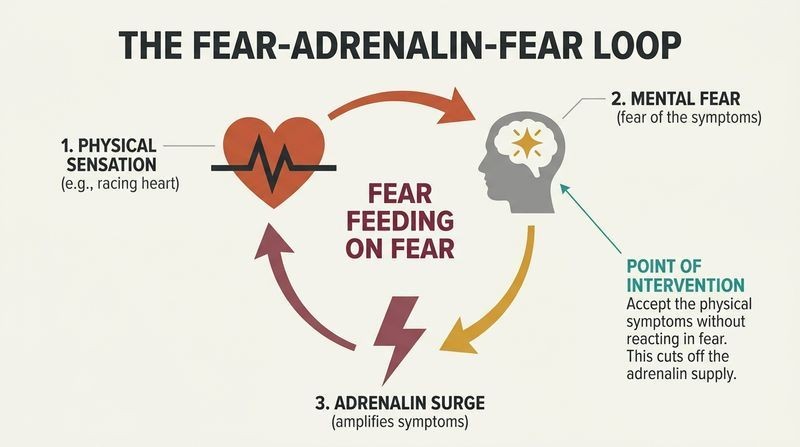
The core diagnosis is deceptively simple. Claire Weekes, a physician writing in 1969, argues that the racing heart, churning stomach, sweating hands, and waves of panic that terrify sufferers are not signs of a brain tumor, heart disease, or impending insanity. They are ordinary stress symptoms produced by adrenalin, made unbearably intense by one thing: fear of the symptoms themselves.
The trap is a self-perpetuating loop. A frightening bodily sensation (say, sudden palpitations at night) triggers fear. Fear releases more adrenalin. More adrenalin intensifies the sensation. That intensified sensation inspires more fear. Weekes calls this the fear-adrenalin-fear cycle. Whatever originally started it, once a person becomes afraid of their own body, they are caught spinning inside the circle. The illness is one of thinking, which is precisely why it can be cured.
What's striking is how far ahead of her time Weekes was. Decades before cognitive behavioral therapy formalized the idea, she identified the cognitive appraisal loop now central to panic-disorder treatment. Clark's 1986 catastrophic-misinterpretation model of panic says almost exactly what she said: patients misread benign sensations as catastrophic, which amplifies them. Modern interoceptive exposure therapy, deliberately inducing dizziness or breathlessness so patients habituate, is essentially her method operationalized. Her framing of illness as a loop rather than a fixed disease state also anticipates systems thinking in psychology. The limitation: some conditions she lumped under nerves would today be triaged for thyroid, cardiac, or trauma workups first.
Stop fighting your symptoms: face, accept, float, let time pass
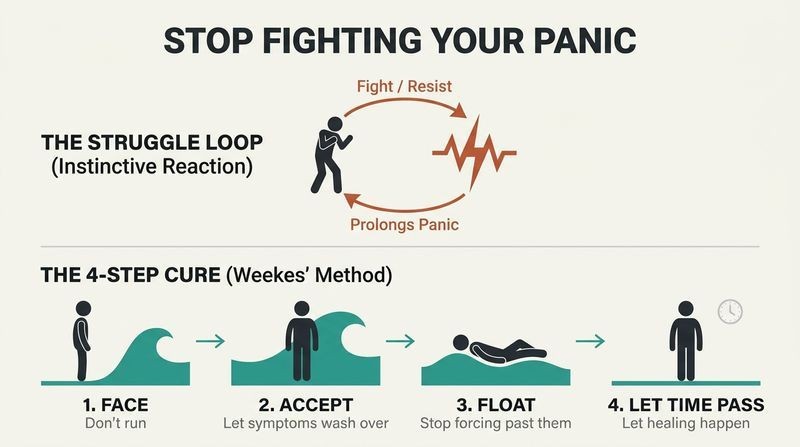
Four words carry the entire cure. Weekes distills recovery into a sequence: face the sensations instead of running, accept them instead of battling, float past them instead of forcing through, and let time pass instead of demanding overnight results. Sufferers instinctively do the opposite. They tense against symptoms, monitor them anxiously, seek frantic distraction, and despair that weeks have passed without cure.
Acceptance is the keystone. Weekes insists true acceptance is not gritted-teeth tolerance or putting up with. It means letting your stomach churn, letting your heart pound, letting your hands tremble without being disconcerted, even at the peak of a panic wave. She recounts an old man who claimed he accepted his churning stomach yet sat tensely dreading it. He had accepted ninety-nine percent. That final one percent, surrender at the worst moment, makes all the difference.
This is radical acceptance before the term existed in clinical psychology. Steven Hayes built Acceptance and Commitment Therapy on a nearly identical insight: struggling against internal experience (experiential avoidance) amplifies suffering, while willingness dissolves it. The paradox that Weekes captures, that you conquer panic only by ceasing to fight it, echoes the ironic-process theory of Daniel Wegner, whose research showed that suppressing a thought makes it rebound stronger. Her one-percent point is psychologically precise: partial acceptance still contains resistance, and resistance is fuel. The word float is her genius stroke, because it replaces the combative metaphor of fighting with an image the exhausted body can actually enact.
Every panic wave is two fears; you control the second
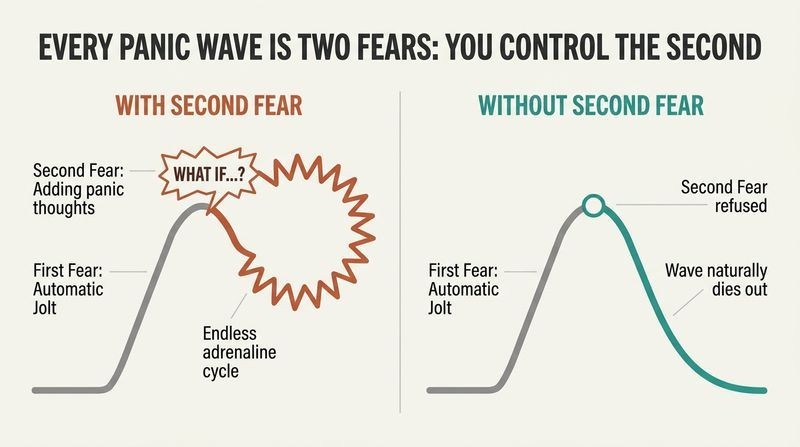
Panic is not one fear but two arriving nearly together. First fear is the automatic jolt, the reflexive flash of alarm that even a healthy person feels facing danger. In a sensitized person this flash is electric, wildly out of proportion. Second fear is what you add on top: the flood of Oh my goodness and What if I make a fool of myself, What if it gets worse. Because sensitized nerves fire so fast, the two fears feel fused into one.
Second fear is the leverage point. You cannot stop first fear immediately, but you can learn to recognize second fear and refuse to add it. Weekes notes second fear can almost always be spotted by its verbal signature: What if and Oh my goodness. Stop stoking those, and the adrenalin cannot keep the fire burning. First fear then rises in a wave, crests, and must fall, because the body's adrenalin supply is limited.
Splitting fear into a reflexive component and an appraised component is conceptually elegant and clinically durable. It maps onto LeDoux's neuroscience of the fast, subcortical amygdala pathway (first fear) versus the slower cortical evaluation (second fear). The actionable move is that intervention targets the layer you can actually influence. Contemporary metacognitive therapy, developed by Adrian Wells, makes the same distinction: it is not the intrusive thought but the worry-about-the-thought that maintains disorder. Weekes even supplies the diagnostic tell, the What if phrasing, which anticipates how modern therapists teach patients to catch catastrophizing self-talk. A practical, teachable, and remarkably compact model of anxiety maintenance.
Your body cannot invent new horrors; adrenalin follows a fixed script
Reassurance grounded in physiology. A huge part of nervous suffering is dread of what fresh catastrophe the body will produce next. Weekes dismantles this by explaining that adrenalin acts only on certain organs and only in certain ways. The pattern is therefore set and limited: racing heart, churning stomach, sweating, tingling, giddiness, tight chest, lump in throat. If you have already felt these, you have literally experienced the worst your nerves can do.
Each symptom gets a plain explanation. The bursting feeling in your throat is just the neck arteries pumping hard, not your heart about to explode. The lump in your throat (globus hystericus) is muscle spasm, not cancer. The inability to breathe deeply is chest muscle tension, while a breathing center in your brain guarantees you will never suffocate. Naming each mechanism strips it of its menace, turning a Pandora's box of surprises into a known, finite list.
There is real therapeutic power in demystification, and research on health anxiety supports it: uncertainty and catastrophic misattribution drive far more distress than sensation intensity itself. By capping the threat, Weekes removes the anticipatory dread that fuels hypervigilance. The move resembles psychoeducation in modern anxiety protocols, where explaining the fight-or-flight response reliably lowers symptom fear. One caveat worth flagging for readers: her blanket reassurance assumes a prior medical clearance, which she repeatedly states. Chest pain, palpitations, and breathlessness genuinely can signal cardiac or endocrine disease. Her framework works precisely because a doctor has already ruled those out. Reassurance without examination would be reckless, and she knows it.
Recovery lives on the far side of panic, not this side
You cannot retreat your way to safety. The agoraphobic instinct is to shrink the world: sit near the exit, avoid the shop where you once felt faint, keep the escape route open. Weekes shows this narrowing is the illness deepening. Each avoidance confirms the danger and tightens the cage until, as she puts it, the horizon is bounded by the front gate. Withdrawal is the jailer.
The cure is to go through, not around. She walks an agoraphobic reader step by step down the street: the trembling legs, the swirling buildings, the neighbor stopping to gossip. At each moment the instruction is the same: slacken the tension, let the jelly legs wobble (they still carry you), let the storm of adrenalin pass. The panic wave breaks hardest first, then subsides if you stand your ground. Practice, she insists, do not test. Testing keeps score; practice simply does.
This is exposure therapy in its purest form, articulated before Wolpe's systematic desensitization was widely known. Modern evidence is overwhelming that avoidance maintains phobias and that graded, sustained exposure extinguishes them. Weekes adds a crucial refinement most exposure protocols underemphasize: the internal stance during exposure matters. Going through panic while still fighting it can re-traumatize, which is why she pairs approach with floating acceptance. Her distinction between practice and test is subtle and wise. Testing carries an implicit demand for a pass or fail verdict, reintroducing the pressure that generates second fear. The reframe lowers stakes, which paradoxically speeds habituation. A durable and humane clinical intuition.
When a problem broke you, borrow a wiser mind until yours heals
A tired mind cannot decide, so stop demanding that it. Weekes separates simple nervous illness from illness driven by a genuine problem, sorrow, guilt, or disgrace. When exhaustion sets in, the sufferer's thoughts wear a single distressing groove, unable to see the problem from any other angle. Decisions become impossible; even choosing whether to carry an umbrella feels monumental.
The remedy is outsourced judgment, temporarily. She rejects the platitude that recovery depends entirely on you. A tired mind, like an injured leg, may need a crutch. Choose one wise counselor (not the nearest confidant, not many voices), reach a workable solution or at least a less painful way of seeing the problem, write it down, and cling to that single view to rest the exhausted brain. At first you may only glimpse the new perspective for a moment each day. That glimpse, practiced, eventually becomes the settled outlook.
Weekes pushes back against a self-reliance dogma that still saturates self-help culture, and the correction is valuable. Cognitive fatigue is real: research on decision fatigue and cognitive load shows depleted executive function genuinely impairs judgment, so counseling a person to just decide can be cruel. Her prescription to hold one written viewpoint resembles both the structured problem-solving of modern CBT and the externalized cognition of writing things down to offload working memory. The insight that recovery is sometimes relational, not purely individual, aligns with attachment-based and social-support research showing that co-regulation accelerates healing. Her warning against collecting too many opinions is also shrewd, since conflicting advice amplifies rumination.
Occupation is a crutch for the mind, but not frantic escape
Idleness is torture; purposeful activity is medicine. For the nervously ill, an empty hour stretches into eternity as the exhausted mind watches every second pass. Weekes prescribes organized occupation, ideally in the company of others, as one of three good friends alongside courage and religion. She tells of a woman lying on a couch for three months, who recovered largely by scraping and repainting a window frame, energized finally by choosing a Chinese-red door.
But there is a crucial distinction. Occupation must be done while accepting symptoms, not as a desperate sprint to outrun them. Feverishly seeking distraction to force forgetfulness is just flight from fear in disguise, and it exhausts. The right stance is calmer: let the feelings come, keep the hands busy anyway, and let interest gradually reclaim attention. Interest, she notes, is the force that lifts a person off the bed.
Behavioral activation, now a frontline evidence-based treatment for depression, rests on exactly this principle: action precedes motivation, not the reverse. Waiting to feel well enough to act keeps the depressed and anxious stuck, while structured engagement rebuilds mood and confidence. Weekes anticipates it by decades. Her nuance, that the same activity heals or harms depending on internal intent, is where she outpaces cruder advice to just stay busy. Busyness as avoidance is well documented to worsen anxiety over time. The red-door detail illustrates something research on flow and intrinsic motivation confirms: engagement driven by genuine interest, not obligation, is what pulls attention outward and quiets rumination.
However long you have suffered, your body still waits to heal
Chronicity is a habit, not a verdict. Weekes flatly rejects the idea of incurable chronic nerves. The only real difference between someone ill for years and someone ill for weeks, she argues, is that the long-term sufferer has accumulated more memories of defeat and therefore despairs faster. Nothing inside the body has been permanently altered. She cites a scientist who panicked for ten years, so exhausted he fell behind on a short walk, then recovered with explanation and went on to lead an expedition.
Setbacks are built into the road. Recovery is not linear; the worst setback may strike just before full recovery, precisely because closeness makes any relapse feel devastating. Panic can flash again years later, stirred by memory. The recovered person is not someone who never feels panic, but someone who no longer adds second fear to it, letting it pass without alarm.
The reframe of chronic as merely entrenched habit is empowering and largely supported by neuroplasticity research: the brain's fear circuitry remains modifiable across the lifespan, and even long-standing anxiety disorders respond to treatment. Weekes's insistence that recovery is non-linear is clinically honest and protective, since patients who expect steady improvement often interpret normal setbacks as total failure and abandon treatment. Her definition of full recovery is especially sophisticated: not the absence of panic but a changed relationship to it. This matches relapse-prevention models in modern therapy, which teach that the goal is not eliminating symptoms forever but removing their power. Hope here is not naive; it is mechanistic.
Substitute floating for patience, because agitated nerves cannot wait
A small linguistic trick with outsized effect. Weekes deliberately never asks the sufferer to be patient. Sick nerves are agitated nerves, and to a person in that state the very word patience is exasperating, an impossible demand. Waiting in a line can feel like torture. So she substitutes a gentler instruction: let time pass. The difference is subtle but real, because letting time pass asks for surrender rather than effortful endurance.
Floating is the physical companion to this stance. She teaches a housebound woman to imagine swimming forward in deep cool water, or drifting on a cloud through a doorway, rather than straining against her own paralysis. Fighting creates tension, and tension inhibits action; imagining floating relaxes the body and frees movement. The same trick releases obstructive thoughts: let them drift away like a leaf on a stream rather than clutching and wrestling them.
The attention to language is more than style. Framing effects are well documented in psychology: how an instruction is worded changes compliance and physiological response. Asking an agitated person for patience implies sustained willed control they cannot muster, whereas letting time pass implies release, which is achievable. The float imagery works because motor imagery and muscle relaxation are linked, and relaxed muscles reduce the proprioceptive feedback that signals threat to the brain. There is a mindfulness parallel too: watching thoughts drift without grasping is the core of practices now validated for anxiety. Weekes intuited that metaphor is not decoration but a lever on the autonomic nervous system itself.
Sensitive, dutiful, conscientious people are the likeliest to break
The illness selects for fine character, not weakness. Weekes is emphatic that the nervously ill person is neither fool nor coward but often a remarkably brave one, fighting through every waking hour with misdirected courage. The very traits that make someone break down, acute sensibility, a strong sense of duty, scrupulous conscience, are admirable ones. A less scrupulous person might simply compromise and move on; the conscientious sufferer cannot, and so dwells and exhausts.
Upbringing shapes vulnerability. The child who waits tensely at dusk for a drunken father develops a more easily aroused nervous system than one raised calmly. Schools teach mathematics but rarely moderation or how to let the first shock of an unpleasant emotion pass before reacting. Weekes offers a proverb: trouble is a tunnel to pass through, not a brick wall to break your head against. A measure of suffering, especially when young, builds the staff you lean on later.
Reframing the sufferer as sensitive rather than defective is both compassionate and, in part, empirically echoed. Trait research links high neuroticism and high conscientiousness to anxiety proneness, and Elaine Aron's work on sensory-processing sensitivity describes a subset of people whose nervous systems genuinely respond more intensely to stimuli. Weekes's developmental point about early stress prefigures research on adverse childhood experiences and stress reactivity. The claim deserves one caveat: framing anxiety as a marker of superior character risks romanticizing suffering and could subtly discourage some from seeking help. Still, for patients drowning in shame and self-blame, relocating the illness from weakness to sensitivity is therapeutically potent and often the first crack of relief.
Analysis
Hope and Help for Your Nerves is a landmark of self-help precisely because it does one thing with total conviction: it demystifies anxiety by reducing it to a single mechanical loop and then hands the reader a portable, memorizable escape route. Claire Weekes, an Australian physician who had herself suffered, wrote in the direct second person, as though sitting beside the reader. That intimacy, combined with physiological explanation, was revolutionary in 1969, when nervous illness was still shrouded in shame and vague talk of subconscious causes.
Her enduring achievement is that she anticipated, in plain language, nearly the entire architecture of modern anxiety treatment. The fear-adrenalin-fear cycle is the panic-maintenance model. Face-accept-float-let-time-pass is acceptance-based exposure. Her first-fear and second-fear split maps onto contemporary neuroscience and metacognitive therapy. Behavioral activation, psychoeducation, interoceptive exposure, and relapse prevention are all present in embryo. Where cognitive behavioral therapy would later formalize and test these ideas, Weekes delivered them as lived, actionable counsel. Neuroscientists and clinicians, including those who later championed her work, have credited her with getting the essentials right before the field had the vocabulary.
The book's limitations are real but bounded. Weekes gathers a wide range of conditions under nerves, occasionally minimizing the need for differential diagnosis, though she consistently insists on prior medical clearance. Her period assumptions about gender, her comfort with sedatives, and her endorsement of shock treatment date the text. Her prose is repetitive, which she defends as necessary reinforcement for an exhausted, forgetful mind, and she is probably right.
What lifts the book above its era is its stance toward the sufferer: not a broken malingerer but a sensitive, dutiful person tricked by their own body. That respect, paired with a mechanism simple enough to recall mid-panic, is why the book still rescues readers half a century on.
Review Summary
Hope and Help for Your Nerves receives overwhelmingly positive reviews for its practical advice on managing anxiety and panic attacks. Readers praise Dr. Weekes' compassionate and straightforward approach, finding her techniques of facing, accepting, floating, and letting time pass particularly helpful. Many consider it a life-changing book, despite its age. The author's personal narration in the audiobook version is highly recommended. While a few critics find it outdated, the majority of readers appreciate its timeless wisdom and clear explanations of anxiety's physiological aspects.
People Also Read





FAQ
What's "Hope and Help for Your Nerves" about?
- Overview: "Hope and Help for Your Nerves" by Claire Weekes is a self-help book aimed at individuals suffering from nervous illnesses, providing guidance on understanding and overcoming anxiety and related symptoms.
- Focus on Recovery: The book emphasizes the possibility of recovery from nervous illness through understanding, acceptance, and specific techniques.
- Practical Advice: It offers practical advice and methods to manage symptoms, such as facing fears, accepting feelings, and letting time pass.
- Target Audience: It is particularly useful for those who feel overwhelmed by anxiety and are seeking a structured approach to regain control over their lives.
Why should I read "Hope and Help for Your Nerves"?
- Comprehensive Guidance: The book provides a comprehensive guide to understanding and managing nervous illnesses, making it a valuable resource for anyone struggling with anxiety.
- Proven Techniques: Claire Weekes introduces proven techniques that have helped many people recover from nervous illnesses, offering hope and practical solutions.
- Empowerment: It empowers readers by teaching them how to face and accept their symptoms, reducing the fear and confusion often associated with anxiety.
- Supportive Tone: The author’s compassionate and supportive tone makes readers feel understood and less alone in their struggles.
What are the key takeaways of "Hope and Help for Your Nerves"?
- Understanding Fear: Recognize that fear is a major component of nervous illness and that understanding it is crucial for recovery.
- Acceptance and Floating: Learn to accept symptoms and let them pass without resistance, a technique referred to as "floating."
- Time and Patience: Recovery takes time, and patience is essential. The book emphasizes letting time pass as part of the healing process.
- Self-Help and Support: While self-help is important, seeking support from friends, family, or professionals can aid in recovery.
What is the "facing, accepting, floating, and letting time pass" method in "Hope and Help for Your Nerves"?
- Facing: Confront your fears and symptoms directly instead of avoiding them, which helps reduce their power over you.
- Accepting: Allow yourself to experience symptoms without fighting them, acknowledging that they are temporary and part of the recovery process.
- Floating: Move through your symptoms with a sense of detachment, as if you are floating past them, which helps reduce tension and anxiety.
- Letting Time Pass: Understand that recovery is a gradual process and requires patience, allowing time to heal your sensitized nerves.
How does Claire Weekes define nervous illness in "Hope and Help for Your Nerves"?
- Emotional and Mental Fatigue: Nervous illness is described as a state of emotional and mental fatigue caused by prolonged stress and fear.
- Sensitization: It involves the sensitization of the adrenalin-releasing nerves, leading to exaggerated responses to stress.
- Common Symptoms: Symptoms include anxiety, panic attacks, palpitations, and a range of physical sensations that can be distressing.
- Fear Cycle: The illness is often maintained by a cycle of fear, where fear of symptoms leads to more symptoms, perpetuating the condition.
What are the common symptoms of nervous illness according to "Hope and Help for Your Nerves"?
- Physical Symptoms: These include a churning stomach, racing heart, sweating, trembling, and a feeling of breathlessness.
- Emotional Symptoms: Anxiety, panic attacks, and a sense of impending doom are common emotional symptoms.
- Cognitive Symptoms: Difficulty concentrating, indecision, and obsessive thoughts can occur.
- Sensory Symptoms: Giddiness, blurred vision, and a feeling of unreality or detachment from the world are also noted.
How does "Hope and Help for Your Nerves" suggest dealing with panic attacks?
- Recognize Two Fears: Understand that panic involves a first fear (initial reaction) and a second fear (fear of the reaction itself).
- Accept and Float: Accept the panic attack as it happens and float through it without adding second fear, which helps reduce its intensity.
- Desensitization: Over time, by not adding second fear, you can desensitize your nerves and reduce the frequency and severity of panic attacks.
- Patience and Practice: Practice these techniques consistently and be patient, as desensitization takes time.
What role does acceptance play in recovery according to "Hope and Help for Your Nerves"?
- Key to Recovery: Acceptance is the cornerstone of recovery, allowing you to experience symptoms without resistance, which reduces their impact.
- Reduces Fear: By accepting symptoms, you reduce the fear associated with them, breaking the fear-adrenalin-fear cycle.
- Promotes Healing: Acceptance helps calm the nervous system, promoting natural healing over time.
- True Acceptance: It involves a genuine willingness to experience symptoms without trying to control or fight them.
How does "Hope and Help for Your Nerves" address the fear of leaving home (agoraphobia)?
- Understanding Agoraphobia: It is described as a fear of leaving the safety of home, often stemming from anxiety about having a panic attack in public.
- Step-by-Step Approach: The book provides a step-by-step approach to gradually facing and accepting the fear of leaving home.
- Slacken Tension: Before leaving home, practice slackening tension and accepting the possibility of fear, which helps reduce its power.
- Build Confidence: Gradually build confidence by taking small steps and celebrating successes, reinforcing the ability to cope with fear.
What advice does "Hope and Help for Your Nerves" offer for dealing with depression?
- Understand Depression: Recognize that depression is a result of emotional exhaustion and can be alleviated by reducing fear and tension.
- Occupation and Company: Engage in meaningful occupation and seek the company of others to distract from depressive thoughts.
- Acceptance and Patience: Accept the depression as a temporary state and be patient, allowing time for emotional reserves to replenish.
- Avoid Isolation: Avoid isolating yourself, as solitude can exacerbate depression; instead, seek environments that uplift your spirits.
What are the best quotes from "Hope and Help for Your Nerves" and what do they mean?
- "Face, accept, float, and let time pass." This encapsulates the core method for overcoming nervous illness, emphasizing acceptance and patience.
- "You are not a coward; you are a suffering, bewildered person." This quote reassures readers that their struggles are valid and not a reflection of weakness.
- "Each of us has unsuspected power to accomplish what we demand of ourselves." It highlights the potential for recovery and self-empowerment.
- "Recovery lies on the other side of panic." This encourages readers to face their fears, as true recovery comes from moving through panic rather than avoiding it.
How does "Hope and Help for Your Nerves" suggest handling setbacks during recovery?
- Expect Setbacks: Understand that setbacks are a normal part of the recovery process and do not indicate failure.
- Acceptance and Patience: Accept setbacks without despair and be patient, allowing time for recovery to continue.
- Learn from Experience: Use setbacks as learning experiences to reinforce the techniques of facing, accepting, and floating.
- Maintain Confidence: Keep confidence in the recovery process, knowing that setbacks are temporary and progress is still being made.
Download PDF
Download EPUB
.epub digital book format is ideal for reading ebooks on phones, tablets, and e-readers.








































