

Key Takeaways
Engineer user habits in four steps: trigger, action, variable reward, investment — the Hook Model
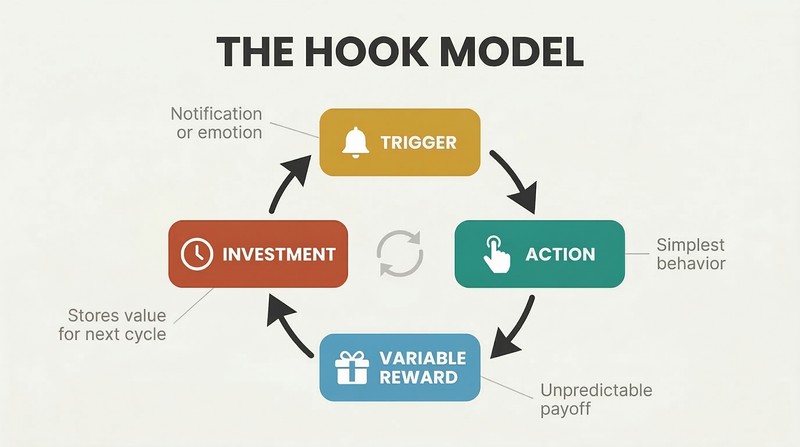
The Hook Model is the book's central framework: a four-phase cycle that companies like Facebook, Instagram, and Twitter use to create user habits without expensive advertising. Each pass through the cycle strengthens the habit:
1. Trigger — the cue that initiates behavior (a notification or an emotion)
2. Action — the simplest behavior done in anticipation of reward
3. Variable Reward — an unpredictable payoff that satisfies yet leaves you wanting more
4. Investment — a bit of work that improves the product for next time
The more users cycle through these hooks, the less they need external prompts. Eventually, they return on autopilot. Habits, by some estimates, guide nearly half our daily actions — and the companies that engineer them reap enormous advantages in growth, retention, and pricing power.
Wire your product to a negative emotion, not just a notification
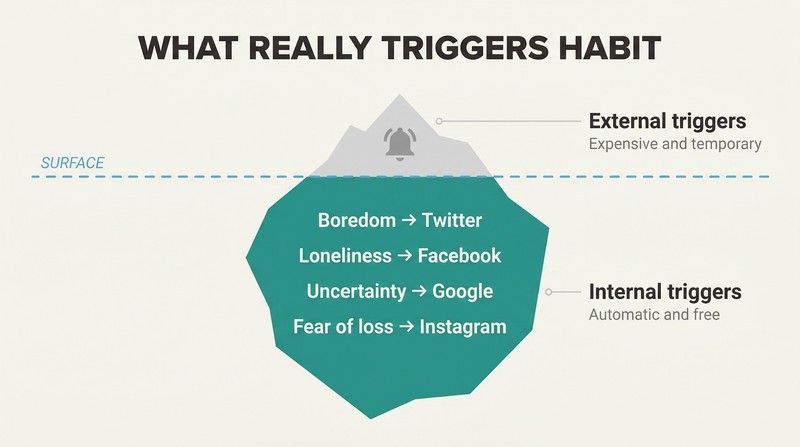
External triggers like notifications get people in the door, but they're expensive and unsustainable. The real goal is reaching internal triggers — the emotions and situations that make users reach for your product automatically. Negative emotions are the most powerful: boredom drives people to Twitter, loneliness to Facebook, uncertainty to Google, and fear of losing a moment to Instagram.
To uncover your users' internal triggers, Eyal recommends the 5 Whys Method, adapted from Toyota's production system. Ask "why" someone uses your product, then ask "why" to each successive answer. By the fifth why, you'll hit an emotion — like fear of being out of the loop. That emotional root is what your product must address to become truly habit-forming.
Simplify the action before boosting motivation
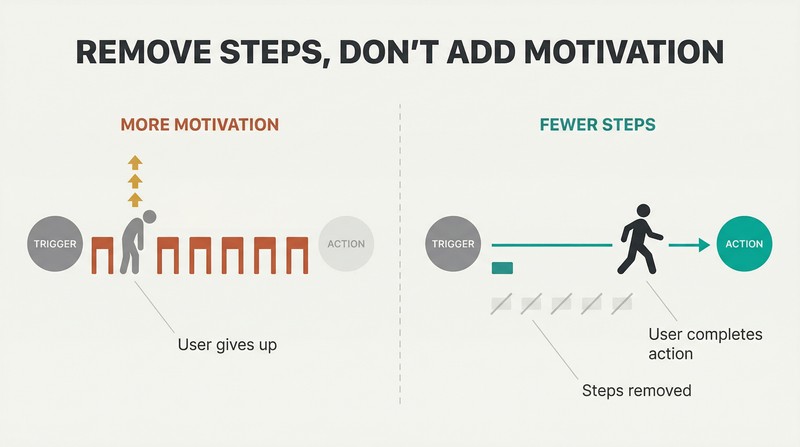
BJ Fogg's Behavior Model states that any behavior requires three things simultaneously: a trigger, sufficient motivation, and sufficient ability (B=MAT). Of these three, increasing ability — making the action easier — delivers the highest return. Users ignore instructions, split attention across tasks, and have zero patience for explanations.
Evan Williams, co-founder of Blogger and Twitter, built two massive companies with one formula: identify a long-standing human desire and use technology to remove steps. Each successive web era — from blogging to social media to photo sharing — succeeded by eliminating friction. Twitter's homepage evolved from cluttered text and dozens of links to just two prominent options: sign in or sign up. Google beat Yahoo not just with better search, but with a cleaner, simpler page.
Unpredictable rewards create craving; predictable ones become invisible
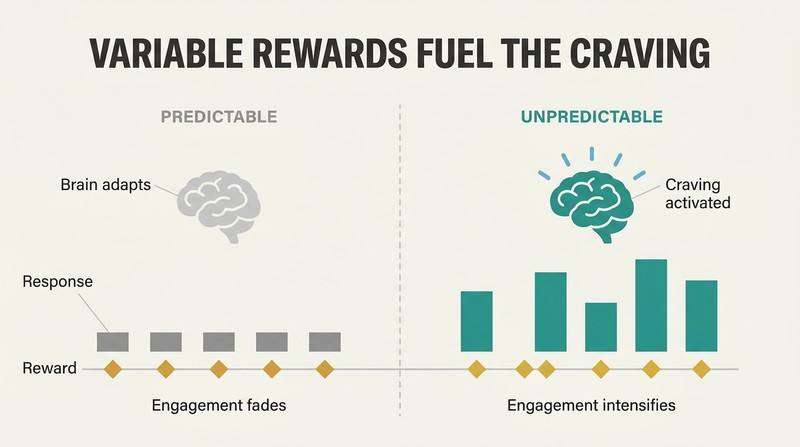
In the 1940s, researchers Olds and Milner discovered that lab mice would forgo food, water, and endure pain just to stimulate a brain region called the nucleus accumbens. Later research by Stanford's Brian Knutson revealed something surprising: this region activates not when we receive a reward, but in anticipation of one. It's the craving, not the payoff, that compels us.
B.F. Skinner demonstrated the power of unpredictability with pigeons: when food pellets came at random intervals instead of every lever press, the pigeons pressed dramatically more often. The same principle explains slot machines, social media feeds, and email — variability suppresses the brain's judgment centers while activating wanting and desire.
Design rewards around social validation, resource hunts, or self-mastery
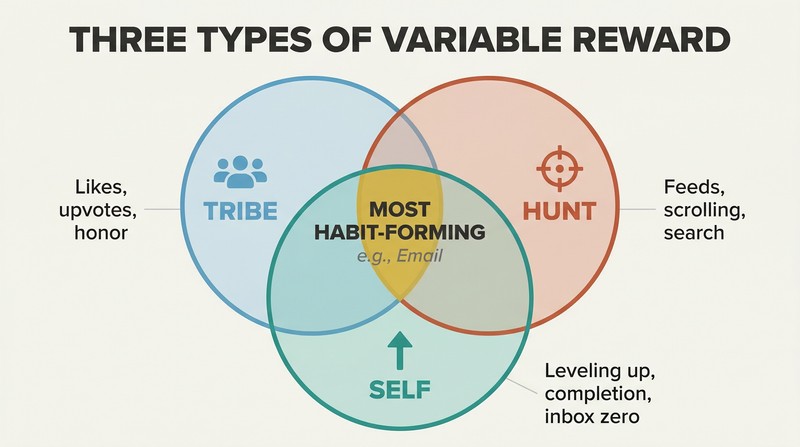
Eyal identifies three categories of variable reward, each tapping a different human drive:
1. Tribe — social validation (Facebook likes, Stack Overflow upvotes, League of Legends Honor Points)
2. Hunt — pursuit of resources and information (Twitter feeds, Pinterest scrolling, slot machines)
3. Self — mastery, competence, and completion (video game leveling, Codecademy progress, inbox zero)
The most habit-forming products combine multiple types. Email uses all three: social obligation (tribe), career opportunities (hunt), and the compulsion to clear your inbox (self). But rewards must match the user's actual motivation. Mahalo paid users cash for Q&A answers and failed, while Quora used free social rewards and thrived — because connection, not money, was what users craved.
Get users to store value so leaving feels like losing
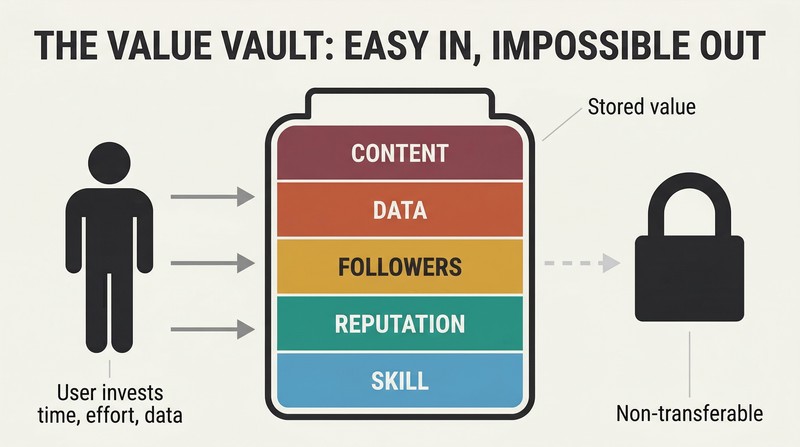
The Investment Phase asks users to put something into the product — time, data, effort, social capital — that makes it better for next time. Unlike the Action phase, investment isn't about immediate gratification; it's about future value stored in five key forms:
1. Content (iTunes playlists, Facebook timelines)
2. Data (LinkedIn profiles, Mint.com financial records)
3. Followers (Twitter audiences built over years)
4. Reputation (eBay seller scores, Airbnb reviews)
5. Skill (Adobe Photoshop expertise that doesn't transfer)
Dan Ariely's IKEA effect research showed people who built origami valued their creations five times higher than outside observers did. Each investment also loads the next trigger — every Snapchat sent prompts a reply, every Pinterest pin generates a notification.
Habit-forming products start as nice-to-haves, then become needs
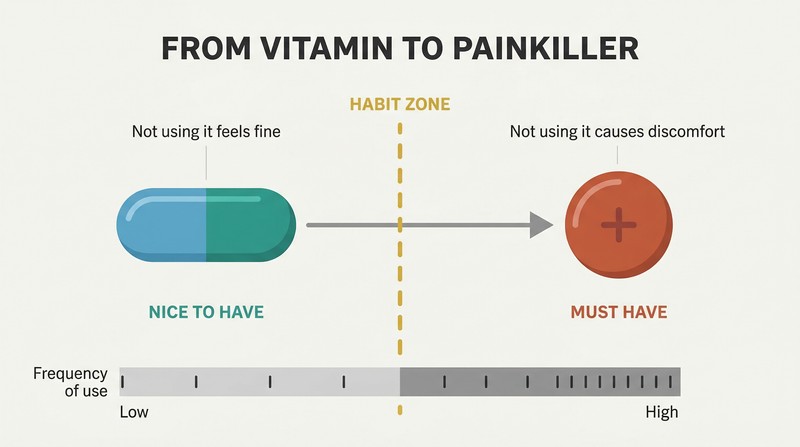
Investors love painkillers — products solving obvious, urgent problems. But today's biggest companies — Facebook, Twitter, Instagram — started as vitamins, seemingly unnecessary products. No one woke up at midnight screaming for a status update. Yet once these products create habits, not using them causes a subtle discomfort — an itch demanding to be scratched. That's when the vitamin has become a painkiller.
A product enters what Eyal calls the Habit Zone when it achieves sufficient frequency and perceived utility. Google wins on frequency (searched dozens of times daily), Amazon on utility (the trusted "everything store"). A 2010 study found some habits form in weeks, others take over five months — but higher frequency always accelerates the process.
Competing against an existing habit requires being 9x better
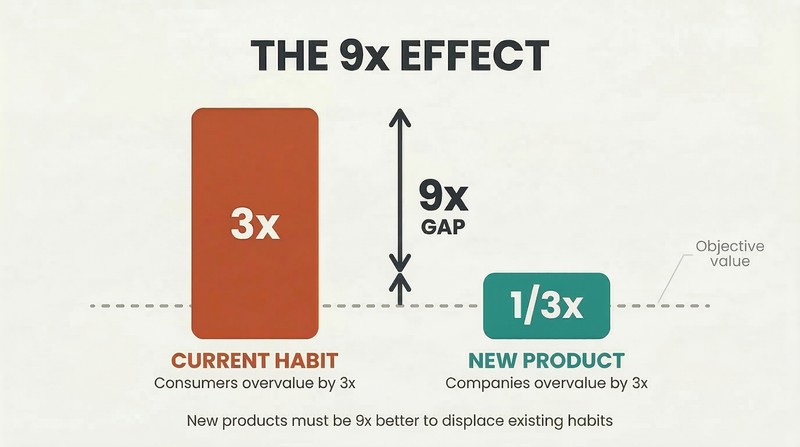
Harvard professor John Gourville found that consumers overvalue what they already have by roughly 3x, while companies overvalue their innovation by 3x — creating a 9x gap any challenger must clear. Products requiring major behavior change fail even when benefits are obvious. The QWERTY keyboard, designed in the 1870s to prevent typewriter jams, persists despite superior alternatives because the switching cost is too steep.
Even near-identical products can't unseat habits. Google and Bing produce virtually the same search results, but the slight cognitive effort of adapting to Bing's interface makes it feel inferior to habituated Google users. Stored value compounds the moat — every email in Gmail, every follower on Twitter makes leaving costlier with each passing day.
Products with finite variability fade; infinite variability sustains
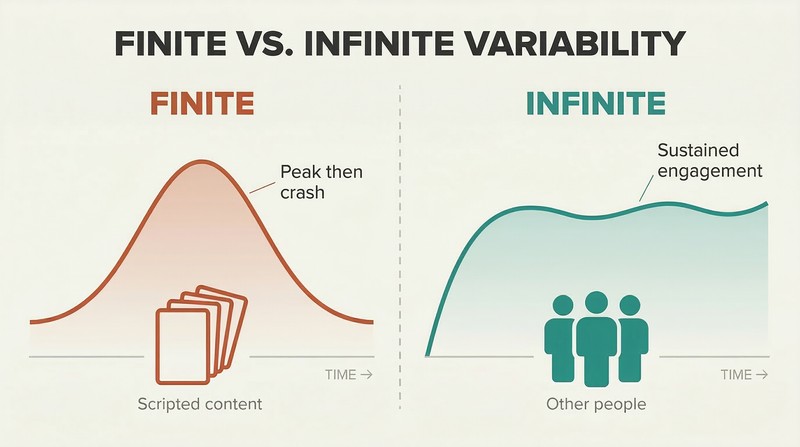
Zynga learned this at a staggering cost. FarmVille exploded to 83.8 million monthly users, but when the company cloned its formula into CityVille, ChefVille, and FrontierVille, players saw through the re-skin. By November 2012, Zynga's stock had cratered over 80% from its March peak. The games offered finite variability — experiences that become predictable after use, like a TV series you've already watched.
Infinite variability sustains engagement because the source of novelty never runs out. World of Warcraft maintained 10 million active users eight years after launch because other players — not scripted content — create unpredictability. User-generated content platforms like YouTube and Pinterest exhibit the same trait. If your product's novelty comes from a fixed library, it has an expiration date.
Ask: Would I use this? Does it improve lives? Then build.
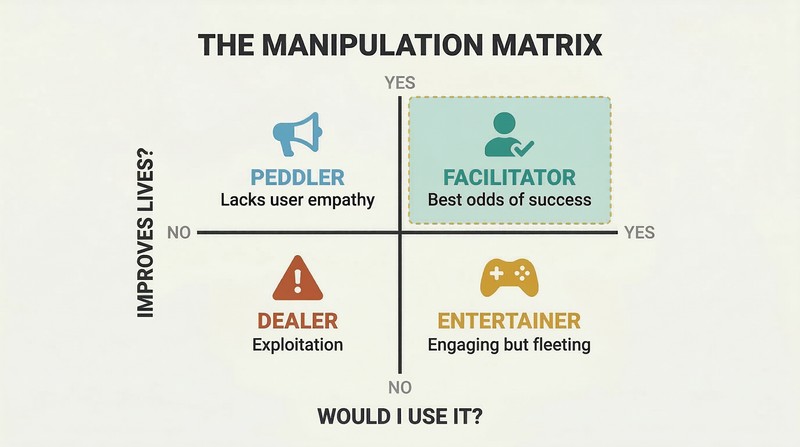
The Manipulation Matrix asks product builders two questions before shipping: "Would I use this myself?" and "Will it materially improve users' lives?" Your honest answers place you in one of four quadrants:
1. Facilitator (yes/yes) — highest odds of long-term success
2. Peddler (no/yes) — well-intentioned but lacks user empathy
3. Entertainer (yes/no) — engaging but fleeting, like hit games
4. Dealer (no/no) — exploitation, plain and simple
Industry data suggests even the most addictive technologies create pathological users at roughly a 1% rate. But companies now have behavioral data to flag at-risk users and bear a moral obligation to protect them. The facilitator path — building what you'd use yourself to solve a genuine human problem — produces both better ethics and better products.
Analysis
Hooked is essentially a product-design manual that reverse-engineers the behavioral loops behind Silicon Valley's most successful consumer products. Published in 2013, before the techlash, it reads differently now — its prescriptions for maximizing engagement feel more fraught after years of congressional hearings about technology addiction, algorithmic manipulation, and children's mental health. Yet the framework remains remarkably durable, still taught in product management programs at Stanford and beyond.
Eyal's primary contribution is synthesis. The Hook Model elegantly merges BJ Fogg's persuasive technology research, B.F. Skinner's operant conditioning schedules, Daniel Kahneman's cognitive biases, and Edward Deci's self-determination theory into one actionable framework. No individual idea here is original to Eyal — what's original is their integration into a four-step cycle practitioners can actually apply.
The book's weakest element is its ethical reckoning. The Manipulation Matrix, introduced in a late chapter, functions more like an appendix than a load-bearing wall. The distinction between 'facilitator' and 'dealer' depends entirely on self-assessment — a notoriously unreliable moral compass, especially when equity stakes are involved. Eyal acknowledges that roughly 1% of users develop pathological dependencies, but this framing elides the fact that 1% of a billion-user platform represents millions of individuals.
What makes Hooked enduringly valuable despite these blind spots is its diagnostic power. The model works not just for building products but for understanding why existing products control your attention. Once you see the hook cycle in your Twitter scrolling or email checking, you can begin to disrupt it. In this sense, Hooked is paradoxically both a builder's playbook and a user's self-defense manual — a feature Eyal gestures toward but never fully develops. The most subversive reading of this book may ultimately be as a guide to unhooking yourself.
Review Summary
Hooked receives mostly positive reviews for its clear framework on building habit-forming products. Readers appreciate the actionable insights and psychological principles behind user engagement. Some criticize the book's length and ethical implications of "hooking" users. The Hook Model's four steps—trigger, action, variable reward, and investment—are widely discussed. Many find it valuable for product design and understanding user behavior, while others question its potential for manipulation. Overall, it's considered a useful read for entrepreneurs and product managers, despite some reservations about its approach.
People Also Read





Glossary
Hook Model
Four-phase habit-forming product cycleA four-step framework — Trigger, Action, Variable Reward, Investment — that describes how products form user habits through repeated cycles. Each pass strengthens the habit by connecting the user's problem with the company's solution, eventually making external prompts unnecessary as internal triggers take over.
Habit Zone
Threshold where habits become automaticThe region on a conceptual graph where a behavior occurs with both sufficient frequency and perceived utility to become automatic. Google enters the Habit Zone through extremely high frequency of use; Amazon through high perceived utility per visit. Behaviors below either threshold remain conscious decisions rather than habits.
Internal Trigger
Emotion or thought cuing behaviorAn automatic mental cue — typically a negative emotion like boredom, loneliness, frustration, or uncertainty — that prompts a user to reach for a product without any external prompt. The ultimate goal of habit-forming products is to become tightly coupled with internal triggers so users return on autopilot, no longer needing notifications or ads.
Fogg Behavior Model (B=MAT)
Behavior needs motivation, ability, triggerA model by Stanford's BJ Fogg stating that for any behavior to occur, three elements must converge simultaneously: sufficient Motivation, sufficient Ability, and a Trigger. Represented as B=MAT. If any component is missing or inadequate, the user won't cross the 'Action Line' and the behavior won't occur. Eyal advises increasing ability before motivation for higher ROI.
Variable Reward
Unpredictable payoff sustaining desireThe third phase of the Hook Model, where users receive an unpredictable reward that satisfies their immediate need while leaving them wanting to re-engage. Comes in three types: rewards of the tribe (social validation), rewards of the hunt (resources and information), and rewards of the self (mastery and completion). Variability increases dopamine activity in the nucleus accumbens.
Manipulation Matrix
Ethical self-assessment for product buildersA 2×2 decision framework asking creators two questions: 'Would I use this product myself?' and 'Will it materially improve users' lives?' The four quadrants are Facilitator (yes/yes), Peddler (no/yes), Entertainer (yes/no), and Dealer (no/no). Designed to help entrepreneurs evaluate moral implications before building habit-forming products.
Finite Variability
Predictable experience that fades over timeAn experience whose variability is exhausted after repeated use, becoming predictable and losing its appeal. TV series, single-player games, and Zynga's FarmVille clones exemplify this pattern. Businesses with finite variability must constantly produce new content to sustain engagement. Contrasted with infinite variability, where user-generated content or multiplayer dynamics provide self-renewing novelty.
Infinite Variability
Self-renewing novelty from user activityAn experience that maintains user interest indefinitely because the source of variability is never depleted. Platforms like YouTube, Facebook, Pinterest, and World of Warcraft exhibit infinite variability because users or players continuously generate new, unpredictable content and interactions, keeping the experience fresh without requiring the company to produce new material. Contrasted with finite variability, where the novelty of a fixed experience is eventually exhausted.
IKEA Effect
Labor increases perceived valueA cognitive bias identified by researchers Dan Ariely, Michael Norton, and Daniel Mochon showing that people disproportionately value things they helped create. Named after the furniture retailer whose assemble-it-yourself model inadvertently exploits this tendency. In the context of habit-forming products, it explains why user investment — entering data, customizing settings, building profiles — increases attachment and switching costs.
Habit Path
Shared steps of devoted usersThe series of similar actions that a product's most loyal, habitual users have taken, identified by analyzing behavioral data during Habit Testing. For example, Twitter discovered that new users who followed 30 people hit a tipping point for long-term engagement. Product teams then modify onboarding to guide all new users down this same critical path.
5 Whys Method
Drill to emotional root causeA technique adapted from Taiichi Ohno's Toyota Production System, used to uncover users' internal triggers. By asking 'why' five successive times about why someone uses a product, designers drill past functional reasons to reach the underlying emotional need — such as fear of being out of the loop — that drives habitual use.
FAQ
What's "Hooked: A Guide to Building Habit-Forming Technology" about?
- Author and Purpose: Written by Nir Eyal with Ryan Hoover, the book explores how to create habit-forming products using psychological principles.
- Core Concept: It introduces the Hook Model, a four-step process that companies use to encourage user habits.
- Target Audience: The book is aimed at entrepreneurs, product managers, and designers interested in understanding user behavior.
- Practical Application: It provides actionable insights for building products that people use regularly without relying on expensive marketing.
Why should I read "Hooked: A Guide to Building Habit-Forming Technology"?
- Understand User Behavior: Gain insights into the psychological triggers that drive user engagement and retention.
- Improve Product Design: Learn how to design products that become a natural part of users' routines.
- Competitive Advantage: Discover how habit-forming products can provide a significant edge in crowded markets.
- Ethical Considerations: The book also addresses the moral implications of creating addictive technologies.
What is the Hook Model in "Hooked"?
- Four Phases: The Hook Model consists of Trigger, Action, Variable Reward, and Investment.
- Trigger: Initiates the behavior, can be external (notifications) or internal (emotions).
- Action: The simplest behavior in anticipation of a reward.
- Variable Reward and Investment: Keeps users engaged by offering unpredictable rewards and encouraging them to invest in the product.
What are the key takeaways of "Hooked: A Guide to Building Habit-Forming Technology"?
- Habit Formation: Understand how habits are formed and the role of frequency and perceived utility.
- User Engagement: Learn how to create products that users return to without external prompting.
- Investment Phase: Discover how user investment increases the likelihood of repeated engagement.
- Ethical Design: Consider the moral responsibilities when designing habit-forming products.
How does "Hooked" define a habit?
- Automatic Behavior: Habits are defined as behaviors done with little or no conscious thought.
- Triggered by Cues: They are often triggered by situational cues, either external or internal.
- Engineered Actions: The book explains how products can be designed to become habitual.
- Impact on Behavior: Habits significantly alter everyday behavior as intended by designers.
What are the types of triggers in the Hook Model?
- External Triggers: These include notifications, emails, and app icons that prompt user action.
- Internal Triggers: These are emotions or thoughts that cue behavior without external prompts.
- Transition from External to Internal: Successful products transition users from external to internal triggers.
- Example: A user might initially be prompted by a notification but later use the product out of habit.
What role do variable rewards play in the Hook Model?
- Create Cravings: Variable rewards create a craving that drives users to return.
- Types of Rewards: The book identifies three types: rewards of the tribe (social), hunt (material), and self (intrinsic).
- Unpredictability: The unpredictability of rewards keeps users engaged.
- Example: Social media platforms use likes and comments as variable rewards.
How does the investment phase work in the Hook Model?
- User Effort: Users invest time, data, or effort, increasing the product's value to them.
- Future Rewards: Investments are about anticipating future rewards, not immediate gratification.
- Stored Value: The more users invest, the more valuable the product becomes to them.
- Example: Following someone on Twitter increases the likelihood of returning to the platform.
What are the ethical considerations discussed in "Hooked"?
- Manipulation Concerns: The book addresses the potential for products to become addictive.
- Moral Responsibility: Designers have a responsibility to ensure their products improve users' lives.
- Manipulation Matrix: A tool to assess whether a product is ethical based on its impact and the designer's use.
- Facilitator Role: Encourages creating products that the designer would use and that improve lives.
What are some real-world examples used in "Hooked"?
- Instagram: Used as an example of how external triggers can become internal.
- Pinterest: Demonstrates the use of variable rewards through endless scrolling.
- Twitter: Shows how user investment in followers increases engagement.
- Bible App Case Study: Illustrates the application of the Hook Model in a religious context.
How can I apply the concepts from "Hooked" to my product?
- Identify Triggers: Determine what internal and external triggers will prompt user action.
- Simplify Actions: Make the desired user actions as easy as possible.
- Incorporate Variable Rewards: Use unpredictability to keep users engaged.
- Encourage Investment: Design ways for users to invest in the product, increasing its value to them.
What are the best quotes from "Hooked" and what do they mean?
- "First-to-mind wins": Highlights the importance of being the go-to solution for users.
- "Habits give companies greater flexibility to increase prices": Explains the economic advantage of habit-forming products.
- "If it can’t be used for evil, it’s not a superpower": Discusses the dual nature of habit-forming technology.
- "The Hook Model is fundamentally about changing people’s behaviors": Emphasizes the core purpose of the book's framework.
About the Author
Other books by Nir Eyal

Download PDF
Download EPUB
.epub digital book format is ideal for reading ebooks on phones, tablets, and e-readers.








































