Key Takeaways
1. Republican Liberty: Freedom as Non-Domination
According to the republican theory, as classically propounded in the rubric De statu hominum at the start of the Digest, the paramount distinction in civil associations is between those who enjoy the status of liberi homines or ‘free-men’ and those who live in servitude.
Classical roots. The republican theory of liberty, originating in classical antiquity and Roman law, defines freedom as being "sui iuris" – in one's own power – rather than subject to the arbitrary will of another. This concept flourished in Renaissance Italian city-republics and was central to English common law, notably Magna Carta, which championed the "liber homo" or free-man. The core idea is that freedom is lost not just by direct interference, but by the mere presence of arbitrary power, which reduces individuals to the status of slaves.
Arbitrary power's threat. This theory posits that even if a master never interferes with a slave's actions, the slave remains unfree because their choices are always subject to the master's arbitrary will. This inherent vulnerability, the constant anxiety of potential interference, is what constitutes servitude. English opponents of the Stuart monarchy, particularly during the lead-up to the Civil War, adopted this view, arguing that the Crown's emphasis on prerogative rights created a discretionary power that threatened to reduce free-born Englishmen to bondage.
Beyond interference. For republicans, true liberty requires independence from the arbitrary will of others. It's not enough to simply not be interfered with; one must also not be liable to interference at the whim of another. This distinction became a rallying cry against perceived royal tyranny, asserting that a king ruling by prerogative, rather than fixed law, inherently enslaved his subjects, regardless of whether he actively suppressed their actions.
2. Hobbes's Early Liberty: Deliberation and Absolute Subjection
When we deliberate about whether to perform an action within our powers, we enter into a process of alternation between our appetites, which incline us to act, and our fears, which withhold us from proceeding.
Will as last appetite. In "The Elements of Law" (1640), Hobbes first explored human freedom through the lens of deliberation. He argued that the "will" is simply the "last appetite" or "last fear" that concludes this process, leading to action or forbearance. This challenged the scholastic view of the will as a permanent faculty of the soul, instead reducing it to a momentary outcome of internal psychological forces. Even actions performed under duress, like throwing goods overboard to save a ship, were considered "altogether voluntary" if they resulted from this final determination of will.
Natural liberty's paradox. Hobbes defined "natural liberty" as the freedom to use one's natural power for self-preservation, equating it with natural right. However, he argued that if everyone retained this absolute right "to do whatsoever he listeth," the inevitable outcome would be a "war of all against all." This state, far from being beneficial, was "unfruitful" and destructive, forcing individuals to seek peace by covenanting away their natural liberty.
Absolute civil subjection. The act of covenanting to form a commonwealth, according to Hobbes, involved an "absolute subjection" to sovereign power. He explicitly stated that this subjection was "no less absolute, than the subjection of servants." He dismissed the idea of "mixed government" as a contradiction and rejected claims of "freemen" under monarchy as mere aristocratic resentment for lack of honor or employment. For Hobbes, in this early work, civil society inherently meant a "loss of liberty," leaving subjects "scarcely any freer than slaves."
3. De Cive's New Definition: Liberty as Absence of Impediments
LIBERTAS, ut eam definiamus, nihil aliud est quam absentia impedimentorum motus.
A mechanical definition. In "De Cive" (1642), Hobbes introduced a groundbreaking, general definition of liberty: "Liberty, to define it, is nothing other than the absence of impediments to motion." This mechanical view applied equally to inanimate objects, animals, and humans, reflecting his overarching philosophical commitment to motion as the sole reality. He explicitly claimed to be the first to properly explicate liberty and servitude, challenging prevailing juridical understandings.
Two types of impediments. To clarify this definition, Hobbes distinguished between two kinds of impediments:
- Externa et absoluta (external and absolute): These are physical blockages that render movement impossible, like water contained in a vessel or hedges preventing a man from trampling crops.
- Arbitraria (arbitrary): These do not absolutely impede motion but do so "per accidens, that is to say by our own choice." Fear, particularly the fear of punishment or death, was the paradigm example. It shapes the will, preventing certain choices, but doesn't physically stop the action.
Reconciling will and impediment. This new framework allowed Hobbes to refine his earlier ideas. While the will was still the last appetite, arbitrary impediments (like fear) could now be seen as powerful emotional forces that, through a process of choice, effectively "took away" the freedom to will certain actions. This provided a more systematic way to explain how internal states, influenced by external threats, could limit an agent's choices without physically restraining them.
4. Civil Liberty Emerges: Freedom within Absolute Rule
Et est cuique libertas maior vel minor, prout plus vel minus spatii est in quo versatur; ut maiorem habeat libertatem qui in amplo carcere, quam qui in angusto custoditur.
Space for movement. With his new definition of liberty, Hobbes found room to introduce "libertas civilis" or civil liberty, a concept absent in "The Elements of Law." He argued that civil liberty consists primarily in the physical space available for movement. Just as a man in a large prison has more liberty than one in a cramped cell, subjects who are not "chained up or incarcerated" possess a degree of civil liberty. This was a significant shift from his earlier assertion that subjects were "scarcely any freer than slaves."
Natural necessity's enduring power. A crucial aspect of civil liberty in "De Cive" was the enduring power of natural necessity. Actions indispensable for "preserving your life or health" remained free, even if they incurred severe legal penalties. Hobbes argued that no punishment, however harsh, could arbitrarily impede someone from acting to save their life. This meant subjects retained a fundamental freedom to defend themselves, a right that transcended civil obligations.
Harmless liberty. Furthermore, Hobbes acknowledged that civil law could not regulate every action. "It is inescapable that there will still be an almost infinite number of actions that are neither enjoined nor prohibited." In these areas, subjects retained a "harmless liberty" to act as they chose. This, combined with the freedom of movement and the right to self-preservation, allowed Hobbes to present a more reassuring picture of life under absolute sovereignty, affirming that subjects were "ruled and sustained," not "oppressed by servitude."
5. Leviathan's Radical Redefinition: External Impediments Only
LIBERTY, Or FREEDOME, signifieth (properly) the absence of Opposition; (by Opposition, I mean externall Impediments of motion;) and may be applyed no lesse to Irrationall, and Inanimate creatures, than to Rationall.
A narrower scope. In "Leviathan" (1651), Hobbes radically redefined liberty, narrowing its scope to "the absence of external impediments to motion." This was a crucial departure from "De Cive," where he had included "arbitrary impediments" (like fear) as limits to freedom. Now, only physical blockages that render an action impossible could take away liberty. This meant that internal states, desires, or fears, while influencing the will, no longer counted as impediments to freedom itself.
Liberty vs. power. This redefinition allowed Hobbes to draw a clear distinction between liberty and power. If a body's movement is hindered by an external obstacle (e.g., chains), it lacks liberty. However, if the impediment is "in the constitution of the thing it selfe" (e.g., a sick man unable to walk), it lacks power, not liberty. This clarified a long-standing ambiguity in his earlier works, asserting that freedom is a predicate of bodies, not an intrinsic quality of the will.
Voluntary acts are free. The elimination of arbitrary impediments also resolved the tension regarding actions performed under compulsion. Since fear is an internal passion, not an external impediment, actions motivated by fear (like throwing goods overboard to save a ship) are now unequivocally "very willingly" performed and thus "free." This solidified Hobbes's position that "Feare, and Liberty are consistent," a cornerstone of his later arguments for political obligation.
6. The Free-Man Redefined: Beyond Non-Domination
A FREE-MAN, is he, that in those things, which by his strength and wit he is able to do, is not hindred to doe what he has a will to.
A direct challenge. Hobbes's definition of a "FREE-MAN" in "Leviathan" was a direct and "sensationally polemical" challenge to the republican ideal of non-domination. He asserted that a free-man is simply someone whose "strength and wit" are not physically "hindred" from doing "what he has a will to." This explicitly rejected the republican notion that freedom is undermined by the mere possibility of arbitrary interference, regardless of whether that interference actually occurs.
Against "specious liberty." Hobbes accused "Democratical writers" and classical authors of propagating "false shew of Liberty" by equating freedom with independence from the will of others. He argued that their clamor for liberty, particularly during the English Civil War, was based on a misunderstanding. For Hobbes, the absence of actual, physical impediments was the sufficient condition for freedom, not the absence of dependence on another's will.
Ignoring domination. This redefinition meant that living under an absolute monarch, even one with vast discretionary powers, did not inherently make subjects unfree, so long as the monarch did not physically prevent their actions. Hobbes thus became the first to offer an alternative definition of freedom that focused entirely on the absence of interference, rather than the absence of domination or dependence, marking a pivotal moment in the evolution of modern liberty theories.
7. Liberty and Fear: Consistent, Not Contradictory
Feare, and Liberty are consistent.
Fear as motivation, not impediment. Hobbes's assertion that "Feare, and Liberty are consistent" was a direct refutation of the republican view that acting out of fear or under arbitrary power negated freedom. By removing "arbitrary impediments" from his definition of liberty in "Leviathan," he clarified that fear, as an internal passion, might motivate an action, but it does not physically impede it. Therefore, an action performed out of fear is still a free, voluntary act.
Obedience is free choice. This principle had profound implications for political obligation. Subjects obey laws out of fear of punishment, but since this fear is an internal state, their obedience is still a free choice. They are not physically prevented from disobeying; they simply choose not to, weighing the consequences. This meant that even under the most absolute sovereign, subjects retained their natural liberty to obey or disobey, making their submission a continuous act of free will.
No physical restraint. Hobbes emphasized that the "bonds of law" are merely "Artificiall Chains" that derive no strength "from their own nature" to physically prevent action. They "hold" only "by the danger, though not by the difficulty of breaking them." This meant that subjects were never truly "tied or chained" by law in a way that deprived them of their "corporall Liberty." They always retained the freedom to break laws, even if doing so was irrational or dangerous.
8. The Illusion of the "Free State": All Sovereign States are Equally Free
There is written on the Turrets of the city of Luca in great characters at this day, the word LIBERTAS; yet no man can thence inferre, that a particular man has more Libertie, or Immunitie from the service of the Commonwealth there, than in Constantinople.
Challenging republican ideals. Hobbes directly attacked the republican ideal of the "free state," which claimed that only republics could ensure true liberty for their citizens. He argued that this concept was a misunderstanding, asserting that "the Libertie... in the Histories, and Philosophy of the Antient Greeks, and Romans... is not the Libertie of Particular men; but the Libertie of the Common-wealth." He aimed to show that the freedom of a state had nothing to do with the internal liberty of its subjects.
External freedom of states. For Hobbes, the "freedom" of a state referred to its independence from other sovereign powers. Just as individuals in the state of nature are absolutely free, so too are independent commonwealths. They exist "in the state and posture of Gladiators," free to act as they judge "most conducing to their benefit" because they have no legal obligations to other states. This external freedom, he argued, is equally true for all sovereign states, whether monarchical or popular.
Lucca vs. Constantinople. Hobbes famously ridiculed the republican distinction between the freedom of city-republics like Lucca and the perceived servitude under a sultan in Constantinople. He declared that "whether a Common-wealth be Monarchicall, or Popular, the Freedome is still the same." The word "LIBERTAS" on Lucca's turrets merely signified its freedom from external domination, not greater individual liberty for its citizens compared to those in an absolute monarchy. This was a crushing blow to a core republican tenet.
9. The True Liberty of a Subject: Inalienable Rights and Silent Laws
We must retain, in Hobbes’s words, ‘Liberty in all those things, the right whereof cannot by Covenant be transferred’.
Unalienable rights. Despite emphasizing absolute sovereignty, Hobbes also articulated a "true Liberty of a Subject" in "Leviathan." This liberty stemmed from certain "inalienable natural rights" that "can by no Covenant be relinquished." These rights, which cannot be extinguished, include:
- The right to resist assault (self-preservation).
- The right to refuse self-incrimination.
- The right to refuse to kill oneself or others (and thus, under certain conditions, military service).
- The right to preserve one's good repute.
These are rights that individuals cannot rationally give up, as their relinquishment would defeat the very purpose of entering a commonwealth (self-preservation).
Silence of the law. Beyond these inalienable rights, subjects retain a wide range of liberties in areas where the law is "silent." Hobbes argued that civil law cannot regulate every aspect of human life, leaving a vast sphere of action unregulated. These "harmless liberties" include:
- The liberty to buy, sell, and contract.
- The liberty to choose one's abode, diet, and trade of life.
- The liberty to educate one's children as one sees fit.
- Crucially, and a significant shift: Freedom of worship, a liberty Hobbes applauded as a positive outcome of the English Civil War's defeat of episcopacy and presbyterianism.
Circumscribed but substantial. Hobbes's strategy was to show that even under absolute government, subjects retain substantial freedoms. While the "Artificiall Chains" of law bind them to obedience, these bonds do not physically impede their natural liberty. The true liberty of a subject is found in these inalienable rights and the vast areas where the sovereign has chosen not to legislate, demonstrating that absolute rule does not equate to total suppression of individual freedom.
10. The Leviathan: An Artificial Person of Unified Power
This is the Generation of that great LEVIATHAN, or rather (to speake more reverently) of that Mortall God, to which wee owe under the Immortal God, our peace and defence.
The artificial man. Hobbes conceived the commonwealth or state as an "Artificiall Man," a "reall Unitie" formed when a multitude covenants to authorize a single natural person or assembly to represent them. This representative becomes the "Artificiall Soul" of the state, and the multitude, by this act of authorization, becomes the "Authors" of all the sovereign's actions. This "Person by Fiction" is the "COMMON-WEALTH, in latine CIVITAS," and its ultimate name is the "great LEVIATHAN."
Power from the people. The iconic frontispiece of "Leviathan" visually embodies this theory. The sovereign's crowned head, emerging from the collective body of the people, symbolizes that his power is derived entirely from the subjects' authorization, not divine right. The people, in turn, form the sovereign's body and arms, representing the unified civil and military strength of the state. This image directly contrasts with the "Eikon Basilike," which depicted Charles I's sovereignty as divine and personal, even in defeat.
Unifying and pacifying force. The Leviathan's dual symbols—a sword (civil authority) and a crozier (ecclesiastical authority)—in its hands illustrate the sovereign's absolute and undivided power over both temporal and spiritual realms. The lower panels of the frontispiece depict the disruptive forces of divided authority: a castle and church, coronet and mitre, cannons and thunderbolts (excommunication), scholastic disputes and civil war. The sovereign's towering presence over a peaceful landscape signifies his role in suppressing these disunities, ensuring "Peace at home, and mutuall ayd against their enemies abroad."
11. Protection and Obedience: The Foundation of Legitimate Rule
The Obligation of Subjects to the Soveraign, is understood to last as long, and no longer, than the power lasteth, by which he is able to protect them.
Mutual relation. Hobbes consistently argued that "the end of Obedience is Protection." This fundamental principle dictates that a subject's obligation to the sovereign lasts only as long as the sovereign can effectively provide security and defense. If a commonwealth falls to enemies, subjects are returned to their natural liberty, and if they find protection elsewhere, they incur a new obligation to that protector. This pragmatic stance allowed Hobbes to justify submission to de facto powers, including the English Commonwealth (Rump Parliament) after the defeat of Charles I.
Consent through submission. Against critics who denied the legitimacy of governments founded on conquest, Hobbes argued that even submission to a conqueror, when offered life and liberty, constitutes a voluntary act of consent. Facing the "present stroke of death," the vanquished choose to "subject themselves, to him they are afraid of," thereby entering into a covenant. This "Conquest" is not merely being overcome by force, but "the Acquiring of the Right of Soveraignty by Victory" through the people's "Submission" and "Covenant."
Conscientious duty. This expansive view of consent meant that those who accepted the Rump's protection, like the royalists who "compounded" for their estates, incurred a conscientious duty of obedience. Their submission was not merely pragmatic but a lawful contract. Hobbes's "Leviathan" thus served as an eirenic work, urging reconciliation with the new regime by demonstrating that its authority, though born of conquest, could be grounded in the voluntary consent of its subjects, thereby establishing a legitimate claim to their allegiance.
Review Summary
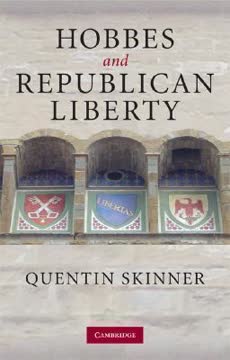
Reviews of Hobbes and Republican Liberty are generally positive, praising Skinner's clear exposition of Hobbes's evolving conception of liberty and his contrast with republican thought. Readers appreciate the Cambridge School's contextual approach and the use of emblems to illustrate ideas. Common criticisms include repetitiveness and insufficient engagement with opposing views. Some question whether republican liberty is a valid concept rather than a modern academic construct, while others note the book's compact, accessible style makes it suitable even for teaching purposes.