
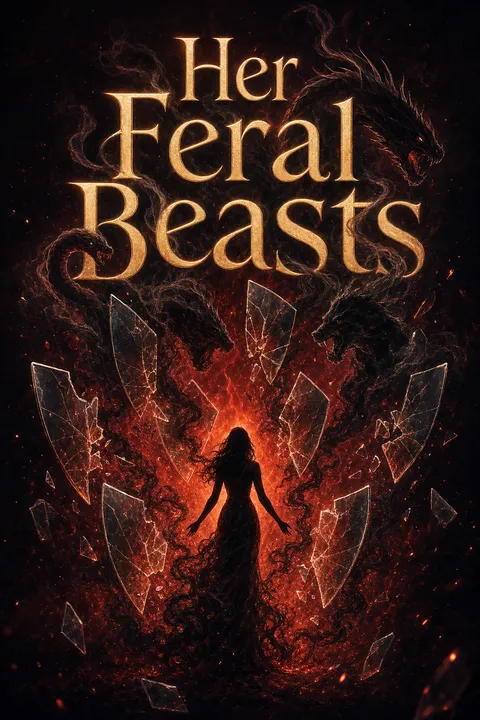


Plot Summary
Prologue
On the day her first blood arrives, thirteen-year-old Aurelia,1 daughter of the Serpent King,7 expects to unveil a proud serpent form before her court. Instead her body convulses through shape after shape, and a mating mark of a skull with five beams burns onto her neck. Her father7 storms off in fury.
The phoenix oracle reveals her fate: five mates of different orders (lion, shark, dragon, wolf, and shadow), two already imprisoned. Because such a mismatched group would expose what she truly is, her father strips her of her princess title, exiles her to a crumbling shack behind her aunt's house, and commands her to keep her scent and mark hidden forever, or be captured and bred to death.
The prologue converts a coming-of-age ritual into a funeral for selfhood. Bali weaponizes puberty as revelation and catastrophe at once: the body betrays the identity a patriarch demanded. Aurelia's exile encodes the book's central trauma, that her very existence is contraband, valuable precisely because it is forbidden. The oracle's prophecy functions as both blessing and curse, promising love while marking her for exploitation. The father's purism (serpents above all) frames bigotry as bloodline honor. Crucially, the prologue installs the survival logic that governs everything after: to be seen is to be owned. Aurelia learns that safety means erasure, and love means danger.
Hunted, Starving, and Framed
Seven years later, Aurelia1 survives as a scrawny eagle, framed for murdering the wealthy husband her father7 sold her to. Starving, she snatches leftovers from a seaside cafe and flees to a national park to eat and rebuild her protective shields.
Her respite shatters when three of her destined mates track her: Savage,2 a feral wolf cradling a pet rooster; Scythe,3 a silver-haired shark who moves like a hitman; and Xander,4 a blind dragon with glowing eyes. They have just torched a luxury store, killing seven, to steal her a gift. Cornered, she throws up magical shields, but Xander4 shifts into a dragon and gives chase, forcing her to run for open sky.
The opening inverts romantasy's meet-cute: the fated mates arrive as apex predators sworn to her death. Bali establishes Aurelia's gallows humor as a survival mechanism, the manic fixation on food masking chronic terror. Hunger becomes literal and symbolic, the depletion of a woman denied every basic dignity. The men's casual atrocity (mass murder to procure a handbag) signals the book's moral universe, where affection and violence are indistinguishable in beasts wired for possession. The scene also seeds the central irony: her body strains toward the very creatures her mind flees, dramatizing the war between instinct and self-preservation that will define her arc.
The Net and the Lion
Fleeing the brothers, Aurelia1 collides with a second hunter: Lyle Pardalia,5 the deputy headmaster of Animus Academy, who fires a magic-neutralizing net that forces her back into human form before a crowd of council hunters and gawking humans. Around her, the brothers are subdued too. Savage2 rages in wolf form, Xander4 incinerates two hunters before being shackled, and Scythe3 surrenders willingly.
Humiliated and naked under a thrown blanket, Aurelia1 is loaded into an armored van bound for Animus Academy, a gothic reform prison for feral shifters where, she is warned, no one has ever escaped. Her carefully laid plan to flee to a distant blended university collapses into captivity alongside the very mates she has spent her life avoiding.
Lyle's introduction, immaculate suit paired with a bazooka, crystallizes the book's aesthetic of controlled savagery: civilization as a thin veneer over predation. His capture of Aurelia reframes rescue as imprisonment, a recurring destabilization of who is protecting whom. The academy itself functions as a Foucauldian institution, a heritage mansion retrofitted with cattle prods and obsidian shackles, promising rehabilitation while enforcing hierarchy. Bali stages Aurelia's shame at public nudity as a metaphor for exposure itself, the terror of being stripped of the shields that constitute her identity. Captivity paradoxically becomes the only place her mates cannot legally kill her.
Denying the Wolf's Claim
Processed into the academy, Aurelia1 finds an unlikely lifeline in Minnie,6 a relentlessly cheerful pink-haired tigress and organizational nerd who becomes her roommate and first true friend. During the ritual mating lines, where unmated animas parade before the animus students, Savage2 tackles Aurelia1 and bellows that she is his regina. Terrified of exposure, she screams that he is lying.
Astonishingly, Xander,4 whose dragon nature detects truth, backs her denial, and the staff let it pass. The lie buys her time but confirms nothing is settled. Meanwhile Aurelia1 glimpses the impossible: the brothers command respect and terror across the school, other students bowing and baring their necks as Scythe3 holds court like an underworld king.
This section dramatizes rejection as taboo. In Bali's world, denying one's mates is the gravest sin, so Aurelia's public disavowal is an act of radical, dangerous self-authorship. Minnie's friendship introduces the book's tender counter-melody: chosen family as the antidote to a lifetime of engineered isolation. The moment Aurelia sobs at being genuinely hugged reveals the depth of her touch-starvation. Xander's inexplicable corroboration of her lie plants an early seed of ambivalence beneath his cruelty. The mating-line spectacle, bodies auctioned to instinct, uncomfortably mirrors the breeding markets Aurelia dreads, blurring sanctioned courtship and commodification.
Kings of the Cafeteria
Aurelia1 learns exactly who her mates are. Scythe Kharkorous3 is a marine-beast mob boss, Savage2 his wolf half-brother and enforcer, a cage fighter bred to kill since toddlerhood, and Xander4 a wealthy blind dragon. Within hours they dominate the academy's underworld, cataloguing every smuggler and dealer while Savage2 kills a defiant lion with one casual blow.
The animas receive nimpins, tiny psychic companion creatures, and Aurelia1 bonds instantly with a blue fluffball she names Henry.8 Scythe,3 reading her darting eyes at the windows, coldly predicts to his brothers that she intends to escape. The brothers resolve to fulfill their bargain and be rid of her, even as their beasts strain toward the regina1 they are sworn to destroy.
Bali builds dramatic irony through the brothers' POV chapters: readers know they are bound by a lethal contract before Aurelia does, sharpening every tender gesture into tragedy. The nimpins operate as emotional prosthetics, externalizing the nurture Aurelia never received and later becoming instruments of her agency. The brothers' instant dominion satirizes prison hierarchy while revealing their shared trauma bond, violence as inheritance. Scythe's clinical detection of her flight instinct establishes him as the analytical predator, the one who dismantles defenses rather than smashing them. The tension between the animus's biological pull and the men's cold agenda becomes the engine of suspense.
Blood on the Threshold
Consumed by his wolf's need to provide, Savage2 repeatedly invades Aurelia's1 dorm. He sleeps in her bed to drown in her scent, rifles her meager belongings, steals a pair of underwear, and leaves behind a small stuffed bear as a courting gift. To reach her, he slaughters the two guards posted at the dormitory door, an act that terrifies the entire anima wing.
Aurelia1 and Minnie6 discover their ransacked room and recognize the wolf's2 pine scent. Torn between fury at the needless deaths and the traitorous comfort of his gift, Aurelia1 sleeps surrounded by his scent that night, more soundly than she has in weeks. Minnie,6 undaunted, begins piecing together the truth of who is stalking her friend.
Savage's courtship literalizes the romance genre's darkest logic: love as trespass, devotion measured in corpses. Bali refuses to sanitize this, letting Aurelia's revulsion coexist with her body's betrayal, a study in trauma-bonded ambivalence. The stolen underwear and gifted bear map the wolf's split psyche, predator and pup, brutality and yearning for family. That two innocent guards die for a teddy bear indicts the possessive instinct the genre often romanticizes, forcing readers to sit with the cost. Minnie's detective enthusiasm provides comic relief while advancing the plot, and the scent-soaked sleep reveals how thoroughly Aurelia's nervous system craves the bond she rationally rejects.
The Prisoner in the Dorm
Determined to learn how the brothers dispose of bodies for her own escape, Aurelia1 slips invisibly into their hidden dragon-magic dorm floor. She finds a tortured serpent student chained to a chair and tries to free him, but a dragon lock traps her, and the brothers return. Scythe3 pins her by the throat and demands she stop lying about being their regina.1
In a reckless gamble, she drops her scent shield, flooding him with her arousal, proving both their bond and her ability to hide it. Enraged and unsettled, the brothers make Savage2 tear out the serpent captive's throat before her eyes. Beak,9 an eagle who once helped her escape and now works for Scythe,3 drags her out, warning her never to return.
This is the book's moral fulcrum, where Aurelia's fantasy of redeemable mates dies against evidence of who they are. Bali stages the throat-grip as erotic threat, the genre's dangerous conflation of dominance and desire, then punctures any romance with the captive's murder. Aurelia's decision to drop her shield weaponizes vulnerability, a paradox: she reveals herself to gain leverage and loses control instead. Beak's reappearance as double agent deepens the theme of loyalty for sale. The scene insists that attraction cannot launder atrocity, and it hardens Aurelia's resolve while confirming the brothers cannot be trusted with the truth of her nature.
The Covenant on His Finger
On escape day, Aurelia1 cloaks herself invisibly and heads for a delivery truck, only to be intercepted first by Scythe3 on the roof, then by Savage2 in an alley. Unable to resist, Savage kisses her against the wall, and she kisses him back with desperate hunger before pain jolts her to her senses.
In that instant she notices the black tattoo on his finger: a blood covenant written in her father's7 serpent script. Using her inherited magic, she reads it. The brothers vowed to return her to her father for execution and vowed never to mate her. The betrayal is total. Her own father7 commissioned her destined mates to hunt her, meaning he has always known who they are.
The kiss and the covenant collapse into a single gutting beat, ecstasy and betrayal indistinguishable, which is Bali's thesis about Aurelia's world. The blood magic tattoo transforms abstract dread into forensic proof: her mates are contract killers hired by her father. This reframes the entire narrative, revealing Mace Naga as puppetmaster who orchestrated even the prophecy's concealment. Aurelia's literacy in serpent magic, a skill her father gave her, becomes the tool that exposes his treachery, a satisfying reversal. The revelation strips away her last illusion that fate might be kind, cementing her understanding that the bond she craves is also the mechanism of her death sentence.
The Wolf Beneath Her Skin
The brothers spring their trap in daylight, seizing Minnie6 to force Aurelia1 out of invisibility. When Savage's2 wolf pins the shifted tigress and lunges for her throat, Aurelia1 detonates: her body erupts not into an eagle but into a black wolf, and she tackles Savage2 off her friend.
The brothers subdue both girls, and Scythe3 begins psychically peeling away her seven shields one by one, exposing her mating mark to all. Before he can dig deeper, Lyle5 and the staff storm in, wrenching the brothers into the air and hauling them to underground cages. Aurelia1 is saved, but her secret second form has been witnessed by her mates, and Lyle5 now knows far more than she wants.
Aurelia's involuntary shift to wolf is the plot's hinge, the first crack in the identity her father forced her to bury. Bali frames the transformation as maternal fury, love overriding self-protection, so that Minnie's endangerment unlocks the very power Aurelia has suppressed for survival. Scythe's shield-stripping is psychic violation rendered as intimacy, terrifying precisely because part of her welcomes being known. The scene escalates the stakes from concealment to exposure: too many now glimpse her impossibility. Lyle's intervention re-positions him as ambiguous guardian, and the underground cages foreshadow the institutional power struggle to come between lion and shark.
Caged Truths, Looming Trial
Lyle5 imprisons the brothers in electrified underground cages and interrogates them, extracting the truth of their blood covenant with the Serpent King7 and refusing to send Savage2 back to Blackwater prison only in exchange for cooperation.
He drops a devastating truth: if Aurelia1 loses her upcoming murder trial, the Old Laws will hand her to her father7 for execution regardless. Meanwhile Aurelia,1 shaken and grieving the covenant's betrayal, is assigned weekly therapy sessions with Lyle5 and a job in the healing clinic to prove her character before the council.
The brothers are released after only a week. Aurelia1 realizes the academy's rules are rigged, its guards partly on Scythe's3 payroll, and that escape, not exoneration, remains her only real hope.
This section widens the antagonist from the brothers to the entire corrupt system, revealing that law itself is an instrument of Mace Naga's will. Lyle's interrogation positions him as a rival power center, ruthless yet bound by a code of honesty that distinguishes him from the mob. The therapy sessions establish the slow-burn dynamic that will complicate the romance, forced intimacy between captor and captive. Bali uses the trial deadline as a ticking clock, converting Aurelia's amorphous dread into structured suspense. The revelation that acquittal is nearly impossible reframes her survival as a problem of escape rather than justice, sharpening her isolation within a rigged institution.
The Villain Slut Era
With a generous mysterious stipend appearing in her account, Aurelia1 and her friends launch a campaign of retaliation. She buys provocative outfits and flaunts her body across campus, knowing that a regina displaying herself to other males is the deepest wound an animus can suffer.
The brothers unravel: Savage2 claims her as wolf territory so no wolf dares approach, Scythe's3 shark prey-drive triggers violently, and both must physically restrain him.
Savage2 retaliates by stealing all her underwear, forcing a mortifying confrontation with Lyle,5 and later kisses her in the healing clinic after deliberately wounding himself so she must heal him. Through recurring dreams, Aurelia1 begins witnessing Savage's2 brutalized childhood as a bred cage-fighter, humanizing the monster even as she wages war against him.
Aurelia reclaims agency by weaponizing the very body that has been commodified her whole life, converting objectification into offense. Bali stages this as feminist reversal within genre constraints: the male gaze becomes her artillery. Yet the campaign is double-edged, deepening the bond it means to punish. The dream-memories introduce a crucial device, granting Aurelia access to Savage's origin as an abused child forced to kill, which reframes his savagery as inherited wound rather than innate evil. This is the book's compassionate turn, insisting monsters are manufactured. The friend-group's giddy solidarity underscores healing through belonging, even as the underlying threat of the trial never recedes.
A Corpse in Her Bed
Aurelia1 finds a decapitated python in her bed with a bloody note: she was always his first. Recognizing her father's7 signature cruelty, she realizes he is staking ownership even from afar and framing her further. Rather than report it, she carries the body to the only people who know how to erase evidence: her mates. Xander4 incinerates it on her command.
Overwhelmed by grief and desire, Aurelia1 surrenders. Savage2 has Scythe3 snap off his covenant-marked finger so he can break the vow, then consummates the bond with her while Scythe3 and Xander4 watch and finally bite their claiming marks into her neck and thigh. For one night, four fractured souls become something whole, before Aurelia1 flees, ashamed and terrified of what it means.
The python corpse externalizes Mace Naga's psychological grip: he owns his daughter so completely he can author murder as correspondence. Aurelia's choice to bring the body to her mates marks her acceptance that she belongs to their violent world, a grim intimacy. The consummation, prefaced by literal self-mutilation to void the death-contract, dramatizes commitment as sacrifice: Savage severs the bond to his death-vow before bonding to her. Bali frames the group claiming as both rapture and surrender, completion at the cost of the autonomy Aurelia guarded her whole life. Her shamed flight afterward preserves the tension: union does not erase the trial, or the danger her nature invites.
Sapphires Before the Storm
The morning of the trial, Xander4 arrives without his headphones, his dragon fully in control. In a startling reversal from his habitual contempt, the dragon drapes Aurelia1 in diamonds and sapphires, declaring that their union was written before the stars and that he will be her general in the war to come.
He tells her the man he inhabits refuses to feel this love because it means more pain, but the dragon feels it regardless. Moved and stunned, Aurelia1 asks him for one crucial favor before he goes. Their exchange quietly arms her escape plan, linking the dragon-trick door in the boys' dorm to a matching hidden door in the anima building, opened only because his regina1 asked.
Bali splits Xander into man and dragon to dramatize how trauma can quarantine love: the human refuses tenderness as self-defense while his beast speaks the truth he cannot afford. The gift of jewels contrasts pointedly with Savage's stolen underwear and gifted bear, mapping each mate's love-language to his order (dragons hoard treasure). The dragon's vow of war reframes devotion as alliance rather than possession, a maturation of the bond. Crucially, this section plants the escape mechanism in plain sight, the paired dragon-doors, satisfying the setup-payoff contract before the climax. Aurelia's request signals her shift from passive prey to strategist commanding her own rescue.
The Rigged Verdict
At the Council of Beasts courthouse, Mace Naga7 orchestrates Aurelia's1 destruction with surgical precision. His forged bank statements paint her as a spendthrift addict, her aunt lies about her promiscuity, and his lawyer exposes the execution of Theo Krait, the boy Aurelia1 lost her virginity to, publicly branding her as someone who signed a lover's death warrant.
Lyle5 testifies honestly in her favor and her clinic heroics are noted, but the corruption is overwhelming. Scythe,3 seated as the council's marine representative, watches four votes fall against her, some bought, some coerced.
The verdict returns guilty of arson and murder, sentencing her under the Old Laws to be returned to her father7 for venomous execution. Her every legal hope dies.
The trial exposes law as theater staged for human consumption, a facade over Old Law brutality, indicting institutional justice as the powerful's plaything. Bali makes Mace Naga's cruelty intimate: he does not merely kill Aurelia, he desecrates her memory and resurrects her murdered first love to shame her. The Theo Krait revelation retroactively deepens the prologue's horror, showing the father's serpent purism claims lovers too. Scythe's helpless vote-counting positions even a mob boss as small before the council's machinery. The guilty verdict converts the slow-burn dread into inevitability, stripping every option except the escape Aurelia has quietly engineered, and setting the stage for explosive revelation.
The Boneweaver Unleashed
At the handover, with her father7 and his masked serpent generals waiting, Aurelia1 springs her trap. Five hidden nimpins unleash a paralyzing psychic scream, dropping the animuses and serpents. Using a bobby pin Minnie6 slipped her, she frees her cuffs.
But her father's7 taunt of her breeding price shatters her final restraint. Her power detonates: her mating mark blazes, and she sees the matching skull ignite on Lyle's neck,5 revealing the deputy headmaster as her fifth mate, the lion.
Losing all control, she shifts through lioness and eagle forms as Scythe3 names what she truly is: a Boneweaver, a mythical shifter able to become any beast. Dodging gunfire, she flies for the hidden dragon-door and vanishes into the night, still caged but free for now.
The climax fuses revelation and liberation: Aurelia's identity, suppressed since childhood, erupts as both weapon and self-actualization. The Boneweaver reveal recontextualizes the entire novel, explaining her father's obsession, her multiple forms, and her astronomical value. Bali stages Lyle's unmasking as her fifth mate with cruel timing, love recognized at the instant of maximum peril, echoing the prologue's prophecy (lion completing the set, with the shadow still unknown). The nimpins, seeded early as comfort objects, pay off as instruments of rebellion, and the dragon-door setup delivers her exit. The ending refuses closure: escape is temporary, freedom borrowed, and the true war, against a father who commodifies his daughter, has only begun.
Epilogue
In the aftermath, Lyle5 kneels amid the chaos, ears ringing, staring at the celestial skull now blazing on Aurelia's neck,1 the same mark he has carried on his own since puberty. He watches his regina1 shift through forms no beast should possess and vanish into the sky, pursued by gunfire.
Scythe3 steps calmly before the kneeling lion5 and gives the impossible its name for all three brothers to hear: their regina1 is a Boneweaver, a supposedly extinct shifter who can become any creature alive. The men who were sworn to kill her now understand exactly what, and whom, they have lost.
The brief shift to Lyle's perspective delivers dramatic recognition in its purest form: the hunter discovering he loves his quarry at the moment she escapes him. Bali withholds Lyle's mate-status until this final beat, making his prior cruelty and reluctant care legible in retrospect. Scythe's naming of the Boneweaver functions as thesis statement, transforming Aurelia from victim into legend, from commodity into force. The epilogue reframes the entire power structure: the men who controlled her institution now grasp that she was always the most powerful being among them. It closes on awe rather than resolution, priming the sequel while affirming Aurelia's monstrous, magnificent worth.
Analysis
Her Feral Beasts operates as a why-choose romantasy that interrogates the genre's own dangerous conventions rather than merely indulging them. Bali's central provocation is bodily autonomy under systems designed to erase it. Aurelia1 is valuable precisely as property, a Boneweaver breeder whose worth is measured in millions, and every institution she encounters (the Serpent Court, Animus Academy, the Council of Beasts) exists to catalog, contain, and monetize bodies. Her seven shields literalize the psychological cost of survival in such a world: to remain unowned, she must remain unseen, which means she can never be known or loved. The novel's tension springs from this cruel equation, dramatized through the war between her anima's biological pull toward her mates and her rational terror of the exposure that bond invites. Bali refuses to sanitize the mates' violence; the men court through murder, and the text forces readers to sit with that cost rather than romanticizing it away. Yet through Savage's2 dream-memories and Xander's4 split man-and-dragon psyche, the book advances a genuinely humane thesis: monsters are manufactured by abuse, and love requires the terrifying vulnerability of lowering one's defenses. The found-family subplot with Minnie6 provides the emotional counterweight, arguing that chosen belonging can heal engineered isolation. Structurally, Bali braids dramatic irony (readers know of the death-covenant before Aurelia) with a rigged-trial ticking clock, building toward a climax that fuses self-actualization and liberation. The father, Mace Naga,7 embodies patriarchal control at its most predatory, weaponizing law, forgery, and even a murdered first love to possess his daughter. Ultimately the novel reframes its heroine from commodity to legend, insisting that the most exploited being in the room was always the most powerful, and that reclaiming one's monstrous nature is itself an act of freedom.
People Also Read




Characters
Aurelia (Lia) Aquinas
Exiled fugitive princessOnce the cherished heir of the Serpent Court, Aurelia was cast out at thirteen when her body revealed forbidden truths, and she has survived seven years in exile by mastering seven layers of magical shields that hide her scent, mind, and mating mark. Fiercely intelligent, sardonic, and half-feral from isolation, she copes with terror through gallows humor and manic self-affirmations. Beneath the bravado lies a profoundly touch-starved young woman who equates being seen with being owned. Driven by a desperate hunger for freedom and belonging, she wars constantly against her own anima's pull toward the mates fate assigned her. Her deepest wound is her father's7 betrayal, and her deepest fear is becoming property in a breeding pen.
Savage Fengari
Feral wolf enforcerA cage fighter bred and beaten into a killing machine since toddlerhood, Savage is the most overtly unhinged of the brothers, prone to singing children's songs mid-slaughter and keeping a pet rooster named Eugene as an emotional anchor. Illiterate, impulsive, and gleefully violent, he masks a wounded pup beneath the monster. As a wolf, he prizes family and pack structure above all, which makes his animus's pull toward Aurelia1 agonizing given his vow to destroy her. He courts her clumsily with stolen gifts and stolen underwear, compelled by instinct he cannot articulate. His devotion, once triggered, is total and obsessive, a starved child's craving for the home he never had.
Scythe Kharkorous
Marine mob bossSavage's2 silver-haired half-brother, Scythe is a great white shark shifter and feared underworld kingpin whose rasping voice and glacial control command instant submission. He perceives the world through blood and water, tracking heartbeats and reading auras, and is haunted by apparitions only he can see. Sold and abused as a child, he channeled his pain into ruthless dominance, vowing to protect Savage2 at any cost. Calculating and unreadable, he approaches Aurelia1 as a threat to be analyzed and eliminated, yet finds his shark's mate-drive nearly ungovernable. His mind is his weapon: he dismantles defenses rather than smashing them, making him the most dangerous, and most quietly conflicted, of her mates.
Xander Drakos
Blind dragon princeA wealthy, privately educated dragon shifter whose eyes were cut out, Xander navigates by magical sight and godlike hearing, wearing headphones for echolocation when shackled. Sardonic, contemptuous, and perpetually bored, he throws around vocabulary to needle the illiterate Savage2 and hides genuine feeling behind cruelty. His dragon hoards treasure and truth, able to detect lies instantly. Estranged from his powerful royal family, he ended up among the brothers under mysterious circumstances tied to his blinding. Toward Aurelia1 he is coldest of all, refusing the love his dragon nonetheless feels, because he has decided further pain is intolerable. His arc quietly questions whether armor against suffering is worth the cost of connection.
Lyle Pardalia
Ruthless deputy headmasterThe lion who runs Animus Academy, famed nationally as the Beast Breaker for rehabilitating rabid shifters, Lyle presents as an immaculate, controlled twenty-seven-year-old in three-piece suits who speaks in a flat, clipped monotone. Beneath the refinement prowls a rabid predator he keeps on a tight leash. Obsessed with order, control, and honesty, he despises being disrespected yet never lies. He captured Aurelia1 and becomes her reluctant therapist and judge, wounded pride warring with dawning fascination. A small carved winged doll on his desk hints at a tender history he guards fiercely. His interactions with Aurelia1 crackle with antagonism and unwilling attraction, positioning him as both jailer and something more.
Minnie Devi
Loyal tigress roommateA curvy, pink-haired tigress with doe eyes, silver bangles, and a beloved color-coded binder, Minnie is relentlessly cheerful, organized, and secretly an adrenaline junkie. Placed in the academy for anger she cannot control, she survived a bad relationship with a dangerous ex. She becomes Aurelia's1 first true friend, offering fierce loyalty, comic relief, and sharp deductive instincts. Her willingness to shift and attack a far deadlier wolf2 to protect Aurelia1 proves the depth of her devotion.
Mace Naga
Tyrannical Serpent KingThe King Cobra ruler of Serpent Court and Aurelia's1 father, Mace is a serpent purist who cultivates a public image of kindness and reform while practicing blood magic, murder, and manipulation behind closed doors. Cold, calculating, and utterly ruthless, he exiled his own daughter1 and now schemes to reclaim and monetize her. He weaponizes law, forgery, and family to engineer her destruction, embodying patriarchal control at its most predatory.
Henry
Psychic companion creatureA palm-sized ocean-blue nimpin assigned to Aurelia1 as an assistance animal, Henry emits calming pheromones, vibrates to soothe her spiraling anxiety, and can unleash a paralyzing psychic shriek. Endlessly affectionate and improbably brave, he becomes Aurelia's emotional lifeline and, alongside his fellow nimpins, a crucial instrument in her plans.
Beak
Double-agent eagleA handsome, well-groomed eagle who once served as a guard at Halfeather's mansion and flirted with Aurelia1, Beak resurfaces at the academy as a secret operative on Scythe's3 payroll. Charming and self-assured, he warns Aurelia1 of the brothers' danger while remaining loyal to the shark3, embodying the theme of loyalty for sale.
Raquel
Blunt wolf friendA pierced, denim-clad wolf anim with a speech stutter from telepathic upbringing, Raquel is gruff, loyal, and streetwise, offering Aurelia1 hard truths about wolf social codes and standing with her friend group.
Sabrina
Bold leopard classmateA confident, flirtatious leopard anima who thrives on male attention and teaches the girls to pick locks, Sabrina masks a rough childhood behind sass and becomes a reluctant but reliable member of Aurelia's1 circle.
Theresa
Compassionate anima counsellorA tattooed, buzz-cut cassowary shifter who guides the first-year animas, Theresa is calm, kind, and genuinely invested in her students' welfare, teaching Aurelia1 healthy outlets for rage and offering rare adult support.
Reuben Lunaris
Giant wolf instructorA seven-foot bearded wolf and the academy's fighting coach, once friends with Savage's2 father, Reuben is tough but wise, sparring with Savage2 and counseling him that a mate must be earned through trust, not force.
Connor
Cheerful lion friendA braided-hair lion who has an anima yet lives in the unmated dorms, Connor is warm, stylish, and gossipy, welcoming Aurelia's1 group and adding levity and solidarity to their found family.
Hope
Kindly charge nurseThe eagle charge nurse who processes Aurelia1 on arrival and mentors her in the healing clinic, Hope is warm and perceptive, quietly protective of the vulnerable young woman under her care.
Plot Devices
The Seven Shields
Concealment of forbidden selfAurelia1 maintains up to seven layers of magical protection, hiding her scent, mind, blood, and mating mark, plus a rare eighth shield of invisibility. This impossible defensive arsenal is both her survival mechanism and a signal of her hidden nature, since no ordinary beast could produce it. The shields externalize her psychological armor: to be exposed is to be enslaved. Throughout the novel their depletion tracks her vulnerability, their strategic dropping becomes a weapon of seduction and revelation, and their forcible stripping by Scythe3 dramatizes intimacy as violation. Their final shattering marks her loss of control and the eruption of her true power, converting a lifetime of hiding into explosive self-revelation.
The Blood Covenant
Binding contract of betrayalA serpent-magic tattoo inked on the fingers of the three brothers and Aurelia's1 father, the blood covenant legally binds the mates to hunt Aurelia1, return her for execution, and never mate with her. Written in the old Naga script, it is readable only to those trained in blood magic, which Aurelia happens to be. The covenant is the novel's central engine of tragic irony: the fated lovers are contractually sworn killers. Its discovery via a stolen kiss reframes the entire story, and its violent severing (through self-mutilation) becomes the precondition for union, dramatizing love as literal sacrifice against a father's7 manufactured doom.
The Mating Mark
Celestial bond made visibleA skull with five beams of light, branded by the stars onto the necks of a soul-group, visible only to its members, the mating mark identifies Aurelia's1 five destined mates across different orders. Established in the prologue as the source of her exile (five mismatched mates expose her secret), the mark recurs as both blessing and liability. Its concealment drives the plot's tension, its exposure escalates danger, and its blazing recognition on a final mate's neck5 delivers the climactic reveal. Bali uses the mark to explore fate versus autonomy: a bond ordained before birth that Aurelia1 must nonetheless choose to accept or reject.
Savage's Dream-Memories
Trauma revealed through sleepAfter physical intimacy with Savage2, Aurelia1 begins experiencing vivid dreams of his childhood: bred as a cage fighter, beaten until his wolf claws emerged, forced to kill an opponent at his father's command, and the fiery night the brothers escaped their abusers. These visions function as a compassion engine, granting Aurelia1 (and readers) access to the manufactured origins of the brothers' monstrousness. Bali uses them to complicate the villain-mate dynamic, insisting that savagery is inherited wound rather than innate evil, and deepening the emotional stakes of Aurelia's ambivalence toward men who both terrify and belong to her.
The Nimpins
Comfort turned weaponTiny psychic companion creatures issued to the animas, nimpins emit pheromones that trigger parental instinct rather than prey-drive, and can unleash a paralyzing high-frequency shriek. Introduced as therapeutic assistance animals that soothe Aurelia's1 anxiety and symbolize the nurture she was denied, they undergo a classic setup-payoff transformation. Their empathic bonding gives Aurelia emotional grounding throughout captivity, while their combined psychic scream becomes the linchpin of her climactic escape, disabling her captors at the crucial moment. Bali cleverly weaponizes softness itself, letting instruments of comfort become instruments of rebellion, mirroring Aurelia's1 own journey from hidden fragility to eruptive power.
Her Vicious Beasts Series





Download PDF
Download EPUB
.epub digital book format is ideal for reading ebooks on phones, tablets, and e-readers.








































