Key Takeaways
1. The Holy Roman Empire: A Unique and Enduring European Ideal.
The Empire lasted for more than a millennium, well over twice as long as imperial Rome itself, and encompassed much of the continent.
A Millennium of Influence. The Holy Roman Empire was not merely a historical footnote but a central force in European development for over a thousand years. Its longevity, far surpassing that of ancient Rome, allowed it to shape the continent's political, social, and cultural landscape from the early Middle Ages to the 19th century. It was a vast entity, extending beyond modern Germany to include parts of ten other European countries, and influencing many more.
More Than a State. Unlike conventional nation-states, the Empire lacked a stable heartland, a single capital, or centralized political institutions. It was defined by a "quasi-religious sense of purpose," a divine mission to provide a stable political order for all Christians and defend them against heretics and infidels. This overarching ideal, rather than territorial control, gave the Empire its unique character and enduring appeal.
A "Translated" Roman Legacy. The Empire's identity was deeply rooted in the concept of translatio imperii, the belief that the imperial title had been "translated" from ancient Rome and Byzantium to Charlemagne. This idea, supported by biblical prophecy, positioned the emperor as the pre-eminent Christian monarch, tasked with moral leadership and guardianship of the church. This spiritual dimension, combined with the Roman legacy, made the Empire a singular and exclusive entity in the European imagination.
2. A Dynamic Partnership: The Evolving Dance of Emperor and Papacy.
Both pope and emperor were considered essential to proper order. Neither could ignore the other without negating his own position.
Two Swords Doctrine. The Empire's foundation in 800 was a joint creation of Charlemagne and Pope Leo III, embodying the "Two Swords" doctrine. This theory posited that God granted spiritual authority (auctoritas) to the Church (pope) and secular power (potestas) to the state (emperor). This division, while intended to create a harmonious Christian order, inherently contained the seeds of conflict over ultimate supremacy.
From Cooperation to Contest. Early medieval popes and emperors often cooperated, with emperors protecting the papacy and popes legitimizing imperial rule. However, the Gregorian Reform movement in the 11th century, advocating "freedom of the church" (libertas ecclesiae), challenged imperial influence over clerical appointments. This culminated in the Investiture Dispute, where Emperor Henry IV's humiliation at Canossa (1077) marked a turning point, weakening the sacrality of kingship.
A Regulated Relationship. The Concordat of Worms (1122) formally resolved the Investiture Dispute, distinguishing spiritual investiture (papal) from temporal authority over church lands (imperial). This agreement, though a compromise, regulated papal-imperial relations for centuries. While later conflicts, like those with the Staufers, saw popes assert greater claims to supremacy, the relationship remained one of interdependence. The emperor needed papal legitimacy, and the pope needed a powerful protector, ensuring a complex, often contentious, but ultimately enduring partnership.
3. Beyond Borders: The Empire's Diverse Lands and Peoples.
The Empire never demanded the absolute, exclusive loyalty expected by later nationalists. This reduced its capacity to mobilize resources and command active support, but it also allowed heterogeneous communities to coexist, each identifying its own distinctiveness as safeguarded by belonging to a common home.
A Patchwork of Identities. The Holy Roman Empire was never a monolithic entity but a "patchwork of lands and peoples." Its vast geographical scope meant it encompassed diverse ethnic, linguistic, and cultural groups, including:
- Germans
- Italians
- Burgundians
- Slavs
- Jews
Unlike later nation-states, the Empire did not seek to homogenize its population, allowing for a rich tapestry of local and regional identities to flourish within its overarching framework.
Fluid Frontiers and Shifting Cores. The Empire's internal and external boundaries were fluid, reflecting political networks rather than fixed geographical lines. Its "core" shifted over time:
- Frankish heartland
- Saxony under the Ottonians
- Rhineland and Bohemia under the Luxembourgs
- Austria under the Habsburgs
This dynamic geography meant that "king's country" was defined by political proximity and resource control, not a singular, stable ethnic or linguistic center.
Hierarchy of Kingdoms. The Empire was structured as a hierarchy of kingdoms, with Germany emerging as the premier realm after Otto I's coronation in 962. Italy and Burgundy, though integral, held distinct positions. This multi-kingdom structure, rather than a unitary state, allowed for varied forms of integration. Regions like Bohemia gained significant autonomy, while others like Poland and Hungary maintained distinct identities despite periods of imperial suzerainty, demonstrating the Empire's capacity to accommodate diverse political entities.
4. Governance by Consensus: A Flexible, Decentralized, and Evolving Monarchy.
Imperial governance entailed fostering a consensus amongst the Empire’s political elite to ensure at least minimum compliance with agreed policy, enabling the emperor to dispense with the burden of both forcing cooperation and of ruling the bulk of the population directly.
Consensus, Not Command. For much of its existence, the Empire was governed through consensus rather than centralized command. Emperors relied on the cooperation of a relatively flat hierarchy of lay and spiritual lords, whose support was secured through:
- Personal engagement
- Rituals
- Discreet negotiations
This approach, exemplified by the Ottonians, allowed the emperor to maintain authority without a large bureaucracy or standing army, adapting to an economy where cash was less important than services and goods in kind.
Evolution of Royal Power. While early Carolingian rule showed some centralized administrative features, these largely faded. The Salian monarchs attempted a more "command style" of rule, but this proved unsustainable, leading to the Investiture Wars. The Staufers then formalized feudal relations, creating a clearer hierarchy of vassals. This evolution was not a sign of "decline" but an adaptation to changing social and economic realities, allowing for a more distributed form of governance where local lords assumed greater responsibility.
The Rise of Institutions. The late Middle Ages saw the gradual institutionalization of imperial governance. The Electoral College gained definitive form in the Golden Bull (1356), formalizing the selection of the German king. The Reichstag emerged as a permanent assembly by 1495, transforming vassals' duty to advise into a right to share in common decisions. These institutions, along with the imperial courts and the Kreis structure, provided a framework for collective action, demonstrating the Empire's capacity for adaptation and its unique path to political organization.
5. The Rise of Territories: How Local Power Shaped the Imperial Whole.
Territorialization developed to enable them to achieve this, thus complementing rather than contradicting imperial authority.
Feudalization and Princely Power. The Staufer era (1138-1250) marked a significant shift towards the "feudalization of the Empire." This involved formally recognizing hereditary fief-holding and deliberately fragmenting larger ducal jurisdictions to create a more numerous and hierarchically structured lordly elite. These "princes" gained greater autonomy and judicial powers within their lands, becoming responsible for local order and justice. This process was not a challenge to imperial authority but a redefinition of roles, with princes acting as local governors within the imperial framework.
Territorialization, Not Fragmentation. The concept of "territorialization" describes how lordly rights became fixed in specific, geographically defined lands. This was driven by demographic and economic growth, which allowed for more intensive land exploitation and necessitated clearer boundaries. Princely chancelleries and administrative districts (Ämter) emerged, creating more coherent territorial units. This process, while leading to a "patchwork" of jurisdictions, ultimately integrated these territories more deeply into the Empire by defining their status and obligations within the imperial legal framework.
A Hierarchy of Immediacy. A fundamental distinction emerged between "immediate" imperial Estates, directly subordinate to the emperor, and "mediate" vassals, who held their fiefs under other lords. This complex hierarchy, codified in Staufer charters, ensured that while princes gained significant local power, their authority derived from and was ultimately constrained by their relationship to the Empire. This system allowed for diverse local governance while maintaining an overarching imperial order, demonstrating a unique form of political integration.
6. Society's Fabric: A Hierarchy of Corporate Rights and Communal Life.
The Empire’s hierarchy was not a chain of command, but a multilayered structure allowing individuals and groups to disobey one authority whilst still professing loyalty to another.
Corporate Society. The Empire's social order was fundamentally corporate and hierarchical, structured into distinct Estates: clergy, nobility, and commons. Identity was tied to membership in these groups, which possessed specific, local, and often unequal rights and privileges. This system, rooted in medieval functional divisions, emphasized mutual interdependence and collective well-being, rather than individual equality.
The Rise of Communes. Communal self-government emerged strongly in towns and villages from the 11th century, becoming a defining feature of the social landscape. These communes, based on households, developed their own laws, courts, and administrative structures, often in cooperation with, or through concessions from, local lords. This allowed for significant local autonomy and a strong sense of collective identity, where "freedom" was understood as specific communal liberties rather than universal individual rights.
Lordship and Fellowship in Tension. The relationship between hierarchical lordship and horizontal fellowship was one of "creative tension." While lords exercised authority and extracted resources, communities asserted their rights and managed local affairs. This dynamic, rather than a simple opposition, shaped the Empire's unique social and political order. The multilayered structure allowed for diverse forms of protest and negotiation, ensuring that grievances could be addressed without necessarily challenging the fundamental legitimacy of the imperial framework.
7. Justice as Mediation: Preserving Peace Through Compromise, Not Command.
Imperial institutions could judge, punish and coerce, but they mainly brokered settlements intended as workable compromises rather than as definitive judgements based on absolute concepts of right and wrong.
Finding the Law, Not Imposing It. Justice in the Empire was characterized by a decentralized, local approach focused on finding appropriate laws and achieving workable compromises. Unlike centralized states, the Empire's legal system, a blend of written and unwritten laws, prioritized "fairness" (Billigkeit) over abstract "justice" (Gerechtigkeit). This reflected a societal acceptance of human imperfection and the complexity of disputes, where absolute verdicts were often avoided in favor of reconciliation.
From Feuds to Public Peace. Early medieval conflict resolution often involved feuds, which were recognized legal means of redress. However, the rising scale of violence in the late Middle Ages led to calls for "general pacification." This culminated in the "eternal public peace" of 1495, which outlawed feuding and established the Reichskammergericht as a supreme court for arbitration. This marked a shift towards juridification, channeling disputes through institutional channels rather than direct violence.
A Multi-Tiered Judicial System. Imperial reform created a multi-tiered judicial hierarchy. Local and territorial courts handled most cases, with the Reichskammergericht serving as a final court of appeal for imperial Estates and, increasingly, ordinary subjects. The Reichshofrat, a second supreme court, safeguarded imperial prerogatives. Despite staffing challenges and backlogs, these courts played a crucial role in preserving peace, defusing social tension, and protecting rights, demonstrating the Empire's commitment to the rule of law within its unique, fragmented structure.
8. The Reformation and Beyond: Adapting to Religious and Political Upheaval.
The Empire remained a common fatherland composed of numerous, lesser homelands.
Navigating Confessional Divides. The Reformation (post-1517) posed an existential threat to the Empire's Christian unity. Unlike other European monarchies that adopted a single official faith, the Empire, through the Peace of Augsburg (1555), embraced religious pluralism. This granted legal recognition to both Catholics and Lutherans, allowing imperial Estates the "right of Reformation" (ius Reformandi) within their territories. This unique solution, while preventing civil war, embedded religious divisions into the constitutional fabric.
War and Constitutional Resilience. The Thirty Years War (1618-1648), though devastating, ultimately demonstrated the Empire's constitutional resilience. Despite foreign interventions and internal conflicts, the Peace of Westphalia (1648) reaffirmed the Empire's mixed monarchy, incorporating Calvinism, and strengthening the role of the Reichstag and Kreis structure in collective security. This outcome, far from signifying collapse, solidified the Empire as a framework for managing diverse religious and political interests.
A Framework for Coexistence. The post-1648 Empire, though often criticized as "moribund," provided a stable framework for coexistence. It avoided the confessional absolutism seen elsewhere, allowing for a degree of religious toleration and legal protection for minorities, including Jews. This unique blend of shared governance and territorial autonomy, while complex and sometimes slow, ensured that the Empire remained a viable political entity, adapting to profound religious and political upheavals without fragmenting into warring states.
9. Dynasty and Diplomacy: The Habsburgs' Enduring Imperial Role.
The Habsburgs were still the only German imperial family.
Habsburg Hegemony. From 1438, the Habsburgs established an almost unbroken hold on the imperial title, a testament to their successful dynastic strategies. Through strategic marriages and inheritances, they amassed vast hereditary possessions—including Austria, Bohemia, and Hungary—that provided an unparalleled material base for their imperial ambitions. This dynastic power, rather than a centralized imperial bureaucracy, became the primary engine of imperial governance, allowing them to project influence across Europe.
A Dual Monarchy. The Habsburgs' growing territorial empire, particularly after the reconquest of Hungary (1683-1699) and the acquisition of Spanish lands (1714), created a "dual monarchy" that partially overlapped with the Holy Roman Empire. While their own lands were increasingly managed through centralized Austrian institutions, the Habsburg emperors skillfully navigated the imperial constitution, presenting their dynastic interests as synonymous with the Empire's welfare, especially in defending against the Ottoman threat.
Managing Rivalry. The rise of Prussia under the Hohenzollerns in the 18th century challenged Habsburg dominance, leading to an "Austro-Prussian rivalry." Despite this, the Habsburgs retained the imperial title, leveraging their prestige and the support of smaller imperial Estates who feared Prussian expansion. Their ability to maintain this complex balance, even amidst military setbacks, underscored the enduring value of the imperial framework as a guarantor of stability and a source of legitimacy for both the emperor and the diverse members of the Empire.
10. A "German Problem" or a European Model? The Empire's Complex Legacy.
Rather than providing a blueprint for today’s Europe, the history of the Empire suggests ways in which we might understand current problems more clearly.
Historiographical Debates. The Empire's dissolution in 1806 coincided with the rise of modern nationalism, leading to its portrayal as a "corpse" or a "failed state" in much of 19th and 20th-century historiography. This narrative, often linked to the "German Problem" or Sonderweg, blamed the Empire for Germany's delayed nation-state formation and subsequent authoritarian tendencies. However, recent scholarship challenges this, re-evaluating the Empire as a unique, complex, and adaptable political entity.
Beyond the Nation-State. The Empire's history offers a counter-narrative to the teleological view of European history culminating in the nation-state. Its decentralized, multi-layered governance, fragmented sovereignty, and tolerance of diverse identities allowed for the coexistence of numerous "lesser homelands." This "federal nationalism" or "communalism" provided a framework for stability and local liberties, contrasting sharply with the homogenizing pressures and often violent conflicts associated with later nationalisms.
Lessons for the EU. Comparisons between the Holy Roman Empire and the European Union, though controversial, highlight the challenges of governing complex, multi-level political systems. Both entities grapple with fragmented sovereignty, diverse identities, and the need for consensus-based governance. The Empire's experience suggests that decentralized structures can foster stability and accommodate diversity, but also face challenges in achieving decisive action and maintaining legitimacy in the face of external pressures. Its legacy encourages a nuanced understanding of political integration beyond the traditional nation-state model.
Review Summary
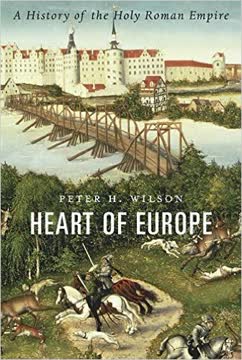
Heart of Europe receives mixed reviews, averaging 3.75/5. Readers widely praise Wilson's exhaustive research and comprehensive scope, acknowledging it as likely the definitive English-language history of the Holy Roman Empire. However, the thematic rather than chronological structure draws significant criticism, with many finding it difficult to follow and better suited as a reference book than a cover-to-cover read. The book's density and assumed prior knowledge make it challenging for general readers, though specialists and dedicated history enthusiasts find considerable value in its depth.