

Key Takeaways
Humanity craves the Kingdom, not religion, which is God's counterfeit
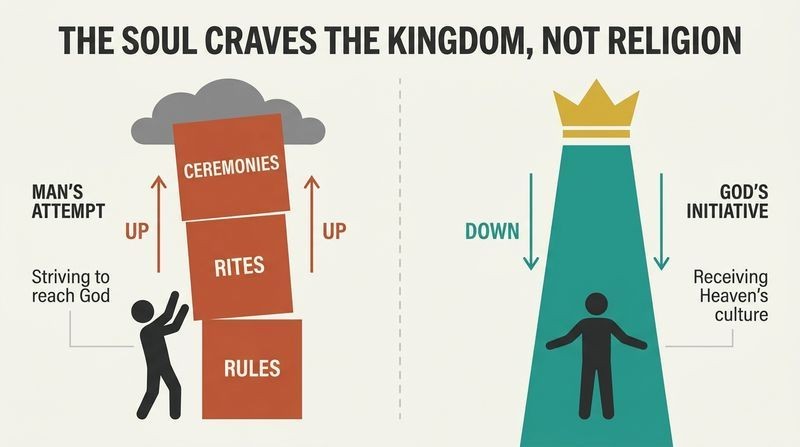
Religion is humanity's best guess, not God's plan. Munroe, a Bahamian pastor, opens with a story: invited to an interfaith rally in Mexico City alongside the Dalai Lama and Muslim imams, he stunned the packed arena not by preaching Christianity but by declaring religion the number one source of the world's problems. The crowd demanded more. His thesis: people worldwide are exhausted by rites, rules, and empty ceremony that never answers the soul's deepest cry.
He distinguishes sharply between religion (man's attempt to reach God) and the Kingdom (God's government arriving on Earth). Religion tries to get God's attention; the Kingdom is about receiving God's intention. Historically, he argues, religious difference has fueled most violent conflict, from the Crusades to modern terrorism. What the world actually longs for, whether it knows it or not, is Heaven's governing culture on Earth.
The religion-versus-Kingdom distinction echoes Dietrich Bonhoeffer's "religionless Christianity" and Karl Barth's critique of religion as human self-justification. Munroe's move is rhetorically bold but theologically contested: many scholars note the New Testament word for "pure religion" (James 1:27) is used positively, so the dichotomy is partly semantic. Still, the sociological point lands. Sociologist Emile Durkheim showed religion functions as social glue, yet that same in-group cohesion breeds out-group hostility. Munroe reframes the sacred as governance rather than tribe, which sidesteps sectarian identity. The provocative claim that people "secretly want" the Kingdom mirrors Augustine's restless heart, though it risks assuming the conclusion it sets out to prove.
God's big idea: colonize Earth with Heaven's culture, planting a garden
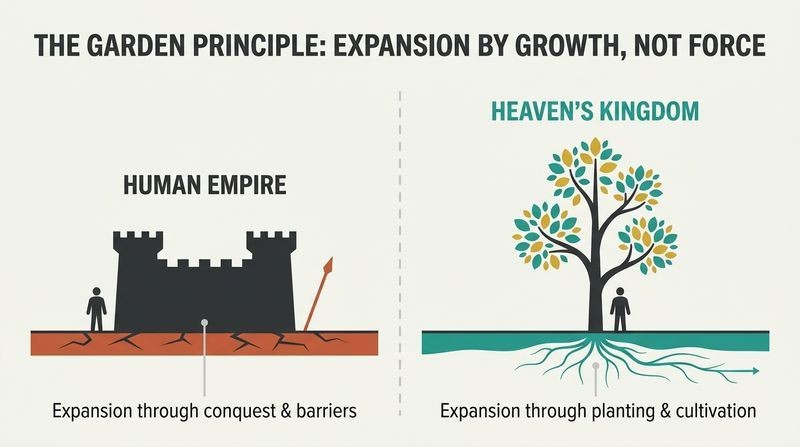
Heaven expands not by war but by gardening. The book's central thesis: God, ruler of an invisible but literal country called Heaven, wanted to extend His government into the visible world. Human empires expand through conquest and slaughter. God did the opposite. He planted a garden in Eden and placed humans in it as citizen-rulers, mandated to be fruitful, multiply, and spread Kingdom "gardens" until Earth reflected Heaven.
Munroe calls this the Garden Principle: influence that grows gradually, beautifully, and irreversibly, transforming barren ground the way vegetation reclaims a desert. Colonization here strips away its brutal historical baggage. Instead of an armed fortress, God's outpost was a place of abundance. The goal was to fill Earth with God's glory (Hebrew kabod, meaning full weight or true nature) so that the natural realm would mirror the supernatural.
Reframing salvation history as colonization is provocative given Munroe's own Bahamian experience under British rule, which he openly acknowledges. He redeems the metaphor by contrasting exploitative human colonies with a benevolent garden that gives rather than extracts. This resonates with N.T. Wright's scholarship, which similarly argues the biblical hope is a renewed Earth, not escape to a disembodied heaven, and that humans are royal image-bearers commissioned to steward creation. The agricultural framing also connects to Wendell Berry's ecological theology. One tension: casting God's expansion as "colonization" may still trouble postcolonial readers, though Munroe's insistence on transformation-by-attraction rather than coercion is a meaningful distinction.
Ideas outlive their makers, so only a better idea defeats a bad one
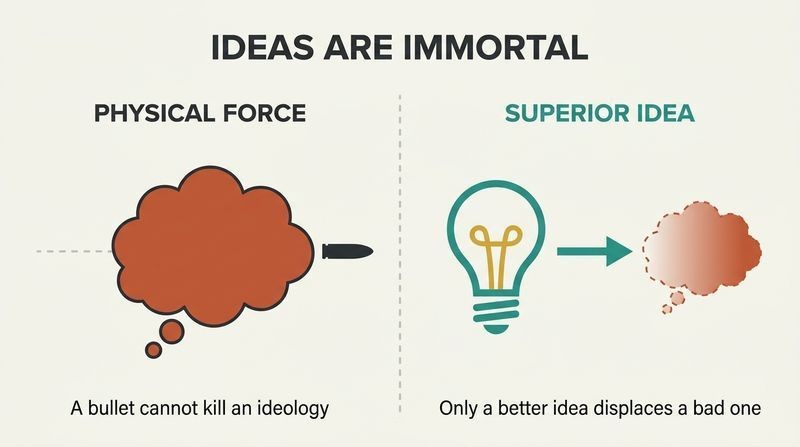
The world is ruled by dead men's ideas. Munroe argues that imperialism, communism, democracy, and dictatorship all survive because ideas incubate in the mind, where no weapon can reach. Kill a man and his idea transfers and multiplies. This, he says, is why terrorism resists military solutions: you cannot shoot an ideology. A bullet never killed a thought.
He traces ideas back to what he calls a precept (pre + cept, meaning "before thought"), the foundational thought that becomes an idea, then a concept, then a philosophy, then a belief system that governs all behavior. Quoting Solomon ("as a man thinks, so is he"), he concludes you cannot live beyond your philosophy, and your philosophy only changes when your ideas change. The Kingdom, therefore, is the superior idea meant to displace all inferior ones.
This is idealism in the philosophical sense, the view that ideas, not material forces, drive history. It sits in productive tension with Marxist materialism, which claims economic conditions shape ideas rather than the reverse. Munroe's claim that terrorism cannot be defeated by force alone is well supported by counterinsurgency research and Rand Corporation studies showing most terrorist campaigns end through political process or policing, not military victory. His etymology of "precept" is loose (it derives from Latin praecipere, to instruct), but the underlying cognitive point holds: beliefs are remarkably durable and change through competing narratives, a principle central to memetics and modern persuasion science.
Read the whole Bible as one story: kingdom lost, kingdom regained
Genesis to Revelation is a single plot. Munroe compresses Scripture into three acts: a kingdom established (Eden, Genesis 1 to 2), a kingdom lost (the fall, Genesis 3), and a kingdom being regained (everything after). Adam and Eve were stewards, not owners, given dominion but not ownership of Earth. Their disobedience was not merely personal sin but treason, a declaration of independence that surrendered their throne to satan, whom Munroe calls "the pretender," an illegal usurper squatting on a domain never rightfully his.
From Genesis 12 onward, God works His recovery plan: calling Abraham, building Israel, and finally sending Jesus, whose first public words announced that the Kingdom of Heaven had drawn near. The prophets' promise of a new heaven and new Earth confirms the original intent never changed. Earth was made to be inhabited, not abandoned.
This kingdom-narrative reading aligns with the biblical-theology movement and scholars like Graeme Goldsworthy and G.K. Beale, who read Scripture as a unified story of God's reign extending through a temple-garden. Framing the fall as treason and satan as an "illegal ruler" gives the atonement a legal, jurisdictional logic, which resonates with the Christus Victor theory of the cross (Christ defeating hostile powers) more than with penal substitution. The strength is coherence; the risk is over-flattening a diverse library of texts written across a millennium into a single tidy arc, potentially muting the wisdom literature, laments, and apocalyptic material that resist neat plotting.
The church is a government agency, not a religious club
Ekklesia was a political word before it was a church word. Munroe leans on history: Rome, unlike the Assyrians or Babylonians who conquered by destruction, expanded by colonization, sending a governor and citizens to reproduce Roman culture in new territory. God timed Jesus' arrival for exactly this moment, so listeners had a living model of Kingdom expansion. When Jesus said "give to Caesar what is Caesar's," He acknowledged Rome's legitimate governmental role.
The Greek word ekklesia, translated "church," originally meant a called-out assembly of citizens that helped administer government policy. Jesus deliberately borrowed this civic term, not a religious one. So the church, Munroe insists, is a governmental body charged with implementing Kingdom policy on Earth. The Great Commission is not a devotional suggestion but a declaration of government policy, and believers are ambassadors on diplomatic assignment.
The historical claim is sound: ekklesia in classical Athens denoted the citizen assembly, and the Septuagint used it for the assembly of Israel. Reframing believers as ambassadors draws directly on Paul's own language in 2 Corinthians 5:20. This political ecclesiology parallels Stanley Hauerwas and John Howard Yoder, who argue the church is itself a polis, a distinct political community, though they push toward pacifist witness rather than Munroe's culture-transforming activism. The framing energizes engagement but carries risk: history shows that when the church conceives itself primarily as a government, from Constantine to Christendom, coercion often follows. Munroe's insistence on influence over force is the necessary guardrail.
Whoever tends your inner garden determines the fruit you bear
The Holy Spirit is the Governor, the Master Gardener. In Munroe's political theology, God the King rules from Heaven and appoints the Holy Spirit as Governor to execute His will on Earth, exactly as Rome's emperor appointed Pilate in Judea. The Governor never speaks on His own authority, only what He receives from the King, which is why He can perfectly conform a believer's mind to God's. He lives not in a mansion but inside the citizen.
Every life is a garden with only one master gardener. The daily question: is the Spirit cultivating your soil, or has the pretender sown weeds of rebellion? Munroe cites Galatians: the sinful nature produces immorality and rage, the Spirit produces love, joy, peace, and self-control. The quality of your fruit reveals who holds the shears.
The garden-and-gardener metaphor makes abstract pneumatology tangible, and the fruit-reveals-root logic anticipates modern character psychology: behavior over time exposes underlying values more reliably than stated intentions. The governor analogy is theologically elegant but risks reducing the Spirit to a functionary; classical Trinitarian theology insists the Spirit is fully personal and divine, not merely a delegated administrator, a nuance Munroe affirms elsewhere. The practical payoff connects to habit science and Aristotelian virtue ethics alike: you become what you repeatedly cultivate. James Clear's environment design and Munroe's "weed the garden daily" arrive at the same soil from opposite directions, one behavioral, one spiritual.
Stop praying to escape Earth; pray for Heaven to invade it
Be yeast in the dough, not a passenger waiting for rescue. Munroe's sharpest rebuke targets escapist Christianity that treats Earth as a doomed waiting room. Jesus compared the Kingdom to yeast a woman mixed into flour "until it worked all through the dough." Yeast never becomes dough; dough becomes yeast-dough. The Kingdom does not abandon the world, it permeates and takes it over.
He rereads the Lord's Prayer as a Kingdom-expansion petition: "Your kingdom come, Your will be done on Earth as it is in Heaven." That, he says, is the only prayer worth centering your life on. Prayer itself is a legal petition to the government of God, not begging for favors but claiming rights already promised. Jesus never prayed for His followers to be taken out of the world, only protected within it while they transform it.
This is a direct challenge to the rapture-focused dispensationalism that dominated 20th-century American evangelicalism and, as sociologists note, often correlated with political and environmental disengagement (why polish brass on a sinking ship?). Munroe's incarnational, world-affirming stance aligns with Reformed thinkers like Abraham Kuyper ("every square inch" belongs to Christ) and Catholic social teaching. The yeast metaphor is doubly apt: yeast works invisibly, slowly, and irreversibly, a useful corrective to activism that expects instant results. One caution: "taking over" language can slide into triumphalism or Christian nationalism if untethered from Jesus' insistence that His kingdom advances through service and suffering, not political dominance.
Culture outlasts politics and religion, and law is how you change it
Whoever controls the mind controls the culture. Munroe argues culture is more durable than any government or creed. Politicians come and go; cultures persist for centuries. He points to his own Bahamas: though the population is largely of African descent, colonial Britain replaced their language, history, and customs so thoroughly that they drink tea and speak the King's English. One culture supplanted another through sustained influence.
Culture, he says, is the collective thinking of a people, and its most effective lever is law, because whatever becomes legal eventually becomes accepted as normal. This is why God, freeing Israel from 400 years of slavery, immediately gave the Ten Commandments: to reprogram a slave mindset into a Kingdom mindset. Change the law, and the culture follows. Renew the mind (Romans 12:2), and behavior follows.
The claim that legalization drives normalization is empirically robust; research on "expressive law" shows statutes shift social norms beyond their enforcement, seen in shifting attitudes on smoking, seatbelts, and same-sex marriage. Munroe's culture-over-politics thesis echoes Andrew Breitbart's later maxim that "politics is downstream from culture," and both trace intellectual lineage to Antonio Gramsci's concept of cultural hegemony, ironically a Marxist framework. His Bahamas illustration is a candid, self-implicating example of how identity is engineered. The tension worth naming: Munroe champions law as a culture-change tool while critiquing coercion elsewhere, and the line between shaping culture through persuasion and imposing it through legislation is precisely where pluralistic societies fight their hardest battles.
Fear no devil; temptation tempers you like a blacksmith forging a sword
Trials test for weakness in order to remove it. Munroe wants believers to drop what he calls the "holy sissy" posture of cowering before satan and begging for evacuation. Since the pretender's power was legally broken at the cross, and since angels serve believers rather than rule them, the enemy operates from weakness and fear, using lies and distraction because direct authority is gone.
His vivid reframe of temptation draws on metalworking. The Greek word for "tempted" means to test for weakness, the same process as tempering steel: heat the sword, hammer the weak gray spots, cool it, reheat, repeat until it cannot break in battle. God permits no temptation beyond what you can bear (1 Corinthians 10:13), which means every trial you face is survivable and designed to strengthen exactly where you are weakest.
The tempering metaphor is scientifically accurate and psychologically potent: repeated stress under controlled limits produces resilience, the exact mechanism behind Nassim Taleb's "antifragility" and post-traumatic growth research showing many people emerge from adversity stronger. Reframing temptation as strength-training rather than threat is cognitively powerful, aligning with Stoic practice (Seneca: "the fire tests gold, misfortune tests brave men") and modern reappraisal therapy, where changing the meaning of a stressor reduces its harm. The theological caveat Munroe himself flags: God permits but never authors evil (James 1:13). The self-help danger is minimizing real trauma; not every hardship is a divinely calibrated dumbbell, and pastoral wisdom must hold both truths.
Engage the world like salt and light, never retreat behind church walls
You cannot season dough you refuse to touch. Munroe attacks the instinct to build a Christian bubble (Christian job, Christian boss, Christian everything). Jesus was criticized precisely for spending time with society's outcasts, answering that the sick, not the healthy, need a doctor. In the parable of wheat and weeds, the farmer deliberately lets both grow together until harvest, meaning Kingdom citizens are meant to live intermingled with the world, not quarantined from it.
He lists what engagement is not: not attacking or condemning people (they already know they fall short), not competing with the world, not avoiding it. Instead: run for the school board, enter politics, business, media, medicine, and entertainment. Yeast is inert in the sealed packet; it only works once released into the dough. Salt in the shaker seasons nothing.
This is a robust theology of vocation, resonant with Martin Luther's doctrine that all honest work is a divine calling, not just clergy. The critique of Christian subculture parallels sociologist Christian Smith's findings on evangelical "embattled and thriving" enclaves and James Davison Hunter's argument in To Change the World that Christians overinvest in politics and underinvest in "faithful presence" within institutions. Munroe's non-condemnation stance is pastorally shrewd; research on persuasion confirms shaming hardens rather than changes minds. The unresolved tension is how to engage without assimilating, the perennial "in but not of" problem, which Munroe answers with distinctiveness of character rather than separation of location.
Find your gift, give it away freely, and greatness follows servanthood
Serve your gift to the world, and doors open. Munroe closes with the disciples squabbling over who would sit at Jesus' right hand. Jesus flips worldly ambition: rulers lord authority over others, "not so with you." In the Kingdom, whoever wants greatness becomes a servant, whoever wants to be first becomes a slave. Jesus modeled it by washing feet and giving His life.
The practical process has three steps:
1. Discover your gift.
2. Define and understand it.
3. Refine it by using it faithfully in small things, then larger ones.
Crucially, you distribute the gift for free, as a servant works without pay. Greatness in the Kingdom is not seized through scheming or self-promotion but earned by pouring yourself out. Seek the Giver, not the gifts, and the King promises to elevate the faithful in due time.
"Servant leadership" has become corporate orthodoxy since Robert Greenleaf coined the term in 1970, and empirical management research links it to higher employee engagement and organizational trust. Munroe roots it in its original source. The three-step gift progression mirrors Jesus' parable of the talents and modern deliberate-practice research (Anders Ericsson): mastery comes from refining a specific capacity through faithful repetition. The "give it away free" ethic is countercultural in a monetize-everything economy, yet aligns with Adam Grant's Give and Take, which found givers, though sometimes exploited, disproportionately populate the top of success distributions. A fitting close: the book's grand political theology lands on the intimate, actionable command to serve where you already stand.
Analysis
Myles Munroe's God's Big Idea is a work of popular political theology dressed as a devotional. Its animating move is a category shift: recast the gospel from religion (private, otherworldly, escapist) to governance (public, this-worldly, transformative). Everything flows from that pivot. Eden becomes a colony, the church becomes an embassy, the Holy Spirit becomes a governor, prayer becomes a legal petition, and salvation becomes the reclaiming of a stolen jurisdiction. This lexical audacity is the book's engine and its risk.
The strengths are real. Munroe writes with the clarity of a preacher who has said these things a thousand times, and the kingdom-as-narrative reading (lost, then regained) offers genuine coherence to readers overwhelmed by Scripture's sprawl. His insistence that biblical hope is a renewed Earth, not evacuation to a disembodied heaven, corrects a genuine distortion in popular Western Christianity and aligns him with serious scholars like N.T. Wright. The yeast, garden, and salt metaphors are pedagogically superb, converting doctrine into memorable images.
The weaknesses are structural. The governance metaphor, pressed relentlessly, can flatten the strangeness and diversity of the biblical texts and edge toward triumphalism. When the Kingdom is framed as an idea destined to "take over" through law and cultural dominance, the line between faithful influence and coercive Christendom grows thin. Munroe repeatedly disavows force, insisting on transformation by attraction, which is the essential guardrail, but readers inclined toward Christian nationalism could easily miss it. His culture-change-through-law argument, borrowed unknowingly from Gramscian logic, cuts both ways in a pluralist society.
The cultural context matters: Munroe writes as a Bahamian who lived under British colonial rule, which lends unusual moral weight to his redemption of the colonization metaphor. He knows exploitation firsthand and deliberately inverts it into a garden that gives rather than takes. The book ultimately earns its ambition by landing not on conquest but on foot-washing servanthood, the humblest possible expression of the grandest possible claim.
Review Summary
God's Big Idea by Dr. Myles Munroe receives overwhelmingly positive reviews, with readers praising its perspective on God's kingdom. Many found it life-changing, helping them understand God's purpose and shift from religious thinking to a kingdom mindset. Readers appreciated the book's emphasis on bringing God's kingdom to Earth rather than focusing on the afterlife. Some highlighted its anti-religious stance while being pro-God. The book is described as inspiring, educational, and transformative, encouraging readers to live out kingdom culture in their daily lives.
People Also Read



Glossary
The Big Idea
Colonizing Earth with Heaven's cultureMunroe's term for God's original and eternal purpose: to extend His invisible heavenly Kingdom into the visible world, filling Earth with Heaven's government, culture, and glory through human beings created in His image. Not a religion but a plan of colonization, launched in Eden and being restored through Jesus Christ.
Garden Principle
Kingdom growth through gradual permeationThe idea that God expands His Kingdom the way a garden transforms barren soil: gradually, beautifully, and irresistibly, rather than through conquest. Believers are "royal gardeners" who plant outposts of Kingdom culture wherever they go, cultivating people's minds until the influence of Heaven fills the Earth.
ekklesia
Called-out governmental assemblyGreek word translated "church," but originally a civic term for a called-out assembly of citizens who helped administer government policy in the Greco-Roman world. Munroe argues Jesus chose this political word deliberately, making the church a governmental body implementing Kingdom policy on Earth, not a religious institution.
The Governor / Master Gardener
Holy Spirit as delegated rulerMunroe's title for the Holy Spirit, modeled on a Roman governor who executes an absent emperor's will in a colony. The Spirit speaks only what He receives from God the King, lives inside believers rather than in buildings, and cultivates the "garden" of each life to produce Kingdom fruit.
The pretender
Satan as illegal usurperMunroe's recurring name for satan, framed as an illegitimate ruler who seized the earthly dominion that rightfully belonged to Adam and Eve. His power was legally broken at the cross, so he now rules by deception and fear rather than genuine authority, and holds no real power over Kingdom citizens.
Kingdom of Heaven vs Kingdom of God
The place versus its influenceMunroe distinguishes the two phrases: "Kingdom of Heaven" refers to the literal country, God's headquarters, while "Kingdom of God" refers to His influence wherever it extends, especially into Earth. You go to the Kingdom of Heaven; you bring the Kingdom of God to Earth.
FAQ
What's God's Big Idea about?
- God's Intent for Humanity: The book explores God's original purpose for humanity, focusing on the Kingdom of Heaven and its intended influence on Earth.
- Restoration Through Christ: It discusses how the Kingdom of Heaven was lost due to humanity's rebellion and is being restored through Jesus Christ.
- Practical Living: The text provides practical insights on living according to Kingdom principles, allowing the Holy Spirit to guide one's character and actions.
Why should I read God's Big Idea by Myles Munroe?
- Understanding Purpose: The book is essential for anyone seeking clarity on their purpose and existence, addressing the universal quest for meaning.
- Transformative Insights: Readers gain insights into living a life that reflects Kingdom values, leading to personal transformation and fulfillment.
- Spiritual Growth: It serves as a guide for deepening one's relationship with God and understanding the Holy Spirit's role in their life.
What are the key takeaways of God's Big Idea?
- Kingdom Culture: Emphasizes creating a Kingdom culture on Earth that reflects God's values, morals, and lifestyle.
- Role of the Holy Spirit: Highlights the Holy Spirit as the Master Gardener, crucial for living a fruitful life aligned with God's will.
- Restoration of Dominion: Discusses how Jesus restores humanity's lost dominion, empowering believers to reclaim their place as Kingdom representatives.
How does God's Big Idea define the Kingdom of Heaven?
- Real and Literal: Describes the Kingdom of Heaven as a real, literal country beyond the physical realm, characterized by God's sovereign rule.
- Earthly Influence: The Kingdom is meant to influence Earth through its citizens, transforming society and restoring God's original design.
- Access Through Christ: Emphasizes that access to the Kingdom is through faith in Jesus Christ, enabling believers to live by Kingdom values.
What is the Garden Principle in God's Big Idea?
- Foundation of Expansion: Refers to God's design for humanity to cultivate Earth as a reflection of Heaven, aligning with Kingdom principles.
- Role of the Holy Spirit: The Holy Spirit, as the Master Gardener, helps individuals grow and produce good fruit in their lives.
- Cultivating Influence: Encourages believers to create a positive influence in their surroundings, spreading the culture of Heaven.
What role does the Holy Spirit play in God's Big Idea?
- Master Gardener: Portrayed as the Master Gardener who cultivates believers' lives, helping them grow in faith and produce good fruit.
- Mediator of God's Will: Ensures believers understand and enact God's will, empowering them to live by Kingdom principles.
- Source of Strength: Provides the strength and wisdom needed to overcome challenges, enabling believers to fulfill their purpose.
How does God's Big Idea address the concept of culture?
- Reflection of Values: Culture is a manifestation of values, with Kingdom culture defined by God's principles evident in believers' lives.
- Transforming Influence: Kingdom culture should permeate life, transforming communities and societies through active participation.
- Contrast with Worldly Culture: Highlights differences between Kingdom and worldly cultures, calling citizens to live distinctly.
What is the significance of community in God's Big Idea?
- Shared Purpose: Community is essential for fulfilling God's purpose, allowing believers to work together towards common goals.
- Support and Accountability: Provides support and accountability, fostering growth in faith and encouraging spiritual journeys.
- Reflecting God's Nature: A Kingdom community should reflect God's love and character, serving as a model for the world.
How can I apply the teachings of God's Big Idea in my life?
- Embrace Kingdom Values: Adopt and live by Kingdom values, shaping behavior and interactions with others.
- Engage with the Holy Spirit: Cultivate a relationship with the Holy Spirit, seeking guidance through prayer and reflection.
- Influence Your Community: Actively participate in communities, spreading the culture of Heaven through service and advocacy.
What does God's Big Idea say about the role of the Holy Spirit?
- Governor of the Kingdom: Described as the Governor of God's Kingdom on Earth, guiding and empowering believers.
- Source of Transformation: Highlights the Holy Spirit's transformative power, enabling believers to live by Kingdom principles.
- Intimacy with God: Facilitates a personal relationship with God, allowing believers to experience His presence and guidance.
How does God's Big Idea address the concept of sin and redemption?
- Sin as Rebellion: Defines sin as rebellion against God's Kingdom, leading to separation from Him.
- Redemption Through Christ: Explains Jesus' role in restoring what was lost due to sin, offering redemption and reconciliation.
- Living in Freedom: Encourages embracing freedom from sin, choosing to follow God's ways and reject worldly influences.
What is the ultimate goal of God's Big Idea?
- Establishing Kingdom Culture: Aims to establish God's Kingdom culture on Earth, transforming society to reflect His values.
- Reclaiming Territory: Emphasizes reclaiming territory lost to the pretender, spreading Kingdom influence worldwide.
- Reflecting God's Glory: Seeks to reflect God's glory through citizens' lives, attracting others to the Kingdom.
About the Author
Other books by Myles Munroe



Download PDF
Download EPUB
.epub digital book format is ideal for reading ebooks on phones, tablets, and e-readers.








































