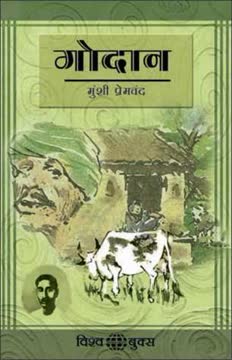
![गोदान [Godan]](https://files.sobrief.com/2517828-godan/v1/covers/cover-800.jpg)

Plot Summary
Hori's Dream of a Cow
Hori Ram,1 a peasant of roughly forty with five bighas of ancestral land, leaves his wife Dhania2 at dawn to visit the Rai Saheb,7 his landlord. On the path he meets Bhola,13 a cowherd from the neighboring village, leading fine new cattle. Hori's1 deepest ambition — owning a pedigreed cow — surges within him. He flatters Bhola13 and hints he might find the recently widowed man a new bride.
The bait works: Bhola13 offers a spotted cow on credit for eighty rupees. But when Bhola13 confesses he has no fodder for his animals, Hori's1 conscience stops him cold. He refuses the cow and instead gives away three baskets of precious straw. Already mired in four hundred rupees of debt, Hori1 cannot afford this cow — but he cannot stop wanting her.
Two Arrivals, Two Seeds
Gobar,3 Hori's1 sixteen-year-old son, fetches the cow from Bhola's13 village the next day. On the walk back, Bhola's13 widowed daughter Jhunia4 accompanies him halfway. She is worldly, sharp-tongued, seductive in a way Gobar3 has never encountered.
By the time she turns back, they have declared themselves to each other — she wanting devotion, he fumbling toward desire. The cow's arrival electrifies the household. Hori1 ties a black cord around her neck against the evil eye. Dhania2 kneads flour and oil for her.
The whole village streams past to admire this magnificent animal — everyone except Hori's1 brothers Heera16 and Sobha. Heera,16 bitter since the family's division of property, suspects Hori1 bought the cow with stolen joint-family money. Joy curdles to worry when Hori1 overhears his brother's accusations that night.
Poison at the Trough
Returning late from visiting his asthmatic brother Sobha, Hori1 finds Heera16 lurking near the cow's trough. Heera16 claims he came for a light from the hearth. They smoke together, talk warmly. But after midnight the cow froths at the mouth, her stomach bloats, her legs stiffen. She has been poisoned. By morning she is dead — and Hori1 knows exactly who did it.
He tells Dhania2 in confidence. Her reaction is volcanic: she vows to drag Heera16 to the police station. Hori1 begs her to stay silent, beats her when she refuses. The next morning Heera16 has vanished from the village, taking five rupees and his belongings. His flight confirms everyone's suspicion. The brightest object in Hori's1 life has been murdered by the jealousy of his own blood.
Masquerade at Semari
The Rai Saheb's7 Dussehra festival gathers the educated elite. Pandit Onkarnath,15 a newspaper editor cloaked in patriotic piety, debates socialism with Mr. Mehta,5 a philosophy professor who defends inequality on eight hundred rupees a month.
Mr. Khanna,8 a bank manager who directs a sugar mill, talks insurance. Miss Malti,6 a doctor returned from England, skewers everyone's hypocrisy with cutting wit. That evening, Mehta5 disguises himself as an armed Afghan and terrorizes the guests. Khanna8 cowers. Onkarnath15 freezes.
The Rai Saheb7 trembles. Only Hori,1 who walks in to remind them about the religious tableau, charges the intruder and knocks him flat. The philosopher's false beard comes off in the peasant's hands. The elite laugh at the prank. The irony settles differently.
Dhania Routs the Inspector
The police inspector arrives to investigate the cow's death, bringing an obvious appetite for bribes. Village headmen — Datadin10 the Brahmin, moneylender Jhenguri Singh,19 revenue clerk Pateshwari,20 and the Rai Saheb's7 bailiff Nokhey Ram21 — scramble to collect thirty rupees from Hori.1
Jhenguri Singh19 loans him the money. But as the coins are about to change hands, Dhania2 appears from nowhere, snatches Hori's1 apron, and sends the rupees clattering across the ground. She declares she will not pay a pice for such corruption and dares the inspector to arrest her instead.
The headmen stand humiliated. The inspector retaliates by extorting fifty rupees from the headmen themselves. The episode mushrooms into legend: pilgrims flock to Dhania,2 believing she snapped handcuffs with divine power and pinned the inspector to the earth.
A Girl at the Doorstep
Months pass. One freezing January night, Dhania2 reaches Hori1 at his field hut with devastating news: Jhunia4 has arrived at their door, five months pregnant, and Gobar3 has vanished into the darkness. Hori's1 fury rises — but when they reach home, Jhunia4 is crumpled on the doorstep, sobbing.
She begs for shelter, saying her father and brothers will kill her. Something in Dhania2 shifts. She pulls the girl to her chest like a bird sheltering its young. Hori1 tells Jhunia4 this house is her home.
Outside, crouched against the wall, Gobar3 hears his parents accept the woman he abandoned. Shame and relief flood him simultaneously. He decides to earn money in Lucknow before facing them. By dawn he is walking twenty miles toward the city, hungry and full of extravagant plans.
The Panchayat's Price
Sheltering an unwed mother triggers social war. Bhola's13 sons hunt for Gobar3 with sticks. The village ostracizes Hori1 — no one shares a pipe with him or accepts water from his hands. When Jhunia4 gives birth to a son, the panchayat convenes.
Datadin,10 Pateshwari,20 Jhenguri Singh,19 and Nokhey Ram21 impose a fine of one hundred rupees cash and thirty maunds of grain. Dhania2 protests that she will not sacrifice a girl's life for false prestige. Hori1 overrules her: the community's voice is God's voice.
Night after night he hauls sacks of wheat, barley, and peas to Jhenguri's19 house. Dhania2 rescues two maunds of barley by physically gripping the last basket. Hori1 then mortgages his house for eighty rupees to cover the cash portion. The family is hollowed out.
The Bullocks Walk Away
Bhola13 storms into Hori's1 house demanding his cow money or Jhunia's4 return. Hori1 offers neither — he has no money and will not abandon the girl. Bhola's13 countermove is surgical: he demands the bullocks.
Hori,1 who views his plough-team as his own limbs, agrees with devastating calm, telling Bhola13 to take them if his conscience permits. Villagers intercept Bhola13 on the road — Datadin,10 Pateshwari,20 and Sobha rally to stop the seizure. But Hori1 admits he was not coerced; he left the decision to Bhola's13 sense of dharma.
The villagers look at him with contempt and let Bhola13 pass. Without bullocks, Hori1 cannot plough. He becomes a sharecropper on his own land, partnering with Datadin10 — the Brahmin provides seeds and oxen, Hori1 provides sweat, and they split the harvest. The peasant has become a serf.
Lucknow Sharpens Gobar
In the city, Gobar3 finds work with Mirza Khurshed,14 then graduates from laborer to street vendor to tea-stall owner earning three rupees a day. He lends money at interest to ekka-drivers and washermen. City life strips away his deference to caste and convention.
Meanwhile, the urban elite circle intensifies: Mehta5 and Malti6 grow closer through a shikar expedition and a river crossing where he carries her on his shoulders. Khanna8 obsesses over Malti6 while neglecting his wife Govindi,9 who writes mournful poetry and contemplates leaving.
Mehta5 delivers a provocative lecture at the Women's League arguing women should embrace sacrifice over suffrage, provoking storms of debate. These threads of privilege wind around each other while Gobar,3 who sends nothing home, fattens on the proceeds of his own labor.
Holi Gifts and Goodbye
Gobar3 returns for Holi carrying saris, a turban, a Japanese doll, and two hundred rupees tied at his waist. He confronts Jhenguri Singh19 about extortionate interest, threatens Datadin10 with legal action, and marches to Bhola's13 village where he recovers the bullocks through sheer bluster and charm — even recruiting Bhola's13 son for a job in Lucknow.
But at home the honeymoon curdles. Gobar3 quarrels with Dhania2 over money, declaring he will not shoulder the family's debts. Jhunia4 piles on, resenting village drudgery.
Dhania2 suspects Jhunia4 has poisoned her son against her. The fight escalates into a house-shaking brawl. Gobar3 packs up, takes Jhunia4 and their child, and walks away. Dhania2 watches her son and grandson disappear down the road. She feels reduced to ashes.
Harvest Devoured
Hori's1 sugar cane — his best crop in years, tipping the scales at one hundred and twenty rupees — never reaches his pocket. Jhenguri Singh19 stations himself at the mill gate and deducts every outstanding anna, handing Hori1 just twenty-five rupees.
Walking out, Hori1 encounters Nokhey Ram21 and impulsively surrenders the remaining twenty-five as well. He returns home with nothing. Dhania2 rages: how will they buy bullocks, how will they eat? The moneylenders — Mangru, Dulari,22 Datadin10 — circle like raptors, each tightening a different knot.
Sobha, who sold his own cane for the same hollow result, walks beside Hori1 in defeated silence. Neither brother can articulate what they both understand: that the debt treadmill has no exit, and the harvest was consumed before the sickle ever touched the stalk.
Bone in the Brahmin's Mouth
Matadin,11 Datadin's10 son, keeps the cobbler woman Selia12 as his secret lover while maintaining his Brahmin rituals with fastidious sandal-paste piety. When he publicly humiliates Selia12 over a seer of grain — calling her a laborer with no claim to his property — her family retaliates.
Her father, brothers, and a band of cobblers storm the threshing floor, snap Matadin's11 sacred thread, and force a piece of bone between his teeth. His mouth polluted, his dharma irrevocably destroyed, Matadin11 collapses.
Yet Selia12 refuses to leave. When her family drags her away, she squats defiantly on the ground. When her mother kicks her, she clings to the earth. She will stay with the man who renounced her, even if he starves her. Dhania2 takes Selia12 into their home.
Sugar Mill in Flames
Khanna's8 sugar mill — his monument to wealth — catches fire and burns to rubble, completely uninsured. Two lakhs borrowed from the bank evaporate in smoke. Khanna8 stands among the ashes babbling about enemies and his former glory.
Govindi,9 the wife he humiliated for years, steadies him with extraordinary calm. She tells him money destroys the soul and that genuine happiness lies in making others happy. Meanwhile, Malti6 — who once collected Khanna's8 gifts and tolerated his obsession — begins nursing the ailing Govindi9 day and night.
The frivolous doctor who refused late-night house calls now sleeps beside her patient's bed. Mehta5 watches Malti's6 transformation with wonder. The two women Khanna8 wronged become the only ones who sustain him when the smoke clears and the creditors arrive.
Two Hundred Rupees for Rupa
Ejectment proceedings loom: Hori1 has not paid land revenue for three years. Datadin10 arrives with a proposal that makes Hori's1 hands tremble. Ram Sewak, a middle-aged widower from another village, will marry young Rupa18 and pay two hundred rupees.
The money would save the land. Hori1 knows this is selling his daughter. He feels as though every passerby has spat on his face. But the alternative — losing the last five bighas of ancestral soil, becoming a landless laborer for good — seems somehow worse.
Dhania2 resists, then slowly, agonizingly yields. The currency notes arrive in Datadin's10 fist, and Hori1 takes them without a word, head bowed. He has survived droughts, poisoned cows, a son's abandonment. This compromise breaks something inside him that nothing will name.
Threads Broken and Mended
In the novel's final season, scattered threads are knotted. Matadin,11 after spending three hundred rupees on penance only to find his community still shuns him, renounces his sacred thread and moves into Selia's12 thatched hut, declaring it a temple.
Gobar3 returns for Rupa's18 wedding, gentle now and reconciled with his parents, promising monthly payments. Heera16 staggers back after years in an asylum, driven mad by guilt over the cow — and Hori1 embraces him without reproach, seeing only the orphaned child who once toddled at his side.
Rupa18 departs for her new home and later sends a cow to her father through a cowherd. Hori,1 burning to repay Ram Sewak and buy a cow for his grandson Mangal, takes work digging gravel under the June sun at eight annas a day.
Twenty Annas for Godan
On a blistering afternoon, Hori1 collapses at the gravel pit. His body has been failing for weeks — one meal a day, parched grain for sustenance, months of famished labor. His consciousness flickers: he sees Gobar3 falling at his feet, Dhania2 as a young bride in red, a celestial cow he milks for Mangal.
Dhania2 arrives frantic. His pulse barely registers. Carried home, he draws the entire village to his door. As his breathing fades, the villagers urge Dhania2 to give a cow in charity — the Hindu rite for the dying.
There is no cow. There has never been a cow. Dhania2 goes inside and retrieves twenty annas, her yarn-spinning earnings. She places the coins in Hori's1 cold palm, offering them in place of the sacred animal. Then she sinks to the ground beside him.
Analysis
Godan operates as a dual autopsy — of the Indian peasant's body and the Indian intellectual's conscience. Premchand constructs parallel worlds that never meaningfully intersect: Hori1 dies digging gravel while Mehta5 and Malti6 debate whether love should be leonine or lamblike. The novel's architecture is itself the argument. The urban elite discuss peasant suffering with philosophical sophistication but cannot cross the structural chasm separating seminar from threshing floor.
The cow functions not merely as aspiration but as economic stress test. Every institution Hori1 encounters — Zamindari, moneylending, the panchayat, even kinship — responds to the cow as a mechanism for extraction. Bhola13 creates debt by offering it on credit. Heera's16 jealousy destroys it. The panchayat exploits the resulting scandal to extract fines. The moneylenders use accumulated debts to seize harvests. Each layer of community operates as a progressively tighter noose.
Premchand's most radical insight is that the peasant's oppressor is not a single villain but a system of interlocking dependencies. Hori1 is exploited simultaneously by landlord, moneylender, priest, revenue clerk, his own brothers, and his own internalized deference to caste and custom. His acceptance of the panchayat's verdict — insisting the Panches speak with God's voice — exposes how deeply the colonized mind absorbs the architecture of its own subjugation.
The urban counterplot offers no solutions. Mehta's5 philosophy remains academic. Malti's6 transformation is individual, not systemic. The Rai Saheb's7 self-awareness produces eloquent confessions but zero behavioral change. Only the peasant women — Dhania2 scattering bribe money, Selia12 clinging to earth, Govindi9 steadying a ruined husband — embody genuine resistance through unglamorous acts of devotion. The godan of the title is ultimately not a gift but an absence: the sacred cow Hori1 can never afford, the spiritual dignity that poverty renders permanently out of reach. In this absence Premchand locates both the cruelty of the system and the terrible beauty of those who endure it.
Review Summary
Godan is widely praised as a masterpiece of Hindi literature that vividly portrays rural Indian life in the early 20th century. Readers appreciate Premchand's nuanced characters, social commentary, and exploration of themes like poverty, caste, and exploitation. The novel's depiction of farmers' struggles resonates with many as still relevant today. Some find the urban characters less compelling, but overall, reviewers consider Godan a powerful, emotionally impactful work that offers profound insights into Indian society and human nature.
People Also Read
Characters
Hori
Peasant dreaming of a cowHori Ram is the peasant protagonist, a man of roughly forty whose existence orbits around five bighas of ancestral land and an impossible dream of owning a cow. Deeply conflicted—honest by instinct yet capable of small deceits born of desperation, defiant in spirit yet paralyzed by deference to caste, community, and custom. His relationship with Dhania2 is the novel's beating heart: they bicker like adversaries and cling to each other like survivors. Hori embodies the Indian peasant's combination of stoic endurance and bottomless aspiration. He pays interest on interest, kowtows to his landlord, suffers his brothers' jealousy—yet never stops reaching for a dignity the system is designed to deny. His moral compass bends under economic pressure but refuses to fully break.
Dhania
Hori's fierce, tender wifeHori's1 wife is the novel's fiercest voice, a woman whose sharp tongue masks raw tenderness. Aged beyond her thirty-six years by poverty—grey-haired, wrinkled, dim-eyed—she has watched three of her six children die without medicine. Where Hori1 bows to authority, Dhania rebels. She challenges landlords, confronts officials, and defends her household with profanity and fists when necessary. Yet her defiance coexists with deep vulnerability: she craves Hori's1 love, fears his death, and weeps for absent children. Dhania operates by an instinctive justice that privileges human life over social convention. Her willingness to shelter the vulnerable against community censure makes her both the family's greatest protector and its most dangerous lightning rod for retribution.
Gobar
Hori's restless, city-bound sonHori's1 sixteen-year-old son enters the story as a sullen youth who questions why his father grovels before landlords. Passionate and impulsive, he lacks the patience to endure village humiliation and the foresight to weigh the consequences of his desires. His journey to Lucknow transforms him externally—from barefoot peasant to pomaded tea-stall owner with shiny shoes—but the deeper question is whether the city reshapes his character or merely refines his selfishness. Gobar represents the generation breaking free of the village's gravity without fully escaping its emotional claims. He oscillates between generosity and cruelty toward his parents, devotion and neglect toward Jhunia4, driven by a survival instinct that has not yet matured into responsibility.
Jhunia
Gobar's worldly, devoted partnerBhola's13 widowed daughter, worldly and fiercely pragmatic, who has delivered milk to market since childhood and learned to read men's intentions with devastating accuracy. Her attraction to Gobar3 is genuine but also strategic: she wants exclusive devotion, not fleeting attention. Under Dhania's2 roof she works tirelessly, enduring the village's contempt in silence. In the city, her resilience is tested by poverty, loneliness, and domestic tension. Yet through each ordeal she proves more durable than anyone expected—a woman who sustains herself and others when the men around her falter. Jhunia's arc asks whether love chosen freely is stronger or weaker than love arranged by convention, and the answer remains deliberately ambiguous.
Dr. Mehta
Idealist philosophy professorProfessor of philosophy and the novel's intellectual provocateur, Mehta earns a handsome salary while preaching about the futility of wealth. Brilliant, contrary, and emotionally guarded—capable of delivering thunderous lectures on feminine virtue while remaining terrified of actual intimacy. His ideal woman is an embodiment of sacrifice and selflessness, yet he keeps women at arm's length with impossible standards. His charity is genuine—he supports dozens of students and widows—but his personal life is chaotic, his finances unmanaged. His attraction to simple, selfless women reveals a man searching for maternal warmth his philosophy cannot provide. Whether he can reconcile grand ideals with messy human connection is his central struggle.
Miss Malti
Doctor transformed by conscienceA doctor educated in England, Malti enters the novel as everything traditional India distrusts: unmarried, witty, flirtatious, Western-influenced. She collects male admirers as social currency, manipulates with charm, and trades barbs with philosophers. But beneath the lacquered surface operates a formidable intelligence and a dormant conscience. Contact with genuine suffering—village poverty, sick children, a friend's domestic anguish—gradually awakens something deeper. Her trajectory is the urban plot's redemptive arc, though whether transformation will prove permanent remains uncertain. She challenges Mehta's5 idealized view of womanhood by embodying contradictions: vanity alongside compassion, independence alongside longing for connection. Her struggle is to find authenticity in a world that rewards performance.
Rai Saheb
Self-aware but trapped landlordThe landlord of Hori's1 village, a Nationalist politician who courted imprisonment during Satyagraha yet continues extracting rents and forced labor from his tenants. Articulate and self-aware, he openly confesses that Zamindars are parasites but cannot relinquish his privileges. A man caught between conviction and circumstance, he philosophizes brilliantly about injustice while perpetuating it through the very system he denounces.
Mr. Khanna
Banker torn by contradictionsBank manager and sugar mill director who embodies the contradictions of Indian capitalism. He courts imprisonment for nationalism, then exploits workers for profit. His obsession with Malti6 masks a deeper emptiness within his marriage to Govindi9. Khanna's two selves—the idealist and the sensualist—wage constant war, with the baser nature usually prevailing, until circumstances strip away the armor of wealth.
Govindi
Khanna's suffering, steadfast wifeKhanna's8 long-suffering wife, a poetess of sorrowful verses whose serene exterior conceals deep anguish. She endures her husband's neglect with patience that others mistake for passivity. Mehta5 regards her as the embodiment of womanly virtue—patient, sacrificing, devoted. Her quiet strength emerges most powerfully in moments of crisis, revealing reserves of philosophical depth that luxury never obscured.
Pandit Datadin
Scheming village BrahminThe village Brahmin who serves as Hori's1 patron, creditor, and manipulator. Datadin performs daily prayers while scheming to profit from every transaction—births, deaths, marriages, misfortunes. Sweet-tongued and thick-skinned, he embodies the priestly class's fusion of spiritual authority with material exploitation. His proposals always serve his interests while wearing the mask of neighborly concern.
Matadin
Brahmin with a forbidden loveDatadin's10 son, a young Brahmin who maintains a secret relationship with Selia12, a cobbler woman, while performing all outward religious rituals with fastidious devotion. This double life creates an unsustainable contradiction between desire and dharma that must eventually rupture. His story tests whether love can transcend the caste system's most fundamental taboos.
Selia
Cobbler woman of fierce devotionA cobbler woman whose devotion to Matadin11 survives every form of rejection and humiliation. She works as a laborer, endures isolation from both her community and his, and refuses to abandon the man she chose even when everyone—including him—orders her away. Her stubborn fidelity becomes the novel's purest expression of unconditional love, untainted by calculation.
Bhola
Cowherd who ignites catastropheAn aging cowherd whose transaction with Hori1 sets the novel's catastrophe in motion. Widowed and lonely, susceptible to flattery about finding him a new wife, Bhola's initial generosity sours when family honor is wounded by his daughter's elopement. He oscillates between kindness and vindictiveness, embodying how personal hurt can corrupt even decent people.
Mirza Khurshed
Generous politician and bon vivantA Muslim politician and shoe-store owner who defies categorization—devout enough to have made the Haj, secular enough to drink heavily and vote Nationalist. Generous to a fault with money that flows through his fingers like water, he employs Gobar3, organizes charitable spectacles, and champions the working class with irrepressible vitality.
Pandit Onkarnath
Compromised newspaper editorEditor of the Flash newspaper, Onkarnath wraps himself in patriotic rhetoric while accepting advertisements from foreign firms. He oscillates between principled defiance and craven sycophancy, writing fiery editorials by day while courting patronage from the Zamindars he denounces. He embodies the compromised Indian press of the colonial era.
Heera
Hori's jealous youngest brotherHori's1 youngest brother, hot-tempered and envious. His jealousy over the cow triggers a catastrophic chain of events for the family. Despite his volatility, he is not irredeemable—his conscience haunts him across years of exile.
Sona
Hori's proud elder daughterHori's1 elder daughter, wheat-complexioned and vivacious. Self-conscious and proud despite poverty, she refuses to let her family bear unnecessary debt for her marriage, sending messages to her prospective in-laws herself.
Rupa
Hori's spirited youngest daughterHori's1 youngest daughter, fierce and imaginative even as a child. She claims the cow as her own, fights her sister17 over cow-dung cakes, and faces hardship with stubborn cheer that masks the family's desperation.
Jhenguri Singh
Ruthless village moneylenderThe village's chief moneylender who stations himself at the sugar mill gate to intercept payments before peasants can pocket a rupee. He wields financial power without mercy or scruple.
Pateshwari
Manipulative revenue clerkThe village revenue clerk who engineers disputes for profit while posing as a pious community pillar. He arranges lawsuits against peasants and skims from every transaction he touches.
Nokhey Ram
Rai Saheb's corrupt bailiffThe Rai Saheb's7 bailiff who controls the village through his position, enabling petty corruption and threatening ejectment for unpaid revenues while pocketing funds himself.
Dulari
Sharp-tongued village shopkeeperA village widow who runs a shop and lends money at steep interest. Despite shrewd business instincts, she maintains a warm, teasing friendship with Hori1 rooted in their shared youth.
Plot Devices
The Cow (Godan)
Measures impossible aspirationThe cow functions as the novel's central symbol and engine. Hori's1 desire to own one drives the opening bargain with Bhola13, and its arrival represents his single moment of genuine prosperity. Its poisoning marks the death of that prosperity. Every subsequent disaster—fines, loss of bullocks, mounting debts—cascades from this original acquisition and loss. The cow Hori1 never replaces becomes the godan he cannot give: the ritual gift of a cow that a dying Hindu should offer for safe passage to the afterlife. Dhania's2 substitution of twenty annas for the sacred animal crystallizes the novel's thesis—that for India's peasants, even the most fundamental spiritual rites are rendered impossible by economic reality. The cow is simultaneously livestock, aspiration, and accusation.
The Debt Cycle
Perpetual economic imprisonmentPremchand constructs debt as an inescapable labyrinth with its own internal logic. Hori1 borrows sixty rupees for a bullock and pays sixty in interest without reducing the principal. A thirty-rupee potato loan swells to one hundred. Each harvest is claimed by creditors before the grain reaches Hori's1 barn. The moneylenders—Mangru, Dulari22, Jhenguri Singh19, Datadin10—form an interlocking system where paying one creditor requires borrowing from another. The debt cycle is not merely financial but generational: it determines whom Hori's1 children can marry, whether his land survives, and ultimately how he lives and dies. Premchand shows this cycle as structurally designed rather than accidental—maintained by the collusion of Zamindars, revenue clerks, and moneylenders.
The Panchayat Fine
Community weaponized against its ownWhen the village panchayat fines Hori1 one hundred rupees and thirty maunds of grain for sheltering Jhunia4, it reveals how community functions as a weapon of the powerful. The headmen impose the fine not from moral conviction but from personal grudge, greed, and desire to control. The fine strips Hori1 of his harvest and his house equity in a single blow. Premchand uses this device to demonstrate that the peasant's deepest oppression comes not from distant colonial administrators but from his own community—the very social body he cannot imagine living outside of. Hori's1 submission to the verdict—insisting the Panches speak with God's voice—reveals the internalized structures of subjugation.
The Sugar Mill
Bridge between rural and urban exploitationKhanna's8 sugar mill connects the rural and urban plotlines through the mechanics of industrial extraction. It buys peasants' cane at prices that barely repay their debts while Khanna8 debates ethics over French wine. Jhenguri Singh19 stations himself at the mill gate as intermediary, deducting debts before peasants see a rupee. The mill's eventual destruction becomes a form of poetic justice—the instrument of rural exploitation consumed by its own contradictions. The strike, the fire, and Khanna's8 ruin mirror in compressed urban time what unfolds slowly in the village: the annihilation of livelihoods by forces beyond any individual's control.
Rupa's Marriage Price
Poverty's ultimate moral compromiseDatadin's10 proposal that Hori1 marry young Rupa18 to middle-aged Ram Sewak for two hundred rupees functions as the novel's moral nadir. It forces Hori1 to choose between two forms of destruction: losing his land and identity as a peasant, or trading his daughter's youth for survival. That he chooses the latter reveals how completely the economic system has eroded his moral autonomy. The two currency notes become the most devastating objects in the novel—more destructive than poison, more final than any court decree. They save the land but annihilate Hori's1 last reserves of self-respect, making his subsequent physical collapse feel not accidental but inevitable.
FAQ
Synopsis & Basic Details
What is गोदान [Godaan] about?
- Peasant's struggle for dignity: गोदान [Godaan] tells the story of Hori, an Indian peasant, and his family's relentless struggle to maintain their dignity and survive amidst poverty, debt, and social exploitation.
- Dream of owning a cow: The novel revolves around Hori's lifelong dream of owning a cow, a symbol of prosperity and social status, and the sacrifices he makes to achieve this elusive goal.
- Exploitation and social injustice: It exposes the harsh realities of rural Indian society, including the oppressive feudal system, the burden of debt, and the rigid social norms that perpetuate inequality and suffering.
Why should I read गोदान [Godaan]?
- Immersive cultural experience: गोदान [Godaan] offers a deep dive into the cultural and social fabric of pre-independence rural India, providing a nuanced understanding of the lives, values, and struggles of its people.
- Timeless themes of humanity: The novel explores universal themes of poverty, exploitation, social injustice, resilience, and the human spirit, making it relevant and thought-provoking for readers of all backgrounds.
- Masterful storytelling and characterization: Munshi Premchand's masterful storytelling and vivid characterization bring the story to life, creating a powerful and emotionally resonant reading experience.
What is the background of गोदान [Godaan]?
- Pre-independence rural India: The novel is set in pre-independence rural India, a time of significant social and political upheaval, marked by the decline of the feudal system and the rise of Indian nationalism.
- Feudal system and Zamindari: The story is deeply rooted in the feudal system, where landlords (Zamindars) held immense power over the land and the peasants who cultivated it, leading to widespread exploitation and oppression.
- Socio-economic disparities: The novel reflects the stark socio-economic disparities of the time, with a small elite class enjoying wealth and privilege while the vast majority of the population lived in abject poverty.
What are the most memorable quotes in गोदान [Godaan]?
- "When your neck is being trampled": "When your neck is being trampled under the tyrant's heel the safest course is to keep on tickling his feet." This quote encapsulates Hori's pragmatic, albeit subservient, approach to dealing with the oppressive Zamindari system.
- "God has made us slaves": "God has made us slaves and we have to put up with our lot." This quote reflects the fatalistic worldview of the peasantry, who often attribute their suffering to divine will rather than systemic injustice.
- "A man is not a man": "A man is not a man without wealth, power and education. We are no better than bullocks, born to be yoked." This quote highlights the dehumanizing effects of poverty and social inequality, reducing individuals to mere instruments of labor.
What writing style, narrative choices, and literary techniques does Munshi Premchand use?
- Realistic and descriptive prose: Premchand employs a realistic and descriptive prose style to vividly portray the rural setting, the characters' lives, and the social realities of the time.
- Omniscient narrator: The story is told from an omniscient point of view, allowing the narrator to delve into the thoughts and feelings of multiple characters, providing a comprehensive view of the social landscape.
- Dialogue-driven narrative: Dialogue plays a crucial role in revealing character traits, advancing the plot, and exploring thematic concerns, often reflecting the colloquial language and cultural nuances of rural India.
Hidden Details & Subtle Connections
What are some minor details that add significant meaning?
- Dhania's cow-dung cakes: Dhania's initial act of making cow-dung cakes, smearing her hands, highlights the manual labor and connection to the land that defines her life, contrasting with the leisure of the upper classes. This connects to the theme of the dignity of labor.
- Hori's torn quilt: Hori's carefully folded, torn quilt symbolizes his poverty and his attempts to maintain dignity despite his circumstances. It also foreshadows the family's continued struggle with poverty.
- The chelum as a social tool: The recurring mention of the chelum (smoking pipe) highlights its importance as a social tool for building relationships and resolving conflicts within the community, revealing the importance of social harmony.
What are some subtle foreshadowing and callbacks?
- Hori's ominous words: Hori's statement, "Dhania, I shall never get to the age of sixty. I shall be gone long before that," subtly foreshadows his premature death due to overwork and poverty.
- Bhola's praise of Dhania: Bhola's effusive praise of Dhania's qualities as a wife foreshadows the later conflict and the importance of those qualities in maintaining the family's stability.
- Rupa's desire to change her name: Rupa's childhood desire to change her name from "silver" to "gold" foreshadows the later societal pressures and the family's struggle to improve their social standing.
What are some unexpected character connections?
- Malti and Mrs. Khanna's shared understanding: Despite their apparent rivalry, Malti and Mrs. Khanna share a subtle understanding of each other's positions and the complexities of their relationships with Mr. Khanna, revealing a hidden layer of female solidarity.
- Hori and Rai Saheb's shared disillusionment: Despite their vast differences in social status, Hori and Rai Saheb share a sense of disillusionment with their respective positions in society, highlighting the universal nature of human suffering.
- Gobar and Jhunia's unconventional union: Gobar and Jhunia's unconventional union challenges societal norms and creates unexpected connections between different social classes, revealing the fluidity of social boundaries.
Who are the most significant supporting characters?
- Dhania: The moral compass: Dhania serves as the moral compass of the story, often challenging Hori's decisions and advocating for justice and dignity, even in the face of adversity.
- Gobar: The rebellious son: Gobar's rebellious nature and his eventual departure from the village highlight the generational conflict and the changing social dynamics of rural India.
- Malti: The modern voice: Malti represents the voice of modernity and progress, challenging traditional gender roles and advocating for social reform, adding a layer of complexity to the narrative.
Psychological, Emotional, & Relational Analysis
What are some unspoken motivations of the characters?
- Hori's need for social validation: Hori's actions are often driven by an unspoken need for social validation and acceptance within his community, leading him to make decisions that prioritize prestige over his family's well-being.
- Dhania's desire for respect: Dhania's defiance stems from an unspoken desire for respect and recognition, both for herself and her family, in a society that often marginalizes the poor and powerless.
- Gobar's search for identity: Gobar's rebellious actions and his eventual departure from the village reflect an unspoken search for identity and a desire to break free from the constraints of his social environment.
What psychological complexities do the characters exhibit?
- Hori's internal conflict: Hori exhibits a complex internal conflict between his desire for social acceptance and his love for his family, often leading him to make decisions that are both selfless and self-destructive.
- Dhania's emotional resilience: Dhania displays remarkable emotional resilience in the face of adversity, balancing her strong will with her deep love and concern for her family.
- Malti's evolving self-awareness: Malti undergoes a psychological journey of self-discovery, grappling with her own desires and societal expectations, ultimately leading her to embrace a more meaningful and fulfilling life.
What are the major emotional turning points?
- The death of the cow: The death of the cow marks a major emotional turning point, symbolizing the loss of Hori's dreams and the beginning of a downward spiral for his family.
- Gobar's departure: Gobar's departure creates a deep emotional rift within the family, leaving Hori and Dhania grappling with feelings of guilt, disappointment, and uncertainty about the future.
- Hori's final moments: Hori's death and his final act of charity evoke a complex mix of emotions, including sadness, regret, and a sense of redemption, leaving a lasting impact on the reader.
How do relationship dynamics evolve?
- Hori and Dhania's evolving partnership: The relationship between Hori and Dhania evolves from one of traditional husband-wife roles to a more complex partnership, marked by both conflict and deep affection.
- Gobar's changing relationship with his parents: Gobar's relationship with his parents undergoes a significant transformation, from rebellion and estrangement to a grudging respect and a desire to help.
- Malti and Mehta's shifting dynamic: The dynamic between Malti and Mehta shifts from intellectual sparring to a deeper understanding and mutual respect, ultimately leading them to embrace a shared commitment to social service.
Interpretation & Debate
Which parts of the story remain ambiguous or open-ended?
- Gobar's ultimate fate: Gobar's ultimate fate and his long-term success in the city remain ambiguous, leaving the reader to speculate about his future and the extent to which he is able to escape the cycle of poverty.
- The true nature of Rai Saheb's transformation: The extent to which Rai Saheb's apparent transformation is genuine or merely a facade remains open to interpretation, prompting debate about the possibility of redemption for those in power.
- The long-term impact of Malti and Mehta's choices: The long-term impact of Malti and Mehta's decision to dedicate their lives to social service remains open-ended, leaving the reader to consider the challenges and rewards of such a path.
What are some debatable, controversial scenes or moments in गोदान [Godaan]?
- Hori's decision to mortgage his daughter: Hori's consideration of marrying off his daughter to an older man for financial gain is a highly debatable and controversial moment, raising questions about the ethics of such a decision and the pressures faced by families in poverty.
- Dhania's treatment of Jhunia: Dhania's initial hostility and harsh treatment of Jhunia spark debate about the complexities of female relationships and the societal pressures that can lead to prejudice and judgment.
- The portrayal of women's roles: The novel's portrayal of women's roles, particularly the emphasis on sacrifice and domesticity, has been subject to debate, with some arguing that it reinforces traditional gender stereotypes.
गोदान [Godaan] Ending Explained: How It Ends & What It Means
- Hori's death as a sacrifice: Hori's death, resulting from overwork and exhaustion, can be interpreted as a final sacrifice, highlighting the exploitation and suffering endured by the peasantry.
- The symbolic gift of the cow: Dhania's offering of the twenty annas in place of a cow symbolizes the ultimate act of faith and the enduring power of the human spirit, even in the face of death.
- Ambiguous hope for the future: The ending offers a glimmer of hope for the future, with Gobar's return and his potential to break free from the cycle of poverty, but also acknowledges the immense challenges that remain, leaving the reader with a sense of both optimism and uncertainty.
Download PDF
Download EPUB
.epub digital book format is ideal for reading ebooks on phones, tablets, and e-readers.








































