


Plot Summary
The Face on the Screen
Fourteen-year-old Lauren Matthews1 has never known anything about her life before adoption at age three. A school essay sends her searching online, and on a missing-children website she finds Martha Lauren Purditt — a girl from Connecticut who vanished just weeks before Lauren1 was adopted.
The birth date is close. The hair is brown, the eyes blue. When Lauren1 holds her own childhood photo beside the screen, the resemblance is undeniable but not conclusive. She shows her best friend Jam,2 who clicks on the age-progressed image.
It looks like Lauren1 — but not exactly. Jam2 prints the poster, then says what Lauren1 hasn't dared think: if Martha is Lauren,1 someone must have taken her deliberately. And her adoptive parents might know more than they're saying.
Secrets in the Attic
Lauren's father5 nearly tells her something over dinner, but her mother4 shuts him down. Eavesdropping afterward, Lauren1 hears Mum4 promise to show her diaries when Lauren1 turns sixteen — proof they've been hiding something. Lauren1 can't wait two years.
She tricks Jam's eccentric mother Carla12 into inviting Mum4 over, then raids the attic while the house is empty. In Mum's4 meticulously labelled trunks, she finds a diary from the year of her adoption.
The entries mention meeting Lauren1 at a place called Marchfield, a woman named Sonia Holtwood6 whose attitude was unbelievable, and a fierce determination to bring Lauren1 home. Tucked into the diary's back sleeve: a business card for the director of the Marchfield Adoption Agency — in Vermont, USA. Lauren1 was adopted from America.
The Hypnotist's Beach
Jam2 suggests Lauren's1 own buried memories might hold answers. Lauren1 asks Carla,12 a practicing hypnotherapist, to put her into deep relaxation. In Carla's12 candle-lit attic room, Lauren's1 body sinks into a chair while her mind drifts backward to age three.
She sees sand, feels sun, holds a red plastic bucket. A woman in white stands further up the beach — dark-haired, laughing, running toward the rocks. Lauren1 drops the bucket and follows, desperate to see her face. Then Carla's12 voice pulls her back to the present and the vision vanishes.
Lauren1 tells Carla12 nothing happened. But privately, a crushing certainty settles over her: the woman on the beach was her real mother. She is Martha. And she will do whatever it takes to find the woman she remembers.
The Escape at Logan
Lauren1 engineers a family trip to New Hampshire by exploiting her brother Rory's15 obsession with a theme-park ride. When her father5 backs out for work, Jam2 takes his place. The real destination was always Vermont — Lauren1 has mapped connecting flights from Boston's Logan Airport to Burlington, near Marchfield.
At Logan, she persuades Mum4 to hand over emergency cash, then she and Jam2 slip away to buy domestic tickets under a fabricated cover story. They board a small plane to Burlington while Mum4 waits at the gate for a flight to New Hampshire, unknowing.
Lauren1 texts a brief reassurance, then switches off her phone. Guilt gnaws at her, but she pushes it down. She has seven hundred dollars, a rucksack, and a best friend willing to follow her into a country neither has ever navigated alone.
Marchfield's Empty File
At the shabby Marchfield agency, Lauren1 meets the mousy director Taylor Tarsen,11 who refuses to share her records — Vermont law forbids it without parental consent. When Lauren1 mentions Sonia Holtwood,6 Tarsen's11 composure fractures.
He claims Sonia6 was Lauren's1 mother, then abruptly gives her a hundred and fifty dollars and sends her to a motel, promising to call her parents in the morning. His generosity feels wrong. That night at four a.m., Lauren1 and Jam2 return, smash a window, and pry open filing cabinets.
Lauren's1 folder is empty — someone has cleaned it out — except for a torn corner of paper bearing a partial address: apartment thirty-four, Lincoln Heights, in a place whose name is cut off. As they flee down the fire escape, Tarsen11 stands silhouetted in the broken window. He doesn't chase them.
Sonia Takes the Wheel
Following the address to Leavington, Lauren1 and Jam2 find an elderly neighbor named Bettina16 who once babysat a quiet, sad little girl for a private woman named Sonia.6 The trail goes cold — and so does their money, stolen by a cab driver who pads change with blank paper. Stranded with a single dollar, they accept a ride from a woman in a police uniform heading to Boston.
Hours later, Lauren1 wakes groggy in a car on an unmade forest road. Their phones are gone. The woman reveals herself as Sonia Holtwood6 — Tarsen11 alerted her after Lauren's1 visit. She unlocks the doors, shoves the teenagers into knee-deep snow twenty miles from anywhere, and drives into darkness. The temperature is below freezing. No one knows where they are.
Firelight in Cold Ridge
Lauren1 and Jam2 stagger through pine forest in the dark. Jam2 explodes — calls Lauren1 the most self-obsessed person he's ever met — and storms off. Lauren1 collapses in the snow, hypothermic, ready to let sleep take her.
But a man named Glane,9 who lives alone in a forest cabin for one month each year, finds Jam2 first, then follows tracks back to Lauren.1 She wakes two days later in a warm wooden room lined with books and hand-carved sculptures. Glane9 feeds them rabbit stew, stitches fleece boot-linings for Lauren's1 split trainers, and walks twenty miles with them to the nearest town.
From a lodge telephone, Lauren1 calls Mum4 — who has been in Boston with Dad5 and the FBI for five agonizing days. Lauren1 confronts her with the accusation that they bought her from Sonia.6 Mum4 says they'll talk in person, and hangs up.
Martha Knocks on the Door
Glane9 drives Lauren1 and Jam2 to Evanport, Connecticut, where the Purditt family still lives. Lauren1 walks the brick path alone, shaking so badly she can barely stand. A hostile thirteen-year-old named Shelby10 opens the door, assuming this is a dare.
Then Annie Purditt3 appears — short dark hair, sad eyes, deeply lined face. Lauren1 tells her she thinks she might be Martha. Annie's3 mouth falls open. The house erupts: Sam Purditt8 shakes Lauren's1 arm in desperate disbelief, Annie3 sobs that this must be their daughter, Shelby10 screams it's a trick.
It is Glane9 — filling the doorway with his massive frame — who silences them all. But Lauren1 feels nothing like the recognition she expected. Annie3 doesn't look like the angel on the beach. She is just a worn, middle-aged stranger.
Dad Breaks the Silence
At the Evanport police station, FBI agent MJ Johnson13 takes Lauren's1 statement while DNA swabs are collected. Then Lauren's adoptive parents4 arrive from Boston — haggard, grey, transformed by five days of terror. Dad,5 normally bumbling and quiet, becomes ice-calm.
He tells Lauren1 what they never wanted her to know: ten years of failed IVF, eight full cycles, countless heartbreaks. Mum4 had a breakdown. She tried to kill herself. No agency would approve them after that — until Taylor Tarsen11 called from Marchfield, offering a child whose birth mother wanted cash, not a relationship.
They paid Sonia6 a fortune, believing they were rescuing a neglected girl. They never knew Lauren1 was stolen. The DNA results arrive the next morning: a 99.9% match. Lauren1 is Martha Lauren Purditt. The FBI arrests her adoptive parents on conspiracy charges.
Neither Daughter Nor Guest
Lauren1 is placed with the Purditts while her adoptive parents sit in custody. Jam2 is sent home to England; their goodbye is sealed with a first kiss and a small carved wooden oval he presses into her palm. At the Purditt house, Annie3 hovers and smothers.
Shelby10 sneers and sends threatening texts. Only six-year-old Madison,7 with enormous brown eyes and secret pocket dolls, offers Lauren1 genuine warmth. Lauren1 catches Shelby10 pinching bruises into Madison's7 belly and shoves her away.
A bright spot arrives when Sam8 takes Lauren1 to meet his parents: his mother Gloria,14 whose flowery perfume triggers an overpowering memory of being loved as a toddler. Gloria14 tells Sam8 something he doesn't want to hear — Lauren1 will always see her English parents as her real parents, and the Purditts must find a way to accept that.
Sonia's Trap on the Water
Jam2 arrives in Evanport in the middle of the night, having stolen money from Carla12 and flown across the Atlantic alone. He proposes they run away together across America. Lauren1 is tempted but can't abandon Madison7 or her imprisoned parents.
The next morning at the marina, they argue and Jam2 walks off. Then Lauren's1 phone lights up: a text ordering her to come to Sam's8 boat or her sister dies. On board the Josephine May, Lauren1 finds Madison7 bound with tape, held by Sonia Holtwood6 and an accomplice.
Sonia6 explains her plan — only Lauren1 and Jam2 can identify her, so she'll stage a drowning that looks accidental. Lauren1 secretly switches her phone to video mode and films Sonia's face and confession from behind a washbasin while pretending to be sick.
The Rock at Long Mile
Sonia's6 accomplice rams the boat onto rocks near Long Mile Beach — the very shore where Lauren1 was kidnapped eleven years ago. Water floods the saloon. The door is wedged shut from outside. But Jam2 has been hiding aboard since the marina, and he rips the boat hook free just as the hull goes under.
Lauren1 dives into freezing water to haul Madison7 out through the saloon opening. The three of them swim to a flat rock, dragging Madison's7 limp body between them. She isn't breathing.
Jam,2 who threw Lauren's phone to the rock inside his trainer before the boat sank, hands it over with frozen fingers. Lauren1 dials emergency services. A helicopter lifts them off the rock. At the hospital, hours crawl by before Madison's7 hand twitches — the faintest pressure — in Lauren's1 grip.
Girl, Found
Lauren's phone video of Sonia — combined with Tarsen's11 crumbling testimony — collapses the criminal case against her adoptive parents. All charges are dropped. They arrive at the hospital as Madison7 opens her eyes.
Sitting across the bed from Annie,3 Lauren1 finally sees what she couldn't before: the beautiful woman from the beach, aged eleven years by grief but unmistakably her mother. Sonia6 is captured at the Canadian border on Thanksgiving. Weeks later, Annie3 and Sam8 make an extraordinary offer — they won't fight for sole custody if Lauren1 wants to go home to England.
But Lauren1 refuses to choose. She proposes splitting her life: school terms in London with Mum4 and Dad,5 holidays in Evanport with Annie,3 Sam,8 and her sisters. She becomes, perhaps, the first person with four legally recognized parents across two continents.
Analysis
Girl, Missing interrogates a question most identity narratives leave comfortably abstract: what happens when finding yourself means unmaking the self you already had? Lauren1 begins her quest believing identity is a locked box — that knowing her biological origins will explain who she is. Sophie McKenzie systematically dismantles this assumption by showing that every answer generates new dispossession. Learning she is Martha Lauren Purditt doesn't fill her sense of incompleteness; it doubles it, splitting her between two families, two countries, and two versions of herself that cannot coexist without mutual compromise.
The novel's most sophisticated insight lies in its treatment of motherhood as a spectrum rather than a binary. Annie Purditt3 and Lauren's adoptive Mum4 are mirror images of desperation — one searching eleven years for a stolen child, the other nearly dying from the inability to conceive one. Both women's love manifests as control: Mum's4 through rigidity and secrecy, Annie's3 through suffocating proximity. Lauren1 must learn that neither woman is the angelic figure from her beach memory, and that real mothers are complicated, damaged people who love imperfectly. The hypnotherapy memory — beautiful, warm, impossibly perfect — functions as a critique of idealization itself, a fantasy Lauren1 must relinquish to see Annie3 clearly.
McKenzie also embeds a sharp critique of commodified childhood. Sonia Holtwood6 treats children as transferable assets; Tarsen11 runs an agency that facilitates fraud for profit; even Lauren's1 well-meaning adoptive parents participated in a financial transaction that, however motivated by love, created market incentives for kidnapping. Annie's3 devastating observation — that if no one paid people like Sonia,6 there would be no incentive to steal children — implicates the entire system's darker economics.
The resolution resists the genre's usual binary: Lauren1 chooses all four parents, insisting that identity is additive rather than zero-sum. This is not sentimentality but pragmatism earned through trauma. Having been stolen, sold, lied to, abandoned in snow, and nearly drowned, Lauren1 arrives at the only honest answer to her essay question: she is the sum of everyone who has loved her, however flawed that love has been.
Review Summary
Girl, Missing received mixed reviews, with an average rating of 3.81 out of 5. Some readers found it gripping and emotionally engaging, praising its fast-paced plot and exploration of identity. However, others criticized the unrealistic storyline, immature writing style, and unlikable characters, particularly the protagonist Lauren. Many felt the book was more suitable for younger readers than young adults. Despite its flaws, some readers appreciated its nostalgic value and compelling mystery, while others found it predictable and poorly executed.
People Also Read







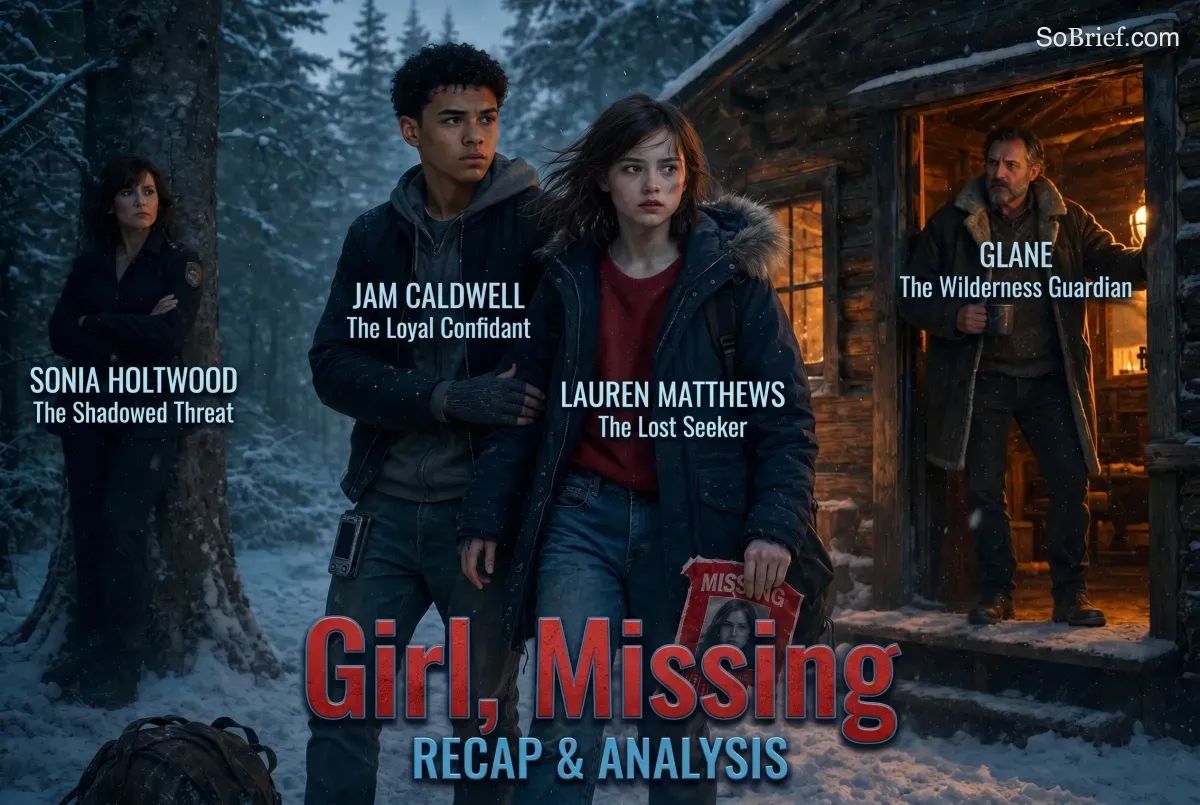
Characters
Lauren Matthews
Adopted girl seeking originsFourteen-year-old Lauren is a London girl whose entire identity rests on a gap she cannot fill. Adopted at three with no memory of her origins, she compensates with fierce independence and a sharp tongue that masks deep insecurity. She is impulsive, single-minded, and capable of extraordinary manipulation — engineering a transatlantic holiday to pursue a lead — yet emotionally naive about how her obsession affects others. Her defining psychological tension is between wanting to belong and fearing that belonging means settling for incomplete knowledge. She pushes away the people who love her while desperately clinging to those who validate her quest. Her central challenge is discovering whether identity comes from genealogy or from the relationships that shape us.
Jam
Lauren's devoted best friendJames 'Jam' Caldwell is Lauren's1 fifteen-year-old best friend, her moral compass, and her quiet counterweight. Tall, golden-skinned, and effortlessly attractive, Jam deflects female attention with awkward charm while nursing a wound he rarely shows: his father abandoned the family and has seen him only six times in three years, each broken promise etched as a notch on his gaming device. Jam is practical where Lauren1 is impulsive, generous where she is self-absorbed — giving her his savings, breaking into buildings, flying across an ocean. His devotion masks a deep need to be needed, rooted in paternal rejection. He is drawn to Lauren1 partly because her intensity mirrors the loyalty his father withheld. Their bond develops from friendship into something deeper that neither fully understands.
Annie Purditt
Lauren's grief-stricken birth motherAnnie is Lauren's1 biological mother, a woman hollowed out by eleven years of searching for a stolen child. Once beautiful — dark-haired, laughing, radiant on a sunlit beach — she has aged into an anxious, hovering figure whose grief has carved deep lines across her face. Her obsession with finding Martha consumed her marriage, her identity, and left her second daughter Shelby10 neglected and resentful. Annie's tragedy is that the reunion she prayed for cannot return what she actually lost: the years, the first words, the scraped knees. She smothers Lauren1 with a love that is really grief wearing a different costume. Her journey requires accepting that the daughter who returned is not the toddler who vanished — and learning to love this stranger anyway.
Mum
Lauren's anxious adoptive motherLauren's1 adoptive mother is bony, anxious, and fiercely controlling — organizing trunks, labeling keys, policing bedtimes. Beneath her rigidity lies a woman who nearly destroyed herself wanting a child. Her refusal to discuss Lauren's1 adoption stems not from cruelty but from terror: of losing Lauren1, of revisiting her breakdown, of Lauren1 discovering the illegal payment that made their family possible. Her relationship with Lauren1 is defined by friction that masks desperate love.
Dad
Lauren's quietly resolute fatherLauren's1 adoptive father is a balding, soft-spoken accountant who has worked for eleven years in a job he dislikes to repay the money they borrowed for Lauren's1 adoption. Slow with words but morally resolute, he is the one who finally breaks the family's silence about their past, revealing painful truths with an icy calm that surprises Lauren1. His relationship with Lauren1 is defined by quiet loyalty rather than the verbal sparring she shares with Mum4.
Sonia Holtwood
Shape-shifting kidnapper and villainThe story's antagonist operates under stolen identities, changing her appearance and name like costumes. She kidnapped Lauren1 as a toddler and sold her through Marchfield's adoption agency11, driven by debt and complete amorality. Calculating, resourceful, and increasingly dangerous, she views people as problems to be managed or erased — a criminal entrepreneur whose business is manufacturing new lives while destroying real ones.
Madison Purditt
Lauren's vulnerable little sisterLauren's1 six-year-old biological sister is the emotional heart of the story. Big-eyed, serious, and secretly imaginative, Madison plays with pocket dolls, dreams of acting, and endures her older sister Shelby's10 cruelty in silence. She attaches to Lauren1 with fierce, uncomplicated love — the one person in the Purditt household who wants Lauren1 exactly as she is. Her vulnerability makes her both Lauren's1 greatest source of tenderness and her most powerful reason to stay.
Sam Purditt
Lauren's stoic birth fatherLauren's1 birth father is tall, athletic, and quietly perceptive — the kind of man who offers privacy without being asked. A boat enthusiast devoted to his youngest daughter Madison7, Sam carries the eleven-year wound of losing Martha with stoic restraint rather than Annie's3 visible anguish. He communicates through actions rather than words, offering sailing trips and respectful silence where Annie3 offers hovering and tears.
Glane
Forest rescuer and blunt sageA musical instrument repairer from Boston who spends one month each year in a Vermont forest cabin, Glane is massive, gentle, and bluntly philosophical. He saves Lauren1 and Jam2 from freezing, feeds them rabbit stew, and delivers uncomfortable truths about self-absorption and gratitude. His observation that it is possible to belong in two places becomes the story's quiet thesis.
Shelby Purditt
Lauren's hostile middle sisterLauren's1 thirteen-year-old birth sister is blonde-dyed, heavily made-up, and savagely territorial. Born two years after Lauren's1 kidnapping, she grew up in the shadow of a missing sister who consumed all of Annie's3 emotional energy. Her hostility toward Lauren1 and cruelty toward Madison7 are expressions of a child who never received enough parental attention — starved by a grief that was never hers but swallowed her family whole.
Taylor Tarsen
Corrupt adoption agency directorDirector of the Marchfield Adoption Agency, Tarsen is a mousy, damp-palmed man whose involvement in Lauren's1 kidnapping runs deep. He facilitated the fraudulent adoption paperwork, hid Lauren's1 file when she came asking questions, and alerted Sonia Holtwood6 to Lauren's1 investigation. His willingness to implicate others to protect himself makes him both a coward and a dangerous complication.
Carla
Jam's eccentric motherJam's2 mother practices hypnotherapy and various alternative treatments. Warm but chaotic, she inadvertently provides Lauren's1 breakthrough through a trance session in her candle-lit attic room, and later becomes a source of both comic relief and logistical complication.
MJ Johnson
Sympathetic FBI agentA tall, horsey-faced FBI agent with a sympathetic drawl, MJ guides Lauren1 through custody proceedings, explains legal procedures, and delivers critical updates about the investigation into Sonia Holtwood's6 crimes.
Gloria
Lauren's warm-hearted grandmotherSam's8 mother and Lauren's1 paternal grandmother. Elegant, sharp-witted, and warmly intuitive, her perfume triggers Lauren's1 deepest buried memory of being loved. Her practical wisdom about family and belonging proves quietly pivotal to the story's resolution.
Rory
Lauren's annoying little brotherLauren's1 eight-year-old adoptive brother, pudgy and obsessed with fantasy games, whose fixation on a theme-park ride inadvertently enables Lauren's1 scheme to get the family to America.
Bettina
Elderly former babysitterAn elderly neighbor in Leavington who once babysat Lauren1 for Sonia Holtwood6. Her testimony confirms Sonia6 was cold and unmotherly, validating Lauren's1 belief that Sonia6 was not her birth mother.
Plot Devices
Missing-Children.com
Inciting discovery catalystThe website displays rotating faces of missing children, searchable by name and birth month. When Lauren1 types her details, she finds Martha Lauren Purditt — matching her in age, coloring, and adoption timeline. The site includes an age-progressed photo that resembles Lauren1, biographical details about Martha's disappearance from Connecticut, and a hotline number Lauren1 is too frightened to call. The website transforms a vague identity question into a concrete, testable hypothesis. It gives Lauren's1 formless longing a name and a face, converting emotional restlessness into detective work. Every subsequent decision — the diary search, the hypnotherapy, the transatlantic escape — flows from this single late-night discovery on a flickering screen.
Mum's Diaries and Marchfield Card
Hidden evidence trailStored in locked trunks in the attic, Mum's4 meticulously organized diaries contain entries from the months surrounding Lauren's1 adoption. They reveal the name Sonia Holtwood6, describe meetings at a place called Marchfield, and document Mum's4 fierce determination to bring Lauren1 home despite obstacles. Tucked into the diary's back sleeve is a yellowing business card for Taylor Tarsen11, director of the Marchfield Adoption Agency in Vermont — physical proof that Lauren's1 adoption was American, not British. The diaries function as Lauren's1 Rosetta Stone, translating her suspicions into actionable intelligence. They provide the adoption agency's name and location, the name of the mysterious woman involved, and the emotional context of her parents' desperation.
The Beach Memory
Recurring emotional compassDuring hypnotherapy with Carla12, Lauren1 recovers a fragment of early memory: a beach, a red plastic bucket, a beautiful dark-haired woman in white who runs laughing toward some rocks. This memory becomes Lauren's1 emotional North Star, driving her conviction that she is Martha and that her real mother loved her. The vision recurs in dreams throughout the story, gradually revealing more detail — the rocks, the panic of losing sight of the woman, and finally her face. More than evidence, the memory is Lauren's1 private mythology of belonging, a shimmering ideal against which every real-world mother falls short. Its power lies not in its accuracy but in the emotional certainty it provides when every external fact remains contested.
Lauren's Cell Phone Video
Decisive evidence recordingWhile held captive aboard a boat, Lauren1 secretly records video on her phone, capturing the face and spoken admissions of a woman6 whose identity no one else can verify. The phone survives the subsequent crisis only because Jam2 protects it by throwing it to safety inside his trainer before the boat sinks. This few minutes of shaky footage becomes the story's most consequential piece of evidence. It provides the first clear image of a criminal who has evaded identification through constant disguise changes, and its existence fundamentally alters the legal proceedings surrounding Lauren's1 adoptive parents.
Jam's PSP Notches
Silent wound counterSix grooves scratched into the back of Jam's2 handheld gaming device — one for each time his absent father has spoken to him since giving it to him three years ago. Lauren1 notices the mysterious marks early in the story but doesn't understand their meaning until Jam2 reveals it much later. The device silently tracks Jam's2 deepest wound: paternal abandonment. It reframes his devotion to Lauren1 as partly compensatory — his willingness to follow her anywhere reflecting a need to prove that love doesn't require distance. The notches are a quiet counterpoint to Lauren's1 dramatic identity quest, reminding readers that the people closest to us carry their own invisible histories of loss.
FAQ
Synopsis & Basic Details
What is Girl, Missing about?
- Quest for Identity: Girl, Missing follows Lauren Matthews, a fourteen-year-old British adopted girl, as she embarks on a desperate search for her biological family after discovering a missing children's website. This initial curiosity quickly spirals into a dangerous journey across America, forcing her to confront hidden truths about her past and the complex nature of family.
- Unraveling a Kidnapping: Lauren's investigation leads her to believe she is Martha Lauren Purditt, an American girl kidnapped at age three. Her quest uncovers a network of illegal adoption and fraud, putting her and her best friend, Jam, in grave danger as they are targeted by the very people who orchestrated her original disappearance.
- Defining Family Bonds: Beyond the thrilling mystery, the novel explores the profound emotional impact of adoption and the meaning of family. Lauren is ultimately torn between her loving adoptive parents and her biological family, forcing her to redefine where she truly belongs and who she is.
Why should I read Girl, Missing?
- Gripping Psychological Thriller: Readers seeking a fast-paced, high-stakes narrative will be captivated by Lauren's perilous journey. The story masterfully blends elements of a missing person mystery with a coming-of-age tale, keeping you on the edge of your seat as Lauren uncovers shocking truths and faces life-threatening situations.
- Deep Emotional Resonance: The novel delves into complex themes of identity, belonging, and the nature of love. Lauren's internal struggle to reconcile her two lives and her evolving relationships with both her adoptive and biological families offer a poignant exploration of what truly makes a family, making it a compelling read for those interested in character-driven stories.
- Thought-Provoking Moral Dilemmas: Girl, Missing challenges readers to consider difficult ethical questions surrounding adoption, desperation, and the lengths people will go to for love or money. The nuanced portrayal of flawed characters, including Lauren's adoptive parents, invites empathy and debate, enriching the reading experience beyond simple plot resolution.
What is the background of Girl, Missing?
- Modern Digital Age Context: The story is firmly rooted in the early 2000s, leveraging the then-emerging accessibility of the internet for personal research and communication. Lauren's initial discovery on a "Missing-Children.com" website and her reliance on texting and online directories highlight the technological landscape that enables her investigation, a stark contrast to earlier missing person narratives.
- Transatlantic Cultural Clash: The narrative spans two continents, contrasting British and American cultures. Lauren's observations on American customs, like the "fork etiquette" (Chapter 28) or the vastness of the landscape, underscore her feeling of being an outsider, even within her biological family's home. This geographical and cultural shift amplifies her sense of displacement and search for belonging.
- Focus on Adoption Ethics: The book delves into the ethical complexities of closed adoptions and the desperation of prospective parents. The revelation of Lauren's adoptive parents paying Sonia Holtwood, though illegal, is presented within the context of their long struggle with infertility and Mum's breakdown (Chapter 19), adding a layer of moral ambiguity to their actions and prompting reflection on the grey areas of the adoption system.
What are the most memorable quotes in Girl, Missing?
- "How can anyone work out who they are, unless they know where they come from?" (Chapter 1): This quote encapsulates Lauren's central existential crisis and the driving force behind her entire journey. It highlights the fundamental human need for roots and a sense of origin to define one's identity, setting the stage for the deep personal exploration that follows.
- "You have four parents who love you. For that, maybe it is possible to belong in two places." (Chapter 31): Spoken by Glane, this profound insight offers Lauren a new perspective on her complex family situation. It challenges the traditional notion of belonging to a single family, suggesting that love and connection can transcend biological or legal boundaries, providing a path to healing and acceptance.
- "Girl, found." (Chapter 40): The final two words of the novel serve as a powerful resolution to Lauren's initial "Who am I?" essay. It signifies her journey from a state of being "missing" – both literally and figuratively in terms of her identity – to a state of self-discovery and integration, where she embraces her multifaceted life and finds peace.
What writing style, narrative choices, and literary techniques does Sophie McKenzie use?
- First-Person, Present Tense Narrative: The story is told from Lauren's immediate perspective, immersing the reader directly into her thoughts, fears, and emotional turmoil. This choice creates a sense of urgency and immediacy, making Lauren's discoveries and dangers feel more personal and impactful, enhancing the psychological realism of her journey.
- Epistolary and Investigative Structure: McKenzie integrates modern communication methods like text messages, emails, and online searches directly into the narrative. This not only grounds the story in a contemporary setting but also serves as a key plot device, propelling Lauren's investigation and revealing crucial information, such as the "Stop looking on the beach. Your sister isn't there. Do NOT contact the police or I will kill her" text (Chapter 32).
- Foreshadowing and Misdirection: The author skillfully employs subtle hints and red herrings to build suspense and keep the reader guessing. For instance, Taylor Tarsen's initial "helpfulness" (Chapter 9) and Sonia Holtwood's disguise as a police officer (Chapter 14) are deliberate misdirections that heighten the sense of betrayal and danger, while recurring dream sequences foreshadow deeper truths about Lauren's past.
Hidden Details & Subtle Connections
What are some minor details that add significant meaning?
- Jam's PSP Notches: The six short grooves scratched into the back of Jam's PSP (Chapter 11, 19) are a subtle but powerful symbol of his own emotional pain and abandonment. He reveals they represent "every time I've spoken to him since then. Every time he's promised to see me and hasn't," highlighting his absent father's broken promises and mirroring Lauren's own feelings of being lost and unwanted.
- The Yellow Ribbon on the Tree: The faded, stained yellow ribbon tied around a tree in the Purditts' front garden (Chapter 26) is more than just a decorative detail. Madison explains it's a "tradition... for when people are a long way from home," symbolizing Annie and Sam's enduring grief and unwavering hope for Martha's return over eleven years, a poignant visual representation of their long wait.
- The "Fork Etiquette" Dinner: The awkward dinner scene where Annie explains the "American thing" of eating with a fork in the other hand (Chapter 28) subtly underscores Lauren's feeling of being an outsider. This seemingly trivial cultural difference highlights the deep chasm between her British upbringing and the Purditts' life, emphasizing that belonging is more than just a DNA match.
What are some subtle foreshadowing and callbacks?
- Lauren's "Mail-Order Dress" Feeling: Early in the novel, Lauren reflects on her adoption, feeling like a "mail-order dress. A dress that didn't fit but that was too much trouble to send back" (Chapter 1). This throwaway line subtly foreshadows the later revelation that she was indeed "bought" by her adoptive parents, albeit unknowingly, and the subsequent feeling of being an unwanted "item" in a transaction.
- Tarsen's Unexplained "Help": When Lauren and Jam are caught breaking into the Marchfield Adoption Agency, Taylor Tarsen appears but does not call the police or stop them, instead offering them money and a motel room (Chapter 9). This seemingly benevolent act is a subtle callback to his complicity, later revealed as a deliberate move to allow Sonia Holtwood to intercept them, ensuring no official investigation into his illegal activities.
- The Recurring Beach Memory: Lauren's vivid, idealized memory of a woman with long black hair on a sunlit beach (Chapter 5, 6, 14) is a recurring motif that foreshadows her true origins. This memory, initially a source of comfort and longing, is later revealed to be a fragmented recollection of her biological mother, Annie, on Long Mile Beach (Chapter 29), the very place she was kidnapped, adding a layer of tragic irony to her idealized vision.
Who are the most significant supporting characters?
- Glane, the Philosophical Rescuer: Beyond saving Lauren and Jam from the woods, Glane serves as a crucial mentor figure. His practical skills (rabbit skinning, boot making) contrast with his profound philosophical insights, such as "This seeking out of your birth family will not tell you who you are. It will only tell you if you are somebody's missing child" (Chapter 31). He helps Lauren understand that identity is not solely defined by blood, but by personal growth and connection.
- Carla, Jam's Eccentric Mother: Carla, Jam's hypnotherapist mother, initially appears as a comedic, "nut job" character (Chapter 5). However, her unconventional methods inadvertently unlock Lauren's repressed memories, providing the first tangible clue to her past. Her free-spirited nature and "intuition" offer a stark contrast to Lauren's anxious adoptive mother, highlighting different approaches to life and parenting.
- Gloria, Sam's Wise Mother: Lauren's biological grandmother, Gloria, plays a pivotal role in bridging the gap between Lauren and the Purditts, and later between the two families. Her immediate, intuitive connection with Lauren (Chapter 31) and her wisdom ("it wouldn't matter if the people you called Mom and Dad were mass-murderers. You were always going to see them as your parents" - Chapter 40) are instrumental in fostering understanding and ultimately leading to the shared custody arrangement.
Psychological, Emotional, & Relational Analysis
What are some unspoken motivations of the characters?
- Mum's Desperation and Breakdown: Lauren's adoptive mother's extreme secrecy and defensiveness about the adoption are rooted in a deeply traumatic past. Her husband reveals she suffered a "breakdown" and "tried to commit suicide" (Chapter 19) after years of failed IVF. This unspoken pain explains her fierce protectiveness and her willingness to "bend a few rules" to adopt Lauren, driven by a desperate need for a child and a fear of losing her.
- Annie Purditt's Obsessive Grief: Annie's initial awkwardness and overbearing nature towards Lauren stem from eleven years of unresolved grief and an obsessive search for her lost daughter. She admits, "Looking for you was all I did. I was obsessed. I neglected Shelby. I neglected Sam" (Chapter 29). Her desire to recreate the past and her difficulty accepting Lauren as a teenager, not a toddler, are unspoken manifestations of her prolonged trauma.
- Shelby's Insecurity and Jealousy: Shelby's initial hostility and bullying of Madison (Chapter 30) are driven by deep-seated insecurity and jealousy. Lauren's sudden return as the "lost princess" threatens Shelby's position within the family, making her feel overlooked and replaced. Her actions are a desperate attempt to assert control and attention, revealing her own vulnerability beneath a tough exterior.
What psychological complexities do the characters exhibit?
- Lauren's Identity Fragmentation: Lauren grapples with a profound sense of identity fragmentation, feeling like a "mail-order dress" (Chapter 1) and later struggling to reconcile her "Lauren Matthews" self with "Martha Lauren Purditt." Her journey is a psychological quest to integrate these disparate parts of herself, culminating in her embracing a dual identity rather than choosing one, reflecting a complex understanding of self.
- Annie's Idealization vs. Reality: Annie Purditt exhibits the psychological complexity of a grieving parent who has idealized her lost child. Her initial interactions with Lauren are strained because Lauren doesn't fit the image of the three-year-old Martha she remembers. Annie's struggle to accept the "here. Now. As I was" (Chapter 28) Lauren, rather than the "toddler" she lost, highlights the psychological challenge of reconciling a cherished memory with a new, evolving reality.
- Jam's Emotional Guardedness: Jam, despite his loyalty and support for Lauren, displays emotional guardedness stemming from his own family issues, particularly his absent father. His habit of scratching notches on his PSP (Chapter 19) is a subtle manifestation of his unspoken pain and disappointment. This complexity makes him a more nuanced character, showing that even supportive friends have their own internal battles.
What are the major emotional turning points?
- The Hypnosis Revelation: Carla's hypnotherapy session (Chapter 5) is a pivotal emotional turning point for Lauren. The vivid memory of the "angel-faced" woman on the beach, her "real mother," provides a powerful emotional impetus for her quest, transforming her intellectual curiosity into a deep, personal longing and conviction.
- Sonia's Betrayal and Abandonment: The moment Sonia Holtwood reveals her true identity and abandons Lauren and Jam in the freezing woods (Chapter 14) is a major emotional shock. This betrayal shatters Lauren's remaining innocence and forces her to confront the raw, terrifying reality of her situation, pushing her to the brink of despair and testing her resilience.
- Madison's Near-Death Experience: Madison's injury and near-drowning (Chapter 36, 38) serve as a profound emotional turning point for Lauren. Witnessing her little sister's vulnerability and feeling immense guilt ("If Madison died, part of me would die forever too" - Chapter 39) awakens a fierce, protective love in Lauren, shifting her focus from her own identity crisis to the well-being of her family.
How do relationship dynamics evolve?
- Lauren and Jam's Friendship to Romance: Their relationship evolves from a platonic best friendship, characterized by mutual support and banter ("Lazerbrain"), into a romantic one. Jam's unwavering loyalty and willingness to risk everything for Lauren, coupled with their shared trauma, deepens their bond, culminating in their first kiss (Chapter 24) and a committed relationship by the end of the novel.
- Lauren and Her Adoptive Parents' Reckoning: The dynamic between Lauren and her adoptive parents shifts from one of unspoken tension and resentment to a painful but ultimately honest confrontation. Their confession about the illegal payment and Mum's past struggles (Chapter 19) forces Lauren to see them as flawed but loving individuals, leading to a deeper understanding and a renewed appreciation for their sacrifices.
- Lauren and Annie Purditt's Healing: The relationship between Lauren and her biological mother, Annie, transforms from initial awkwardness and Annie's idealized expectations to a more realistic and empathetic connection. Annie's "letting go" of her need to control and her acceptance of Lauren's bond with her adoptive parents (Chapter 40) allows Lauren to finally see Annie as "The woman on the beach. My mother" (Chapter 39), fostering genuine love and acceptance.
Interpretation & Debate
Which parts of the story remain ambiguous or open-ended?
- Sonia Holtwood's Full Backstory: While Sonia's real name (Marcia Burns) and her involvement in child kidnappings and identity fraud are revealed (Chapter 40), the full extent of her past and her deeper psychological motivations remain somewhat ambiguous. Her coldness and lack of remorse are clear, but the narrative doesn't fully explore the origins of her depravity, leaving some questions about her character unanswered.
- Taylor Tarsen's Deeper Complicity: Taylor Tarsen admits to knowing about the kidnapping and facilitating the illegal adoption, even signing a plea bargain (Chapter 31). However, the precise nature of his long-term involvement in Sonia's broader criminal network and the extent of his manipulation of the adoption system are not fully detailed, leaving some ambiguity about the full scope of his crimes.
- Long-Term Implications of Shared Custody: The ending, with Lauren belonging to "four legally recognised parents across two continents" (Chapter 40), offers a hopeful resolution. However, the practical and emotional challenges of maintaining such a complex arrangement over the long term, especially as Lauren grows older and her relationships evolve, are left open-ended, inviting readers to consider the ongoing complexities of her unique family structure.
What are some debatable, controversial scenes or moments in Girl, Missing?
- The Adoptive Parents' Illegal Payment: The revelation that Lauren's adoptive parents paid Sonia Holtwood a large sum of money for her (Chapter 19) is highly controversial. While presented with the context of their desperation and belief they were "rescuing" Lauren, it raises ethical questions about their complicity in an illegal act and whether their love justifies breaking the law, sparking debate among readers about moral culpability.
- Sonia Holtwood's Extreme Cruelty: Sonia's actions, particularly drugging and abandoning Lauren and Jam in the freezing woods (Chapter 14) and later attempting to drown Lauren and Madison (Chapter 37), are moments of extreme cruelty. These scenes are debatable in their intensity for a young adult novel, pushing the boundaries of what is acceptable, and prompting discussions about the portrayal of villainy and trauma.
- Shelby's Bullying of Madison: Shelby's physical and emotional abuse of Madison, revealed through the "little bruises on Madi's stomach" and Shelby's "Shitty, smelly girls get punished" taunt (Chapter 30), is a disturbing and controversial element. It highlights the darker side of family dynamics and the impact of trauma on siblings, raising questions about parental awareness and the psychological toll on children.
Girl, Missing Ending Explained: How It Ends & What It Means
- A Redefined Sense of "Home": The novel concludes with Lauren choosing not to choose between her two families, instead embracing a unique arrangement where she lives with her adoptive parents in London during school terms and spends holidays with her biological family in Evanport (Chapter 40). This ending redefines "home" not as a single geographical location or biological unit, but as a fluid concept encompassing multiple loving relationships and places.
- Integration of Dual Identity: Lauren's final "Who am I?" essay, titled "Girl, found" (Chapter 40), signifies her journey from a fragmented identity to one of integration and self-acceptance. She no longer feels "missing" or defined by a single past, but rather
Girl, Missing Series

Download PDF
Download EPUB
.epub digital book format is ideal for reading ebooks on phones, tablets, and e-readers.








































